I Saw A Boy Sitting Under The Highway Bridge Every Night At 3 AM. I Finally Stopped To Help Him, And He Told Me He Was Waiting For His Dad To Return From A Trip He Took Eight Years Ago.
PART 1
Chapter 1: The Ghost of Mile Marker 402
The interstate at 3:00 AM isn’t a road; it’s a hypnotic tunnel of black asphalt and white lines. When you’ve been driving a swaying eighteen-wheeler for twelve hours straight, your mind starts to play tricks on you. You see shadows that aren’t there. You hear voices in the static of the CB radio.
But the boy under the bridge was real.
I first saw him in early November. I run the I-90 route through Montana twice a week. It’s a desolate stretch of highway—just mountains, pine trees, and the occasional roadkill. Mile Marker 402 is where the highway crosses over a dried-up riverbed. It’s a massive concrete overpass, a cathedral of grey stone in the middle of nowhere.
The first time I saw him, I thought he was a trick of the light. A flash of red fabric in my peripheral vision as I roared overhead.
The second time, I slowed down. He was there. Sitting on the concrete abutment underneath the bridge, his legs dangling over the edge. He was small. Too small to be out there alone.
By the third week, he had become a part of my route. I called him ” The Watcher.”
I tried to radio it in. “Dispatch, I got a kid under the 402 bridge.”
They sent a patrol car. The next night, the dispatch crackled back. “Miller, the staties checked 402. Nobody there. Just trash and graffiti. You need some sleep, old man.”
Maybe they were right. Maybe I was losing it. But every time my headlights swept over that bridge, I saw him. He was always in the same spot, wearing the same faded red hoodie, staring intently at the oncoming traffic.
It started to snow on Tuesday. A real Montana blizzard. The temperature dropped to single digits. The wind howled like a banshee, shaking the cab of my truck.
I hit Mile Marker 400. My stomach tightened. If he was out there tonight, he was dead. No human could survive this wind chill without shelter.
I came around the bend. The bridge loomed ahead.
I squinted through the windshield wipers.
There he was.
He wasn’t sitting on the edge this time. He was curled into a ball against the concrete pillar, his knees pulled to his chest. He was covered in a layer of snow.
He wasn’t moving.
I didn’t think. I slammed on the brakes. The air brakes hissed and squealed, the trailer fishtailing slightly on the ice before the rig groaned to a halt on the shoulder.
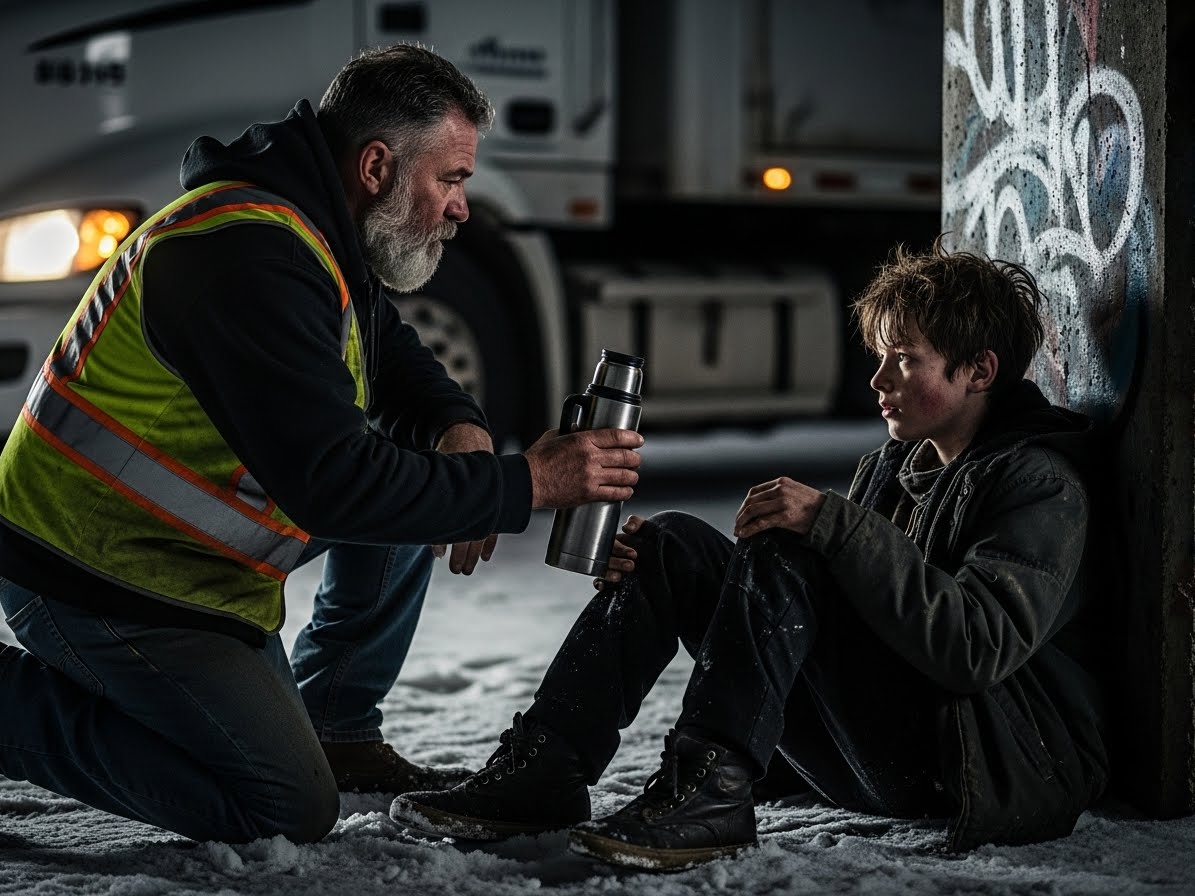
I grabbed my heavy flashlight, my thermos of coffee, and the emergency wool blanket from my bunk. I opened the door and the wind almost ripped it off the hinges.
“Hey!” I screamed into the storm.
I climbed over the guardrail and slid down the steep embankment. The snow was up to my knees.
“Kid! Wake up!”
I reached the bottom of the underpass. It was slightly sheltered from the wind here, but it was still freezing. The air smelled of frozen mud and diesel exhaust.
I ran to the pillar.
He was real. He wasn’t a ghost. He was a boy, maybe thirteen or fourteen, but scrawny. His face was pale, his lips blue. His eyes were closed.
I dropped to my knees and shook him. “Come on, son. Open your eyes.”
He didn’t move.
I put my hand on his neck.
A pulse. Faint, slow, but there.
I wrapped the wool blanket around him and pulled him upright.
His eyes fluttered open. They were grey, like the winter sky, and completely unfocused.
“Dad?” he whispered.
Chapter 2: The Long Wait
“No, son,” I said, my voice gruff with worry. “My name is Miller. I’m a driver. You’re freezing to death.”
I tried to lift him, but he panicked. He scrambled back, pushing himself against the graffiti-covered concrete.
“I can’t go!” he gasped, his teeth chattering so hard the words were barely intelligible. “I can’t leave the spot.”
“Kid, if you stay here, you’re going to be a popsicle by morning,” I yelled over the wind. “We need to get you to the truck. I have heat. I have food.”
“He won’t see me!” the boy cried. tears were freezing on his cheeks. “If I’m not here, he won’t stop. He promised. He said, ‘Wait right here, Toby. Don’t move until I get back.'”
“Who?” I asked, softening my voice. “Who told you to wait?”
“My dad,” Toby said. He looked at the highway above us, where the trucks were rumbling past. “He had a flat tire. He didn’t have a spare. He got into a blue sedan with a man to go to the gas station. He said… he said he’d be right back.”
I looked at the boy. He was wearing clothes that were worn thin, patched with duct tape. His hair was matted. This wasn’t a kid who had been waiting for an hour.
“Toby,” I said gently. “When did your dad leave?”
Toby reached into his pocket and pulled out a small, battered notebook. He opened it with trembling fingers. It was filled with tally marks. Thousands of them.
“I count the days,” he whispered. “And the trucks. I count the trucks so I don’t fall asleep.”
He pointed to the last page.
“He left on October 14th.”
“Of this year?” I asked.
Toby shook his head. He looked at me with a devastating, hollow sadness.
“No,” he said. “Eight years ago.”
The wind howled through the underpass, but the silence between us was louder.
Eight years. This kid had been surviving under a bridge, waiting for a blue sedan, since he was six years old.
“Toby,” I choked out. “How… how are you alive?”
“People leave food,” he muttered, clutching the blanket I gave him. “The campers. The construction guys. Sometimes I go into town to the dumpster behind the diner. But I always come back before dark. I have to be here when the headlights come.”
He looked up at the road again, his eyes scanning the darkness.
“He has a distinct car,” Toby said, his voice taking on a manic edge. “A 1998 Ford Taurus. Blue. With a sticker of a fish on the bumper. I have to watch for the fish.”
My blood ran cold.
I knew that car.
I had seen that car. Not eight years ago.
I saw it an hour ago.
It was parked at the rest stop ten miles back. The driver was a man I knew. A man everyone on the road knew. ‘Slick’ Rick. A drifter who did odd jobs and sold things out of his trunk that nobody asked questions about.
“Toby,” I said, gripping his shoulder. “I need you to listen to me. I think I know the car.”
Toby’s eyes went wide. “You saw him? Is he coming? Did he get the tire fixed?”
“I don’t know, son,” I lied. I couldn’t tell him that Rick didn’t have a kid. I couldn’t tell him that Rick was known for being bad news. “But we can’t wait here. We need to go find him.”
“No!” Toby shouted. “I can’t leave! He said stay!”
“If you stay, you die!” I snapped. “And if you die, you can’t see your dad. Now get in the truck!”
I didn’t wait for permission. I scooped him up. He was light, terrifyingly light. He kicked and screamed, but he was too weak to fight me.
I hauled him up the embankment and threw him into the passenger seat of my cab. I cranked the heat up to maximum.
“We’re going to the rest stop,” I said, putting the rig in gear. “We’re going to find that blue sedan.”
I didn’t tell him that I also had a tire iron under my seat. Because if Rick had taken this boy’s father eight years ago, he wasn’t going to give me answers just because I asked nicely.
PART 2
Chapter 3: The Blue Taurus
The drive to the rest stop felt like the longest ten miles of my life. The blizzard was intensifying, turning the world into a swirling vortex of white. Beside me, Toby was thawing out. The heat from the vents was bringing the color back to his face, but he was shivering violently—the kind of shivers that come from shock, not just cold.
“Is he going to be there?” Toby asked, his voice small. He was clutching his seatbelt like a lifeline.
“If it’s the right car,” I said, gripping the steering wheel until my knuckles ached. “We’ll find out.”
I didn’t tell him what I was really thinking. I was thinking that if Rick had that car, Toby’s dad wasn’t coming back. Rick was a scavenger. A vulture on wheels. He didn’t give rides; he took things.
We saw the lights of the rest stop cutting through the gloom. It was a desolate place—a concrete block of restrooms and a few vending machines. There were three semi-trucks idling in the back lot.
And there, parked under the only working streetlamp near the entrance, was the sedan.
A 1998 Ford Taurus. The paint was peeling, eaten away by road salt. Rust ate at the wheel wells.
I pulled my massive rig alongside it, blocking it in. I cut the engine, but left the headlights on, flooding the small car with blinding light.
“Is that it?” I asked, pointing.
Toby unbuckled his seatbelt and pressed his face against the glass. He let out a gasp that sounded like a balloon popping.
“The fish,” he whispered. “Look at the bumper.”
I looked. There, faded and peeling, was a sticker of a largemouth bass.
“That’s his car,” Toby said, reaching for the door handle. “He’s back! He’s really back!”
“Stop!” I barked, grabbing his collar. “You stay here. Lock the doors. Do not come out until I say so.”
“But it’s my dad!”
“Toby, look at the driver,” I said, pointing.
Through the snow-covered window of the Taurus, we could see a silhouette. It wasn’t a man eagerly waiting for his son. It was a man slumped against the window, a cigarette glowing in the dark.
“That’s not your dad,” I said grimly.
I reached under my seat and pulled out the tire iron. It was heavy, cold steel.
“Stay here,” I ordered.
I opened the door and stepped out into the storm.
Chapter 4: The Vulture
The wind whipped my coat around my legs as I marched toward the Taurus. The snow crunched under my boots.
I didn’t knock. I didn’t ask politely. I swung the tire iron and smashed the driver’s side window.
CRASH.
Glass exploded inward. Rick screamed, flailing in the seat, dropping his cigarette on his lap.
“What the hell!” he shrieked, batting at the burning ash and the broken glass.
I reached in, grabbed him by his greasy jacket, and hauled him out through the broken window. He tumbled onto the asphalt, coughing and sputtering.
Rick was a weasel of a man. Skinny, unshaven, with eyes that darted around like a trapped rat. He recognized me instantly.
“Miller?” he gasped, scrambling backward on the ice. “Are you crazy? You broke my window!”
I didn’t speak. I stepped on his chest, pinning him to the frozen ground. I raised the tire iron.
“Where did you get the car, Rick?” I roared.
“I bought it!” he yelled, holding his hands up. “I bought it years ago! Get off me!”
“You’re lying!” I pressed the boot harder. “There’s a kid sitting in my truck who has been waiting under a bridge for eight years. He says this is his dad’s car. The dad who went for gas and never came back.”
Rick’s face went pale. Paler than the snow. His eyes widened, pupils constricting to pinpricks.
“The bridge?” Rick whispered. “Mile Marker 402?”
“Yeah,” I said. “You know it.”
“I didn’t know about the kid,” Rick stammered, panic rising in his voice. “I swear to God, Miller, I didn’t know there was a kid!”
“What did you do to him?” I screamed, bringing the iron down an inch from his head. The metal rang against the pavement.
Rick flinched violently. “I didn’t kill him! I swear! He was changing a tire! He flagged me down!”
“And?”
“And he had cash!” Rick blurted out. “I saw it in his wallet when he went to pay me for a jack. I… I hit him. With a wrench. I just wanted the money!”
My stomach turned. I wanted to vomit.
“You killed him,” I said, my voice dead.
“No! He was breathing!” Rick cried, tears freezing on his dirty face. “I dragged him into the ditch. Deep in the brush. I took the keys and the wallet. I just took the car! I thought he was alone! I didn’t know anyone was waiting under the bridge!”
I looked back at my truck. Toby was watching. His face was pressed against the glass, bathed in the yellow light of the clearance markers. He couldn’t hear us, but he could see the violence.
“You left a man to die in a ditch,” I whispered. “And you left his son to rot.”
“I didn’t know!” Rick sobbed. “I’ve been driving this junker for eight years because I couldn’t sell it without a title! I’m cursed, Miller! This car is cursed!”
Chapter 5: The Keepsake
I hauled Rick up by his collar and slammed him against the side of the Taurus.
“Open the trunk,” I commanded.
“Why?”
“Because if you kept the car, you kept the junk inside it. Open it!”
Rick fumbled with his keys, his hands shaking so bad he dropped them twice. Finally, he popped the trunk.
It was filled with trash. Old clothes, empty bottles, tools. Rick’s life of scavenging.
I started digging. I threw aside a rusty jack, a pile of magazines.
“Where is it?” I snarled. “Where is his stuff?”
“I pawned most of it!” Rick whined. “The watch, the tools.”
Then, my hand brushed against something soft in the corner, wedged behind the spare tire well. It was a small, blue duffel bag. It looked ancient, covered in dust and mold.
I pulled it out.
“I couldn’t open the zipper,” Rick muttered. “It was stuck. I just forgot about it.”
I unzipped it. It was stiff, but it gave way.
Inside, there were clothes. A man’s flannel shirt. A map. And a small, wrapped box with a bow that had long since flattened.
I picked up the box. There was a tag on it. The ink was faded, but legible.
To Toby. Happy 6th Birthday. Love, Dad.
My heart shattered. The dad hadn’t left to get gas. He hadn’t abandoned the boy. He was coming back with a birthday present. He was changing a tire to get his son to a party, or a home, or wherever they were going.
And this piece of filth had ended it all for fifty bucks and a rusted Ford.
I heard a door slam.
I spun around. Toby was running across the icy lot. He wasn’t wearing shoes—he had kicked them off in the truck. He was running in his socks.
“Dad!” he screamed, running toward the Taurus.
“Toby, wait!” I stepped in front of him, blocking his view of Rick. I didn’t want him to get close to the man who ruined his life.
Toby stopped, panting, looking at the car. He looked at the trunk. He saw the blue duffel bag in my hand. He saw the present.
He froze.
“That’s…” Toby’s voice broke. “That’s the present. He said I could open it when we got to the motel.”
He looked at Rick, who was cowering against the quarter panel. He looked at the tire iron in my hand.
The realization hit him slowly. It wasn’t abandonment. It was theft.
“Where is he?” Toby asked Rick. His voice wasn’t a child’s voice anymore. It was cold. Hollow.
Rick couldn’t look him in the eye. “I… I’m sorry, kid.”
Toby didn’t scream. He didn’t attack. He just collapsed. He fell into the snow like his strings had been cut. The eight years of waiting, of hope, of counting trucks… it all evaporated in a single second.
I dropped the tire iron and scooped him up. He buried his face in my coat and let out a sound I will never forget. It wasn’t a cry. It was a howl. A sound of pure, unadulterated grief.
I looked at Rick over the boy’s head.
“You’re not going anywhere,” I said. “I’m calling the police. And you’re going to tell them exactly where you dumped him.”
Rick nodded, defeated. “Mile Marker 402,” he whispered. “North side. Behind the drainage pipe.”
I held Toby tighter. At least now we knew. The Watcher didn’t have to wait anymore.
PART 3
Chapter 6: The Grave Beneath the Concrete
The convoy of police cruisers looked like a river of blood and ice moving down the interstate. I drove my rig behind them, following the flashing lights back to Mile Marker 402. Toby sat in the passenger seat, wrapped in a blanket, clutching the unopened birthday present. He hadn’t said a word since the rest stop. He just stared out the windshield, his eyes fixed on the horizon where the bridge loomed.
We arrived at the overpass at 4:00 AM. The snow had stopped, leaving the world silent and white. The police taped off the area. Floodlights were set up, bathing the underside of the bridge in a harsh, artificial glare that made the graffiti look like ancient cave paintings.
Rick was in the back of a squad car, handcuffed, weeping. He had given them the exact location.
I walked Toby down the embankment one last time. We stood near the concrete pillar where he had spent three thousand nights waiting.
“He’s here?” Toby whispered. It wasn’t really a question.
“Rick said he dragged him into the culvert,” I said, pointing to a dense thicket of frozen brush about twenty yards from the pillar. “Right over there.”
The irony hit me like a physical blow. For eight years, Toby had sat on that concrete barrier, dangling his legs, scanning the highway for a blue car. And for eight years, his father had been lying just fifty feet away, hidden by snow in winter and weeds in summer. He hadn’t abandoned his boy. He had been waiting with him.
The forensics team moved in with shovels and probes. We watched from a distance. It was brutal work. The ground was frozen solid.
An hour passed. Then two. The sun began to crest over the mountains, painting the snow pink.
Then, a shout from one of the officers. “We found something!”
Toby flinched. He tried to step forward, but I held him back.
“You don’t want to see this part, son,” I said gently. “Let them do their job.”
“Is it him?” Toby asked, tears spilling over again.
The coroner nodded to the detective. They pulled a distinctive flannel shirt from the earth—preserved by the cold and the dry climate.
Toby let out a sound that was half-sob, half-relief. “That’s his lucky shirt. The red plaid.”
He collapsed against my leg. I put my hand on his head, ruffling his matted hair. The waiting was over. The mystery was solved. But the pain was just waking up.
They brought the remains up in a black bag. As they passed us, the detective stopped. He looked at Toby.
“He didn’t suffer, kid,” the detective lied kindly. “It looks like it was quick.”
Toby nodded, wiping his nose on his sleeve. He looked up at the bridge. At the spot where he used to sit.
“I counted the trucks,” he whispered to the black bag. “I counted every single one, Dad. I didn’t fall asleep.”
Chapter 7: The Unwrapped Gift
The next few days were a blur of fluorescent lights and paperwork. Social Services took temporary custody of Toby, placing him in a hospital to get treated for malnutrition and exposure.
I parked my rig in the hospital lot and refused to leave. I slept in the cab, showering in the truck stop across the street, and spent every visiting hour in Toby’s room.
He was a ghost in that hospital bed. Pale, thin, surrounded by machines. He wouldn’t talk to the doctors. He wouldn’t talk to the social workers. He just held onto the blue duffel bag and the wrapped box.
On the third day, a social worker named Mrs. Higgins cornered me in the hallway.
“Mr. Miller,” she said, clutching a file. “We’ve been unable to locate any next of kin. The father… John… appears to have been a widower. No siblings. No grandparents.”
“So what happens to Toby?” I asked, crossing my arms.
“He goes into the foster system,” she said. “We have a group home in Missoula that has an opening.”
“A group home?” I scoffed. “He’s been living under a bridge for eight years. You put him in a crowded house with rules and noise, he’s going to run. He’s feral, ma’am. He needs space.”
“Do you have a better suggestion?”
“I take him,” I said.
Mrs. Higgins blinked. “You? You’re a long-haul trucker. You live on the road.”
“Exactly,” I said. “He likes the road. He knows the road. And I make good money. I can tutor him. I can show him the country. He needs to move, Mrs. Higgins. If he stays in one place, the memories will eat him alive.”
It took a week of background checks, character references, and a very intense meeting with a judge, but they agreed to a “probationary guardianship.”
I walked into Toby’s room with the papers.
“Pack your bags, kid,” I said. “We’re rolling out.”
Toby looked at me. For the first time in a week, a spark of life returned to his grey eyes.
“Where are we going?”
“West,” I said. “To the ocean. You ever seen the ocean?”
He shook his head.
“Then let’s go.”
Before we left, I sat on the edge of the bed. I pointed to the box on the nightstand.
“You going to open that?” I asked. “It’s been eight years.”
Toby picked up the box. The wrapping paper was faded, the bow crushed flat. His hands trembled as he tore the paper.
Inside was a small, wooden box. He opened the lid.
Resting on a bed of velvet was a compass. A beautiful, brass pocket compass.
Underneath it was a folded note. Toby unfolded it. The ink was old, but readable.
Toby, So you never get lost. No matter how far we go, this will always point you North. And I’ll be right beside you. Love, Dad.
Toby stared at the compass. He watched the needle spin and settle, pointing toward the window. North.
He closed his hand around the brass metal. He didn’t cry this time. He took a deep breath, and for the first time, he didn’t look like a lost boy waiting for a ghost. He looked like a navigator finding his bearing.
“North is that way,” Toby said, pointing.
“Then let’s head North,” I smiled.
Chapter 8: The Co-Pilot
One Year Later
The engine of the Peterbilt hummed a steady rhythm, a song of diesel and asphalt that vibrated through the floorboards. We were cruising down I-5, heading toward Seattle.
“Miller,” a voice called from the passenger seat. ” weigh station open in two miles. You’re five hundred pounds heavy on the rear axle.”
I glanced over. Toby was sitting in the co-pilot seat. He wasn’t the scrawny, dirty kid from under the bridge anymore. He had filled out. His hair was cut short. He wore a clean flannel shirt and jeans that actually fit.
He had a map spread out on his lap and a GPS tablet mounted on the dash.
“I know, kid,” I grunted, shifting gears. “I’ll slide the tandems at the next stop.”
“You better,” Toby smirked. “I don’t want a ticket on my logbook.”
We passed a green sign. Butte, Montana – 50 Miles.
The mood in the cab shifted. We were getting close.
We hit Mile Marker 402 around sunset. The bridge looked the same—grey, imposing, casting a long shadow over the valley.
I started to lift my foot off the gas, an instinct to slow down.
“Don’t,” Toby said softly.
I looked at him. He wasn’t looking at the bridge. He wasn’t looking at the spot where he used to sit. He was looking at the brass compass in his hand.
“Keep driving,” Toby said. “We’re not stopping.”
I pressed the accelerator. The engine roared. We flew under the bridge at seventy miles per hour. The concrete pillar blurred past. The drainage ditch where his father had lain for so long was just a streak of green and brown.
We came out the other side, into the golden light of the setting sun.
Toby didn’t look back. Not once.
He snapped the compass shut and put it in his pocket. He picked up his logbook and made a note.
“Mile Marker 402 cleared,” he said. “Next stop, Seattle.”
I smiled, feeling a lump in my throat. The Watcher was gone. The boy who waited was gone.
“You hungry?” I asked.
“Starving,” Toby said. “There’s a diner in forty miles. They have good pie.”
“Copy that, Co-Pilot,” I said. “Over and out.”
We drove on, leaving the ghosts in the rearview mirror, chasing the white lines toward the ocean.
THE END.