I Thought I Was Dead to the World—Until I Saved a Child and Woke Up the Monsters.
PART 1
Chapter 1: The Ghost in the Rain
The rain in Seattle doesn’t wash you clean. It just adds another layer of grime, pressing you down into the concrete until you feel like you’re part of the pavement. That’s how I liked it. I wanted to be part of the pavement. Unnoticed. Trodden on. Invisible.
My name, according to the laminated card in my wallet and the lease on my studio apartment, is Ben Aris. I work the graveyard shift at a logistics warehouse near the port. I keep my head down. I pay cash. I don’t date. I don’t drink in bars where people might remember my face.
But my real name is Elias Thorne. And three years ago, Elias Thorne died in a car explosion just outside of Chicago. Or at least, that’s what the six o’clock news told the world.
The truth is messier. The truth is sitting in a witness protection safe house for six months, realizing the system was compromised, and running before the marshals could sell me out to the people I was supposed to testify against. I’ve been running ever since.
I was three blocks from my apartment, walking the long way to avoid the cameras at the intersection of 4th and Pike. The downpour was torrential, the kind of weather that drives sane people indoors. The wind whipped off the Puget Sound, stinging my face.
I pulled my hood down lower. My utility jacket was heavy, waterproof, and lined with fleece—my armor against the world. Underneath, I was nobody.
Then, the scream cut through the storm.
It wasn’t a drunk shouting at the moon. It wasn’t a lovers’ quarrel. It was the high-pitched, primal shriek of a child.
I stopped. My boots crunched on the wet gravel. Every instinct I had honed over a decade of working undercover screamed at me: Move. Don’t look. Walk away.
Curiosity gets you killed. Empathy gets you tortured.
I took a step forward, intending to round the corner and disappear into the alleyway. But the scream came again, followed by a choked, gurgling sob.
I clenched my jaw so hard my teeth ached. I turned my head.
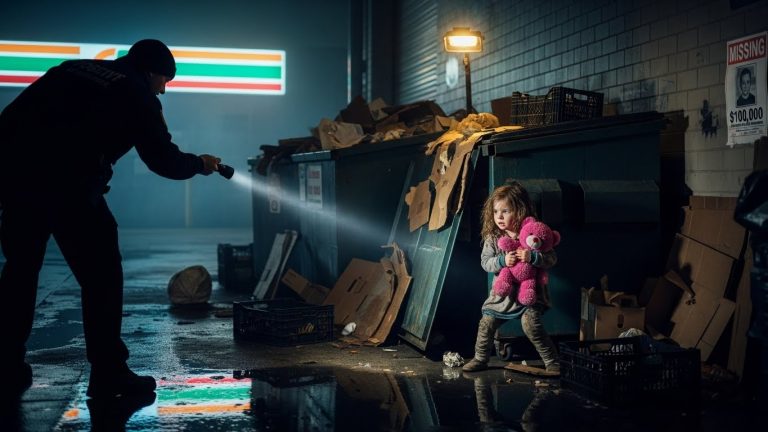
Across the street, near a rusted chain-link fence bordering a construction site, stood a child. She was tiny, maybe three years old. She was wearing a flimsy pink dress, completely soaked, clinging to her skin like wet tissue paper. Her hair was matted to her skull.
She was alone.
I scanned the street. 360-degree check. Old habits. No parents running down the block. No frantic mother. Just empty cars and the relentless rain.
The girl was standing in a puddle that was rapidly rising. The drain was clogged. The water was swirling around her shins. She looked up at the sky, eyes squeezed shut, and wailed for a mommy who wasn’t coming.
A sedan sped past, hitting the puddle. A sheet of oily, freezing sludge sprayed over her. She fell backward, landing hard in the water.
She went under.
I didn’t decide to move. My body just did it.
I sprinted across the four lanes. I vaulted the median. A taxi laid on its horn, the sound distorting in the wet air, but I didn’t flinch. I reached the sidewalk and splashed into the water.
I grabbed the back of her dress and hauled her up. She was coughing, spitting out street water. She was light, too light. Fragile.
“I’ve got you,” I grunted. “Easy now.”
I pulled her against my chest. She was shaking so violently it felt like she was vibrating. Her skin was ice. Her lips were a terrifying shade of violet. Hypothermia wasn’t a threat; it was happening right now.
She looked at me, eyes wide with terror, but she didn’t pull away. She buried her face in my jacket, seeking heat.
“Mommy?” she whimpered.
“We’ll find her,” I lied. I looked around. The street was still empty. I couldn’t leave her here. I couldn’t take her to my apartment—that was rule number one. Never bring the outside world in.
She shivered, a convulsive full-body spasm.
“Okay,” I muttered. “Okay, kid.”
I set her down on the driest patch of concrete I could find, sheltered slightly by the construction hoarding.
“Stay standing,” I ordered.
I unzipped my jacket. The cold air hit my chest like a hammer, instantly soaking my gray t-shirt. I stripped the heavy coat off.
“Arms up,” I said.
She obeyed, robotically.
I draped the jacket over her. It swallowed her whole. It hung down past her knees, the sleeves dragging on the ground. I zipped it up to her chin and pulled the hood over her head.
“Better?” I asked, wiping rain from my eyes.
She nodded, sniffling.
I was exposed now. Just a wet t-shirt in forty-degree weather. But that wasn’t the problem.
The problem was my arms.
The headlights of a car swept over us. I flinched, turning my face away, but it was too late to cover the ink.
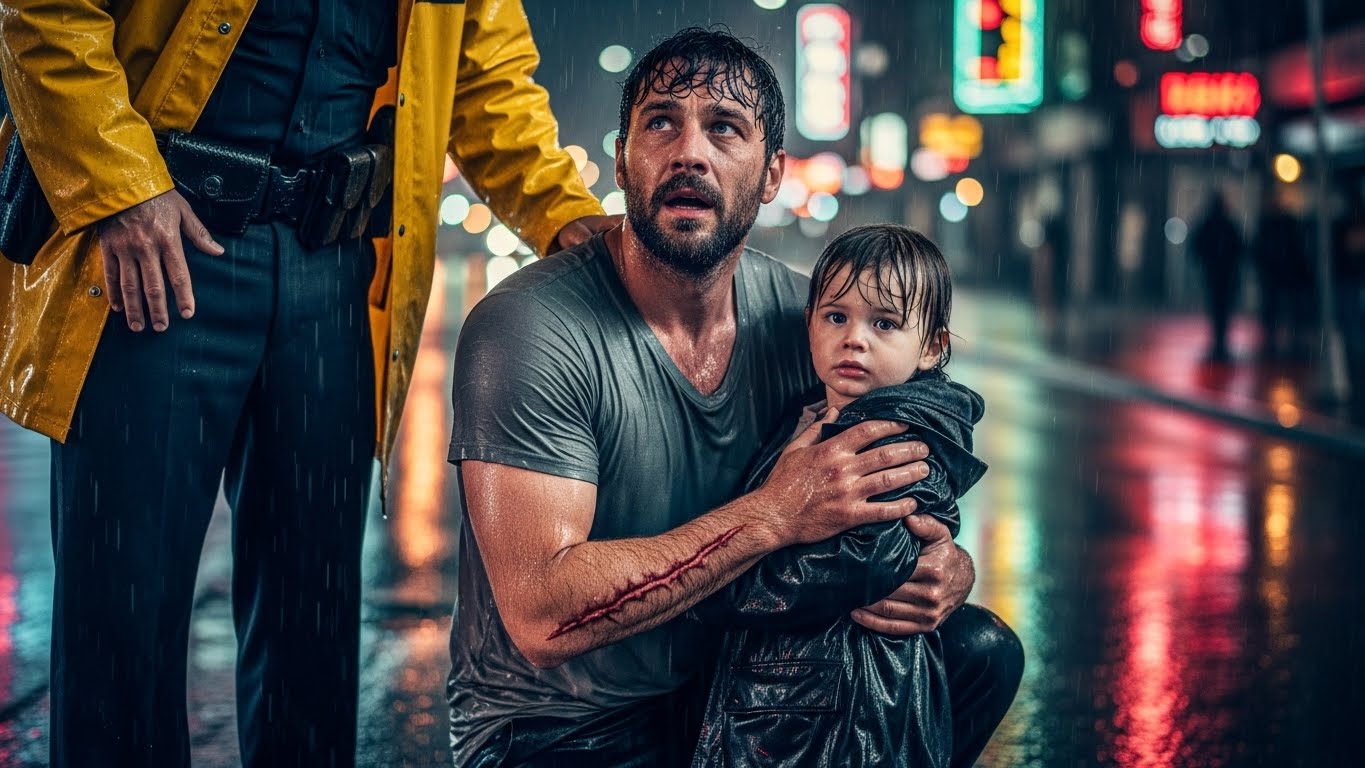
On my right forearm, distinct and ugly against pale skin, was the scar. A burn. A double-headed serpent. The initiation mark of the Varga Cartel.
And below it, the patch of scarred skin where I had burned off my police badge number.
The car didn’t drive past. It slowed down. Blue and red lights flickered on, bouncing off the wet construction tarp.
Police.
Run, my brain screamed. Leave the kid and run.
But she reached out a tiny hand and grabbed my pinky finger.
I stayed.
Chapter 2: The Dead Man Walking
The squad car door opened. Two officers. One rookie, young, looking like he’d rather be anywhere else. One veteran, thick around the middle, mustache drooping with the rain.
“Everything okay here?” the veteran asked. He didn’t have his gun drawn, but his hand was resting on the grip.
“Found her alone,” I said, pitching my voice up. Making it sound nervous. Civilian. “She fell in the water. She was freezing.”
“Is that your kid?”
“No. Never seen her before.”
The veteran walked closer. He had a flashlight in his left hand. He clicked it on. The beam cut through the darkness, blinding me for a second.
“What’s your name, son?”
“Ben,” I said. “Ben Aris.”
“You got ID, Ben?”
“Left it at home. Was just going for a run.”
“A run? In this weather?” He sounded skeptical.
“I like the cold,” I said.
The flashlight beam moved down. It hit the little girl, bundled in my oversized jacket. Then it moved back to me. It traveled down my chest to my arms.
I tried to cross them, to hide the markings, but the movement was too sudden. It looked aggressive.
“Keep your hands where I can see them!” the veteran barked.
I froze, hands out to my sides. palms open.
The beam hit the serpent scar.
I saw the officer’s eyes narrow. He took a step closer, squinting through the rain. He wasn’t looking at the gang brand. He was looking at the burn mark below it.
The silence stretched out, agonizing and thick. The only sound was the girl’s soft hiccups.
“Turn around,” the veteran said. His voice had changed. It was lower. Tighter.
“Officer, I’m just helping the—”
“Turn around! Now!” He drew his weapon.
The rookie jumped. “Sarge? What are you doing? He’s helping the kid.”
“Shut up, Miller,” the veteran snapped. “Call it in. Tell dispatch we have a Code 99.”
Miller’s eyes went wide. “A 99? Officer in distress?”
“Just do it!”
I turned around slowly, putting my hands behind my head. My heart was hammering against my ribs like a trapped bird. He knew. Somehow, he knew.
The veteran walked up behind me. He didn’t cuff me. He leaned in close, right by my ear.
“You got a lot of nerve coming back to the surface, Thorne,” he whispered.
My blood ran cold.
“I’m Ben Aris,” I said, staring at the wet brick wall in front of me.
“Ben Aris doesn’t have a burnt-off badge number on his arm,” the cop hissed. “And Ben Aris didn’t die in a fireball on I-90 three years ago.”
He grabbed my wrist, twisting it painfully to look at the scar again.
“Elias Thorne,” he said, loud enough for the rookie to hear. ” The Ghost of Chicago.”
“Sarge, who is that?” Miller asked, radio in hand.
“The man who was supposed to bring down the Varga family,” the veteran said. “Before he got bought out. Or killed. Depending on who you ask.”
I spun around. “I wasn’t bought out.”
The veteran stepped back, gun leveled at my chest. “Doesn’t matter now. You’re alive. Which means a lot of dangerous people are going to be very unhappy.”
“The girl,” I said, pointing at the child. “She needs a hospital.”
“We’ll take care of her,” the veteran said. “Get on your knees.”
“Please,” I said. “If you call this in… if you put my name on the radio… I’m dead. Again.”
The veteran hesitated. I saw it in his eyes. A flicker of doubt. He knew the Varga reach. He knew that if I was alive, there was a reason I was hiding.
But then the radio on his shoulder crackled.
“Dispatch to Unit 4-Alpha. We have an Amber Alert issued three minutes ago. Missing child. Female, age three. Taken from the residence of Senator Blackwood.”
The color drained from the veteran’s face. He looked at the little girl in my jacket.
“Senator Blackwood?” Miller repeated. “The guy running for Governor?”
The veteran looked at me. “You didn’t just find a lost kid, did you, Thorne? You snatched Blackwood’s daughter.”
“I found her in the gutter!” I yelled. “I saved her life!”
“Or maybe you’re using her as leverage,” the veteran said, his finger tightening on the trigger. “Maybe the Varga family wants to send a message to the Senator.”
“I don’t work for them!”
“Tell it to the judge.”
Sirens. Lots of them. Coming from all directions. The night lit up with a kaleidoscope of blue and red.
I looked at the girl. She was watching me, her big eyes confused. She didn’t look scared of me. She looked… grateful.
I had saved her. And in doing so, I had framed myself for kidnapping the daughter of the most powerful man in the state.
I realized then that the rain wasn’t going to wash anything away tonight. It was going to turn into a bloodbath.
“Get on your knees!” the veteran screamed over the sirens.
I dropped to my knees on the wet asphalt. As the cold water soaked through my jeans, I looked up at the sky and laughed. A short, bitter bark.
I had spent three years hiding from the devil. And tonight, I just invited him to dinner.
PART 2
Chapter 3: The Cage and the Key
The steel cuffs bit into my wrists, cold and tight. I didn’t resist. I knew the drill. If you fight the cuffs, you just bruise your bones. You save your energy for the fight that matters, and I knew that fight was coming fast.
Sergeant Vance, the veteran with the drooping mustache, shoved me into the back of the cruiser. He didn’t protect my head as I ducked in. My skull cracked against the doorframe, flashing white stars across my vision.
“Sit tight, ghost,” he spat.
I sat in the hard plastic seat, the smell of stale vomit and industrial cleaner filling my nose. Through the wire mesh, I watched the scene unfold outside. It was a circus.
Paramedics were swarming the little girl—Lily, the radio had called her. They were cutting off my jacket, wrapping her in thermal blankets. She was crying now, a high, thin wail that pierced the glass of the squad car. She was reaching out, her tiny hand grasping at the air where I had been standing.
She wanted me. The man who pulled her from the black water. Not the cops with their loud radios and flashing lights.
That broke me more than the handcuffs.
Rookie Miller got in the driver’s seat. He looked at me in the rearview mirror, his eyes wide, reflecting the strobe of the light bar.
“Is it true?” Miller asked, his voice shaking. “Are you really him? Elias Thorne?”
I stared out the window at the rain. “Elias Thorne is dead. I’m just the guy who didn’t let a kid drown.”
“Drive, Miller,” Vance growled, sliding into the shotgun seat. “And don’t talk to the prisoner.”
The ride to the precinct was a blur of neon lights and rain-streaked glass. My mind was racing, running simulations, calculating odds.
The Varga Syndicate. The most ruthless criminal organization in the Pacific Northwest. I had been their lead enforcer’s right hand—undercover, of course. For two years, I wore their colors, ate their food, and gathered the evidence that was supposed to bury them.
But the system leaks. A DA with a gambling debt sold the witness list. Three other witnesses died within 24 hours. I barely made it out of the safe house before it went up in flames.
I made a choice then. I let the world believe I burned in that house. I spent three years scrubbing floors, working docks, and being invisible.
And now? Now I was sitting in the back of a black-and-white, heading to the 12th Precinct, accused of kidnapping the daughter of Senator Blackwood.
Senator Blackwood. The “Law and Order” candidate. The man promising to clean up Seattle.
Why was his daughter alone in a storm three miles from his estate?
The puzzle pieces didn’t fit. A kidnapping for ransom? Then why leave her in the rain to die? A message? Maybe.
We hit the underground garage of the precinct. The press was already there. Vultures. They smelled blood in the water.
“Head down,” Vance ordered as he hauled me out.
Cameras flashed, blinding explosions of white light in the gloomy garage. Microphones were shoved in my face.
“Did you take her?” “Are you working for the cartels?” “Why did you hurt the Senator’s daughter?”
I kept my jaw locked. I stared straight ahead. But I knew my face was being beamed to every TV screen and smartphone in the state.
And that meant he would see it.
Victor Varga. The man I betrayed. The man who promised to peel the skin from my bones if he ever found me.
They dragged me into the processing room. They took my fingerprints, which I had burned off with acid years ago. They took my mugshot. Then they shoved me into Interrogation Room B.
It was a windowless concrete box with a table bolted to the floor and a two-way mirror that hummed with hidden judgment.
They handcuffed my right hand to the table bar.
I sat there for an hour. Silence is a tactic. They want you to stew. They want you to get anxious and start talking just to fill the void.
But I was trained for this. I slowed my breathing. I counted the cracks in the cinder blocks.
The door opened.
It wasn’t Vance. It was a man in a sharp navy suit. Slicked-back hair. Eyes like polished glass. He didn’t look like a cop. He looked like a shark in human skin.
He sat down opposite me, placing a sleek leather folder on the table.
“Mr. Aris,” he said, his voice smooth, cultured. “Or should I say, Detective Thorne?”
“I’m Ben Aris,” I said flatly.
“Drop the act,” he smiled, but it didn’t reach his eyes. “My name is Sterling. I’m Senator Blackwood’s Chief of Staff. I’m here to offer you a deal.”
“A deal?” I raised an eyebrow. “I haven’t even been charged yet.”
“Oh, you will be,” Sterling said. “Kidnapping. Child endangerment. Assault on a police officer. And, once the Feds get here, flight to avoid prosecution and falsifying federal documents.”
He leaned forward.
“Unless…”
“Unless what?” I asked.
“Unless you sign a confession stating that you were hired by Victor Varga to abduct Lily Blackwood.”
I froze.
“What?”
“It’s simple,” Sterling said, tapping the folder. “We need a narrative, Elias. The Senator is trailing in the polls. He needs a win. He needs a villain. You kidnap the girl on Varga’s orders. The Senator’s brave police force rescues her. The Senator vows to crush the Syndicate once and for all. You go to prison, yes, but we put you in solitary. Supermax. Safe from Varga. You live.”
I looked at him. Really looked at him.
“She was in the water,” I said quietly. “She was drowning. No kidnapper dumps their leverage in a storm drain.”
Sterling’s face didn’t twitch.
“Maybe you panicked,” he shrugged. “Maybe you’re incompetent. It doesn’t matter. The story is what matters.”
“And if I refuse?”
Sterling stood up. He buttoned his jacket.
“Then we put you in the general population at County Jail tonight. And we make sure the Vargas know exactly which cell you’re in.”
He walked to the door.
“You have one hour, Mr. Thorne. Be a hero one last time. Give the Senator his war.”
The door slammed shut.
I stared at the metal table.
It was a setup. It wasn’t just a framing. It was a political play. Blackwood was using his own daughter as a prop. And I was the expendable villain.
But Sterling made a mistake.
He thought I was just a witness. He forgot I was a detective.
I replayed the image of Lily in the rain. Her dress wasn’t torn. She wasn’t bruised. She was just wet. And she hadn’t run to the police. She had run to me.
She wasn’t afraid of the stranger. She was afraid of the men who left her there.
I wasn’t going to sign anything. And I sure as hell wasn’t going to die in a cell tonight.
Chapter 4: The Whisper in the Walls
The hour passed. The silence in Interrogation Room B grew heavier, thick with the threat of what was waiting outside the door.
I tested the handcuffs. Standard issue Smith & Wesson Model 100s. High carbon steel. I couldn’t break them, and I didn’t have a shim. I was locked to the table, a sitting duck.
I closed my eyes and focused on the sounds of the station.
I heard the heavy footsteps of uniformed officers. The frantic typing of clerks. The distant ringing of phones.
Then, I heard something else. A rhythm I recognized.
Tap. Drag. Tap. Drag.
A heavy boot with a limp.
My stomach dropped.
I knew that walk.
Three years ago, during a raid on a Varga warehouse, I had shot a hitman in the knee. A man named Silas. He was Varga’s favorite cleaner. He didn’t get arrested. He disappeared.
And now, he was walking down the hallway of a police station.
The footsteps stopped right outside my door.
I heard a muffled conversation. Sergeant Vance’s voice.
“You can’t go in there. He’s a high-value suspect.”
Then a smooth, oily voice. Not Sterling. Someone else.
“Attorney privilege, Sergeant. Mr. Aris requested legal counsel. Unless you want a lawsuit before the ink dries on the arrest report?”
“I didn’t call a lawyer,” Vance grumbled.
“The Constitution called for him,” the voice said.
The lock clicked. The door swung open.
A man stepped in. He was wearing a cheap suit that fit poorly, holding a battered briefcase. He looked like every overworked public defender in the city.
Except for the eyes. And the limp.
It was Silas.
He closed the door and leaned against it. He didn’t smile. He just looked at me with the cold indifference of a butcher looking at a side of beef.
“Hello, Elias,” he said softly.
“Silas,” I nodded, keeping my voice steady despite the adrenaline flooding my veins. “Nice suit. Goodwill?”
“Men’s Warehouse,” he deadpanned. He limped over to the camera in the corner of the room. He took a piece of chewing gum out of his mouth and stuck it over the lens.
“Vance is watching through the glass,” I said, nodding at the mirror.
“Vance is currently distracted by a very generous donation to the Police Benevolent Association handled by my associate in the lobby,” Silas said. “We have three minutes.”
He placed the briefcase on the table. He didn’t open it.
“Victor sends his regards.”
“I bet he does.”
“He was very hurt when you died, Elias. He cried. He really liked you. Said you were like a son.” Silas walked around the table, standing behind me. “Imagine his surprise when he sees you on the news, playing hero for the Senator’s brat.”
“I didn’t take her, Silas.”
“We know,” Silas said. He leaned down, his breath smelling of mint and rot. “We know you didn’t take her. Because we were supposed to take her.”
My blood froze.
“What?”
“The Senator owed Victor a lot of money,” Silas whispered. “Campaign funds. Dark money. Blackwood promised favors he didn’t deliver. So, Victor decided to take collateral. We had a team ready to grab the girl tonight.”
“But she was already gone,” I realized.
“Exactly,” Silas said. “We got to the house, and the bird had flown. Someone else took her. And then dumped her.”
“Blackwood,” I breathed. “He staged it.”
“Looks that way,” Silas mused. “He stages a kidnapping to get sympathy votes, blames it on an unknown assailant, and then you—idiot that you are—stumble into the middle of the play and catch the falling star.”
“So why are you here?” I asked. “To kill me?”
“Eventually,” Silas said. “But not right this second. Victor is… curious. If Blackwood is playing games, Victor wants to know the rules. You’re the wildcard.”
Silas reached into his pocket. I tensed, expecting a knife or a garrote.
He pulled out a small, silver key.
He slid it across the table.
“Victor wants you to run, Elias.”
I looked at the key. It was a handcuff key.
“Why?”
“Because if you stay here, Blackwood kills you to silence you. If you run, you create chaos. And Victor loves chaos.”
Silas tapped the table.
“You have two minutes until Vance comes back. If you’re still in this chair, you’re dead. Blackwood’s people are already processing your transfer to County. You won’t make it to the van.”
“And if I run?”
“Then the hunt is on. Police. Feds. Blackwood’s cleaners. And us.” Silas grinned, a horrific stretching of scar tissue. “It’ll be like old times. Run, rabbit, run.”
He turned and walked to the door.
“Oh, and Elias?”
“Yeah?”
“The girl. Lily.”
“What about her?”
“If Blackwood was willing to toss her in a gutter to win an election… what do you think he’ll do to her when he realizes she can identify the people who took her?”
The door clicked shut.
I was alone again.
I looked at the silver key glistening under the harsh fluorescent lights.
Silas was right. If I stayed, I was a dead man. But more importantly, if I stayed, that little girl was a loose end.
Blackwood had tried to dispose of her once. He would do it again.
I grabbed the key.
My hands were shaking, not from fear, but from rage.
I unlocked the cuff. The steel clicked open. I rubbed my wrist.
I stood up. I wasn’t Ben Aris anymore. I wasn’t the scared witness.
I was Elias Thorne. And I was going to burn this whole city down to save that kid.
I moved to the ventilation grate in the ceiling. It was old, rusted. Loose.
I didn’t have a plan. I just had a direction.
Out.
And then, to the girl.
Chapter 5: The Rat in the Walls
The ventilation shaft was a coffin made of galvanized steel. It smelled of thirty years of dust, stale coffee, and the metallic tang of dried blood—maybe mine, maybe just the building’s history.
I dragged myself forward on my elbows, my knees scraping against the rivets. The space was tight, barely eighteen inches high. For a man of my size, it was torture. My shoulders jammed against the sides with every pull.
Below me, I heard the heavy thud of the interrogation room door slamming open.
“Where is he?” Vance’s voice. A roar of pure, panicked rage.
“The cuffs are on the table! How the hell did he get out of the cuffs?” That was the rookie, Miller.
“Lockdown!” Vance screamed. “Seal the building! Nobody leaves! Thorne is loose!”
I froze, pressing my face against the cold metal floor of the duct. The alarm blared—a harsh, rhythmic buzzing that vibrated through my chest.
I had minutes. Maybe less.
Silas had given me a key, but he hadn’t given me a map. I was relying on memory. Most precincts in this city were built on the same brutalist architectural blueprints from the seventies. The ventilation usually fed into a central HVAC unit on the roof, or down to the boiler room in the basement.
Heat rises. I needed to go up.
I crawled until my fingers were raw. The sound of chaos below was muffled but distinct. Boots running on tile. Radios squawking. They were sweeping the ground floor.
I reached a junction. A vertical shaft. A service ladder was bolted to the side, slick with condensation. I grabbed the rungs and pulled. My muscles screamed—a reminder that I hadn’t been an active operator in three years. I was strong from dock work, but I wasn’t “combat fit.” There’s a difference.
I climbed, hand over hand, until I hit the grate at the top. I pushed. It gave way with a groan of rusted hinges.
I spilled out onto the roof of the precinct.
The rain was still falling, a relentless, freezing sheet that washed the dust from my clothes instantly. I gasped, sucking in the wet air.
I wasn’t safe yet. I was just outside the cage.
I ran low, crouching behind the HVAC units, moving toward the fire escape on the north side. Below, the street was a disco of flashing lights. News vans. Cruisers. SWAT trucks were already rolling in.
They thought I was trapped inside. That bought me time.
I reached the edge of the roof and looked down. The alleyway was dark, blocked by dumpsters. A sheer drop of twenty feet to the top of a garbage truck, then another ten to the ground.
I didn’t hesitate. I swung my legs over the parapet and dropped.
I hit the roof of the truck hard, rolling to absorb the impact. Pain shot up my shin, hot and sharp, but nothing snapped. I slid off the side, landing in a pile of wet cardboard boxes.
I was out.
I merged into the shadows of the alley, moving away from the light. I needed to blend in. I was a white male in a t-shirt and jeans in the middle of a storm. I looked like a junkie or a victim.
I found a homeless encampment under the overpass three blocks away. A man was sleeping under a blue tarp.
I hated myself for what I was about to do.
“Hey,” I whispered.
The man stirred. “Go away.”
“I need your coat,” I said. I pulled a wad of cash from my wet pocket—my tips from the last week of work. It was wet, but it was legal tender. Two hundred bucks. “Buy yourself a room for the week. Give me the coat.”
The man looked at the money, then at me. He stripped off his oversized, stained army surplus jacket.
“God bless you,” he mumbled, snatching the cash.
“God doesn’t look this way,” I muttered.
I put the jacket on. It smelled of woodsmoke and old sweat, but it covered my arms. It covered the brand.
I pulled a discarded Mariners cap from a puddle, shook it off, and jammed it on my head.
Now I was just another shadow in Seattle.
I walked to a bodega on the corner. Through the glass, I saw the TV mounted behind the counter.
Breaking News. My mugshot was plastered on the screen. The photo was from three years ago—clean-shaven, arrogant eyes. Beside it was a sketch of me now—bearded, haggard.
“…Manhunt underway for Elias Thorne, armed and dangerous. Suspect is believed to have kidnapped Lily Blackwood…”
I stared at the ticker at the bottom of the screen.
“Lily Blackwood in stable condition at Harborview Medical Center. Senator Blackwood to give press conference at 10 PM.”
Harborview.
That’s where she was.
And that’s where the killer would be.
Silas had said Blackwood’s people—the real kidnappers—had missed their chance because I interfered. They needed to finish the job. A three-year-old girl who could say “It wasn’t Ben who took me, it was the man with the scary voice” was a loose end that could destroy a Senate campaign.
Blackwood wouldn’t do it himself. He’d send a professional. Maybe someone on his payroll. Maybe a dirty cop.
I had to get to her first.
I checked my watch. It was a cheap Casio. 9:15 PM.
Harborview was two miles uphill.
I started to run. Not the sprint of a fugitive, but the steady, ground-eating jog of a predator.
The city was against me. The cops were hunting me. The Syndicate was watching me. And the most powerful politician in the state wanted me dead.
But they all forgot one thing.
I used to be the best detective in the Organized Crime division. I knew how to break into places designed to keep people out.
I wasn’t going to Harborview to visit. I was going to war.
Chapter 6: The Lion’s Den
Harborview Medical Center is a fortress of glass and steel perched on First Hill. It’s the only Level 1 trauma center in the state. It’s designed to handle mass casualties, plagues, and riots.
Tonight, it was locked down tighter than the Pentagon.
I stood across the street, huddled in the shadow of a parking garage. I watched the perimeter. Uniformed officers were stationed at every entrance. Two squad cars were parked in the ambulance bay.
The front door was suicide.
But hospitals have a rhythm. They breathe. Supplies go in, waste goes out.
I circled to the loading docks on the south side. A laundry truck was idling, the driver arguing with a security guard over paperwork.
The guard was distracted, waving a clipboard. The driver was shouting about union mandated breaks.
I moved.
I slipped past the rear bumper of the truck and vaulted onto the loading platform. I flattened myself against the wall, behind a stack of biohazard bins.
The guard signed the paper. The driver got back in. As the hydraulic lift gate began to close on the back of the truck, I rolled inside.
I was in the dark, surrounded by canvas carts full of dirty scrubs and linens. The smell was antiseptic mixed with sickness.
The truck reversed into the bay. The doors opened. A porter in blue scrubs grabbed a cart.
“Jeez, heavy night,” he muttered to himself.
As soon as he turned his back to push the cart through the swinging double doors, I slipped out. I moved silently across the concrete floor, ducking into a supply closet.
I needed camouflage.
I grabbed a set of green surgical scrubs from a shelf. They were XL. Good enough. I stripped off the wet homeless coat and my soaked clothes, shoving them into the bottom of a trash bin. I pulled on the scrubs. I found a surgical mask and a hairnet.
I stepped out.
I was no longer Elias Thorne, the fugitive. I was just another exhausted orderly in a massive machine.
I checked the directory on the wall. Pediatric ICU – 7th Floor.
I took the service elevator. It smelled of bleach.
When the doors opened on the 7th floor, the atmosphere changed. It wasn’t the usual quiet hum of a hospital at night. It was tense.
There were cops. Two uniforms at the nurses’ station. But what caught my eye were the men standing outside Room 712.
Suits. Earpieces. They weren’t police. They weren’t hospital security.
They stood with feet shoulder-width apart, hands clasped in front of them. Private military contractors. Mercenaries.
Blackwood’s personal detail.
I grabbed a clipboard from an unattended cart and walked with purpose. Head down, eyes scanning.
I stopped at the nurses’ station, pretending to read a chart.
“I don’t care what the protocol is,” a man was whispering aggressively near the coffee machine.
I glanced over. It was Sterling. The Chief of Staff who had tried to get me to confess.
He was on his phone.
“She’s waking up,” Sterling hissed into the receiver. “The doctors say she’s stabilizing. If she talks to a child psychologist… yes, Senator. I understand. We’ll move her tonight. To the private clinic in Bellevue. We can control the narrative there.”
He paused, listening.
“No, the police won’t stop us. I have the custody papers signed. We leave in twenty minutes. It’ll look like a medical transfer.”
He hung up.
My grip tightened on the plastic clipboard until it cracked.
They were going to move her. Once she was out of this public hospital, she would disappear. A tragic complication. A sudden decline. A closed casket.
And the Senator would grieve on national television, securing his victory.
I looked at the two mercenaries guarding the door. They were big. Professional.
I had no gun. I had a clipboard and a plastic pen.
But I had the element of surprise.
I needed a distraction. Something big.
I walked down the hall, away from Room 712, toward the oxygen storage closet.
I slipped inside. Rows of pressurized green tanks lined the walls.
I didn’t want to hurt anyone innocent. I just needed panic. Chaos.
I grabbed a heavy wrench from the maintenance hook on the wall. I smashed the valve off the top of a small transport tank.
The gas hissed out with a deafening screech. I kicked the tank over. It spun on the floor, clanging against the others.
I grabbed a handful of alcohol swabs from a shelf, lit them with a lighter I’d found in the homeless jacket (which I’d stupidly left downstairs, damn it—no lighter).
Plan B.
I grabbed the fire alarm lever on the wall and pulled it down hard.
The klaxons erupted. WHOOP. WHOOP. WHOOP.
Strobe lights flashed.
“Code Red!” a nurse screamed. “Fire on the 7th floor!”
The doors to the rooms opened. Nurses began scrambling. The two uniforms at the desk looked confused.
But the mercenaries didn’t move. They stayed planted at the door of Room 712.
Sterling came running out of the break room. “Secure the girl! We move now!”
I stepped out of the closet. I dropped the mask.
I walked straight toward the mercenaries.
The one on the left saw me first. He saw the face from the news. His hand went inside his jacket.
“Thorne!” he yelled.
I didn’t stop. I broke into a sprint.
“Gun!” the second mercenary shouted, drawing a weapon—a silenced pistol. In a hospital.
I threw the clipboard like a frisbee. It hit the gunman in the throat. He gagged, his shot going wild, shattering the glass of the ICU window.
Panic erupted. Real panic now. People screaming, diving for cover.
I tackled the first guard. We hit the linoleum hard. He was strong, trained in MMA, I could tell by the way he tried to transition to a mount. But he was fighting for a paycheck.
I was fighting for redemption.
I headbutted him. Once. Twice. The sound of cartilage crunching was sickening. He went limp.
The second guard, the one I’d hit with the clipboard, was recovering. He raised his gun.
I was five feet away. Too far to reach him.
I stared down the barrel of the silencer.
Bang.
The glass of the door behind the guard shattered. He jerked forward, blood blossoming on his shoulder. He dropped the gun.
I spun around.
At the end of the hall, near the elevators, stood a figure.
It wasn’t a cop.
It was Silas. The hitman.
He was holding a long-barreled revolver. He winked.
“Chaos, Elias,” he shouted over the alarm. “We love it!”
I didn’t wave. I kicked the door to Room 712 open.
Lily was there. Sitting up in bed, hooked to monitors, eyes wide with terror.
She saw me. The scrub top was ripped, I was bleeding from the forehead, and I looked like a monster.
But her face lit up.
“Ben!” she cried.
I ripped the IVs out of her arm—gently but quickly. I scooped her up, wrapping the hospital blanket around her.
“Hold on tight, kid,” I said. “We’re leaving.”
“The bad men are outside,” she whispered.
“I know,” I said, kicking the door wider. “But the boogeyman is here now. And he’s on your side.”
I stepped into the hallway. Silas was providing covering fire, keeping the cops pinned at the nurses’ station.
“Elevator’s out!” Silas yelled. “Stairs!”
I ran for the stairwell, Lily clinging to my neck.
Sterling was screaming orders into his phone. “Kill him! Kill them both!”
I hit the stairwell door with my shoulder. We were seven floors up. The police were coming up. The mercenaries were behind me.
I looked at the girl.
“Do you trust me?” I asked.
She nodded against my chest.
“Good. Because this is going to get bumpy.”
I started down the stairs, taking them three at a time.
Chapter 7: The Standoff on the Fourth Floor
The stairwell was a concrete echo chamber. Every boot stomp, every shout, every metallic clang of a door opening reverberated up and down the shaft, magnifying the chaos.
I held Lily tight against my left shoulder, my right hand gripping the railing as I descended. My knees were burning, the adrenaline beginning to curdle into exhaustion.
“Hold on, honey,” I whispered into her wet hair. “Almost there.”
We hit the landing of the fifth floor. I heard heavy footsteps coming up from the ground level. Tactical teams. The heavy, rhythmic thud of combat boots. They were sweeping up.
Above us, the door to the seventh floor slammed open.
“He’s in the stairs!” a voice screamed. “Clear to engage! Hostile is armed!”
I wasn’t armed. I was holding a three-year-old child. But they didn’t care. To Blackwood’s mercenaries, Lily wasn’t a person anymore; she was a liability. Collateral damage in a cleanup operation.
I was trapped. Hammer from above, anvil from below.
I looked at the heavy steel door of the fourth floor. It was my only option.
I burst through it, stumbling into a dimly lit corridor. This wing was under renovation. Plastic sheeting hung from the ceiling like ghosts. The floor was stripped to bare concrete. It was silent, smelling of drywall dust and paint thinner.
I sprinted down the hallway, looking for an exit, a window, anything.
“Freeze!”
The command came from the shadows ahead.
I skidded to a halt, turning my body to shield Lily.
A figure stepped out from behind a stack of drywall. Service weapon drawn. Two-handed stance.
It was Sergeant Vance. The mustache, the weary eyes, the yellow raincoat still dripping water onto the dusty floor.
He had anticipated the flush. While the SWAT teams went up the stairs, he had taken the elevator to the middle floors to cut off the escape. Smart cop.
“Put the girl down, Thorne,” Vance said. His voice was steady, but his eyes were darting between me and the child.
“I can’t do that, Sergeant,” I said, my chest heaving.
“It’s over,” Vance said, taking a step forward. “The building is surrounded. You have nowhere to go. Give me the girl, and I promise you won’t get shot on the spot.”
“You can’t promise that,” I said. “You’re not in charge here anymore, are you?”
Vance hesitated. He knew it was true. The suits, the private security, the Feds—they had pushed the locals aside.
“They’re going to kill her, Vance,” I said, my voice cracking with desperation. “Blackwood’s men. They tried to take her from the room. They weren’t moving her to a clinic. They were moving her to a grave.”
“That’s a hell of an accusation,” Vance said, keeping the gun leveled at my chest.
“Why was she in the rain?” I shouted, the sound bouncing off the bare walls. “Why was a Senator’s daughter alone in a storm drain three miles from home? You think I took her? Look at me! I’m a ghost! I was living on nothing! Why would I surface for a kidnapping?”
Lily stirred in my arms. She lifted her head and looked at the police officer.
Vance looked at her. Really looked at her.
“Officer?” Lily piped up. Her voice was small, trembling.
Vance softened. “Yeah, sweetheart?”
“Don’t let the bad man take me,” she whispered.
Vance’s eyes narrowed. “I’m not going to let him take you, honey. I’m going to take you to your daddy.”
Lily shook her head violently, burying her face in my neck. “No! Not Daddy’s men! The men in the suits! They hurt my arm!”
The silence that followed was heavy enough to crush us both.
Vance looked at the bruise forming on Lily’s arm—finger marks, fresh and dark, from where Sterling had grabbed her earlier. Then he looked at the door behind me, where the sound of the mercenaries was getting louder.
“Thorne!” a voice shouted from the stairwell. ” breach and clear!”
Vance looked at his gun. Then he looked at me. He saw the scar on my arm—the badge number I had burned off. He saw a man who used to be him.
“The renovation elevator,” Vance said softly.
“What?”
“Behind you. Freight elevator. It goes down to the loading dock. It bypasses the lobby.”
I stared at him.
Vance holstered his weapon.
“Go,” he hissed.
“Vance—”
“I said go! Before I remember I’m a cop!”
I didn’t waste a second. I ran past him toward the heavy sliding doors of the freight elevator. I hit the button. The gears groaned.
As the doors began to slide open, the stairwell door behind us burst open.
Three mercenaries in tactical gear poured out. They saw me. They raised their rifles.
Vance stepped into their line of fire. He spread his arms wide.
“Hold your fire!” Vance screamed. “Blue on blue! Officer in the line of fire!”
“Move, Sergeant!” the lead mercenary yelled.
“I said stand down!” Vance bellowed, his hand hovering over his holstered gun.
Through the closing gap of the elevator doors, I saw Vance standing his ground, a lone honest man against a tide of corruption. He bought me the three seconds I needed.
The doors clanged shut. The elevator lurched downward.
I leaned back against the metal wall, sliding down until I hit the floor. I hugged Lily.
“You’re okay,” I gasped. “We made it.”
But we hadn’t made it. We were just out of the trap. Now we were in the wild.
The elevator hit the ground floor with a bone-jarring thud. The doors opened onto the loading dock—the same place I had entered.
The rain was still pouring outside, a curtain of gray.
There was an ambulance parked near the exit, engine idling. The driver was nowhere to be seen—probably inside watching the chaos.
I ran for it. I threw the back doors open, placed Lily on the stretcher, and scrambled into the driver’s seat.
I slammed the vehicle into gear.
The tires screeched on the wet concrete as I peeled out of the bay, knocking over a row of traffic cones.
I hit the siren. Wee-ooo-wee-ooo.
We were moving. But I wasn’t running away this time.
I checked the GPS on the dashboard.
Senator Blackwood Press Conference – Westlake Park – 2.5 Miles.
“Hold on, Lily,” I gritted my teeth, gripping the steering wheel. “We’re going to crash the party.”
Chapter 8: The Sunlight of Truth
Westlake Park was a sea of umbrellas and TV trucks. A massive stage had been erected under a white tent. Giant screens displayed Senator Blackwood’s face—solemn, strong, presidential.
It was 10:05 PM. He was live.
I drove the ambulance like a battering ram. I hopped the curb two blocks away, driving down the sidewalk as pedestrians dove out of the way. I wasn’t trying to be subtle. I wanted every camera in the city to turn toward me.
The police barricade was ahead. Wooden horses and two squad cars.
I didn’t slow down. I blared the air horn.
The cops scattered. I clipped the side of a cruiser, sparks flying, metal screaming against metal. The ambulance shuddered, but kept moving.
I slammed on the brakes ten yards from the stage. The ambulance fishtailed on the wet pavers and came to a halt right in the middle of the press pool.
Silence.
Then, chaos.
“Cut the feed!” someone screamed.
“Keep rolling!” a cameraman shouted back.
I kicked the driver’s door open. I raised my hands high.
“Don’t shoot!” I screamed. “I have the girl!”
Police officers swarmed the vehicle, guns drawn. Red laser dots danced on my chest.
“Get on the ground!”
I moved slowly to the back of the ambulance. “She’s in here! She’s safe!”
I opened the rear doors.
Lily was sitting on the stretcher, wrapped in the hospital blanket. She looked small and terrified, blinded by the floodlights.
A collective gasp went through the crowd.
Senator Blackwood stood on the stage, frozen. His “grieving father” mask slipped for a fraction of a second, revealing a look of pure, unadulterated horror.
“Lily!” Blackwood shouted, rushing to the microphone. “Thank God! The kidnapper has surrendered!”
He ran down the steps, arms outstretched. “Get away from him, sweetie! Daddy’s here!”
This was the moment. The narrative was teetering on a knife’s edge.
I stepped back, letting Lily see him.
“Go to him, Lily,” I said softly.
She looked at me. Then she looked at her father. She looked at the man running toward her with a perfect suit and a perfect smile.
And she screamed.
It wasn’t a scream of joy. It was a scream of recognition.
“No!” she shrieked, scrambling back into the ambulance, reaching for me. “Don’t let him take me! He left me in the dark!”
The crowd froze. The reporters lowered their cameras, then raised them again, sensing the blood in the water.
Blackwood stopped dead in his tracks.
“She’s… she’s in shock,” Blackwood stammered, turning to the cameras. “Stockholm Syndrome. The man brainwashed her!”
“She’s not brainwashed, Senator,” I said, my voice carrying over the silence. “She’s cold. And she remembers who put her in the car yesterday morning.”
“Arrest him!” Blackwood screamed, pointing at me. “Kill him! He’s reaching for a weapon!”
Sterling, the Chief of Staff, was standing near the security detail. He pulled a gun from his ankle holster. He wasn’t law enforcement. He was cleaning up a mess.
He raised the weapon, aiming at me—and by extension, at Lily.
Bang.
The shot rang out.
I flinched, waiting for the impact.
But it wasn’t me who fell.
Sterling dropped the gun, clutching his leg.
I looked to my left.
Sergeant Vance was standing by the barricade, his service weapon smoking. He had followed the ambulance. He had made his choice.
“Drop the weapon!” Vance yelled at Sterling. “Police! Nobody touches the witness!”
The floodgates opened. The press swarmed. The cameras caught everything: the terrified girl clinging to the “kidnapper,” the Senator’s henchman trying to shoot them, and the honest cop taking down the corruption.
I fell to my knees. The energy left my body. I put my hands on my head.
Officers rushed in. They cuffed me. They were rough, but not brutal. They dragged me away from the ambulance.
As they pushed me toward a squad car, I looked back.
Paramedics were tending to Lily. She was looking for me.
“Ben!” she cried out.
I managed a weak smile. “I’m okay, kid. You’re safe now.”
I looked up at the giant screen. The news feed had cut away from the Senator’s speech to a live shot of him being questioned by the FBI agents who had just arrived on the scene. The political dynasty of Senator Blackwood was crumbling in real-time, dissolved by the rain and the truth.
They shoved me into the back of the car.
The rain streamed down the window, distorting the lights of the city.
I was going back to prison. Or maybe witness protection. Or maybe, just maybe, with Vance’s testimony and the video of tonight, I’d walk free.
I closed my eyes.
For three years, I had been a ghost. I had been hiding in the dark, afraid of my own shadow.
Tonight, I stepped into the light.
I felt a vibration in my pocket—the pocket of the scrub pants I was still wearing.
I shifted my weight and realized I still had the phone I’d swiped from the nurse’s station to check the time earlier.
It was buzzing.
I looked at the screen. Unknown Number.
I shouldn’t answer it. The cop in the front seat was busy radioing dispatch.
I pressed answer and held it to my ear, crouching low.
“Hello?”
“Quite a show, Elias,” a voice purred.
It was Silas.
“You got your chaos,” I rasped.
“We did,” Silas said. “Victor is very pleased. Blackwood is finished. The vacuum of power will be… profitable for us.”
“I didn’t do it for you.”
“I know. That’s what makes you so interesting. You’re a hero, Elias. The world loves a hero.”
“I’m in handcuffs, Silas.”
“Handcuffs have keys,” Silas said. “Check your back pocket.”
I froze.
I shifted my hip. I felt a small, cold piece of metal in the back pocket of the scrubs.
He must have slipped it in there when he provided covering fire at the hospital. Or maybe he had a guy in the ambulance crew. It didn’t matter.
“The ride to the station is long,” Silas whispered. “And the night is still young. Run, rabbit, run.”
The line went dead.
I looked out the window at the Seattle skyline. The rain was finally stopping. The clouds were breaking, revealing a sliver of a moon.
I leaned back against the seat and felt the outline of the key against my skin.
I smiled.
The story wasn’t over. It was just beginning.
The End.