“Sir, Can You Pretend To Be My Husband For One Hour?” She Whispered. I Had No Idea Saying ‘Yes’ Would Put A Target On My Back.
CHAPTER 1: The Proposal
“Sir… could you please pretend to be my husband… just for a little while?”
It took a solid five seconds for my brain to process the words coming out of her mouth.
We were standing in the TSA security line at DFW International Airport in Dallas. It was absolute chaos—people losing their belts, laptops clattering into plastic bins, the smell of stress, body odor, and stale coffee hanging heavy in the air.
And here was this woman—blonde, elegant, dressed in a sharp beige blazer that probably cost more than my entire wardrobe—looking at me with eyes that were absolutely screaming for help.
“Excuse me?” I asked, assuming I’d misheard her over the deafening announcement of a gate change. I shifted my backpack, feeling the weight of my laptop. I was just a mechanical engineer on a layover, trying to get back to Seattle. I wasn’t looking for drama.
“Please,” she hissed, her voice dropping to a desperate whisper. She stepped closer, invading my personal space in a way that felt calculated, yet terrified. “I need someone to act as my husband. Just to get past the gate. I know it sounds insane, but I can explain.”
I looked around instinctively.
Nobody was paying attention to us. Everyone was too busy fighting with their luggage or scrolling on their phones. But the way her knuckles were white as she gripped the handle of her sleek leather carry-on told me this wasn’t a prank. This wasn’t a TikTok trend.
“My name is Claire,” she said, her voice trembling slightly. “And I am in serious danger.”
My flight to Seattle wasn’t for another two hours. I deal in logic. I fix machines. I make things run smoothly. This situation? This was the opposite of smooth. This was a jagged edge waiting to cut me.
But there was something in her face—a raw, unfiltered fear—that made me freeze.
“My family is… complicated,” she rushed on, her eyes darting to the entrance of the terminal like a hunted animal. “My father owns a massive construction conglomerate here in Texas. I worked for him for ten years. Last week, I found irregularities in the government contracts. Massive fraud. We’re talking millions in embezzled funds and safety violations.”
She paused, swallowing hard, checking over her shoulder again.
“When I confronted him, he threatened me. Not like a father scolds a daughter. Like a boss threatens a liability. I walked out. I’m flying to Chicago to meet with a federal prosecutor and a journalist. He knows I’m here. He’s trying to stop me.”
I felt a cold knot form in my stomach. The airport noise seemed to fade into a dull roar. “Okay… but what does that have to do with me?”
“He’s old school,” she whispered, her eyes locking onto mine. “He’s a bully, but he cares about public image more than anything. He has a twisted code. He won’t cause a public scene if he thinks I’m with a ‘protector.’ If he thinks I’m traveling with my husband, he’ll hesitate. He won’t drag me away screaming if there’s a man standing between us. It buys me time.”
It sounded like the plot of a bad movie. Or a hallucination.
But standing there, looking at the sweat beading on her forehead and the genuine terror in her blue eyes, it felt terrifyingly real.
“I don’t want to drag you into this,” she said, tears welling up. “I just need you until I board. Then you’ll never see me again.”
I could have walked away. I should have walked away. I could have mumbled “sorry” and moved to the next security line.
But my gut told me that if I left her alone, something terrible was going to happen in this terminal.
“Okay,” I heard myself say. “I’ll do it.”
I had no idea that those two words were about to turn my boring layover into a nightmare.
CHAPTER 2: The Shark in the Suit
I thought it would be simple.
I figured I’d just have to stand next to her, maybe hold her hand, look annoyed at the flight delays, and then wave goodbye.
But reality rarely adheres to the plan.
Ten minutes after our “agreement,” we were sitting at a small table near a generic airport bar, pretending to share a croissant. That’s when the atmosphere shifted.
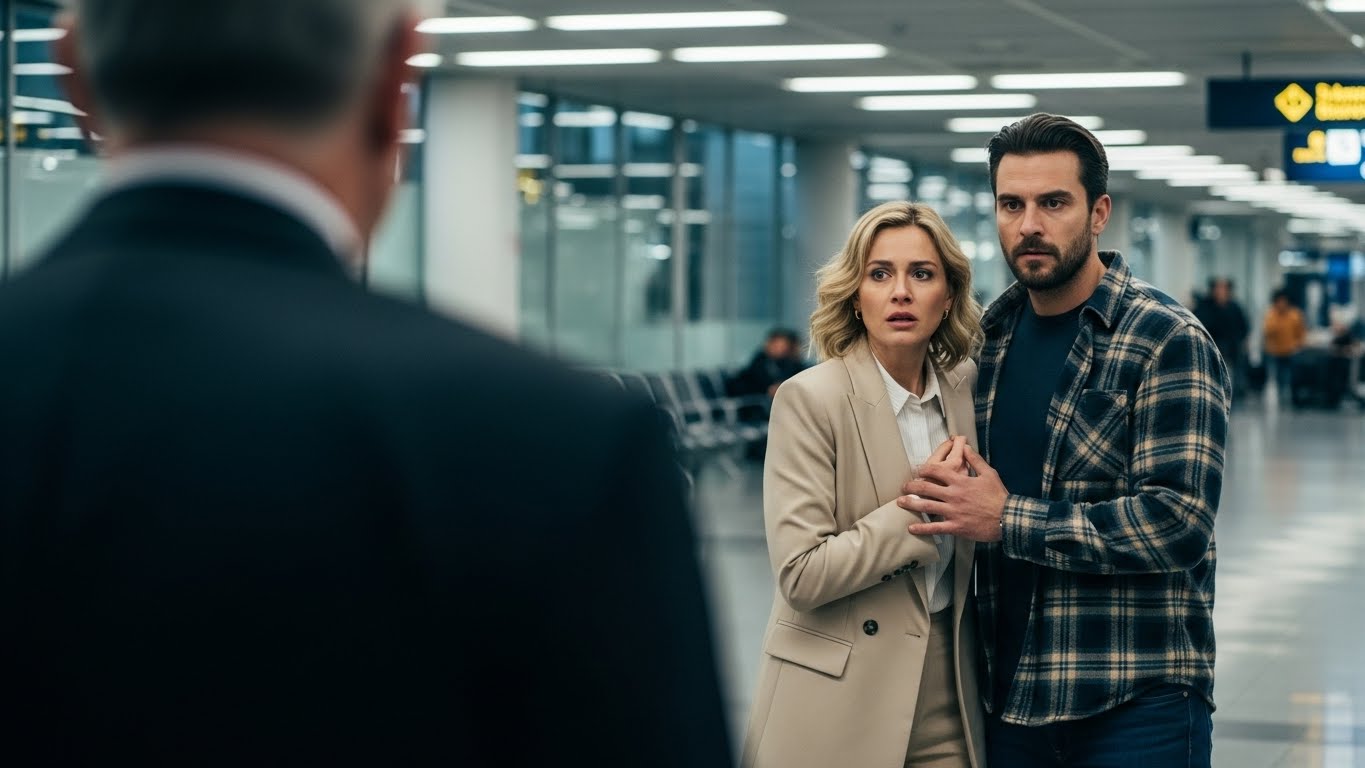
A man in a dark blue, custom-tailored suit was walking toward us. He didn’t walk like a tourist. He walked like he owned the floor tiles he was stepping on. He was older, maybe sixty, with silver hair and shoulders that looked like they could tackle a linebacker.
He had the aura of a coming storm.
“That’s him,” Claire whispered. She grabbed my hand. Her grip was surprisingly strong, her palm clammy. “That’s my father.”
The man stopped five feet away from our table. He didn’t look at the departure screens. He didn’t look at the crowd. He looked directly at us.
His eyes were cold. Calculating. He looked at us the way a butcher looks at a side of beef—analyzing the cuts.
“Claire,” he said. No hello. No hug. Just her name, spoken like an indictment. “I knew you were here. Your assistant confirmed it.”
Claire took a deep, shaky breath, sitting up straighter. I felt her squeeze my hand so hard it hurt.
“Dad, I’m traveling with my husband. I don’t want any trouble.”
His gaze snapped to me. It felt like a physical blow. It was sharp, dissecting.
“Your husband?” he repeated. His voice was a low rumble, rich with skepticism. “I wasn’t aware there was a wedding.”
“I don’t have to report every detail of my life to you anymore,” Claire shot back. Her voice was firm, but I could feel the tremors running through her arm pressed against mine.
Then came the moment I’ll never forget. Her father took a step closer—invading our bubble—and smiled. It wasn’t a happy smile. It was the smile of a predator who found prey in a trap.
“And what do you do for a living… son?” he asked me.
I had anticipated this. I reverted to the truth, mostly.
“I’m an engineer,” I said, keeping my voice steady, channeling every ounce of professional confidence I had. “Aerospace and mechanical systems.”
He hummed, unimpressed. “Interesting. And where did you two meet?”
“Sustainability conference,” Claire cut in, quick as lightning. “In Austin. It was serendipity.”
I was impressed by how easily she lied. It terrified me, actually. It showed me just how much practice she had navigating this man’s minefield.
Her father didn’t blink.
“Claire,” he said, his voice dropping to a dangerous octave. “I heard rumors that you intend to share sensitive company documents with the press. I will not allow that to happen. And this man…” He looked me up and down with pure disdain. “…if he is involved, he will go down with you.”
“He isn’t involved,” Claire said, her voice rising. “Leave us alone.”
He didn’t back down. He leaned in, placing both hands on our table.
“I’ll give you one chance. Come home. Cancel the flight. My legal team will clean up this mess you’ve made. But if you get on that plane… I won’t just stand by.”
The silence that followed was heavy, suffocating. I could hear Claire’s heart pounding—or maybe it was mine. She looked at me, a silent plea in her eyes. Don’t leave me. Please.
I took a breath. I made a choice.
“My wife isn’t cancelling her flight,” I said, staring right back into his cold eyes. “We are doing this together.”
His jaw tightened. A vein pulsed in his temple.
“Very well,” he said softly. “If you choose to be an enemy, you will be treated like one.”
He turned and walked away without looking back. But as he walked, he pulled out his phone.
Claire slumped in her chair, exhaling a breath she seemed to have been holding for five minutes.
“I am so sorry,” she whispered. “I just dragged you into a war.”
“I’m here now,” I said, trying to sound braver than I felt. “Let’s just get you on that plane.”
We got up and started walking toward Gate C12. But we hadn’t gone twenty steps before I noticed them.
Two men. Buzz cuts. tactical pants. Wearing earpieces. They weren’t TSA. They weren’t police.
They were private security contractors. And they were following us.
“We’re being watched,” I murmured.
“I know,” Claire said, her face pale. “My father doesn’t play by the rules.”
We reached the gate, breathless. I looked up at the board, expecting to see ‘BOARDING SOON.’
Instead, in bright red letters, it read: FLIGHT DELAYED – MAINTENANCE.
Claire let out a small, strangled sob.
“He did this,” she whispered, horrified. “He has contacts everywhere. The airport board, the logistics companies… he grounded the plane.”
The realization hit me like a truck. This wasn’t just a disagreement. We were trapped in the terminal.
And the hunters were closing in.
CHAPTER 3: The Skylink Trap
The digital letters on the departure board blinking DELAYED felt like a countdown to an execution.
“We can’t stay here,” I said, grabbing Claire’s elbow. My voice was low, urgent. “This gate is a kill box. If the plane isn’t leaving, we’re sitting ducks.”
Claire looked at me, her face pale, stripping away the composure of the corporate executive she tried to project.
“Where do we go?” she asked. “They’re watching the exits.”
I glanced over my shoulder. The two men in tactical pants were lingering near a Hudson News stand about fifty feet away. They weren’t even hiding it anymore. They were waiting for orders.
“We need to move,” I said. “Keep moving. Hard targets are harder to hit. We’re going to the Skylink.”
DFW Airport is massive—a sprawling city of glass and steel. The Skylink is the high-speed train connecting the terminals. If we could get on it, we could switch terminals, maybe buy a ticket on a different airline, or at least lose the tail.
We started walking. Fast. Not running—running attracts attention—but that speed-walking pace you use when you’re late for a connection.
“Keep holding my hand,” I instructed. “Look at me. Smile. We’re just a couple stressed about a delay, looking for a better place to eat.”
Claire forced a smile that looked painful. “You’re taking this surprisingly well for an engineer.”
“I solve problems,” I muttered, steering us toward the escalators. “Right now, the problem is two goons in Oakleys.”
As we hit the escalator, I risked a glance back. They were moving. They had matched our pace.
“They’re following,” I said.
We hit the platform level. The Skylink doors were open, the chime dinging, signaling they were about to close.
“Run,” I whispered.
We bolted. We abandoned the casual act and sprinted the last twenty feet. We jumped through the sliding glass doors just as the warning chime turned into a solid tone.
The doors hissed shut behind us.
Through the glass, I saw the two men reach the platform. One of them slapped the glass in frustration. The train jerked forward, accelerating smoothly, leaving them behind.
Claire let out a breath that sounded like a tire deflating. She slumped against the metal pole.
“We lost them,” she said, closing her eyes.
“For now,” I said, scanning the car. It was mostly empty—a tired family with a stroller, a businessman typing on a laptop. “But they have radios. They’ll just radio ahead to the next station. We need a plan.”
I looked at her. Really looked at her.
“Claire, what exactly is in those documents? Why is your father risking a felony in a federal airport to stop you?”
She clutched her purse tighter.
“It’s not just money,” she whispered, her voice trembling. “It’s the concrete mix. They’re diluting it to save costs on high-rise residential projects in Chicago and Dallas. If an earthquake hits, or even high winds… buildings could collapse. People could die. Thousands of them.”
I stared at her. The gravity of the situation shifted. This wasn’t just a family squabble. This was a moral crisis.
“I have the lab reports on a flash drive,” she patted her pocket. “Originals. Signed. If I get this to the prosecutor in Chicago, my father goes to prison. If I don’t… he buries it, and eventually, he buries me.”
The train slowed as we approached Terminal D—the international terminal. It was bigger, busier, more chaotic. Better for hiding.
“We get off here,” I said. “We buy a ticket on another airline. American, United, Spirit—I don’t care. We just need to get you in the air.”
The doors opened. We stepped out into the bright, cavernous space of Terminal D.
But as we stepped off the escalator, I froze.
Standing at the bottom, casually leaning against a pillar near the food court, was one of the men from the gate.
How?
Then I realized. He hadn’t missed the train. He had sprinted to the other train going the opposite direction, or they had a team already stationed in every terminal.
He wasn’t looking at us yet. He was scanning the crowd.
“Back up,” I hissed, pushing Claire behind a large advertisement for duty-free perfume.
“He’s here,” she gasped.
“They have a net,” I realized, my blood running cold. “They aren’t chasing us. They’re herding us.”
My phone buzzed in my pocket. A text message.
I frowned. Who would be texting me?
I pulled it out. It was a number I didn’t recognize.
The message read: “Walk away, Engineer. Last warning.”
I dropped the phone like it was hot. They had my number. They had run my face through some database, found my identity, and got my cell.
“What is it?” Claire asked.
“They know who I am,” I said, feeling the walls closing in. “Claire, we can’t buy a ticket.”
“Why not?”
“Because to buy a ticket, I have to show ID. As soon as I scan my passport or driver’s license, the system flags me. Your father clearly has access to the airport’s backend data.”
“So we’re stuck?” Tears were spilling over now. “We’re trapped in Terminal D?”
“No,” I said, a crazy idea forming in my head. “We don’t buy a ticket. We don’t try to fly commercial.”
I looked at the badge of a pilot walking past us.
“We need to find a way to get you out of here that doesn’t involve a boarding pass.”
But before I could formulate the plan, the airport Public Address system chimed. That distinct, three-tone melody that usually precedes a gate change.
But this announcement wasn’t about a flight.
“Attention please. Security is looking for a male suspect, approx six-foot-one, brown hair, wearing a grey hoodie. He is believed to be forcibly detaining a female passenger. If you see this individual, please alert the nearest police officer immediately.”
My heart stopped.
People around us stopped walking. They looked up at the speakers. Then, slowly, eyes started scanning the crowd.
“He flipped the script,” I whispered, horror washing over me. “He told the police I’m kidnapping you.”
CHAPTER 4: The Public Enemy
The genius of the lie was sickening.
By framing me as a kidnapper, Claire’s father had just weaponized every single person in the airport against me. The police, the TSA, even the helpful civilians—they were all his soldiers now.
“Oh my god,” Claire breathed, her hands flying to her mouth. “He’s crazy. He’s actually crazy.”
“He’s not crazy,” I said, pulling my hood up, trying to shrink inside my clothes. “He’s strategic. If the cops grab me, they separate us. They take me to a holding cell for questioning. That leaves you alone. And that’s when his team grabs you.”
A woman standing near the pretzel stand looked at me, then looked at Claire. She frowned. Her hand went into her purse, reaching for her phone.
“We have to move, now,” I said. “Don’t run. If we run, we look guilty.”
I put my arm around Claire, pulling her tight against my side. To an observer, it had to look like a romantic embrace. To Claire, it probably felt like a vice grip.
“Laugh,” I commanded.
“What?”
“Laugh at something I said. Make it look like we are happy. Like we are in love. Kidnap victims don’t laugh.”
Claire let out a high-pitched, hysterical giggle that sounded manic, but from a distance, it might pass.
We ducked into the busy corridor leading toward the Grand Hyatt hotel entrance connected to Terminal D. It was less crowded, a transition zone.
“Where are we going?” she hissed.
“The hotel lobby,” I said. “It’s outside the TSA secure zone, but it’s public. If we can get a room, we can barricade ourselves in. Call the FBI from a landline. Bypass the local airport cops.”
We reached the security exit. The one-way glass doors that let you leave the terminal but not return.
“Once we step through there,” I warned, “we can’t come back in without tickets.”
“I don’t care,” she said. “I just want to be somewhere safe.”
We stepped through the sensors. The doors slid open. We walked out into the pre-security arrival hall.
“Hey!”
The voice was deep and commanding.
I turned. It wasn’t the police.
It was the man from the Skylink station—the private security contractor. He was standing near the baggage claim, blocking our path to the hotel elevators. And he wasn’t alone. Another man, wider and taller, stepped out from behind a pillar.
They had anticipated the exit.
“Mr. Evans,” the lead man said. He knew my last name. “Let her go.”
We were in a semi-public area, but it was a quiet corner near the oversized luggage drop-off. Not many witnesses.
“She’s my wife,” I lied, my voice echoing slightly. “Back off.”
The big man stepped forward. He moved with a speed that shouldn’t have been possible for his size. He reached for me.
I didn’t think. I reacted.
I shoved Claire behind me and swung my heavy backpack with all my strength. The laptop inside made it a solid ten-pound brick.
It connected with the big man’s face with a sickening thud.
He stumbled back, blood spurting from his nose.
“Run!” I yelled.
I didn’t wait to see if she listened. I grabbed her hand and yanked her toward the sliding doors leading to the curbside pickup.
“Get them!” the lead man shouted.
We burst out into the Texas heat. The humidity hit us instantly. Cars, buses, and shuttles were whizzing by. The noise was deafening.
“Taxi!” I screamed, waving my arm frantically.
A yellow cab swerved toward us. I threw the back door open and shoved Claire inside.
But before I could get in, a hand grabbed the back of my hoodie.
I was jerked backward so hard my feet left the ground. I slammed onto the concrete sidewalk.
The lead security guard stood over me, his boot pressing onto my chest. He wasn’t holding a gun—too risky outside—but he was holding a telescoping baton.
“You should have walked away, engineer,” he sneered.
Inside the cab, Claire was screaming. “Leave him alone! Help! Somebody help!”
Passersby were stopping. Phones were coming out. The guard looked around, realizing he was losing control of the scene. He couldn’t beat me to a pulp in front of fifty Uber drivers.
“Get in the car, Claire,” the guard barked at her, ignoring me on the ground. “Your father is waiting in the limo just up the road.”
Claire looked at me, pinned to the concrete, gasping for air. Then she looked at the guard.
And then, she did something I didn’t expect.
She didn’t cower.
She reached into the front seat of the taxi, grabbed the driver’s heavy metal thermos, and launched herself out of the cab.
She swung the thermos like a hammer, smashing it into the guard’s shoulder.
He grunted in shock, stumbling off me.
“Get up!” she screamed at me, her eyes wild. “Get in!”
I scrambled up, adrenaline masking the pain in my ribs, and dove into the taxi. Claire jumped in right behind me.
“Drive!” I yelled at the terrified driver. “Just drive! Go!”
The driver slammed on the gas. The tires screeched. We merged into traffic just as the guard recovered and started running after the car.
We watched him shrink in the rear window, furious and defeated.
I slumped back against the seat, my chest heaving, sweat soaking through my shirt. Claire was shaking uncontrollably next to me.
“You came back,” I wheezed, looking at her. “You could have run.”
“You didn’t leave me,” she said, her voice breaking. “I wasn’t going to leave you.”
We were out of the airport. But as I looked out the window at the Dallas skyline, I realized the problem had just gotten infinitely worse.
We weren’t just hiding in a terminal anymore. We were fugitives in a city owned by her father.
My phone buzzed again.
“Big mistake. Now we take the gloves off.”
I looked at the driver.
“Don’t stop,” I said. “And turn off your GPS.”
“Where to?” the driver asked, eyeing us in the rearview mirror like we were bank robbers.
I looked at Claire. We had no flight. We had no plan. And we had a powerful enemy tracking our digital footprint.
“We need to disappear,” I said. “Take us to the nearest Greyhound station. We’re getting off the grid.”
But I knew, deep down, that getting off the grid wouldn’t be enough. We didn’t just need to hide.
We needed to fight back.
CHAPTER 5: Going Dark
“Stop the car,” I told the taxi driver.
We weren’t at the Greyhound station yet. We were about three blocks away, in a gritty industrial area of Dallas where the streetlights flickered and the buildings were covered in graffiti.
“Here?” the driver asked, looking nervous. “This isn’t the station.”
“This is fine,” I said, handing him a wad of cash—Claire’s cash. “Keep the change. And forget you saw us.”
We scrambled out. The humid Texas air wrapped around us like a wet blanket. As the taillights of the taxi faded, I turned to Claire.
“Give me your phone,” I said.
“What? Why?” She clutched it to her chest. “It’s my lifeline. My contacts, the evidence backup…”
“It’s a tracking beacon,” I corrected her. “Your father owns the network infrastructure. He doesn’t need the police to ping your location. As long as that thing has a battery, he can see us.”
She hesitated, looking at the device that held her entire life. Then, with a trembling hand, she handed it over.
I took mine out too. I placed both iPhones on the pavement. I found a loose brick from a crumbling wall nearby.
Smash.
I brought the brick down. Glass shattered. Metal bent. I hit them again and again until they were just sparkling debris on the concrete.
“Okay,” I said, breathing hard. “Now we’re ghosts.”
“We’re also stranded,” Claire said, her voice rising in panic. “No Uber. No Maps. No way to call the journalist.”
“We do this the old-fashioned way,” I said. “We need a car that doesn’t talk to satellites.”
We walked for twenty minutes until we found a “Buy Here Pay Here” used car lot that looked like it hadn’t seen a legitimate inspection in a decade.
Claire had three thousand dollars in emergency cash in her purse.
“Let me do the talking,” she said, wiping the smudge of dirt from her expensive blazer. She walked into the trailer office. Ten minutes later, she walked out with a set of keys.
“1998 Ford Taurus,” she said, dangling the keys. “It smells like wet dog and cigarettes, but it runs.”
“It’s perfect,” I said.
We pulled out onto the highway, merging into the endless stream of traffic on I-35 North. We weren’t going to the bus station. That was the first place they’d look. We were driving to Oklahoma.
“Why Oklahoma?” Claire asked, staring out the window at the passing strip malls.
“Jurisdiction,” I said, gripping the worn steering wheel. “Your father owns Dallas PD. But across state lines? It gets harder for him. And from there, we head to Chicago.”
Night fell. The road became a hypnotic blur of red taillights. The adrenaline was wearing off, replaced by a bone-deep exhaustion.
“You really are an engineer, aren’t you?” Claire asked softly. ” The way you think… it’s all systems and logic.”
“I fix things,” I said. “Usually engines. Sometimes plumbing. Today, apparently, kidnapping plots.”
She looked at me in the dim light of the dashboard.
“You’re not kidnapping me,” she whispered. “You’re saving me.”
But the radio interrupted us. A news break.
“Breaking news. An Amber Alert has been issued for Claire Sterling, 32. Police are searching for a suspect, identified as Mark Evans, 34. Evans is considered armed and dangerous…”
My grip on the wheel tightened until my knuckles turned white.
” armed and dangerous,” I repeated bitterly. “I’m holding a lukewarm Dr. Pepper.”
“They’re controlling the narrative,” Claire said, anger flashing in her eyes. “We need to upload those files. Tonight.”
CHAPTER 6: The Motel Standoff
We couldn’t drive straight through. The car was overheating, and so were we.
We pulled into a Motel 6 just across the Oklahoma border. It was the kind of place where people didn’t ask questions and paid in cash.
Inside the room, the smell of stale smoke was overwhelming. I pushed the dresser against the door—a flimsy barricade, but it made us feel better.
Claire sat on the edge of the bed, pulling the flash drive from her pocket. It looked so small. So insignificant.
“This little piece of plastic destroys his empire,” she murmured.
“Does the room have Wi-Fi?” I asked.
“It does,” she said, checking the laminated card on the nightstand. “But if we log in, they might trace the IP.”
“We don’t have a choice,” I said. “We can’t drive to Chicago. That car won’t make it, and every cop in three states is looking for my face. We need to send it to the journalist now.”
I opened the ancient laptop I’d found in the backseat of the Taurus—the previous owner had left it. It was slow, running Windows 7, but it had a browser.
“Okay,” I said. “Give it to me.”
I plugged in the drive. The screen flickered.
A password prompt appeared.
ENCRYPTION KEY REQUIRED.
Claire froze. “I… I don’t know it. I thought I just copied the files.”
“It’s encrypted at the source,” I realized, feeling a pit in my stomach. “Corporate security. Who created these files?”
“The Chief Financial Officer,” she said. “My dad’s right-hand man.”
“Then we need his key. Or we need to hack it.”
“I don’t know how to hack!” she cried, throwing her hands up. “And you’re a mechanical engineer, not a cyber-security expert!”
We were stuck. We had the bullet, but no gun.
Suddenly, a heavy pounding on the door made us both jump.
“Housekeeping!” a muffled voice called out.
It was 11:00 PM. Housekeeping doesn’t come at 11:00 PM.
I signaled Claire to get into the bathroom. I grabbed the heavy lamp from the bedside table, ripping the cord from the wall.
“Go away,” I shouted. “We’re sleeping.”
The handle jiggled. Then, a loud crack as the wood splintered. The door flew open, shoving the dresser aside with terrifying force.
It wasn’t housekeeping.
It was the man from the airport—the one Claire had hit with the thermos. He was wearing a sling on his arm, and his face was a mask of pure rage. behind him stood two local sheriff’s deputies.
“Found you,” the security guard snarled.
They didn’t track the phones. They didn’t track the car.
“How?” I gasped.
The guard held up a small, black device. A key fob.
“You took the car keys from the lot,” he grinned. “Modern keys have RF chips. We just scanned for the frequency once we knew the make of the car you bought. You’re not as smart as you think, Engineer.”
The deputies stepped forward, guns drawn.
“Mark Evans,” one shouted. “On the ground! Now!”
I looked at the bathroom door. Claire was safe for the moment. If I surrendered, maybe she could slip out the window.
I dropped to my knees, hands behind my head.
“Don’t shoot,” I said. “I surrender.”
The guard stepped over me, ignoring the cops, and walked straight to the laptop. He yanked the flash drive out.
“Game over,” he said.
But he didn’t check the bathroom.
CHAPTER 7: The Engineer’s Gambit
They cuffed me. The metal bit into my wrists.
“Where is the girl?” the deputy asked.
“She ran,” I lied. “She ran away hours ago. I stole the car.”
The security guard, whose name I learned was Kincaid, laughed. “Don’t lie to me. She’s in the bathroom.”
He kicked the bathroom door open.
Empty.
The small frosted window above the shower was open, the screen pushed out.
Kincaid cursed, his face turning purple. He ran to the window and looked out into the dark alley behind the motel.
“She can’t have gone far! Fan out!” he screamed at the deputies.
They dragged me out to the parking lot. The red and blue lights of the police cruisers were blinding. They shoved me against the hood of a squad car.
“You’re in a lot of trouble, son,” the deputy said. “Kidnapping. Grand theft auto. Crossing state lines.”
“I didn’t kidnap anyone,” I said calmly. “Check the security footage from the airport. She approached me.”
“We’ll let the judge decide that,” the deputy said.
Kincaid was pacing, talking furiously into his phone. “She has the drive… No, I have the drive. She has the backup? I don’t know! Just find her!”
Wait. He had the drive. He had taken it from the laptop.
But Claire had escaped.
Suddenly, the lights in the parking lot flickered. Then the motel sign buzzed and died. The streetlights went black.
Total darkness engulfed us.
“What the hell?” the deputy muttered.
A roar of an engine tore through the silence.
The Ford Taurus—the beat-up 1998 sedan—screamed around the corner of the motel. One headlight was out, the other was blindingly bright.
It was heading straight for the police cruisers.
“Look out!”
The deputies dove out of the way.
The Taurus didn’t hit the cars. It swerved at the last second, drifting sideways, and slammed into a utility pole next to Kincaid’s black SUV.
Sparks showered down. The live transformer wire fell, dancing across the hood of Kincaid’s car, trapping him inside as he tried to retrieve his gear.
The driver’s door of the Taurus flew open.
“Get in!” Claire screamed.
She hadn’t run away. She had circled back.
I didn’t hesitate. I shoulder-checked the distracted deputy, knocking him into the dirt, and sprinted for the car. I dove into the passenger seat, my hands still cuffed behind my back.
“Go! Go! Go!”
Claire stomped on the gas. The Taurus wheezed, tires spinning in the gravel, and then caught traction. We shot out of the parking lot, leaving the chaos behind.
“You came back,” I said, staring at her in disbelief. “Again.”
“I told you,” she said, her eyes fixed on the road, tears streaming down her face. “We’re in this together. Also, I figured out the password.”
“What?”
“The password for the files. I remembered something my dad used to say. ‘Family First.’ I typed it in before I jumped out the window. It unlocked.”
“But Kincaid has the drive!” I shouted over the engine noise.
“He has a drive,” Claire smiled, a fierce, predatory smile that reminded me of her father. “I swapped it. He has a flash drive full of MP3s of Taylor Swift from 2012 that I found in the glove box.”
I laughed. I actually laughed, hysterical and loud.
“So where are the files?”
“I emailed them,” she said. “To the New York Times, the FBI, and the Chicago Tribune. While I was in the bathroom. It’s done, Mark. It’s over.”
CHAPTER 8: The Departure
The sun was rising as we crossed the state line into Kansas.
The radio was different now. The tone had shifted.
“…shocking revelations regarding Sterling Construction… massive federal investigation launched this morning… CEO under house arrest…”
We pulled the car over at a rest stop surrounded by cornfields. The engine finally gave up, steam hissing from the hood. It didn’t matter. We didn’t need to run anymore.
I sat on the hood of the dead car. Claire stood next to me.
I was still in handcuffs.
“I called the local police,” Claire said softly. “They’re coming to pick us up. But this time, they know the truth. You’ll be cleared.”
“It’s going to be a long process,” I said. “Lawyers. Interrogations.”
“I’ll pay for the lawyers,” she said. “I’ll pay for everything.”
She turned to face me. The morning light caught her hair, making it look like gold. She looked exhausted, her blazer ruined, her makeup smeared.
She looked beautiful.
“You saved my life,” she said.
“You saved yourself,” I replied. “I just drove the getaway car.”
She stepped closer. She reached out and touched my face.
“You pretended to be my husband for 24 hours,” she whispered. “And you were better at it than any real man I’ve ever met.”
The sirens were approaching in the distance. The sound of safety. The sound of the end.
“What happens now?” I asked.
“Now,” she said, leaning her forehead against mine. “We face the music. And then… maybe you can take me on a real date. One without felonies.”
“I’d like that,” I said. “Dinner? Somewhere with no TSA lines?”
“Deal.”
The police cruisers pulled into the rest stop, slowing down as they saw us. Officers stepped out, but their guns were holstered. They knew the story. The world knew the story.
Claire took my hand—my cuffed hand—and squeezed it.
“Ready?” she asked.
“Ready,” I said.
We stood there, side by side, watching the officers approach. Two strangers who met in a security line, forged in fire, standing in the middle of nowhere, waiting for the rest of our lives to begin.
I looked at her one last time before the chaos returned.
“Best layover ever,” I joked.
She laughed, and the sound was freer than anything I’d heard in years.
“Best husband ever,” she replied.
And as the officers reached us, I knew one thing for sure.
I missed my flight to Seattle. But I had found exactly where I was supposed to be.