Innocent Nanny Facing Life Sentence Saved When 4-Year-Old “Ghost” Storms Courtroom and Screams the Chilling Truth at the Real Killer…
PART 1 OF 2
Chapter 1: The interruption
The heavy oak double doors of the Superior Court of Connecticut didn’t just open; they exploded inward with a thunderous bang that echoed off the high, vaulted ceilings like a gunshot.
Every head in the packed gallery whipped around in unison. The court stenographer flinched, her hands hovering over the keys. Even the stoic bailiff, a man who looked like he was carved from granite, reached instinctively for his belt. We were in the middle of the prosecution’s closing arguments for the murder trial of the century, a case that had gripped the entire state and dominated the headlines for months. But suddenly, the dense, suffocating tension of the legal proceedings was shattered.
Standing in the center aisle, framed by the bright, harsh light of the hallway behind her, was a tiny, trembling figure.
It was Sophie. My charge. The four-year-old daughter of the victim.
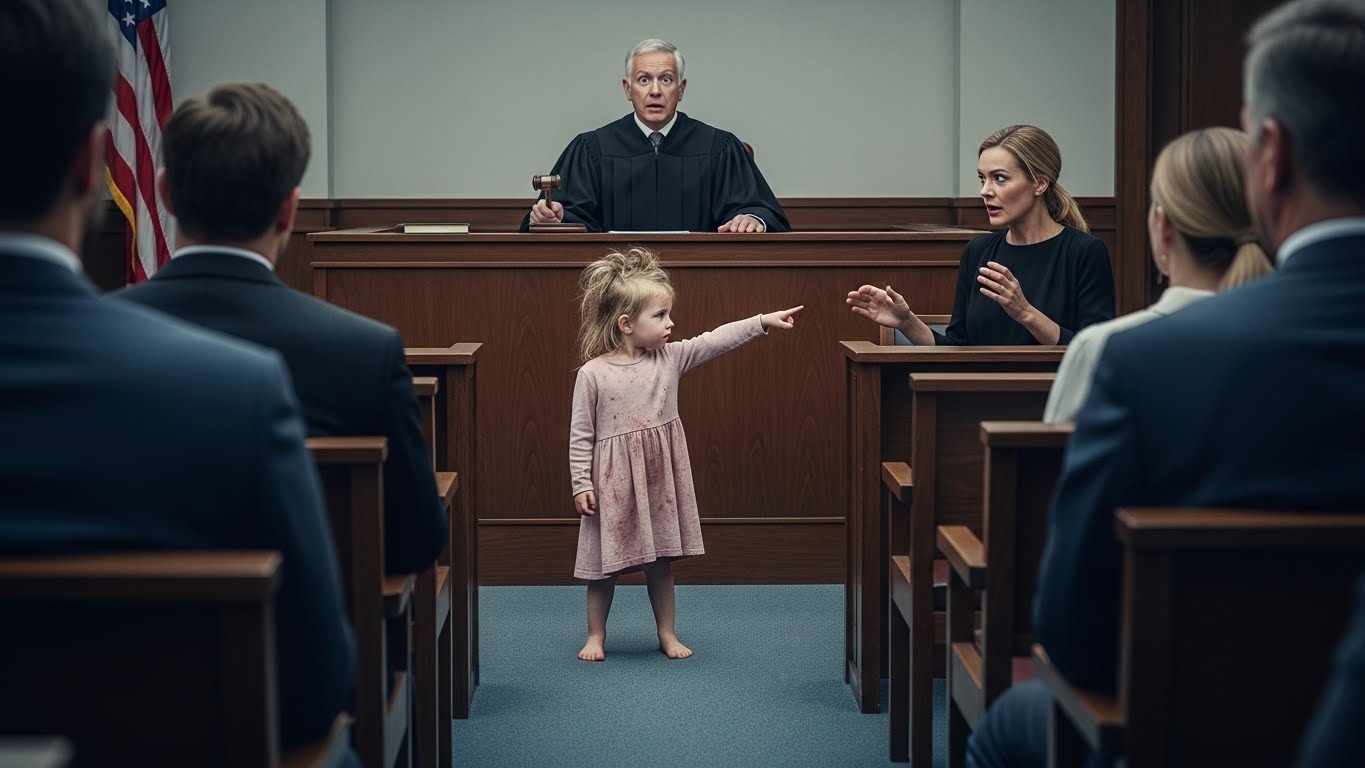
She looked like a ghost of the happy, vibrant child I used to know. Her favorite pink dress—the one with the lace trim we had bought together for her fourth birthday—was smeared with dark mud and grease. Her hair, usually brushed into perfect gold curls, was a tangled bird’s nest of knots and leaves. And she was barefoot. Her small, pale feet were dirty and scraped, as if she had run miles on rough asphalt to get here.
The silence in the room was absolute. It was heavy and suffocating. You could hear the low hum of the air conditioning and the distant sound of traffic outside.
Then, her small voice, cracked from crying but fueled by a desperate, childish fury, pierced the dead air.
“Katie didn’t do it!” she screamed, her little chest heaving with every breath. “Katie is good! She didn’t hurt Daddy!”
I froze in the defendant’s chair. My heart, which had been a heavy, cold stone in my chest for months, suddenly slammed against my ribs with a violence that made me dizzy. I blinked through the haze of exhaustion and fear, trying to understand if I was hallucinating. “Sophie?” I whispered, the name catching in my dry, aching throat.
The judge, the Honorable Marcus Sterling, sat with his gavel suspended in mid-air, his mouth slightly open behind his gray beard. The whispers began to ripple through the room like a rising tide, growing louder by the second.
How did she get here? Who was watching her? Where were her court-appointed guardians?
Sophie didn’t look at the crowd of strangers. She didn’t look at the imposing figure of the judge. She locked eyes with me. For a second, the rest of the world dissolved. The wood paneling, the jury, the press—it all faded. I saw the terror in her blue eyes, a raw, primal terror that no four-year-old should ever have to know.
Then, with a determination that made her look decades older than her years, she turned. She raised her small arm and pointed a shaking, dirt-stained finger toward the front row of the gallery.
“It was her,” Sophie said. Her voice dropped to a whisper, but in the silent room, it sounded like a shout. “She is the bad one. She is the monster.”
Veronica, the grieving widow, sat in the front row. She was dressed in immaculate, designer mourning black, a veil of controlled sorrow draped over her features. She had been the picture of the heartbroken wife throughout the trial, dabbing her eyes with a silk handkerchief at all the right moments. But as that tiny finger pointed at her, her mask slipped.
I saw it. The jury saw it. Even the judge saw it.
For a split second, pure, unadulterated panic flashed behind Veronica’s perfectly applied makeup. Her eyes, usually cold and calculating, darted left and right, looking for an exit, looking for an excuse. Her posture, usually rigid and regal, collapsed just an inch.
Judge Sterling slammed the gavel down, the sound violent and final. “Order! Order in this court!”
The room erupted. Reporters were shouting questions, the bailiffs were moving to secure the aisle, and the jury was murmuring frantically among themselves.
“I am calling a thirty-minute recess!” the Judge bellowed over the chaos, his face turning red. “Counsel, in my chambers. Now! And get that child some assistance!”
Before the bailiffs could secure the defendant’s table, Sophie broke into a run. She didn’t run away; she ran to me. She ducked under the wooden railing, scrambling toward the defense table with a desperate speed.
“Hold it!” a deputy shouted, stepping forward to intercept her.
“Let her through!” my defense attorney, Mr. Clarke, barked, stepping between the guard and the child, using his broad shoulders as a shield. “That is the victim’s daughter, for God’s sake! Have you no soul?”
I dropped to my knees as far as the handcuffs chained to my waist would allow. Sophie collided with me, burying her face in the crook of my neck. She smelled of rain, exhaust fumes, and sweat, but underneath that, she smelled like my Sophie. Baby shampoo and innocence.
She was trembling so hard her teeth chattered against my collarbone. I pressed my cheek against the top of her matted head, weeping openly now, ignoring the cameras, ignoring the stares. “I’ve got you,” I sobbed, rocking her back and forth. “I’ve got you, Sophie. You’re safe.”
She pulled back just an inch, her tear-streaked face close to mine. Her small hands gripped the fabric of my orange jumpsuit. She looked deep into my eyes, and she whispered the words that would change everything—words that terrified me more than the prospect of prison.
“I saw her, Katie,” she whispered, her voice trembling. “I was awake that night. I saw what she put in Daddy’s drink.”
Chapter 2: The Serpent in the Garden
To understand the horror of that moment in the courtroom, you have to understand how perfect things were before she arrived.
Six months earlier, the sprawling Novak estate in the wealthy suburbs of Greenwich, Connecticut, felt like a different world. It was a place of light and laughter. The house was a masterpiece of colonial architecture, sitting on five acres of manicured lawn, but inside, it was a home.
I remember the day the atmosphere shifted. It was a Tuesday in late spring. The afternoon sun was streaming through the floor-to-ceiling windows of the solarium, illuminating the dust motes dancing in the air. The smell of expensive furniture polish and fresh-cut lilies filled the room.
Sophie was on the floor, surrounded by an army of stuffed animals. She was arranging them in a circle for a tea party. I was nearby, folding laundry and watching her with a smile. I had been working for John Novak for three years, ever since his first wife passed away in that tragic car accident. I wasn’t just an employee; I was the one who held Sophie when she cried for her mother. I was the one who taught her to tie her shoes. She was practically my own child in every way that mattered.
“Katie?” Sophie asked, holding up a teddy bear with a missing button eye. “Do you think Mr. Fluffles likes Earl Grey?”
“Mr. Fluffles is a bear of refined taste,” I laughed, walking over to straighten her collar. “He only drinks the best.”
The heavy front door opened, and John’s booming voice echoed through the marble hallway. “Sophie! Princess! Come here, I have a surprise!”
There was a different tone in his voice that day. It wasn’t just happy; it was nervous. Expectant. It was the sound of a man who is about to make a mistake.
Sophie scrambled up, abandoning the tea party. We walked into the grand foyer together. John was standing there, looking dapper in his tailored navy suit, his briefcase on the floor. But he wasn’t alone.
Standing next to him, gripping his arm with a manicured hand that looked more like a claw, was a woman.
She was beautiful, in a sharp, angular way that felt dangerous. High cheekbones, hair the color of dark chocolate that cascaded in perfect, glossy waves, and eyes that were a shade of blue so pale they looked like ice. She wore a silk dress that fit her like a second skin and probably cost more than my entire year’s salary.
“Sophie,” John beamed, gesturing to the woman with a pride that made my stomach turn. “I want you to meet someone very special. This is Veronica.”
Veronica smiled. It was a surgically perfect smile. White teeth, symmetrical lips. But it didn’t reach her eyes. Her eyes remained cold, calculating, scanning the room—and Sophie—like she was appraising the value of a piece of furniture at an auction.
“Hello, sweetie,” Veronica said. Her voice was smooth, like velvet, but there was a metallic edge to it. She leaned down, but she didn’t kneel to be on Sophie’s level. She kept her distance, protecting her outfit. “Your daddy has told me so much about you.”
Sophie froze. Kids have a sixth sense about people, a survival instinct that adults often lose as they get older. She took a half-step back, pressing her small body against my leg. I instinctively placed a hand on her shoulder.
“Are you staying?” Sophie asked, her voice small and wavering.
John laughed, a nervous, hearty sound that bounced off the high walls. “Better than that, princess. Veronica and I… we’re getting married.”
I felt the blood drain from my face. Married? He had known this woman for maybe two months. He had met her at a charity gala in the city. I had heard him mention her name a few times, but marriage? It was too fast. It was reckless.
“That means Veronica is going to be your new mommy,” John said, his eyes pleading for his daughter to be happy, blinded by his own infatuation.
Veronica reached out a hand to touch Sophie’s cheek. Sophie flinched, pulling her head back.
“Come here, darling,” Veronica cooed, stepping closer. “We are going to be a perfect family.”
When she finally pulled Sophie into a hug, I saw it. I was standing at the perfect angle, just behind John’s line of sight. As John turned to hang up his coat, Veronica’s face transformed. The smile vanished instantly, replaced by a look of sheer annoyance and disgust. She squeezed Sophie. Not a loving squeeze. A hard, possessive clamp on the child’s shoulder, her nails digging into the fabric of Sophie’s shirt.
I saw Sophie wince in pain.
“Ow,” Sophie whispered.
“Shh,” Veronica hissed, her lips barely moving, so low only Sophie and I could hear. “Big girls don’t complain. And big girls don’t get in the way.”
She looked up and locked eyes with me over Sophie’s shoulder. Her gaze was predatory. She knew I was the help. She knew I was watching. And in that moment, she declared war. There was no fear in her eyes, only a challenge.
“You must be the nanny,” she said, straightening up and smoothing her dress as if touching Sophie had soiled it. “Kaitlin, isn’t it?”
“Katie,” I corrected, keeping my voice steady despite the alarm bells ringing in my head.
“Right. Katie,” she said dismissively, turning her back to me. “Could you fetch us some coffee? Black. John and I have a lot of planning to do. Changes are coming.”
“Of course, Mr. Novak,” I said, addressing John, but my eyes were on her.
As I walked to the kitchen, my stomach twisted into knots. I looked back one last time. Sophie was standing there in the middle of the foyer, looking small and terrified, while Veronica whispered something in John’s ear that made him laugh.
I knew, right then and there, that a serpent had entered our garden. I just didn’t realize that this serpent would end up wrapping its coils around John’s neck, and I would be the one blamed for the bite.
PART 2 OF 2
Chapter 3: The Mask Falls
The shift in the house was subtle at first, like the temperature dropping a few degrees before a snowstorm. John was blinded by love, or perhaps the desperate need for companionship, and he couldn’t see what was happening right under his nose. But I saw it. Sophie felt it.
Three weeks after Veronica moved in, John announced he had to go on a business trip to Tokyo. It was a ten-day trip. Ten days that would leave Sophie and me alone with her.
“I don’t want you to go, Daddy,” Sophie pleaded the morning of his departure, clinging to his leg in the foyer. She looked small and fragile in her pajamas.
John knelt down, his face soft with regret. “I have to, Princess. It’s for work. But look, you have Veronica now! You two can have a girls’ week. Paint your nails, bake cookies. It’ll be fun.”
He looked at Veronica, who was standing by the door, checking her reflection in the hallway mirror. “Won’t it, darling?”
Veronica turned, plastering that synthetic smile back onto her face. “It will be magical, John. Don’t you worry about a thing.”
As soon as the heavy front door clicked shut and the sound of the town car faded down the driveway, the atmosphere in the house snapped. The warmth evaporated instantly.
Veronica dropped the smile. Her face went slack, bored. She walked past Sophie without a word, her heels clicking sharply on the marble floor.
“Can we make cookies?” Sophie asked, her voice trembling slightly, trying to be brave, trying to make her father’s promise come true.
Veronica stopped on the stairs. She didn’t turn around. She just spoke to the empty air. “I don’t bake. And I don’t like sticky children in my kitchen. Go to your room.”
“But Daddy said—”
Veronica whipped around, her eyes blazing with a cold fire that made me step in front of Sophie instinctively. “Daddy isn’t here,” she hissed. “I am. And in this house, you do what I say. Now, disappear.”
Sophie burst into tears and ran up the stairs. I moved to follow her, to comfort her, but Veronica’s voice stopped me cold.
“Not you, Katie. We need to establish some ground rules.”
I turned to face her, my hands balling into fists at my sides. “She’s a child, Veronica. She’s scared.”
“She’s spoiled,” Veronica corrected, descending the stairs slowly, like a predator stalking prey. “And you… you are a servant. John might treat you like family, but let’s be clear: you are replaceable. Extremely replaceable.”
She stopped inches from my face. I could smell her perfume—something heavy, floral, and expensive—but underneath it, there was a chemical tang, something sharp and bitter.
“Stay out of my way,” she whispered. “Do your job, keep that brat quiet, and maybe you’ll still have a job when John gets back. Cross me, and I will destroy you.”
For the next nine days, the house was a prison. Veronica spent her days shopping or locked in the master bedroom making hushed phone calls. She ignored Sophie completely, acting as if the child were a ghost. Sophie stopped playing. She stopped laughing. She spent her days in my room, drawing dark pictures of storm clouds and jagged monsters.
“I don’t like her, Katie,” Sophie whispered to me one night as I tucked her in. “She smells like the flowers when Daddy forgets to change the water. Like… dead water.”
I shushed her, stroking her hair, but a chill ran down my spine. Children notice things we don’t. They sense rot before it becomes visible. I just didn’t realize how literal her description was.
Chapter 4: The Scent of Decay
John returned early. It was late on a Thursday night when the cab pulled up. I was in the kitchen making tea, unable to sleep. When he walked in, I barely recognized him.
He was gray. His skin, usually tanned and healthy, looked like parchment paper. He was sweating profusely, shivering despite the warm summer air.
“Mr. Novak?” I rushed to him as he stumbled against the kitchen island. “My God, are you alright?”
“Just… the flu,” he wheezed, clutching his stomach. “Hit me on the flight back. Feel terrible.”
“I’ll call the doctor,” I said, reaching for the wall phone.
“No!” Veronica’s voice rang out from the doorway. She had appeared out of nowhere, wearing a silk robe. She moved quickly, positioning herself between me and John. “He’s exhausted, Katie. He doesn’t need a doctor poking at him at midnight. He needs rest.”
She draped his arm over her shoulder, acting the part of the concerned wife perfectly. “Come on, darling. I’ve got you. I’ll take care of you.”
John looked at me, his eyes glassy and confused. “It’s okay, Katie. Just… need sleep.”
They went upstairs. I stood in the kitchen, holding the phone receiver, a knot of dread tightening in my stomach. Something was wrong.
Over the next two days, John didn’t leave the master bedroom. Veronica banned everyone from entering. She claimed he was contagious, that he needed absolute quiet. She would come down to the kitchen, prepare trays of broth and tea, and take them up herself.
I tried to go in. Twice.
The first time, the door was locked. The second time, Veronica opened it just a crack. Her eyes were wild, her hair slightly disheveled. “I told you to stay away!” she snapped.
“I just wanted to see if he needs anything,” I said, trying to look past her. The room was dark, the curtains drawn. It smelled stifling—sickly sweet, like rotting fruit and medicine.
“He needs you to do your job and watch the girl,” she slammed the door in my face.
But Sophie… Sophie was watching.
That Saturday afternoon, Veronica left the house for an hour to run an “urgent errand”—likely to the pharmacy, she claimed. I seized the chance. I told Sophie to stay in her room, and I crept toward the master bedroom.
I reached for the handle, but before I could turn it, I felt a small hand on my leg. I jumped.
It was Sophie. She was holding her teddy bear, her eyes wide.
“Don’t go in there, Katie,” she whispered.
“Daddy’s sick, baby. I need to check on him.”
“She gives him the blue water,” Sophie said. The words made no sense to me.
“What blue water?”
“From the little bottle. In her purse. I saw her. She puts it in his tea. It makes him sleep, but he makes scary noises after.”
My blood ran cold. “When did you see this, Sophie?”
“Last night. The door was open. I wanted to say goodnight.”
I didn’t wait. I turned the handle. It was unlocked. I pushed the door open and rushed to the bed.
John was unconscious. His breathing was shallow, ragged, sounding like a rattle in his chest. His skin was cold and clammy.
“John?” I shook him. “John, wake up!”
He groaned, his eyelids fluttering. “Veronica…” he mumbled, his voice thick and slurred. “The taste… so bitter…”
I reached for the phone on the nightstand to dial 911. My fingers hovered over the buttons.
“What do you think you’re doing?”
Veronica was standing in the doorway. She hadn’t gone to the pharmacy. She had been watching. And in her hand, she held a small, heavy glass pestle.
Chapter 5: The Frame-Up
The next few hours were a blur of chaos and screaming.
I didn’t back down. I dialed 911 right in front of her. Veronica didn’t attack me; she was too smart for that. Instead, she started screaming. She fell to the floor, sobbing, yelling that I had poisoned him, that she had caught me trying to finish the job.
By the time the paramedics arrived, John was in cardiac arrest. They worked on him for twenty minutes right there on the bedroom floor. I stood in the corner, holding a terrified Sophie, while Veronica put on the performance of a lifetime—wailing, clutching his hand, begging him not to leave her.
They pronounced him dead at 8:42 PM.
The police arrived shortly after. Detective Miller, a tired-looking man with sharp eyes, separated us immediately. Veronica told them a story she must have rehearsed a thousand times in her head. She claimed I was obsessed with John. That I was jealous of their marriage. That I had been making his tea for the last two days because she was “too distraught” to do it.
“Check her room,” Veronica sobbed, pointing a shaking finger at the door. “Please, just check her room. She has… she has these pills. I saw them once.”
I protested. I screamed that she was lying. But they went to my room.
Five minutes later, an officer walked out holding a clear evidence bag. Inside was a bottle of arsenic-based rat poison and a small vial of a clear blue liquid—digitalis.
“Is this yours, ma’am?” the officer asked me.
“No! I’ve never seen that in my life! She put it there!”
“You have the right to remain silent…”
The world tilted on its axis. As they handcuffed me, marching me out of the house I had loved, the only thing I saw was Sophie. She was standing at the top of the stairs, held back by a female officer. She wasn’t crying anymore. She was staring at Veronica.
Veronica stood by the door, dabbing her eyes with a tissue. As I passed her, she leaned in, her voice a whisper that the police couldn’t hear.
“I told you I’d destroy you.”
The cruiser door slammed shut. I watched through the window as the house disappeared, taking my freedom and the little girl I loved with it.
Chapter 6: Steel Bars and Lies
Prison is not like the movies. It’s loud, it smells of industrial cleaner and despair, and it is incredibly boring. For six months, I sat in a 6×8 cell, waiting for the trial.
The media circus was relentless. ” The Nanny Nightmare,” they called it. “The Black Widow in the Apron.” Veronica played the media perfectly. She gave tearful interviews about how betrayed she felt, how she had welcomed me into her home, how I had twisted John’s kindness into a sick obsession.
My lawyer, Mr. Clarke, was a good man, but he was losing. The evidence was damning. The poison was in my room. My fingerprints were on the tea cup (of course they were, I washed the dishes). The prosecution had built a narrative that made sense to the jury: the lonely spinster nanny in love with her rich employer, killing him to get the wife out of the picture.
I lost hope. I really did. I lay on my cot at night, staring at the concrete ceiling, wondering if Sophie was okay. Wondering if she remembered me. Wondering if she was safe with her.
When the trial started, it was a nightmare. Witness after witness painted me as unstable. Veronica took the stand on the third day. She was brilliant. She cried at the right times, she looked brave, she looked shattered. She looked at me with pity, not anger, which made the jury hate me even more.
“I just wanted us to be a family,” she sobbed into the microphone. “Katie… she just couldn’t accept that.”
Then came the closing arguments. The prosecutor called me a “wolf in sheep’s clothing.” He pointed at me and called me a cold-blooded killer.
I looked at the jury. They weren’t looking at me. They were looking at their hands, or the floor. They had already decided. I was going to die in prison.
Mr. Clarke squeezed my arm. “Stay strong, Katie,” he whispered, though I could hear the defeat in his own voice.
That was when the doors banged open.
That was when Sophie ran in.
Chapter 7: The Girl Who Saw Too Much
Back in the courtroom, the chaos was slowly settling into a tense, vibrating silence. The Judge had ordered the recess, but nobody moved. Sophie was clinging to me, her small heart beating against my chest like a trapped bird.
“Counsel,” Judge Sterling barked, “Get that child a chair. And get the jury out of here!”
“No!” Sophie yelled, spinning around in my lap to face the judge. “No! You have to listen!”
Mr. Clarke stood up. “Your Honor, this is highly irregular, but this child is a material witness. She has been blocked from testifying by the prosecution due to her age, but she clearly has something to say.”
The prosecutor, a slick man named Mr. Henderson, jumped up. “Objection! She is four years old! She has been traumatized! She is incompetent to testify!”
“She seems pretty competent to me,” the Judge said, peering over his glasses. He looked at Sophie. “Young lady, do you know what it means to tell the truth?”
Sophie nodded vigorously. “It means you don’t tell lies. Lies make Jesus cry and make your nose grow.”
A ripple of nervous laughter went through the crowd.
“And do you know what a lie is?” the Judge asked.
“It’s what she does,” Sophie said, pointing a finger at Veronica again. Veronica was now pale, her hands gripping the bench in front of her so hard her knuckles were white.
“Let her speak,” the Judge ruled. “On the record. Jury, stay seated.”
Sophie climbed onto the witness chair. It was too big for her; her legs dangled far above the floor. She looked tiny, but her voice was steady now.
“Sophie,” Mr. Clarke asked gently, “You said you saw something the night your daddy died. Can you tell us what you saw?”
“I couldn’t sleep,” Sophie said into the microphone. “I was thirsty. I went to Daddy’s room because I wanted him to read me a story. The door was open a little bit.”
She took a deep breath.
“Veronica was there. She had a cup of tea. But she didn’t give it to Daddy. She took a little blue bottle from her necklace.”
“Her necklace?” Mr. Clarke asked.
“Yes. The big silver locket she wears. It opens. There is a little glass bottle inside. She poured it into the tea. She smiled at the tea. A scary smile.”
The entire courtroom turned to look at Veronica. Instinctively, her hand flew to her throat. She was wearing a large, silver locket. It was a statement piece she had worn every day of the trial.
“She made Daddy drink it,” Sophie continued, tears spilling down her dirty cheeks. “And then she went to Katie’s room. She had the key. She put something in Katie’s bag. I saw her. I was hiding behind the plant.”
Mr. Clarke turned to the Judge, his voice booming. “Your Honor! The defense moves to have that piece of jewelry entered into evidence immediately! If the child is telling the truth, there could be residue inside that locket!”
Veronica stood up, her chair screeching against the floor. “This is ridiculous! It’s a family heirloom! I will not be—”
“Bailiff!” The Judge shouted. “Seize that necklace!”
Veronica tried to run. It was a foolish, desperate move. She scrambled toward the aisle, but the bailiff was faster. He grabbed her arm. She screamed—a guttural, animalistic sound that had nothing to do with grief and everything to do with rage.
“Get off me! You stupid brat! You ruined everything!” she shrieked, thrashing as they wrestled her to the ground.
The locket snapped off in the struggle and skittered across the floor, sliding to a stop right in front of the jury box. The clasp popped open.
Inside, nestled in the velvet lining, was not a picture of a loved one. It was a tiny, empty glass vial. And around the rim, a faint, crystalline blue residue was visible to everyone in the front row.
Chapter 8: A New Dawn
The courtroom erupted. The gavel banged uselessly. Veronica was screaming curses at Sophie, at me, at John. Her mask was gone, and the monster beneath was revealed for the world to see.
I didn’t watch her being dragged away. I only had eyes for Sophie. I pulled her off the witness stand and held her so tight I thought I might crush her.
“You were so brave,” I whispered into her hair. “You saved me. You saved us.”
It took two hours for the formalities to be sorted out. The charges were dropped immediately. The judge apologized to me personally—a rare occurrence.
Walking out of the courthouse was surreal. The sun was setting, casting a golden glow over the city. The reporters were still there, but the questions were different now. They were cheering.
Sophie held my hand, refusing to let go. We didn’t have anywhere to go immediately—the house was a crime scene, and my apartment was gone. But Mr. Clarke offered us his guest house until things were settled.
Later that night, after Sophie had finally fallen asleep, clean and fed, I sat on the porch of the guest house, looking up at the stars.
John was gone. That pain would never fully heal. He was a good man who made a fatal mistake—he trusted the wrong person. But he had left me the greatest gift imaginable.
He left me Sophie.
A month later, the courts granted me full guardianship. It turned out John had updated his will shortly after meeting Veronica, just in case, but he hadn’t signed the final amendments giving her everything. The original will stood: in the event of his death, he wanted Sophie to be with the person who knew her best. Me.
We moved away from Greenwich. We bought a small house near the ocean in Maine, far away from the memories of the poisoning and the trial.
Veronica is serving three consecutive life sentences. She tries to appeal every year. Every year, she is denied.
Sometimes, I watch Sophie playing on the beach, the wind catching her hair, and I think back to that moment in the courtroom. The moment the doors blew open.
They say heroes wear capes. But my hero wore a dirty pink dress and no shoes, and she kicked down the doors of hell to bring me back.
THE END.