I Hid My Husband’s Last 9/11 Voicemail for 23 Years. When I Finally Pressed Play, The Voice On The Tape Wasn’t Alone.
Chapter 1: The Box That Time Forgot
The September sun in upstate New York has a specific way of hitting the floorboards—a sharp, golden angle that highlights every speck of dust you missed. For Eleanor Vance, the dust was the least of her problems. At sixty-eight, she was dismantling a life built over four decades, packing it into cardboard boxes that smelled of adhesive and old memories.
The “For Sale” sign had been planted in the front lawn of the Victorian house in Poughkeepsie for three weeks. It had sold in three days. Now, the assisted living facility in Albany was waiting, a sterile promise of safety that Eleanor didn’t particularly want but knew she needed. Her knees were giving out, and the silence of the big empty house had grown too loud.
She sat on the floor of the master bedroom closet, surrounded by piles of shoe boxes and winter coats she wouldn’t need anymore. In her hands was a heavy, fireproof lockbox. It was the kind of box people kept deeds, birth certificates, and social security cards in. But Eleanor knew the weight of this box wasn’t from paper.
Her hands, spotted with age and trembling slightly, traced the cold steel edges. She hadn’t opened this box since October of 2001.
“Twenty-three years,” she whispered to the empty room. Her voice cracked, dry as the autumn leaves outside.
Inside this box was the ghost of Robert Vance.
Robert, her husband. The man who had walked out the door on September 11, 2001, in a suit that cost more than their first car, his face purple with rage. The man who had died in the South Tower.
Eleanor closed her eyes, and the memory washed over her, as visceral and sharp as if it had happened ten minutes ago. The shouting match. It had been about Lucas, their son. Lucas was nineteen then, skinny, strung out, and stealing from them to feed a habit that was eating him alive. Robert had had enough.
“I’m cutting him off, El!” Robert had screamed, slamming his coffee mug onto the counter so hard coffee splashed onto the linoleum. “He’s a leech. He’s dead to me until he gets clean. And if you give him another dime, you’re choosing him over me.”
“You heartless tyrant!” she had screamed back, throwing a dish towel at him. “He’s our son!”
Robert had stormed out. He didn’t kiss her goodbye. He didn’t look back. He got on the train, went to the city, went up to the 84th floor, and the world ended.
At 9:02 AM, the landline in the kitchen had rung. The answering machine picked up. Eleanor had been in the garden, crying, ignoring the phone. By the time she ran inside, the line was dead.
She had listened to the first three seconds. “El, pick up the phone…”
His voice had been tight, strained. She knew that tone. It was his “lecture” tone. His “final verdict” tone. She was convinced, with every fiber of her being, that Robert had used his dying breath to curse their son and scold her. She couldn’t bear to hear it. She couldn’t let Lucas hear it. So, she had ejected the micro-cassette, locked it in this box, and told the world that Robert died a hero who loved them both. She had canonized him to protect her son from the truth of his father’s hate.
A heavy thud downstairs snapped her out of the trance.
“Mom?” A deep voice echoed up the staircase. “Door was unlocked. I brought more packing tape.”
Lucas.
Eleanor quickly shoved the lockbox behind a stack of sweaters. She smoothed her hair and took a steadying breath. “Up here, Luke.”
Lucas Vance appeared in the doorway a moment later. At forty-two, he looked nothing like the scarecrow boy of 2001. He was broad-shouldered now, wearing a flannel shirt and work boots. His face was lined, a roadmap of hard years, but his eyes were clear. He had been sober for fifteen years. He had a wife, a daughter, a job as a contractor. He was a good man.
But the air between them was always thin, fragile.
“You’re making progress,” Lucas said, surveying the chaos of the closet. He didn’t step inside. He rarely crossed thresholds in this house comfortably; he always looked like he was ready to bolt.
“Slowly,” Eleanor said, struggling to her feet. Lucas moved to help her, but she waved him off. “I’m fine. Just… going through the old coats.”
Lucas’s eyes drifted to the pile of sweaters. He frowned. He reached out before Eleanor could stop him and shifted the pile. The gray fireproof box sat there, exposed like a raw nerve.
Eleanor froze.
“I remember this,” Lucas said softly. He crouched down. “Dad kept his bonds in here. We should probably check if there’s anything valuable before you move.”
“No!” Eleanor snapped, too loud.
Lucas flinched, looking up at her. “Mom? It’s just paperwork. We need to organize it.”
“I said no, Lucas. Leave it alone.”
But Lucas was already curious. The intensity of her reaction had triggered something. He saw the small key taped to the bottom of the box, where Robert always hid it. He peeled the tape back.
“Lucas, don’t you dare,” Eleanor warned, stepping forward. Her heart was hammering against her ribs like a trapped bird. “There is nothing in there for you.”
“Why are you acting like this?” Lucas asked, his voice dropping. “Is it about the will? Is there something you haven’t told me?”
He turned the key. The latch clicked.
Eleanor lunged, grabbing his wrist. “Lucas, stop!”
“Mom, let go!”
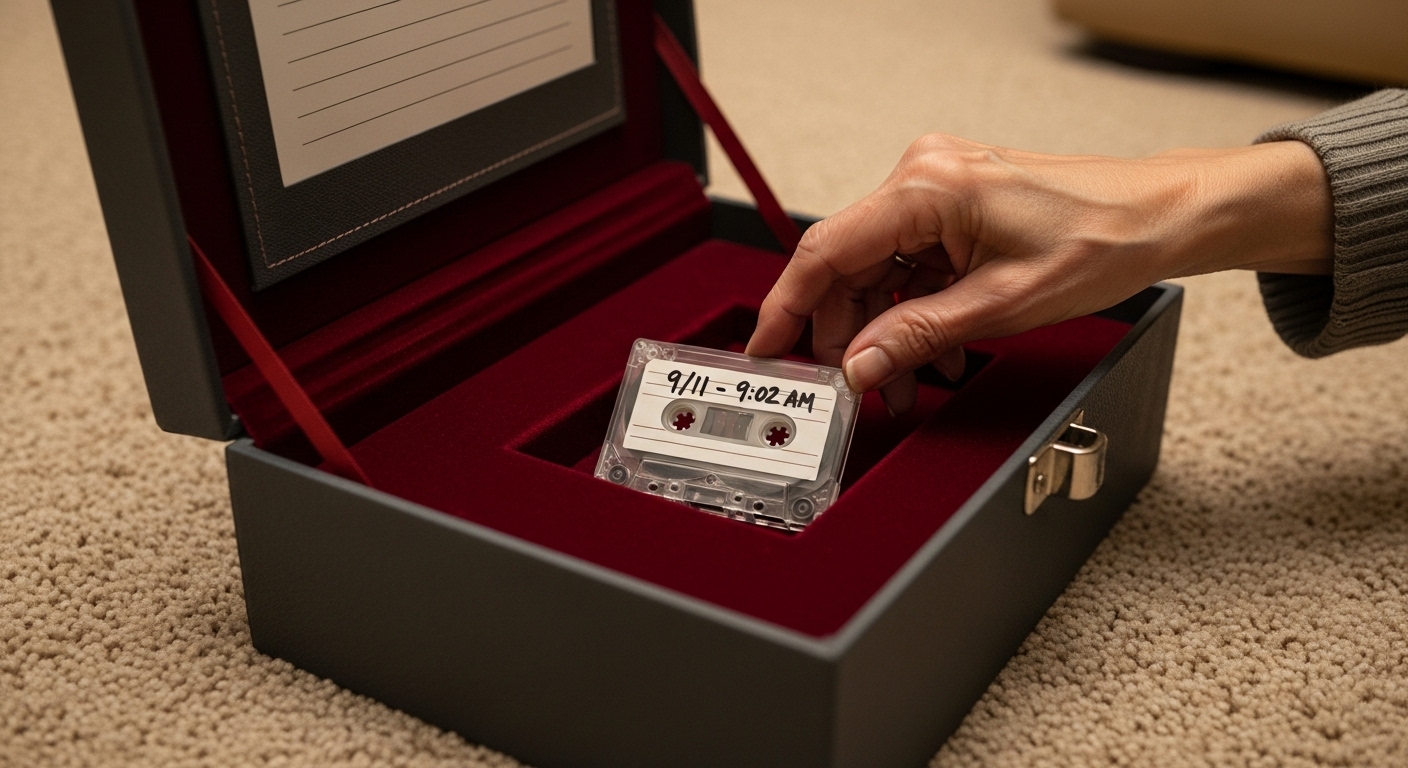
In the struggle, the lid popped open. There were no bonds. No cash. Just a single, tiny micro-cassette tape in a clear plastic case, resting on a bed of velvet. Written on the label in Robert’s distinctive, sharp handwriting was: 9/11 – 9:02 AM.
The silence in the room was deafening. The dust motes seemed to stop dancing.
Lucas stared at the tape. His face went pale. He looked up at Eleanor, betrayal warring with confusion in his eyes. “You told me… you told me the machine was broken that day. You told me he never called.”
Eleanor began to weep, her hands covering her face. “I did it to protect you.”
“To protect me?” Lucas stood up, clutching the tape. His hands were shaking. “Protect me from what? My father’s last words?”
“He was angry, Lucas!” Eleanor cried out, the twenty-year-old secret spilling out like poison. “He was furious with us! We fought that morning. About you. He left the house hating us. If you hear that tape… if you hear him tell you that you’re disowned… it will destroy you. It will destroy everything you’ve built.”
Lucas stared at the tape, his thumb running over the plastic. “You’ve had this for twenty-three years. You let me think he died without reaching out. You let me think I wasn’t worth a goodbye.”
“I let you think he loved you!” Eleanor sobbed.
“I need to hear it,” Lucas said, his voice low and dangerous.
“No, you don’t.”
“I’m not that kid anymore, Mom. I can take it. If he hated me… I need to know. I need to know who he really was.”
Lucas turned and walked out of the closet, heading toward the pile of electronics Eleanor had set aside for donation. On top of the pile was the old Panasonic answering machine.
“Lucas, please!” Eleanor chased after him, grabbing his arm. “Don’t do this to yourself.”
“I have to,” he said, shaking her off. He plugged the machine into the wall outlet. The red light blinked aggressively.
He inserted the micro-cassette.
Eleanor backed away, pressing her back against the wall, bracing herself for the explosion of rage she had feared for two decades. She waited for Robert’s voice to tear their lives apart one last time.
Lucas pressed PLAY.
Chapter 2: The Stranger on the Line
The machine whirred, a mechanical grind that sounded like a tank tread in the quiet bedroom. Then, the static hissed—a sound from a bygone era.
“El, pick up the phone…”
Robert’s voice filled the room. It was tinny, distorted by the limitations of 2001 technology and twenty years of magnetic decay. But it was him.
Eleanor flinched. That was as far as she had ever listened. She closed her eyes, waiting for the yelling. Waiting for him to say ‘Tell that junkie son of ours to go to hell.’
But the yelling didn’t come.
“El, listen to me,” Robert’s voice continued. He wasn’t shouting. He was breathless. In the background, there was a horrific, low-frequency roaring sound, like a jet engine idling in a cave. There were distant screams, muffled and surreal.
“I don’t have much time,” Robert said. He sounded terrified. “I’m on the 84th floor. The stairs are gone, El. It’s… it’s hot up here.”
Lucas was kneeling on the floor, his head bowed, tears streaming silently onto his work boots. Eleanor covered her mouth, sliding down the wall until she was sitting.
“I have to tell you something,” Robert said. “I didn’t want you to find out this way, but if I don’t say it now, you’ll never know.”
Eleanor braced herself. Here it comes. The disownment.
“I lied, El. I lied about the overtime. I lied about the investments.”
Eleanor’s eyes snapped open. What?
“I haven’t been working late for the firm. I’ve been… God, I’ve been going to Atlantic City. I’ve been gambling, El. It started small, just trying to make up for the market dip, but I couldn’t stop.”
Robert coughed, a wet, hacking sound.
“The retirement account is empty. The equity in the house… I took a second mortgage. I forged your signature. We’re broke, El. We’re worse than broke. I was going to tell you tonight. I was going to beg you to forgive me.”
The room spun around Eleanor.
For twenty years, she had struggled. She had worked two jobs—one at a library, one at a bakery—to pay off the mortgage. She had assumed the debts she found after his death were just bad luck, market crashes, or hidden fees she didn’t understand. She had cursed the economy. She had scraped and saved, eating toast for dinner so she could keep the house.
It wasn’t the economy. It was him.
The Saint. The Hero. The man who judged their son for his addiction had been hiding an addiction of his own. He had left her destitute.
“That son of a bitch,” Eleanor whispered, the shock turning instantly into a cold, white-hot fury.
Lucas looked up, his eyes wide. “Mom?”
“He lost it all,” she hissed, staring at the spinning tape. “He judged you? He treated you like garbage for being an addict? And he was gambling away our lives?”
The irony was so bitter it tasted like copper. The pedestal she had built for Robert shattered into a thousand pieces.
But the tape wasn’t finished.
“But none of that matters now,” Robert said, his voice cracking. “I just… I wanted to clear my conscience. But El… something happened.”
The background noise on the tape shifted. A loud crash, like metal twisting, made the speakers crackle. Then, a different sound. A younger voice. Someone else was there.
“I found him, El,” Robert said. His voice sounded strange—confused, maybe delusional from smoke inhalation. “I found Lucas.”
Lucas froze. He looked at the machine, then at his mother. “What?”
“I wasn’t there,” Lucas whispered. “I was in Oakland. I was in rehab in Oakland.”
Robert’s voice came through, choked with emotion. “He’s here with me. He’s scared, El. He’s stuck under some debris near the stairwell door. I’m trying to get him out.”
“Mom?” A voice on the tape. Weak. Terrified. Coughing. “Mom, I want to go home.”
Lucas scrambled backward, away from the machine as if it were radioactive. “That’s not me. That’s not my voice.”
Eleanor was trembling. “Robert? Robert, who are you talking to?” she whispered to the dead man.
“It’s okay, son,” Robert’s voice soothed on the recording. It was a tone Eleanor had never heard him use with Lucas. It was gentle. Tender. “I’ve got you, Lucas. Dad’s here. We’re going to be okay.”
The tape hissed. “El, tell him… if we don’t make it… tell Lucas I love him. I’m holding him right now. I’m not letting go.”
Click.
The machine stopped.
The silence that followed was heavier than the one before. The room felt pressurized.
“I wasn’t there,” Lucas said again, his voice rising in panic. “Mom, you know I wasn’t there! Was he hallucinating? Was he losing his mind?”
Eleanor stared at the machine. Her anger at the gambling was suddenly eclipsed by a profound, chilling mystery. Robert was a practical man. He wasn’t prone to flights of fancy. But he had sounded so sure. And that other voice… the boy crying for his mother.
“We have to find out,” Eleanor said, her voice steeling. “We have to know who was in that room with him.”
Chapter 3: The Digital Ghost
Two days later, Eleanor and Lucas sat in a soundproof studio in downtown Manhattan. The air conditioning was freezing, but Eleanor was sweating.
They had hired a forensic audio specialist, a man named Davis who usually worked on criminal cases. He sat at a massive console, the waveform of Robert’s voicemail displayed on a large monitor like a green mountain range.
“I’ve cleaned up the background noise,” Davis said, swiveling his chair. “Removed the low-frequency hum of the fire and the structural groans. I isolated the vocals.”
“Play it,” Lucas said. He was gripping the armrests of his chair so hard his knuckles were white.
Davis pressed a button.
The audio was crisp now. Terrifyingly crisp. You could hear Robert’s ragged breathing. You could hear the distinct sound of a fire alarm pinging in the distance.
“I found him, El. I found Lucas.”
Then, the other voice.
“Please… I can’t breathe. My leg…”
Davis paused the track. “Okay, analysis indicates two distinct vocal profiles. Subject A is your husband. Subject B is a male, likely late teens or early twenties. But here’s the thing…”
Davis looked at Lucas. “It’s definitely not you. The vocal pitch is higher. The accent is different. Slightly Queens or Brooklyn, not Upstate.”
“So who is it?” Eleanor asked.
“Listen closely to the end,” Davis said. “Your husband calls him Lucas. But listen to what the boy says right before the line cuts.”
Davis played the final ten seconds, boosting the volume of the background voice.
Robert: “I’ve got you, Lucas. Dad’s here.”
Boy: “Leo… my name is Leo… tell my mom…”
Robert: “It’s okay… I’ve got you…”
The recording ended.
“Leo,” Eleanor exhaled.
“He wasn’t talking to me,” Lucas said, his voice breaking. “He was talking to a kid named Leo.”
“Why did he call him Lucas?” Eleanor asked, confusion knitting her brow.
Lucas stood up and walked to the window, looking out at the city skyline. The Freedom Tower pierced the sky in the distance.
“Because of the smoke,” Lucas said quietly. “Or the shock. Or maybe…” He turned back to his mother. “Maybe because he needed to. He spent that morning hating me, Mom. He spent the last five years disappointed in me. In his final moments, he saw a scared kid, about my age, dying alone. He didn’t want that kid to die without a father. And he didn’t want to die without a son.”
Eleanor felt the truth of it settle in her chest. It was a heavy, heartbreaking truth. Robert, in his guilt and fear, had projected his son onto a stranger. He had spent his final minutes trying to redeem his failure as a father by comforting someone else’s child.
“He stayed,” Eleanor whispered. “He said the stairs were blocked, but later he said he was trying to get the boy out from under debris. He could have kept trying to find a way down. He stayed to hold him.”
The anger about the gambling debt, about the lies, began to recede. It didn’t vanish—Robert was still a flawed man who had made terrible mistakes. But in the end, stripped of his ego and his money, he had chosen love.
“We have to find him,” Eleanor said.
“Who?”
“Leo. We have to find Leo’s family.”
Chapter 4: The Ledger of Souls
Finding a “Leo” who died in the South Tower on the 84th floor wasn’t as hard as Eleanor feared. The internet, and the grim meticulousness of the 9/11 memorial archives, made it possible.
Leo Moretti. 22 years old. An intern at an investment bank on the 84th floor. From Queens.
He was survived by his mother, Maria Moretti.
Three weeks later, on a crisp October afternoon, Eleanor and Lucas parked their car in front of a small row house in Astoria, Queens. Eleanor clutched her purse. inside was a USB drive with the cleaned-up audio.
“Are you sure about this?” Lucas asked. “This might reopen wounds for her.”
“If it were you,” Eleanor said, looking at her son, “if you had died there… wouldn’t you want to know that you weren’t alone? That someone held your hand?”
Lucas nodded. “Yeah. I would.”
They knocked. Maria Moretti was a small woman with sad eyes and hair dyed a defiant shade of black. She welcomed them in, confused by their call but polite. Her living room was a shrine to Leo. Photos of a smiling boy with dark curls covered the walls.
They sat on her plastic-covered sofa. Eleanor explained everything. The tape. The mistake. The name.
Maria listened, her hand covering her mouth, her eyes wide and unblinking.
“I never knew,” Maria whispered. “They found… they found remains. But I never knew how it happened. I always had nightmares that he was calling for me and nobody answered.”
“He did call for you,” Eleanor said gently. “And someone answered.”
Eleanor nodded to Lucas. He set up the laptop on the coffee table.
They played the tape.
When Leo’s voice cut through the room—“Mom, I want to go home”—Maria let out a sound that wasn’t a scream or a sob, but something guttural, like an animal in pain. She lunged forward, touching the screen.
Then came Robert’s voice. “I’ve got you… Dad’s here… We’re going to be okay.”
They listened to Robert comfort the boy. They listened to him lie, beautifully and tragically, pretending to be a father so a boy wouldn’t be afraid. They listened to the two of them, strangers bound by fate, facing the end together.
When the tape finished, the silence in the room was holy.
Maria was weeping openly now, rocking back and forth. “He wasn’t alone. My baby wasn’t alone.” She looked at Eleanor. “Your husband… he stayed with him?”
“He stayed,” Eleanor said. Tears were streaming down her own face. “He thought it was our son. But he stayed for yours.”
Maria reached across the table and grabbed Eleanor’s hands. Her grip was iron-strong. “Thank you. Thank you for bringing this to me.”
Then, she looked at Lucas. She stood up, walked over to him, and pulled the grown man into a fierce hug. Lucas hesitated, then hugged her back, burying his face in her shoulder.
In that row house in Queens, two mothers and a son wept for the men they had lost, and the strange, terrible grace that had connected them.
Chapter 5: 9:02 AM
The 9/11 Memorial Plaza was crowded, the sound of the waterfalls drowning out the city noise. It was the first time Eleanor had visited in ten years.
She stood with Lucas by the South Pool. They found Robert Vance’s name cut into the bronze parapet.
Eleanor ran her fingers over the letters. She thought about the gambling. The debt. The years of struggle. She thought about the anger she had carried for weeks after finding the tape.
“Do you forgive him?” Lucas asked, standing beside her. He was holding his own daughter’s hand—Eleanor’s granddaughter, who was six years old.
Eleanor looked at the name.
“He was a fool with money,” Eleanor said softly. “He was stubborn. He was hard on you.” She paused. “But when the world was falling down, he didn’t run. He became the man I always wanted him to be. He became a father.”
She looked at Lucas. “I forgive him. Because he gave me you back.”
“What do you mean?”
“If he hadn’t left that message… if I hadn’t played it… we would still be strangers, Lucas. You and I. We would still be pretending.”
Lucas looked down at the bronze name. He reached into his pocket and pulled out a small stone—a Jewish tradition he had picked up from a friend. He placed the stone on his father’s name.
“I always thought he hated me,” Lucas said. “Hearing him talk to that kid… hearing him say ‘I love you, Lucas’… even if it wasn’t really me… it felt like it was.”
“It was for you,” Eleanor said firmly. “In his heart, it was for you.”
Eleanor looked a few feet to the right. There, etched into the bronze, was another name.
Leo Moretti.
She walked over and placed her hand on it. She saw a fresh white rose stuck in the name. Maria had been here this morning.
The wind picked up, scattering a few dry leaves across the plaza. Eleanor took a deep breath. For the first time in twenty-three years, the air didn’t feel heavy. The secret was out of the box. The ghosts had spoken.
“Come on, Mom,” Lucas said, offering her his arm. “Let’s go get some lunch. I know a place.”
Eleanor took her son’s arm. She looked back one last time at the names, then turned away from the grief.
“Okay,” she said. “Let’s go.”
They walked away from the void, stepping out of the shadow of the past and into the bright, clear afternoon