The Teacher Mocked Him for Sleeping in Class, Then She Flipped His Test Over and Dropped Her Wine Glass
Chapter 1: The Iron Lady of Room 3B
The radiator in Room 3B hissed and rattled, a dying mechanical beast that perfectly matched the mood of Blackwood Elementary. It was a humid Tuesday in late May, the kind of day where the air in the Rust Belt hangs heavy with the smell of wet asphalt and impending storms.
Mrs. Clara Gable stood at the front of the classroom, her spine as rigid as a steel rod. At sixty-two, she was an institution in this town. She had taught the parents of half the children currently squirming in their desks. She was “Old School.” She didn’t believe in participation trophies. She didn’t believe in excuses. And she certainly didn’t believe in sleeping during the most important day of the academic year.
“Pencils down until I say otherwise,” she commanded, her voice cutting through the humid air. She adjusted her glasses, her eyes scanning the rows of fourth-graders. “This is the State Math Assessment. This is not a game. This determines your placement for Middle School. It determines if you go into the Advanced Track, or…” She let the sentence hang, the threat clear enough.
The door creaked open.
Every head turned. Standing in the doorway was Leo.
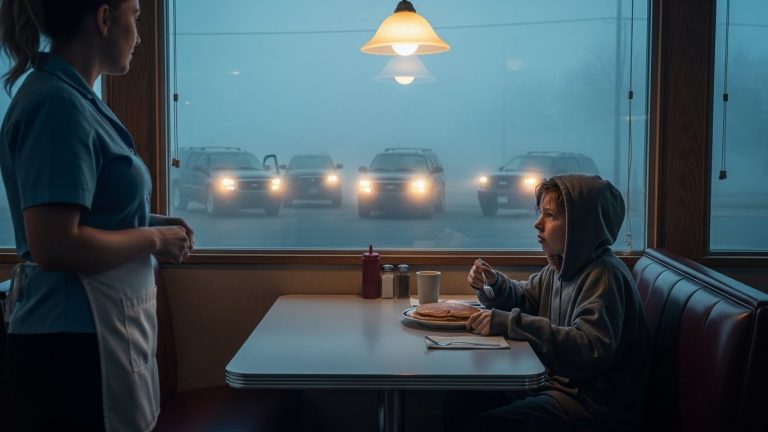
Leo was ten years old, but he carried himself with the posture of an old man. He was small for his age, drowning in a faded navy-blue hoodie that he wore even today, in seventy-five-degree heat. His hair was matted on one side as if he hadn’t brushed it in a week.
But it was the smell that arrived before he did. It was the scent of stale laundry, damp basement, and unwashed skin. The boy in the front row, a well-fed child named Timothy, pinched his nose and whispered, “Zombie’s here.”
Mrs. Gable looked at the clock. 8:15 AM. The bell had rung ten minutes ago.
“Nice of you to join us, Leo,” Mrs. Gable said, her tone dripping with the sarcasm she usually reserved for the faculty lounge. “I assume the video games kept you up until dawn again?”
The class erupted in a ripple of giggles. Timothy snickered openly.
Leo didn’t flinch. He didn’t blush. He just stared at her with eyes that were hollow, rimmed with dark, purple circles that looked like bruises against his pale skin. He gripped the strap of his empty backpack.
“Sorry,” he whispered. His voice was raspy, dry.
“Sit down,” Mrs. Gable sighed, gesturing to the empty desk in the back corner. “And try to stay awake. If you drool on this test, the scantron machine won’t read it, and you’ll be repeating the fourth grade. Do you understand?”
Leo nodded slowly. He shuffled to his desk, dragging his feet. He sat down and immediately put his head in his hands, rubbing his temples.
Mrs. Gable felt a surge of irritation. She was tired. She was retiring in three weeks. She was done with the lack of funding, the crumbling infrastructure, and parents who treated school like a daycare. She looked at Leo and saw everything wrong with the modern generation: lazy, unmotivated, and soft.
“Begin,” she ordered, starting the timer.
The room filled with the sound of scratching pencils. Mrs. Gable walked the aisles, her heels clicking rhythmically. She watched Timothy breeze through the first page. She watched Sarah biting her lip.
Then she reached the back.
Leo wasn’t sleeping. He was writing. His hand was moving across the paper with a ferocity that was almost frightening. He wasn’t looking around. He wasn’t counting on his fingers. He was attacking the paper. His left hand was gripping the edge of the desk so hard his knuckles were white.
At least he’s trying, she thought dismissively, moving on. Probably just filling in random bubbles to get it over with.
Chapter 2: The Silent Scream
The test was designed to take ninety minutes.
At the sixty-minute mark, the heat in the room was stifling. Mrs. Gable opened a window, but it only let in the noise of a siren wailing in the distance—a common sound in this part of Ohio. The town had been dying for a decade, ever since the steel mill scaled back, and the opioid crisis had moved in like a fog, filling the empty spaces the jobs left behind.
Mrs. Gable returned to her desk, keeping one eye on the class. She watched Leo.
He was shaking. A fine tremor ran through his shoulders. He wiped sweat from his forehead with his hoodie sleeve. He looked like he was running a marathon while sitting still.
Is he on something? The thought crossed her mind, ugly and cynical. Ten years old. Surely not.
With five minutes left on the clock, Leo stopped. He put his pencil down. He took a deep, shuddering breath.
Then, he did something strange. He flipped the test booklet over to the blank back cover. He picked up his pencil again. He wrote something. It took him maybe ten seconds.
Then, the energy seemed to leave his body all at once. It was as if a string had been cut. His head dropped onto his folded arms on the desk with a heavy thud.
“Time,” Mrs. Gable called out. “Pencils down.”
Groans of relief filled the room. “Pass your papers forward.”
The stacks of booklets made their way to the front. Mrs. Gable collected them, tapping them into a neat pile. She looked at the back of the room.
“Leo,” she called out.
He didn’t move.
“Leo, class is dismissed for recess.”
Still nothing.
Timothy walked past Leo’s desk and nudged his shoulder. “Hey, Zombie. Wake up.”
Leo slumped sideways, nearly falling out of the chair.
Mrs. Gable marched to the back of the room, her annoyance spiking. “Leo! This is unacceptable!” She reached out and shook his shoulder firmly.
The boy was limp. His skin, when she touched his neck, wasn’t hot with fever—it was clammy and cold.
“Leo?” Her voice softened, just a fraction.
He groaned, his eyelids fluttering. “I finished…” he mumbled, his words slurring. “I got… the hundred.”
“Go to the nurse,” Mrs. Gable said, pointing to the door. “Get some juice. Wash your face. You look disgraceful.”
Leo stumbled up, using the desk for balance. He looked at the pile of tests in her hand. “Did you… are you gonna grade it tonight?”
“I grade all my papers the same day, Leo. You know my policy.”
“Okay,” he whispered. “Okay.”
He shuffled out of the room, looking smaller than ever. Mrs. Gable watched him go, shaking her head. “Waste of potential,” she muttered to herself. “Absolute waste.”
Chapter 3: The Message
That evening, Mrs. Gable sat at her kitchen table. Her house was a sanctuary of order. The oak floors gleamed. The clock on the wall ticked with reassuring precision. Outside, the crickets chirped in the manicured suburban silence.
She poured herself a generous glass of Merlot. It had been a long day.
She had already graded twenty papers. Most were average. A few B-pluses. Timothy had managed an A-minus.
She reached the bottom of the stack. Leo’s paper.
She sighed, taking a sip of wine. She picked up her red pen, ready to slash through incorrect answers. She opened the booklet.
Question 1: Correct. Question 2: Correct. Question 3: Correct.
She frowned. She flipped the page.
The long division problems. The geometry proofs. The word problems that usually stumped even the brightest kids.
Correct. Correct. Correct.
Mrs. Gable sat up straighter. She put her wine glass down. She scanned the work. It wasn’t just right; it was brilliant. He had used shortcuts and mental math techniques she hadn’t even taught them yet. The handwriting was shaky, jagged, like a seismograph during an earthquake, but the logic was flawless.
Question 50: Correct.
It was a perfect score. 100%.
Mrs. Gable stared at the number she had written in red ink. A perfect score from the boy who slept in class every day. The boy she had humiliated this morning.
Guilt, sharp and cold, pricked at her chest. He was listening, she thought. He was learning. Why is he so tired?
She remembered seeing him write on the back of the booklet. She turned the test over, intending to write a note of congratulations, perhaps an apology for her harshness earlier.
There was writing there. Smudged graphite, pressed hard into the paper.
She adjusted her reading glasses. The handwriting was desperate, the letters varying in size.
“I got a 100 like you said. I did a good job. Please, Mrs. Gable, you said if we do good we get a reward. Can you please come wake up my daddy? He hasn’t moved since Tuesday. The baby is eating toothpaste because there is no food. I’m scared to call 911 because they will split us up. Please come. The door is unlocked. I live at Lot 44, Shady Creek.”
Mrs. Gable’s hand shook.
The glass of Merlot was knocked over. The red wine spilled across her pristine oak table, looking like a pool of blood spreading under the dim kitchen light.
She didn’t move to clean it up. She couldn’t breathe.
He hasn’t moved since Tuesday. The baby is eating toothpaste.
The judgment she had passed on that boy—”lazy,” “soft,” “video games”—came crashing down on her head with the weight of a cathedral. He wasn’t sleeping because he was lazy. He was sleeping because he was dying of exhaustion.
She stood up so fast her chair toppled over. She didn’t call the police. The note said he was scared they would split them up. He trusted her. He had taken the test, poured every ounce of his remaining energy into a math assessment, as a bargaining chip for her help.
He thought his merit could buy his survival.
Mrs. Gable grabbed her car keys. She didn’t even put on her coat. She ran out into the night.
Chapter 4: The Reality
Shady Creek Trailer Park was only five miles away, but it was a different universe. The streetlights here were broken. The roads were gravel and potholes.
Mrs. Gable’s Buick bounced violently as she navigated the maze of rusted mobile homes. She saw shadows moving behind torn curtains. She saw a group of men standing around a fire barrel who stopped talking and watched her car pass.
Lot 44 was at the very end, near the woods.
It was a single-wide trailer, the metal siding peeling like dead skin. The windows were dark. There was no car in the driveway.
Mrs. Gable slammed her car into park and killed the engine. The silence of the woods was oppressive.
She ran to the door. It was flimsy aluminum.
“Leo!” she banged on the metal. “Leo! It’s Mrs. Gable!”
A dog barked inside—a hoarse, weak bark.
She heard a lock click. The door creaked open.
The smell hit her first. It wasn’t the stale laundry smell from the classroom. It was something primal, sweet, and rotting. It was the smell of biology breaking down. Mrs. Gable gagged, covering her nose and mouth with her hand.
Leo stood in the doorway. He wasn’t wearing the hoodie anymore. He was in a dirty t-shirt, his arms stick-thin. On his hip, he was holding a toddler—a little girl, maybe two years old.
The girl’s face was smeared with white paste. Toothpaste. Her eyes were glazed over.
“You came,” Leo whispered. He looked at her car, then behind her, checking for police. “Did you bring the grade?”
“Oh, my God,” Mrs. Gable choked out. She stepped inside, ignoring the filth, ignoring the danger. She wrapped her arms around Leo and the baby, pulling them into the fresh air of the porch. “I came, Leo. I’m here.”
“Daddy is in the back,” Leo said, his voice void of emotion, detached by trauma. “He fell asleep. He was hurting from his leg, from the war. He took his medicine and he fell asleep. I tried to wake him up but he’s heavy.”
Mrs. Gable looked into the dark cavern of the trailer. “Stay here, Leo. Give me the baby.”
“No,” Leo tightened his grip. “She’s scared.”
“Okay. You sit right here on the steps. Do not come inside.”
Mrs. Gable pulled her phone out and turned on the flashlight. She stepped into the trailer. The floor was littered with trash, empty cereal boxes, and prescription bottles.
She walked to the back bedroom.
On the bed lay a man. He was young, maybe thirty-five. A faded Marine Corps cap sat on the nightstand next to a pile of orange pill bottles. He lay on his back, his mouth open. His skin was a color that humans should never be—a gray-blue marble.
He had been dead for days.
Mrs. Gable backed out of the room, her heart hammering against her ribs like a trapped bird. She dialed 911.
“I need an ambulance and police to Lot 44 Shady Creek,” she whispered, her voice trembling. “DOA. And… and two minors in extreme distress.”
She hung up and went back to the porch. She sat down on the rotting wood next to Leo. She took off her cardigan and wrapped it around the baby, who was shivering.
Leo looked up at her. His eyes were huge in the darkness.
“Mrs. Gable?”
“Yes, honey?”
“Did I really get a 100?” he asked, his voice cracking. “Or were you lying to make me feel better?”
Mrs. Gable felt tears—hot and stinging—flood her eyes. This boy had been living with a corpse. He had been starving. He had been parenting a toddler. And his biggest fear, in this moment, was that he hadn’t performed well enough on a state math test.
“You got a 100, Leo,” she sobbed, pulling him into her chest. “You got a perfect score. You are the smartest boy I have ever known. You did everything right.”
“I thought if I got a 100…” Leo started to cry, finally letting go. “I thought if I was good, you would help us. Nobody else listens.”
Chapter 5: The Redemption
The next hour was a blur of flashing red and blue lights.
Police cars filled the gravel lot. An ambulance took the father’s body away. A social worker, a young woman who looked overworked and exhausted, arrived with a clipboard.
Mrs. Gable sat in the back of an ambulance with Leo and the baby, whose name she learned was Mia. The paramedics were checking their vitals. Dehydration. Malnutrition. But alive.
The social worker, Ms. Davis, approached. “Ma’am, thank you for calling. We’ll take custody from here. We have an emergency placement for the girl in the next county. The boy will likely go to a group home in Columbus until we can find a foster family.”
“No,” Mrs. Gable said.
The word was quiet, but it had the weight of thirty years of classroom authority behind it.
Ms. Davis blinked. “Excuse me?”
Mrs. Gable stood up. She was covered in grime from the trailer. Her hair was a mess. But she drew herself up to her full height.
“You are not separating them,” Mrs. Gable said. “Did you see that house? Did you see what that boy did? He has kept his sister alive for four days. He is the only stability she has. You rip them apart tonight, and you break whatever is left of him.”
“It’s protocol, Ma’am. Unless there is kin…”
“I am his teacher,” Mrs. Gable declared. “I have a clean background check on file with the state. I own a four-bedroom home. I have a pension. I am applying for emergency kinship fostering. Right now.”
“That’s highly irregular…”
“I don’t care about irregular!” Mrs. Gable shouted, startling the police officer nearby. “I failed this boy every single day for a year. I looked at him and judged him while he was carrying the weight of the world. I am not failing him tonight. They come home with me.”
She turned to the police officer, one of her former students. “Officer Miller, tell her.”
Officer Miller looked at the social worker. “Mrs. Gable is… well, she’s Mrs. Gable. If she says she’s taking them, she’s taking them. I’ll vouch for the safety of the home.”
Epilogue: Six Months Later
The autumn wind blew crisp and cold through the veterans’ cemetery. The leaves were a burning red and orange.
Mrs. Gable stood by the headstone. She was wearing jeans—something she never would have worn in public a year ago.
Corporal James R. Miller USMC Beloved Father
Leo stood next to her. He looked different. He had gained ten pounds. His cheeks had color. He was wearing a winter coat that fit him perfectly. Little Mia was holding Mrs. Gable’s hand, babbling about a squirrel she saw.
“Do you miss him?” Mrs. Gable asked softly.
Leo touched the cold stone. “Yeah. He wasn’t bad, Mrs. Gable. The medicine just… it took him away before he died.”
“I know, Leo. He was a hero. He fought a war, and then he fought another one at home. You need to remember the hero part.”
“I will.”
They walked back to the car. Mrs. Gable opened the door for them.
“Can we get pizza?” Leo asked.
“Vegetables first,” she said automatically, but then she smiled. “But… maybe we can order a pepperoni for movie night.”
They drove home to the house on the quiet street. The kitchen was warm. The oak table was clean, but there was a scratch on it now from a toy car Mia had driven across it. Mrs. Gable didn’t mind.
On the refrigerator, right in the center, held up by a magnet shaped like a star, was a piece of paper.
It was wrinkled. It had a smudge of graphite on the back. But in the center, circled in bright red ink, was the number 100%.
It was the most important grade she had ever given. Not because it measured math, but because it had measured the strength of a boy who refused to give up, and the awakening of a teacher who finally learned how to see.