They Bullied A 300lb Farmer And Destroyed His Stall, Thinking He Was An Easy Target. But When They Broke Into His Farm That Night, They Realized Too Late That His “Fat” Was Just Armor For A Retired Delta Force Commander Who Had Been Waiting 8 Years For This Exact Moment.
PART 1: THE SLEEPING GIANT
Chapter 1: The Masquerade
The morning sun painted long, golden shadows across the Eagle’s Rest Farmers Market, but James Cooper wasn’t watching the sunrise. His eyes, buried beneath the brim of a stained John Deere cap, were scanning the perimeter. To the casual observer, he was just unloading crates of heirloom tomatoes, his heavy breathing and lumbering movements typical for a man carrying nearly 300 pounds on a 6’2″ frame. But inside James’s mind, a different program was running.
Sector A clear. Sightlines on the north roof good. Two exits blocked by delivery trucks.
James moved a crate of squash, deliberately letting it thud heavily onto the table. He wiped sweat from his forehead with a handkerchief that had seen better days. Ruth Whitaker, seventy years old and the town’s unofficial matriarch, smiled at him from the next stall.
“Those tomatoes look particularly fine today, James,” she said, adjusting her shawl against the Montana chill. “Your grandmother would be proud.”
“Thanks, Miss Ruth,” James said, his voice a soft, slow drawl that sounded like molasses. “Just trying to keep the family tradition alive.”
He didn’t tell her that the “tradition” he was currently maintaining involved an eight-year deep-cover operation to dismantle a weapons pipeline stretching from Montana to the Mexican border. He didn’t tell her that the extra weight he carried wasn’t from pie and laziness, but a calculated disguise to mask the muscle density of a man who had led Tier 1 operations in places that didn’t exist on maps.
At 8:47 AM, the peace shattered.
The low rumble of V-twin engines echoed off the valley walls. James didn’t need to look up to know who it was. The Storm Riders. Five bikes, riding in a V-formation. They were early.
James felt the shift in the market immediately. Conversation died. Shoulders tensed. The air grew thick with anxiety. He continued stacking tomatoes, his hands steady, but his peripheral vision locked onto the riders as they parked, blocking the main entrance. A tactical error, James noted. It creates a bottleneck, but leaves their rear exposed.
Lance “Python” Kingston dismounted first. He was a wire-thin man with eyes that looked like broken glass and a leather cut that smelled of stale beer and violence. He walked with a limp—a new injury, James analyzed. Right knee. Favoring it. Weak point.
“Well, well,” Python announced, his voice carrying over the silent crowd. “Looks like the local yokels are having a vegetable party.”
James kept his head down, playing the role he had perfected. He felt Python’s shadow fall over his table.
“Morning, gentlemen,” James said, forcing a nervous tremor into his voice. “Looking for some fresh produce?”
Python laughed, a dry, hacking sound. Sledge, his enforcer, stepped up beside him. Sledge was built like a vending machine and had about as much personality.
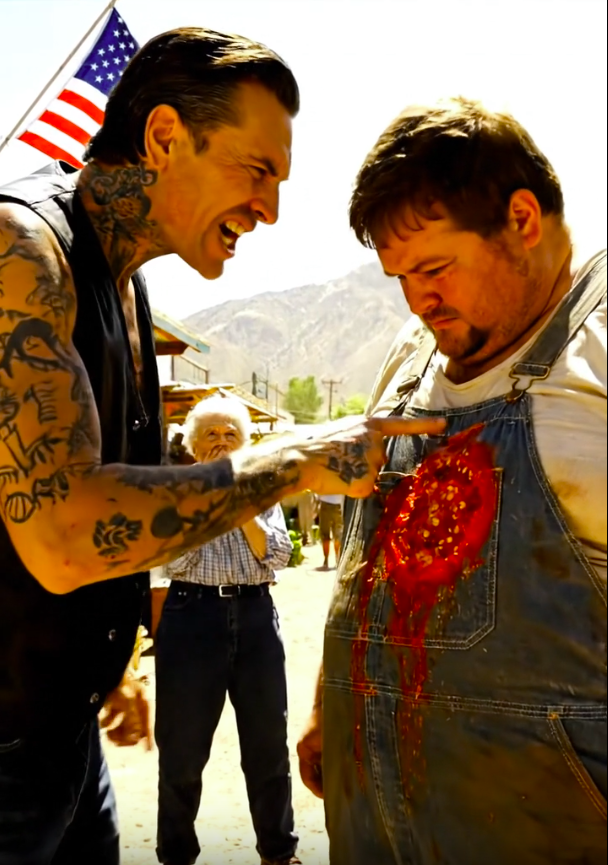
“We’re looking for our cut, fat man,” Python sneered. He reached out and picked up one of the prize tomatoes James had just placed. “Market’s on our territory now. Time to pay rent.”
“I… I already paid the town permit fee,” James stammered, taking a half-step back.
Python squeezed his hand. The tomato burst, red pulp and seeds exploding across the table and splattering onto James’s white shirt.
“Town permits don’t buy protection,” Python hissed, leaning in close. James could smell the whiskey and meth on his breath. “We’ll be by your farm tonight. Have the cash ready. Or maybe we’ll burn that barn of yours down with you inside it.”
James stared at the ruined tomato. In his mind, he visualized three different ways to disarm Python and break Sledge’s trachea before they could draw the weapons bulging under their vests. It would take 1.8 seconds.
Instead, James took another step back, hunching his shoulders to look smaller. “Please,” he whispered. “I don’t want any trouble.”
“Then have the money,” Sledge grunted, knocking a crate of corn onto the pavement as they turned to leave.
As the bikes roared away, Ruth rushed over, her face pale. “Oh, James! Are you alright? We should call the Sheriff.”
James bent down to pick up the corn, his face hidden. “No, Miss Ruth. Sheriff Anderson has his hands full. I’ll… I’ll figure it out.”
He stood up, his face a mask of fear. But as he turned toward his truck, the fear vanished, replaced by a cold, hard resolve. His phone buzzed in his pocket. He checked it. A single encrypted message from his handler.
Green light. Operation Thunderstruck is active.
James deleted the message. They were coming to his farm tonight. Good. He was tired of waiting.
Chapter 2: The Kill Box
The sun dipped below the horizon, turning the sky a bruised purple. James Cooper sat on his front porch in a rocking chair, a shotgun resting across his knees. To anyone watching from the road, he looked like a terrified man guarding his castle.
But inside the house, everything had changed.
The “terrified farmer” routine ended the moment he crossed his threshold. James had moved with efficient speed. The loose floorboard in the pantry had been lifted, revealing a hidden cache. Out came the secure comms, the thermal imaging scanners, and the customized Glock 19 with the suppressor.
He had spent the last three hours preparing the “battlefield.” The barn wasn’t just a barn; it was a labyrinth. The tall grass around the perimeter wasn’t just neglect; it was concealment.
James tapped his earpiece. “Eagle One to Nest. Targets are mobile. Five bikes, one support truck. ETA ten minutes.”
“Copy, Eagle One,” came the voice of Martinez, his FBI liaison. “Do not engage unless lethal force is authorized. We need the network, James. Not just the foot soldiers.”
“If they breach the perimeter, I’m authorized to defend myself,” James said calmly. “I’ll make it look like an accident.”
He stood up and moved inside, locking the heavy oak door. He went to the kitchen, poured a glass of milk, and left it on the table next to a half-eaten sandwich. It was a prop—a sign of a man interrupted. Then, he moved to the basement door. But he didn’t go down. He went up, climbing into the crawlspace above the kitchen cabinets, a vantage point that offered a view of the entire ground floor through strategically drilled peepholes.
At 9:42 PM, the headlights swept across the front yard. The roar of engines cut so abruptly it was more unsettling than the noise itself. They were coasting in. Trying to be stealthy.
James watched on his wrist monitor, which was linked to the thermal cameras hidden in the birdhouses outside. Heat signatures flared white against the cool blue of the night. Six men. Python, Sledge, and four prospects.
They didn’t knock.
The front door exploded inward with a kick. Wood splinters flew across the hallway.
“Here little piggy, piggy!” Python’s voice echoed through the house. “Come out and pay the toll!”
James slowed his heart rate. Breath in. Hold. Breath out.
Two men moved into the living room. Two went for the kitchen. Python and Sledge stayed in the hall.
“He’s not here,” one of the prospects yelled from the living room. “TV’s on, though.”
“Check the kitchen,” Python commanded. “Fat man probably hiding under the table.”
The two prospects entered the kitchen. James, perched six feet above them in the shadows, watched them sweep the room. They saw the milk. They saw the sandwich. They relaxed.
“Looks like he ran,” one laughed, holstering his gun to grab the sandwich.
That was the mistake.
James dropped.
For a man of 300 pounds, he made zero sound. He landed behind the second prospect. Before the man could turn, James’s hand clamped over his mouth, and he drove a precise, localized strike into the vagus nerve in the neck. The man crumpled instantly, unconscious before he hit the linoleum.
The sandwich-eater turned, eyes widening in shock. He opened his mouth to scream, but James was already there. James used his weight, stepping into the man’s space and driving a shoulder into his solar plexus. The air left the man’s lungs with a wet whoosh. James spun him around and applied a sleeper hold. Four seconds later, the man was dead weight.
James lowered him gently to the floor. Two down. Silent.
“Hey! You find any booze in there?” Python yelled from the hall.
James picked up the glass of milk and poured it onto the floor, creating a puddle. Then he threw the glass against the far wall. Crash.
“What the hell?” Sledge barked. “Get in there!”
Sledge and the other two prospects charged into the kitchen. They saw their friends on the floor. They slipped on the milk. Chaos.
In the confusion, they didn’t see James. He had merged with the shadows in the pantry. As Sledge tried to regain his balance, a hand reached out from the darkness. It didn’t look like a farmer’s hand anymore. It looked like a claw.
James grabbed Sledge by his leather vest and yanked him into the darkness of the pantry. The sound of a brief, brutal struggle—fist meeting meat, bone snapping—lasted less than three seconds. Then, silence.
Sledge’s body slid out of the pantry, unconscious.
Python was alone in the hallway now. The silence of the house was heavier than the noise had been.
“Sledge?” Python called out, his voice cracking. He drew his weapon, a 9mm that looked too big for his skinny hand. “This ain’t funny, farmer!”
“You’re right,” a voice said, coming from everywhere and nowhere. “It’s not funny.”
Python spun around, aiming at shadows. “Show yourself!”
“You came for a victim,” the voice continued, deep and resonant. “You found a soldier.”
The lights in the hallway flickered and died. James had cut the main breaker from his remote panel. In the pitch black, Python fired blindly. Bang! Bang! The muzzle flashes illuminated the terror on his face.
Then, a heavy hand landed on Python’s shoulder. It felt like a falling tree.
“Welcome to the harvest,” James whispered in his ear.
End of Part 1
PART 2: THE HUNTER BECOMES THE HUNTED
Chapter 3: The Art of the Lie
Silence returned to the farmhouse hallway, heavy and suffocating, broken only by the ragged breathing of Lance “Python” Kingston. The gang leader was no longer the arrogant predator who had crushed a tomato in James’s face that morning. He was currently zip-tied to a sturdy oak chair in the center of the kitchen, his leather cut stripped away, his face bruised and swelling from a collision with the floor that he couldn’t quite remember.
James Cooper stood by the sink, calmly washing his hands. The water turned pink as he scrubbed away the adrenaline and the grime of the short, brutal fight. He dried his hands on a dish towel, his movements slow and deliberate, the “scared farmer” mask completely gone. In its place was the face of a man who had interrogated high-value targets in black sites across the Middle East.
He poured a cup of coffee from the pot that had been brewing since the intrusion began. He didn’t offer any to Python.
“You… you’re dead,” Python wheezed, spitting a mixture of blood and saliva onto the linoleum. “My boys… the cartel… they’ll skin you alive.”
James took a sip of coffee, savoring the bitterness. He turned and leaned against the counter, the floorboards creaking under his weight. “Your boys are currently sleeping very soundly in the pantry and the mudroom,” James said, his voice terrifyingly calm. “As for the cartel, I assume you’re referring to the suppliers moving product through the Eagle’s Rest corridor. The ones paying you to secure the route.”
Python’s eyes widened. The pain in his ribs was forgotten for a second. “How do you…”
James walked closer. He moved with a quiet grace that defied his size. He pulled a chair opposite Python and sat down, the wood groaning. “I know about the shipments, Lance. I know about the modified trucks running north from Mexico. I know you’re not the boss. You’re just the loud noise they hired to scare the locals away so no one asks questions about why heavy cargo is moving through farm roads at 3:00 AM.”
James leaned forward, his face inches from Python’s. “Who is handling the logistics? Who is the contact?”
“Go to hell,” Python spat.
James didn’t strike him. He didn’t yell. He simply reached into his pocket and pulled out Python’s phone. He tapped the screen. “You didn’t lock it. Careless. I see a lot of encrypted messages from a user listed as ‘Architect.’ And a GPS coordinate for a meeting tomorrow night.”
Python turned pale. “You touch that, and you’re a dead man. That ain’t just some gang banger. That’s military.”
“I know,” James said softly. “That’s why I’m interested.”
Blue and red lights flashed through the kitchen window, dancing across the walls. The cavalry had arrived. James sighed, the soldier vanishing instantly as he slumped his shoulders, messed up his hair, and widened his eyes.
“Showtime,” James whispered.
He stood up, grabbed a frying pan from the stove, and tossed it onto the floor with a loud clang. Then he unlocked the back door just as Sheriff Anderson burst in, gun drawn, followed by two deputies.
“James! James, are you hurt?” Anderson yelled, sweeping the room. He froze when he saw the carnage—bodies stacked like cordwood, Python tied to a chair.
“Sheriff!” James stammered, his hands shaking violently as he pointed at Python. “They… they broke in! I was just… I was eating a sandwich and they kicked the door and I just started swinging! I used the cast iron skillet! I think I blacked out!”
Anderson lowered his gun, looking at the bruised and battered gang members. He looked at the “panicked” farmer. “You… you did all this with a skillet, James?”
“I was terrified, Chief! My grandma’s skillet is heavy!” James hyperventilated, grabbing the counter for support. “Are they dead? Did I kill them? Oh god, I’m going to jail.”
“They’re breathing,” Anderson said, checking a pulse on the floor. He looked at Python, then back at James with a mixture of confusion and respect. “Looks like you just protected your home, son. Nothing illegal about that.”
As the deputies began dragging the groaning gang members out to the cruisers, a man in a nondescript suit entered the kitchen. He didn’t look like a local. He moved past the Sheriff and stopped next to James.
“Rough night, Mr. Cooper?” the man asked quietly.
James looked up. It was Agent Martinez, his FBI handler, posing as the town’s new insurance claims adjuster.
“Terrifying,” James said loud enough for the Sheriff to hear, then dropped his voice to a whisper only Martinez could catch. “Phone’s on the counter. User ‘Architect.’ They’re moving a major shipment in 48 hours. And they’re bringing in professional contractors to clean up this mess.”
Martinez nodded imperceptibly, slipping the phone into an evidence bag. “The Sheriff is buying the ‘lucky farmer’ story?”
“For now,” James murmured. “But the people Python works for won’t. They’ll know a simple farmer doesn’t take down a six-man assault team without a scratch. The next wave won’t be bikers with bats. It’ll be operators.”
“We can pull you out,” Martinez whispered. “Mission parameters have changed.”
James looked out the window where Python was being shoved into a squad car, yelling threats that nobody was listening to.
“No,” James said, his eyes hard. “I’ve spent eight years waiting for the head of the snake to show itself. If they want a war in Eagle’s Rest, I’ll give them one.”
Chapter 4: The calm Before the Storm
The next morning, Eagle’s Rest was buzzing. The story of “Big Jim” Cooper defending his farmhouse against the notorious Storm Riders with nothing but a frying pan and “farm boy strength” had spread faster than a prairie fire.
James drove his battered pickup truck into town, parking in front of Jenny’s Diner. He stepped out, moving with an exaggerated limp, feigning soreness. He needed the town to believe he had struggled, that his victory was a fluke of adrenaline and mass, not precision combat tactics.
“There he is!” Old Man Miller shouted from the barbershop across the street. “The Heavyweight Champion of Montana!”
A few people clapped. Ruth Whitaker waved frantically from the sidewalk. James forced a shy, embarrassed smile, ducking his head. He hated the attention. Every set of eyes on him was a variable he couldn’t control.
He entered the diner. The smell of bacon and coffee hit him, usually a comfort, but today it felt like the waiting room of a battlefield. Jenny, the waitress who knew everything about everyone, poured his coffee before he even sat down.
“On the house today, James,” she said, her eyes shining with admiration. “Those animals got what they deserved. You okay? You look tired.”
“Just a bit shaken up, Jenny,” James said, wrapping his large hands around the mug. “Didn’t get much sleep. kept hearing noises.”
“Well, don’t you worry. Sheriff says he’s got a deputy parked up near your road for the next few days.”
James nodded, knowing full well a deputy in a Crown Vic wouldn’t stop what was coming. He took a sip of coffee and glanced toward the corner booth. Martinez was there, reading a newspaper, looking every bit the boring bureaucrat.
James didn’t approach him. They had protocols. Instead, he pulled out his flip phone and checked the draft folder in his messages. Martinez had remotely uploaded a new intel packet.
James read it quickly while pretending to check the weather.
TARGET UPDATE: General Marcus Roberts (Ret.). Dishonorable discharge. Runs a private military company (PMC) called ‘Obsidian Shield.’ Linked to cartel logistics in three states. Python’s failure triggered a Level 4 response. Roberts is sending a ‘cleanup crew.’ Expect arrival by sunset.
James felt a cold chill. He knew Roberts. They had never met personally, but Roberts’ reputation was legendary in the special operations community—and not in a good way. Roberts was brilliant, brutal, and utterly lacking in moral compass. He didn’t hire thugs; he hired ex-Special Forces operators who had washed out for being too violent.
James deleted the message and looked out the window. A black SUV with tinted windows rolled slowly down Main Street. It wasn’t a local car. It had no front plate. The tires were heavy-duty run-flats.
As the car passed the diner, James noted the driver. Short hair, high collar, sunglasses despite the overcast sky. He wasn’t looking at the road; he was scanning the rooftops and the alleyways.
Scout unit, James thought. Establishing a perimeter. Assessing the threat.
The SUV slowed as it passed James’s truck, then accelerated away. They knew.
James finished his coffee and stood up, leaving a ten-dollar bill on the table. He needed to get back to the farm. The “lucky farmer” act had bought him twelve hours of confusion, but Roberts wouldn’t be fooled for long. He would analyze the police reports. He would see the medical files on the gang members—the precise nerve strikes, the clean breaks. He would realize that James Cooper was a anomaly.
James stepped out of the diner and bumped into Ruth Whitaker.
“Oh, James! I made you a casserole,” she beamed, holding out a foil-wrapped dish. “For your nerves.”
James took it, his heart aching slightly. These people were innocent. They were sheep living in a valley that had just been discovered by wolves. And he was the only sheepdog around.
“Thank you, Miss Ruth,” he said gently. “But do me a favor? Stay inside tonight. Maybe go visit your sister in Billings for a few days.”
Ruth frowned, confused. “Why, James? The Sheriff said the gang is in jail.”
“Just… a feeling,” James said, patting her hand. “Weather’s turning.”
He got into his truck and drove out of town, watching his rearview mirror. The black SUV was three cars back, trailing him. They weren’t hiding it anymore. They wanted him to know.
James smiled grimly. Intimidation was their tactic. They wanted him to panic, to run, to make a mistake.
He turned onto the dirt road leading to his farm. The deputy was there, asleep in his cruiser. James didn’t wake him. Let the kid sleep.
He parked the truck in the barn, out of sight. He walked into the center of the dark, dusty space and stood still. He closed his eyes and inhaled the scent of hay, oil, and old wood.
“Okay,” he whispered to the empty air. “You want to play with the big boys? Let’s play.”
He walked to the back of the barn, to a stack of hay bales that looked undisturbed for decades. He gripped a hidden handle and pulled. The entire section of the wall swung open on silent hydraulic hinges, revealing a small, windowless room bathed in the blue glow of computer monitors.
This wasn’t a farm storage room. It was a Command and Control center.
On the screens, live feeds from hidden cameras all over his property flickered. He saw the black SUV park a mile down the road. He saw four men get out. They weren’t wearing leather vests. They were wearing tactical gear, carrying suppressed carbines and advanced optics.
James stripped off his overalls. Underneath, he wasn’t wearing flannel. He was wearing a tactical vest that strained slightly against his bulk but fit perfectly. He strapped a Ka-Bar knife to his thigh and checked the action on his custom M4 carbine.
The “fat farmer” was gone. The Commander was back.
Chapter 5: The Kill Zone
Nightfall in the valley was absolute. The clouds had rolled in, choking out the moon and stars, creating a suffocating blanket of black. It was perfect operating weather for a team equipped with night vision.
James sat in the loft of the barn, motionless. He had slowed his breathing to a meditative rhythm. His heat signature would be minimal, masked by the insulation he had installed in the roof years ago for exactly this purpose.
Below him, the farm looked abandoned. He had turned off all the lights in the house. He had sent the dog to stay with Martinez. The stage was set.
At 11:15 PM, his perimeter sensors tripped. Sector North. The cornfield.
James checked his wrist monitor. Four heat signatures moving in a diamond formation. Their movement was fluid, professional. They stopped every twenty yards to scan. These weren’t brawlers; they were hunters.
“Eagle One, targets are inside the wire,” James whispered into his comms. “Four tangos. Armed and dangerous.”
“Copy,” Martinez replied, his voice tense. “HRT (Hostage Rescue Team) is twenty minutes out. Do not engage unless necessary.”
“They’re not here to talk, Martinez. They’re here to liquidate the asset. If I wait twenty minutes, they’ll be scrubbing my blood off the floorboards.”
James watched them approach the farmhouse. They bypassed the front door—amateurs used doors. Two of them moved to the windows, placing breaching charges. Silent drills.
But James wasn’t in the house.
He had rigged the house with what he called “passive resistance.”
One of the mercenaries peered into the living room window through night-vision goggles. He signaled to his leader. Clear.
They blew the window. A muffled thump, and the glass shattered inward. Two men vaulted inside.
James pressed a button on a remote detonator in his hand.
He didn’t use explosives. He used light.
Inside the living room, four high-intensity industrial floodlights—rigged to motion sensors and batteries—erupted with 50,000 lumens of blinding white light.
For men wearing night-vision goggles, that amount of sudden light was blinding. It overloaded the sensors and seared their retinas.
Screams of pain echoed from the house.
“Contact! Contact! We’re blind!” one shouted.
“Pull back! It’s a trap!”
The two men inside stumbled back toward the window, tearing their goggles off, firing blindly into the furniture.
The two men outside, the support team, spun around, scanning for the source of the ambush. They expected gunfire. They didn’t expect the tractor.
James had rigged his massive John Deere combine harvester in the barn. He hit the remote start. The engine roared to life like a waking dragon, the headlights blazing on.
The sound was deafening in the quiet night. The psychological effect was instant. The mercenaries outside flinched, turning toward the barn.
That was James’s window.
He didn’t shoot. Gunshots drew attention, and he needed this to look… confusing. He needed it to look like a nightmare, not a firefight.
He launched a specialized drone from the loft. It buzzed out through the hay door, hovering over the courtyard. It dropped a canister of CS tear gas right between the two outside men.
Coughing and choking, their discipline broke. They scrambled for cover behind the water trough.
James descended the ladder, moving with surprising speed. He slipped out the side door of the barn and flanked them. He moved through the darkness like a ghost, his size forgotten, his footsteps silent on the damp earth.
He came up behind the team leader, who was trying to radio for extraction.
“Base, this is Alpha! The target is… the target is fortified! We have…”
James grabbed the radio antenna and yanked the device from the man’s hand.
The leader spun, pulling a knife. He was fast. But James was efficient.
James blocked the thrust with his forearm, absorbing the blow on his armor, and stepped inside the man’s guard. He grabbed the man’s tactical vest and slammed him backward into the wooden fence post. The air left the mercenary’s lungs.
“General Roberts sent you?” James growled, his voice a low rumble.
The mercenary wheezed, trying to knee James in the groin. James caught the leg and twisted. The man shouted in pain.
“Listen to me,” James hissed, leaning close, his face painted in camouflage grease. “You tell Roberts that the farm is closed. You tell him that if he sends another team, I won’t use tear gas and floodlights. I’ll use the soil. I’ll bury you here.”
James head-butted the man, knocking him cold.
The other three mercenaries were stumbling out of the house, blinded, coughing, disoriented.
James fired three shots into the dirt near their feet. Thwip. Thwip. Thwip. Suppressed rounds kicking up dust.
“Run,” James bellowed from the darkness. “Or stay and feed the pigs!”
Panic, primal and overwhelming, took over. The highly trained operators broke. They dragged their unconscious leader toward the SUV, scrambling, coughing, defeated by a “farmer” they couldn’t even see.
James watched them pile into the vehicle and peel out, tires spinning on the gravel.
He stood in the center of his yard, adrenaline pumping through his veins. He checked his pulse. 110. Manageable.
Martinez’s voice crackled in his ear. “James? Status?”
“They’re retreating,” James said, watching the taillights fade. “They’re scared. Confused. They think I’m a crazy survivalist with booby traps.”
“Good,” Martinez said. “That buys us time.”
“Not much,” James replied, walking over to pick up a piece of gear the mercenaries had dropped in their panic. It was a high-tech tracking beacon. “They’re going to realize that was too coordinated for a civilian. Roberts won’t stop. He’s going to escalate.”
James looked up at the dark sky. The storm wasn’t over. It was just beginning.
“Let them come,” James said, crushing the beacon in his hand. “I’m digging in.”
PART 2 (Continued): THE HARVEST
Chapter 6: Scorched Earth
General Marcus Roberts didn’t handle failure well. In his mobile command center—a heavily armored tactical vehicle parked three miles from Cooper’s farm—he stared at the drone footage of his elite team retreating in panic. He threw his tablet against the wall.
“A farmer,” Roberts seethed, his voice trembling with icy rage. “You let a farmer with a flashlight and a tractor route a Tier-1 extraction team?”
“Sir,” his lieutenant stammered, nursing a broken nose. “It wasn’t just a tractor. The timing… the tear gas… he knew our breach protocols. He anticipated the flashbangs.”
Roberts narrowed his eyes. He walked over to the large screen displaying James Cooper’s dossier. James Cooper. 58 years old. Honorable discharge, Army Logistics. Weight: 295 lbs. Medical history: Hypertension, bad knees.
“Fake,” Roberts whispered. “It’s all fake. The fat, the limp, the logistics background. It’s a ghost file.” He turned to his comms officer. “Get me the ‘Cleaners.’ All of them. And tell the Storm Riders to mobilize every bike they have. We aren’t capturing the asset anymore. We are burning the town down to find him.”
Back at the farm, James was already moving. He knew Roberts’ psychological profile. The General was a narcissist who viewed tactical setbacks as personal insults. He wouldn’t retreat; he would escalate. He would punish the environment that defied him.
“Martinez,” James barked into his earpiece, stripping off his heavy tactical vest and replacing it with a lighter, ceramic-plated carrier hidden under a thick flannel jacket. “Roberts is going to hit the town. He needs to draw me out, and he knows I won’t let civilians get hurt.”
“We have Feds inbound, James, but they are an hour out,” Martinez replied, the sound of a helicopter rotor thumping in the background. “You have to hold the line.”
“I’m not holding the line,” James said, loading armor-piercing slugs into his shotgun. “I’m moving the line.”
James climbed into his battered pickup truck. He didn’t take the main road. He drove straight through the cornfield, crushing stalks, bouncing over irrigation ditches. He knew the terrain better than anyone. He knew the choke points.
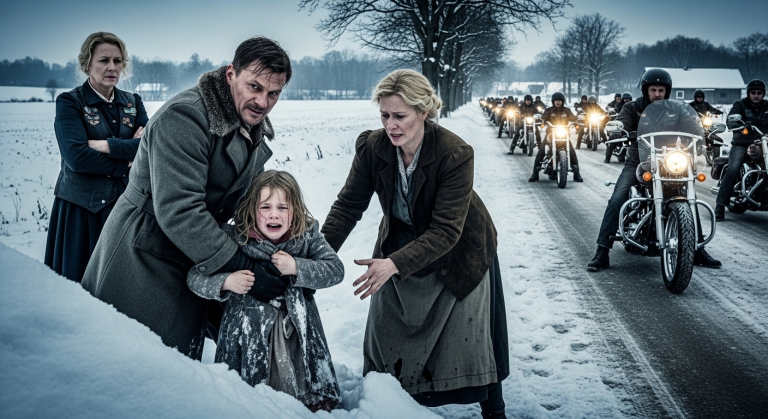
He reached the main bridge leading into Eagle’s Rest just as the convoy appeared. Six SUVs and twenty motorcycles, a cavalcade of steel and chrome roaring toward the sleeping town. They weren’t coming to intimidate anymore; they were coming to torch Main Street.
James slammed on the brakes, slewing the truck sideways to block the bridge. He stepped out, the shotgun resting casually on his shoulder. He stood in the single pool of light from the streetlamp, a massive, unmovable object.
The convoy screeched to a halt. Python, bandaged and hopped up on painkillers, was in the lead SUV. He rolled down the window.
“Move the truck, fat man!” Python screamed. “Or we kill everyone you know!”
James didn’t move. He reached into his pocket and pulled out a remote detonator.
“Turn around,” James said, his voice carrying over the idling engines.
“You think we’re scared of a bomb?” Python laughed nervously.
“Not a bomb,” James said. “Irrigation.”
He pressed the button.
On the hillsides overlooking the road, the massive industrial sprinkler systems James had modified roared to life. But they weren’t spraying water. They were spraying a mixture of high-grade fertilizer and diesel fuel—a blinding, slick sludge that coated the windshields of the SUVs and made the asphalt instantly treacherous for the motorcycles.
Chaos erupted. Bikes slipped and crashed. SUVs spun their tires, sliding into guardrails.
“Now,” James whispered.
He raised the shotgun. He didn’t aim at the men. He aimed at the engine blocks. Boom. Boom. Boom. The precise, rhythmic thunder of the 12-gauge echoed through the valley. Three SUVs died instantly, their radiator grilles shattered, engines seized.
“You want a war?” James roared, his voice finally unleashing the command authority he had hidden for eight years. “Come and get it! But you leave the town out of this!”
He turned and ran back to his truck, not in retreat, but to lead them away. He was the bait. And the wolves, angry and blind, took it. They turned their vehicles around, abandoning the town, and chased the “fat farmer” back toward the kill box he had spent a decade preparing.
Chapter 7: The Devil’s Playground
The chase led them away from Eagle’s Rest, up the winding mountain roads toward the old logging camp on the north ridge—territory James knew intimately. His truck groaned as he pushed it to the limit, bullets pinging off the tailgate.
“Martinez, I have them in the funnel,” James shouted over the roar of the engine. “Is the trap set?”
“Federal assets are in position at the logging camp,” Martinez replied. “But James, Roberts is with them. Satellite confirms the Command Vehicle is part of the pursuit. He wants to see you die personally.”
“Good,” James grimaced, swerving to avoid a PIT maneuver from a Storm Rider. “I have a presentation for him.”
James crested the ridge and slammed through the rusted gates of the logging camp. He drifted the truck into the center of the clearing and bailed out while it was still moving. He rolled—heavy but agile—into the cover of a massive log pile.
The enemy convoy swarmed in behind him, circling like sharks. General Roberts’ armored vehicle pulled up to the center. The General stepped out, surrounded by six heavily armed contractors. He looked like a conqueror surveying a battlefield.
“Cooper!” Roberts yelled, his voice amplified by a megaphone. “It’s over! You have nowhere to run. Come out and I’ll make it quick.”
James lay flat against the rough bark of a pine log, checking his ammo. He had three rounds left in the shotgun and a full mag in his Glock. Not enough for a firefight. But he didn’t need bullets. He needed Roberts to talk.
“Why, Roberts?” James shouted from cover, his voice echoing off the canyon walls. “Why sell prototype missiles to cartels? You were a patriot once!”
“Patriotism doesn’t pay the pension, Cooper!” Roberts laughed, walking closer, confident in his superior numbers. “The government retired me. Cast me aside. Now I dictate the market. These weapons secure borders—just not the ones Washington cares about.”
“So you admit it?” James called out. “You’re trafficking Class-A munitions?”
“I’m not trafficking,” Roberts sneered. “I’m reallocating assets. And you are just a loose end. A fat, sad relic playing soldier.”
Roberts signaled his men. “Burn the wood pile. Flush him out.”
A mercenary stepped forward with a flamethrower.
James smiled. Checkmate.
He reached into his pocket and pulled out not a weapon, but a flare gun. He fired it straight up into the air. The red phosphorus burned bright against the dark sky.
Suddenly, the “wood piles” around the perimeter of the camp fell away. They weren’t wood piles. They were camouflage nets.
Underneath them weren’t federal agents. They were cameras. dozens of high-definition broadcast units, satellite uplinks, and massive floodlights.
And stepping out from the treeline wasn’t just Sheriff Anderson. It was a chaotic mix of the entire town of Eagle’s Rest—Ruth Whitaker, Old Man Miller, Jenny—along with twenty FBI agents.
But the real weapon was the large screen James had rigged on the side of the old sawmill. It flickered to life.
It showed a live feed. Not just a recording, but a livestream.
“You’re live, General,” James said, standing up and stepping into the light. “On every major news network. Martinez patched the feed directly to the oversight committee hearings in D.C. They just heard your entire confession.”
Roberts froze. He looked at the cameras. He looked at his phone, which was suddenly blowing up with calls from the Pentagon.
“You…” Roberts stammered, his face draining of color. “You can’t…”
“I didn’t just hide on a farm, Marcus,” James said, walking toward him, unarmed. The mercenaries lowered their weapons, unsure of what to do with the cameras rolling. “I built a surveillance hub. I’ve been recording your shipments for eight years. Tonight was just the season finale.”
James stopped inches from Roberts. The General looked small now.
“The fat farmer tricked you,” James whispered. “Because you were too arrogant to look past the overalls.”
Chapter 8: The Quiet Earth
The arrest of General Roberts was less of a battle and more of a surrender. With the world watching, his mercenaries dropped their weapons instantly. They were contractors, after all; they didn’t get paid to fight the FBI on live television.
James Cooper stood by his battered truck, watching the flashing lights illuminate the mountain. Sheriff Anderson walked over, shaking his head in disbelief.
“You streamed it?” Anderson asked. “You streamed the whole thing?”
“Best security system is the truth, Sheriff,” James said, wiping soot from his face. “Hard to cover up a conspiracy when it’s trending on Twitter.”
Ruth Whitaker hobbled up, pushing past a federal agent who tried to stop her. She walked right up to James and poked him in his massive chest.
“You,” she scolded, though her eyes were teary. “You told me to go to Billings.”
“I wanted you safe, Ruth,” James said softly.
“I don’t leave my friends, James Cooper,” she huffed. “Besides, I brought the casserole. I figured you’d be hungry after saving the world.”
James laughed, a deep, genuine sound that broke the tension of the night. He took the foil-wrapped dish. “I am starving, actually.”
Martinez approached, holding a secure phone. “Washington is asking for you, James. Reinstatement. A medal. A desk at the Pentagon.”
James looked at the phone, then at the sunrise breaking over the valley. He looked at the townspeople who were currently explaining to CNN reporters how their “Big Jim” was a hero.
“Tell them I’m retired,” James said. “My tomatoes need watering. And I think I broke my truck’s axle.”
“They won’t stop asking,” Martinez warned.
“Then tell them James Cooper doesn’t exist,” James said, opening the door of his truck. “Tell them it was just a local farmer who got lucky.”
Martinez smiled and put the phone away. “Copy that. Just a farmer.”
James drove back down the mountain as the chaos of the investigation took over the logging camp. He pulled into his farm, the morning light revealing the damage—the broken windows, the tractor tracks, the scorched earth. It would take weeks to fix.
He walked into the barn, past the hidden room which was now dark and silent. He picked up a crate of vegetables he had packed yesterday morning, before the world went crazy.
He walked out to his stall at the end of the driveway. He set up the crate. He wrote a sign on a piece of cardboard: Tomatoes. $3/lb. No Gang Discounts.
He sat down in his chair, tipped his John Deere cap over his eyes, and waited for the first customer.
The war was over. The harvest was just beginning.
James Cooper closed his eyes and listened to the wind in the corn. He was still watching. He would always be watching. But for now, he was just a man enjoying the sun.
And God help anyone who tried to smash his tomatoes again.
Enjoyed the story? Don’t forget to like, comment, and share! Let us know in the comments: Do you think James should have taken the job at the Pentagon, or did he make the right choice staying on the farm?