They Laughed When I Brought My Daughter to the Interview. Then She Stopped a $50 Million Cyberattack.
Chapter 1: The Final Notice
The eviction notice didn’t look like I thought it would. In the movies, they’re always big, yellow signs taped to the door with dramatic black lettering. In real life, it was just a standard envelope, the paper cheap and thin, stamped with a boring red square: FINAL NOTICE.
I stared at it until the words blurred together. 72 hours.
Six years in this apartment. It wasn’t much—the radiator clanked like a dying engine and the view was a brick wall—but it was ours. It was the only home Emma really remembered. And now, unless a miracle fell out of the sky, we were going to be on the street by Friday.
The weight of the last three months crashed down on my shoulders. It was a physical heavy thing, sitting right at the base of my neck. RiverTech had laid off four hundred people in a single afternoon. “Restructuring,” they called it. I called it losing our health insurance and our future. Since then, I had sent out ninety-seven applications. I had sat through twenty-three interviews.
Result: Zero offers. Bank balance: $247.12.
“Mom? Are you okay?”
I flinched, shoving the letter deep into my coat pocket. I turned around, plastering on the ‘Mom Face’—the mask that said everything was under control, even when the world was burning.
Emma stood in the doorway of her bedroom. She was small for nine, wearing a t-shirt that was slightly too big and leggings with a hole in the knee. But it was her eyes that always got me. They were Robert’s eyes. Intense. Calculating. Intelligent beyond her years.
“I’m fine, sweetie,” I lied. My voice sounded thin to my own ears. “Just… boring grown-up mail. Bills, bills, bills, right?”
Emma didn’t smile. She scanned my face, her gaze dropping to my pocket where the letter was hidden, then back to my eyes. She knew. She always knew.
“We need to hurry,” I said, checking my watch. My pulse spiked. “The bus for downtown leaves in twelve minutes. If I miss this interview at Quantum Dynamics, I might as well just… well, we can’t miss it.”
Emma turned back to her room and grabbed her backpack. It was heavy, weighed down not by dolls or coloring books, but by what she called her “projects.” She clutched a worn, spiral-bound notebook to her chest.
“Can I bring my projects?” she asked.
I hesitated. Mrs. Patel, our neighbor who usually watched Emma for free in exchange for me helping with her groceries, was in Chicago visiting her new grandson. I had called three other friends. No one could take her.
“Emma, this is a very fancy office,” I said, dropping to one knee to fix her collar. “Quantum Dynamics is a serious place. They build… cyber-things. Security shields. Big, important stuff.”
“I know,” Emma said matter-of-factly. “They use quantum encryption keys. It’s partially distinct from standard RSA algorithms.”
I blinked. I had no idea what she had just said. It was like living with a tiny alien who spoke a language of pure logic.
“Right,” I said. “Well, you have to be quiet. You have to sit in the waiting room and be a ghost. Can you be a ghost for me?”
“I can be a ghost,” she promised.
We ran to the bus stop, the November wind biting through my thin suit jacket. I had bought this suit at a thrift store five years ago. I’d spent the last night shaving the pilling off the fabric with a razor, trying to make it look professional.
As we waited for the Number 42 bus, I watched Emma. She wasn’t looking at the street or the cars. She was staring at the traffic light box on the corner, her fingers twitching against her notebook cover, tracing invisible lines.
“What are you doing?” I asked gently.
“The timing sequence is off,” she murmured, not looking away. “The crosswalk triggers four seconds too late after the red light. It creates a bottleneck.”
I sighed, smoothing her hair. “Honey, don’t worry about the traffic lights. Just… worry about being a good girl today.”
The bus screeched to a halt in front of us. As the doors hissed open, I felt a wave of nausea. This interview was it. The rent was due. The eviction was looming. If I didn’t get this job, I didn’t know how I was going to feed her next week.
I took her hand, squeezing it tight. “Let’s go,” I whispered.
We stepped onto the bus, moving toward a destiny neither of us could have predicted. I thought I was bringing a burden to an interview. I didn’t realize I was bringing the solution.
Chapter 2: The Glitch
The Quantum Dynamics headquarters loomed over the city like a fortress of glass and steel. It reflected the morning sun so brightly it hurt to look at it. To me, it looked like money. It looked like stability.
To Emma, apparently, it looked like a puzzle.
“The architecture facilitates airflow for the server cooling systems,” she noted as we walked toward the revolving doors. She pointed up at the massive vents near the roof. “Smart.”
“Please, Emma. Just… ‘yes, ma’am’ and ‘no, ma’am’ inside. Okay?”
We pushed through the doors and the air conditioning hit us instantly. The lobby was silent, smelling of expensive polished stone and ozone. It was vast, with ceilings three stories high and a reception desk that looked like the command bridge of a spaceship.
People in thousand-dollar suits rushed past us, tapping furiously on tablets, shouting into Bluetooth headsets about “Q3 projections” and “scalability.” I felt shrinking, my thrift-store suit suddenly feeling like a costume.
We approached the desk. The receptionist, a woman whose nameplate read DIANE, didn’t look up for a full ten seconds. When she finally did, her gaze started at my scuffed heels and ended at Emma’s messy ponytail.
“Can I help you?” Her tone suggested she very much doubted she could.
“Hi, I’m Catherine Morgan,” I said, my voice shaking slightly. I cleared my throat. “I have a 10:30 interview with HR. For the administrative assistant position.”
Diane tapped a perfectly manicured fingernail on her desk. “And… this?” She gestured vaguely at Emma.
“This is my daughter, Emma. I apologize, my childcare fell through at the last minute. She’s very quiet. She has a book. She’ll just sit in the waiting area.”
Diane sighed, a long, suffering sound. “Ms. Morgan, this is a secure facility. We have strict protocols regarding unauthorized personnel. Especially minors.”
“Please,” I whispered, leaning in. Desperation clawed at my throat. “I really need this interview. She won’t move from the couch. I promise.”
Diane stared at me. She saw the desperation. For a second, her face softened—just a fraction. Or maybe she just didn’t want to deal with a crying woman in the lobby.
“Fine,” she snapped, typing something into her computer. “But if she disrupts the environment, you will be asked to leave immediately. Have a seat.”
“Thank you. Thank you so much.”
I guided Emma to a sleek, leather sofa in the corner, far away from the foot traffic. “Okay, ghost mode,” I reminded her.
“Ghost mode,” Emma repeated. She sat down, opened her backpack, and pulled out her notebook and a tablet.
The tablet was a piece of junk she’d found in a dumpster behind the electronics store six months ago. The screen was cracked in three places. She had fixed it herself using parts from an old phone and a soldering iron she’d borrowed from the super. I didn’t even know it turned on until I saw her coding on it one night under her covers.
I sat next to her, clutching my resume, my knees bouncing nervously. I checked the time: 10:20 AM. Ten minutes. Just breathe.
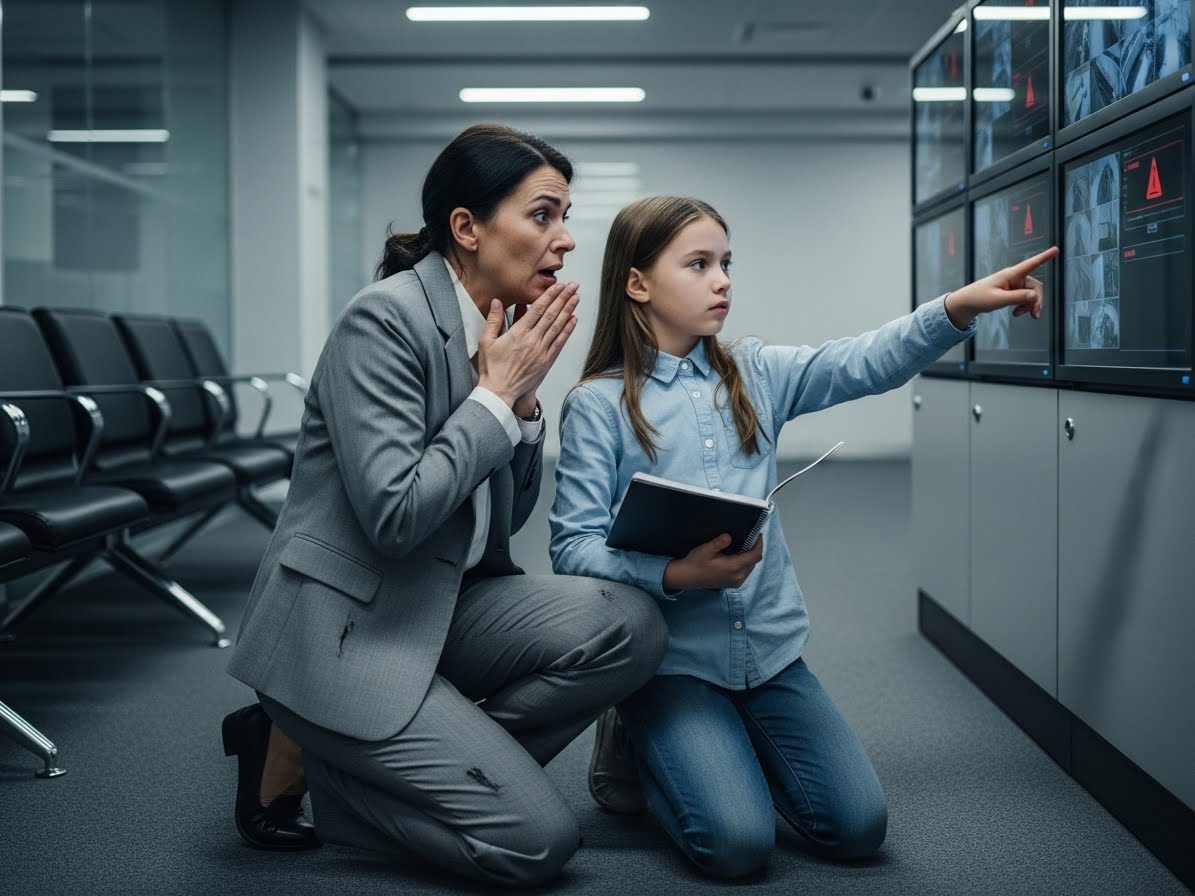
Above us, on the massive wall behind the reception desk, was a grid of twenty large monitors. They showed live feeds of different parts of the building: the server farm, the cafeteria, the elevators, the parking garage.
It was mesmerizing. It projected total control. Total safety.
“Mom,” Emma said softly.
“Shh.”
“Mom, look at screen four and screen nine.”
I didn’t look up. “Emma, I’m reviewing my answers.”
“The timestamps are desynchronized,” she whispered, her pen scratching furiously in her notebook. “And look at the data packets on the bottom ticker. They’re looping.”
“Emma, stop it.”
“It’s not a glitch,” she insisted, her voice getting a tiny bit louder. “Someone is pinging the handshake protocol. They’re knocking on the door.”
I turned to shush her again, but then I saw it.
Diane, the receptionist, was frowning. She tapped her keyboard. Then she tapped it harder. She picked up her desk phone, listened for a second, and slammed it down.
“That’s odd,” a man standing near the elevators said. He was wearing a security badge. He tapped his earpiece. “Command, this is Sanders in the lobby. My badge isn’t reading. Can you override?”
Static.
Then, the lights flickered.
It wasn’t a normal flicker, like a bulb dying. It was a strobe. The massive chandelier in the center of the lobby dimmed, then surged with blinding brightness, then dimmed again.
Bzzt.
The sliding glass doors at the entrance slammed shut.
Click-lock.
The revolving door froze, trapping a courier inside with his cart. He started banging on the glass.
“What is going on?” Diane stood up, her voice rising an octave.
“Mom,” Emma said, and this time, her voice was cold. Clinical. “They aren’t just knocking anymore. They’re inside.”
I looked at the wall of monitors.
Screen 1: Static. Screen 2: Static. Screen 3: SYSTEM LOCKDOWN.
Suddenly, a red banner flashed across every single screen in the lobby, overlaying the camera feeds. It wasn’t English text. It was a stream of binary code, zeroes and ones cascading down like digital rain, forming a skull shape.
An alarm began to blare—a low, rhythmic whoop-whoop-whoop that vibrated in my chest.
People stopped walking. The busy hum of the lobby died, replaced by confusion and rising panic. Executives pulled out phones, but I could see them tapping furiously—no signal.
“The Wi-Fi is down!” someone shouted. “My laptop just bricked!” “We’re locked in!”
I grabbed Emma’s arm, my instinct to run taking over. But there was nowhere to run. The doors were sealed.
“We have to get under the table,” I hissed, terrified it was a terrorist attack.
“It’s not a bomb, Mom,” Emma said calmly. She held up her cracked tablet. Her fingers were flying across the screen so fast they were a blur. “It’s a Denial of Service, but it’s… weird. It’s masking a redirection.”
“What?”
“They’re distracting the security AI with a lot of noise so they can steal the keys,” she explained, as if she were talking about the weather. She looked up at me, her eyes wide but not scared. Excited. “I can see them doing it.”
Just then, the elevator doors pinged open. A man stumbled out. He looked disheveled, his tie crooked. It was the man from the magazines.
Nathan Pierce. The CEO.
He looked around the chaotic lobby, his face pale. He spotted Sanders, the security guard.
“Report!” Pierce barked. “Why is my building locked down? Why are the investors in the conference room screaming that their accounts are draining?”
“We don’t know, sir!” Sanders yelled back over the alarm. “The firewall melted. Nothing is responding. We’re completely locked out. It’s… it’s like the system is fighting itself.”
“Mom,” Emma said, tugging my sleeve hard. “I need to show them.”
“Show them what? Emma, sit down!”
“I know how to stop it,” she said. She stood up, clutching her notebook.
Before I could grab her, she walked right into the center of the room, straight toward the billionaire CEO and the panicked security team.
“Excuse me!” her small voice piped up, cutting through the noise.
Nathan Pierce spun around. He looked down, confused, seeing a nine-year-old girl in holey leggings standing amidst a corporate disaster.
“Who are you?” he snapped.
“Your firewall isn’t melting,” Emma said, holding up her drawing. “It’s trembling. Because it’s confused. If you don’t reset the handshake protocol in the next forty seconds, you’re going to lose the encryption keys forever.”
The lobby went silent. Even the alarm seemed to pause for a breath.
Diane shrieked from the desk. “Get that child away from him! Where is the mother?”
I scrambled forward, mortified. “I’m so sorry! Emma, come here right now!”
But Nathan Pierce didn’t look at me. He was looking at the drawing in Emma’s hand. He snatched it from her. He stared at the scribbles—circles, arrows, and lines of code written in crayon and pencil.
He looked at his watch. Then he looked at the screens.
“Sanders,” Pierce said, his voice low. “Get me a laptop. Now.”
“Sir?”
“Give the girl a laptop!”
Chapter 3: The Terminal
“Give the girl a laptop!” Nathan Pierce roared.
The command echoed off the marble walls, silencing the murmurs of the panicked employees. Sanders, the security guard, hesitated for a split second, looking from the terrified mother to the nine-year-old girl in the worn sneakers. Then, training kicked in. He unclipped his tough-book workstation from his belt and knelt.
“Sir, this violates every Level 5 security protocol we have,” Sanders warned, his thumb hovering over the biometric scanner. “If she connects to the mainline during a breach, she could accelerate the crash.”
“Look at the screens, Sanders!” Nathan pointed at the massive wall of monitors. The red binary skull was flashing faster now. “We have thirty seconds before the core dumps. We are already crashed. Unlock it.”
Sanders pressed his thumb to the pad. Beep. The screen flared to life.
I stood frozen, my hands trembling against my mouth. “Emma,” I whispered, terrified. “Honey, be careful.”
Emma didn’t hear me. She didn’t hear the CEO or the alarms. Her world had narrowed down to the glowing rectangle in front of her. She sat cross-legged right there on the cold, polished floor of the lobby.
“It’s not a standard keyboard,” she mumbled, her small fingers hovering over the keys. “The latency is terrible.”
“Twenty seconds!” a voice screamed from the mezzanine. It was Michael Chen, the Chief Technology Officer, leaning over the railing, his face purple with rage. “Pierce! What are you doing? Get that child off the network!”
Emma began to type.
It wasn’t the slow, hunt-and-peck typing of a child doing homework. It was a blur. Her fingers danced across the keys with a rhythmic, percussive clack-clack-clack-clack.
“They’re using a mirror attack,” Emma said out loud, though she was talking to herself. “They aren’t breaking the door down. They convinced the door that they are the house.”
Nathan Pierce crouched beside her, ignoring the crease in his thousand-dollar suit pants. “Explain that,” he demanded, his eyes glued to her screen where lines of code were scrolling faster than I could read.
“The system thinks it’s talking to itself,” Emma said, not breaking her rhythm. “See this loop? It’s asking for a password, and the attacker is saying, ‘I am you. You don’t need a password from yourself.’ And the system is saying, ‘Okay, come in.'”
“Identity verification bypass,” Sanders breathed. “Jesus. That’s… that’s elegant.”
“It’s lazy,” Emma corrected. “They left a footprint.”
The lights in the lobby surged again. A spark showered down from a recessed light fixture, making Diane scream.
“Ten seconds to core dump!” Chen yelled from above. “Pull the plug! Kill the servers physically! We have to save the hard drives!”
“No!” Emma shouted. It was the loudest I had ever heard her speak. “If you kill the power, the loop locks. You’ll lose the data forever.”
Nathan stood up. He looked up at his CTO on the balcony, then down at the nine-year-old girl on the floor. It was the moment that would define his career.
“Let her work!” Nathan ordered. “Nobody touches the power!”
Chapter 4: The Green Line
The lobby held its breath. The only sound was the frantic tapping of Emma’s fingers and the low hum of the emergency lights.
My heart was hammering so hard I thought I might pass out. I looked at my daughter—my brilliant, weird, quiet daughter who struggled to make friends at recess—and I saw something I had never seen before.
She wasn’t just smart. She was a maestro.
“Got you,” Emma whispered.
She hit the ‘Enter’ key with a definitive thwack.
For three seconds, nothing happened. The red skulls continued to flash on the monitors. The alarm continued to wail.
Diane let out a scoff. “See? It’s just a child playing games. We’re ruined.”
Then, Screen 1 flickered.
The red skull vanished, replaced by a wall of scrolling blue text.
Then Screen 2. Then Screen 3.
A wave of blue washed over the wall of monitors, purging the red error messages like fresh water clearing out mud. The screeching alarm cut off abruptly, leaving a ringing silence in the air.
“System integrity restoring,” a robotic voice announced from the ceiling speakers. “Firewall rebooting. Threat isolated.”
Emma slumped forward, her forehead resting on the spacebar. She let out a long, shaky breath.
“I caught them in a honeypot,” she said quietly, rubbing her eyes. “I tricked them into thinking they succeeded, but I routed their connection into a dead-end sandbox. They’re stuck in there now.”
Silence. Absolute, stunned silence.
Sanders stared at his tablet. “She’s right. The data flow is returning to normal. The encryption keys are secure. We… we didn’t lose a byte.”
Nathan Pierce stared at the monitors, then slowly lowered his gaze to Emma. He looked like a man who had just seen a magic trick he couldn’t explain.
“Who taught you to do that?” he asked softly.
Emma shrugged, looking small again. She reached for her juice box. “The library has free internet. And people throw away good computers just because they’re slow. I fix them.”
I rushed forward, scooping her up into a hug, burying my face in her hair. “I’ve got you. I’ve got you. I’m so sorry, Emma.”
“Did I do a good job, Mom?” she mumbled into my shoulder. “Can we go home now? I’m hungry.”
Before I could answer, the elevator doors pinged open. A group of men in grey suits stormed out. They didn’t look like tech guys. They looked like money. Angry money.
“Pierce!” the lead man shouted. “What the hell just happened? My portfolio dropped four percent in six minutes!”
It was Marcus Williams, the lead investor. I recognized him from the news.
Nathan straightened his tie. The shock was fading, replaced by a sharp, calculating look. He stepped between us and the angry men.
“We had a security breach, Marcus,” Nathan said calmly. “And we just solved it.”
Chapter 5: The Phantom Signature
Marcus Williams marched up to us, his face flushed. He looked at me, then at Emma, who was still holding the security laptop.
“Solved it?” Marcus spat. “I saw the logs from upstairs. You gave root access to an external terminal in the lobby. Who is this? Who authorized this?”
“I did,” Nathan said.
“And who is she?” Marcus pointed a shaking finger at Emma. “Why is there a child in a Level 4 secure facility during a cyber-attack?”
“This is Emma,” Nathan said, his voice gaining strength. “And she’s the reason you still have a company to invest in.”
Michael Chen came running down the stairs, panting. He looked at Emma with a mixture of fear and embarrassment. “Sir, the board isn’t going to like this. We rely on certified professionals. If the public finds out a grade-schooler fixed our “
“Our certified professionals were watching the firewall melt, Michael,” Nathan cut him off. He turned back to Emma. “Emma, the attack… was it random?”
Emma shook her head. She pulled her notebook back out. “No. It was personal.”
The adults went quiet again.
“What do you mean?” Nathan asked, kneeling down again.
“The code,” Emma explained, flipping to a page covered in scribbles. “The hacker used a specific loop structure. It’s called a ‘recursive phantom.’ It’s really old school. I saw it on a forum once. The user’s name was ‘GhostWriter88’.”
Sanders, the security guard, went pale. “GhostWriter… that’s Thomas Reeves.”
Nathan froze. “Reeves? The engineer we fired three years ago?”
“Yes,” Sanders said. “He kept warning us about the vulnerability in the identity verification protocol. We ignored him. We fired him for ‘insubordination’ because he wouldn’t drop it.”
“He wasn’t trying to destroy the company,” Emma said, pointing at the screen. “Look. He didn’t steal any money. He just locked the doors. He wanted to show you that he was right.”
A heavy silence fell over the group. The arrogance in the room evaporated. A billion-dollar company, brought to its knees by its own hubris, saved by a girl who saw the world differently.
Nathan stood up slowly. He looked at Michael Chen. “You fired Reeves, didn’t you, Michael?”
Chen stammered. “He… he was difficult. He didn’t follow standard procedure.”
“Neither does she,” Nathan said, gesturing to Emma.
Chapter 6: The Exit
“This is ridiculous,” Marcus Williams scoffed, checking his phone as the signal returned. “I don’t care about your internal drama. The point is, this looks bad. Amateur. Get this woman and her kid out of here. We have a press release to write.”
He looked at me with disdain. “Go on. You’ve caused enough chaos.”
My face burned. The adrenaline was fading, and the reality of my life was crashing back in. I was still broke. I was still getting evicted. And now, I had humiliated myself in front of the most powerful people in the city.
“Come on, Emma,” I whispered, grabbing her hand. “Let’s go.”
“Wait,” Nathan called out.
I didn’t stop. I walked toward the revolving doors, my head down, fighting back tears. I just wanted to get back to the safety of our apartment before the locks were changed.
“Ms. Morgan!”
Nathan caught up to us just as we reached the sidewalk. The cold air hit us, a stark contrast to the heated madness of the lobby.
“I’m sorry, Mr. Pierce,” I said, not meeting his eyes. “We shouldn’t have come. I know I’m not qualified for the assistant job. I just… I needed a chance.”
Nathan wasn’t looking at me. He was looking at Emma, who was watching a pigeon peck at a crumb on the concrete.
“You’re right,” Nathan said. “You’re not qualified for the assistant job.”
My heart sank. “I understand.”
“And honestly,” he continued, “I don’t think we can afford to have you answering phones.”
He pulled a business card from his pocket. On the back, he wrote a number in sharp, black ink.
“I need to deal with the sharks inside,” he said, gesturing back at the building. “But I know talent when I see it. And I know a survivor when I see one.”
He handed me the card.
“My personal cell. Call me tomorrow morning. Do not call HR. Call me.”
“Mr. Pierce, I…”
“Where do you live?” he asked suddenly.
“The, uh… The Bradbury Apartments. On 4th.”
He frowned. He knew the area. It was bad. “Are you okay? Do you need a ride?”
“We’re fine,” I lied. Pride was the only thing I had left. “The bus is coming.”
He looked like he wanted to argue, but the revolving doors spun, and Chen came out, waving frantically.
“Call me,” Nathan said again, intensely. “I mean it.”
We got on the bus. I slumped into the plastic seat, clutching the business card like a lifeline. Emma rested her head on my arm.
“He was nice,” she yawned. “For a suit.”
I looked at the card. Nathan Pierce, CEO.
“Yeah,” I whispered. “He was.”
But as we rode back to our crumbling apartment, I didn’t know if he would actually answer the phone. Rich people say a lot of things in the heat of the moment. I looked at the eviction notice still crinkled in my pocket.
We had 48 hours left.
Chapter 7: The Knock on the Door
The next morning, I called the number. It went to voicemail. I called again at noon. Voicemail.
By 5:00 PM, the hope that had sparked in my chest had turned into a cold, hard lump of ash. Of course. He was a CEO. He had a company to save, investors to calm, a PR disaster to manage. He had forgotten about the desperate woman and the weird kid in the lobby.
I sat on the floor of the living room, surrounded by boxes. I had started packing. There was no point in waiting until the Sheriff came.
“Can I keep the soldering iron?” Emma asked. She was sorting her “lab”—a pile of junk electronics in the corner.
“Only if it fits in the backpack, Em. We can’t take much.”
Knock. Knock. Knock.
I froze. The landlord wasn’t supposed to come until tomorrow.
“I’m not opening it,” I whispered.
Knock. Knock. Knock.
“Ms. Morgan?” A male voice. Not the landlord.
I crept to the peephole. I gasped and pulled back.
“Who is it?” Emma asked.
“It’s… it’s him.”
I fumbled with the chain and opened the door.
Nathan Pierce stood in the dim, urine-smelling hallway of our apartment building. He wasn’t wearing a suit jacket today, just a white dress shirt with the sleeves rolled up. He looked tired.
And he wasn’t alone. He was holding a pizza box.
“I,” he started, looking around the hallway, “I tried calling, but your phone seems to be disconnected.”
My face flushed. “I… I ran out of minutes on my prepaid plan.”
He nodded, as if this was a normal logistical hurdle and not a sign of abject poverty. “May I come in?”
I stepped aside. He walked into our tiny apartment. He saw the boxes. He saw the bare walls. He saw the “Final Notice” I had left on the counter.
He didn’t say a word about it. He just set the pizza down on a stack of books.
“Pepperoni,” he said. “I guessed.”
“Mr. Pierce, why are you here?” I asked, hugging my arms around myself.
He turned to Emma. “I brought you something, too.”
He pulled a sleek, silver case from behind his back. He opened it. inside sat a top-of-the-line Quantum X-1 laptop. Not a toy. A machine worth more than my car.
“It has a sandbox environment pre-installed,” Nathan said to Emma. “So you can break things without shutting down my building again.”
Emma’s eyes went wide. She looked at me for permission. I nodded, stunned. She took it like it was a holy relic.
“Thank you,” she whispered.
Nathan turned to me. “I looked into your file, Catherine. Six years at RiverTech. Top of your department in efficiency. Laid off because you didn’t have a four-year degree.”
“I learned on the job,” I said defensively.
“I know,” he said. “So did I.”
He sat down on one of our packing boxes. “I grew up in an orphanage, Catherine. I didn’t go to MIT. I learned to code on a calculator I stole from a supply closet. I built Quantum because I wanted to create a place where what you can do matters more than where you came from.”
He looked around the room. “Somewhere along the way, I got lost. I started listening to the investors. I started hiring the suits. I forgot.”
He looked me in the eye.
“Yesterday, your daughter reminded me. And you… you stood in a room full of sharks and protected her.”
Chapter 8: The Department of Unconventional Talent
He reached into his pocket and pulled out a folded document. It wasn’t an eviction notice. It was heavy, cream-colored paper.
“This is an offer letter,” he said.
“For the admin assistant role?” I asked, hope fluttering in my chest.
“No,” he smiled. “We’re starting a new division. ‘The Department of Unconventional Talent.’ I need someone to run operations. Someone who can spot the people the system throws away. The people who think differently.”
I took the paper. My eyes scanned the numbers. The salary… it was more than I had made in the last three years combined.
“And for Emma,” he continued, “Quantum has a scholarship program for gifted youth. It includes a full stipend for a specialized school, and… after-school mentorship in our labs. Under my supervision.”
“Mr. Pierce…” Tears pricked my eyes. I couldn’t stop them this time.
“Nathan,” he corrected. “But there’s a condition.”
I wiped my face. “Anything.”
“You have to burn that eviction notice,” he said. “Company housing is included. We have a corporate apartment downtown. It has a view of the park. And high-speed internet.”
Emma looked up from her new laptop, her face illuminated by the blue glow of the screen.
“Does it have good airflow for the servers?” she asked.
Nathan laughed. A real, genuine laugh. “Yes, Emma. The airflow is excellent.”
…
Six months later.
I walked through the glass doors of Quantum Dynamics. I wasn’t wearing the thrift-store suit. I was wearing a navy blazer that fit perfectly. Diane, the receptionist, smiled and waved as I walked past.
“Good morning, Ms. Morgan.”
“Morning, Diane.”
I took the elevator to the 30th floor. The sign on the glass door read: UNCONVENTIONAL TALENT – C. MORGAN, DIRECTOR.
Inside, the room was buzzing. Not with panicked executives, but with kids. Teenagers in hoodies, a mechanic who had taught himself cryptography, a former teacher who saw patterns in data no one else did.
And in the corner, in a beanbag chair, sat Emma. She was typing on her silver laptop, a juice box on the desk, guiding a team of MIT graduates through a complex firewall patch.
She looked up and caught my eye. She didn’t smile—she rarely did—but she gave me a small nod. A thumbs up.
I looked out the window at the city below. We weren’t invisible anymore. We weren’t ghosts.
We were the ones holding the keys.
Chapter 3: The Unauthorized Access
“Give the girl a laptop!”
Nathan Pierce’s command didn’t just echo in the lobby; it detonated like a grenade.
For a heartbeat, the chaos froze. The frantic shouting of traders on their phones, the sobbing of the receptionist, the blaring red sirens—it all seemed to suspend in disbelief.
Sanders, the head of lobby security, stared at his CEO as if the man had spoken in tongues. He looked down at the ruggedized Toughbook clipped to his tactical belt—a device with Level 5 clearance, capable of accessing the deepest roots of the Quantum Dynamics server—and then at the nine-year-old girl in the scuffed sneakers holding a juice box.
“Sir,” Sanders stammered, his hand hovering over the device. “With all due respect, this violates every protocol in the handbook. Section 14, Paragraph 2 specifically states that during a active hostile breach, no external nodes—”
“Sanders!” Nathan barked, stepping closer. The veins in his neck were visible, pulsing against his collar. “Look at the wall!”
We all looked. The massive grid of security monitors wasn’t just flashing red anymore. The binary skull that had taken over the screens was starting to laugh—a jagged, digital animation that mocked the billion-dollar company. Beneath it, a countdown timer had appeared.
00:03:45
“That is the time until the cooling systems fail,” Nathan said, his voice dropping to a terrifyingly calm register. “When that hits zero, the server farm overheats. The physical drives melt. We lose the government contracts, we lose the investor capital, and this company becomes a smoking crater. We are past protocol. We are in survival mode. Give. Her. The. Laptop.”
Sanders swallowed hard. He unclipped the workstation. His fingers trembled as he scanned his thumbprint to unlock the biometric seal.
Chime.
He knelt down, placing the heavy, rubber-cased computer on the cold marble floor in front of Emma.
“It’s logged in as Admin,” Sanders whispered to her, his voice tight with fear. “Don’t… please don’t make it worse.”
I felt like I couldn’t breathe. My hands were gripping my purse strap so hard my knuckles were white. This was insane. This was my little girl—the one who was afraid of the dark, the one who cried when she scraped her knee.
“Emma,” I choked out, stepping forward. “Honey, you don’t have to do this. We can just leave. We can go.”
Emma didn’t look at me. She didn’t look at Sanders or the terrified CEO. She was staring at the screen with an intensity that scared me. It was the same look she had when she was taking apart the broken toaster oven I’d found in the alley—absolute, unwavering focus.
She sat cross-legged on the floor, ignoring the skirt of her dress bunching up around her knees. She cracked her knuckles—a habit she picked up from me.
“The keyboard layout is different,” she mumbled, almost to herself. “The latency is lagging by 0.4 seconds.”
“Can you work with it?” Nathan asked, crouching down beside her, ruining the crease in his Italian suit trousers without a second thought.
Emma nodded. “I just have to predict the lag.”
Her fingers touched the keys.
And then, she began to play.
It wasn’t typing. It was a performance. Her small hands flew across the keyboard with a speed and rhythm that seemed impossible for a child. There was no hesitation, no backspacing. Just a relentless stream of commands entering the terminal.
Clack-clack-clack-clack-enter. Clack-clack-clack-enter.
From the mezzanine balcony above, a voice boomed down like thunder.
“WHAT IS HAPPENING DOWN THERE?”
I looked up to see a man in a rumpled shirt running to the railing. It was Michael Chen, the Chief Technology Officer. He looked like he hadn’t slept in a week, and right now, he looked ready to kill.
“Pierce!” Chen screamed, his face turning a violent shade of purple. “I’m seeing an unauthorized root access from the lobby node! Who is on the terminal? Is that… is that a child?”
Nathan didn’t look up. “She’s fixing your mess, Chen!”
“My mess?” Chen sputtered. “She’s going to brick the kernel! Security! Restrain them! Cut the connection!”
Two guards by the elevators took a step forward, hands reaching for their batons.
I moved without thinking. I stepped in front of Emma, putting my body between her and the guards. I was five-foot-four. I was wearing a thrift-store suit that smelled like lavender detergent. I had $247 to my name. But in that moment, I was a lioness.
“Don’t you touch her,” I hissed. My voice was low, dangerous. “Let her finish.”
The guards hesitated. They looked at Nathan.
Nathan held up a hand. “Stand down! That is a direct order! If anyone touches that laptop, they’re fired before they hit the floor!”
Chen was screaming into his radio now, trying to override the command from the server room, but Emma was faster.
“He’s trying to remote-lock me out,” Emma said, her eyes darting across lines of scrolling green code. “He’s using the master administrative kill-switch.”
“Can you block him?” Nathan asked.
“I don’t need to block him,” Emma said, a tiny smirk touching the corner of her mouth. “I’m already past the admin layer. I’m in the basement.”
She hit the ‘Enter’ key with a definitive thwack.
On the big screen, the countdown timer froze at 00:02:18.
The digital laughter of the skull stopped.
For a second, the entire building seemed to shudder. The lights dimmed to a brown-out level, casting long, eerie shadows across the lobby, before surging back to full brightness.
“What did you just do?” Sanders whispered.
“I didn’t stop the attack,” Emma said calmly, typing a new string of commands. “I just invited it in for tea.”
Chapter 4: The Architecture of Silence
The concept of “inviting the attack in” seemed to terrify the adults in the room even more than the attack itself.
“You did what?” Nathan asked, his voice tight.
“It’s a redirection,” Emma explained, her voice taking on that lecture tone she used when explaining to me why the toaster needed a new capacitor. “The attacker isn’t trying to break the door down. The attacker is pretending to be the door. It’s a mirror attack.”
She pointed to the screen, where a complex diagram was starting to form—a web of red lines intersecting with green ones.
“See the red lines?” Emma said. “That’s the bad data. It’s copying the good data—the green lines—exactly. It matches the timestamp, the packet size, even the user ID. The system can’t tell them apart, so it locks up because it’s confused. It’s like… like two people trying to walk through a doorway at the exact same time, wearing the exact same clothes, claiming to be the exact same person.”
“So the system freezes to protect itself,” Nathan realized. “A deadlock.”
“Exactly,” Emma said. “Mr. Chen is trying to push the red guy out. But every time he pushes, the red guy pushes back with equal force because the system thinks the red guy belongs there. That’s why the firewall is melting. The friction is creating heat.”
“So how do you stop it?” I asked, looking at the timer. It was still frozen, but the red skull was starting to twitch, trying to break free of whatever hold Emma had put on it.
“You don’t push,” Emma said simply. “You open another door.”
She began typing again. This time, the rhythm was different. Slower. More deliberate.
“I’m creating a virtual sandbox,” she narrated. “A fake server. It looks exactly like the main database. It smells like money. It has files labeled ‘CONFIDENTIAL’ and ‘PASSWORDS’. It’s a honeypot.”
On the massive wall of monitors, a new window popped up. It showed a black void.
“Now,” Emma whispered. “I’m going to tell the red guy that the other door is open.”
She pressed a sequence of keys: Ctrl + Alt + Shift + F12.
“Go,” she whispered.
Suddenly, on the screens, the red lines shifted. Instead of slamming against the firewall, they turned. They flowed like water finding a new channel. They poured into the black window Emma had created.
The main screens—Screen 1, Screen 2, Screen 3—flickered.
The red skull dissolved.
In its place, the standard Quantum Dynamics blue logo appeared, rotating smoothly.
SYSTEM STATUS: ONLINE. THREAT LEVEL: NEUTRALIZED. INTEGRITY: 100%.
The silence that followed was deafening. It was heavier than the noise of the alarms. It was the sound of fifty people realizing that their entire understanding of reality had just been shifted by a child in leggings with a hole in the knee.
From the ceiling speakers, the automated voice returned, calm and polite. “Cooling systems stabilized. Temperature returning to nominal levels. Network traffic normalized.”
Emma sat back, rolling her shoulders. She rubbed her eyes with the back of her hand, leaving a smudge of dirt on her cheek.
“They took the bait,” she said, closing the laptop lid halfway. “They’re trapped in the sandbox now. They think they’re stealing terabytes of data, but they’re just downloading the same garbage file over and over again. It’s a loop.”
Nathan Pierce fell back onto his heels. He sat there on the floor, staring at the blue logo. He looked like a man who had just watched a mountain move two inches to the left.
“Sanders,” Nathan croaked.
“Yes, sir?”
“Did we lose anything?”
Sanders was tapping furiously on his tablet. “I… I’m checking the logs. Sir, the encryption keys are untouched. The client data is secure. The financial ledgers are intact. She… she didn’t just stop it. She quarantined it without losing a single packet.”
Nathan turned his head slowly to look at Emma. His eyes were wide, filled with a mixture of awe and something that looked painfully like hope.
“You,” he whispered. “How did you know about the mirror attack? That’s… that’s theoretical. It’s something we talk about in white papers. It hasn’t been seen in the wild.”
Emma shrugged, reaching for her juice box which was now warm. She took a sip and made a face.
“It’s not theoretical,” she said. “I saw someone talking about it on a forum. They said the architecture of your verification protocol had a ‘blind spot’ in the logic gate. They posted a proof of concept three years ago.”
“Three years ago?” Nathan frowned. “Who?”
“A user named Phantom,” Emma said. She opened her notebook, flipping past the drawings of the traffic lights to a page covered in dense, handwritten code. “See? I copied his syntax. He writes his loops backward. It’s his signature.”
“Phantom,” Sanders repeated, his face draining of color. He looked at Nathan. “Sir… the backward loops. The recursive logic. That’s… that’s Thomas.”
Nathan stiffened. “Thomas Reeves?”
“Who is Thomas Reeves?” I asked, my voice trembling. The adrenaline was starting to fade, replaced by the shaky aftershocks of fear.
“He was a senior engineer here,” Nathan said, his voice grim. “Brilliant. erratic. He kept telling us our security had a flaw. He wrote memo after memo. We… we didn’t listen.”
“You fired him,” Sanders corrected quietly. “Michael Chen fired him. For ‘wasting resources on imaginary threats.'”
Emma looked at the drawing in her notebook. “He wasn’t imagining it. He was right. And today, he proved it.”
“He attacked us to prove a point?” I asked, horrified.
“No,” Emma said, shaking her head. “He didn’t want to hurt the company. That’s why he used a mirror attack. It doesn’t destroy data; it just freezes it. It’s like… holding your breath. He wanted you to pass out, not die.”
Just then, the elevator doors blasted open.
The silence was shattered by the sound of expensive leather shoes slapping against the marble floor. A group of men in grey suits stormed out, led by a man I recognized from the business news channels. Marcus Williams. The lead investor.
He looked furious. His face was red, his tie was slightly askew, and he was holding a phone that I assumed had just started working again.
“Pierce!” Williams shouted, his voice echoing off the glass walls. “My dashboard just dropped four percent! I have clients in Dubai calling me asking if their assets are frozen! What is going on?”
He stopped, looking at the scene on the floor.
The CEO of a multi-billion dollar company sitting on the marble. A security guard with a tablet. A terrified mother in a cheap suit. And a nine-year-old girl holding a juice box.
“And why,” Williams spat, pointing a manicured finger at Emma, “is there a child playing with a laptop in the middle of a corporate crisis?”
Nathan Pierce stood up. He brushed off his knees. He buttoned his jacket. In three seconds, he transformed from the stunned man on the floor back into the CEO.
“Marcus,” Nathan said, his voice cold and hard as steel. “You can tell your clients in Dubai that their assets are safe. In fact, they are safer than they have ever been.”
“I don’t care about safe!” Williams yelled. “I care about the optics! This looks like a circus! Who is this woman? Who is this kid?”
“This kid,” Nathan said, stepping between Williams and Emma, “is the new Head of Cyber Security.”
Williams blinked. “What?”
“You heard me,” Nathan said. “Now, get out of my lobby. I have a job interview to finish.”