The Boardroom Laughed When I Adopted Five Homeless Boys With Only 90 Days Left To Live. They Didn’t Know These “Street Rats” Were About To Rewrite History.
PART 1
Chapter 1: The Ash in the Glass
The Manila envelope sat unopened on my mahogany desk, casting a long, thin shadow across the leather surface. It looked innocuous, just a standard medical packet, but the weight of it seemed to tilt the entire room on its axis.
Through the floor-to-ceiling windows of my penthouse office on the 52nd floor, Manhattan sparkled like a jewel box. It was a kingdom of steel and glass, and I was its king. But looking at it now, all I could see were the lights of people who had futures. People who had tomorrow.
“Three months,” I whispered.
The silence in the room was deafening. My personal physician, Dr. Aris, had left ten minutes ago, unable to look me in the eye as he delivered the verdict. Pancreatic. Aggressive. Stage IV.
“Three months to live.”
I said it louder this time, testing the weight of the words. At 58, Alexander Morgan was a name that moved markets. The Morgan Investments logo crowned skyscrapers in twelve countries. My net worth would make small nations envious. I had spent forty years climbing the mountain, sacrificing everything—friendships, sleep, morality—to get to the summit.
And now that I was here, the view was just… empty.
I loosened my silk tie, the fabric feeling like a noose, and walked to the wet bar. I poured myself three fingers of 30-year-old Scotch. The amber liquid caught the dying sunlight as I raised it to my lips.
It tasted like ash.
“What legacy am I leaving?” I asked the empty room.
My voice, normally commanding enough to silence a boardroom of shouting executives, sounded hollow. My wife, Elizabeth, had succumbed to a similar darkness five years ago. We had never had children. We were always too busy building the empire. Always thinking there would be time later.
” later.” The greatest lie we tell ourselves.
Now, there was no more later.
I moved to the window, watching the tiny figures scurrying below on Fifth Avenue like ants. How many of them were rushing home to families? How many had someone waiting to ask them how their day was? The thought sent a wave of loneliness crashing over me so violent it almost knocked the wind out of my lungs.
Memories flooded back, unbidden. My childhood in a cramped apartment in the Bronx. The smell of boiling cabbage and stale cigarettes. My mother working three jobs after my father abandoned us. The scholarship that had been my golden ticket out. The relentless, blood-soaked climb to the top.
I had promised myself I would never be vulnerable again. Never need anyone again. And I had succeeded. Brilliantly, terribly.
My phone buzzed on the desk. Another board meeting reminder. Another acquisition target. Another billion to add to accounts that would soon belong to distant cousins who had never bothered to call me on my birthday.
Alexander Morgan, Master of the Universe, was going to die alone.
I set down the untouched drink. The mask of the ruthless businessman slid back into place, a reflex honed over decades. I gathered my papers. But something had cracked inside me. Something fundamental.
“James,” I spoke into the intercom. “Bring the car around. I’m skipping the gala.”
“Sir? You’re the guest of honor.”
“I said bring the car.”
Twenty minutes later, the armored Mercedes Limousine was gliding through the late-night streets of Manhattan. The city was dressed for Christmas, garland and lights mocking my internal funeral.
“Take the next right, James,” I instructed suddenly. “The shorter route. Through the warehouse district.”
“Sir, that’s not… the security protocol advises against—”
“Just drive.”
We turned into a narrower street, the glitz of Fifth Avenue fading into the grime of the industrial sector. Headlights swept across storefronts shuttered for the night and alleyways choked with shadows.
As we passed a particularly dark alley between two condemned buildings, I glimpsed movement.
“Stop the car.”
“Sir?”
“Stop. Now.”
Against my driver’s frantic protests, I stepped out into the December chill. The forecast had mentioned snow before morning, and the air tasted of iron and ice. I approached the alley cautiously, my Italian leather shoes clicking out of place against the cracked pavement.
Five huddled forms became visible in the gloom.
They were using cardboard and damp newspapers as blankets, pressed against a venting grate that blew out stale, warm air from a basement laundry.
The oldest couldn’t be more than fifteen. The youngest, a tiny thing buried in an oversized coat, looked perhaps seven or eight.
They were awake instantly. Alert. Tense. Like prey animals sensing a predator.
“Easy,” I said, raising my hands, my breath pluming in the cold air. “I’m not the police.”
The oldest boy stood up. He moved with a fluid, dangerous grace, positioning himself protectively in front of the others. He held a piece of rusted pipe, not aggressively, but ready.
“We ain’t doing nothing wrong,” he rasped. His voice was cracking, halfway between child and man. “This is private property, but the owner said we could stay until they start construction next week.”
I noticed their setup. It wasn’t just a pile of trash. It was organized. Their few possessions were neatly arranged in crates. There was a perimeter set up with tin cans on strings—a primitive alarm system.
There was an intelligence here.
“What are your names?” I asked.
Silence. The wind howled through the alley, biting at my exposed face.
Then the oldest spoke again, deciding I wasn’t a threat, or perhaps deciding he could take me if I was. “I’m Ethan. These are Tyler and Thomas.” He gestured to two identical boys, around thirteen, watching me with calculating eyes. “That’s Lucas,” a thin eleven-year-old with long fingers clutching a sketchpad. “And Dylan.”
He pointed to the tiny boy with enormous, owl-like eyes who was shivering violently.
“Your brothers?”
“Not by blood,” Ethan replied, his chin lifted. “By circumstance.”
Something stirred in my chest. A feeling I thought had atrophied years ago. An impulse. Irrational. Powerful. Reckless.
“It’s going to snow tonight,” I said. “I have a place nearby. Warm beds. Hot food.”
The suspicion in their eyes was immediate and total.
“We don’t go with strangers,” Ethan said. “We know how that ends.”
“No strings attached,” I added quickly. “Just tonight. It’s Christmas season. Look, I… I just found out some bad news. I don’t want to be alone in a big house. You’d be doing me a favor.”
The boys conferred in whispers. I saw them weighing the risk of freezing to death against the risk of a stranger. My driver, James, was standing by the car, hand inside his jacket, ready to draw his weapon.
Finally, Ethan looked up.
“One night. We stay together. We see one door locked that shouldn’t be, we break windows and we run. Agreed?”
“Agreed.”
Twenty minutes later, Alexander Morgan, a man who fired executives for using the wrong font on a memo, watched five street boys cautiously enter his pristine penthouse.
Chapter 2: The Invasion
They stood huddled together in the vast foyer, looking simultaneously awed and terrified. The marble floors reflected their dirty sneakers. The crystal chandelier seemed to loom over them like a judgment.
“Take your shoes off if you want,” I said, unbuttoning my coat. “Or don’t. It’s just a floor.”
They kept their shoes on. Ready to run.
“The kitchen is stocked,” I said, gesturing vaguely. “Bedrooms are down that hall. There are five guest suites. Pick whatever you want. The bathrooms have hot water, soap, fresh towels. There are clothes in the walk-in closets—some old things of mine, might be too big, but warmer than what you have.”
They didn’t move. They were scanning the room, counting exits, assessing threats.
“I’ll be in my study,” I said, feeling suddenly exhausted. The adrenaline of the alley was fading, replaced by the gnawing pain in my abdomen. “If you need anything… just ask.”
As I turned to leave, the smallest one, Dylan, spoke up. His voice was high and clear.
“Why?”
I paused, hand on the doorframe.
“Why what?”
“Why are you doing this?” Dylan asked. He stepped out from behind Ethan’s leg. “Rich people don’t help street kids. They call the cops.”
I looked at him. I could have told him about the tax write-off. I could have told him about my childhood. But I was tired of lying.
“Because I can,” I said. “And because tonight, my money feels very useless to me.”
I retreated to my study and closed the door. I sat there for hours, staring at the family portrait of my parents that hung over the fireplace. I listened.
At first, silence. Then, the creak of floorboards. The sound of running water—showers, likely. The clatter of plates.
Around midnight, I heard hushed voices right outside my study door.
“It’s unlocked,” one whispered.
“Don’t touches it, Ty. We stick to the deal,” Ethan’s voice.
“But look at the wiring on this security panel,” another voice—Tyler or Thomas—whispered back. “It’s a localized bi-metric loop. Ancient. I could bypass this in ten seconds.”
“Shut up. We eat, we sleep, we leave.”
I smiled grimly. A localized bi-metric loop. The kid knew his tech.
The next morning, the sun broke over Manhattan with a blinding brilliance. I walked out into the living room, expecting chaos. Expecting theft.
Instead, the room was immaculate. The boys were sitting on the expensive Italian sofas, but they had placed towels down first so their clothes wouldn’t soil the fabric.
They froze when I entered.
“Breakfast?” I asked.
“We cooked,” Lucas said. He pointed to the dining table. They had found eggs, bacon, and toast. They had set six places.
I sat down. It was the first time in five years I hadn’t eaten breakfast alone with a newspaper.
“This is insane,” Harold Winters, my attorney of twenty years, muttered two hours later. He had arrived with paperwork for the upcoming merger and found me watching cartoons with five homeless children.
We stood in the doorway of the media room.
“Temporary guardianship is one thing, Alex,” Harold hissed, adjusting his glasses. “But you’re talking about… what? Keeping them?”
“Why not?”
“Because you’re dying! You have three months! What happens to them when you go? They go back to the system. It’s cruel to give them a taste of this life only to rip it away.”
“I can leave them money. Trusts.”
“They’re minors. The state will take it. Or guardians will embezzle it.” Harold shook his head. “And think of the optics. The shareholders will think you’ve lost your mind. ‘Terminal CEO adopts street gang.’ The stock will tank.”
“Let it tank,” I said, watching the twins, Tyler and Thomas, inspecting the back of my 80-inch television.
“What are they doing?” Harold asked, alarmed.
“I think they’re fixing the HDMI port. It’s been flickering for weeks.”
“Alex, be reasonable. Give them some cash, call a shelter, and let’s focus on your estate planning.”
I looked at Ethan, who was sitting in the corner, reading a discarded Wall Street Journal. He wasn’t looking at the cartoons. He was reading the market data. His finger traced the columns of numbers, his lips moving silently.
“Harold,” I said softly. “Process the paperwork. I want emergency foster certification. I have connections in the mayor’s office. Make it happen by tonight.”
“You’re making a mistake.”
“It’s my last mistake to make.”
Three days passed. The tension in the house was a physical thing. The boys were waiting for the other shoe to drop. They were waiting for me to get angry, to hit them, to kick them out.
They tested boundaries.
Lucas broke a priceless Ming vase while throwing a football in the hallway. I came out of my room to see the shattered porcelain on the marble.
The five of them lined up, terrified. Ethan stepped forward. “I did it.”
“No, I did it,” Lucas cried, tears in his eyes.
I looked at the shards. $50,000 worth of history, gone.
“It was ugly anyway,” I said, kicking a piece aside. “Don’t play ball in the hall. Go outside on the terrace.”
They stared at me, stunned.
On the fourth night, I couldn’t sleep. The pain was sharp, a gnawing rat in my gut. I went down to the library to get a book, hoping to distract myself.
I found the door unlocked. I pushed it open.
There, sitting in my leather armchair, was Dylan. The seven-year-old. He was surrounded by stacks of books. Not storybooks.
Gray’s Anatomy. Oncology and Hematology: Principles and Practice. Advanced Cellular Biology.
He jumped when he saw me, trying to hide the heavy tome behind his back.
“What do you think you’re doing?” I asked, perhaps too harshly.
“I… I wanted to see your books,” he stammered.
“You can read these?” I asked, skepticism dripping from my voice.
Dylan straightened up. He looked small, fragile, and incredibly serious.
“Ethan taught us to read. He says knowledge is better than money for survival.”
I walked over and picked up the book he was hiding. It was opened to the chapter on pancreatic carcinoma.
My diagnosis.
“You understand this?” I asked, tapping the page filled with complex medical jargon.
“Most of it,” Dylan said. “The body is just a machine, Mr. Morgan. Like a car engine. If you understand the parts, you can fix what’s broken.”
“Some things can’t be fixed, Dylan.”
He looked me right in the eye. “That’s what the doctors told me about my asthma. But I read about a breathing technique in a magazine, and I fixed it myself.”
He pointed to a diagram of a pancreas.
“You’re sick. That’s why you take the blue pills, right? And why you hold your side when you think nobody is looking.”
I sank into the chair opposite him. “Yes. I’m sick.”
“Is that why you let us stay?” Dylan asked. “Because you need a distraction?”
“Maybe,” I admitted. “Or maybe because I didn’t want the last thing I saw in this world to be a spreadsheet.”
Dylan nodded solemnly. “Well, you shouldn’t give up. The book says there are experimental protocols. Immunotherapy combinations. Have you tried the T-cell modification?”
I stared at him. “That’s… that’s cutting-edge research. Barely out of trials.”
“But have you tried it?”
“No.”
“You should.”
I looked at the other books. Finance. Engineering. Art history.
“Where are your brothers?”
“Ethan is in the media room watching the financial news. The twins are in the basement—they said your server room has a ‘pathetic firewall’ and they’re patching it. Lucas is drawing the skyline.”
I sat back, the realization hitting me like a physical blow.
I hadn’t adopted five homeless boys. I had adopted a think tank. A feral, untrained, brilliant think tank disguised as street urchins.
And for the first time since the doctor handed me that envelope, the ash in my mouth tasted a little bit like hope.
PART 2
Chapter 3: Wolves in Silk Suits
The story broke faster than I had anticipated.
“Terminal Billionaire Adopts Five Street Urchins,” screamed the headline on the New York Finance Tribune. By morning, the phone in my study wouldn’t stop ringing. My PR team was in a panic, my board was calling for emergency mental health evaluations, and the paparazzi were camped outside the wrought-iron gates of my estate like vultures waiting for a carcass to ripen.
“Ignore them,” I instructed the staff, tightening my own tie in the mirror. My hands were shaking. The medication was losing its war against the pain.
Tonight was the Annual Children’s Hospital Benefit at the Waldorf Astoria. It was the biggest event of the season, a shark tank of Manhattan’s elite. And I was bringing my new family.
“Why do we have to go to this thing?” Thomas asked, tugging uncomfortably at the collar of his custom-tailored tuxedo.
I turned to see the five of them. They looked transformed. The grime of the alley was gone, scrubbed away by hot showers and expensive grooming. In the black suits, they looked like a miniature boardroom in training. But their eyes—their eyes were still watchful. Still street.
“Because,” I said, smoothing down Dylan’s cowlick, “people are talking. They say I’ve lost my mind. They say you are animals who will tear through my estate. I want them to see what I see.”
“They won’t see it,” Ethan said flatly. He was adjusting his cufflinks with a surprising dexterity. “They’ll see what they want to see. Rats in expensive wool.”
“Then we make them look again.”
The ride to the Waldorf was silent. As the limousine pulled up, flashbulbs erupted like a lightning storm. Security ushered us through the blinding glare and into the Grand Ballroom.
The room glittered with diamonds and malice.
As we entered, the hum of conversation died instantly. Hundreds of eyes turned toward us. I felt the boys bunch closer together, a defensive formation they had learned on the cold concrete of the Bronx.
“Chin up,” I whispered. “You own the room.”
We hadn’t taken ten steps before the whispers began. They were barely concealed behind manicured hands and crystal champagne flutes.
“Morgan’s lost his mind…” “Look at them, you can take the boy out of the gutter…” “It’s a publicity stunt before he kicks the bucket…”
I felt a surge of anger, hot and sharp, but I kept my face impassive. I was Alexander Morgan. I didn’t react to gossip.
“Alexander!”
The voice dripped with false warmth. Curtis Lawson, CEO of Lawson Global and my fiercest rival, approached us. He was a man who smiled with his mouth but never his eyes. He smelled of expensive cologne and ambition.
“How… charitable of you,” Lawson said, looking down his nose at the boys. “To bring your little pet project tonight.”
I felt Ethan stiffen beside me.
“They are my sons, Curtis. Not a project.”
Lawson’s smile didn’t waver. “Of course, of course. Though one wonders if the Morgan Investments Board shares your paternal enthusiasm. Especially given your… health concerns.”
He leaned in closer, dropping his voice. “The sharks are circling, Alex. They smell blood. And dragging these strays into the spotlight isn’t helping your stock price.”
I opened my mouth to retort, but Lawson had already turned his attention to the boys.
“And what do you street entrepreneurs think of high finance?” he sneered, looking at Ethan. “Found anything worth pocketing yet? The silverware is sterling, you know.”
The insult hung in the air, toxic and heavy. People nearby chuckled nervously.
Before I could intervene, Ethan stepped forward. He didn’t look like a child. He looked like a predator who had just spotted a weakness.
“Actually, Mr. Lawson,” Ethan said, his voice calm and carrying perfectly over the crowd. “I haven’t been looking at the silverware. I’ve been reading your quarterly reports.”
The chuckles died. Lawson blinked. “Excuse me?”
“Your latest acquisition of the Bolivian lithium mines,” Ethan continued, reciting the details from memory. “You leveraged 40% of Lawson Global’s liquid assets to fund it. But the geopolitical instability in that region has spiked insurance premiums by 200%. Your debt-to-equity ratio is currently sitting at a dangerous 4.5. By my calculation, if the market corrects even 3% next quarter, you’ll be insolvent.”
Silence. Absolute, crushing silence.
A woman in diamonds gasped.
Lawson’s face turned a violent shade of red. “Watch your tongue, boy. You don’t know what you’re talking about.”
“I know math,” Ethan replied coolly. “And I know that most of the people in this room are invested in your funds. They might want to check their exposure.”
Lawson’s hand twitched, as if he wanted to strike him. I stepped between them, my presence a stone wall.
“My son has a talent for numbers, Curtis,” I said, my voice deadly soft. “Perhaps you should listen.”
“This is ridiculous,” Lawson spat, looking around at the crowd for support. “You’re dying, Morgan. The medication has rotted your brain. These gutter rats have convinced you to hand over your legacy. Everyone knows it!”
Tyler lunged forward, fists clenched, but Thomas caught his arm. “Don’t. He’s not worth it.”
“I think,” I said, “we’ll be leaving early.”
I turned to guide the boys away, my heart pounding with a mixture of rage and pride. But before we could exit, little Dylan stopped. He turned back to face Lawson and the gathered elite, hundreds of people staring at a seven-year-old boy.
“You think we’re using him because he’s dying?” Dylan’s voice was small but clear.
He pointed a shaking finger at the crowd.
“But you’re the ones who left him alone when he got sick. You only care about his money. We care about him.”
The truth of it hit the room like a physical slap. No one spoke. No one moved. The shame was palpable.
“Come on, Dylan,” I said, my throat tight. “Let’s go home.”
In the limousine, I expected them to be upset. I expected tears. Instead, there was a heavy silence until Lucas, the artist, finally spoke.
“Do you care what those people think, Alexander?”
I looked at them. Five boys who had just faced down the wolves of Manhattan to defend a man they had known for less than a week.
“I used to,” I admitted. “Very much. But tonight? Tonight, I only care what you think.”
Ethan looked at me in the rearview mirror. A slow grin spread across his face.
“Then I think it’s us against them,” he said. “And we’re not losing.”
Chapter 4: The Boardroom in the Basement
The humiliation at the Gala had ignited something within me. It wasn’t just about my legacy anymore. It was about dignity. I wanted to prove that these boys belonged.
But the world wasn’t ready to let us in.
Over the next two weeks, the pressure mounted. My health was deteriorating faster than the doctors predicted. The pain was now a constant companion, a dull roar in the background of every conversation. I was hiding it from the boys, or so I thought.
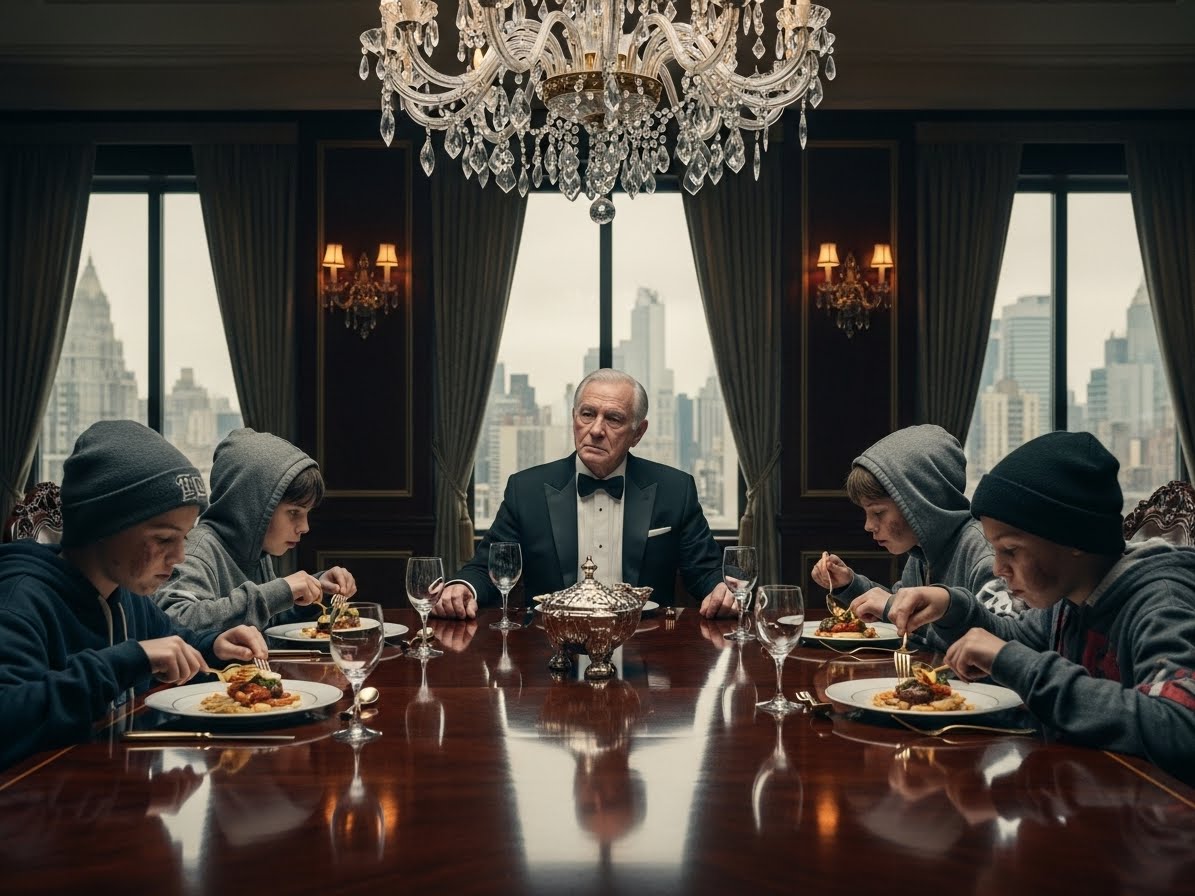
We tried to host a private dinner party at the mansion to smooth things over with a few key board members. I hired an etiquette coach. The boys learned which fork to use for salad and how to pour wine.
It was a disaster.
Only three couples showed up out of thirty invitations. The empty chairs at the long dining table felt like missing teeth. The guests who did attend treated the boys like zoo exhibits. When Lucas accidentally knocked over a water glass, the wife of a hedge fund manager sighed loudly.
“Whatever,” she muttered to her husband. “What do you expect from trash?”
I kicked them out. All of them. I didn’t care about the merger. I didn’t care about the board votes. I ushered them to the door and told them never to return.
That night, the mansion felt huge and silent. I sat in my study, staring at the fire, feeling the weight of my failure. I was dying, and instead of protecting these boys, I had painted a target on their backs.
“Alexander?”
It was Dylan. It was 3:00 AM.
“Go to bed, Dylan,” I groaned, clutching my side. The pain was bad tonight. Searing.
“We need you to come downstairs,” he said.
“It’s late.”
“Please. It’s important. The others are waiting.”
I sighed, grabbing my cane—I needed it now—and followed him. I expected a broken pipe or a nightmare.
He led me past the living room, past the kitchen, to the service elevator that went down to the basement levels.
“Where are we going?”
“The Hive,” Dylan said.
“The what?”
The elevator doors opened, and I stopped dead.
The basement, which had been a glorified storage space for old furniture and wine, was unrecognizable.
It hummed.
Computer servers were stacked on metal racks along the far wall, their cooling fans whirring aggressively. My old mahogany desk from the storage unit had been dragged to the center, covered in six monitors. Whiteboards lined the walls, covered in complex equations, chemical structures, and architectural blueprints.
Ethan, Tyler, Thomas, and Lucas were there. They looked up as I entered. They weren’t wearing pajamas. They were dressed in jeans and hoodies, looking wide awake.
“What is this?” I whispered.
“We call it Project Phoenix,” Ethan said, stepping forward. He looked exhausted, bags under his eyes, but his energy was electric. “We’ve been busy.”
“Busy doing what? This equipment… where did you get this?”
“We built it,” Tyler said, spinning a screwdriver in his hand. “We repurposed the processors from your old crypto-mining rig in the attic. And we borrowed some bandwidth from the neighbor’s unsecured Wi-Fi so we wouldn’t flag your internal network.”
“Why?” I asked, leaning heavily on my cane.
Ethan walked to the biggest whiteboard. It was covered in financial data.
“We heard what Lawson said at the party,” Ethan said. “About your company. He’s right. He’s trying to kill Morgan Investments. He’s shorting your stock, driving the price down so he can buy a controlling interest for pennies on the dollar when you… when you’re gone.”
He tapped the board.
“But he made a mistake. He’s leveraging his own company to do it. He’s overexposed.”
Ethan hit a key on the keyboard. The monitors flared to life, showing a complex algorithm running in real-time.
“We built a predictive model,” Thomas chimed in. “It analyzes market sentiment, global supply chains, and social media trends. It’s faster than the high-frequency trading bots on Wall Street because it doesn’t just look at numbers. It looks at people.”
“And?” I asked, stunned.
“And,” Ethan smiled wolfishly, “we can crush him. We can trigger a squeeze on his positions that will bankrupt Lawson Global in 48 hours. We can save your company, Alexander.”
I stared at the screen. The math was beautiful. It was genius. It was something my entire analytics department, with their MBAs and Ivy League degrees, hadn’t figured out.
“But that’s not all,” Lucas said softly.
He pointed to the other side of the room.
There was a lab bench set up. Microscopes, centrifuges, and stacks of medical journals.
Dylan walked over to it. He picked up a tablet.
“The money is the easy part,” the seven-year-old said. “The hard part is you.”
He pulled up a 3D model of a pancreas on the screen. It was covered in red clusters—my cancer.
“Your doctors are treating you with the standard protocol,” Dylan said, sounding like a fifty-year-old oncologist. “Gemcitabine and Paclitaxel. It’s not working because your tumor has a specific genetic mutation. The KRAS-G12D variant.”
My mouth fell open. “How could you possibly know that?”
“I hacked your medical files,” Tyler admitted from the corner. “Sorry. Privacy laws are more like guidelines.”
“We found a study,” Dylan continued, ignoring the confession. “From a university in Switzerland. It’s an immunotherapy treatment that targets that specific mutation. It was shelved because of funding issues.”
Lucas handed me a piece of paper. It was a schematic.
“I drew this,” Lucas said. “It’s a modification for the delivery system. If we can get the funding, and if we can find a doctor brave enough to try it…”
“We can buy you time,” Ethan finished. “Maybe a year. Maybe more. Enough time to fight.”
I looked around the room. At the humming servers. The stolen Wi-Fi. The illegal medical hacking. The sheer, audacity of it all.
These boys, who the world saw as trash, as leeches, had built a command center in my basement to save my life and my empire.
“You did all this…” I choked out, tears finally spilling over. “Why? Why try to save me? Why not just wait for the inheritance?”
The question hung in the air, heavy and real.
Ethan walked over to me. He looked me in the eye, the street toughness melting away to reveal a scared, loyal boy.
“Because you were the first person to look at us and see something worth keeping,” he said. “And because family doesn’t let family die without a fight.”
I dropped my cane. I pulled Ethan into a hug, and then the others swarmed in. We stood there in the humming basement, a dying billionaire and five street kids, plotting against death itself.
“Okay,” I said, wiping my face and finding my voice. It was stronger now. The ash taste was gone. “Show me the plan. Let’s go to war.”
PART 2 (Continued)
Chapter 5: The Snake in the Garden
The mansion underwent a metamorphosis. It was no longer a home; it was a fortress.
Alexander Morgan’s residence, once a cold museum of unused furniture, now vibrated with the heat of servers and the smell of ozone. We called it “Protocol Alpha.”
The East Wing was converted into a research facility. Dylan and Lucas, guided by remote consultations with renegade specialists I’d secretly hired, set up the treatment protocols. It was insane. It was illegal. And it was my only shot.
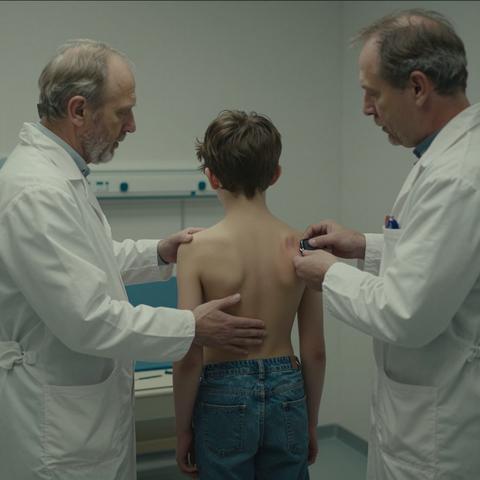
“This is going to hurt,” Dylan warned me on the first morning. He was wearing a lab coat that was three sizes too big, sleeves rolled up past his elbows. He held a syringe filled with a clear, viscous liquid—the experimental immunotherapy cocktail they had synthesized.
“Do it,” I said, rolling up my sleeve.
The pain was immediate, like liquid fire coursing through my veins. I gritted my teeth, refusing to scream in front of them.
“Vitals are stable,” Lucas reported, monitoring the screens. “Heart rate elevated, but within tolerance.”
While I fought the war in my blood, Ethan and the twins fought the war on the streets—Wall Street.
“The algorithm is live,” Tyler announced on the third day. We were gathered in the library, which had become the War Room. “We’re calling it ‘The Eye.’ It sees everything.”
The screens on the wall flickered with cascading data. Green lines shot upward.
“We just shorted three of Lawson’s shell companies,” Ethan explained, pointing to the graph. “The Eye predicted a supply chain failure in his microchip division forty-eight hours before the news broke. We made twelve million dollars in ten minutes.”
I watched in awe. These children were navigating the treacherous waters of high finance with the intuition of veteran sharks.
But success draws attention. And attention brings danger.
It started with a phone call from Diane Pembroke, the Chair of my Board of Directors.
“Alexander,” her voice was ice over granite. “The shareholders are nervous. There are rumors. Strange expenditures. Medical equipment deliveries. And… the children. People are saying you’re running a cult.”
“My personal life is not board business, Diane.”
“It is when the CEO is rumored to be mentally incompetent. There’s a vote of no confidence scheduled for Friday. If you don’t step down, we will remove you.”
“Let them try,” I snapped and hung up.
But the real threat wasn’t the Board. It was closer.
Eleanor Hayes, my executive assistant for twenty-three years, arrived the next evening. Eleanor was the gatekeeper of my life. She knew where the bodies were buried because she had helped dig the graves.
“I brought the files you asked for, sir,” she said, entering the library. Her eyes darted around the room, taking in the servers, the medical charts, the boys huddled over laptops.
“Thank you, Eleanor. Just leave them on the desk.”
She lingered. “Alexander, are you sure about this? These… people. You’re giving them access to the accounts? To the mainframe?”
“They’re helping me, Eleanor.”
She looked at Ethan, who was aggressively typing code. A flicker of something dark passed over her face—jealousy? Resentment?
“I’ve served you for two decades,” she said quietly. “I thought… when the time came… I would be the one you trusted.”
“I trust you with the company, Eleanor. I trust them with my life.”
It was the wrong thing to say.
Later that night, the pain from the treatment was unbearable. I was drifting in and out of consciousness in the makeshift hospital room. I reached for my secure phone to check the time.
It was gone.
Panic, cold and sharp, pierced through the drug haze. That phone contained the encryption keys to everything—Project Phoenix, the offshore accounts, the algorithm.
“Ethan!” I croaked.
The boys were there in seconds.
“My phone. It’s gone.”
“Lock down!” Ethan shouted. “Tyler, track the GPS!”
The twins scrambled. Minutes passed like hours.
“It’s still in the house,” Tyler shouted. “Wait… no. The signal just moved. It’s at the gate. It’s leaving.”
“Pull up the perimeter cameras,” I ordered, struggling to sit up.
The footage appeared on the large monitor. We watched in silence as a figure slipped out the side entrance, clutching a bag.
It was Eleanor.
“She has the phone,” I whispered. “And she took photos of the medical charts.”
“She’s going to Lawson,” Ethan said, his face grim. “She’s going to sell you out. She’ll give him the proof that you’re mentally unstable and undergoing illegal treatments. They’ll lock you up and dissolve the company.”
My chest tightened. Twenty years of loyalty, vaporized by envy.
“We have to stop her,” Lucas cried.
“No,” Dylan said. The seven-year-old stepped forward, a strange calmness radiating from him. “Let her go.”
“What?” I stared at him. “She has the blueprints! She has the algorithm code!”
Dylan smiled. It was a terrifying smile.
“She has what we wanted her to take.”
I looked at the twins. They were grinning.
“We switched the files on your phone an hour after she arrived,” Tyler explained. “We saw her snooping on the internal network. We didn’t stop her. We just… redirected her.”
“To what?”
“To a decoy folder,” Ethan said. “She thinks she stole the algorithm. What she actually stole is a logic bomb. The moment Lawson tries to upload that code into his trading system… well, let’s just say his servers are going to have a very bad day.”
I sank back onto the pillows, laughing until I coughed.
“You knew,” I rasped. “You knew she would betray me.”
“We know people,” Ethan said softly. “On the street, you learn to spot the hungry ones. She was starving for power, Alexander. It was only a matter of time.”
The snake had bitten, but we had milked the venom. Now, we just had to wait for the poison to work.
Chapter 6: The Boy King of Wall Street
The victory over Eleanor was sweet, but short-lived. The stress of the betrayal, combined with the aggressive immunotherapy, broke my body.
The next morning, I tried to stand up to use the restroom and simply crumpled. The floor rushed up to meet me, and then… darkness.
I woke up to the beeping of monitors. I wasn’t in a hospital. I was still in the East Wing, but the room had been upgraded. More machines. More tubes.
“He’s awake,” a voice whispered.
I opened my eyes. All five of them were there. They looked terrified.
“What happened?”
“System crash,” Dylan said, checking my IV drip. “Your blood pressure bottomed out. We had to resuscitate you.”
“The Board meeting,” I gasped, trying to rise. “It’s today. Friday. The vote of no confidence.”
“You can’t go,” Lucas said, pushing me gently back down. “You can’t even walk.”
“If I’m not there,” I wheezed, “Lawson wins. He’ll take over the company. He’ll stop the funding for the research. I die. You go back to the street.”
“No one is going back to the street,” Ethan said.
I looked at him. He was wearing my best suit—a charcoal Tom Ford that I hadn’t worn in years. It was slightly big in the shoulders, but he had tailored it with safety pins on the inside. He had combed his hair back. He wore non-prescription glasses he must have found in a drawer.
He didn’t look like a teenager. He looked like a shark in training.
“Ethan,” I warned. “You can’t go in there. They’ll eat you alive.”
“Let them try,” he repeated my words from the night before. “I have the Power of Attorney you signed last week. I am your legal proxy.”
“They won’t listen to a fifteen-year-old.”
“They’ll listen to the money,” Ethan said. “The Eye made us another fourteen million this morning. Money talks, Alexander. And right now, I’m the loudest voice in the room.”
He turned to his brothers. “Protocol Beta. Twins, keep the cyber defenses up. If Eleanor tries to detonate that data, I want to be ready. Lucas, handle the press. Dylan… keep him alive.”
With that, the boy turned and marched out of the room.
I watched the rest on the live feed from the boardroom security camera.
The Morgan Investments boardroom was a cavern of glass and steel. Twelve men and women in expensive suits sat around the table, looking impatient. Diane Pembroke checked her watch.
“He’s not coming,” she announced. “Alexander Morgan is incapacitated. I move to immediately—”
The doors banged open.
Ethan strode in. He didn’t walk; he prowled. He carried a leather briefcase and an air of absolute entitlement.
“Alexander sends his regards,” Ethan said, his voice dropping an octave to sound older. He threw the briefcase onto the table. It slid down the mahogany surface and stopped perfectly in front of Diane.
“Who are you?” Diane demanded, standing up. “Security!”
“I am the acting CEO,” Ethan said calmly. “And if you call security, I will release the dossier on your offshore accounts in the Cayman Islands, Diane. The ones you haven’t declared to the IRS.”
The room went dead silent.
“How dare you,” she sputtered, but she sat down.
Ethan didn’t blink. He walked to the head of the table—my chair—and sat down. He spun it slightly.
“Now,” he said, opening a folder. “Regarding the hostile takeover bid from Lawson Global.”
“It’s a generous offer,” one of the board members argued. “Considering the instability.”
“It’s a trap,” Ethan countered. “Lawson is insolvent.”
“That’s absurd. Lawson Global is a titan.”
“Lawson Global is a house of cards,” Ethan corrected. “And ten minutes ago, they tried to upload a piece of stolen code into their central trading algorithm. Code they thought was ours.”
He pointed to the large screen on the wall.
“Twins,” he said into his earpiece. “Put it on screen.”
The monitor flickered to life. It showed the live stock ticker for Lawson Global.
It was red. Deep, bloody red. The line was plummeting straight down.
“What is happening?” a board member screamed.
“A logic bomb,” Ethan explained casually. “They tried to use stolen intellectual property. Unfortunately for them, it corrupted their entire high-frequency trading platform. They are currently dumping stocks they meant to hold and buying stocks they meant to short. It’s a fire sale, gentlemen.”
He looked around the table, meeting every pair of eyes.
“Lawson is finished. Alexander Morgan protected this company. He protected your dividends. Now, I suggest we vote on that motion of no confidence.”
Diane looked at the screen, where Lawson’s stock was down 40% in minutes. She looked at the boy sitting in the CEO’s chair.
“Motion withdrawn,” she whispered.
Back in the mansion, watching the feed, I let out a breath I didn’t know I was holding.
“He did it,” Lucas cheered.
“Checkmate,” Tyler said, high-fiving Thomas.
But I was looking at Dylan. The seven-year-old was staring at my monitor, frowning.
“Alexander,” he said softly. “Your heart rate is spiking again. And… look at the markers.”
He turned the screen toward me.
The new blood work had just come in from the auto-analyzer.
“Is it bad?” I asked, bracing myself for the end.
Dylan looked up, tears welling in his enormous eyes.
“No,” he whispered. “It’s impossible.”
“What?”
“The tumor markers,” Dylan said, his voice shaking. “They aren’t just stable. They’ve dropped. By thirty percent.”
I stared at the numbers. It didn’t make sense. Thirty percent in a week?
“The fever,” Dylan realized aloud. “The collapse. It wasn’t the body failing. It was the Cytokine storm. It was the immune system waking up. It’s actually attacking the cancer.”
I lay back on the pillow, the room spinning.
My company was safe. My enemies were burning. And for the first time in months, the future didn’t look like a black wall. It looked like a door, slowly creaking open.
But as I closed my eyes, exhausted, I didn’t see the flashing red light on the perimeter security feed.
Ethan had stopped Lawson. He had stopped the Board. But we had forgotten about the one thing street kids fear most.
The System.
A black government SUV had just pulled up to the front gate. And the woman stepping out wasn’t a social worker. She was wearing an FBI windbreaker.
And she wasn’t alone.