“They’re Doing It To Mom Again”: The 911 Call That Froze Two Police Officers in Horror on Pinewood Lane
CHAPTER 1: The Storm Inside
The rain that night didn’t feel like normal rain. It felt like the sky was weeping, tapping a frantic, rhythmic warning against the thin glass of the living room window on Pinewood Lane.
Inside, the air was heavy. It was thick with a smell I had learned to hate before I even learned to read—the sour, metallic stench of cheap beer and stale cigarettes. It hung in the curtains; it seeped into the carpet. It was the smell of bad nights.
I was six years old.
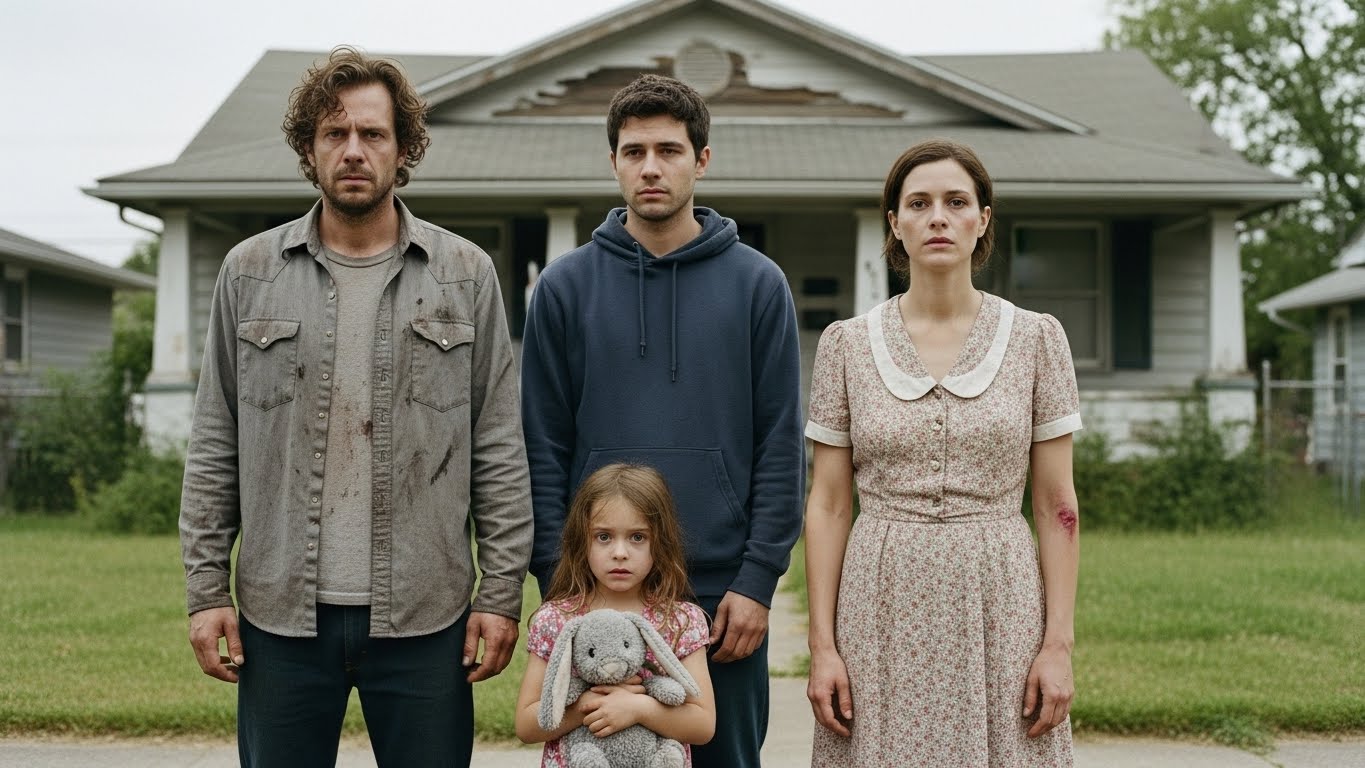
I sat cross-legged on the scratchy rug in the living room, my back pressed against the sofa. In my arms, I held Barnaby. He used to be a white rabbit, fluffy and bright, the kind you see in Easter commercials. Now, his fur was matted down, gray from dirt and stiff from dried tears. His left ear was hanging by a thread, but I didn’t mind. I held him so tight I could feel the seams stretching against my chest.
“Just stay quiet, Em,” I whispered to him, mimicking the way Mom whispered to me. “If we’re quiet, maybe they’ll forget we’re here.”
But the house was small. The walls were thin. And forgetting wasn’t something my father did when he was drinking.
Derek Grant was my father. When the sun was out, he was quiet. He worked at the garage, came home with grease under his fingernails, and sometimes he’d ruffle my hair and call me “Kiddo.” But when the sun went down, and the bottles came out, Derek went away.
The Monster took his place.
Tonight, the Monster had a friend. Kyle Monroe.
Kyle was shorter, twitchy. He had eyes that always looked like they were searching for an exit. He laughed too loud at my dad’s jokes, a desperate, cackling sound that made my stomach turn over. They had been in the kitchen since 5:00 PM.
Now it was dark.
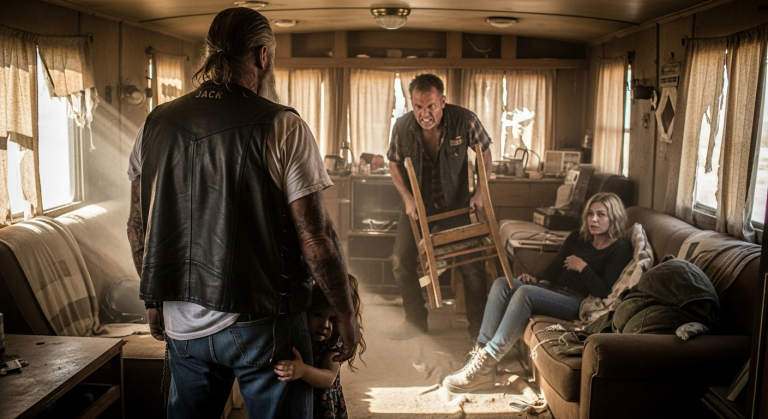
I heard the heavy thump of a fist hitting the kitchen table. The plates rattled.
“You think you’re better than me?” My dad’s voice was slurred, dragging the vowels out into long, ugly sounds. “Is that it, Mel? You think you’re some kind of… saint?”
“Derek, please,” my mom’s voice answered. It was shaking. I could picture her perfectly—standing by the sink, wringing her hands in her apron, eyes darting to the hallway, praying I was asleep. “I just said you’ve had enough. You have work tomorrow. Please.”
“Don’t tell me what I have!”
A chair scraped violently against the linoleum floor.
I flinched. I buried my face into Barnaby’s gray fur. Don’t go out there. Don’t go out there.
“Hey, easy, D,” Kyle muttered. His voice was lower, nervous. “She’s just sayin’…”
“Shut up, Kyle!” Dad roared. “You don’t know her! She looks at me like I’m trash! Look at her!”
I heard footsteps. Heavy. Stumbling. Then the sound of something breaking—glass. Maybe a beer bottle. Maybe a cup.
“Stop it! Derek, stop!” Mom screamed.
It wasn’t a warning scream. It was a scream of pain.
I squeezed my eyes shut, my heart hammering against my ribs like a trapped bird trying to break free of a cage. My breathing hitched. In through the nose, out through the mouth. That’s what Mom taught me. Be brave, Emily.
But I wasn’t brave. I was six. And I was terrified.
“You want to leave?” Dad shouted. “You want to take my kid and leave? Is that it?”
“I never said that!” Mom was crying now. “I just want you to stop drinking!”
Thud.
The sound was dull. Wet. Like a sack of flour hitting the floor.
“Mommy?” I whispered.
Silence.
For a second, the only sound was the rain lashing against the window and the humming of the refrigerator from the other room.
Then, Kyle’s voice, high-pitched and panicked. “Whoa, Derek. D, man… she’s down. You hit her hard.”
“She’s fine,” Dad grunted. “Get up, Mel. Stop acting.”
She didn’t answer.
My blood ran cold. I knew, with a chilling certainty that settled deep in my bones, that this time was different. This wasn’t the usual shouting. This wasn’t the usual push and shove.
The Monster hadn’t just come out to play. The Monster had broken something he couldn’t fix.
I looked at the phone on the wall in the entryway. It was an old beige landline with a long, curly cord. It looked a million miles away.
Mom had grabbed my shoulders two weeks ago, her eyes frantic, a fresh bruise blooming on her cheekbone like a dark flower. “Emily, listen to me. If it gets bad… if Daddy hurts me and I can’t get up… you know the number. We practiced. You call the number.”
I trembled. I stood up, my legs feeling like jelly. I clutched Barnaby in one hand and crept toward the hallway.
The kitchen light spilled onto the floor. I saw shadows moving. I saw a boot.
I didn’t look further. I couldn’t.
I reached for the phone.
CHAPTER 2: The Call and The Silence
My fingers were so small against the plastic buttons. My hands were shaking so violently that I missed the first time. I hit the ‘8’ by mistake.
Panic rose in my throat, tasting like bile. I hung up. I tried again.
Focus, Emily. Focus.
I pressed the receiver to my ear. The dial tone cut off, replaced by a ringing sound. One ring. Two rings.
“911, what is your emergency?”
The voice was a woman. She sounded calm. Professional. Like a teacher. It was so different from the chaos in the kitchen that it made me want to cry.
“My… my dad…” I whispered. I couldn’t find my voice. It was stuck in my chest.
“Hello? Is someone there?” the operator asked, her tone shifting, becoming more urgent.
I took a ragged breath. “My dad and his friend are drunk… they’re doing it to Mom again.”
There was a pause on the other end. A typing sound. “Honey, what’s your name?”
“Emily.”
“Okay, Emily. You’re doing a great job. How old are you?”
“Six.”
“Okay, six is big. You’re a big girl. Where are your mom and dad right now?”
I peered around the corner, just a tiny peek. I saw Kyle pacing back and forth, running his hands through his greasy hair. I saw my dad sitting on the floor, his head in his hands.
And I saw Mom’s foot. Just her foot. It wasn’t moving.
“They’re in the kitchen,” I choked out, tears spilling over now, hot and fast. “Mommy fell down. Dad hit her and she fell down and she won’t get up.”
“Is she awake, Emily?”
“No,” I sobbed. “She’s quiet. She’s too quiet. Please… please hurry. I’m scared.”
“I have officers on the way, Emily. They are coming very fast. I need you to go somewhere safe. Can you lock yourself in a room?”
“No,” I whispered. The locks on the bedroom doors didn’t work. Dad had broken them a long time ago. “The doors don’t lock.”
“Okay. Can you hide? Is there a closet? Or under a bed?”
“Under the table,” I said. “In the dining room. It has a big tablecloth.”
“Go there now, Emily. Take the phone if you can. If you can’t, leave it off the hook.”
I couldn’t take the phone. The cord wasn’t long enough.
“I have to go,” I said, my voice barely a squeak.
“Emily, don’t hang—”
I dropped the receiver. It swung against the wall, banging softly. Clack. Clack.
I ran on my tiptoes to the dining room table. It was an old oak table covered in a heavy floral cloth that reached almost to the floor. I dove under it, curling into a tight ball in the center, surrounded by the wooden legs of the chairs.
I pulled Barnaby over my face. I bit his ear to stop myself from screaming.
Time stopped.
I could hear them talking in the kitchen now.
“We gotta call someone, Derek,” Kyle was saying. He sounded like he was crying. “She’s bleeding, man. Look at the blood.”
“She tripped,” Dad mumbled. His voice sounded hollow. “She tripped. That’s what we say. She fell.”
“Nobody’s gonna believe that! Look at her head!”
“Shut up! Help me move her to the bedroom.”
“I ain’t touching her! This is on you!”
“You watched!” Dad roared. “You watched and you laughed! You’re in this too!”
I squeezed my eyes shut until sparkles appeared behind my eyelids. Please hurry. Please hurry. Please hurry.
I heard dragging sounds. The sound of fabric sliding over linoleum. A sickening, wet smear sound.
I covered my ears.
Then—sirens.
At first, it was faint, like a mosquito in the distance. Then it grew louder. A wail. A scream of machinery coming to save us.
Blue and red lights flashed through the dining room window, illuminating the dust motes dancing in the air under the table. They painted the floor in alternating stripes of color.
Tires screeched on the wet pavement outside. Car doors slammed.
“POLICE! OPEN UP!”
The voice was booming. Authoritative.
In the kitchen, the arguing stopped instantly.
“Oh god,” Kyle whispered. “They’re here.”
Crash. The front door burst open. I heard boots—heavy, confident boots—thundering onto the entryway floor. Rain swept in with them, cold and sharp.
“POLICE! SHOW ME YOUR HANDS!”
Officers James Porter and Maria Alvarez moved into the house with guns drawn. They had been to this house before. Domestic disturbances. Noise complaints. But never a Code 3—immediate threat to life.
Officer Alvarez scanned the living room. It was empty, save for the TV playing a infomercial on mute.
“Clear left!” Porter yelled.
“Kitchen!” Alvarez shouted back.
They moved toward the kitchen. I saw their black boots pass right by my hiding spot.
“Hands! Up! Now!” Porter barked.
I heard the sound of bodies hitting the floor. “Don’t shoot! Don’t shoot!” Kyle was screaming.
“Where is she?” Alvarez demanded. “Where is the female?”
“Bedroom,” my dad mumbled. “She’s… she’s sleeping.”
“Cuff ’em. Watch ’em,” Porter ordered.
Then, the boots walked back toward the hallway. Officer Alvarez paused near the dining table. Maybe she heard me breathing. Maybe she saw the slight tremble of the tablecloth.
She lifted the edge of the fabric.
The light hit my face. I flinched, holding Barnaby up like a shield.
Officer Alvarez’s face softened instantly. She holstered her weapon and crouched down. She smelled like rain and safety.
“Hey, sweetheart,” she whispered, her voice trembling just a little. “It’s okay. You’re Emily, right?”
I nodded. I couldn’t speak.
“You did good, Emily. You were so brave.” She reached out a hand. “Come out here with me. I don’t want you to be alone.”
I crawled out, clinging to her leg.
“James?” Alvarez called out to her partner. “I’ve got the child. Check the bedroom.”
Officer Porter was already at the bedroom door. He pushed it open with his foot, his service weapon raised, ready for anything.
But he wasn’t ready for this.
I saw him freeze. I saw the way his entire body went rigid, like he had been turned to stone.
The hallway light flickered. Porter lowered his gun slowly, his breath hitching in his throat loud enough for us to hear.
“Maria…” he choked out, his voice sounding wet and horrified. “Get the paramedics. Now.”
He turned back to look at us, and his face was pale, his eyes wide with a horror that he couldn’t hide. He looked at me, then looked away quickly, as if seeing me hurt him physically.
“Don’t let her come in here,” Porter said, his voice cracking. “Whatever you do, don’t let the kid see this.”
Alvarez pulled me into her chest, covering my eyes with her hand. But she was too late. Through the gap in her fingers, I had already seen the red soaking into the carpet.
And I knew.
CHAPTER 3: The Color of Silence
The world became a blur of blue lights and static noise.
Officer Alvarez picked me up. She didn’t ask if I wanted to walk. She just scooped me into her arms, pressing my face into the rough material of her uniform. It smelled like starch and rain.
“Don’t look, Emily. Just look at me,” she commanded. Her voice was fierce, protective.
But I was a child. And children are curious, even when they shouldn’t be.
As she carried me through the living room, past the overturned coffee table and the shattered glass, I peeked over her shoulder.
I saw the paramedics. They weren’t rushing anymore.
In movies, the ambulance people run. They shout “Clear!” and use paddles to shock hearts back to life. They move with a frantic energy that screams hope.
These men were moving slowly. One of them, a tall man with a mustache, was shaking his head at Officer Porter. He reached down and pulled a sheet up.
He didn’t put Melissa Grant on a stretcher to rush her to the hospital. He left her where she was.
That was the moment I knew.
My mother wasn’t just hurt. She wasn’t just sleeping. The Monster had won.
“Mommy?” I whimpered into Alvarez’s shoulder.
She tightened her grip on me, her fingernails digging slightly into my coat. “I’ve got you, honey. We’re going to go for a ride in my car. It’s warm in there.”
Outside, the rain had turned into a deluge. The entire neighborhood was awake. People stood on their porches under umbrellas, their faces glowing in the strobe of the police lights.
Mrs. Higgins from next door was there, clutching her robe tight to her throat. She looked at me as I was carried out, and for a second, our eyes met. She looked away first. She looked down at her slippers.
She had heard the screaming. She always heard the screaming. But she never called.
Alvarez placed me in the back of her patrol car. The seat was hard plastic, cold against my legs. She wrapped a heavy wool blanket around my shoulders and handed me a bottle of water.
“I need to go back inside for a minute, Emily. Can you be brave for me?”
I nodded, clutching Barnaby. His gray fur was wet now, soaked from the rain and my tears.
From the back window, I watched them bring out the men.
Derek Grant came first. My father.
He wasn’t roaring anymore. He looked small. Deflated. His hands were cuffed behind his back, and his head hung low. He was stumbling, his feet dragging on the wet pavement. He didn’t look at the crowd. He didn’t look for me.
Then came Kyle. He was crying. Actually sobbing. He was yelling something to the officers, twisting his body as if he could shake off the handcuffs.
“I didn’t do it! It was him! I tried to stop him!” Kyle screamed, his voice cracking in the night air.
Officer Porter shoved him into a separate squad car.
The doors slammed shut.
I sat alone in the dark, the radio on the dashboard crackling with voices I didn’t understand. Codes. Numbers.
10-55. Coroner requested.
I didn’t know what a coroner was. But the word felt cold.
A few minutes later, a different lady arrived. She didn’t wear a uniform. She wore a business suit and carried a clipboard. She looked tired.
This was the social worker from Child Protective Services.
“Hey there, Emily,” she said, opening the car door. “My name is Sarah. I’m going to take you somewhere safe for tonight.”
“I want my mom,” I said. My voice sounded like it belonged to someone else. It was hollow.
Sarah looked at Officer Alvarez. They exchanged a look—that adult look that screams pity.
“I know, sweetie,” Sarah said softly. “But Mom… Mom can’t come right now.”
They didn’t tell me she was dead. Not yet. They let me hold onto the lie for a few more hours.
As Sarah drove me away from Pinewood Lane, I twisted in my seat to look back at my house. It was lit up like a Christmas tree with police lights. Yellow tape was being strung across the front yard, fluttering in the wind.
It didn’t look like my home anymore. It looked like a crime scene.
And in the backseat of a stranger’s car, clutching a dirty rabbit, I felt the last piece of my childhood break off and float away.
CHAPTER 4: The House of Whispers
The days that followed were a gray haze.
I was placed in emergency foster care with a woman named Mrs. Gable. She was nice. She made pancakes in the shape of Mickey Mouse and had a golden retriever named Buster.
But I couldn’t eat the pancakes. And I didn’t want to pet the dog.
I stopped speaking.
The doctors called it “selective mutism.” They said it was a trauma response. I didn’t care what they called it. I just didn’t have any words left. All my words had been used up in that 911 call.
While I sat in Mrs. Gable’s window seat, staring at the rain, the world outside was dissecting my life.
I later learned—years later, when I was old enough to read the case files—what was happening in the interrogation rooms.
The detectives, Detective Miller and Detective Vance, were peeling back the layers of our life on Pinewood Lane. It wasn’t hard. The rot was right on the surface.
They interviewed the neighbors.
“Yeah, they fought a lot,” Mr. Henderson from across the street told them. “You’d hear yelling a couple of times a week. Usually after Derek got home from the bar.”
“Did you ever call the police?” Detective Miller asked.
“Well, no,” Henderson admitted. “You don’t want to get involved in domestic stuff, you know? It’s private. Plus, Melissa… she never asked for help.”
She never asked for help.
That phrase haunts me. Because she did. She asked with her eyes. She asked by wearing long sleeves in the summer to hide the grip marks on her arms. She asked by making sure I was always in the other room when the front door opened.
They found the medical records. Three visits to the ER in the last year.
“Fell down the stairs.” “Walked into a door.” “Slipped in the shower.”
The doctors knew. The nurses knew. They had given her pamphlets on safe houses. They had offered to call the police.
But Mom always said no.
“He’s under a lot of stress,” she would say. “He’s a good man when he’s not drinking. He loves Emily.”
She stayed for me. She thought a broken father was better than no father. She thought she could absorb the violence so it wouldn’t touch me.
But violence is like water. It seeps through everything.
Back at the station, the autopsy report came back.
Cause of death: Blunt force trauma to the cranium.
It wasn’t an accident. It wasn’t a “slip.”
The medical examiner determined that my mother had been struck multiple times. And then, when she was down, she had been kicked.
The force was enough to shatter bone.
When Officer Alvarez read the report, she had to leave her desk. She went to the bathroom and washed her face with cold water for ten minutes. She had a daughter my age. She told me later that she couldn’t stop seeing my face on every child she passed on the street.
The headline in the local paper the next day was brutal: “IGNORED CRIES: Mother Dead, Child Orphaned in Drunken Rage.”
The community was suddenly outraged. People who had heard the screams and done nothing were now posting on Facebook about “justice for Melissa.” They left teddy bears and flowers on our front lawn—the same lawn they used to ignore as they walked their dogs.
It made me angry. Even at six years old, I felt a burning, hot anger in my chest.
Where were you? I wanted to scream at them. Where were you when the lamp broke? Where were you when I was hiding under the table?
But I didn’t scream. I just hugged Barnaby tighter.
Mrs. Gable tried to get me to draw. She gave me crayons and paper.
“Draw how you feel, Emily,” she said gently.
I picked up a black crayon. I drew a big black square. Then I drew a smaller black square inside it.
“What is that, honey?” she asked.
I didn’t answer. But I knew what it was.
It was the dark. The dark under the table. The dark in the bedroom. The dark where my mother was now.
CHAPTER 5: The Rat and The Wolf
The legal system is a slow, grinding machine. But for Derek Grant and Kyle Monroe, the gears started turning immediately.
They were separated. Rule number one of interrogation: divide and conquer.
Derek was in Interrogation Room A. He was sobering up, and the reality of his hangover was hitting him harder than the reality of his crime.
He was slumped in the metal chair, rubbing his temples. He didn’t ask about Mom. He didn’t ask about me.
“Can I get an aspirin?” he asked Detective Vance.
Vance slammed a folder onto the table. “You want an aspirin? Your wife is in the morgue, Derek. Do you understand that? She’s dead.”
Derek blinked. His eyes were bloodshot, glassy. “I didn’t… I didn’t mean to. We were just arguing. She pushed me.”
“She pushed you?” Vance leaned in, his face inches from my father’s. “She weighed a hundred and ten pounds. You’re six-foot-two. She pushed you, so you bashed her head in?”
“I don’t remember,” Derek muttered, looking away. “It’s fuzzy. I blacked out.”
The “blackout” defense. The coward’s shield.
But in Interrogation Room B, Kyle Monroe was singing like a bird.
Kyle wasn’t a killer. He was a follower. He was a weak man who wanted to be tough, but when the blood actually started flowing, he crumbled.
He was pacing the small room, sweating through his shirt.
“I want a deal,” Kyle stammered as soon as Detective Miller walked in. “I’ll tell you everything. But I want a deal. I didn’t hit her. I swear to God, I didn’t touch her.”
“Sit down, Kyle,” Miller said calmly. “Talk to me.”
“We were drinking,” Kyle started, his words spilling out fast, tripping over each other. “Derek was in a mood. He got fired two days ago, did you know that? He didn’t tell Melissa. He was mad at the world.”
“Go on.”
“He started picking a fight. Melissa was just trying to make dinner. She told him to quiet down because the kid was awake. That set him off.”
Kyle took a shaky breath, wiping his nose with his sleeve.
“He threw a bottle. Missed her head by an inch. Then he grabbed her. I… I tried to stand up, man. I said, ‘Derek, chill out.’ But he pushed me back. He was strong. Crazy strong.”
“And then?”
“Then he threw her into the dresser. She hit hard. She went down. And he just…” Kyle gagged, covering his mouth. “He started kicking her. I heard it crack, man. I heard the crack.”
“Did you call 911?” Miller asked.
Kyle looked down. “No. I was scared. I thought… I don’t know what I thought. I froze.”
“A six-year-old girl called 911, Kyle,” Miller said, his voice dripping with disgust. “A baby had more guts than you.”
Kyle put his head on the table and wept.
The District Attorney, a sharp woman named Helen Ross, looked at the evidence. She had Kyle’s testimony. She had the physical evidence.
But the most damning piece of evidence wasn’t the blood. It wasn’t the fingerprints.
It was the tape.
The 911 call.
I listened to it years later. It’s a haunting thing to hear your own voice as a child, terrified, pleading for help that arrived seven minutes too late.
“My dad and his friend are drunk… they’re doing it to Mom again…”
That tape was the nail in the coffin.
The Grand Jury didn’t hesitate.
Derek Grant: Indicted for Murder in the Second Degree. Kyle Monroe: Indicted for Manslaughter and Failure to Render Aid.
But indictments are just pieces of paper. The real battle was the trial.
And the biggest question hung in the air: Would I have to testify?
Would they force a mute, traumatized six-year-old to sit on a stand, look her father in the eye, and point a finger at him?
Officer Alvarez came to visit me at Mrs. Gable’s house. She wasn’t in uniform this time. She wore jeans and a sweater.
She sat on the floor next to me while I colored another black square.
“Emily,” she said softly. “The bad men are in jail. They can’t hurt you anymore. But we need to make sure they stay there.”
I stopped coloring. I looked at her.
“You don’t have to speak if you don’t want to,” she promised. “But we might need you to be brave one more time.”
I didn’t know what “brave” meant anymore. I thought brave meant saving someone. And I hadn’t saved Mom.
But as I looked at Alvarez, I saw something in her eyes. A promise.
I reached out and took her hand. It was warm.
I nodded.
—————FULL STORY—————-
CHAPTER 6: The Monster in the Suit
The courthouse looked like a castle made of gray stone, cold and imposing against the downtown skyline. To a six-year-old, it felt like the belly of a whale.
I walked in holding Officer Alvarez’s hand on one side and Mrs. Gable’s hand on the other. I was wearing a dress that scratched my neck and patent leather shoes that felt too tight. I wanted my sneakers. I wanted my jeans. But Mrs. Gable said I had to look “presentable.”
The hallway was filled with people in suits, carrying briefcases that clicked when they walked. They spoke in hushed, urgent whispers. But when they saw me, the whispers stopped.
They knew who I was. I was “The Girl on the Tape.”
We entered the courtroom. It was a massive room with high ceilings and wood paneling that smelled like old furniture polish and dust.
And then, I saw him.
My father.
But he didn’t look like my father. He wasn’t wearing his greasy mechanic’s jumpsuit. He was wearing a suit that was too big for him, bunching at the shoulders. His hair was combed. He was shaved.
He looked like a stranger. He looked like a normal man.
That terrified me more than anything. If he could look like a normal man, how could anyone know he was a monster?
He turned his head. His eyes locked onto mine.
I stopped breathing. I expected him to yell. I expected the red-faced anger.
But he just stared. His eyes were dead. Like shark eyes. There was no love in them, but there was no anger either. Just a hollow, terrifying emptiness.
“Don’t look at him, Em,” Alvarez whispered, squeezing my hand. She led me to the front row, behind the table where the nice lady prosecutor, Ms. Ross, was sitting.
The trial began. It was a lot of talking. Words I didn’t understand. Objection. Sustained. Premeditation.
I sat there, clutching Barnaby, drawing invisible circles on the wooden bench.
Then, it was time for the evidence.
Ms. Ross stood up. She looked at the jury—twelve people sitting in a box, looking serious and sad.
“Ladies and gentlemen,” she said, her voice clear and strong. “You have heard the defense claim that this was an accident. That Derek Grant was merely a man pushed too far, who made a mistake in a drunken haze.”
She walked over to a small table with a machine on it.
“But accidents don’t sound like this.”
She pressed a button.
The sound of static filled the large room. Then, a ringtone.
And then, a voice. My voice.
“My dad and his friend are drunk… they’re doing it to Mom again…”
The sound of my own terror echoed off the high ceiling. It sounded like a ghost.
In the courtroom, you could hear a pin drop. The jury members shifted in their seats. One woman covered her mouth with a tissue. A man in the back row took off his glasses and rubbed his eyes.
“Please… please hurry… I’m scared…”
On the recording, you could hear the thud. The crash. The scream.
I squeezed my eyes shut. I didn’t want to hear it. I wanted to disappear. I pulled my knees up to my chest, burying my face in Barnaby’s fur.
Officer Alvarez put her arm around me, creating a shield against the sound.
When the tape ended, the silence was heavier than the noise had been.
Ms. Ross looked at the jury. “That was the sound of a six-year-old girl watching her mother die. That was the sound of a man who didn’t care.”
I peeked at my father.
He wasn’t looking at me anymore. He was staring at the table, his jaw clenched so hard a muscle was twitching in his cheek. He looked small.
For the first time in my life, I realized something.
He wasn’t a giant. He wasn’t a god. He was just a mean, small man who hurt people because he was broken.
CHAPTER 7: The Betrayal and the Gavel
The next day, the Monster’s friend took the stand.
Kyle Monroe looked terrible. He was wearing an orange jumpsuit. His skin was pale, pasty, like uncooked dough. He shook as he walked to the witness chair.
He had taken a plea deal. He would testify against Derek to save himself from a life sentence.
“State your name for the record,” the bailiff said.
“Kyle Monroe,” he whispered.
“Speak up, Mr. Monroe,” the judge commanded.
“Kyle Monroe!” he cracked.
Ms. Ross walked up to him. She wasn’t nice to him like she was to me. She was sharp.
“Mr. Monroe, tell the court what happened on the night of November 14th.”
Kyle swallowed hard. He wouldn’t look at Derek.
“We were drinking,” Kyle started. “Derek was mad about work. He was always mad about work. Melissa… she just came in to get a glass of water.”
“Did she provoke him?” Ms. Ross asked.
“No,” Kyle said. “She was tip-toeing. She was scared of him.”
“What did Derek do?”
“He started yelling. Calling her names. He threw a bottle. It smashed against the wall.” Kyle’s hands were trembling so hard the microphone in front of him vibrated. “She tried to run to the bedroom. He grabbed her by the hair.”
“Objection!” Derek’s lawyer shouted.
“Overruled,” the judge said. “Continue.”
“He threw her down,” Kyle said, tears starting to stream down his face. “She hit the dresser. She didn’t get up. I told him… I swear I told him… ‘Derek, stop, she’s hurt.’ But he didn’t stop.”
Kyle took a deep breath, a ragged, sobbing sound.
“He kicked her. Once. Twice. He was screaming that she was useless. That she was faking it. He looked at me and said, ‘She deserves it.'”
A gasp went through the courtroom.
Suddenly, a chair scraped loud against the floor.
“LIAR!”
It was my father.
He had jumped up. His face was purple, veins bulging in his neck. The mask of the “normal man” had fallen off. The Monster was back.
“You’re a liar, Kyle! You stood there and laughed! You’re a coward!”
“Order! Order in the court!” The judge banged his gavel, a loud wooden crack that sounded like a gunshot.
Two bailiffs grabbed my father, forcing him back into his chair. He was struggling, snarling like a wild animal.
I shrank back into my seat, my heart hammering. But Officer Alvarez was there instantly, standing between me and him. Her hand was on her belt, ready.
“Sit down, Mr. Grant, or I will have you bound and gagged!” the judge warned, his voice like thunder.
Derek slumped back, panting. He looked at the jury. They looked back at him with pure horror.
He had just shown them exactly who he was. He had just convicted himself.
The jury didn’t take long.
Two days later, we were back. The air in the room was electric.
“Have you reached a verdict?” the judge asked.
The head juror, a tall woman with gray hair, stood up. She held a piece of paper. Her hands were steady.
“We have, Your Honor.”
“In the case of The People vs. Derek Grant, on the charge of Murder in the Second Degree, how do you find the defendant?”
I held my breath. The whole world seemed to hold its breath.
“Guilty.”
A wave of air rushed out of the room. A collective exhale.
“And on the charge of Aggravated Assault?”
“Guilty.”
“And on the charge of Child Endangerment?”
“Guilty.”
The judge nodded. He looked at my father.
“Derek Grant, you have been found guilty by a jury of your peers. Due to the brutal nature of this crime, and the presence of a minor… I am sentencing you to life in prison without the possibility of parole.”
Life.
That meant forever.
That meant he was never coming back to Pinewood Lane. He was never coming to get me.
The bailiffs pulled him up. He didn’t fight this time. He looked defeated. As they led him away, the chains on his ankles rattled. Ching. Ching. Ching.
It was the most beautiful sound I had ever heard.
He walked through the side door and disappeared into the darkness of the prison system.
I looked at Officer Alvarez. She was smiling, but there were tears in her eyes.
“It’s over, Emily,” she whispered. “He’s gone.”
CHAPTER 8: The Sun After the Rain
Healing doesn’t happen in a straight line. It’s like a winding road with potholes and sudden turns.
For the first few months, I had nightmares. I would wake up screaming, convinced I could hear the heavy footsteps in the hallway.
But the footsteps never came.
I was adopted six months after the trial. A couple named Mark and Sarah. They lived in a town three hours away, in a house painted soft yellow, with a big oak tree in the front yard.
They didn’t try to replace my mom. They knew they couldn’t.
“We’re just here to love you,” Sarah told me on the first day, kneeling down to my level. “And to make sure you’re safe. You are always safe here.”
They bought me a new bed with a pink canopy. They bought me paints and canvases.
I started seeing a therapist named Dr. Andrews. She had a sand tray and puppets.
“The bad things happened,” Dr. Andrews told me. “We can’t change that. But we can change how much room they take up in your head.”
Slowly, the black squares in my drawings started to shrink.
I started using blue for the sky. Green for the grass. Yellow for the sun.
And one day, I drew a woman. She had brown hair and a kind smile. She was wearing angels’ wings.
I showed it to Sarah.
“That’s Mommy,” I said. It was the first time I had spoken about her without crying.
Sarah hugged me, and for the first time, I hugged back.
Years passed. The little girl who hid under the table grew up. I went to high school. I went to college. I studied psychology. I wanted to help kids who had seen the things I had seen.
One autumn afternoon, ten years after the verdict, I received an invitation.
The police department was opening a new wing of the domestic violence shelter. They were naming it “The Melissa House.”
I drove back to my old town. It felt strange to be there. The streets looked smaller.
The ceremony was crowded. There were ribbons and speeches.
And there she was.
Officer Alvarez.
She was older now. She had gray in her hair and stripes on her sleeve—she was a Sergeant now.
When she saw me, she froze. Then, she broke protocol. she ran to me and wrapped me in a bear hug that knocked the wind out of me.
“Look at you,” she said, holding me at arm’s length. “You’re beautiful. You’re strong.”
“I learned from the best,” I said, smiling.
She led me to the podium.
“I wasn’t going to speak,” I told her.
“You don’t have to,” she said.
But I looked at the crowd. I saw women with bruises they tried to hide with makeup. I saw children clutching stuffed animals, looking scared and small.
I walked to the microphone.
“My name is Emily,” I said. My voice didn’t shake. “Ten years ago, I made a phone call that changed my life. I was terrified. I was alone.”
I looked directly at a young mother in the front row.
“But I learned that the darkness doesn’t win. It only wins if we stay silent. My mother didn’t make it. But because of her, I am standing here. Because of her, this house exists.”
I took a deep breath, inhaling the crisp autumn air. It didn’t smell like rain and fear anymore. It smelled like leaves and hope.
“If you are scared,” I said to the crowd. “If you are hurting. Speak up. Scream. Call for help. There are people who will listen. There are hands ready to catch you.”
I looked up at the sky. It was a brilliant, cloudless blue.
“You are not alone,” I whispered. “And you are safe now.”
I felt a warm breeze brush against my cheek. It felt like a kiss.
I knew she was watching. And I knew, finally, that she was at peace.
And so was I.