My father mocked my military wedding—until 150 soldiers saluted me
Chapter 1: The Weight of White
The text message vibrated against the polished wood of the antique table in the bridal suite. Just one buzz. It was enough to crack the composure I’d spent two decades building.
I didn’t need to look at the sender’s name. I knew the cadence of his disapproval better than my own heartbeat.
Do not embarrass us by wearing that silly costume. Just be normal for once.
I stared at the phone until the screen went black, reflecting my own tightened jaw. My father, Richard Morgan, a man whose only currency was appearance and corporate status, had chosen the morning of my wedding to fire one last shot across my bow.
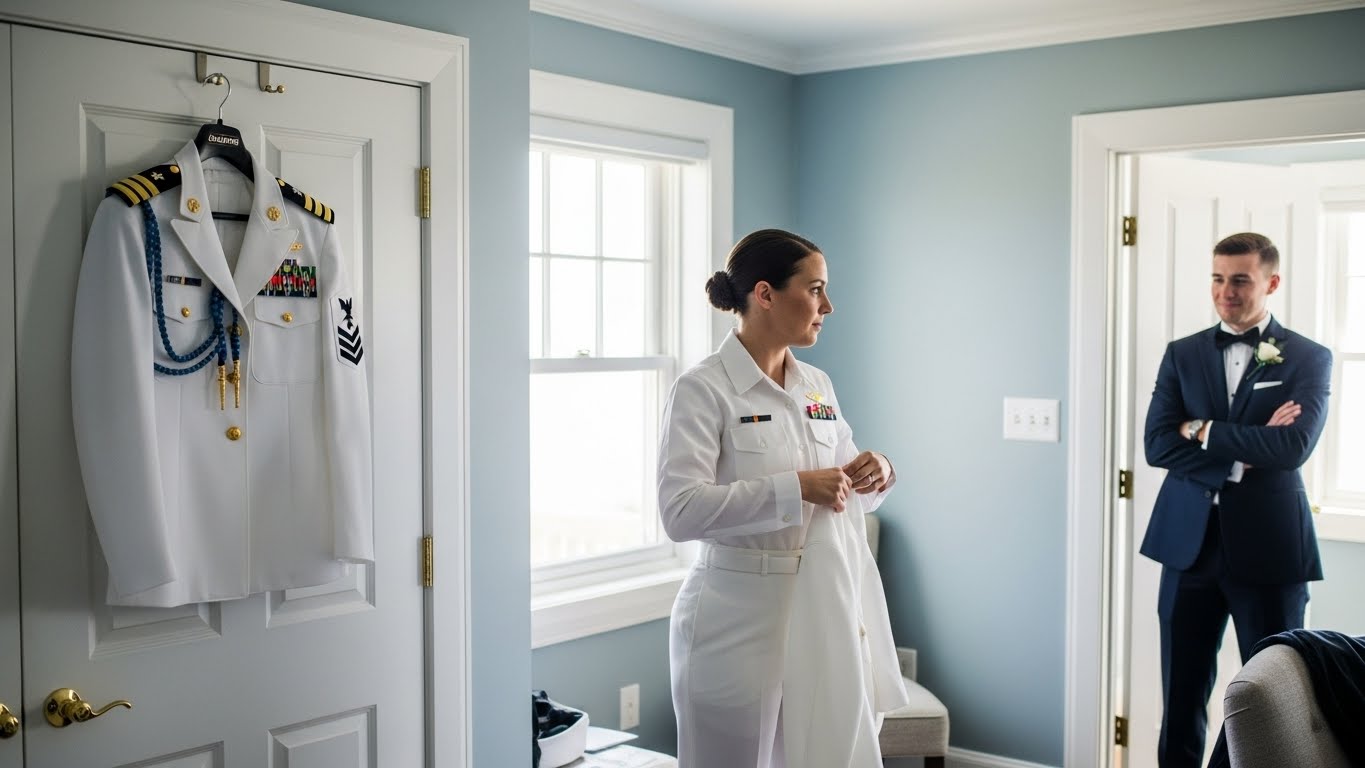
Slowly, I turned away from the phone to the uniform hanging on the wardrobe door. My Service Dress Whites.
To him, it was a costume. A rebellious phase that had stretched into a twenty-year career he refused to acknowledge. To me, it was a chronicle of survival.
I ran my fingers over the fabric. It was heavy, immaculate, tailored to a fraction of an inch. It didn’t just represent the United States Navy. It represented nights spent shivering in operational outposts, decisions made in split seconds that determined whether good people went home to their families, and the crushing weight of command.
The four stars gleaming on the shoulder boards weren’t jewelry. They were earned in blood, sweat, and the kind of silence that haunts you long after the noise of battle fades.
But to Richard Morgan, sitting out there in the chapel in his five-thousand-dollar Italian suit, waiting to give me away to a man he barely respected, I was just his disappointing daughter playing dress-up.
I had spent my entire childhood trying to twist myself into the shape he wanted. I tried to be quieter, prettier, softer. It never worked. I was always too intense, too driven, too much.
Joining the Navy wasn’t an escape; it was a desperate search for a place where what I did mattered more than how I looked doing it. I found that place. I rose through the ranks. I became Admiral Clare Morgan.
Yet, staring at that text message, I felt like I was ten years old again, waiting at the dinner table for a scrap of attention that was never going to come. The poison of his dismissal was potent. It was designed to make me feel small.
I breathed in slowly, a tactical pause. I was not that little girl anymore. I was a commander of fleets. And today, I wasn’t just getting married. I was drawing a line in the sand.
Chapter 2: The Golden Child’s Laugh
The door to the suite didn’t just open; it was breached with the casual arrogance of someone who has never been told “no.”
My brother, Daniel, strolled in. He was already in his tuxedo, looking every inch the corporate prince my father adored. Daniel was the golden child. The one whose mediocre achievements were heralded as triumphs, whose failures were always someone else’s fault.
He stopped short when he saw the whites hanging there. A grin spread across his face—not a smile of brotherly affection, but the smirk of someone who just found the punchline to a cruel joke.
He let out a short, sharp laugh that cut the tension in the room like a knife.
“Seriously, Clare?” He shook his head, adjusting his perfectly tied bowtie. “Dad is going to have an aneurysm. You couldn’t just put on a dress and play the part for five hours? You have to make this whole day about your… thing?”
My thing. My career. My life.
“It’s not a ‘thing,’ Daniel,” I said, my voice steadier than I felt. “It’s who I am. It’s my dress uniform. It is appropriate for the occasion.”
He rolled his eyes, leaning against the doorframe with studied nonchalance. “It’s a Halloween costume, Clare. Look, I get it, you’re tough. You’re one of the boys. Hoo-ah, or whatever. But today isn’t about the Navy. It’s about family. And you’re making us look ridiculous.”
The words hung in the air, thick with the accumulated resentment of years.
Daniel had never stood on the bridge of a ship in a churning sea, responsible for two thousand souls. He had never had to write a letter to a mother explaining why her son wasn’t coming back. His biggest crisis was a dip in the quarterly earnings report or a delayed flight to Vail.
Yet here he was, lecturing me on propriety.
“You know,” he continued, checking his expensive watch, “Mom’s already taking bets on how fast Dad leaves the reception if you wear that. Just think about someone other than yourself for once.”
He pushed off the doorframe, chuckling to himself as he turned to leave. “Good luck out there, Admiral. Try not to salute the priest.”
The door clicked shut behind him.
The silence he left behind was worse than his words. It was the silence of being utterly unseen by the people who share your blood.
I looked back at the uniform. Daniel’s laugh echoed in my ears, mixing with my father’s text message. They were so sure of themselves. So sure of my place in their world.
They thought they knew what was about to happen. They thought I was walking into that chapel to be judged by them one last time.
They were wrong.
I wasn’t walking in there alone. And they were about to find out that the “costume” they mocked commanded a loyalty they couldn’t buy with all the money on earth.
I reached for the jacket. It was time to get dressed.
Chapter 3: The Ghost at the Feast
To understand why I didn’t cancel the wedding, or simply elope to a courthouse to avoid my father’s judgment, you have to understand the Christmas dinner that broke me. It was the moment I finally realized that no amount of achievement would ever be enough to buy my way into this family.
The memory is three years old, but it sits in my chest like a jagged stone that refuses to erode.
It was a typical Morgan family Christmas. The house in Connecticut was decorated with the kind of professional precision that stripped all warmth from the holiday. The garland on the banister was symmetrical to the millimeter; the tree was a towering spruce adorned with glass ornaments that cost more than a junior enlisted sailor’s monthly paycheck. It was beautiful, cold, and utterly terrifying.
I had driven six hours from the naval base to be there. I was exhausted. I had just returned from a nine-month deployment, one of the most grueling of my career. I hadn’t slept in a real bed for weeks. I was craving warmth, turkey, and just a hint of “Welcome home, Clare.”
I should have known better.
Richard, my father, sat at the head of the mahogany table, carving the roast beast with surgical focus. He looked like a king holding court. My mother, Margaret, fluttered around him, an anxious hummingbird trying to ensure the wine glasses never dipped below the half-full mark.
And then there was Daniel.
He sat to my father’s right—the seat of honor. He was glowing. Actually glowing. He had just secured a promotion to Regional Vice President of Sales for a pharmaceutical company. To hear him tell it, he had single-handedly saved the American economy.
“It was a bloodbath in the boardroom,” Daniel said, gesturing with his fork, a piece of prime rib trembling on the tines. “The legacy guys didn’t want to pivot to the new software model. But I told them, ‘If you aren’t disrupting, you’re dying.’ Dad, you should have seen their faces. I walked out of there with a twenty percent budget increase and a corner office.”
My father beamed. It was a look I had chased for thirty years—a mixture of pride, respect, and deep satisfaction.
“That’s my boy,” Richard boomed, raising his glass. “That is how you command a room. You don’t ask for permission, Daniel. You take it. That’s the Morgan way.”
I sat silently at the far end of the table, near the kitchen door. I pushed a pearl onion around my plate. Command a room? Daniel had commanded a PowerPoint presentation.
I waited for the lull. I knew the rhythm of these dinners. Daniel would brag, Dad would praise, Mom would agree, and then there would be a brief silence while everyone chewed. That was my window.
“I have some news too,” I said. My voice sounded loud in the sudden quiet.
They looked at me. Not with interest, but with the polite confusion you give a stranger who has just interrupted a private conversation.
“I received the Defense Superior Service Medal last week,” I said. I tried to keep the pride out of my voice, tried to sound casual so I wouldn’t seem desperate. “It was for the task force leadership during the operation in the Gulf. The citation came from the Secretary of Defense.”
I reached into my pocket and pulled out the small velvet box. I had brought it, foolishly, thinking they might want to see it. I placed it on the table.
My father looked at the box. Then he looked at me. He didn’t pick it up. He didn’t open it.
“Another little pin, Clare?” he asked. His tone wasn’t angry; it was bored. “You have a chest full of those things. Do they come with a raise? A stock option?”
“It’s not about the money, Dad,” I said, my face heating up. “It’s one of the highest non-combat awards in the Armed Forces. It represents—”
“It represents government bureaucracy,” he cut in, waving his hand as if swatting away a fly. “It’s a participation trophy for state employees. Look at Daniel. He’s building equity. He’s building a legacy. You’re just… following orders.”
He turned back to Daniel. “So, tell me about the bonus structure for the next quarter.”
I froze. The room seemed to tilt. The velvet box sat there on the white tablecloth, an island of rejected sacrifice. I slowly reached out, took the box, and put it back in my pocket. My hand was trembling.
I excused myself ten minutes later. I walked out into the biting December cold and sat in my car. The engine block was frozen, and the leather seats were stiff, but I couldn’t go back inside.
I called my mother from the driveway. I watched her silhouette in the window, moving around the dining room, clearing plates.
“Mom,” I said when she answered. “Did you hear what he said?”
“Oh, Clare, honey,” she sighed. Her voice was tired. “Don’t be so sensitive. You know how he is. He’s from a different time. He doesn’t understand your world.”
“He doesn’t try to understand,” I snapped. “I’m an officer in the United States Navy. I command thousands of people. And he treats me like I’m a rebellious teenager working at a fast-food joint.”
“He just wants to see you settled,” she said, dropping the bomb that always ended these conversations. “He worries about you. He sees you in those clothes, running around with guns and rough men… he just wants you to be safe. To be normal. Like Daniel.”
Normal. Like Daniel.
I hung up the phone. I sat in the dark for an hour, watching the festive lights of my family’s home, realizing that the warmth inside was not for me. It never had been.
That night, I made a vow. I wouldn’t try to explain myself to them anymore. I wouldn’t bring my medals to dinner. I wouldn’t beg for scraps. If they couldn’t see me, I would force them to look.
And now, on my wedding day, that vow was about to come due.
Chapter 4: Valkyrie
My father thought my job was “following orders.” He thought I was a paper-pusher in a costume. He had no concept of the room I truly lived in—the room where I earned the name Valkyrie.
While Daniel was fighting over “software pivots” in a climate-controlled boardroom, I was usually standing in the center of the Joint Operations Center (JOC), a windowless bunker that smelled of stale coffee, ozone, and high-stakes adrenaline.
Six months before the wedding, I was in the JOC. It was 0300 hours. The world outside was asleep, but inside the bunker, the air was electric.
On the massive main screen, a grainy, night-vision drone feed showed a compound in a hostile region of the Middle East. Inside that compound were two American aid workers who had been taken hostage forty-eight hours prior. Outside, in the shadows of the alleyways, was a team of Navy SEALs.
My team.
I stood at the commander’s console. The headset pressed against my ear, filtering the low static of the encrypted comms channel. I wasn’t just watching a movie; I was the conductor of a symphony of violence and rescue. Every person in that room—intelligence officers, comms specialists, drone operators—was looking at me.
“Valkyrie, this is Bravo One,” the voice of the SEAL team leader crackled in my ear. “We have eyes on the target building. Heat signatures confirm two pax in the basement. Multiple tangos on the ground floor. We are burning daylight. Requesting green light for breach.”
I looked at the screens. I looked at the intelligence data streaming on the side monitors. The risk was astronomical. If I gave the order and the intel was wrong, I would be sending twelve men into a death trap. If I waited, the hostages would likely be moved or executed by sunrise.
The room was dead silent. I could hear the hum of the server banks.
This wasn’t a “corporate decision.” I couldn’t circle back next week. I couldn’t form a committee. I had to decide, right now, with human lives as the currency.
My father’s voice echoed in my head for a split second—silly costume.
I pushed the button on my mic. My hand was steady. My heart rate was 60 beats per minute. Ice cold.
“Bravo One, this is Valkyrie,” I said. My voice was calm, authoritative, absolute. “You are clear to engage. Execute Alpha. Bring them home.”
“Solid copy, Valkyrie. Moving.”
The screen erupted into controlled chaos. I watched the infrared figures breach the door. I listened to the sharp, staccato reports of gunfire, the calls for clearing rooms, the shouts of “Jackpot” when the hostages were secured.
For twenty minutes, I held the lives of those men in my hands. I guided air support. I coordinated the extraction choppers. I made three split-second calls that shifted their exit route to avoid an ambush.
When the helicopter lifted off, carrying the SEALs and the hostages to safety, the room let out a collective breath.
The team leader’s voice came back over the comms, breathless but relieved. “Valkyrie, we are wheels up. Package is secure. Drinks are on us when we get back. Good call on that extraction route. You saved our asses.”
“Just doing the job, Bravo One,” I replied. “Get some rest. Valkyrie out.”
I took off the headset and rubbed my eyes. A young Lieutenant handed me a fresh cup of coffee. He looked at me with something my father had never shown me: absolute awe.
“Nice work, Admiral,” he whispered.
That was the reality of my life. I was Valkyrie. I was the voice in the dark that the toughest men on the planet trusted with their lives. I didn’t need a corner office. I had the respect of warriors.
And that was why the text message in the bridal suite hurt, but it didn’t break me. My father thought he could shame me because he didn’t know who I was. He was mocking a ghost, a version of his daughter that didn’t exist anymore.
He was about to meet Valkyrie.
Chapter 5: The Trap is Set
Back in the present day, the timeline was ticking down.
I finished buttoning the jacket of my Service Dress Whites. The high collar felt restrictive to some, but to me, it felt like armor. I checked the ribbons on my chest—three rows of color that told the story of twenty years of service. The Defense Superior Service Medal was there. The “little pin” my father had dismissed.
I placed the combination cover—my hat—on my head, pulling the brim down until it sat perfectly level just above my eyebrows.
I looked in the mirror. I didn’t see a bride worrying about her makeup. I saw an Admiral preparing for an inspection.
“It’s time, ma’am,” a voice said from the door.
I turned. It wasn’t my brother. It was Master Chief Peterson, my senior enlisted advisor and best friend for the last decade. He was in his dress blues, holding the door open. He looked at me and grinned.
“You look sharp, Admiral,” he said. “The troops are in position.”
“Are they?” I asked, a small smile playing on my lips. “Did we have any issues with the ushers?”
“Negative,” Peterson laughed. “The ushers were… encouraged to follow the new seating chart. Your family is in the front row, stage left. The ‘special guests’ have been filtered in through the side entrances so the main hall looks empty to anyone sitting in the front. We wanted the element of surprise.”
“Perfect,” I said.
I walked out of the hotel and into the waiting limousine. The ride to the chapel was short. My phone buzzed again. Another text from Daniel.
We’re all seated. People are whispering. Where is your dress? Dad is furious.
I didn’t reply.
When the limo pulled up to the back of the chapel, the air was crisp. I could hear the organ music leaking through the stone walls. It was a traditional hymn, something somber and serious.
I stepped out. My Honor Guard was waiting. Eight sailors, perfectly matched in height, carrying rifles with gleaming bayonets. They snapped to attention the moment my foot touched the pavement.
“Ready, Admiral?” Ryan asked.
Ryan, my fiancé, walked around the corner. He was a Captain in the Navy, a pilot with eyes that had seen as much as mine. He was in his dress whites too. He looked handsome, but more importantly, he looked like a partner. He wasn’t threatened by my rank. He wasn’t trying to compete with me.
He took my hand and squeezed it. “I saw your dad inside,” he whispered. “He looks like he sucked on a lemon.”
“He’s about to look worse,” I said.
We moved to the vestibule at the rear of the chapel. The heavy oak doors were closed. I could hear the murmur of the crowd inside.
I knew exactly what my father was seeing right now. He was sitting in the front row, looking around at a seemingly half-empty church. I had instructed the military guests to sit in the back rows or stand in the choir lofts initially, keeping the main body behind the family clear.
Richard Morgan was likely thinking that no one had shown up. He was likely thinking that my “weird military life” had left me friendless and isolated. He was probably leaning over to Daniel right now, whispering about how embarrassing this turnout was.
He was constructing a narrative of my failure in his head.
I signaled to the Master Chief. “Give the order.”
Peterson nodded and spoke into his radio earpiece. “All units. Execute movement. Fill the gaps.”
Inside the chapel, though I couldn’t see it, I knew what was happening. The side doors were opening. The choir loft was filling. The silent, disciplined rows of men and women were filing in with the stealth they were trained for.
The organ music swelled to a crescendo and then cut out abruptly. The silence that followed was heavy.
It was time.
I nodded to the ushers. They gripped the heavy iron handles of the oak doors.
“Open them,” I commanded.
The doors swung outward. The light from the afternoon sun flooded the vestibule, framing me in a halo of brightness.
I stepped into the doorway.
The scene before me was etched into my mind forever. My father was turned halfway around in his pew, his face a mask of irritated boredom. Daniel was checking his phone.
But then, they looked up.
They saw me. They saw the white uniform. They saw the stars.
And then, they heard the sound. It wasn’t the wedding march. It was the sharp, thunderous crack of three hundred boots hitting the floor simultaneously as the entire congregation rose—not as guests, but as soldiers.
The trap was sprung.
Chapter 6: The Wall of White
The silence in the chapel was absolute. It was the kind of heavy, pressurized silence that precedes a bomb blast.
I stood at the threshold, the sunlight from the open doors casting a long shadow down the center aisle. My father, Richard, was twisting in his seat. I saw his lips move. I couldn’t hear the words, but I could read the shape of them.
She looks ridiculous.
He turned to Daniel, a smirk beginning to curl on his face, ready to share one last moment of mockery. He thought the guests behind him were just friends, neighbors, maybe a few work colleagues. He thought he was the most important man in the room.
Then, the voice of Master Chief Peterson shattered the air. It didn’t come from a microphone. It came from the diaphragm of a man who had shouted orders over the roar of helicopter rotors and mortar fire.
“ADMIRAL ON DECK!”
The reaction was instantaneous. It wasn’t the polite, shuffling stand of a church congregation. It was a violent, synchronized snap.
One hundred and fifty men and women—Navy SEALs, pilots, surface warfare officers, and enlisted sailors—shot to their feet. The sound of their heels striking the stone floor was like a single clap of thunder.
THWACK.
My father flinched. He physically jumped in his seat, his hands flying up as if to ward off a blow. Daniel dropped his phone.
The smirk vanished from my father’s face, replaced instantly by a look of primal confusion. He spun around, looking behind him for the first time.
What he saw wasn’t a sparse gathering of “friends.” He saw a wall of white and blue.
Rows upon rows of uniforms stood rigid. Chests were covered in medals that caught the light from the stained-glass windows. Faces were set in stone—expressions of fierce, unyielding loyalty. These weren’t just attendees; they were a phalanx.
They weren’t looking at the altar. They were looking at me.
I began to walk.
I didn’t walk with the hesitant, gliding step of a traditional bride. I walked with the cadence of an officer inspecting the line. My steps were measured. My chin was up.
As I passed the first pew, a hand snapped up. A salute. Then another. Then a wave of them, rippling down the aisle as I passed.
I saw Captain Miller, whose ship I had helped guide through a typhoon in the Pacific. He held his salute, his eyes wet.
I saw Petty Officer Gonzalez, a young corpsman I had recommended for a commendation after he saved three lives in a training accident. He looked at me with pure adoration.
I wasn’t “Richard’s daughter” here. I wasn’t “Daniel’s sister.” I was their Admiral.
I reached the front of the church. The air was vibrating with the energy of the salute. I stopped and turned to face my family.
My father was pale. All the blood had drained from his face. He looked at the sea of soldiers standing at attention behind him, then he looked back at me. For the first time in my life, I didn’t see judgment in his eyes.
I saw fear.
He was a man who understood power dynamics. He understood leverage. And in that moment, he realized he was hopelessly outgunned. The corporate title, the expensive suit, the country club membership—it all meant nothing in the face of this.
He looked small. He shrank into the pew, pulling his arms in close to his body, as if trying to make himself invisible.
Daniel was staring at a Navy SEAL standing in the aisle seat of the second row—a man who was six-foot-four, with a scar running down his jawline. The SEAL stared back, his face impassive, his physical presence overwhelming Daniel’s tailored softness. Daniel looked down at his lap, terrified.
I held my father’s gaze for three long seconds. I didn’t smile. I didn’t frown. I just looked at him with the cool, detached assessment of a commander surveying a neutralized threat.
Then, I broke eye contact, turned to the altar, and faced Ryan.
Ryan grinned, his eyes shining. He leaned in as I took my place beside him.
“I think they got the message,” he whispered.
“We’re just getting started,” I replied.
Chapter 7: The Empty Table
The reception was held in the grand ballroom of the officers’ club. It was a space designed for history—dark wood paneling, oil paintings of past fleets, and flags hanging from the rafters.
Usually, at a wedding, the bride’s family is the center of gravity. They host the table of honor. They receive the guests. They hold court.
My father had expected this. He had expected to sit at the head table, accepting congratulations on “giving me away,” making jokes about how much the wedding cost him, and networking with anyone who looked wealthy.
But I had arranged the seating chart myself.
The head table was for the bridal party—my fellow officers. The tables immediately surrounding us were for the active-duty teams.
My family was seated at Table 12. It was a nice table, near the back, by the kitchen swing doors.
I watched them from across the room. It was a study in isolation.
The room was roaring with laughter and storytelling. Pilots were reenacting dogfights with their hands; SEALs were toasting with beer bottles; Senators were mingling with Sergeants. The air was thick with a camaraderie that you cannot fake and cannot buy. It is a bond forged in fire.
And then there was Table 12.
Richard and Margaret sat there, stiff and awkward. Their expensive clothes looked like costumes now. No one was approaching them. No one was asking my father for investment advice. No one was asking Daniel about his promotion.
They were ghosts at the feast.
I saw a Four-Star General—the Vice Chairman of the Joint Chiefs of Staff—walk into the room. My father’s eyes lit up. He recognized power. He stood up, smoothing his jacket, preparing to intercept the General and introduce himself.
But the General walked right past him. He didn’t even glance at Richard. He walked straight to me.
“Clare,” the General boomed, taking my hands. “Incredible ceremony. And hearing about that operation last month? Phenomenal work. The Secretary wants a briefing on it next week.”
“Thank you, General,” I smiled.
My father froze in the middle of the floor, his hand half-extended. He looked like a man who had reached for a lifeline and grasped only air. He slowly lowered his hand and sat back down.
I decided to offer one act of mercy. I walked over to their table with Ryan by my side.
“Hello, Dad. Mom,” I said.
My mother looked up, her eyes wide and watery. “Clare… it’s… it’s very loud.”
“It’s a celebration, Mom,” I said.
My father wouldn’t look at me. He was staring at his untouched drink. The anger was gone, replaced by a sullen, defeated petulance.
“You made your point,” he muttered, his voice barely audible over the music.
“What point is that, Dad?” I asked, my voice sharp.
He looked up then. His eyes darted around the room, taking in the hundreds of people who adored me—people he deemed “low class” or “violent” or “weird.”
“That you don’t need us,” he spat out. “That you’re… whatever this is. You’re not one of us anymore.”
I looked at him, and I felt a sudden, profound sense of lightness. The weight I had been carrying for twenty years—the need for his approval—just evaporated.
“No, Dad,” I said softly. “I never was. And that’s okay.”
I turned to Daniel. He was scrolling through his phone, desperately trying to look busy.
“Enjoy the cake,” I said.
I walked away. I didn’t look back.
Twenty minutes later, I saw them leave. They didn’t come to say goodbye. They didn’t hug me. They just stood up, collected their coats, and slipped out the side exit.
I watched the door close behind them.
“You okay?” Ryan asked, his hand resting on the small of my back.
I took a sip of champagne and looked at the room full of my true family—the people who would take a bullet for me, and for whom I would do the same.
“I’m perfect,” I said. “I’m finally free.”
Chapter 8: The Definition of Legacy
It has been five years since that day.
I am sitting in my office at the Pentagon now. The window overlooks the Potomac River. There are four stars on my collar.
I don’t speak to my parents often. We exchange cards on holidays. The conversations are polite, brief, and shallow. They still talk about Daniel’s career, about the stock market, about the country club. They never ask about my work.
And I don’t offer it.
They still tell their friends that their daughter is “in the Navy,” saying it with a tone of vague apology, as if I’m working through a difficult phase.
But I know the truth. And more importantly, I know what legacy really means.
My father believes legacy is what you leave in a bank account. He believes it’s the family name etched onto a building or a seat on a board of directors. He thinks he is building something eternal.
But I have seen what happens to men like him when the power is stripped away. I saw it in the chapel. Without the suit and the money, he was small. He was terrified.
Legacy is not what you hoard; it is what you give.
My legacy is in the sailors I have trained who are now commanding their own ships. It is in the refugees we pulled from the ocean during the crisis in the Mediterranean. It is in the hostages who are home with their children because I made the right call in a dark room at 3:00 AM.
Legacy is the respect that stands up when you walk into a room—not because they have to, but because they want to.
Sometimes, late at night, I look at the wedding photo on my desk.
It’s not the formal portrait. It’s a candid shot taken during the reception.
I am throwing my head back laughing, holding a glass of champagne. Ryan is looking at me with love. And surrounding us, filling every inch of the frame, are the SEALs and officers. They are leaning in, arms draped over shoulders, a chaotic, beautiful mess of white uniforms and genuine joy.
You can’t see Table 12 in the photo. It’s cropped out.
And that is how I live my life now. I don’t focus on the empty seats or the people who couldn’t love me for who I was. I focus on the people who stood up.
To anyone out there who is fighting for approval from people who refuse to give it: Stop.
Don’t shrink yourself to fit into their small boxes. Don’t trade your stars for their comfort.
Build your own family. Earn your own respect. And when the time comes, walk down your own aisle with your head high.
Let them sit in the silence. You have an army to lead.