The House of Five Hearts: They Said We Weren’t a Real Family, Until a Voice from the Grave Changed Everything
Chapter 1: The Constellation and the Storm
The farmhouse in rural Vermont didn’t just sit on the land; it seemed to grow out of it, a sprawling, architectural hodgepodge of timber, stone, and ivy that defied structural logic but embraced warmth. To the locals in the nearby town of Burlington, it was just the “Miller Place,” but to ten-year-old Leo, it was the center of the universe.
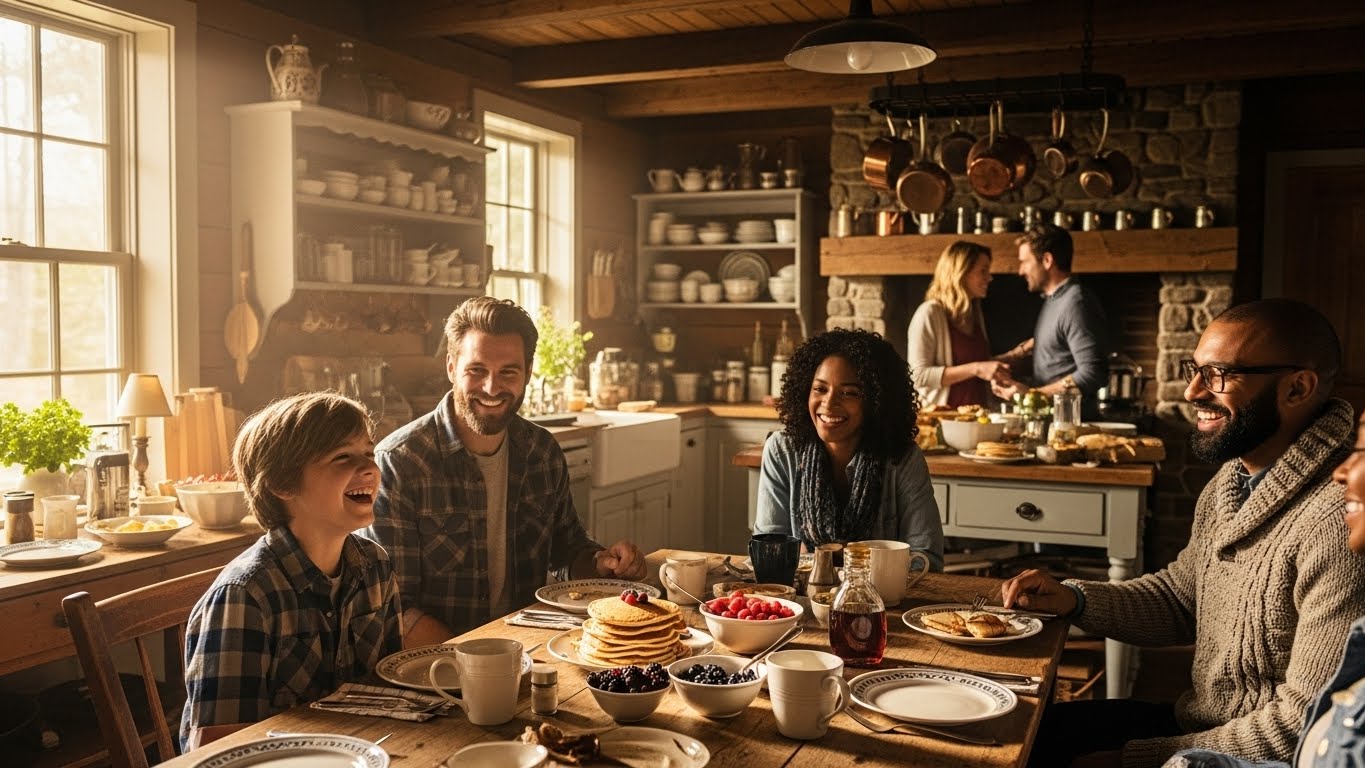
It was a Sunday morning in October, the kind where the maple trees set the hills on fire with reds and oranges, and the air tasted crisp, like apples and woodsmoke. Inside the farmhouse, the kitchen was a symphony of organized chaos.
“Leo, catch!”
Mark, a burly man with salt-and-pepper hair and the broad shoulders of a carpenter, tossed a clementine across the room. Leo, wearing his favorite Red Sox jersey, snatched it out of the air with a grin.
“Nice reflex, kid,” Mark grunted, turning back to the stove where bacon sizzled. Mark was “Dad 2,” the protector, the one who checked for monsters under the bed and taught Leo how to throw a curveball.
Sitting at the large oak table, Chris (“Dad 3”) was sketching rapidly in a charcoal pad. He was younger, leaner, with paint-stained fingers. “Hold that smile, Leo. Just like that. The light is hitting your cheekbone perfectly.” Chris was the artist, the dreamer, the one who taught Leo that the sky wasn’t just blue; it was cerulean, azure, and indigo.
Elena (“Mom 2”) breezed through the room carrying a basket of laundry, pausing to kiss the top of Leo’s head. She smelled of lavender detergent and oatmeal. “Eat your eggs, Leonardo. You have a math test tomorrow.” Elena was the anchor, the one who bandaged scraped knees and knew exactly how Leo took his hot chocolate.
And then there were Sarah and David. The biological parents. The “Origin Points,” as Chris liked to call them.
Sarah entered the kitchen adjusting an earring, looking radiant in a emerald dress that brought out the green in her eyes—eyes she had passed down to Leo. David was right behind her, struggling with his tie, looking every bit the pragmatic architect he was.
“You look like a movie star, Mom,” Leo said, his mouth full of toast.
Sarah laughed, a sound that seemed to make the dust motes dance. She wrapped her arms around Leo from behind, squeezing tight. “And you look like a crumb monster. Be good for Elena and the guys, okay? It’s just two days.”
“It’s our ten-year anniversary, buddy,” David added, finally conquering the tie. “We’ll be back Tuesday night. Maybe we’ll bring you that telescope you wanted.”
“Promise?” Leo asked.
“Cross my heart,” Sarah said. She looked around the room, her gaze lingering on Elena, Mark, and Chris. There was a profound, silent communication between them—a shared understanding that transcended conventional labels. They weren’t just roommates; they were a “constellation,” a family built not just on biology, but on deliberate, chosen love. “Take care of our boy,” Sarah whispered to Elena.
“Always,” Elena replied, smoothing Sarah’s collar. “Go. Celebrate. We’ve got this.”
The goodbye was standard. Hasty hugs, the smell of Sarah’s perfume—notes of vanilla and jasmine—lingering in the hallway, the sound of the station wagon crunching over the gravel driveway. Leo watched from the window until the car disappeared around the bend of the maple-lined road. He didn’t know that the image of the taillights fading into the autumn mist would be the last memory he would ever have of them.
The day passed in a blur of domestic bliss. Mark fixed the porch swing; Chris helped Leo paint a landscape of the backyard; Elena made a pot roast. It was a paradise built on five pillars, sturdy and seemingly unbreakable.
But paradise is fragile.
It started with the rain. Around 8:00 PM, the Vermont sky opened up. It wasn’t just rain; it was a deluge, a cold, aggressive sheet of water that hammered the tin roof like shrapnel. By 10:00 PM, the wind was howling.
At 11:15 PM, the phone rang.
It wasn’t a cell phone chirp; it was the heavy, ominous ring of the landline in the hallway. The house fell silent. Mark, who was reading by the fire, stood up. Elena froze mid-stitch on the sofa. Chris looked up from his sketchbook.
Mark answered. “Hello?”
Leo, watching from the top of the stairs, saw Mark’s back stiffen. He saw the color drain from the man’s neck. He saw Mark’s hand grip the edge of the table so hard his knuckles turned white.
“Yes,” Mark said, his voice sounding like it was coming from underwater. “Yes, that’s them. Yes. Oh, God. No.”
Mark hung up the phone. He turned around. He looked older, suddenly. Broken.
“What?” Elena whispered, standing up. “Mark, what is it?”
“The bridge on Route 7,” Mark choked out, tears instantly pooling in his eyes. “Hydroplaned. The guardrail gave way. They… they’re gone, El. They’re both gone.”
The scream that tore out of Elena’s throat was a sound Leo would never forget. It was primal, a sound of an animal caught in a trap. Chris dropped his sketchbook.
Leo didn’t move. He sat at the top of the stairs, his small hands gripping the banister. Gone? The word didn’t make sense. They were just buying a telescope. They were coming back Tuesday.
The next three hours were a nightmare montage. The flashing blue and red lights of the police cruisers washing over the living room walls. The solemn officers standing in the entryway, water dripping from their hats onto the hardwood floor. The coroner’s representative.
Leo sat on the sofa, flanked by Elena and Chris. Elena was trembling so violently she was shaking the couch. Mark was talking to the Sheriff, a man named Henderson who knew the family.
“I need to see the guardianship papers, Mark,” Sheriff Henderson said gently, his hat in his hand. “I know how you folks live. I respect it. But the law is the law. If Sarah and David are deceased, I need to know who has custody of the boy.”
Mark rummaged frantically through the filing cabinet in the study. Papers flew everywhere. Tax returns, deeds, bills. “We were working on it,” Mark stammered, sweat beading on his forehead. “We had the lawyer draft them last month, but Sarah… she wanted to change a clause about the trust fund. They haven’t been signed. Not the final notarized copies.”
Sheriff Henderson sighed, a heavy, mournful sound. “Mark. Without those signatures, legally… you’re strangers to the boy.”
“Strangers?” Chris stood up, his voice cracking. “I taught him to walk. Elena cut his umbilical cord. Mark pays for his school. We are his parents!”
“Not to the State of Vermont,” Henderson said, his eyes full of pity. “I have to call Child Protective Services. And I have to contact the next of kin.”
“No,” Elena gasped. “Not them. Sarah hasn’t spoken to her parents in six years. They hate us. They hate everything about us.”
“They are the biological grandparents,” Henderson said. “They are the default guardians.”
The wait for the grandparents was the longest hour of their lives. When the black SUV pulled up the driveway, it looked like a hearse.
Out stepped Arthur and Margaret. They were dressed in black, even though they couldn’t have known about the deaths for more than two hours. They looked like they belonged in a boardroom in Boston, not a mud-slicked driveway in Vermont. Margaret was sharp-featured, her hair a helmet of hairspray; Arthur was silent, imposing, leaning on a cane.
They walked into the house, ignoring Mark’s outstretched hand. Margaret looked around the cozy, cluttered living room with a sneer of undisguised disgust. Her eyes landed on Leo.
“Leonardo,” she said. Her voice was cold, lacking any warmth. “Get your coat.”
“I want to stay with Mom,” Leo whimpered, burying his face in Elena’s sweater.
“She is not your mother,” Margaret snapped. “She is the help. Or worse. Come here immediately.”
“You can’t take him!” Mark roared, stepping between them. “He just lost his parents. This is his home!”
“Officer,” Arthur spoke for the first time, his voice like grinding gravel. “Remove this man from my grandson’s vicinity. We have temporary emergency custody. We are taking the boy to a proper environment.”
The CPS worker, a tired-looking woman who clearly wanted to be anywhere else, nodded. “Mr. Miller, please step aside. You have no legal standing here. Don’t make me arrest you for interference.”
The scene that followed broke something inside Leo.
Margaret grabbed his wrist. Her grip was iron. “No! Elena! Mark! Chris!” Leo screamed, thrashing. “Don’t let them take me!”
“Leo!” Elena lunged, but the Sheriff held her back. “We love you! We’ll come for you! We promise!”
“Get your hands off him!” Margaret hissed at Elena, who had managed to brush Leo’s arm. “You’ve done enough damage with your perversion.”
Leo was dragged out into the rain. He looked back to see the only three people he had left in the world standing on the porch, illuminated by the porch light, sobbing helplessly against the police barricade. Mark was on his knees. Chris was burying his face in his hands. Elena was reaching out into the empty air.
The heavy door of the SUV slammed shut, sealing Leo in darkness.
Chapter 2: The Gilded Cage and the War Room
Boston was grey. Not the cozy, slate-grey of a Vermont winter, but the dirty, industrial grey of old money and cold concrete.
Leo was installed in a brownstone in Beacon Hill. His room was three times the size of his room at the farmhouse, but it was empty. The walls were beige. The bedspread was stiff and scratchy. There were no paintings on the walls, no charcoal sketches, no baseball mitts.
“We are saving you,” Margaret told him the next morning over a breakfast of grapefruit and dry toast. The silence in the dining room was deafening. The only sound was the ticking of a grandfather clock. “Your mother… she was confused. She fell in with bad people. A cult, really.”
“They aren’t a cult,” Leo said, staring at his spoon. “They’re my family.”
“Don’t speak of them,” Arthur rumbled from behind his newspaper. “We are scrubbing that filth from your life. You will attend St. Jude’s Academy starting Monday. You will learn proper values.”
Later that afternoon, Leo found his backpack in the hallway trash can. He scrambled to retrieve it. Inside was the sketchbook Chris had given him—filled with drawings of the farmhouse, of Sarah, of the trees.
Margaret appeared at the top of the stairs. “Arthur, burn it.”
“No!” Leo cried, clutching the book.
Arthur descended the stairs slowly, took the book from Leo’s hands with effortless strength, and walked to the fireplace in the parlor. He tossed it onto the logs. Leo watched in horror as the flames licked the edges of the paper, curling the charcoal image of his mother’s smiling face into ash.
“Cleanliness,” Margaret said, placing a hand on Leo’s shoulder. “It starts with wiping the slate clean.”
Three hundred miles away, the farmhouse was a tomb.
The silence was heavy, suffocating. Elena hadn’t showered in three days. She sat in Leo’s room, clutching his pillow, inhaling the fading scent of his shampoo.
Mark was in the kitchen, but he wasn’t cooking. The table was covered in legal pads and bank statements. He was on the phone, his voice hoarse.
“I don’t care what it costs, Steven,” Mark shouted into the receiver. “Liquiate the retirement accounts. Sell the truck. I want the best family law attorney in New England. I want a shark.”
Chris was in the studio, but he wasn’t painting beauty anymore. The canvases were dark, chaotic swirls of black and red. He was painting his grief. “We’re losing him, Mark,” Chris said, walking into the kitchen, covered in paint. “Every day he’s there, they’re poisoning him against us.”
“We have a hearing in two weeks,” Mark said, hanging up the phone. “The lawyer, Mr. Sterling, says it’s an uphill battle. A cliff, really.”
“Why?” Elena asked, appearing in the doorway, looking ghostly. “We raised him. We were the ones who sat up with him when he had the flu. We were the ones who taught him to read.”
“Because of the ‘Best Interests of the Child’ standard,” Mark explained, his voice breaking. “Sterling says the court favors biology and conventional stability. Margaret and Arthur are wealthy, upstanding citizens. We… we are three unrelated adults living together. To a conservative judge, we look unstable. Immoral, even.”
“So we have to prove we’re better parents?” Chris asked.
“No,” Mark said grimly. “We have to prove that separating him from us causes ‘irreparable harm.’ And we have to prove that Margaret and Arthur are unfit. But they aren’t abusive in the traditional sense. They’re just… cold.”
The days bled into weeks. Leo stopped trying to call. Margaret had blocked the numbers. He learned to be quiet. He learned that if he smiled and said “Yes, Grandmother,” the lectures would stop. He was learning to be a ghost.
Back at the farmhouse, Mark was organizing evidence. Photos of birthday parties. School report cards signed by Elena. Receipts for baseball camps paid for by Mark. It was a mountain of love, reduced to paper.
“It’s not enough,” Mark whispered one night, head in his hands. “Sterling says it’s all hearsay. It’s just ‘roommates helping out.’ We need a smoking gun. We need Sarah.”
“Sarah’s dead, Mark,” Elena sobbed.
“I know,” Mark said. “I know.”
He stood up to pace the room and knocked over a stack of boxes they had brought down from the attic—Sarah’s old things they were supposed to sort through. A box spilled open. Old clothes, books, and a silver iPad with a cracked screen.
“I remember this,” Chris said, picking it up. “She stopped using it a month ago because the screen cracked. She bought a new one.”
“Does it turn on?” Mark asked, without hope.
Chris plugged it in. The Apple logo appeared. He swiped it open. Sarah’s passcode was Leo’s birthday.
Chris opened the Photos app. He scrolled past hundreds of pictures of Leo. Then, he saw a video file. It was dated just three weeks ago. The thumbnail was Sarah, sitting on the front porch swing, looking directly into the camera. The duration was 12 minutes.
“Guys,” Chris whispered. “Come here.”
They gathered around the small screen. Chris pressed play.
Sarah’s face filled the frame. She looked tired but happy. “Okay, is this recording? Yeah. Hi. So, David thinks I’m paranoid, but I’ve been having these weird dreams lately. About… not being here. And with the trip coming up, I just… I wanted to leave a record. Just in case.”
Elena covered her mouth to stifle a sob. It was like she was in the room.
“I know our family looks weird to people,” Sarah continued on the screen. “I know my parents call it a sin. But I need the world to know something. If anything happens to David and me… Leo belongs in that house. With Elena. With Mark. With Chris.”
Mark’s breath hitched.
“Biology made me a mother,” Sarah said, wiping a tear. “But Elena? She’s his mommy. Mark is his dad. Chris is his soul. They are his parents. Not my parents. God, please, never my parents. They don’t know how to love a child without breaking him first. If I am gone, the Constellation is his home. Promise me.”
The video ended.
The room was silent for a long time. Then, Mark stood up. He picked up the iPad like it was the Holy Grail.
“Get the car,” Mark said, his eyes burning with a new, terrifying intensity. “We’re going to Boston.”
Chapter 3: The Judgment
The courtroom was suffocatingly warm. The wood paneling felt oppressive, closing in on the three people huddled at the defense table.
On one side sat Margaret and Arthur, flanked by a team of expensive lawyers. They looked the picture of grieving, responsible grandparents stepping up to save their kin.
On the other side sat Mark, Elena, and Chris. They looked exhausted. They had spent their life savings on this day.
Judge Halloway was an older man with bushy eyebrows and a reputation for being strictly by-the-book. He looked over his glasses at the assembly.
“This is a custody hearing for the minor, Leonardo Miller,” the Judge intoned. “Let us proceed.”
The grandparents’ lawyer, a shark named Mr. Vane, went first. He was brutal. He painted the farmhouse as a den of hedonism. He projected photos of the “communal sleeping arrangements” (which were just harmless sleepovers in the living room) and implied unspeakable things. He questioned Elena’s employment history. He questioned Chris’s mental stability as an artist.
“Your Honor,” Vane concluded, pacing before the bench. “This boy has lost his biological parents. He needs stability. He needs tradition. He needs blood relatives who can provide a moral compass, not a confusing experiment in social engineering.”
It was going badly. Elena could feel the Judge’s disapproval radiating from the bench. When Elena took the stand, Vane tore her apart.
“So, you have no legal relation to the child?” “No, but—” “And you have no income?” “I am a stay-at-home mother. Mark provides—” “So you are a dependent. A nanny, essentially?” “I am his mother!” Elena cried out. “Objection. Unresponsive,” Vane said coolly.
When it was Mark’s turn, his lawyer, Sterling, stood up.
“Your Honor,” Sterling said. “We have one piece of evidence we would like to submit. It was found on the decedent’s personal device.”
“Is this relevant?” Judge Halloway asked, looking at his watch.
“It is the mother’s dying wish, Your Honor,” Sterling said.
Margaret scoffed audibly from the other table.
The Judge nodded. “Proceed.”
Sterling connected the iPad to the courtroom monitor. The lights dimmed. Sarah’s face appeared, ten feet tall.
The courtroom fell dead silent.
As Sarah spoke—about her love for Elena, her fear of her own parents, her definition of family—the atmosphere shifted. The air grew heavy.
Margaret went pale. She stared at the screen, watching her dead daughter speak about her with such fear and pity. “They don’t know how to love a child without breaking him first.” The words hung in the air like an indictment.
When the video ended, you could hear a pin drop.
“I would like to call one final witness,” Sterling said quietly. “Leo Miller.”
The Judge hesitated. “He is a minor. I will interview him in my chambers. Counsel only.”
In the Judge’s chambers, Leo sat in a large leather chair, looking small and defeated. He wore a stiff suit his grandmother had bought him.
“Leo,” Judge Halloway said gently. “You saw the video?”
Leo nodded, tears streaming down his face. “Yes, sir.”
“Your grandparents… they can give you a lot. Best schools. Safety.”
Leo looked up. The fear was gone, replaced by a sudden, fierce clarity.
“Grandma smells like expensive soap,” Leo said, his voice trembling but clear. “And she’s cold. Even when she hugs me, she’s cold. Elena smells like oatmeal and rain. Mark smells like sawdust. Chris smells like paint.”
He took a deep breath. “Grandma threw away my baseball glove because it was ‘dirty.’ Mark oiled that glove every spring. Grandma burned my sketchbook. Chris taught me how to hold the pencil. I don’t want to be saved, Judge. I’m not lost. I just want to go home.”
The Judge looked at the boy. He looked at the transcript of the video. He looked at the law books on his shelf, which spoke of biology and statutes. Then he looked at his own heart.
Chapter 4: The Definition of Home
Back in the courtroom, Judge Halloway adjusted his robes. He looked tired.
“The law,” Halloway began, “is designed to protect children. Usually, that means placing them with blood relatives. It presumes that biology equals best interest.”
Margaret sat up straighter, a smug look returning to her face. Elena held Mark’s hand so tight her nails drew blood.
“However,” the Judge continued, his voice hardening. “The law also recognizes the doctrine of the ‘Psychological Parent.’ A person who, on a day-to-day basis, fulfills the role of a parent through interaction, companionship, and emotional support.”
He looked directly at Margaret and Arthur. “The video evidence provided by the late Sarah Miller is compelling. It clearly indicates her intent. But more importantly, the testimony regarding the destruction of the child’s personal property—his artwork—by the current guardians is… disturbing. It shows a disregard for the child’s emotional identity.”
Margaret gasped.
“Therefore,” the Judge slammed his gavel. “I am stripping Mr. and Mrs. Miller of custody effective immediately. Permanent Guardianship is awarded jointly to Elena Ross, Mark Evans, and Christopher Tate.”
The courtroom erupted. Elena screamed and collapsed into Mark’s arms. Chris jumped over the railing.
“This is an outrage!” Arthur shouted, standing up and waving his cane. “We will appeal!”
“You will sit down!” Judge Halloway roared. “Or I will hold you in contempt. The boy goes home today.”
The bailiff opened the side door. Leo came running out. He didn’t look at his grandparents. He sprinted, a blur of motion, and launched himself into the air.
Mark caught him.
It was a tangle of limbs, tears, and laughter. Elena was kissing Leo’s face, wiping away the tears. Chris was hugging them all. The “Constellation” had reformed. The missing stars—Sarah and David—were gone, but the gravity held.
Margaret stood by the exit, watching. She watched the way Leo buried his face in Elena’s neck. She watched the way he clung to Mark. She saw a raw, unfiltered love that she had never allowed in her own home, a love she had withheld from Sarah in the name of propriety.
For the first time in her life, Margaret felt a crack in her armor. She looked at the empty space beside her where her daughter should have been. “They don’t know how to love…”
She turned and walked out, old and alone.
Epilogue: Six Months Later
The farmhouse was loud. The smell of pancakes and turpentine filled the air.
It was spring now. The windows were open.
“Leo, you’re going to be late for practice!” Mark yelled from the porch.
“Coming, Dad!” Leo shouted, thundering down the stairs.
A car pulled up the driveway. It wasn’t a police car. It was a black sedan.
Leo froze on the porch. Elena stepped out, wiping her hands on a towel.
Margaret got out of the car. She looked different. Her hair was less stiff. She held a box. She walked up to the porch steps, stopping at the bottom. She didn’t look like a conqueror anymore. She looked like a guest.
“I… I brought something,” Margaret said, her voice shaking.
She handed the box to Leo. He opened it cautiously.
Inside was a high-end, professional artist’s sketchpad and a set of charcoals.
“I can’t replace the one we… the one that was lost,” Margaret said, struggling with the words. “But I thought maybe you could start a new one.”
Leo looked at the sketchpad, then at his grandmother. He didn’t run to her, but he didn’t run away. He looked at Elena. Elena gave a small, barely perceptible nod.
“Thanks,” Leo said.
“Would you…” Elena started, the hesitation heavy in her throat. “Would you like a cup of coffee, Margaret? The house is a mess, but the coffee is fresh.”
Margaret looked at the chaotic, loving, vibrant house—the house of five hearts. She looked at the woman raising her grandson.
“I would like that,” Margaret whispered. “Thank you.”
She walked up the stairs, leaving the cold behind, stepping finally, tentatively, into the warmth