My Millionaire Father Refused to Pay My Tuition. My “Poor” Stepdad Secretly Sold His Only Possession to Save Me. Years Later, I Found a Shoebox That Changed Everything.
Chapter 1: The Tale of Two Fathers
The acceptance letter from Yale felt heavier than the paper it was printed on. To me, Lucas Miller, an eighteen-year-old kid from a rust-belt town in Ohio, it wasn’t just paper; it was a golden ticket. It was the escape hatch from a life of coupon clipping and “maybe next month.”
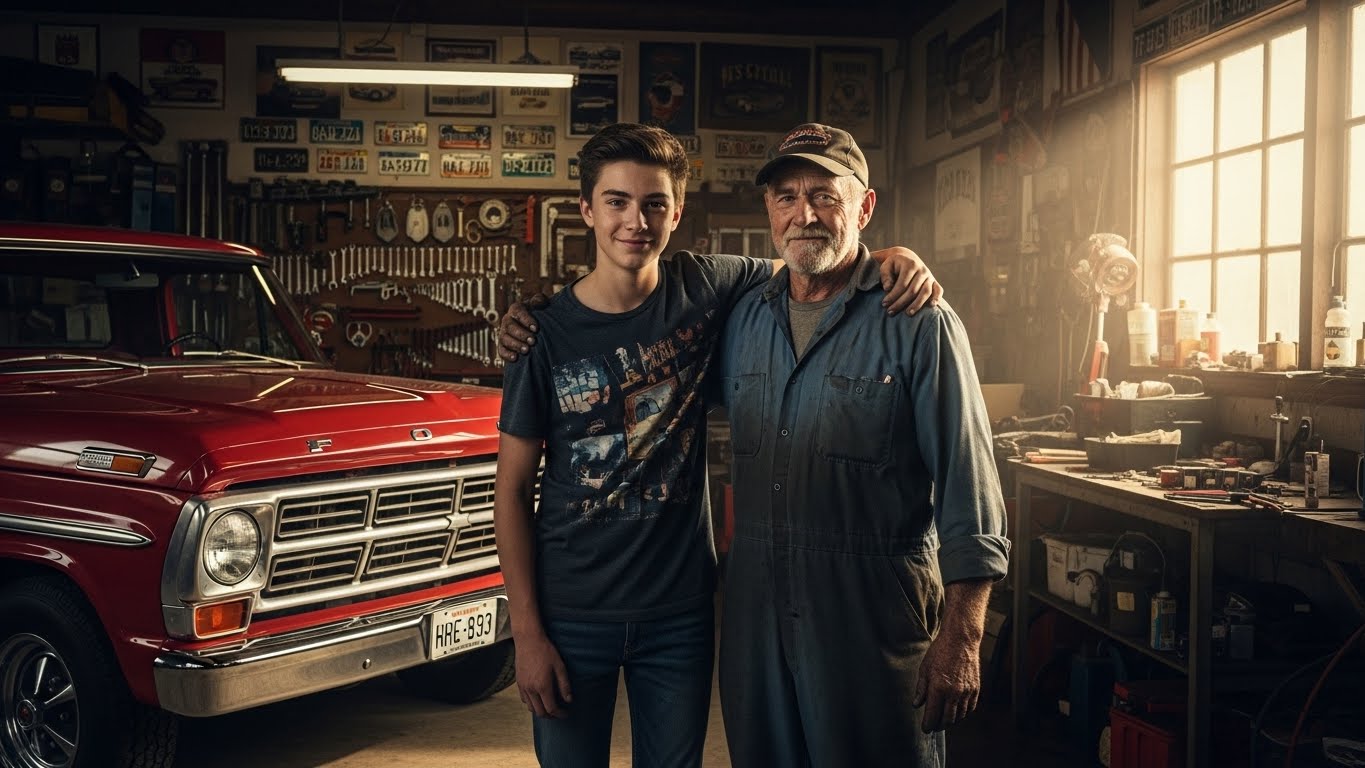
I remember running out to the garage, the smell of oil and old gasoline hitting me like a comforting blanket. Frank was there, of course. He was always there. He was under the hood of “The Red Lady,” his 1968 Cherry Red Ford F-100. That truck was more than a vehicle; it was the third member of our family. He’d spent twenty years restoring it, scouring junkyards for original parts, sanding away rust until his fingerprints were practically gone.
“Frank! Pop!” I shouted, waving the envelope.
Frank slid out from under the chassis on his creeper, wiping grease onto a rag that was already black. He squinted at the logo on the envelope, and his eyes, usually tired and crow-footed, widened. “Is that it? The big one?”
“I got in,” I breathed, my voice trembling. “I actually got in.”
Frank didn’t say a word. He stood up, his knees popping, and pulled me into a hug that smelled of Valvoline and Old Spice. It was a bear hug, the kind that squeezed the air out of you but put the confidence back in. “I knew it,” he rumbled against my shoulder. “Smartest kid in the state. I told your mom. I told everyone.”
That night, we celebrated in our usual way. Frank fired up the charcoal grill in the backyard. We had burgers—the cheap frozen kind—but Frank toasted the buns just right. We sat on the porch swing, watching the fireflies, and for a moment, everything was perfect.
But the next day brought the reality check. The financial aid package was decent, but the remaining tuition was astronomical. It was a number that made my mother cry at the kitchen table.
“We can’t do it, Luke,” she whispered, burying her face in her hands. “Even if we mortgaged the house… it’s not enough.”
“Don’t worry,” I said, though my stomach churned. “I have a plan. I have Richard.”
Richard was my biological father. He lived two towns over in a gated community called “Emerald Hills.” He was a corporate attorney who drove a Porsche and wore suits that cost more than Frank’s truck. He had left when I was two, but we had a scheduled “visitation” dinner once a month. It was usually transactional—he’d ask about my grades, brag about his firm, and pay the bill.
I called him. He agreed to meet at The Gilded Steer, the most expensive steakhouse in the city.
The contrast between my two fathers couldn’t have been starker. Frank had celebrated with frozen burgers and pride. Richard ordered a $200 bottle of Cabernet and barely looked at me.
“Yale,” Richard said, swirling his wine. “Impressive. Good genetics, obviously.”
“I worked hard, Dad,” I said, trying to keep my voice steady. “But I need help. Mom and Frank… they can’t cover the tuition. I need you to sign for the rest. Or maybe…” I hesitated. “Maybe you could help pay for it?”
Richard stopped swirling his glass. He cut a piece of his medium-rare filet mignon and chewed slowly. The silence stretched until I felt like I couldn’t breathe.
“Lucas,” he began, his tone patronizing, like he was explaining a contract clause to a junior associate. “I’m proud of you. But you know my philosophy. Handouts create weakness. Struggle creates character.”
“This isn’t a handout,” I argued. “It’s an investment. It’s my future.”
“It’s $60,000 a year,” Richard corrected. “And frankly, my liquidity is tied up. I’m closing on the new lake house next month, and I’ve ordered the new MasterCraft boat for the summer. I can’t tie up my cash flow right now.”
I stared at him. “A boat? You’re choosing a boat over my college?”
Richard wiped his mouth with a linen napkin. “Don’t be dramatic. You can go to state school. Or take out loans. Real men make their own way, Lucas. I built my empire from nothing. You should do the same.”
He signaled the waiter for the check. He didn’t even look guilty. He looked annoyed that I had ruined the ambiance of his meal.
I drove home in my beat-up sedan, tears of rage blurring my vision. Richard had millions. He could have written that check without blinking. But he chose a boat. He chose a toy over his son.
When I got home, the house was dark, except for the garage light. Frank was out there, polishing the chrome bumper of the Ford. He saw my face and knew.
“He said no?” Frank asked quietly.
“He said he’s buying a boat,” I spat out, kicking a tire. “He said ‘real men make their own way.'”
Frank looked at me, then at the truck. He ran his rough hand over the hood, a tender, loving gesture. “Well,” Frank said softly. “He’s a fool, Lucas. But we’ll figure it out.”
“There is no figuring it out, Frank!” I shouted, taking my anger out on the only father who actually cared. “It’s over! I’m declining the offer tomorrow.”
I stormed to my room and slammed the door. I didn’t know it then, but that was the night everything changed. That was the night Frank made a choice that would haunt me for the rest of my life.
Chapter 2: The Silent Sacrifice
The next morning, the house was strangely quiet. My mom was at work, and usually, I’d hear Frank tinkering in the garage or listening to talk radio. But there was nothing.
I walked into the kitchen, eyes swollen from a sleepless night. On the counter sat a large yellow envelope with my name on it. Next to it was a note in Frank’s blocky, all-caps handwriting.
“LUCAS. DON’T GIVE UP ON THE DREAM. HEAD UP. – POP”
I opened the envelope. Inside was a cashier’s check. The amount made my knees buckle. It was enough to cover the first two years of tuition, room, and board.
My heart hammered against my ribs. Had Richard changed his mind? Had my mom won the lottery?
I ran outside to find Frank. “Frank! Frank, what is this?”
I stopped dead in the driveway.
The garage door was open. The tools were there. The oil stains were there. But the spot where the 1968 Ford F-100 had sat for as long as I could remember was empty.
My stomach dropped. I ran to the backyard, then to the side of the house. No truck.
Just then, I saw Frank walking up the long driveway. He was walking slowly, his shoulders slumped, looking older than I had ever seen him. He was wearing his best flannel shirt, but he looked small. Defeated.
“Frank?” I ran to him. “Where’s the truck? Where did this money come from?”
Frank looked up, forcing a smile that didn’t reach his eyes. “Oh, hey kid. You get the envelope?”
“Frank, where is the Red Lady?”
He waved a hand dismissively, avoiding my gaze. “Ah, bad news on that front. Engine block cracked this morning when I started her up. Total loss. Pistons seized. It was gonna cost more to fix than she’s worth.”
“So… you sold it?”
“Scrap and parts,” he lied. He was a terrible liar, but I was so desperate to believe him. “But here’s the thing… I had an old union pension fund I totally forgot about. Cashed it out this morning. Combined with the scrap money from the truck… it’s enough.”
“Frank,” I said, holding the check. “This is… are you sure?”
He gripped my shoulder, his hand shaking slightly. “You are going to Yale, Lucas. You’re going to be a big shot. You think I care about an old truck? It’s just metal. You’re flesh and blood.”
I hugged him, crying into his flannel shirt. I was so relieved, so happy, that I didn’t question why a cracked engine block would require him to sell the entire truck in three hours. I didn’t question why he had walked five miles home from the scrapyard. I was eighteen, and I was selfish.
I took the money. I went to Yale. And I left Frank looking at an empty driveway.
Chapter 3: The Ivory Tower and The Drift
Yale was a different world. It was a world of old money, boat shoes, and weekends in the Hamptons. I threw myself into my studies, determined to prove Richard wrong—or perhaps, subconsciously, to become him.
I majored in Economics. I joined the right clubs. I softened my Ohio accent. I started dressing better. And slowly, inevitably, I began to drift away from home.
The calls to Frank and Mom became shorter. “How’s school?” Frank would ask. “Busy, Pop. Really busy. I have a mixer with Goldman Sachs tonight.” “Oh. That sounds… good. The driveway looks big without the truck, tell you that much.” “Yeah. Listen, I gotta run.”
I graduated top of my class and landed a job at a high-powered investment firm in New York City. I was making more money in a month than Frank made in a year. I bought a condo in Manhattan. I bought expensive suits. I became the man Richard wanted me to be.
I visited home rarely. When I did, it felt cramped. The house felt small. Frank looked frailer every time. Without the truck to work on, he had lost his purpose. He retired from the mechanic shop, claiming his arthritis was too bad. He spent his days sitting on the porch, staring at the empty spot where the Red Lady used to be.
He never complained. He just listened to my stories about mergers and acquisitions, nodding as if he understood, beaming with that same silent pride.
“You’re soaring, kid,” he’d say. “Just like I knew you would.”
But there was a sadness in him now. A hollowness. I saw it, but I chose to ignore it. I was too busy climbing the ladder.
Chapter 4: The Thanksgiving Betrayal
The turning point—the moment I look back on with the most shame—happened when I was twenty-six. I had come home for Thanksgiving. To “keep the peace,” I agreed to a joint dinner. My mom and Frank hosted, but Richard decided to grace us with his presence, bringing along his new, twenty-something girlfriend.
Richard pulled up in his new Mercedes. Frank was on the porch. He stood up to shake Richard’s hand. Richard barely touched him.
Dinner was excruciating. Richard dominated the conversation, bragging about his firm’s latest victory. He poured himself the wine he had brought, ignoring the beer Frank offered.
Then, the conversation turned to my success.
“Well,” Richard said, leaning back and unbuttoning his suit jacket. “Lucas certainly has the killer instinct. He gets that from me. It’s in the blood.” He looked around the modest dining room with a sneer. “God knows he didn’t learn how to close a deal in this neighborhood.”
My mom looked down at her plate. Frank kept chewing, his jaw tight.
“You know,” Richard continued, swirling his wine. “I’m still surprised you managed to pay for that education. Ivy League isn’t cheap.” He looked directly at Frank. “What did you do, Frank? Rob a bank? Or did you finally find some gold buried in that junk heap of a backyard?”
It was a cruel, classist jab. A direct insult to the man who had raised me.
And what did I do?
I didn’t flip the table. I didn’t defend Frank. I didn’t tell Richard to get out.
I laughed.
It was a nervous, awkward chuckle, trying to diffuse the tension, trying to stay in the “club” of successful men. “Heh. Yeah. Something like that,” I said.
I saw Frank flinch. It was subtle—a slight drop of his eyes, a tightening of his hand around his fork. He looked at me, not with anger, but with profound disappointment. He realized in that moment that I was ashamed of him.
Frank stood up quietly. “I’m gonna check on the pie,” he mumbled.
He walked into the kitchen. He didn’t come back out until Richard left.
That was the last Thanksgiving we all spent together.
Chapter 5: The Empty Chair
Four years later, I was a Junior Partner. I was thirty years old. I was in a meeting about a hostile takeover when my phone buzzed. It was my mom.
I sent it to voicemail. I was busy.
She called again. And again.
I stepped out of the conference room, annoyed. “Mom, I’m in a meeting, I can’t—”
“Lucas,” her voice was broken, a sound I’ll never forget. “It’s Frank. He’s gone.”
Massive heart attack. He had died in the garage, sitting on his old mechanic’s stool, looking at the wall where his tools used to hang.
The funeral was a blur of rain and black umbrellas. Richard sent flowers but didn’t come. I stood by the grave, feeling a numbness that scared me. I realized I didn’t know the man in the casket anymore. I had spent ten years running away from him.
After the funeral, I stayed to help my mom sort through his things. The house was filled with silence. I walked into the garage. It smelled of dust and stale oil.
“He wanted you to have this,” my mom said, standing in the doorway. She handed me an old, battered shoebox wrapped in duct tape. It was labeled “LUCAS’S FUTURE.”
I sat down on the cold concrete floor and opened it.
Inside wasn’t money. It was paperwork.
On top was a Bill of Sale. Dated twelve years ago. The day before he gave me the check.
Item: 1968 Ford F-100. Restored. Buyer: Miller Construction Co. Price: $42,000.
The exact amount of the first two years of Yale tuition.
He hadn’t found a pension fund. There was no cracked engine block. He had sold the Red Lady. He had sold his heart, his hobby, his retirement, his legacy—for me. And he had sold it to a construction company, knowing they would beat it into the ground.
Under the bill of sale was a letter. The paper was yellowed. He must have written it the night he sold the truck but never sent it.
“Dear Lucas,
If you’re reading this, I’m probably gone. I know you wondered where the money came from. I lied because I didn’t want you to feel guilty. I didn’t mind walking, kid. I really didn’t. I just wanted to see you fly. That truck was just metal and rubber. You are my legacy. You are the best thing I ever helped build. Don’t look back. Just keep driving.
Love, Pop.”
The tears came then. Violent, racking sobs that echoed in the empty garage. I curled up on the floor, clutching the letter. I remembered my laugh at Thanksgiving. I remembered Richard’s boat.
Richard wouldn’t sacrifice a weekend for me. Frank had sacrificed everything.
Chapter 6: Rust and Regret
I returned to New York, but I was a ghost. I couldn’t focus on spreadsheets. I couldn’t care about stock prices. All I could see was Frank walking up that driveway.
I hired a private investigator. “Find the truck,” I told him. “I don’t care what it costs.”
It took three weeks. The truck was in a scrapyard in New Jersey, about to be crushed. It had been used as a hauling truck for a cement company for a decade.
I drove there immediately. When I saw it, I nearly vomited.
The Cherry Red paint was gone, replaced by primer and rust. The grill was smashed. The bed was dented and filled with trash. The “Red Lady” was a broken shell.
“You want this piece of junk?” the yard owner asked, spitting tobacco. “Engine’s dead. Transmission is shot. It’s scrap.”
“How much?” I asked.
“$500.”
“I’ll give you $5,000 if you tow it to my house in Ohio today.”
I bought the truck. Then, I made another call.
Richard picked up on the second ring. “Lucas! Long time. I heard about Frank. Shame.”
“Don’t,” I said, my voice ice cold.
“Excuse me?”
“Don’t say his name. You don’t have the right.”
“Lucas, you sound emotional. Let’s discuss this when—”
“There’s nothing to discuss,” I interrupted. “I’m done, Richard. I don’t want your connections. I don’t want your inheritance. I don’t want to be anything like you.”
“You’re being irrational. You’re my son.”
“No,” I said, looking at the rusted carcass of the Ford F-100. “I’m just your biology. Frank was my father.”
I hung up. I blocked his number. I never spoke to him again.
Chapter 7: The Roar of Redemption
I quit my job. My partners thought I was insane. “You’re on the track to Senior Partner!” they screamed. “You’re throwing away millions!”
“I’m buying back my soul,” I told them.
I moved back to Ohio. I moved into my old room. And I went into the garage.
I didn’t know much about cars, not really. I had watched Frank, but I had never learned. So, I learned. I bought manuals. I watched videos. I hired an old friend of Frank’s to teach me.
It took two years.
Two years of busted knuckles, grease in my hair, and sweat in my eyes. I stripped the truck down to the frame. I sanded every inch of rust. I hunted down parts from all over the country.
It was my penance. Every bolt I tightened was an apology to Frank. Every layer of paint was a “thank you.”
I repainted it Cherry Red. The exact shade.
Last week, I finally finished. The truck sat in the driveway, gleaming in the sun, looking exactly as it did the day I got my acceptance letter.
But I didn’t stop there. I used my savings—the money I had made in the “ivory tower”—to start a foundation. The Frank Miller Initiative. We provide full-ride scholarships to trade schools and colleges for the children of mechanics, construction workers, and janitors. No loans. No questions asked.
Yesterday was the first drive.
I put my three-year-old son, faint grease smudges on his cheeks, into the passenger seat. He looked at me with wide eyes.
“Is this Grandpa’s fwuck?” he asked.
“Yeah, buddy,” I smiled, fighting back tears. “This is Grandpa’s truck.”
I put the key in the ignition. I held my breath.
I turned it.
The engine roared to life. A deep, throaty rumble that shook the ground. It sounded like strength. It sounded like love. It sounded like forgiveness.
I looked at the empty passenger seat next to my son, imagining Frank sitting there, wiping his hands on a rag, smiling that silent, proud smile.
“We’re going for a ride, Pop,” I whispered.
I shifted into gear and drove down the driveway, the sun reflecting off the hood, finally heading in the right direction.