The Obituary Said She Died in 1984, But A Secret Ledger In My Father’s Desk Led Me To A Run-Down Nursing Home Where My “Dead” Sister Has Been Waiting For Me For 40 Years.
Chapter 1: The Ledger of Sins
The rain at Judge Harrison Vance’s funeral didn’t wash away the grief; mostly, it just made the lies slicker.
Arthur Vance, sixty-two years old and a retired District Attorney himself, stood under the black canopy at the cemetery in Greenwich, Connecticut. He watched the mahogany casket descend into the wet earth. Around him, the town’s elite—senators, bankers, old money socialites—bowed their heads. They whispered words like “integrity,” “pillar of the community,” and “moral compass.”
Arthur felt nothing but a dull, gray exhaustion. He adjusted his glasses, wiping a stray droplet of rain from the lens. He had spent his entire life trying to live up to the man in that box. Harrison Vance had been a terrifyingly perfect father: a man of ironed shirts, starched principles, and zero tolerance for imperfection.
“He was a great man, Artie,” said Mrs. Calloway, the head of the Historical Society, placing a gloved hand on Arthur’s arm. “You must be so proud to carry on his legacy.”
“Thank you, Margaret,” Arthur lied, his voice practiced and smooth. It was the lawyer’s voice he had perfected over forty years. “He loved this town.”
Did he? Arthur wondered. Harrison Vance loved order. He loved reputation. He loved the idea of a family more than the messy reality of one.
Two days later, the house was quiet. It was a sprawling colonial estate that smelled of lemon polish and old leather. Arthur was in his father’s study, a room he had been forbidden to enter as a child. Now, it was his duty to dismantle it.
He was sorting through the financial records. His father’s estate was immaculate, of course. Stocks, bonds, real estate holdings—everything organized in color-coded binders. Arthur was about to close the final ledger for the 1980s when a small, loose slip of paper fluttered to the floor.
He bent down, his knees popping slightly—a reminder of his own age—and picked it up.
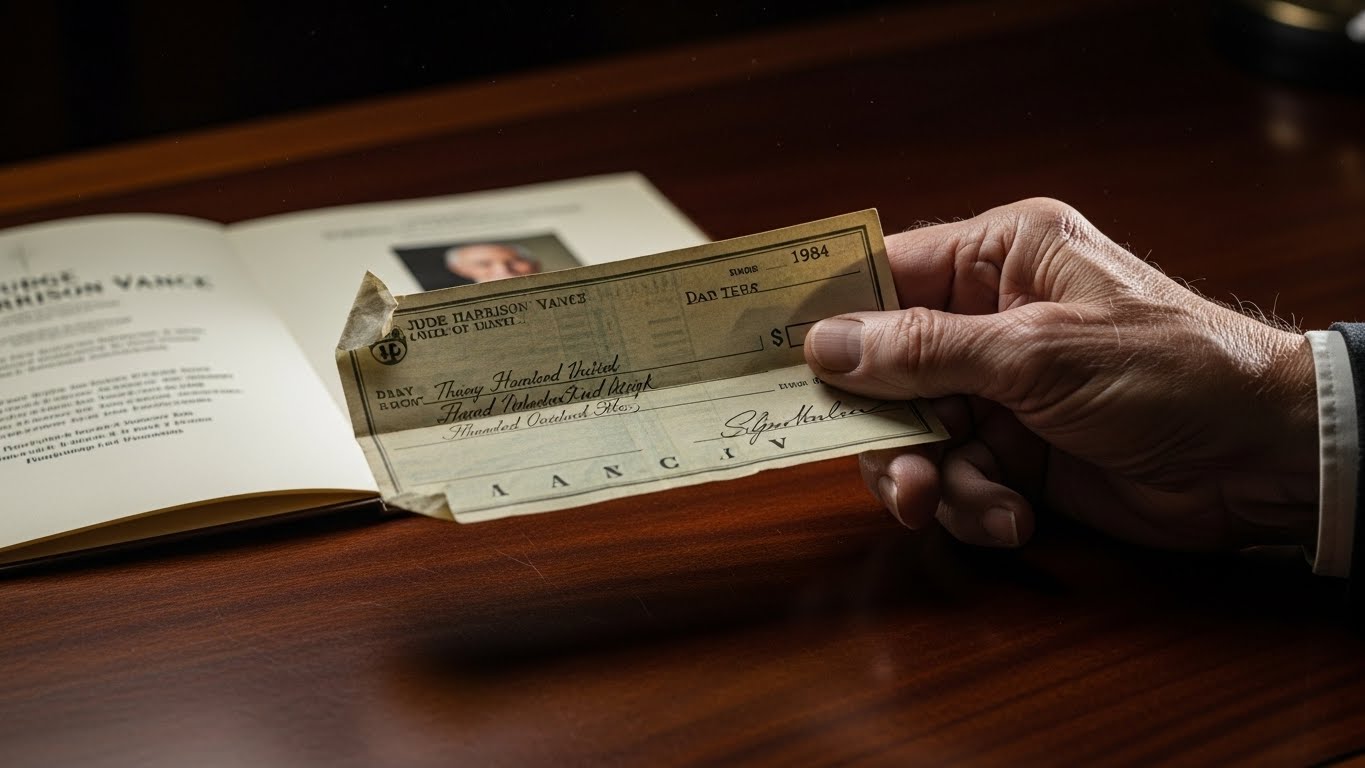
It was a carbon copy of a personal check, dated March 14, 1984. The amount was modest: $500. The payee was “The Pines Extended Care Facility.”
Arthur frowned. He knew every charity his father supported. The Opera House, the Yale Alumni Fund, the Red Cross. He had never heard of The Pines.
He turned the page of the ledger. There it was again. April 1984. May 1984.
He began flipping through the subsequent ledgers, his heart beating a little faster. 1990. 1995. 2005. 2020.
Every single month, for forty years, Harrison Vance had sent a check to this facility. The amount had adjusted for inflation, growing from $500 to $2,500 a month by the time the checks stopped—last week, the day his father died.
“A mistress?” Arthur whispered to the empty room. It was the only logical explanation. The great moral judge had a woman tucked away somewhere.
Arthur went to the computer and typed in “The Pines Extended Care Facility.”
The search results didn’t show a luxury condo or a private apartment complex. It showed a one-star nursing home in a rural, depressed county in Ohio. The reviews were scathing: “Smells like urine,” “Understaffed,” “My mom got bedsores here.”
Why would Harrison Vance, a man who wore Italian silk suits, be sending money to a dump in the Rust Belt?
Arthur couldn’t let it go. It wasn’t just curiosity; it was a desperate need to find a crack in his father’s perfect armor, something to make the old man human.
He didn’t tell his wife, Sarah. He just packed a bag, told her he had to settle some out-of-state property issues, and got into his Mercedes.
The drive took nine hours. The landscape shifted from the manicured hedges of Connecticut to the gray highways of Pennsylvania, and finally to the flat, worn-out cornfields of Ohio.
When Arthur pulled up to The Pines, his stomach turned. It was a brick building that looked more like a prison than a care home. Weeds poked through the cracks in the sidewalk. The windows were streaked with grime.
He walked into the lobby. The air was thick with the smell of industrial bleach and boiled cabbage, masking an underlying scent of decay. A flickering fluorescent light buzzed overhead.
At the reception desk, a woman with tired eyes and a stained blue scrub top looked up. She was chewing gum.
“Help you?” she asked, not looking away from a small TV screen playing a soap opera.
“I’m Arthur Vance,” he said, using his courtroom voice—authoritative, deep. “I’m the executor of the estate of Harrison Vance. I found records of payments made to this facility for the last forty years. I’m here to see who they were for.”
The woman stopped chewing. She typed something into a beige, outdated computer. Her eyebrows shot up.
“Vance… right. The check for ‘Patient 302’. We were wondering if the payment was coming this month.”
“Patient 302?” Arthur asked. “Does this person have a name?”
“Jane Doe,” the nurse said. “That’s what the paperwork says. Admission date: February 12, 1984. Legal guardian: Harrison Vance. Instructions: Strict anonymity. No visitors.”
“I am her legal guardian now,” Arthur said, his hand trembling slightly on the counter. “Take me to her.”
The nurse sighed, grabbed a ring of keys, and buzzed him through a security door.
They walked down a long hallway. Moans and the sound of coughing drifted from open doors. Arthur felt overdressed in his cashmere coat. He felt like an alien species in this place of forgotten people.
“She’s in the back,” the nurse said. “She’s one of our longest residents. Doesn’t talk much. Mostly just stares out the window.”
They stopped at Room 302. The door was peeling paint.
“She can get agitated with men,” the nurse warned. “Just… go slow.”
Arthur stepped inside.
The room was small, lit by the gray light of a rainy Ohio afternoon. There was a single bed, a nightstand, and a wheelchair facing the window.
In the chair sat a woman. Her hair was a coarse, steel gray, chopped short in a utilitarian cut. She was wearing a faded pink sweatshirt that was two sizes too big.
Arthur took a breath. “Hello?”
The woman didn’t turn. She was rocking back and forth, a rhythmic, soothing motion. In her hands, she was clutching something tightly against her chest.
Arthur took a step closer. The floorboards creaked.
The woman stiffened. She turned her head slowly.
Arthur froze. The breath left his lungs as if he’d been punched.
She had aged. Her face was lined, her skin pale from decades without sun. But the eyes—those wide, almond-shaped, hazel eyes—were unmistakable. And the shape of her face, the characteristic features of Down Syndrome that Arthur hadn’t seen in forty years…
“Elsie?” he whispered.
The woman blinked. She made a low, guttural sound and hugged the object in her arms tighter.
Arthur looked at what she was holding. It was a stuffed rabbit. Once, it had been white velvety plush. Now, it was gray, matted, and missing an eye. The ear had been stitched back on with red thread that didn’t match.
Arthur knew that rabbit. He had bought it with his allowance money from mowing lawns when he was twelve. He had given it to his baby sister, Elsie, on her eighth birthday. She had named it “Mr. Hop.”
The memory crashed into him with the force of a freight train.
1984. Arthur was twenty-two, finishing his first year of law school. He had come home for spring break to find the house quiet. His mother was weeping in the kitchen. His father, Harrison, stood by the fireplace, looking grim.
“It was pneumonia, Artie,” his father had said. “It moved so fast. Her heart gave out. She’s gone.”
There had been a funeral. A closed casket. His father said it was because the illness had ravaged her, and he wanted them to remember her as she was. Arthur had cried until he threw up. He had loved Elsie more than anyone. She was the only person in that cold house who ever hugged him without reason.
“Elsie,” Arthur said, his voice breaking into a sob. “My God. Elsie.”
He fell to his knees on the dirty linoleum floor. He didn’t care about his suit pants. He crawled toward the wheelchair.
The woman recoiled, pulling her legs up. She looked terrified.
“It’s me,” Arthur pleaded, tears streaming down his face. “It’s Artie. It’s Bobby. Remember? You used to call me Bobby.”
She stared at him. There was no recognition in her eyes, only fear. The fear of a caged animal.
Forty years.
His father hadn’t buried her. He had shipped her two states away like a defective package because he was running for the State Supreme Court. A daughter with special needs didn’t fit the image of the perfect, powerful Vance dynasty. It was a liability. A blemish.
So he had erased her.
Arthur reached out a hand, but stopped when she flinched. He looked at the rabbit, then at her face. The rage that ignited in his chest was unlike anything he had ever felt. It wasn’t the anger of a lawyer losing a case. It was the primal fury of a brother who had failed his only job.
“I’m going to get you out of here,” Arthur vowed, his voice trembling with a mix of sorrow and venom. “I promise you, Elsie. I’m taking you home.”
But as he tried to stand, the nurse appeared in the doorway, accompanied by a burly security guard and a man in a cheap suit who looked like the administrator.
“Mr. Vance,” the administrator said coldly. “I’ve just checked the file. The original contract signed by your father is very specific. Under no circumstances is ‘Jane Doe’ to be removed from this premises. If you attempt to move her, we are instructed to call the police and your father’s attorneys immediately.”
Arthur wiped his face, smearing tears and dust. He stood up, towering over the small administrator.
“My father is dead,” Arthur growled.
“The contract isn’t,” the man replied. “And neither is the confidentiality clause. You take her, you lose the estate. That’s the deal.”
Arthur looked back at Elsie, who was rocking again, humming a tune that sounded vaguely like a lullaby their mother used to sing.
The war had just begun.
Chapter 2: The Price of Silence
The administrator’s office was small, cluttered, and smelled of stale cigarette smoke. Mr. Henderson, the man in charge of The Pines, sat behind his desk, looking at Arthur with a mixture of boredom and condescension.
“Look, Mr. Vance,” Henderson said, tapping a thick file folder. “I don’t make the rules. Your father was… thorough. This facility receives a very generous endowment to keep Jane—sorry, Elsie—safe and comfortable.”
“Comfortable?” Arthur slammed his hand on the desk, making a stapler jump. “She’s in a room that smells like a latrine! She’s wearing rags! Where did the money go, Henderson?”
Henderson leaned back, unfazed. “Care is expensive. Security is expensive. Silence is expensive.”
Arthur grabbed the file. He flipped through the documents until he found the admission papers from 1984.
The handwriting was unmistakably his father’s. Sharp, angular, precise.
Reason for Admission: Social Incompatibility. Undue burden on the family structure. Medical Notes: Patient has Trisomy 21 (Down Syndrome). Docile but dependent. Special Instructions: Patient is to be severed from all past connections to facilitate adjustment. No family contact. Report death immediately to the undersigned.
Arthur felt bile rise in his throat. “Severed from all past connections.” That was why she didn’t know him. They had systematically deprogrammed her. They had taken a girl who loved music and hugs and turned her into a ghost.
“I’m taking her,” Arthur said, his voice deadly quiet. “Today.”
“You can’t,” Henderson said. He pulled out a specific sheet of paper. “Read the ‘Morality and Reputation Clause’ attached to the trust that funds this place—and your inheritance. If the existence of this patient is revealed to the public, or if she is removed against medical advice, the entire Vance Estate is liquidated to a blind charity trust. You lose the house, the money, everything. And more importantly, you destroy your father’s name.”
Arthur stared at the paper. It was a trap from the grave. Harrison Vance had anticipated everything. He knew Arthur’s weakness: the family name. The Vance legacy.
Arthur walked out of the office and went back to his car. He sat in the driver’s seat, his hands gripping the steering wheel until his knuckles turned white.
He thought about his life in Connecticut. The country club membership. The respect he commanded when he walked into a restaurant. The “Vance Wing” at the local library. His wife, Sarah, who loved their comfortable, predictable life.
If he exposed this, he would be the son of a monster. The town would turn on them. The Vance name would be mud. And he would be penniless at sixty-two.
He started the car. He could just drive away. He could keep sending the checks. He could make sure she got a better room, maybe hire a private nurse for her inside the facility. He could visit her secretly once a month.
He put the car in reverse.
Then he looked up at the third-floor window.
He saw a silhouette. A small head, slightly tilted.
A memory flashed: He was eighteen, leaving for college. Elsie was fourteen. She was crying, holding onto his leg. “Don’t go, Bobby. Who gonna read to me?” He had knelt down and hugged her. “I’ll always come back for you, Els. I promise. Cross my heart.”
Arthur turned off the ignition.
He reached into the glove compartment and pulled out his phone. He dialed his wife.
“Arthur?” Sarah’s voice was tinny. “When are you coming home? The grand opening for the statue is on Sunday. You haven’t written your speech.”
“Sarah,” Arthur said. “I need you to listen to me very carefully. I’m not coming home alone.”
“What? What do you mean?”
“I found Elsie.”
“Elsie? Your… dead sister?”
“She’s not dead, Sarah. He hid her. He buried her alive in a hole in Ohio for forty years.”
There was a long silence on the other end.
“Arthur,” Sarah whispered. “If you bring her back… do you know what people will say?”
“I don’t care.”
“Think about the estate, Arthur. We’re retiring. We need that security.”
“Sarah,” Arthur said, his voice cracking. “She still has the rabbit. She still has Mr. Hop.”
He heard Sarah crying softly on the other end. Sarah had never met Elsie, but she knew the stories. She knew the shadow the “death” had cast over Arthur’s life.
“Bring her home, Artie,” Sarah said finally. “To hell with the money.”
Arthur hung up. He got out of the car. He walked to the trunk and opened his suitcase. He took off his suit jacket, his tie, and his dress shirt. He pulled on a soft, gray cashmere sweater he had packed for the evenings.
He walked back into the facility. He bypassed the reception desk. He walked past the security guard, who stepped forward to stop him.
“Get out of my way,” Arthur said. He didn’t shout. He didn’t need to. The authority of a man who has nothing left to lose is a terrifying thing. The guard stepped back.
Arthur went into Room 302.
Elsie was still by the window. She flinched when the door opened.
Arthur knelt down again. He was on her eye level. He wasn’t a giant in a suit anymore. He was just a man in a soft sweater.
“Elsie,” he said softly.
He began to hum. It was a stupid song from a cartoon they used to watch in the 70s. The Scooby Doo theme song.
Elsie stopped rocking. Her head tilted.
Arthur kept humming, tears leaking from his eyes. Scooby Dooby Doo, where are you…
Elsie’s mouth twitched. Her hand loosened its grip on the dirty rabbit.
She looked at him. Really looked at him. She reached out a trembling hand and touched the soft wool of his sweater.
“Soft,” she croaked. Her voice was rusty from disuse.
“Yes,” Arthur smiled through his tears. “It’s Bobby. I’m here.”
He reached into his pocket and pulled out a chocolate bar he had bought at a gas station. Elsie’s eyes widened.
“Chocolate?” she whispered.
“For you,” Arthur said. “But we have to go for a ride to eat it. In my car. Is that okay?”
Elsie looked at the room. The peeling paint. The smell. Then she looked at Arthur.
She nodded.
Arthur lifted her from the wheelchair. She was light, terribly light. Bones and loose skin. He carried her out of the room, past the stunned nurses, past the angry administrator who was shouting into a phone.
He carried her out into the fresh air. The rain had stopped.
He put her in the passenger seat of the Mercedes and buckled her in.
“Where go?” Elsie asked, clutching Mr. Hop.
“Home,” Arthur said. “We’re going home.”
Chapter 3: The Dedication
The scandal broke before they even crossed the state line. The administrator had called the family lawyers, who had panicked and called the press to try and spin the story before Arthur could.
By the time Arthur pulled into the driveway in Greenwich, news vans were parked on the lawn.
The headline on the local paper read: VANCE MYSTERY: LOST DAUGHTER FOUND?
Sarah met them at the door. She looked terrified, but when she saw Elsie—frail, confused, clutching a filthy rabbit—her expression softened. She helped Arthur get Elsie into a warm bath. They scrubbed the smell of the nursing home off her skin. They washed her hair. They gave her fresh clothes—Sarah’s silk pajamas, rolled up at the cuffs.
For three days, the house was under siege. Lawyers called every hour, threatening lawsuits. The Historical Society threatened to cancel the statue dedication.
Sunday came. The day of the dedication.
The town square was packed. People had come for the gossip, not the statue. The bronze figure of Judge Harrison Vance stood covered by a velvet tarp.
Arthur stood at the podium. He looked tired. He hadn’t slept.
He looked out at the crowd. He saw the faces of the people who had idolized his father.
“You all came here to honor a great man,” Arthur began into the microphone. The feedback squealed. “A man of law. A man of order.”
The crowd was silent.
“My father believed that perfection was the only thing that mattered,” Arthur continued. “He believed that anything broken should be thrown away. Or hidden.”
Arthur gestured to the side of the stage.
Sarah pushed a wheelchair up the ramp. In it sat Elsie. She was wearing a beautiful blue dress. Her hair was clean and brushed. She was holding Mr. Hop, who had been carefully washed and stitched up by Sarah.
A gasp went through the crowd. Murmurs of “Is that her?” “My God.”
Elsie looked at the crowd. She wasn’t scared. She was holding Arthur’s hand.
“This is Clara Elsie Vance,” Arthur said, his voice booming. “My sister. The obituary in 1984 said she died of pneumonia. That was a lie. She was sent to a warehouse for the unwanted because she didn’t fit the picture of the Senator’s family.”
Arthur walked over to the covered statue.
“You want to honor the Vance legacy?” Arthur asked. “This is the legacy.” He pointed to Elsie. “She is the only person in this family who has never told a lie. She is the only one of us who knows how to love without conditions.”
Arthur grabbed the velvet rope.
“My father was not a hero,” Arthur said. “He was a coward.”
Instead of unveiling the statue, Arthur turned his back on it. He walked over to Elsie, knelt down, and kissed her forehead in front of five hundred people and a dozen cameras.
“Let’s go get some ice cream, Els,” he said into the mic.
“Ice cream?” Elsie beamed, her face lighting up with a pure, unadulterated joy that shamed every cynical soul in the audience. “Strawberry?”
“Strawberry,” Arthur promised.
They left the stage. Behind them, the tarp remained on the statue. No one moved to uncover it.
Epilogue: The Oak Tree
The lawyers took the money. They took the investments. They took the trust.
Arthur and Sarah had to sell the big colonial house. They moved into a smaller cottage near the coast. It was cozy. It had a porch.
Elsie lived for seven months.
The doctors said her heart had been weak for years, weakened by neglect and loneliness. But those seven months were the best months of Arthur’s life.
He retired from law. He spent his days reading Charlotte’s Web to Elsie on the porch. They listened to Elvis records. They ate strawberry ice cream every day at 3 PM.
Elsie didn’t say much. Her mind was a child’s, trapped in a tired body. But she smiled. She laughed. She learned to hug again.
One evening in October, as the sun was setting, painting the sky in shades of lavender and gold, they were sitting on the porch swing.
Elsie was holding Mr. Hop. She was breathing shallowly.
She turned to Arthur. She placed her hand, now spotted with age but warm, on his cheek.
She looked at him with a clarity he hadn’t seen before.
“Bobby,” she whispered. “You came back.”
Arthur choked back a sob. “I promised, Els. I promised.”
“Good Bobby,” she sighed. She closed her eyes. Her hand slipped from his cheek.
She died peacefully, right there on the swing, with the taste of strawberries still on her lips.
They buried her under a massive oak tree on a hill overlooking the ocean. There was no family crypt. No marble mausoleum. Just a simple stone.
It didn’t mention Harrison Vance. It didn’t mention the Senator.
It read:
Elsie Vance 1966 – 2024 She was the best of us.
Arthur stood by the grave. He was poorer than he had ever been. He had lost his status. He had lost his inheritance.
But as he walked away, holding Sarah’s hand, listening to the ocean crash against the rocks, Arthur Vance felt lighter than air. He was finally free.