I Buried My Dad Six Months Ago. Yesterday, I Found A Wet Ink Note In His Handwriting Dated ‘Today’—And Then I Heard Footsteps Upstairs.
PART 1
Chapter 1: The Box That Wasn’t Sealed
My father has been dead for one hundred and eighty-six days. I count them because numbers are the only thing that makes sense anymore. Grief is messy; numbers are clean. 186 days since the knock on the door. 186 days since the state trooper took his hat off and looked at the ground before meeting my mother’s eyes. 186 days since the world turned gray.
He was a structural engineer, a man who believed that if the foundation was strong, the house would stand. He was meticulous. He organized his socks by color, his books by genre, and his life by a strict code of ethics. When his car went off the bridge on Route 9 during a freak icy rainstorm, the police said it was an accident. Just bad luck. A structural failure of the tires, perhaps.
But my dad checked his tires every Sunday morning.
I moved back home to Willow Creek, Oregon, three weeks ago. My degree in graphic design was gathering dust, much like my childhood bedroom, and Mom wasn’t doing well. She was fading. The vibrant woman who used to host book clubs and garden parties had turned into a ghost haunting her own hallways. She spent her days staring at the television or chopping vegetables for meals she wouldn’t eat.
Yesterday started like any other Tuesday. The sky was a bruised purple, threatening rain. I decided it was time to tackle the attic. It was the one place Mom refused to go. “Too many memories,” she’d say, her voice cracking. “Too much of him up there.”
The attic in our Victorian house was a cavernous space, smelling of cedar, old fiberglass insulation, and the dry, sweet scent of decay. Dust motes danced in the single beam of light cutting through the hexagonal window. It was quiet. The kind of quiet that presses against your ears.
I was moving boxes labeled “TAXES 2010-2015” and “OLD WINTER COATS” to get to the back corner. That’s where Dad’s personal effects were. The things the police had returned. The things from his office.
There was one box in particular. A heavy plastic bin. I remembered packing it myself three months ago, right before I went back to the city to finish my semester. I had sealed it with grey, heavy-duty duct tape and written “DAD’S OFFICE – DO NOT OPEN” in thick black marker. I wanted to preserve his workspace until I was ready to deal with it.
I knelt on the rough floorboards, wiping sweat from my forehead. I reached for the box to slide it toward the stairs.
That’s when I froze.
The tape was cut.
It wasn’t peeled back or ripped by age. It was sliced. A clean, surgical line ran right through the center of the tape, severing the words “DO NOT” in half.
My heart did a weird flutter in my chest. Maybe Mom came up here? No, her knees were bad, and she was terrified of the attic ladder. Maybe I didn’t tape it as well as I thought? No, I remembered the sound of the tape gun. Screeeech-rip. I had done three layers.
I lifted the lid. It came off silently.
Inside, sitting right on top of his leather-bound architecture portfolios, was a yellow legal pad.
It didn’t belong there. I knew every item in this box. His stapler, his framed photo of us at the Grand Canyon, his drafting ruler. I had packed them. This legal pad was new.
I reached in. The paper felt different—crisp, not soft with age. I pulled it out.
A single note was scrawled on the top sheet. The ink was emerald green.
My stomach dropped so fast I felt like I was falling. My dad only used emerald green ink. It was a Montblanc knock-off he bought in bulk. He said blue was boring and black was for funerals. Green was for building.
I brought the paper closer to the sliver of light, my hands shaking so violently the paper rattled.
The handwriting. The jagged, star-like ‘A’. The way the ‘y’ looped backward, defying cursive rules. It was his hand. There was no doubt. It was the same hand that had signed my report cards, written my birthday checks, and left notes in my lunchbox until I was seventeen.
It read:
“Maya, don’t go into the basement. She isn’t who you think she is. I’m so sorry.”
And below it, the date.
November 29th.
Today.
I stared at the date until the numbers blurred. I checked my watch. November 29th.
“This isn’t funny,” I whispered to the empty attic. My voice sounded thin, pathetic. “Whoever is doing this, it isn’t funny!”
I expected silence.
Instead, I smelled it.
A waft of air moved past me, not from the window, but from the darker corner of the attic, behind the chimney stack. It hit me like a physical blow.
Sandalwood. Old Spice. And a hint of peppermint gum.
My dad’s scent.
I scrambled backward, crab-walking away from the dark corner, my breath hitching in my throat. “Dad?”
Silence. Just the settling of the house. Creeeeak.
I looked down at the note again. The ink… I rubbed my thumb over the period at the end of the sentence.
It smeared.
It was wet.
Someone had written this note minutes ago. Someone was up here.
Chapter 2: The Stranger in the Kitchen
Panic is a cold thing. It starts in the toes and shoots up to the brain, freezing logic. My first instinct was to scream, but something in the note stopped me.
“She isn’t who you think she is.”
She? There was only one “she” in this house. Mom.
I scrambled to my feet, clutching the yellow paper like a lifeline. I needed to get out of the attic. I needed to get to the police. But first, I had to pass the dark corner behind the chimney to get to the ladder.
I grabbed a heavy brass candlestick from a box of donations I’d pushed aside earlier. It felt cool and deadly in my hand. I forced my legs to move. One step. Two steps.
I swung the candlestick around the corner of the chimney.
Nothing. Just shadows and cobwebs. A pile of old insulation rolls looked vaguely like a body, but it was just trash.
I let out a breath I didn’t know I was holding and practically threw myself down the pull-down ladder. I landed in the upstairs hallway, my socks sliding on the hardwood. I shoved the ladder up, hearing it click shut, and locked it with the pole hook.
I leaned against the wall, gasping. Okay. Think, Maya. Think.
Someone broke into the house. They’re hiding in the attic. They’re playing a sick game. They forged Dad’s handwriting. They… they knew his ink. They knew his scent.
I had to tell Mom. We had to leave. Immediately.
I ran down the main staircase, the note crumpled in my sweaty palm. The house felt different now. The family photos on the wall—Mom and Dad smiling on their honeymoon, me at graduation—felt like props on a stage set.
I burst into the kitchen.
Mom was at the island, her back to me. The rhythmic sound of a knife hitting the cutting board filled the room. Chop. Chop. Chop.
“Mom!” I gasped.
She didn’t stop. Chop. Chop.
“Mom, we have to go. Now.”
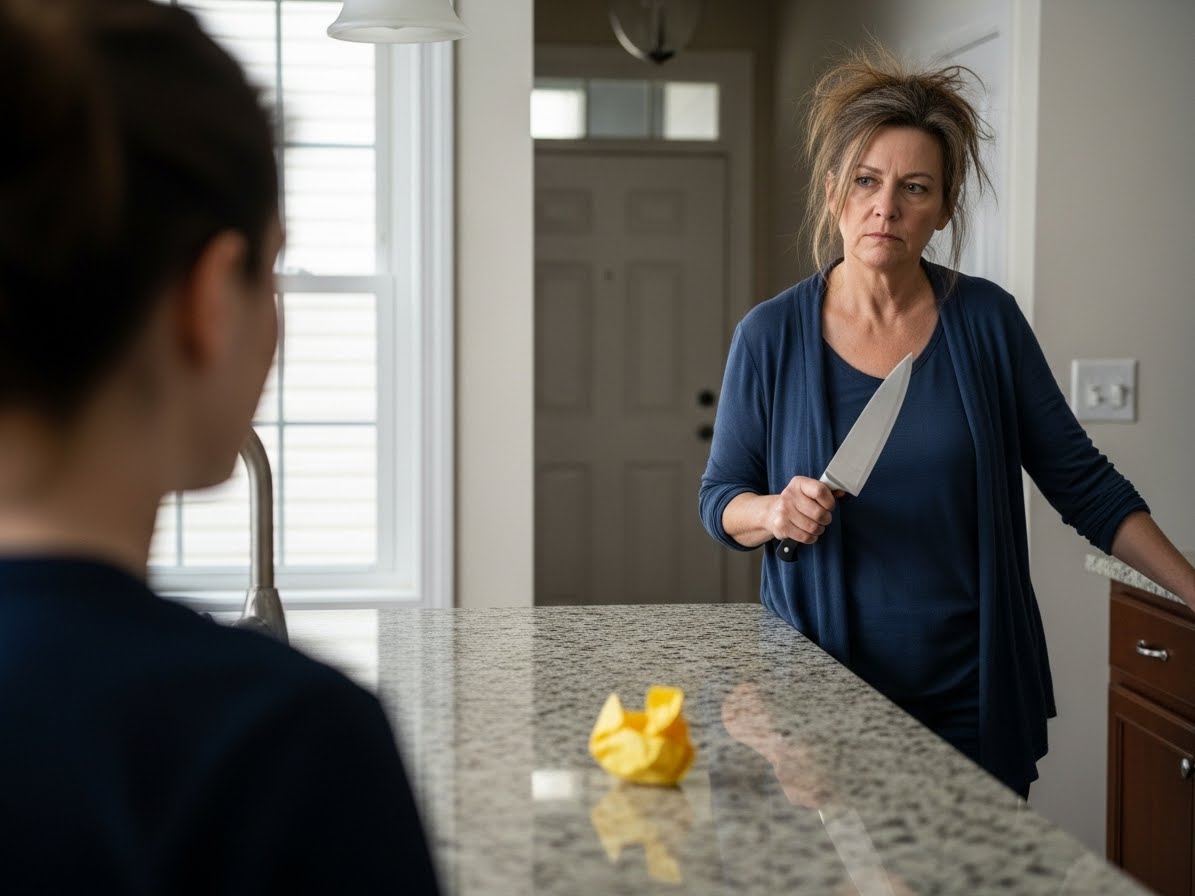
She paused. Slowly, she turned around. She was holding a large chef’s knife. Her apron was stained with tomato juice, looking disturbingly like fresh blood.
“Maya?” Her voice was floaty, detached. “Why are you shouting? I’m making Dad’s favorite. Bolognese.”
My blood ran cold. “Mom… Dad is dead.”
She smiled. It wasn’t a warm smile. It was a tight, strained grimace, like the skin on her face was being pulled back by invisible clips. “Don’t say that. He’s just away on a site visit.”
“Mom, stop it!” I yelled, stepping forward and slamming the yellow note onto the granite island, right next to the pile of chopped carrots. “Look at this! I found it in the attic! It’s fresh ink! Someone is in the house, Mom!”
She looked down at the note. I watched her eyes scan the words.
“Maya, don’t go into the basement. She isn’t who you think she is.”
I waited for the shock. I waited for her to grab her phone and dial 911.
Instead, her expression went blank. Completely, utterly blank. The smile vanished. The grief vanished. It was like looking at a mannequin.
She reached out and picked up the note. She didn’t read it again. She crumpled it into a ball in her fist.
“Mom?” I stepped back, hitting the refrigerator.
“You shouldn’t have gone into the attic, Maya,” she said. Her voice was no longer floaty. It was low. Gravelly. It sounded like… like she was acting. Like she was reciting a line she had rehearsed a thousand times.
“What are you talking about?” I asked, my hand reaching behind me for the handle of the fridge, needing something to hold onto. “Mom, the note says—”
“I know what the note says,” she interrupted. She took a step toward me. The knife was still in her hand, hanging loosely at her side. “Your father always did have a dramatic flair. Even from the grave.”
“You… you knew?”
“Maya,” she sighed, sounding bored. “Go to your room.”
“No! We need to call the police!”
“I said,” she snapped, her head snapping up, her eyes blazing with a sudden, terrifying intensity, “Go. To. Your. Room.”
And then, I heard it.
Above us. The ceiling creaked.
Thump. Thump. Thump.
Heavy boots. Pacing.
It wasn’t the wind. It wasn’t the house settling. It was the distinct, heavy stride of a man walking directly above the kitchen.
In the attic I had just locked.
I looked at the ceiling, then back at Mom. She wasn’t looking up. She was looking at me, and for the first time in my life, I saw something in my mother’s eyes that I couldn’t recognize.
It was anticipation.
“He’s awake,” she whispered.
I didn’t wait. I didn’t ask questions. The “fight or flight” switch in my brain finally hammered down on flight.
I turned and bolted for the back door.
“Maya, no!” she screamed, lunging for me.
I fumbled with the deadbolt. My fingers were slippery. I heard her rushing around the island. I threw the lock open and threw myself out onto the porch, stumbling down the steps into the wet grass of the backyard.
I didn’t stop running until I reached the detached garage. I punched in the code for the keypad. 1-9-8-0. Dad’s birth year.
Beep-Beep-Beep. Error.
I tried again. 1-9-8-0.
Error.
“No,” I whimpered. “No, no, no.”
I looked back at the house. Mom was standing in the back doorway. She wasn’t chasing me. She was just watching, the knife still in her hand.
And in the attic window, three stories up… I saw the blinds move.
Someone was watching me from the attic.
I looked down at the keypad. I tried the one code I prayed wouldn’t work. The code Dad used for his high-security projects. The code he told me never to write down.
0-0-0-0.
The light turned green. The heavy garage door began to rumble upward.
My dad had changed the code. Or someone who knew his secrets had.
I ducked under the rising door and scrambled into the darkness of the garage, hitting the button to close it immediately. As the door ground shut, sealing me in with the smell of gasoline and darkness, I realized I had made a terrible mistake.
I was trapped. And whoever was in the attic… they weren’t stuck in the house.
They were coming down.
PART 2
Chapter 3: The Sanctuary of Iron and Oil
The garage was my father’s cathedral. While the house belonged to Mom and her floral prints, the garage was a sanctuary of concrete, steel, and the sharp, biting smell of grease.
I stood in the center of the dark space, my chest heaving. The only light came from the small, grimy window on the side door, casting a pale, sickly rectangle on the cement floor.
Think, Maya. Think.
I needed a weapon. I needed a phone. I had left mine on the kitchen counter in my haste to escape the woman who looked like my mother but held a knife like a butcher.
I fumbled my way toward Dad’s workbench. My hands brushed against the cold metal of his tool chest. I pulled a drawer open. Screwdrivers, wrenches, a heavy hammer.
I grabbed the hammer. It was an Estwing, leather-wrapped handle, solid steel. It felt familiar. Dad had taught me how to drive a nail with a single strike when I was ten. “Precision, Maya,” he’d say. “Force is nothing without aim.”
I gripped it until my knuckles turned white.
I moved to the window, peering out toward the house. The back porch light had been flipped on. It flooded the yard with artificial yellow light.
And there she was.
Mom was walking down the back steps. She moved with a terrifying grace, the knife no longer in her hand. She was holding something else now.
A set of keys.
She was walking toward the garage.
“No,” I whispered, backing away.
I turned to the keypad on the inside of the garage door—the manual override. I hit the button to lock it down, to disengage the opener so the remote wouldn’t work.
Nothing happened. The LED light on the control box was dead.
My blood ran cold. The power to the garage had been cut. That meant the electric opener wouldn’t work, but the manual lock… the manual lock on the side door could still be opened with a key.
Her key.
I looked around frantically. I was trapped in a concrete box with a woman who had just watched me run for my life and didn’t even blink.
I retreated to the back corner, behind Dad’s restored 1967 Mustang. He never drove it. He just polished it. It was his baby.
I crouched behind the rear bumper, trying to make myself small. The smell of the car wax was overwhelming, triggering a memory of him rubbing a chamois cloth over the fender, humming a Beatles song.
Humming.
I froze.
I wasn’t imagining it.
A low, rhythmic humming sound was coming from inside the trunk of the Mustang.
It was faint, barely audible over the pounding of my own heart, but it was there. It sounded like… a laptop fan? A server?
I looked at the trunk lock. Dad kept the keys in the ignition.
I crawled to the driver’s side door. It was unlocked. I reached in, grabbed the keys, and scrambled back to the trunk.
I shouldn’t open it. I should be watching the door. Mom was seconds away.
But the note. “She isn’t who you think she is.”
Dad was trying to tell me something. Dad, who was supposed to be dead, was leaving breadcrumbs.
I jammed the key into the trunk lock and turned.
Click.
I lifted the lid.
The trunk wasn’t empty. It wasn’t full of spare tires or jumper cables.
It was full of electronics.
A bank of hard drives was bolted to the floor of the trunk, their little blue lights blinking in the darkness. They were wired to a massive battery pack. And in the center, a small monitor was glowing blue.
On the screen, a single window was open. It was a live feed.
My hand flew to my mouth to stifle a scream.
The camera feed was of my bedroom.
It was a bird’s-eye view, hidden somewhere in the ceiling fan or the smoke detector. I could see my unmade bed, my laptop on the desk, my discarded clothes on the floor.
I touched the trackpad built into the rig. I clicked to the next camera.
The Kitchen.
I saw the chopping block. The pile of carrots. The crumpled note where Mom had left it.
Next camera.
The Basement.
I stopped breathing.
The basement camera was different. It wasn’t a wide shot of a room. It was night vision, grainy and green. It was pointed at a heavy steel door I had never seen before. A door with a keypad and a biometric scanner.
We didn’t have a steel door in our basement. Our basement was unfinished concrete, full of holiday decorations and old furniture.
Where was this?
Then, the audio from the feed crackled. A voice.
“Subject 1 is secure. Subject 2 has breached containment.”
It was Mom’s voice. But it wasn’t coming from outside the garage. It was coming from the computer speakers.
She wasn’t just my mother. She was… reporting.
Suddenly, the side door of the garage clicked. The tumblers of the lock turned.
Chunk.
The door handle turned slowly.
Chapter 4: The Rat in the Walls
I didn’t have time to think. I gently lowered the trunk lid, leaving it unlatched just a fraction so it wouldn’t make a sound.
I couldn’t hide behind the car. If she had a flashlight, she’d see me instantly.
I looked down. Under the car.
The mechanic’s pit.
Dad had dug a shallow maintenance pit into the floor so he could work on the Mustang’s undercarriage without a lift. It was covered by heavy wooden planks.
I grabbed the edge of the first plank and heaved. It was heavy, rough splintery wood. I slid it aside just enough to squeeze through.
The door handle rattled again. It was stuck. She was jiggling it.
I dropped into the pit. It was about four feet deep, smelling of damp earth and old oil. I reached up and dragged the plank back into place above me.
Darkness swallowed me whole. Absolute, suffocating darkness.
I curled into a ball on the cold concrete floor of the pit, clutching the hammer to my chest.
Above me, the garage door opened.
Creak.
Steps. Heavy, deliberate steps on the concrete. Not the soft patter of Mom’s sneakers. These were boots.
Wait. Mom was wearing slippers when I ran out.
This wasn’t Mom.
I held my breath, my lungs burning. Dust from the pit tickled my nose. Don’t sneeze. Don’t cough. Don’t move.
The footsteps stopped right beside the Mustang.
“Clear,” a male voice said. Deep. Raspy.
It wasn’t Dad’s voice. It was someone else.
“She ran this way,” Mom’s voice replied. She was in the garage now too. “I saw her enter. The code was used.”
“Maybe she went through the woods,” the man said.
“No,” Mom snapped. “She’s smart. She’s Robert’s daughter. She knows the woods are perimeter-fenced. She’s hiding.”
Robert. She never called Dad “Robert.” It was always “Rob” or “Honey.”
“Check the loft,” Mom commanded.
I heard the man climbing the wooden ladder to the storage loft above the garage.
I needed to move. If they searched the car, if they saw the trunk unlatched…
My hand brushed against the wall of the pit. It wasn’t concrete. It was… dirt?
I felt around in the dark. The concrete wall ended abruptly about two feet down. Behind it, there was a hole. A tunnel?
I remembered Dad telling me stories about this house. It was built in the 1920s, during Prohibition. He used to joke that the original owners were bootleggers who ran moonshine.
“A structural engineer loves a house with secrets, Maya.”
I reached into the hole. It was tight, maybe three feet wide, shored up with rotting wood beams. A draft was coming from it. Cool, stale air.
It went toward the house.
Above me, the man jumped down from the loft. Thud.
“Nothing up there.”
“Check the car,” Mom said.
My heart stopped.
I didn’t have a choice. I turned onto my stomach and wriggled into the hole in the wall.
It was tight. My shoulders scraped against the dirt. Spiderwebs brushed against my face like sticky, invisible fingers. I suppressed a shudder of revulsion.
I crawled. One elbow, one knee. Dragging the hammer.
Behind me, I heard the trunk of the Mustang pop open.
“We have a breach,” the man’s voice echoed into the pit. “The terminal has been accessed.”
“Find her,” Mom hissed. Her voice sounded demonic now. “If she saw the feed, she knows about the facility.”
“Do we terminate?”
There was a pause. A silence that stretched for an eternity as I froze in the dirt tunnel.
“Only if necessary,” Mom said. “We still need her DNA to unlock the primary vault. Robert made sure of that.”
I bit my lip so hard I tasted copper. My DNA?
I crawled faster. The tunnel was sloping downward. Deeper.
I wasn’t just going back to the house. I was going under it.
The crawl seemed to last for hours. My knees were raw. My shirt was soaked with sweat and dirt. The air grew colder, damper.
Finally, my hand hit something hard. Wood.
I felt around. It was a vertical surface. A panel.
I pushed. It didn’t budge.
I tapped it gently with the hammer. It sounded hollow.
I pressed my ear against it.
I could hear a low hum. The same hum I heard in the garage trunk. But louder. Like a massive generator.
And I heard voices.
“Vital signs are stabilizing. The regeneration process is 80% complete.”
I pushed harder. The wood groaned, then gave way. It was a false back to a cupboard or a shelf.
I tumbled out, landing on a cold tile floor.
I scrambled up, hammer raised, ready to swing.
I wasn’t in the basement I knew. I wasn’t in the laundry room with the Christmas decorations.
I was in a sterile, white corridor. Fluorescent lights buzzed overhead. The walls were lined with metal piping.
I turned around to see where I had come from. I had pushed through the back of an old, dusty coal chute door that had been sealed off.
I was in the “basement.” The real basement.
“Don’t go into the basement,” the note had said.
I was standing right in the belly of the beast.
Chapter 5: The Glass Wall
I moved down the corridor. My sneakers squeaked on the pristine white tiles, a jarring contrast to the dirt and cobwebs covering me.
At the end of the hall, there was a large observation window.
I crept toward it, staying low, hugging the wall.
I peered through the thick glass.
The room beyond was massive. It looked like a hospital operating theater mixed with a server room. Banks of computers lined the walls.
In the center of the room, there was a tank. A glass cylinder filled with a translucent blue liquid.
Floating inside the tank was a man.
He was naked, suspended by tubes and wires connected to his chest, his arms, his temples. An oxygen mask covered his nose and mouth.
I pressed my hand against the glass, leaving a muddy print.
The man in the tank was older. His hair was graying. He had a scar on his left shoulder from a roofing accident ten years ago.
It was Dad.
My Dad.
He wasn’t dead. He wasn’t in a casket six feet under the Willow Creek cemetery. He was here. Floating. Sleeping.
But if he was here… who wrote the note?
Who was in the attic?
Suddenly, a door on the far side of the lab opened.
Two people walked in.
One was the man from the garage—a tall, military-looking guy with a buzz cut.
The other was a man wearing a white lab coat.
The man in the lab coat turned to look at a clipboard, and my breath hitched.
He looked exactly like my father.
Same hair. Same glasses. Same posture. But his face… it was younger. Smoother. Devoid of the laugh lines and the worry wrinkles that defined my dad.
He looked like a polished, perfect copy.
“The Subject in the tank is showing resistance to the memory wipe,” the Copy-Dad said. His voice was identical to my father’s, but colder. Clinical.
“Increase the dosage,” the military man said. “We can’t have him waking up and overriding the security protocols again. We barely caught that note he slipped out.”
“He’s fighting it,” Copy-Dad said, looking up at the tank with a strange expression. Not empathy. Curiosity. “The emotional attachment to the offspring is creating a neural pathway we can’t sever. He keeps trying to protect the girl.”
“The girl is a liability,” the military man grunted. “The Mother says she’s suspicious.”
“The Mother is failing her parameters,” Copy-Dad noted, tapping a screen. “She was supposed to sedate the girl upon arrival. Now we have a containment breach.”
I slid down the wall, my legs giving out.
The Mother. The Copy.
They weren’t my parents. They were… things. Replacements.
And my real dad had been down here for six months, being harvested for… what? Memories? Codes?
“Maya,” a voice whispered.
I jumped, swinging the hammer blindly.
But there was no one in the hallway.
“Maya, listen to me.”
The voice was coming from the intercom speaker on the wall above me.
“Dad?” I whispered.
“I can see you on the perimeter camera,” the voice said. It was Dad. My real Dad. Weak, strained, but him. “You have to listen carefully. I don’t have much time before they cycle the sedation again.”
I looked through the glass. The Dad in the tank… his eyes were open. He was staring right at the hidden camera in the corner of the room, but he was talking to me. He had hacked the audio.
“Dad! I’m here! I’m going to get you out!”
“No!” he rasped. “You can’t. The glass is bulletproof. The door is bio-locked to the Clone’s DNA. Listen to me! You found the note?”
“Yes.”
“Good. The ‘Mother’ upstairs… she’s a Synthentic. An android. So is the one in the lab coat. They replaced us, Maya. They replaced half the town.”
My head spun. “Why?”
“The project,” he gasped. The bubbles in the tank agitated. “Structural engineering wasn’t just buildings, Maya. I was building… infrastructure for them. To live among us. But I found a flaw. I tried to stop it. They crashed my car. They put me here.”
“How do I stop them?” I was crying now, hot tears cutting through the dust on my face.
“The attic,” he said. “The one place they can’t go.”
“Why can’t they go in the attic?”
“The frequency,” he said, his voice fading. “I installed a signal jammer in the chimney stack. It disrupts their neural link. That’s why I hid there before they caught me. That’s why the note was there. The jamming signal… it’s the only thing that hurts them.”
“The footsteps…” I realized. “That wasn’t you.”
“No,” he said. “That was the prototype. The first clone. It’s defective. Violent. It’s trapped up there because the signal cripples it, but it guards the jammer.”
“Dad, what do I do?”
“You have to turn the jammer up,” he said. “To maximum. It will fry their chips. It will kill the clones. But you have to get past the Prototype.”
“And you?” I asked, looking at his floating body. “If I fry the system… what happens to the life support?”
There was a silence.
“It runs on the same network, Maya,” he whispered.
“No,” I sobbed. “No, I won’t do it.”
“You have to,” he commanded, his voice gaining a sudden, fierce strength. “They are going to activate the sleeper protocol tonight. At midnight. Every replacement in the tri-state area will ‘wake up’. Thousands of people will die. You have to kill the signal.”
“Dad…”
“I love you, star-shine,” he said. “Now run. They know you’re here.”
The intercom clicked off.
Inside the lab, the Copy-Dad turned his head sharply toward the hallway. He looked right at the spot where I was crouching.
He smiled. A predatory, shark-like smile.
“Found you,” he mouthed through the glass.
The door to the hallway hissed open.
I scrambled to my feet. I had the hammer. I had the truth.
And I had a death sentence to execute.
I turned and ran back toward the coal chute, but a metal gate slammed down, blocking my path.
Trap.
There was only one way to go.
Up.
Through the facility. Into the house. And up to the attic.
To kill my father to save the world.
PART 3
Chapter 6: The Hollow Men
The metal gate rattled behind me as the Copy-Dad slammed his fist against it. His face, usually a mask of calm intellect, was twisted into a snarl that my real father never could have made. It was a digital rage, a glitch in the software manifesting as pure hatred.
“You cannot stop the integration, Maya,” he shouted, his voice echoing down the sterile corridor. “It is mathematically inevitable.”
I didn’t stay to debate the math. I ran.
The hallway stretched out before me, branching off into rooms I didn’t want to see. I passed a door left ajar—inside, rows of identical mailmen uniforms hung on racks. Another room held shelves of wigs—blonde, brunette, gray. It was a factory of neighbors. A workshop of ordinary people.
I needed stairs. I needed to get to the surface.
At the end of the hall, a red sign glowed: EMERGENCY EXIT – ALARM WILL SOUND.
I didn’t care about alarms. The whole house was a death trap now.
I slammed my shoulder into the crash bar. The door flew open, and a klaxon began to wail—a harsh, rhythmic whoop-whoop-whoop that pulsed in time with the adrenaline flooding my veins.
I stumbled out into the cool night air? No.
I wasn’t outside. I was in the pantry.
The secret door opened into the kitchen pantry, hidden behind a shelving unit of canned peaches and bags of flour.
I tumbled out onto the kitchen floor, covered in dust, sweat, and cobwebs, gripping my hammer like it was Excalibur.
The kitchen was dark. The only light came from the blinking digital clock on the microwave: 11:42 PM.
Eighteen minutes.
Dad said the sleeper protocol activated at midnight. Eighteen minutes until every “replacement” in the tri-state area woke up and did… whatever they were programmed to do. Kill? Capture? Replace the rest of us?
I scrambled to my feet. The house was silent again, save for the muffled alarm coming from behind the pantry door.
“Maya.”
The voice came from the living room.
I spun around.
Mom was sitting in Dad’s favorite armchair. The room was pitch black, but I could see the silhouette of her hair, the curve of her shoulders.
“Don’t go upstairs, honey,” she said. Her voice was soft, reasonable. It was the voice that had soothed me when I scraped my knees. The voice that read me Goodnight Moon. “We can be a family again. A better family. No sickness. No death. Just us. Forever.”
“You’re not my mother,” I whispered, stepping backward toward the stairs.
“I am better than her,” the thing in the chair said. It stood up. Its movements were too smooth. Fluid. Like mercury. “Your mother was weak. She was depressed. She was broken by grief. I am efficient. I am happy. Isn’t that what you wanted? A happy mother?”
“I want my real mother!” I screamed.
“She’s gone, Maya,” the thing said, stepping into a patch of moonlight.
I gasped.
Half of “Mom’s” face was… wrong. The skin around her jaw was sagging, revealing a dull, metallic sheen underneath. The stress of the “hunt” must have damaged her synthetic skin. Her left eye was flickering, the pupil dilating and contracting rapidly.
“The Prototype is upstairs,” she said, tilting her head. “He will tear you apart. Stay here. Let me cook you something. Are you hungry?”
She lunged.
It wasn’t a human lunge. It was a ballistic launch. She cleared the ten feet between us in a blink.
I didn’t think. I swung the hammer.
CRACK.
The steel head connected with her shoulder. It didn’t sound like hitting bone. It sounded like hitting a car fender. A wet, metallic crunch.
She didn’t scream. She just looked at her caved-in shoulder with mild annoyance.
“That was rude,” she said.
She grabbed my arm. Her grip was like a hydraulic vice. I felt my radius bone bowing, threatening to snap.
“Let go!” I kicked her in the shin, then the knee. It was like kicking a lamppost.
“You need a reboot,” she whispered, her flickering eye buzzing. She raised her other hand—her fingers had extended into long, sharp scalpels. “I will fix you.”
I looked around frantically. The kitchen island. The knife block.
No time.
My eyes landed on the toaster plugged into the counter behind her.
“Let. Go!”
I swung the hammer again, not at her, but at the granite countertop, smashing the ceramic fruit bowl. The shards flew.
She flinched—a defensive algorithm triggering to protect her eyes.
In that split second, I dropped my weight, twisting my arm. The skin tore, but I slipped free.
I grabbed the heavy cast-iron skillet from the drying rack and swung it with both hands, using every ounce of hysterical strength I possessed.
I hit her square in the face.
CLANG.
The sound was deafening. The impact knocked her backward, her head snapping back at an unnatural angle. She stumbled, her feet tangling in the rug, and she fell hard against the stove.
Sparks showered from her neck. She twitched, her voice box looping. “Din-din-dinner is… din-din… served.”
I didn’t wait to see if she would get up.
I sprinted for the stairs.
Chapter 7: The Prototype
The staircase felt like climbing a mountain. My legs were lead. My arm was throbbing where she had grabbed me.
11:50 PM.
Ten minutes.
I reached the second-floor landing. The pull-down ladder to the attic was still up.
I grabbed the hook pole from the corner and yanked the door down.
CREEEEAK.
The ladder slid down. Darkness poured out of the square hole in the ceiling.
And the smell.
It was stronger now. The sandalwood and Old Spice… but mixed with something else. Rotting meat. Ozone. Burnt hair.
I climbed.
My head popped up into the attic space.
It was freezing. The insulation I had seen earlier was still there, but the layout had changed. The boxes were shoved to the sides, creating an arena in the center.
And standing in front of the chimney stack, guarding the brick column where the jammer must be hidden, was the Prototype.
I stifled a retch.
It was… Dad.
But it was a rough draft.
It was huge, maybe seven feet tall. The skin was patchy, translucent in places, revealing pistons and wiring. One arm was massive, muscular, and human-looking; the other was a skeletal metal claw. The face was the worst part. It had my father’s eyes, but no mouth. Just smooth skin where the lips should be.
It stood perfectly still, vibrating slightly.
“Dad said the signal hurts it,” I whispered to myself. “That’s why it’s violent. It’s in pain.”
I climbed fully into the attic. The floorboards groaned.
The Prototype’s head snapped toward me.
It didn’t have a voice, but it made a sound. A high-pitched whine, like a dog whistle amplified through a speaker.
It charged.
It didn’t run like the Mom-bot. It shambled, heavy and erratic, thrashing its metal arm.
I dove to the right, rolling over a box of old yearbooks. The metal claw smashed into the floorboards where I had just been, splintering the wood into toothpicks.
I scrambled up and threw the hammer. It bounced harmlessly off its chest.
Stupid. Stupid.
I needed to get to the chimney. The brick stack was ten feet away, behind the monster.
The Prototype turned, its human eye weeping a black fluid. It raised its claw again.
“I’m sorry,” I sobbed. “I’m so sorry.”
I grabbed a loose brick from the floor—leftover from a chimney repair years ago.
I ran at it.
It swung the claw. I slid on my knees, ducking under the lethal arc. I felt the wind of the swipe ruffle my hair.
I slammed the brick into its knee joint—the metal one.
Crunch.
Something sparked. The leg buckled. The Prototype fell forward with a crash that shook the whole house.
I didn’t look back. I scrambled toward the chimney.
There was a loose panel in the brickwork, just like Dad said. A fake clean-out door.
I ripped it open.
Inside, there was a device that looked like a tangled mess of copper wire, radio tubes, and a modern digital interface. A red dial was set to “3”.
The range went to “10”.
Behind me, the Prototype roared—a digital scream tearing through its skin-covered mouth. It grabbed my ankle with its human hand.
Its grip was warm. It felt like Dad’s hand.
I looked back. The monster was dragging me away from the dial. Its eyes… they were pleading. Or maybe they were just glazing over.
“Let me go!” I kicked it in the face.
It didn’t let go. It began to pull me toward its chest, the metal claw raising for a killing strike.
“DADDY!” I screamed.
The monster froze.
For a second—one single, impossible second—the eye cleared. The rage subsided. The grip on my ankle loosened.
It remembered. somewhere in that corrupted hard drive, there was a file labeled Maya.
It let me go.
I scrambled back to the chimney. I grabbed the dial.
11:58 PM.
I thought of the man in the tank downstairs. My real father. Floating. Waiting.
“I love you,” I whispered.
I cranked the dial.
4… 5… 6…
The air in the attic began to hum. My teeth started to ache.
7… 8…
The Prototype began to convulse. It arched its back, the metal claw tearing at its own throat.
Downstairs, I heard a scream. A woman’s scream. Mom.
9…
The hum became a shriek. The lights in the attic exploded, raining glass.
10.
Chapter 8: The Silence
The world turned white.
A soundless concussion wave hit me, throwing me back against the eaves of the attic. It felt like my brain was being microwaved.
I saw the Prototype stiffen, straight as a board, and then collapse. Smoke poured from its eyes, its ears, its chest.
Then, darkness.
I woke up to the sound of rain.
A steady, gentle drumming on the roof shingles just inches above my head.
I opened my eyes. It was morning. Gray light filtered through the hexagonal window.
I was alive.
I sat up, groaning. My body felt like one giant bruise.
I looked at the center of the attic.
The Prototype lay there. It was motionless. The skin had turned gray and ash-like. It looked like a discarded mannequin.
I crawled over to it. I touched the human hand. It was cold.
“Goodbye,” I whispered.
I stood up, swaying. The house was silent. Completely silent. No hum of the refrigerator. No HVAC system. No ticking clocks.
I climbed down the ladder.
The second floor was empty.
I went down to the kitchen.
The “Mom” thing was lying by the stove where I had left her. She hadn’t moved. Her eyes were open, staring at the ceiling, dark and lifeless. The flickering was gone. She was just a machine with the power cut.
I walked to the pantry. I opened the secret door.
The alarm was off. The red lights were dead.
I walked down the long, dark corridor, using my phone’s flashlight.
I reached the lab.
The glass wall was intact.
I shined my light into the tank.
The blue liquid was still there, but the bubbles had stopped. The pumps were silent. The heart monitor screen was black.
My father floated in the suspension, peaceful. His head was bowed, his arms drifting loosely at his sides.
He was gone.
I pressed my hand against the glass one last time. I didn’t cry. I had no tears left. I just felt a hollow, aching pride.
He built the house. He built the trap. And he gave me the hammer to close it.
I turned and walked away.
Two Weeks Later.
The police report said it was a gas leak. Carbon monoxide poisoning. Tragedy in Willow Creek. Mother and Father dead. Daughter survived but “disoriented.”
They didn’t find the basement. Dad had designed it well. When the power died, the doors sealed. They looked like foundation walls. The police never even saw the seam.
I burned the house down three days ago.
It was an “electrical fire.” Faulty wiring in the attic.
I watched it burn from the end of the driveway. I watched the flames lick the night sky, taking the bodies, the clones, the tank, and the lies with them.
I’m leaving Willow Creek today.
I’m at a diner on Route 9, staring at my coffee.
The TV in the corner is playing the news. The anchor is talking about a “sudden wave of unexplained cardiac arrests” across the tri-state area two weeks ago. Hundreds of people died simultaneously at midnight on November 29th.
Doctors are baffled. The CDC is investigating.
I sip my coffee. It’s bitter.
I reach into my bag and pull out the only thing I saved from the attic.
The yellow legal pad.
I flip past the note Dad wrote me.
There’s a second page.
I found it just before I lit the match.
It’s a list.
Portland. Seattle. Denver. Chicago.
And next to each city, a set of coordinates.
I look out the window. My car is packed. My hammer is under the seat.
Dad stopped the invasion in Willow Creek. But he didn’t just build one jammer. He hid them. Everywhere.
He left me a map.
I put a five-dollar bill on the table.
The waitress walks over. She’s young, maybe my age. She smiles.
“Can I get you anything else, hon?” she asks.
I look at her. Really look at her.
Her smile is a little too perfect. Her left eye twitches, just barely.
“No,” I say, sliding out of the booth. “I’ve got work to do.”
I walk out the door. The bell chimes.
The war isn’t over. It’s just beginning.
And I am my father’s daughter.
(THE END)