They Mocked Me For Being Just The “Coffee Girl.” They Didn’t Know I Outranked Their Commander—Until The Admiral Walked In And Saluted Me First.
Chapter 1: The Ghost in the Machine
The Navy’s Operations Center was never truly quiet. Even in the dead hours, the so-called “graveyard shift,” the air inside the bunker carried a low, vibrating hum. It was the sound of a thousand distinct machines working in unison—computers whirring, heavy-duty printers churning out classified maps, and the static crackle of encrypted radios pulling in half-heard transmissions from the other side of the planet.
It smelled the way these places always smelled. A mixture of stale coffee that had been reheated three times too many, the metallic tang of ozone from overheating electronics, and the sharp, sour scent of men who had been awake for thirty hours straight.
A dozen massive monitors dominated the north wall, a glowing mosaic of the world. They were divided into intricate grids showing live satellite feeds, mission timelines ticking down in bright red numbers, and scrolling lines of communication chatter. Officers moved briskly between workstations, their faces pale in the blue light of the screens. The room thrummed with a specific kind of tension—that razor-thin line between absolute control and total chaos.
And right in the middle of it all, I stood.
I was the statue in the storm. I stood quietly beside the SEAL Commander’s heavy oak desk, a plastic clipboard clutched in my left hand. My uniform—if you could call it that—was deliberately underwhelming. A simple, navy-blue issue blouse, trousers that were functional rather than flattering, and boots that had seen better days. No flashy medals. No rank pins catching the light. No warfare devices pinned to my chest to scream, “I have been there. I have done that.”
I had rolled my sleeves up just past the wrist, revealing the sinew of my forearms. If anyone had looked closely, really looked, they might have noticed the muscle definition wasn’t from typing memos. It was the kind earned from years of carrying rucksacks that weighed more than a small child. They might have noticed the faint, jagged scar running along my radial artery, a souvenir from a knife fight in a dirty alley in Damascus.
But nobody looked closely.
To the men in this room, I was background noise. I was an afterthought. A piece of the scenery, somewhere between the water cooler and the shredder.
“Check it out,” a junior operator muttered, leaning over the partition to his teammate. He thought he was being subtle. He wasn’t. “Commander’s got himself a new assistant. What is this, the third one this month?”
His teammate, a burly guy with a beard that violated at least two grooming regulations, snorted. “Wonder how long she lasts before she gets tired of running coffee and filing reports. They always break, man. This pace eats civilians alive.”
They didn’t bother lowering their voices. Why would they? To them, I wasn’t a threat. I wasn’t even a peer. I was just the help.
I heard them. Of course I did.
Years in the field had trained my ears to pick up whispers through drywall. I could distinguish the sound of a safety being clicked off in a crowded market. I could hear the change in a man’s breathing right before he decided to pull a trigger. Two bored SEALs gossiping five feet away might as well have been shouting through a megaphone.
But I didn’t react. I didn’t give them the satisfaction of a flinch, a glare, or a tightened jaw. I didn’t straighten my spine in indignation.
Instead, I finished jotting down a coordinate update on my clipboard, my pen moving in clean, precise strokes. I flipped the page smoothly and moved on.
The SEAL Commander, a broad-shouldered man named Miller with a voice like gravel tumbling inside a dryer, didn’t notice the exchange. He was too busy staring at a tactical map, arguing with two other officers about an operation currently unfolding in the Sandbox.
I stood at his side like a shadow. My presence was designed to be neither interrupting nor intruding. Every few minutes, he would thrust a folder toward me without looking up. I would catch it mid-air, file it in seconds, and place the document exactly where it belonged in the priority stack.
A pair of SEALs walked in from the adjoining tactical prep room, smelling of gun oil and sweat. They were laughing about a near-miss during a live-fire exercise. One of them, a Lieutenant with cold eyes, glanced at me, looked me up and down, and smirked before turning back to his buddy.
I recognized that look. It was universal. One part dismissal, one part casual arrogance. It was the look men gave women when they assumed the only reason she was in the room was to serve them.
Let them think it, I told myself, keeping my face impassive. Let them think I’m here to type reports and fetch schedules.
They had no idea.
From where I stood, I had a clear line of sight to the “Big Board”—the giant classified operations map that dominated the far wall. It was a digital lattice of color-coded regions, mission markers, and blinking alert icons.
Most people—even some of the officers in this room—would glance at that board and see a tangle of confusing information. But I read it like a second language. I read it like poetry.
The pattern of red and blue dots told me pressure was building in two separate conflict zones that were supposedly unrelated. The timestamps on the drone feeds told me Bravo Team was moving too quickly, burning fuel reserves faster than their supply chain could physically replenish.
And the placement of certain communication signals in Sector 7? That told me enemy movement was faster than the intel reports claimed. Someone, somewhere, was underestimating the threat.
I kept these observations to myself. In the military, you learn that people reveal who they truly are not by their titles, but by what they do when they think no one is watching.
Right now, these SEALs thought no one was watching them. At least, no one who mattered.
They were wrong.
A flustered Lieutenant rushed in from the communications bay, clutching a thick envelope stamped TOP SECRET // NOFORN. He looked sweaty. He handed the envelope to Commander Miller.
Miller tore it open, scanned the pages, and frowned, rubbing his temples. “This timeline is tight,” he muttered. “Too tight.”
Without looking, he passed the open folder to me. It was a muscle memory for him now. Hand it to the girl. Let her file it.
I caught it.
I didn’t file it.
In the span of three seconds, I scanned the document. It was a reconnaissance extraction plan. My eyes locked onto the grid coordinates and the extraction window.
Mistake.
The intel packet had used a sun-angle calculation from three days ago. Based on the current position of the target and the ridgeline in that valley, the helicopter would be blinded by the setting sun at the proposed extraction time. They would be flying directly into a glare that would wash out their thermal sensors.
The team on the ground would be invisible to air support for twelve critical minutes. In a firefight, twelve minutes is a lifetime. It’s a death sentence.
I didn’t hesitate. I pulled a yellow sticky note from my pocket. With my pen, I wrote three bullet points in sharp, decisive handwriting.
- Sun angle data obsolete (-4 degrees).
- Thermal wash-out imminent at 1800 local.
- Push extraction +30 mins or approach from North Ridge.
I slapped the note onto the map inside the folder, closed it, and handed it back to Miller.
“File this?” Miller asked, distracted, reaching for it.
“Review it, Sir,” I said. My voice was low, soft, but it carried a weight that made his hand pause.
He blinked, looked at me, and then opened the folder again. He saw the yellow note. He read it.
A frown creased his forehead. He looked up at the main board, checking the sun telemetry. Then he looked back at the note. A brief flicker of surprise crossed his face. Just a fraction of a second, but enough.
“That’s…” he murmured, almost to himself. “That’s good catch.”
He turned to the sweaty Lieutenant. “Adjust the timeline. Push extraction by thirty minutes. And route the approach from the North Ridge. Trust me.”
The Lieutenant nodded, looking relieved, and sprinted off.
No one else in the room had noticed the exchange. The two gossiping SEALs were still chuckling about their weekend plans.
I kept my eyes on my clipboard, but inwardly, my mind was running tactical math. Three bullet points had just saved a reconnaissance team from walking into a kill zone. The intel packet had been wrong, and I’d spotted it before the Commander even had time to process it.
Still, I said nothing. I just stood there, the invisible woman in the corner.
Chapter 2: The Calm Before the Storm
An alarm pinged on one of the side monitors, a sharp, piercing sound that cut through the low hum of the room. A young communications officer rushed to mute it, typing furiously. Someone swore under their breath.
Across the room, two SEALs leaned over a terminal, debating the finer points of an insertion route. One was tracing a line on the screen with a greasy finger, arguing for a water insertion. The other was shaking his head, pointing to the rocky shoreline.
I made another note on my clipboard. Water temperature in that sector is ten degrees lower than seasonal average due to the current shift. Hypothermia risk is elevated.
When you’ve operated in the shadows long enough, you learn the value of invisibility. I had been called many things in my career. Operative. Officer. Ghost.
But “Assistant” was the one label that kept people looking the other way. And for now, that was exactly how I wanted it.
The SEAL Commander stepped away to take a secure call in the glass-walled soundproof booth in the corner. I shifted my stance, taking the opportunity to scan the room properly.
My eyes moved like a camera lens, pausing on faces, screens, and small gestures. I took in everything.
I saw the scratch marks on a rifle stock leaning against a desk—battle damage, not wear and tear. I noted the way one operator’s boots were still dusty with reddish sand, telling me he’d just rotated back from a specific valley in Africa. I memorized the pattern of names on the sign-in log for the Operations Floor.
All data. All useful.
Somewhere deep in the building, a heavy blast door clanged shut. The sound reverberated faintly through the ventilation ducts, almost lost beneath the hum of electronics.
But I caught it. I always caught it.
I thought about the men in this room. They were tough. They were capable. They were confident to the point of arrogance. I respected them. I did. They’d been through hell and back, and they’d go again without hesitation.
But respect didn’t mean I’d let them underestimate me forever. There was a time and place for revelation, and that time wasn’t now.
I glanced at the digital wall clock. 13:48 hours.
My pulse remained steady, resting at 52 beats per minute. But my mind began to sharpen, focusing down to a pinprick.
Somewhere across the base, a convoy of black SUVs was already rolling through the main security gates. I knew the schedule better than the base commander did.
In twelve minutes, the atmosphere in this room would shift completely.
In twelve minutes, a man with more stars on his uniform than anyone here had seen in person would walk through that door.
And in thirteen minutes, every single man in this room would see me differently.
For now, I turned another page on my clipboard, my expression unreadable. The Navy’s Operations Center buzzed on. The SEALs moved, spoke, planned, joked. They still thought I was just a shadow in the Commander’s wake.
They let themselves think that because the truth was far more dangerous than they could imagine.
“Hey,” a voice cut through my thoughts.
I looked up. It was the smirking Lieutenant from earlier—the one who had laughed about me lasting a week. He was holding an empty coffee mug, extending it toward me with a lazy, entitled grin.
“Since you’re standing there doing nothing,” he said, “mind topping this off? Black. Two sugars.”
The room went quiet for a split second nearby. A few other operators watched, waiting to see if I’d snap.
I looked at the mug. I looked at him.
I could have told him that I was currently mentally tracking three different kill-teams across two continents. I could have told him that I could dismantle him in six seconds using only the clipboard in my hand.
Instead, I took the mug.
“Black. Two sugars,” I repeated, my voice flat.
His grin widened. “Thanks, sweetheart.”
I walked over to the coffee pot, poured the sludge-like liquid, added the sugar, and walked back. I handed it to him.
“Here you go, Lieutenant,” I said.
He took a sip and turned his back on me, dismissing me entirely as he rejoined his conversation. “Like I said,” he laughed to his friend. “Useful for some things.”
I returned to my spot by the Commander’s desk.
Enjoy it, I thought, watching the back of his head. Enjoy the arrogance while it lasts.
Because I had just received a vibrating alert on the secure phone tucked into my waistband. A single text message. Encrypted. Short.
EAGLE HAS LANDED. ETA 2 MIKES.
I deleted the text instantly.
The hum of the Operations Center continued around me. The men still thought I was in the background. The reality was that I was already shaping decisions they wouldn’t even realize were mine for another week.
And in less than two minutes, their world—and their perception of the “coffee girl”—was going to shatter.
“All personnel,” the intercom crackled, the voice carrying the clipped precision of someone trying to sound calm but failing. “Standby for arrival of Flag Officer. Admiral on base. ETA sixty seconds.”
It was like flipping a switch.
The low hum of the Operations Center shifted into a sharper, more frantic frequency. Conversations stopped mid-sentence, replaced by the rustle of uniforms being straightened and the scrape of chairs as people stood a little taller.
“Admiral here?” someone near the wall muttered. “That’s unusual.”
It was unusual. Admirals didn’t just walk into Forward Operations Centers without a very specific reason. Their world was strategy at the highest level—war rooms, the Pentagon, briefings with Congress. When one showed up in person, smelling of the outside world, it meant something significant was in motion.
The SEALs reacted instinctively. Boots shined, sleeves adjusted, badges squared. Even the most battle-hardened operators understood the weight of a personal visit from someone with four stars on their collar.
At my table, I continued to work. I flipped through a field report from a Recon Team operating halfway around the world. My pen moved steadily, correcting a grid reference, flagging a line of intel that seemed suspiciously optimistic.
If I noticed the ripple of unease in the room, I didn’t show it.
Commander Miller moved briskly toward me. “Admiral’s on deck,” he said, more out of habit than necessity. He looked nervous. He was checking his pockets, making sure he had his access badge.
He looked at me. “Make yourself scarce, alright? Or just… try to blend in. We don’t want to clutter the deck.”
“Yes, Sir,” I replied, my tone neutral.
I set the corrected report on his desk. “Updated coordinates for Team Bravos’ LZ. Trust me, they’ll need them.”
He gave the page a cursory glance, too distracted to really look. “Yeah, okay. Thanks.”
Across the room, the two junior SEALs were whispering again.
“Bet he’s here for the Op in Sector Delta,” one said.
“No way, man,” the other replied. “They wouldn’t send an Admiral for that. Maybe he’s here to evaluate Command. Maybe Miller is in trouble.”
The first one laughed quietly. “Or maybe he’s here to meet the new assistant.” He jerked his chin subtly in my direction.
They both stifled a laugh. “Right. Because the Admiral is going to fly halfway across the country to talk to the coffee girl.”
I didn’t turn, but I caught every word.
Wait for it, I told myself.
The blast doors at the far end of the Operations Center hissed and began to slide open.
The noise inside the room dropped to zero. It was as if the air itself had tightened.
He stepped through.
Admiral Vance. Tall, broad, his posture carrying decades of command. His dark blue dress uniform was immaculate, four silver stars gleaming on each shoulder like warning beacons. His face was weathered, carved from granite, with eyes that scanned the room with the kind of precision that came from a lifetime of reading men in an instant.
Conversation stopped completely. Every SEAL in the room snapped to attention.
Commander Miller moved forward to greet him, hand extended, a rehearsed greeting on his lips.
But the Admiral’s gaze wasn’t on the Commander.
From the moment he crossed the threshold, his eyes swept the space. He looked past the senior officers. He looked past the decorated operators. He looked past Miller.
His eyes locked directly on me.
It wasn’t a casual glance. It wasn’t curiosity. It was recognition.
I stood where I was, clipboard at my side, my expression unchanged.
For a heartbeat, the room seemed frozen. Commander Miller’s hand, halfway extended for a shake, lingered awkwardly in the air as the Admiral walked right past him without breaking stride.
A murmur rippled through the personnel, too low to be words. Boots shifted. Someone cleared their throat.
The Admiral closed the distance in eight purposeful steps. His eyes never left mine. The sound of his dress shoes on the polished floor echoed like gunshots in a canyon.
In the stillness, I didn’t move. I didn’t fidget. I didn’t look around to see the stares that were gathering like a storm.
He stopped two feet in front of me.
He stood close enough for me to catch the faint scent of starch and old tobacco that clung to his uniform. His face was stern, but not unkind. It was the face of a man who had commanded fleets and buried too many good people.
And then, he did the unthinkable.
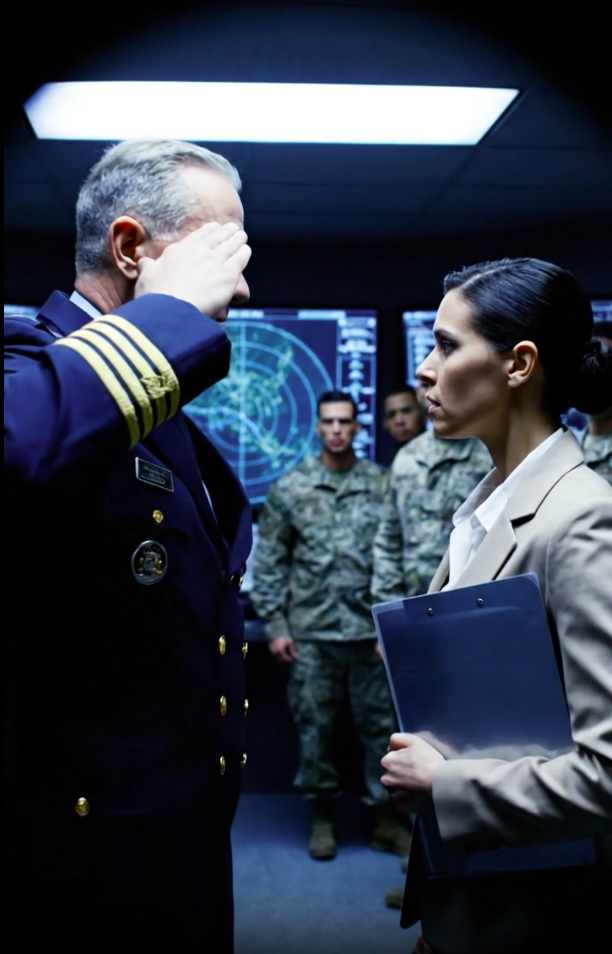
He raised his right hand in a crisp, flawless salute.
It was as if the oxygen had been sucked out of the room. The SEALs stared, jaws tight, brows furrowed.
Salutes like that weren’t handed out carelessly. Especially not from a four-star Admiral to someone who, by all appearances, was a civilian nobody.
I returned the salute without hesitation.
My movement was smooth, economical, and so precise it might have been carved from ice. The sound of my heels clicking together rang out, sharp in the quiet.
We held the salute for two beats longer than protocol demanded.
Then, in unison, we dropped our hands.
“Good to see you again, Captain,” the Admiral said.
His voice carried easily to every corner of the silent room.
Captain.
The word hung in the air, vibrating.
The smirking Lieutenant near the coffee pot dropped his mug. It didn’t break, but the clatter was deafening.
Heads turned sharply toward me. The younger SEALs who had been whispering earlier looked like they had just swallowed a grenade.
The Admiral smiled faintly. “I see you’re still keeping a low profile.”
“Old habits, Sir,” I replied.
Commander Miller finally found his voice. It came out as a squeak. “Sir… you… you two know each other?”
The Admiral glanced at Miller, then back at me.
“We served together,” the Admiral said. “Different times. Different places.”
The way he said it made it clear those different places weren’t on any map these men had ever seen.
“Gentlemen,” the Admiral announced, turning to address the stunned room. “I suggest you listen to whatever she has to say. Because if she’s in the room, it means you’re already in more trouble than you think.”
He looked back at me. “Ready to get to work, Shadow Hawk?”
I nodded. “Always.”
And just like that, the invisible woman was gone. The legend had arrived.
Chapter 3: The Ghost Story
The silence that followed the Admiral’s salute wasn’t just quiet; it was heavy. It was the kind of silence that presses against your eardrums, suffocating and absolute.
Admiral Vance lowered his hand, his eyes still locked on mine. He didn’t look at the stunned SEALs. He didn’t look at Commander Miller, whose face had drained of color, leaving him looking like a man who had just realized he was standing on a pressure plate.
“Captain,” Vance said again, the title landing like a sledgehammer. “It’s been a while since Operation Black Dagger. I heard rumors you’d gone dark.”
Black Dagger.
The moment that code name left his lips, the temperature in the room dropped ten degrees.
If “Captain” had been a shock, “Black Dagger” was a nuclear detonation.
Conversations about Black Dagger didn’t happen in hallways or over beers at the officers’ club. It was one of those whispered operations that floated through the Special Forces community like a ghost story. It was never officially acknowledged, never written down in unredacted files, but everyone who wore a Trident knew the rumors.
The younger SEALs didn’t know the specifics—only that it was a suicide mission deep behind enemy lines in a region that didn’t exist on public maps. A small team, cut off, no air support, surrounded by a warlord’s militia.
The older operators, however, knew more. They remembered the classified After Action Reviews that were sealed immediately. They remembered the stories of a single operative who had navigated twelve miles of hostile terrain to extract the team without firing a single unsuppressed shot.
They looked at me now with a dawning, horrified recognition.
The woman they had been mocking for her clipboard. The woman they thought was a glorified secretary.
She wasn’t just part of the story. She was the story.
Commander Miller swallowed hard. He looked from the Admiral to me, his brain trying to rewire six weeks of assumptions in six seconds.
“Sir,” Miller stammered, his voice losing all its gravelly authority. “You… you’re saying she…”
“I’m saying,” the Admiral cut him off, his voice turning cold, “that if it weren’t for the Captain here, three of my best commanding officers wouldn’t be alive today. Including the man who trained you, Miller.”
Miller flinched.
The Admiral turned back to me, a faint smirk touching the corner of his mouth. “You still running your own playbook, Shadow Hawk?”
“Always, Sir,” I replied. My voice was calm, steady. “Standard operating procedure tends to get people killed when the intel is bad.”
“And how are these boys treating you?” Vance asked, gesturing vaguely at the room full of elite warriors who were now staring at their boots.
I glanced around the room. I looked at the Lieutenant who had asked me for coffee. He was pale, staring at the wall, wishing he could dissolve into the drywall. I looked at the two gossiping operators. They looked like statues.
“They’re learning, Admiral,” I said smoothly. “They have potential.”
A ripple of tension ran through the ranks. No one missed the implication. I could have buried them. I could have reported them for disrespect, for lax operational security, for arrogance.
But I didn’t. That wasn’t my style.
The Admiral chuckled, a low, dry sound. “Learning. That’s a polite way to put it.”
He stepped back, his demeanor shifting from the warmth of an old comrade back to the rigidity of a flag officer. He turned to face the room.
“You have one of the single best tactical minds in the Naval Special Warfare community standing in this room,” Vance announced, his voice projecting command. “She has more field time in denied areas than most of you have time in the service. Do not waste her time. Do not second-guess her intel.”
He paused, letting the order sink in.
“We have a situation developing in Sector 4. The Captain is going to walk you through it. And for the love of God, Miller,” he shot a look at the Commander, “get her a real workspace. She’s not an intern.”
“Yes, Sir,” Miller barked, snapping to attention.
“Thank you, Admiral,” I said, inclining my head.
“Don’t thank me,” Vance said quietly as he turned to leave, his voice low enough that only I could hear. “Just make sure they come home. That’s why I sent you here.”
“I always do,” I whispered.
He nodded once, then turned and marched out the blast doors. The heavy steel slammed shut behind him, sealing us back in.
For a long, agonizing moment, no one moved.
The echo of his boots faded, but the presence of the Admiral—and the bomb he had dropped—remained.
Finally, the silence was broken by the petty officer near the back. “Shadow Hawk,” he whispered, as if testing the name.
I didn’t look at him. I walked over to the Commander’s desk, where my clipboard still lay. I picked it up.
“All right,” I said, my voice cutting through the fog of their shock. “Show’s over. We have a timeline to meet.”
I looked at Miller. He was staring at me, his eyes wide, searching for the person he thought he knew.
“Captain,” he said, the word feeling strange in his mouth. “I… I didn’t know.”
“You weren’t supposed to,” I said simply. “If I wanted you to know my rank, I would have worn it. I needed to see how your team operates when they think no one important is watching.”
Miller winced. He knew exactly what I had seen. Arrogance. Sloppiness. Assumptions.
“Now,” I said, walking past him toward the large tactical table in the center of the room. “Let’s talk about the Sector 4 extraction. Because if we stick to your current plan, Bravo Team is going to be dead by sunrise.”
Chapter 4: The Red Pen
The shift in the room was physical.
Ten minutes ago, I was an obstacle to be navigated around. Now, I was the center of gravity.
As I approached the main tactical table, the crowd of SEALs parted like the Red Sea. Men who would normally elbow their way to the front to give their opinions now stepped back, giving me a wide berth.
I didn’t wait for an invitation. I tossed my clipboard onto the digital surface of the map table and keyed in my personal access code.
The screen flickered. The “Access Denied” prompt that usually greeted junior staff didn’t appear. instead, the system flashed green: ACCESS GRANTED: LEVEL 5 – EYES ONLY.
A collective intake of breath hissed through the room. Level 5 was above Miller’s pay grade. It was above almost everyone’s pay grade.
“Bring up the satellite feed for the Northern Valley,” I ordered. I didn’t look up to see who would do it. I knew someone would.
Immediately, a young comms officer scrambled to his keyboard. The main wall monitor shifted, zooming in on a jagged range of mountains in the Middle East.
“This is the current target package,” Miller said, stepping up beside me. He was trying to regain his footing, trying to be the Commander again. “High-value target. Arms broker. Intel says he’s moving a shipment of guidance chips through this pass at 0200.”
“Intel is wrong,” I said.
I didn’t say I think. I didn’t say Maybe. I said it as a fact.
Miller paused. “The source is reliable. It’s from a CIA asset in—”
“The asset has been compromised since Tuesday,” I interrupted. I reached out and tapped the screen, drawing a red circle around a narrow canyon three miles east of the supposed route. “The broker isn’t moving through the pass. That’s a decoy. He’s moving here.”
“That’s a goat path,” the smirking Lieutenant—whose name I now recalled was Lieutenant Hanes—spoke up. He sounded less arrogant now, more confused. “You can’t get a convoy down that.”
“He’s not using a convoy,” I corrected, zooming in on the map. “He’s using mules. Local smugglers use this route to bypass thermal checkpoints. The rocks retain heat from the day, masking the heat signatures of the animals and men. If you set your ambush at the main pass, you’ll be hitting empty trucks while the target walks right past you.”
The room went silent again.
Hanes looked at the map, then at me. “How do you know that?”
I looked him dead in the eye. “Because I mapped that path myself four years ago. On foot. While carrying a wounded man.”
Hanes shut his mouth.
“Adjust the ambush coordinates,” I told the comms officer. “Move Bravo Team to the ridge overlooking the goat path. And tell them to switch to seismic sensors. Thermals will be useless against that rock face.”
“Done,” the officer said, typing furiously.
“Wait,” Miller said, frowning at the screen. “If we move them there, they’re outside the radio relay window. We’ll lose comms for twenty minutes during the pinch.”
“No, you won’t,” I said. I pulled a folder from my stack—one I had reorganized earlier that morning while they were ignoring me. “I re-tasked a high-altitude drone twenty minutes ago. It’s loitering at 30,000 feet right now. It will act as a passive relay. You’ll have clear audio the entire time.”
Miller stared at me. “You… you commandeered a drone? Without authorization?”
“I have authorization,” I said calmly. “I just didn’t feel the need to interrupt your coffee break to explain it.”
A few of the operators had to bite their lips to keep from laughing. The dynamic had completely flipped. They were realizing that while they were playing checkers, I had been playing three-dimensional chess.
I spent the next hour dismantling their plan and rebuilding it.
I caught a timing error in the supply drop that would have alerted the enemy. I flagged a medical evacuation route that went too close to a known anti-air battery. I adjusted the sniper overwatch positions to account for the Coriolis effect at that specific altitude.
Every change I made was precise. Every explanation was backed by hard data or personal experience.
The SEALs stopped looking at me with shock and started looking at me with hunger. Not a physical hunger, but professional hunger. They were warriors. They valued competence above all else. And they were realizing that I was an endless well of it.
“Ma’am,” a grizzled Chief Petty Officer named Daniels spoke up. He was the most senior enlisted man in the room, a man who had likely killed more people than cancer. “Regarding the extraction… if the weather turns, that ridge becomes a wind tunnel. Copters won’t be able to hold a hover.”
It was a valid question. A test.
“Good catch, Chief,” I said, acknowledging him. “That’s why we’re not extracting from the ridge. If the wind speeds hit forty knots, the team rappels down the south face to the valley floor. It adds forty mikes to the exfil, but it puts them in a defilade where the wind is blocked. The birds can land hard.”
Daniels nodded slowly, a look of genuine respect crossing his scarred face. “Rappelling down the south face in the dark… that’s hairy.”
“Better hairy than dead,” I said.
“Hoo-yah,” Daniels murmured.
By the time the briefing was over, the map on the screen looked completely different. It was tighter. It was smarter. It was lethal.
Miller looked at the finished plan. He looked tired, but he also looked relieved. He knew, deep down, that the original plan had holes. He just hadn’t known how to fix them.
“Alright,” Miller announced to the room. “You heard the Captain. Update the teams on the ground. We move on the new coordinates.”
He turned to me. “Anything else, Captain?”
“One thing,” I said.
I walked over to the coffee pot—the same one Hanes had asked me to serve him from. I poured a cup.
The room watched me.
I walked back to Hanes. He stiffened.
I took a sip of the coffee myself, holding his gaze.
“Next time you want coffee, Lieutenant,” I said quietly, “get it yourself. You’re a SEAL, not a toddler.”
Hanes turned bright red. “Yes, ma’am.”
I set the cup down on the tactical table. “Now, let’s get to work.”
Chapter 5: The Weight of Silence
The hours that followed were a blur of controlled chaos.
The mission launched. We watched the feeds in real-time.
The drone I had repositioned beamed back crisp, clear video. We saw the empty trucks of the decoy convoy roll through the main pass, just as I had predicted. If the team had been there, they would have sprung their trap on nothing, revealing their position for zero gain.
Then, the camera panned to the narrow goat path.
“Contact,” the radio crackled. “Visual on the mules. Target confirmed.”
The room erupted in a low buzz of excitement.
“Wait for it,” I said, my eyes glued to the screen. “Let the point man pass the choke point.”
Miller reached for the microphone, but stopped. He looked at me. He was deferring the call.
I nodded. “Now.”
“Execute,” Miller ordered.
On the screen, shadows detached themselves from the rocks. It was over in seconds. The flash of suppressed muzzles, the takedown of the guards, the securing of the target. It was text-book.
“Target secure. No casualties. Moving to exfil.”
A cheer went up in the Operations Center. High-fives were exchanged. The tension that had coiled in everyone’s stomach finally unspooled.
I stood back, leaning against a support pillar, watching them celebrate.
It was a good feeling. It never got old—the feeling of bringing everyone home.
But I didn’t join the celebration. I wasn’t part of the brotherhood, not really. I was the architect, not the bricklayer.
“You called it,” a voice said.
I looked over. It was Daniels, the Chief. He was holding two mugs of coffee. He offered one to me.
“Black, no sugar,” he said. “Figured you didn’t need the sweetness.”
I took the mug. “Thanks, Chief.”
He stood beside me, watching the screen where the team was beginning their rappel down the south face.
“So,” he said, his voice low. “Shadow Hawk. I thought that was just a story they told us in BUD/S to scare us. The operator who walked into a warlord’s compound and walked out with his head.”
“People like to exaggerate,” I said, taking a sip.
“The Admiral didn’t seem to think so,” Daniels countered. He paused, then looked at me sideways. “You’ve been here six weeks. You let Hanes talk to you like you were the maid. You let the Commander hand you filing work. Why?”
It was the question everyone wanted to ask. Why the disguise? Why the silence?
“Because respect isn’t a rank you wear on your collar, Chief,” I said. “And it’s not a reputation you talked about in a bar. If I had walked in here on day one with my rank and my history, you all would have listened to me, sure. You would have followed orders.”
I turned to face him fully.
“But you wouldn’t have trusted me. You would have wondered if I was just some officer climbing the ladder, looking for a medal. I needed to know who you were when the protocol was stripped away. And you needed to see that I could do the work—the grunt work, the boring work, the invisible work—before I asked you to trust me with your lives.”
Daniels processed that. He nodded slowly.
“Well,” he said. “You made your point. Hanes is going to be waking up in a cold sweat for a month.”
I allowed myself a small smile. “Good. Fear keeps you sharp.”
Across the room, Commander Miller was wrapping up the post-op call with the base Admiral. He hung up and walked over to us.
“Admiral sends his regards,” Miller said. “He wants an After Action Report on his desk by 0800.”
He looked at me. “He specifically asked for your signature on it, Captain.”
“I’ll have it ready,” I said.
Miller hesitated. “Look… about before. The last few weeks. I apologize. We should have recognized…”
“Stop,” I said, raising a hand. “You were focused on the mission. That’s what a Commander does. Just don’t let your focus narrow so much that you miss the assets standing right next to you.”
“Understood,” Miller said.
He looked at the digital clock. 04:15 hours.
“Get some rest, Captain,” Miller said. “We’ve got another briefing at 1000. And… I’d like you to lead it.”
It was a handing over of the torch. He wasn’t stepping down, but he was stepping aside. He was acknowledging that in matters of tactics, I was the superior officer.
“I’ll be there,” I said.
I gathered my things—my jacket, my clipboard (which no one would ever mock again), and the secure laptop I had finally unlocked.
As I walked toward the blast doors, the room went quiet again. But it wasn’t the awkward silence of earlier. It wasn’t the shocked silence of the salute.
It was the silence of respect.
Operators nodded as I passed. Hanes stood up and gave a stiff, awkward, but genuine nod.
I pushed the heavy door open and stepped out into the cool night air of the base. The stars were bright overhead.
I took a deep breath, letting the adrenaline fade.
They knew who I was now. The secret was out. The game had changed.
But as I walked toward my quarters, I knew the hardest part wasn’t over. Winning their respect was one thing. Leading them into what was coming next… that was something else entirely.
Because the intel I had seen on the Admiral’s private server—the intel that had brought me here in the first place—was far worse than a few arms dealers in the mountains.
Something was coming. Something big.
And now, I had a team to fight it with.
Chapter 6: The Ghost Goes to War
The peace didn’t last. In our line of work, peace is just the reloading time between crises.
I had barely closed my eyes in my temporary quarters when the base-wide siren began to wail. It wasn’t the rhythmic test siren. It was the frantic, undulating scream of a Priority One scramble.
I was out of my bunk and in my boots before the first echo faded.
When I burst back into the Operations Center, the room was a hive of panicked activity. But the moment I stepped through the doors, eyes snapped to me. The panic didn’t vanish, but it focused. They weren’t looking for Miller anymore. They were looking for the Shadow Hawk.
“Situation?” I barked, moving to the main table.
Commander Miller was already there, his face grim. “We cracked the intel from the broker we just grabbed. He talked.”
“And?”
“He didn’t just sell guidance chips,” Miller said, sliding a tablet toward me. “He sold a dirty bomb. A radiological dispersal device. It’s sitting in a mountain fortress twelve clicks from the extraction point we just used. And the buyer is moving it tonight.”
I scanned the tablet. The location was a nightmare. The “Fortress” was an old Soviet-era listening post built into a sheer cliff face. One way in, one way out, and guarded by a private army that made the previous smugglers look like Boy Scouts.
“Launch the birds,” I said. “We need to interdict that convoy before it leaves the valley.”
“We can’t,” Daniels interjected, his voice tight. “Storm front just slammed into the mountains. Visibility is zero. Rotors will freeze in minutes. Air support is grounded.”
Silence descended on the room. A dirty bomb moving under the cover of a storm. No air support. No drones.
“If that bomb leaves the valley,” Miller said quietly, “it disappears into the global black market. Next time we see it, it’ll be in a container ship pulling into New York or London.”
I looked at the map. I looked at the storm telemetry. And then I looked at the team—Hanes, Daniels, Miller, and the others. They were exhausted from the earlier op, but they were ready.
There was only one way to do this.
“We go on foot,” I said.
Miller looked at me. “Captain, that’s a twelve-mile hike through blizzard conditions, followed by a vertical assault on a fortified position.”
“I know,” I said. “I’ve done it before.”
I walked over to the equipment locker in the corner of the room. The SEALs watched, confused, as I didn’t stop at the comms station. I walked straight to the weapons rack.
I pulled a suppressed HK416 from the rack. I checked the bolt, the action smooth and silent. I grabbed a plate carrier vest and began strapping it on over my blouse.
“Ma’am?” Hanes asked, his voice wavering slightly. “What are you doing?”
I turned to face them, cinching the vest tight.
“You need a guide,” I said. “I know that mountain. I know the blind spots in their thermal grid. And I know how to kill the men guarding it without waking the rest of the base.”
“You’re a high-value asset,” Miller argued, though his resistance was weak. “If you get captured…”
“If that bomb walks, millions die,” I cut him off. “I’m not an asset right now, Miller. I’m a shooter.”
I looked at the team. “Gear up. Wheels up in ten. We drive to the trailhead, then we walk. We hit them hard, we secure the package, and we pray the weather clears for extraction.”
For a second, nobody moved. The idea of the “coffee girl” grabbing a rifle and leading a Tier One element into a blizzard seemed insane.
Then, Chief Daniels grabbed his helmet.
“You heard the lady,” he growled, a fierce grin breaking through his beard. “Move your asses!”
Chapter 7: The Death Zone
The cold was a physical thing. It was a hammer that struck every inch of exposed skin.
We had abandoned the vehicles at the snow line. For the last two hours, we had been trudging through knee-deep snow, the wind howling like a banshee.
I took point.
I didn’t use a GPS. I didn’t check a map. I navigated by the shape of the ridgelines visible through the swirling white, by the feel of the incline under my boots.
Behind me, the SEALs were struggling. They were fit—the fittest men on earth—but they weren’t used to this. This was my playground. This was where I had spent years hunting ghosts in the Hindu Kush.
I raised a fist. Halt.
The team froze instantly, blending into the snow in their white over-gear.
I tapped my headset. “Thermal net ahead,” I whispered. “Two sentries. South ridge.”
Hanes, breathing hard behind me, squinted into the whiteout. “I don’t see anything.”
“You won’t,” I murmured. “They’re dug in.”
I handed my rifle to Hanes. “Hold this.”
“Captain?”
“Stay here,” I ordered. “If you fire a shot, the acoustic sensors will trigger the alarm. This has to be blade work.”
I drew the combat knife from my vest. The steel was cold and dark.
I moved forward, dropping into a crouch. I didn’t walk; I flowed. I matched my breathing to the wind gusts. I placed my feet in the disturbed snow where the wind had already scoured the ground.
To the SEALs watching through their night-vision goggles, I must have looked like a phantom. One second I was there, the next I was a blur of white motion dissolving into the storm.
I crept up the blind side of the ridge. I could smell the sentries before I saw them—cheap tobacco and unwashed bodies. They were huddled in a small dugout, trying to stay warm, their eyes on the valley floor, not the ridge above them.
Assumption. It kills you every time.
I dropped into the dugout.
It was over in three seconds. No screams. No struggle. Just the wet thud of bodies hitting the dirt.
I keyed my mic two times. Click-click.
The team moved up. When they reached the dugout, Hanes looked at the two downed guards, then at me. I was wiping my blade on the snow, my face completely devoid of emotion.
There was fear in his eyes now. Not the fear of the enemy, but the fear of what I was capable of.
“Clear,” I whispered. “The fortress is two hundred meters north. We breach the ventilation shaft.”
The “fortress” loomed out of the storm—a slab of concrete buried in the rock. We rappelled down the ventilation shaft, moving from the howling wind into the suffocating silence of the interior.
We were inside.
The facility was a maze. I led them through the corridors, bypassing cameras I knew were there, timing our movements to the rotation of the automated patrols.
We reached the main hangar. And there it was.
In the center of the room, surrounded by technicians and armed guards, was a lead-lined container. The bomb. They were loading it onto a heavy-duty truck.
“Miller,” I whispered. “Take the left flank. Daniels, right. On my signal.”
I raised my suppressed rifle. I lined up the shot on the commanding officer shouting orders by the truck.
I took a breath. I held it.
Drop.
My round took the officer in the throat. Before his body hit the ground, the rest of the team opened up.
The hangar erupted in the thwip-thwip-thwip of suppressed fire. The enemy didn’t stand a chance. They were fighting shadows. We cut them down with the ruthless efficiency of a machine.
“Secure the package!” I yelled, moving toward the truck.
Hanes and Daniels vaulted onto the truck bed, checking the container.
“It’s live!” Daniels yelled. “Timer is active! They rigged it to blow if they got hit!”
“Disarm it!”
“I can’t!” Daniels shouted, panic edging into his voice. “It’s a dual-core tamper switch. I need four hands and a bypass code I don’t have!”
I slung my rifle and sprinted to the truck. I vaulted up beside them.
I looked at the device. It was a mess of wires and C4 strapped to a cobalt core.
“I’ve seen this design,” I said, my mind flashing back to a raid in Chechnya three years ago. “It’s not a timer. It’s a dead man’s switch linked to the network.”
I ripped the panel off the side. “Give me your knife.”
Daniels handed it over.
“Cut the blue wire on three,” I ordered. “I’m going to bridge the circuit with the blade.”
“Captain, if you miss…”
“I don’t miss,” I said. “One. Two. Three!”
Daniels cut. I jammed the knife into the circuit board.
Sparks flew. The humming of the bomb whined up to a shriek—and then died.
The lights on the console went black.
Silence returned to the hangar, heavy and sweet.
I exhaled, my hands steady. “Package neutral.”
Hanes slumped against the wall of the truck, laughing breathlessly. “Jesus… Jesus Christ.”
I looked at them. “We’re not done. We still have to walk out of here.”
Chapter 8: No Longer a Shadow
The extraction was brutal, but successful.
By the time the weather cleared and the choppers flared for landing at the rendezvous point, we were all running on fumes.
I sat in the back of the Pave Hawk helicopter, staring out at the receding mountains. My face was smeared with camouflage paint and dirt. My hands were trembling slightly—not from fear, but from the adrenaline crash.
Commander Miller sat across from me. He looked wrecked. But his eyes were fixed on me.
He tapped his headset, switching to the internal comms channel.
“Captain,” he said.
I looked up. “Commander.”
“Back there,” he said, gesturing to the mountain. “What you did on the ridge. And with the bomb. I’ve never seen anything like that.”
I shrugged, leaning my head back against the vibrating hull. “It’s the job, Miller.”
“No,” he said firmly. “It’s not just the job. It’s… it’s the standard.”
He looked around at the other SEALs. They were all watching me. Hanes. Daniels. The young guys.
There was no more skepticism. No more mockery. The barrier between “us” and “her” was gone. I had bled with them. I had frozen with them. I had saved them.
“When we get back,” Miller said, “I’m buying the coffee.”
A tired smile tugged at the corner of my mouth. “Two sugars, Miller. Don’t forget.”
The team burst into laughter—a release of tension, a bonding ritual.
When we landed back at base, the sunrise was bleeding purple and gold across the horizon. We walked off the tarmac in a V-formation.
Admiral Vance was waiting for us.
He stood by the hangar doors, hands clasped behind his back. He saw the team approach—dirty, battered, victorious.
He saw me walking in step with them, not behind them.
He smiled.
I stopped in front of him. I didn’t salute this time. I was too tired, and honestly, we were past that.
“Mission accomplished, Sir,” I rasped. “Package secured. Hostiles neutralized.”
“I heard,” Vance said. “Drone feed caught the thermal bloom from the hangar takedown. Impressive work, Shadow Hawk.”
He looked at Miller. “Commander, report.”
Miller stepped forward. He looked at the Admiral, then he looked at me.
“Sir,” Miller said, his voice ringing clear in the morning air. “The Captain… Shadow Hawk… she took point. She neutralized the sentries. She disarmed the device. To be honest, Sir, we were just carrying her gear.”
It was a lie—they had fought bravely—but it was the highest compliment a SEAL could give. He was giving me the credit. He was giving me the glory.
Vance nodded, his eyes twinkling. “I tried to tell you, Commander. Some weapons don’t look like weapons.”
I unclipped my vest, letting it drop to the tarmac with a heavy thud. I felt lighter than I had in years.
“I’m going to the showers,” I said, rubbing the grease paint from my cheek. “And then I’m going to sleep for a week.”
“Captain,” Hanes called out.
I turned.
The Lieutenant—the one who had started this whole thing with a smirk and an empty mug—was standing at attention.
“Hoo-yah, Ma’am,” he said.
It wasn’t a mandatory courtesy. It was the SEAL war cry. It was an acceptance into the tribe.
“Hoo-yah, Lieutenant,” I replied softy.
I walked away toward the barracks, the morning sun warming my back.
They still called me the coffee girl sometimes, as a joke. But the tone was different now. It was affectionate. It was protective.
I had walked into that room as a ghost. I was leaving it as a sister.
The Navy’s Operations Center would continue to hum. The missions would keep coming. But the dynamic had changed forever.
They learned the lesson that every enemy I’ve ever faced learned too late:
The most dangerous thing in the room isn’t the man shouting orders.
It’s the quiet woman in the corner, holding the clipboard, who has already figured out how to kill you five different ways before you’ve even finished your sentence.
[END OF STORY]