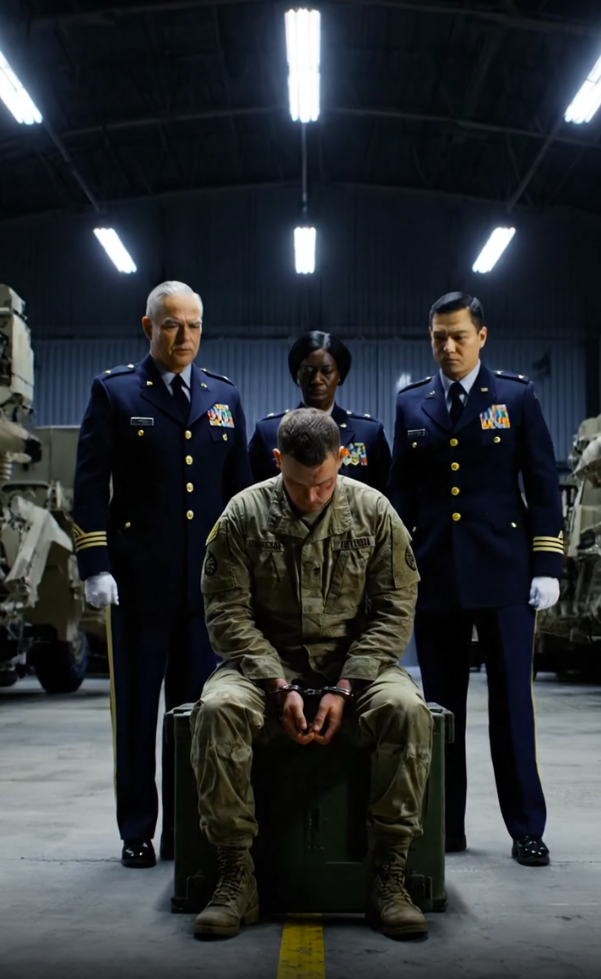
He Silenced Her To Protect The Base. Minutes Later, Three Generals Arrived In Black SUVs And Shut The Whole Place Down.
PART 1: THE INCIDENT
Chapter 1: The Silence of the Desert
Fort Kearney was a ghost town disguised as a military installation. It sat in the dead center of the Nevada desert, a scorched patch of earth surrounded by miles of nothing but sagebrush, sand, and silence. Officially, it was listed as a logistics and supply hub for Air Force operations—a boring, unremarkable dot on the map where maintenance reports went to die. It was the kind of place career soldiers were sent when the brass didn’t know what else to do with them.
Unofficially, every soul stationed within the perimeter fence knew that the math didn’t add up.
The isolation was oppressive. The heat was a physical weight that pressed down on your shoulders from sunrise to sunset. But it was the nights that really got to Sergeant Daniel Harlo. At night, the desert didn’t sleep. It hummed. Massive cargo planes would land on the unlit auxiliary runways at 03:00 hours, unload crates marked with high-level encryption codes, and take off again before dawn. No manifests. No flight plans. Just engines screaming in the dark and then silence.
Daniel had been at Fort Kearney for eight months. He was a man who had seen too much of the world already. Two tours in Afghanistan, one in Syria. He had a commendation for bravery that he kept shoved in the bottom of a duffel bag and a jagged white scar running along his jawline from an IED fragment. War had hollowed him out. He didn’t believe in glory anymore. He believed in survival. He believed in keeping his head down, doing his shift, and not asking questions.
That philosophy was being tested every single day at Fort Kearney.
He worked in logistics and maintenance, a job he was vastly overqualified for, but one that kept him far away from gunfire. His days were a blur of inventory audits and signing off on maintenance requests. But lately, the paperwork had started to look more like fiction.
He was being ordered to sign off on thousands of gallons of jet fuel for aircraft that hadn’t left the hangar in six months. He was processing repair orders for “Ghost Units”—squadrons that didn’t appear on any official Air Force roster. When he had casually asked his superior, Lieutenant Reyes, about the discrepancies a week ago, the response had been chillingly flat.
“It’s a clerical lag, Sergeant,” Reyes had said, not looking up from his screen. “Sign the papers. Forget the numbers.”
So Daniel signed. He signed because he was tired. He signed because he wanted to just do his twenty years and retire to a cabin where he never had to see a weapon again. But the unease was growing in his gut, a slow-burning ulcer of anxiety.
That night, the hangar was suffocating. The industrial air conditioning had rattled and died three hours ago, leaving the massive space filled with stagnant, hot air that smelled of grease, hydraulic fluid, and old dust. The overhead fluorescent lights hummed with an irritating buzz that felt like it was drilling directly into Daniel’s skull.
He was alone, sitting at a metal workbench in the center of the vast, empty space. In front of him was a stack of files a foot high, each one stamped CONFIDENTIAL in red ink. He was rubbing his temples, trying to stave off a migraine, when the heavy steel door at the far end of the hangar creaked open.
He didn’t need to turn around to know who it was. The rhythmic, purposeful click of boot heels against the concrete gave her away.
Corporal Emma Reeves.
She was ten years younger than Daniel, with eyes that were too sharp and a mind that was too quick for a place like this. She had transferred in two months ago and had immediately become a problem. Not because she was incompetent—she was brilliant—but because she actually read the files. She noticed the things everyone else was paid to ignore.
“Burning the midnight oil, Sergeant?” she asked. Her voice echoed in the cavernous room.
Daniel didn’t look up. He picked up a pen and scribbled a signature on a fuel requisition form. “Someone has to keep the books straight, Reeves.”
“Straight?” She let out a dry, humorless laugh. She walked up to the desk and dropped a clipboard onto his stack of papers. The sound was like a gunshot in the quiet room. “Is that what we’re calling it now? Straight?”
Daniel finally looked at her. She looked exhausted, pale under the harsh lights, but her eyes were burning with a frantic intensity. She was holding a cup of black coffee, her knuckles white around the Styrofoam.
“Go to bed, Emma,” Daniel said, his voice gravelly. “It’s late.”
“I can’t sleep,” she said, leaning in close. “And neither can you. I know you see it, Daniel. I know you’re not stupid.”
“I don’t know what you’re talking about.”
“The fuel,” she whispered, as if the walls were listening. “The parts. The money. I ran a cross-reference on the logistical supply chain for the last fiscal quarter. Daniel, we are bleeding millions of dollars. Equipment is vanishing. Money is being funneled into accounts that lead nowhere. This isn’t just ‘clerical lag.’ This is theft. Massive, organized theft.”
Daniel leaned back in his chair, the metal groaning under his weight. He felt a cold spike of fear in his chest. Not for the theft, but for her. She didn’t understand the machine she was poking.
“Emma,” he said, keeping his voice low and steady. “Listen to me very carefully. You are imagining things. You are seeing patterns where there are none. You need to take that clipboard, shred whatever is on it, and go back to your barracks.”
She shook her head, her ponytail whipping side to side. “No. I’m not imagining it. And neither are you. You’re signing off on it! That makes you complicit, Daniel. When this blows up—and it will blow up—they are going to hang this on us. On the logistics team. On you.”
“We follow orders,” Daniel snapped, his patience fraying. “That is the job.”
“That is the excuse!” she shouted. Her voice cracked. “That is the excuse of a coward!”
The word hung in the air, heavy and ugly.
Daniel stood up abruptly. His chair screeched backward, toppling over. He was a big man, imposing, and the sudden movement made Emma take a half-step back, though she held her ground.
“Watch your tone, Corporal,” he warned, his jaw tightening. The scar on his face turned a stark white against his flushed skin.
“You can intimidate the fresh recruits, Daniel, but you can’t scare me,” Emma said, her voice trembling but defiant. “You’re scared. I can see it. You’re protecting yourself. You know this base is dirty, and you’re helping them scrub the floors.”
“I am trying to keep us alive!” Daniel roared, stepping around the desk. “You think this is just theft? You think you can just write a report and be a hero? These people—whoever is running this—they will bury you in the desert and nobody will ever find the grave. Stop digging!”
“I’ve already dug!” Emma yelled back. She grabbed the radio on her belt. “I sent the files. I sent copies to external review at the Pentagon an hour ago. It’s done, Daniel. It’s over.”
Daniel froze. The world seemed to stop spinning. The hum of the lights grew deafening.
“You did what?” he whispered.
“I reported it,” she said, her chin high. “It’s out of their hands now. Investigation teams will be—”
She didn’t finish the sentence.
Something inside Daniel broke. It wasn’t a rational thought. It was a surge of pure, animalistic panic. He saw his life—his pension, his freedom, his safety—vaporizing in an instant. He saw the court-martial. He saw the dark cell. He saw the inevitable retaliation from the shadowy figures running this base. She had doomed them both.
He didn’t think. He reacted.
His hand shot out and grabbed the nearest object on the workbench—a heavy, solid steel mechanic’s wrench.
“Daniel, don’t!” Emma screamed, seeing the look in his eyes. She raised her hands.
He swung.
It was a blind, desperate arc of motion. The heavy steel connected with the side of her head with a sound that Daniel would never, ever forget. It was a dull, wet thud, followed by a sickening crack.
Emma’s eyes rolled back. Her knees buckled instantly. She didn’t even make a sound as she collapsed, hitting the concrete floor like a ragdoll.
The wrench clattered from Daniel’s hand, bouncing on the floor.
Silence rushed back into the hangar, instantaneous and absolute. Daniel stood over her, his chest heaving, his hands shaking so violently he couldn’t make a fist. He looked down at the woman who had just been trying to do the right thing.
She wasn’t moving.
Chapter 2: The Arrival
“Emma?”
Daniel’s voice was a broken whisper. He dropped to his knees beside her, disregarding the oil stains on the floor. He reached out, his fingers hovering over her, afraid to touch her. Blood was already pooling beneath her hair, dark and thick, spreading across the grey concrete like a growing shadow.
“Oh god. Oh god, no.”
He checked for a pulse. His own heart was hammering so hard in his fingertips that he couldn’t tell if the beat he felt was hers or his own. He pressed harder against her neck.
There. Faint. Thread-like. But it was there. She was alive.
Panic, cold and sharp, flooded his system. He had to get her help. He had to call the medics. He reached for his radio.
But his hand stopped halfway to his belt.
If he called the medics, he would have to explain. He would have to explain the argument. He would have to explain why he hit a fellow soldier with a weapon. He would be arrested immediately. And then… then the investigation would start. The investigation Emma had triggered. They would look at him. They would see his signature on the fraudulent documents. They would see the assault.
They wouldn’t see a man having a panic attack. They would see a conspirator silencing a whistleblower. He would go down for everything. The theft, the fraud, the attempted murder.
He pulled his hand back. He couldn’t call them yet. He needed to think. He needed to fix this.
“I can fix this,” he muttered to himself, his mind fracturing. “Just… just get her up. Get her to the infirmary. Say she fell. Say a crate fell on her.”
He slid his arms under her shoulders, groaning with the effort as he dragged her limp body across the floor. He needed to get her out of the open. He dragged her behind a towering stack of supply crates in the corner of the hangar, hidden from the main door.
He stripped off his uniform jacket, wadded it up, and pressed it gently against the wound on her head to staunch the bleeding. She moaned softly, a sound of pure pain that twisted a knife in Daniel’s gut.
“I’m sorry, Emma. I’m so sorry,” he wept, rocking back on his heels.
He stood up and ran back to the workbench. The blood. There was blood on the floor. He grabbed a handful of industrial rags and a bottle of solvent. He dropped to his knees and scrubbed frantically at the stain, the chemical smell mixing with the copper scent of blood.
Scrub. Scrub. Hide it.
He was just standing up, the bloody rags clutched in his hand, when the side door of the hangar burst open.
Beams of white light cut through the gloom. Flashlights.
“Sergeant Harlo!” A voice boomed.
MPs.
Daniel spun around, hiding the rags behind his back. “I’m here!” he called out, his voice cracking. “Everything’s fine! Just… just dropped some tools.”
Two Military Police officers walked in, their hands resting on their holsters. They didn’t look relaxed. They looked tense, alert.
“We heard shouting, Sergeant,” the lead MP said, shining his light directly into Daniel’s face. Daniel squinted, blindingly bright. “Report came in from the perimeter guard. Sounded like a fight.”
“No fight,” Daniel lied, his heart slamming against his ribs. “Just me. I knocked over a shelf. Frustrated with the paperwork. You know how it is.”
The MP didn’t smile. He lowered the light, sweeping it across the floor. The beam passed over the workbench. It passed over the wet spot where Daniel had just scrubbed. It kept moving.
Daniel held his breath. Go away. Please, just go away.
The beam hit the corner of the room. It stopped.
Sticking out from behind the crates, illuminated in the harsh white light, was a boot. A standard-issue combat boot.
The MP’s hand flew to his gun. “Man down! Sector four!” he shouted into his radio.
“Wait!” Daniel stepped forward, raising his hands. “It’s not what you think!”
The second MP had his weapon drawn and leveled at Daniel’s chest before Daniel could take another breath. “Get on the ground! Now! On your knees, hands behind your head!”
“Please, she needs a medic!” Daniel screamed as he dropped to his knees. “I didn’t mean to!”
The next few minutes were a blur of chaos. He was slammed face-first into the concrete. Cuffs were ratcheted onto his wrists so tight they bit into the bone. He watched from the floor as medics rushed in, swarming over the corner where Emma lay. He heard the words “Head trauma,” “Critical,” and “Load her up.”
They dragged Daniel up and hauled him toward the door. As they stepped out into the night air, the base was unrecognizable.
It wasn’t just a police response. It was an invasion.
Red emergency lights were flashing from every tower. Sirens wailed, a mournful, rising and falling scream that echoed off the distant mountains. Soldiers were pouring out of barracks, confused, pulling on gear.
Colonel Patterson, the Base Commander, pulled up in his jeep, tires screeching. He jumped out, but he didn’t look at Emma being loaded into the ambulance. He looked at Daniel.
And the look on the Colonel’s face wasn’t anger. It was terror. Pure, unadulterated terror.
“You idiot,” Patterson hissed, walking up to Daniel as the MPs held him. “You absolute idiot. What did you do?”
“I… I hit her,” Daniel stammered. “We argued about the logs.”
“The logs?” Patterson’s face went white. “She talked about the logs?”
“She sent a report,” Daniel said, his head hanging low. “She said she sent it to the Pentagon.”
Patterson looked like he had been punched in the gut. He looked up at the sky, then at the main gate. “Secure him,” Patterson ordered, his voice shaking. “Put him in the hangar holding cell. Nobody speaks to him. Nobody touches him until they get here.”
“Who?” Daniel asked. “Who is coming?”
Patterson didn’t answer. He turned to his aide. “Cut the landlines. Kill the internet. We are in full blackout protocol.”
Daniel was dragged back into the hangar, placed on a crate, and chained to a structural beam. He sat there for twenty minutes, listening to the sirens, his mind replaying the sound of the wrench hitting bone over and over again.
Then, the sirens stopped.
A strange, heavy silence fell over the base. The kind of silence that happens when a predator enters the clearing.
Through the open hangar doors, Daniel saw the main gates slide open.
Three black SUVs, dark-tinted and unmarked, rolled onto the base. They didn’t have military plates. They moved in a tight formation, kicking up dust that swirled in the red emergency lights.
They stopped right in front of the hangar.
The doors opened in unison.
Three men stepped out. They wore dress uniforms, impeccable and sharp, contrasting with the dust and grit of the desert base. Stars gleamed on their shoulders.
Generals. Three of them.
General Whitaker was the tallest, a man with a face like carved granite. General Sloan was shorter, stocky, with eyes that scanned the perimeter like a targeting system. General Drayton carried a leather briefing folder and looked at the base with utter disdain.
They didn’t speak to Colonel Patterson, who had run up to greet them. They walked right past him.
They walked straight toward the hangar. Straight toward Daniel.
Daniel shrank back against the steel beam, the chains clinking. He was a Sergeant. He had never been this close to a General, let alone three.
General Whitaker stopped five feet away. He looked at the bloodstain on the floor, then looked at Daniel. The General’s expression was unreadable, cold, and terrifyingly calm.
“Sergeant Harlo,” Whitaker said. His voice was soft, but it carried raw power.
“Sir,” Daniel choked out.
“You have made a mess,” Whitaker said. “A very large, very expensive mess.”
“I… I assaulted an officer, sir. I’m ready to accept—”
“Assault?” Whitaker cut him off with a dismissive wave of his hand. “Son, if this was about an assault, you’d be in the brig with the local MPs. You think three Generals fly from D.C. to the middle of nowhere for a domestic dispute?”
Daniel stared at him, confused. “Then… why are you here?”
Whitaker took a step closer. The shadows stretched long across the floor.
“Corporal Reeves triggered a tripwire in the Pentagon’s server when she uploaded those files,” Whitaker said. “She didn’t just find fraud, Sergeant. She found the funding stream for a Black Operation that officially doesn’t exist. And by hitting her… by drawing attention to this specific room at this specific time… you have just put a spotlight on the darkest secret in the United States Air Force.”
Whitaker leaned in, his eyes hard as flint.
“We are shutting this base down. Right now. And you, Sergeant, are going to help us bury it.”
PART 2: THE COVER-UP
Chapter 3: The Lockdown
The atmosphere inside the hangar shifted instantly. It was no longer a crime scene; it was a command post.
General Whitaker didn’t shout. He didn’t need to. He simply turned his back on Daniel and began issuing orders to the space around him, knowing they would be obeyed.
“Sloan, kill the external feeds,” Whitaker said, his voice flat. “I want a localized jammer on the comms tower. If a single text message leaves this zip code, I’m holding you personally responsible.”
General Sloan, the stocky man with eyes that seemed to constantly calculate angles, nodded once and tapped a device on his wrist. “Already done, sir. The base is dark. Landlines are cut. Cell towers are jamming everything within a ten-mile radius. We are a black hole.”
“Drayton,” Whitaker continued, walking toward the spot where Emma had fallen. “Secure the perimeter. No one in, no one out. If the local sheriff comes asking about the sirens, tell him it was a malfunctioning turbine drill. If he pushes, detain him under the National Security Act.”
“Understood,” General Drayton replied. He turned on his heel and marched toward the terrified MPs who were still guarding Daniel. “You two. Get out. Forget what you saw. If I hear a whisper of this in the barracks, you’ll be peeling potatoes in Greenland for the rest of your careers. Move.”
The MPs scrambled out of the hangar as if the building were on fire.
Daniel sat frozen on the crate, the handcuffs biting into his wrists. He watched the machinery of the cover-up whir into motion. It was terrifyingly efficient. These men weren’t reacting to a crisis; they were executing a rehearsed protocol. They had done this before.
Colonel Patterson, the Base Commander who had been king of this hill just an hour ago, looked like a child who had broken a vase. He hovered near the entrance, wringing his hands.
“General Whitaker,” Patterson stammered. “I… I had no idea about the assault. Sergeant Harlo has a clean record. This was an isolated incident.”
Whitaker stopped pacing and looked at Patterson with mild annoyance. “Colonel, stop talking. You are relieved of command effective immediately. Go to your office, sit at your desk, and do not touch your computer. We will come for you when we are ready.”
Patterson opened his mouth to argue, saw the look in Whitaker’s eyes, and closed it. He turned and walked away, his shoulders slumped.
Now, it was just Daniel and the Generals.
Whitaker pulled a metal chair from the workbench, dragged it over to Daniel, and sat down backwards on it, resting his arms on the backrest. He looked like a disappointed father, which was infinitely worse than an angry officer.
“Let’s talk about timing, Sergeant,” Whitaker said softly.
Daniel swallowed hard. His throat felt like it was full of sand. “Sir?”
“Do you know what today is?” Whitaker asked.
“Tuesday, sir.”
“It is Tuesday,” Whitaker agreed. “But more importantly, it is forty-eight hours before the Senate Oversight Committee reviews the black budget allocations for the next fiscal year. Forty-eight hours.”
Whitaker leaned in closer. “Corporal Reeves—the woman you just bludgeoned—sent a packet of encrypted data to a secured Pentagon drop box tonight. Do you know what happens when the Pentagon receives unsolicited encrypted data alleging massive fraud?”
Daniel shook his head.
“Alarms go off,” Whitaker whispered. “Digital alarms. And those alarms ring in offices that you didn’t even know existed. Offices that belong to me.”
Daniel looked down at his hands. They were still stained with the faint, dark residue of the grease he had used to try and clean the blood. “I didn’t know about the budget, sir. I just… she was going to report the missing fuel. I thought I was protecting the unit.”
Whitaker let out a short, dry chuckle. “The missing fuel? Son, nobody cares about the fuel. The fuel is a rounding error. You think we flew out here because of gas money?”
The General stood up and walked to the stack of files on the desk—the files Daniel had been signing, the lies he had been helping to perpetuate.
“Fort Kearney isn’t a logistics hub,” Whitaker said, picking up a manifest. “It’s a wallet. A very deep, very secret wallet. The ‘Ghost Units’ you and Corporal Reeves found? They don’t exist because the planes aren’t here. The planes are currently flying surveillance sorties over borders we aren’t supposed to be crossing. The money you thought was being stolen? It wasn’t being stolen. It was being moved.”
Daniel felt the blood drain from his face. “So… she was wrong?”
“No,” Whitaker said, dropping the file. “She was right. Technically, it is fraud. Legally, it is embezzlement. But operationally? It is necessary. And Corporal Reeves was about to expose a twenty-year intelligence network because she’s good at math.”
The General looked at Daniel with a strange mixture of pity and contempt.
“You tried to silence her to save your own skin,” Whitaker said. “But in doing so, you created a crime scene. A physical, violent event that we can’t just delete from a server. You gave us a body. You gave us blood. And now, we have to clean up your mess before the sun comes up.”
The hangar door opened again. General Sloan walked in, holding a tablet.
“We have a problem,” Sloan said, his voice tight.
Whitaker turned. “What?”
“The Corporal,” Sloan said. “She’s in the infirmary. The medics stabilized her.”
Daniel felt a surge of relief so strong it made him dizzy. She’s alive.
“That’s not a problem, Sloan,” Whitaker said calmly. “That’s an opportunity.”
“She’s awake,” Sloan continued, ignoring the optimistic tone. “And she’s asking for a lawyer. She says she knows what she found, and she knows Harlo hit her to cover it up. She’s threatening to talk to the civilian police the second she gets a phone.”
Whitaker sighed, rubbing the bridge of his nose. “Of course she is.”
He turned back to Daniel.
“Well, Sergeant. It seems you didn’t hit her hard enough. Now we have a witness who is not only alive but very, very angry.”
Whitaker stood up and adjusted his uniform jacket.
“Uncuff him,” Whitaker ordered Sloan.
Sloan hesitated. “Sir? He’s a violent offender.”
“Uncuff him,” Whitaker repeated. “He’s not a prisoner anymore. He’s staff. We’re going to need help shredding the last ten years of paperwork, and Sergeant Harlo here knows exactly where the bodies are buried.”
Chapter 4: The Archive of Lies
The handcuffs clicked open. Daniel rubbed his wrists, the skin raw and red. The sensation of freedom was terrifying because he knew it was fake. He wasn’t free. He was just useful.
“Get up,” Sloan barked.
Daniel stood, his legs trembling. The adrenaline from the assault had faded, replaced by a deep, bone-weary exhaustion.
“Where are we going?” Daniel asked.
“To the records room,” Whitaker said, leading the way. “Digital records can be wiped with a keystroke. But the military loves its paper. Triplicate forms, carbon copies, signed manifests. We have four hours to turn three tons of incriminating paper into confetti.”
They marched him out of the hangar and across the tarmac. The night air was freezing now, the desert temperature plummeting. The base was eerily silent. No vehicles moved. No soldiers walked the paths. It was a ghost town, enforced by the will of three men.
They reached the Administration Building. Inside, the lights were harsh and bright. The hallway stretched out, lined with doors to offices that were usually bustling with clerks. Now, they were empty.
Whitaker kicked open the door to the Archives.
It was a large room filled with rows of metal filing cabinets. It smelled of old paper and dust. This was Daniel’s domain. He knew this room better than anyone. He knew which drawers stuck, which files were mislabeled, and which ones contained the lies.
“General Drayton is handling the physical assets,” Whitaker said, gesturing to the room. “Sloan is scrubbing the servers. You and I, Sergeant, are going to rewrite history.”
Whitaker walked to the nearest cabinet and pulled a drawer open. He pulled out a random file.
“Project Silver Spear,” Whitaker read aloud. “According to this, we purchased twelve million dollars in spare parts for F-22 Raptors last year. Did we receive those parts, Sergeant?”
“No, sir,” Daniel whispered.
“And yet,” Whitaker flipped to the back of the file, “here is your signature receiving them.”
Daniel flinched. “I was ordered to sign.”
“I know,” Whitaker said, his voice surprisingly gentle. “And tonight, you are ordered to destroy.”
Whitaker handed him a heavy-duty shredder bag. “Start with fiscal years 2018 through 2022. Anything marked with the prefix ‘X-ray’ or ‘Sierra.’ Shred it all. If it has a signature, it goes. If it has a dollar amount over fifty thousand, it goes.”
Daniel hesitated. “Sir… if we destroy these, won’t people ask where they went? An audit…”
“There won’t be an audit,” Whitaker said, pulling a lighter from his pocket and flicking it open. The flame danced in the stagnant air. “Because tomorrow morning, there is going to be a terrible electrical fire in this building. Faulty wiring. Old infrastructure. A tragedy. All records lost.”
Daniel stared at the lighter. “You’re going to burn the building down?”
“Containment, Sergeant,” Whitaker said, snapping the lighter shut. “Now, get to work.”
For the next three hours, Daniel worked like a machine. He pulled files. He checked the codes. He fed the shredder until the motor whined and overheated, then he started tearing them by hand and stuffing them into burn bags.
It was grueling, mindless work, but it gave his brain time to catch up with reality.
He was destroying the evidence of his own complicity. Every file he shredded was one less chain binding him to a court-martial. But it was also binding him to Whitaker. He was now an active participant in the cover-up. He wasn’t just a soldier who snapped; he was a conspirator.
As he worked, Whitaker sat on a desk, reading through select files, occasionally pocketing one that was too sensitive even for the fire.
“You have a good record, Harlo,” Whitaker said suddenly, breaking the silence. “Afghanistan. The Korangal Valley. That was a bad spot.”
“Yes, sir,” Daniel grunted, ripping a stack of invoices in half.
“You saved your squad leader,” Whitaker said, reading from a personnel file he had pulled. “Took shrapnel to the face. Dragged him two miles to the evac point.”
“He died anyway, sir.”
“But you tried,” Whitaker said. He looked at Daniel with a scrutiny that made Daniel’s skin crawl. “That’s the thing about loyalty, Sergeant. It’s not about the result. It’s about the effort. You were loyal to your squad then. Tonight, you need to decide if you can be loyal to the bigger picture.”
“Is the bigger picture worth killing for?” Daniel asked. The words slipped out before he could stop them.
The room went deadly silent.
Whitaker stood up slowly. He walked over to Daniel and loomed over him.
“We didn’t kill anyone, Sergeant,” Whitaker said coldly. “You almost did. But we didn’t. We protect. We do the ugly things so the people in the suburbs can sleep without knowing how close the wolves are to the door. That money? That ‘theft’? It paid for intelligence that stopped a dirty bomb in Seattle three years ago. It paid for the drone strike that took out the architect of the Embassy attack.”
He poked Daniel in the chest.
“Emma Reeves sees numbers. She sees red and black ink. She doesn’t see the blood that those numbers save. She is dangerous because she is righteous. And righteous people burn down the world just to prove a point.”
Daniel looked at the shredder bag. He felt sick. He realized Whitaker was manipulating him, twisting his guilt, using his soldier’s instinct to follow orders. But he also realized he had no other choice.
“What happens to her?” Daniel asked quietly.
Whitaker checked his watch. “She’s being debriefed by Sloan right now. If she’s smart, she signs a Non-Disclosure Agreement, takes a promotion, and transfers to a desk job in Alaska. If she’s not smart…”
Whitaker didn’t finish the sentence. He didn’t have to.
“I want to see her,” Daniel said.
“That’s a bad idea.”
“I hit her,” Daniel said, his voice rising. “I need… I need to know she’s okay. If you want me to burn this building down, let me see her.”
Whitaker studied him for a long moment. He seemed to be weighing the risk. Finally, he shrugged.
“Finish the ‘Sierra’ files. Then we’ll go to the infirmary.”
Chapter 5: The Confrontation
The infirmary was stark white and smelled of antiseptic and fear.
It was located in a separate block, away from the main barracks. When Daniel and Whitaker arrived, two armed soldiers—Special Forces, not the regular MPs—were guarding the door. They stepped aside instantly for the General.
Inside, Emma Reeves was sitting on the edge of a hospital bed.
She looked small. A thick white bandage was wrapped around her head, a stark contrast to her dark hair. Her face was pale, and there were dark circles under her eyes. She was holding an ice pack to her temple.
When the door opened, she looked up.
Her eyes found Daniel immediately.
She didn’t scream. She didn’t recoil. She just stared at him with a look of profound betrayal that hurt more than any physical blow.
“You brought him here?” Emma said, her voice raspy. She looked at Whitaker. “Is this the intimidation tactic? You bring the man who tried to kill me to remind me what happens if I don’t sign your papers?”
“I asked to come,” Daniel said, stepping forward. “Emma, I…”
“Don’t,” she snapped. She winced, the sudden movement causing pain in her head. She took a breath and steadied herself. “Don’t you dare apologize, Daniel. Not after you stood there and watched them scrub the floor while I was bleeding out behind a crate.”
“I panicked,” Daniel said, his hands helpless at his sides. “I was trying to protect us.”
“Protect us?” She laughed, a bitter, sharp sound. “You were protecting yourself. You were protecting your pension. And now look at you. You’re walking around free? With him?” She gestured at the General. “So I guess you’re part of the team now. Congratulations, Sergeant. You finally got promoted.”
Whitaker stepped into the room, his presence filling the small space.
“Corporal Reeves,” Whitaker said pleasantly. “I trust the medical staff has treated you well?”
“They gave me aspirin and told me I couldn’t use the phone,” Emma said, glaring at him. “I want a lawyer, General. I want to speak to the Inspector General.”
“We can do that,” Whitaker said, pulling a chair over and sitting down. “We can absolutely do that. But first, I want to show you something.”
Whitaker pulled a tablet from his jacket pocket. He tapped the screen and held it up for her to see.
“This is a satellite feed of a location in Northern Syria,” Whitaker said. “Safe house. Four operatives inside. They are currently gathering intel on a cell that is planning to hit a subway station in New York next month.”
Emma looked at the screen, confused. “What does this have to do with me?”
“The funding for this safe house,” Whitaker said, “comes from the maintenance budget of Fort Kearney. specifically, the ‘Ghost Units’ you identified in your report.”
Emma went silent. She looked from the screen to the General.
“You found the money, Emma,” Whitaker said softly. “Congratulations. You were right. It was illegal. It was off the books. But if you expose it—if you go to the Inspector General, if you leak those files—the funding freezes. The safe house goes dark. Those operatives get pulled out. And the people planning that attack go unmonitored.”
Whitaker turned off the tablet.
“So here is the choice. You can be right. You can be the hero who exposed corruption. You can put me in jail and Daniel in prison. But the cost of your righteousness is that four men die in Syria, and a lot of civilians might die in New York.”
He leaned forward, his voice dropping to a whisper.
“Or… you can sign the paper Sloan has prepared. You accept a transfer. You forget you ever saw the logs. And we pretend tonight never happened.”
Emma looked down at her hands. She was trembling.
“You’re lying,” she whispered. “You’re making it up to scare me.”
“Am I?” Whitaker asked. “Look at me, Corporal. Do I look like a man who needs to make things up?”
The room was suffocating. Daniel watched Emma struggle. He saw the exact moment her resolve began to crack. She was a soldier. She believed in the mission. Whitaker was using her own patriotism against her, just like he had used Daniel’s loyalty.
“And him?” Emma asked, pointing a shaking finger at Daniel. “He hit me with a wrench. He almost cracked my skull open. Does he just walk away?”
Whitaker looked at Daniel.
“Sergeant Harlo is going to be reassigned,” Whitaker said. “He won’t be in logistics anymore. He won’t be anywhere near you. He’s going to a place where his particular set of… reflexes… will be more useful.”
Emma looked at Daniel one last time. The anger was still there, but it was mixed with pity now. She saw him for what he was—a broken tool being used by powerful men.
“I can’t sign it,” she whispered, tears forming in her eyes. “It’s wrong. It’s all wrong.”
“It is wrong,” Whitaker agreed. “But it’s necessary.”
The door opened and General Sloan walked in, holding a clipboard with a single sheet of paper on it. He held a pen.
He walked to the bed and held it out to Emma.
“The shuttle for the airfield leaves in twenty minutes,” Sloan said. “If you sign, you’re on it. You go to Ramstein Air Base in Germany. Promotion to Sergeant. Fresh start.”
“And if I don’t?” Emma asked.
Sloan didn’t answer. He just looked at Whitaker.
Whitaker stood up. “Then we have a very different conversation. One that doesn’t end with a shuttle ride.”
Daniel felt a chill run down his spine. He knew, with absolute certainty, that if Emma didn’t sign, she wouldn’t leave this base alive. The accident would become real. A cerebral hemorrhage from the fall. A tragedy.
“Emma,” Daniel said, his voice desperate. “Sign it. Please. Just sign it.”
She looked at him, tears spilling over. “You coward,” she whispered.
“Yes,” Daniel said. “I am. But I want you to live. Sign the damn paper.”
For a long, agonizing minute, nobody moved. The only sound was the hum of the air conditioner.
Then, slowly, Emma reached out. Her hand shook as she took the pen. She pressed it to the paper.
She signed.
Sloan snatched the clipboard back instantly. “Smart choice.”
Whitaker nodded. “Get her things. Get her to the plane.”
As Sloan and the guards began to help Emma up, she stopped and looked at Daniel one last time.
“I hope you remember this,” she said, her voice hollow. “Every time you close your eyes. I hope you see me on that floor.”
“I will,” Daniel said. And he knew it was true.
They led her out. The door closed.
Daniel was alone with Whitaker again.
“She’s gone,” Daniel said. “It’s over.”
“Over?” Whitaker laughed. He checked his watch. “Sergeant, it’s 0400. The sun is coming up. We haven’t even started the fire yet.”
He clapped a hand on Daniel’s shoulder. It felt heavy, like a yoke.
“Come on, son. We have a building to burn.”
PART 3: THE AFTERMATH
Chapter 6: The Inferno
The Archives room was dead silent, save for the rhythmic sound of paper tearing.
Daniel Harlo stood in the center of the room, surrounded by black trash bags filled with shredded history. His hands were cramping. His uniform was soaked with sweat, not just from the exertion, but from the stifling, airless heat of the room. They had shut off the ventilation to prevent the smoke from triggering the sensors too early.
General Whitaker was methodically pouring a clear liquid from a red canister onto the carpet in the corner of the room—right underneath the main electrical junction box. It smelled sharp and chemical. Accelerant.
“Wiring in these old desert bases is notoriously bad,” Whitaker said conversationally, as if he were discussing the weather. “Dry rot. Insulation stripped by rats. A spark jumps, hits a stack of old, dry paper… tragic.”
He walked over to the filing cabinets Daniel had emptied. He splashed the remaining liquid inside the metal drawers.
“It has to look natural, Sergeant,” Whitaker instructed, tossing the empty canister into the pile of shredded paper. “That’s the art of it. Chaos needs to look accidental, or people start asking questions.”
Daniel looked at the pile. It wasn’t just paper. It was his integrity. It was the proof of Emma’s innocence. It was the evidence of the crimes he had facilitated. By destroying it, he was cementing the lie.
“Sir,” Daniel said, his voice hoarse. “What if the fire spreads? The barracks are only two hundred yards away.”
“The wind is blowing north,” Whitaker said, checking a device on his wrist. “It will take the roof of this building and maybe the motor pool. The barracks are safe. We aren’t monsters, Daniel. We don’t kill our own unless we have to.”
Unless we have to. The words hung in the air, toxic and heavy.
Whitaker walked to the door and held it open. He took a silver Zippo lighter from his pocket—the same one he had flicked earlier. He held it out to Daniel.
Daniel stared at the lighter. The brushed steel glinted under the harsh fluorescent lights.
“You want me to do it?” Daniel asked.
“You started this tonight, Sergeant,” Whitaker said, his eyes hard and unyielding. “You swung the wrench. You spilled the blood. You need to be the one to finish it. It’s about ownership.”
Daniel hesitated. His hand trembled as he reached out. He took the lighter. It felt warm in his palm.
He looked at the puddle of accelerant under the fuse box. He thought of Emma, sitting on that hospital bed, forced to sign away her life to save it. He thought of the “Ghost Units” and the money funneling into black ops.
If he lit this fire, there was no going back. He would never be just a soldier again. He would be one of them. A cleaner. A keeper of secrets.
“Do it,” Whitaker commanded. “For the greater good.”
Daniel flicked the lighter. The flame sprang up, yellow and eager.
He stared at it for a second, a prayer for forgiveness dying on his lips. Then, he tossed the lighter into the pile of soaked paper.
The reaction was instantaneous. A whoosh of air sucked into the center of the room as the chemicals ignited. A wall of orange flame roared up the side of the filing cabinets, licking at the ceiling tiles. The heat was intense, pushing them back.
“Move!” Whitaker barked.
They exited the room, slamming the heavy fire door shut. But they didn’t lock it. They left it unlatched, just enough for the draft to feed the beast inside.
They walked down the hallway, the sound of crackling fire already audible behind them. The fire alarm hadn’t triggered yet. It was a ghostly, terrifying walk.
By the time they reached the exit of the Administration Building, the smoke detectors finally screamed. A piercing, electronic wail that shattered the silence of the desert night.
They stepped out into the cool air just as the first window blew out behind them, showering the pavement with glass.
Chapter 7: The Departure
Dawn broke over Fort Kearney not with sunlight, but with a pillar of black smoke.
The Administration Building was an inferno. The roof had collapsed twenty minutes ago, sending a plume of sparks into the pale blue sky. Fire trucks from the base and the neighboring county were spraying arcs of water into the ruin, but it was just a formality. There was nothing left to save.
Every file, every hard drive, every scrap of paper that proved the corruption was gone. Ash and smoke.
Daniel stood near the flight line, watching the destruction. He was still in his uniform, now covered in soot and grime. He looked like a hero who had tried to fight the fire. That was the story, after all.
“Sergeant Harlo discovered the electrical fault,” the official report would say. “He attempted to extinguish it but was forced to retreat.”
General Sloan and General Drayton stood by the open door of a Gulfstream jet that had taxied onto the runway while the fire raged. The black SUVs were already loaded into a cargo transport nearby.
The base was in chaos, but it was a distracted chaos. No one was looking at the logs anymore. No one was asking about the budget. They were all watching the fire.
General Whitaker walked up to Daniel. The General was immaculate. Not a speck of soot on his uniform. He looked fresh, rested, and terrifyingly calm.
“Good work, Sergeant,” Whitaker said. He handed Daniel a thick manila envelope.
“What is this?” Daniel asked, taking it.
“Your new orders,” Whitaker said. “You’re transferring out. Effective immediately.”
Daniel looked at the envelope. “Where am I going?”
“Washington,” Whitaker said. “The Pentagon. You’re going to work in my office. Logistics and Oversight.”
Daniel felt a chill that had nothing to do with the desert morning. “You’re promoting me?”
“I’m keeping you close,” Whitaker corrected him. “You have a talent for… difficult situations. And now we share a secret. That makes you family.”
Daniel looked back at the burning building. “And Emma?”
“Emma Reeves is on a transport to Germany,” Whitaker said. “She will have a long, boring career in supply chain management. She will marry a nice man, have two kids, and never speak of this night again. Because she knows we are watching.”
Whitaker stepped closer, lowering his voice.
“You think you’re the villain of this story, Daniel. You’re not. You’re just a man who woke up and realized the world is more complicated than a rulebook. You saved the program. You saved lives.”
“I don’t feel like I saved anything,” Daniel whispered.
“Give it time,” Whitaker said. He turned and walked toward the jet.
At the stairs, he paused and looked back.
“Get on the plane, Daniel. The fire is out. It’s time to go.”
Daniel stood there for a long moment. He looked at the base. The soldiers running with hoses. The confusion. The lies.
He realized he could stay. He could run to the local sheriff, scream the truth, tell them about the wrench and the fire and the files.
But who would believe him?
He was a Sergeant who had assaulted an officer. Whitaker was a three-star General. The truth had burned up in that building.
Daniel Harlo tightened his grip on the envelope. He turned his back on the fire. He walked toward the plane.
Chapter 8: The Ghost
Six Months Later.
The hallway in the Pentagon was quiet, lined with portraits of men who had made difficult decisions. The air smelled of floor wax and old money.
Staff Sergeant Daniel Harlo sat at a mahogany desk outside a heavy oak door. His uniform was pressed, his boots shone like mirrors. The scar on his jaw had faded slightly, but it still throbbed when the weather changed.
He wasn’t in the desert anymore. He was in the heart of the machine.
He processed files. High-level clearance files. Black budgets. Covert operations. He saw the numbers moving—millions of dollars vanishing into thin air, funding things that officially didn’t exist.
He signed off on them without blinking.
The phone on his desk rang. Daniel picked it up.
“Harlo,” he said.
“Sir,” a nervous voice on the other end said. It was a young Lieutenant from a logistics hub in Guam. “I’m looking at these fuel requisitions for the Pacific fleet. The numbers… they don’t match the manifest. I think there’s a mistake.”
Daniel froze. The voice was young, eager. Just like Emma’s had been.
He closed his eyes. For a second, he was back in the hangar. He could smell the grease. He could hear the hum of the lights. He could feel the weight of the wrench in his hand.
He opened his eyes. He looked at the closed door of General Whitaker’s office.
“Lieutenant,” Daniel said, his voice flat and cold. “What is your name?”
“Lieutenant Miller, sir.”
“Listen to me, Lieutenant Miller,” Daniel said. “There is no mistake. Those numbers are correct. You are reading them wrong.”
“But sir,” the Lieutenant pressed. “I ran the cross-reference. It’s impossible. It looks like fraud. I was thinking of filing a report with—”
“Do not file a report,” Daniel interrupted. The command was sharp, absolute. “Do not speak to anyone. Do not write anything down.”
“Sir? I don’t understand.”
“You don’t need to understand,” Daniel said. “You need to trust that the people above you know what they are doing. Silence is safety, Lieutenant. Do you understand me?”
There was a long pause on the other end of the line.
“I… yes, sir,” the Lieutenant whispered, confused and intimidated.
“Good,” Daniel said. “Sign the papers. Send them through. And Miller?”
“Yes, sir?”
“Forget you ever saw them.”
Daniel hung up the phone.
He stared at the receiver for a moment. His hand wasn’t shaking anymore.
The door to the inner office opened. General Whitaker stepped out. He looked older, tired, but his eyes were still sharp.
“Everything alright, Sergeant?” Whitaker asked.
Daniel looked at the man who had burned down a building to hide the truth. He looked at the man who had turned him into this.
“Yes, General,” Daniel said smoothly. “Just a clerical error in Guam. I handled it.”
Whitaker smiled. It was a proud smile. “Good man.”
The General went back inside.
Daniel turned back to his computer. He opened the file for Guam. He approved the transfer of four million dollars to a shell company in the Philippines.
He worked quietly, efficiently.
Fort Kearney was gone. Shut down, scrubbed, and forgotten. A ghost story told in barracks whispers.
But the machine kept turning. And Daniel Harlo was no longer the man who threw the wrench. He was the wrench.
He typed his password, approved the next lie, and disappeared into the silence.
[END OF STORY]