I Was Crawling Up The Stairs While They Filmed Me. Then The Quiet Kid In The Hoodie Touched My Paralyzed Leg And Whispered The Secret That Would Burn The School Down.
CHAPTER 1: THE BROKEN LIFT
The smell of floor wax and teenage hormones is distinct. It hits you the second you roll through the double doors of any high school in America, but at Northwood High, it smelled like something else, too. It smelled like apathy.
I’m Sergeant Jack Miller. I left half my mobility in a dusty alleyway in Kandahar six years ago, and today, I was supposed to be the “Guest of Honor” for their Veterans Day assembly.

The rain was lashing against the floor-to-ceiling windows of the atrium, casting long, grey shadows across the linoleum. I adjusted my grip on the wheels of my chair, the leather of my gloves creaking.
“We have a situation, Sergeant,” Principal Henderson said. He was a tall man with a weak chin and a suit that cost more than my disability checks for a year. He wasn’t looking at me; he was looking at the maintenance guy, who was shrugging helplessly next to the elevator.
“Broken?” I asked, my voice rasping a little. It happens when it rains. The dampness gets into my lungs.
“Stuck between floors,” the maintenance guy mumbled, chewing on a toothpick. “Ain’t moving till the technician gets here from the city. Three hours, minimum.”
Henderson sighed, a dramatic exhale that puffed out his cheeks. “Well, that’s just fantastic. Look, Sergeant, the auditorium is on the second floor. There’s no other way up except the main staircase.”
I looked at the staircase. It was a grand, sweeping thing, a relic from when they built this place in the 50s. Twenty-four marble steps. Then a landing. Then another twelve.
“Maybe we reschedule?” Henderson suggested, his eyes darting to his watch. “The kids are already seated. It’s going to be a logistical nightmare to move them to the gym.”
I looked up at the balcony overlooking the atrium. A group of seniors was leaning over the rail. Varsity jackets. iPhones out. They were watching the crippled guy and the principal. I could see the smirks. I could feel the judgment. To them, I wasn’t a hero. I was a disruption to their second period.
“No,” I said.
Henderson blinked. “Excuse me?”
“I said no. I drove two hours in the rain to get here. I have something to say to these kids.”
“But Sergeant, you can’t… I mean, the stairs.”
I looked at the stairs again. They looked like a mountain. But I’d climbed mountains before. I’d climbed mountains with eighty pounds of gear on my back and bullets zipping past my ears. I could handle a little marble.
“I’ll crawl,” I said.
The silence that followed was thick. Henderson looked horrified, but not because of my dignity. He was worried about liability. He was worried about how it would look.
“Sergeant, I really don’t think—”
“Get my chair to the top,” I ordered, unbuckling the strap across my lap. “I’ll meet you there.”
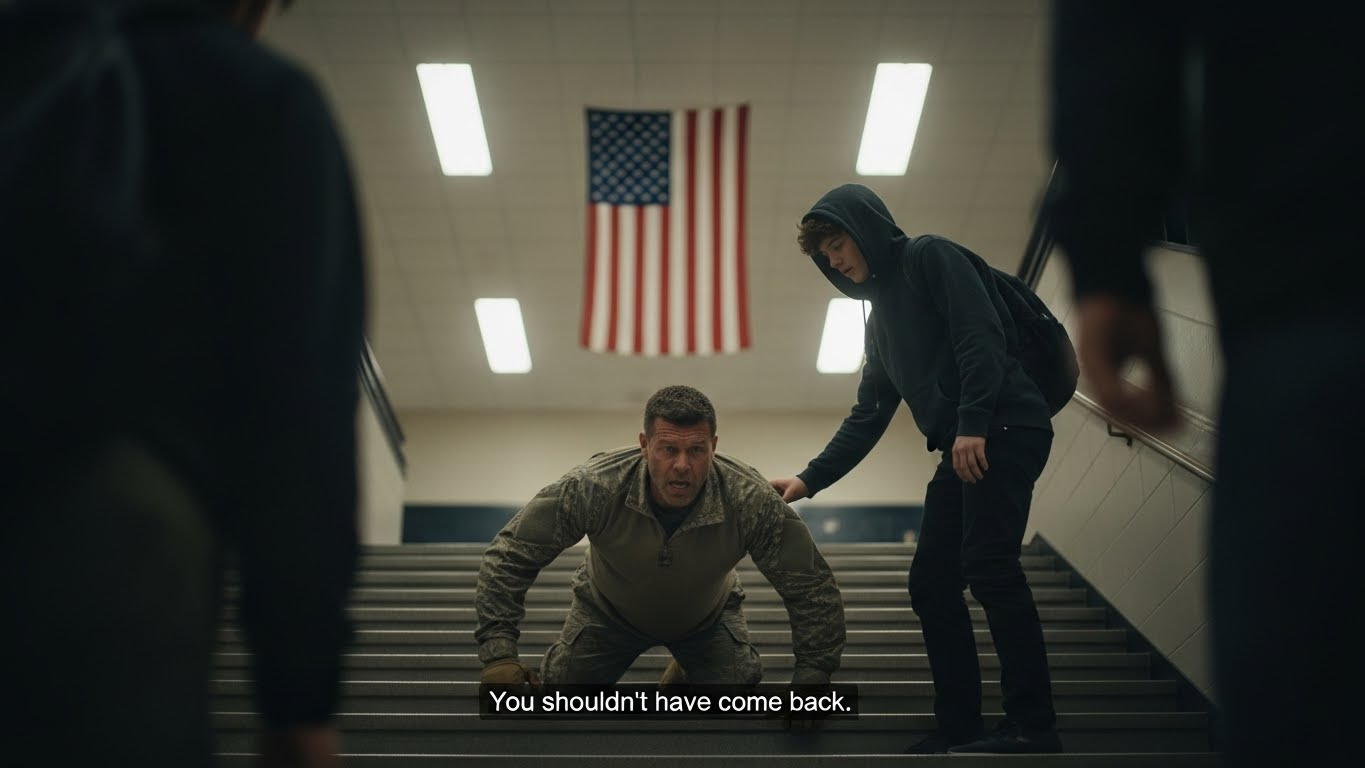
I didn’t wait for his permission. I locked the brakes. I swung my legs—dead, heavy things wrapped in cargo pants—off the footrests. I slid forward, gripping the armrests until my knuckles turned white.
I lowered myself to the floor. The linoleum was cold. It seeped through my clothes instantly.
From the balcony above, a whistle rang out. “Yo! G.I. Joe is going commando!”
Laughter rippled through the upper floor.
My jaw tightened. I focused on the first step. It was just stone. It was just physics. I reached up, planting my hands on the tread of the first step. I engaged my triceps, the muscles that had become my lifeline over the last six years.
I pulled.
My body dragged behind me, scraping against the floor. My belt buckle clicked against the marble.
One.
I paused, breathing through my nose. The pain in my shoulders flared immediately, a sharp, hot reminder of the shrapnel that was still lodged near my clavicle.
“Sergeant, please,” Henderson said, hovering nervously behind me. “Let me get the football team. They can carry you.”
“Don’t touch me,” I growled, not looking back. “Nobody carries me.”
This wasn’t about pride. It was about control. In a world where I had lost control of my own legs, I needed to know that I could still move. I needed to know that if the building burned down, I wouldn’t just burn with it.
I reached for the second step.
The laughter upstairs died down, replaced by a murmur. They were realizing this wasn’t a joke. They were watching a grown man, a soldier, drag himself like a wounded animal.
I pulled again. My legs bumped against the riser with a dull thud.
Two.
Sweat pricked at my hairline. The air in the school felt recycled and stale. I focused on the pattern in the marble. Grey veins. White stone.
Three.
Four.
By the fifth step, the rhythm took over. Reach. Plant. Pull. Drag. Reach. Plant. Pull. Drag. It was a brutal, humiliating cadence.
I was halfway up the first flight when I heard the footsteps.
They weren’t the clicking heels of the principal or the heavy boots of the maintenance guy. They were sneakers. Soft, rhythmic scuffs on the stone. Coming down.
I stopped, my chest heaving, and looked up.
Standing at the top of the first landing, blocking my path, was a student.
He wasn’t wearing the school colors. He was wearing a black hoodie, zipped up to his chin, the hood pulled low over his eyes. His hands were buried deep in the front pocket. He was skinny, almost gaunt, but there was a tension in his stance that reminded me of a coiled spring.
The hallway had gone quiet. Even the rain seemed to hold its breath.
Henderson’s voice echoed up from the bottom. “Hey! You! Get back to the assembly! The Sergeant is coming up!”
The kid didn’t move. He just stared down at me. From this angle, I couldn’t see his eyes, just the shadow of his face.
I gritted my teeth. “Move, kid,” I wheezed.
He took a step down. Then another.
He wasn’t moving out of the way. He was coming right at me.
CHAPTER 2: THE INTERVENTION
My combat instincts, dormant but never gone, flared up.
In the military, you learn to read body language. You learn to spot a threat before it manifests. This kid? He was screaming ‘threat.’
He moved with a deliberate slowness that was unnerving. He didn’t bounce like the jocks or slouch like the burnouts. He moved like he had a target.
I was vulnerable. Prone on the stairs, hands occupied with holding my weight. If he wanted to kick me, I couldn’t stop him. If he wanted to push me backward, I’d tumble down ten marble steps and probably crack my skull.
“I said move,” I repeated, my voice louder this time, echoing off the high ceiling.
The kid stopped three steps above me. He slowly pulled his hands out of his hoodie pocket.
I braced myself. My triceps locked. I prepared to launch myself forward, to tackle him by the ankles if I had to.
But he didn’t produce a weapon. His hands were empty. They were shaking slightly.
He crouched down. He was close now. I could smell him. He smelled like stale tobacco smoke and rain.
“You’re doing it wrong,” he said. His voice was low, flat.
I blinked, sweat stinging my eyes. “What?”
” climbing,” he said. “You’re using too much shoulder. You’re gonna blow your rotator cuff before you hit the landing.”
I was too stunned to speak. I stared at him. He had a scar running through his left eyebrow, and his eyes were dark, almost black. They weren’t looking at my face. They were looking at my legs.
“Get out of my way,” I spat, trying to heave myself up to the next step.
The kid moved faster than I expected. He shot his hand out.
I flinched, expecting a blow.
But his hand landed on my left leg. My dead leg. He gripped the thigh muscle, right above the knee.
The contact was electric. Not because I could feel it—I couldn’t feel anything below the waist—but because of the audacity. You don’t touch a stranger. You definitely don’t touch a disabled veteran without asking.
“Get your hands off me!” I roared.
Below us, Henderson was shouting something, his footsteps clattering as he started to run up the stairs. “Get away from him! Security!”
The kid ignored the principal. He ignored my anger. He squeezed my leg. Hard.
“You can feel that,” he whispered.
It wasn’t a question. It was a statement.
I froze. “I’m paralyzed, son. I can’t feel a damn thing.”
“Liar,” he hissed.
He leaned in closer, his face inches from mine. The hood fell back slightly, revealing a buzz cut that looked like it had been done with kitchen shears.
“I saw your foot twitch on step three,” he said, his voice urgent, frantic. “When you slipped. You caught yourself. You used your right quad to stabilize.”
My heart hammered against my ribs like a trapped bird. The world seemed to narrow down to just me and this kid on the cold stairs.
“You’re seeing things,” I said, but my voice lacked conviction.
“No,” he said. “I’m not. And I know why you’re pretending.”
He gripped my leg tighter, his knuckles white.
“I know what happened in Kandahar, Jack,” he whispered.
I stopped breathing.
Nobody called me Jack. It was Sergeant Miller. Or Mr. Miller. Only my unit called me Jack. And my unit was dead.
“Who are you?” I demanded, my voice trembling with a mix of rage and fear.
The kid looked over his shoulder at the principal, who was just a few steps away now, red-faced and panting.
“They’re watching,” the kid said, turning back to me. “The cameras aren’t just for the news, Jack. They’re watching to see if the programming held.”
“What programming?”
“The reason you ‘can’t’ walk,” he said. “It’s not your spine. It’s in your head. And they’re here to make sure you never figure that out.”
Henderson reached us. He grabbed the kid by the shoulder. “Get away from him, you delinquent! I’m calling the police!”
The kid didn’t fight. He stood up, hands going back into his pockets. He looked at me one last time, his eyes burning with intensity.
“Don’t let them give you the water,” he said. “Whatever you do, don’t drink the water on the stage.”
Then, he turned and bolted. He leaped over the railing of the staircase, dropping ten feet to the atrium floor below, landing in a roll like a trained gymnast, and sprinted out the front doors into the rain.
“My god,” Henderson gasped, wiping his forehead. “I am so sorry, Sergeant. That boy… he’s disturbed. He’s been suspended three times. We shouldn’t even have let him in.”
I looked at the empty space where the kid had been. I looked at my leg.
My right foot. The one the kid said had moved.
I tried to wiggle my toe. Nothing.
But the fear in my gut was real. He knew my name. He knew Kandahar. And he knew about the water.
“Sergeant?” Henderson asked, reaching out to help me. “Are you okay?”
I slapped his hand away. “I’m fine.”
I looked up at the remaining steps. The assembly awaited. The ‘They’ the kid mentioned awaited.
“I’m going up,” I said.
But this time, as I reached for the next step, I wasn’t just climbing to prove a point. I was climbing to find answers.
And I had a terrible feeling that the war I thought I left overseas had just followed me home to a high school in Ohio.
CHAPTER 3: THE BOTTLE ON THE PODIUM
By the time I reached the twenty-fourth step, my hands were raw. The skin on my palms was blistered, and my triceps were trembling so violently I thought I might collapse right there on the landing.
Principal Henderson was waiting for me. He was breathless, not from exertion, but from panic. He had two students—linebacker types with thick necks—lift my wheelchair up the stairs behind me.
“Get him in the chair,” Henderson snapped at them. “Quickly! We’re ten minutes behind schedule.”
They manhandled me into the seat. I didn’t fight them. I was too busy trying to slow my heart rate, too busy trying to process what the kid in the hoodie had said.
The programming. Don’t drink the water.
“Here, let me wipe you off,” Henderson said, pulling a handkerchief from his pocket and dabbing at the sweat on my forehead. It felt intrusive. I jerked my head away.
“I’m fine,” I rasped.
They wheeled me into the auditorium.
The noise hit me first. A wall of sound. Five hundred teenagers, restless, bored, murmuring. Then the lights. Spotlights cut through the darkness, blinding me as I was rolled toward center stage.
There was a polite smattering of applause, initiated by the teachers standing in the aisles. It wasn’t a hero’s welcome. It was an obligation.
I was positioned next to a wooden podium. The American flag hung massive and still behind me.
“And now,” Henderson’s voice boomed over the PA system, “please welcome our guest of honor. A man who sacrificed his ability to walk for our freedom. Sergeant Jack Miller.”
The applause grew slightly louder, then died away quickly.
I sat there, the spotlight burning my skin. I looked out at the sea of faces, darkened and indistinguishable. Somewhere in that darkness was the kid. Was he watching? Or had he really run?
Then I looked at the podium.
Right next to the microphone, sitting on a crisp white coaster, was a bottle of water.
It wasn’t a generic brand. It wasn’t Aquafina or Dasani. It was a sleek, clear bottle with a blue label I didn’t recognize. “Hydra-Pure,” it read in minimalist font. The cap was sealed tight.
My throat was like sandpaper. The climb had dehydrated me faster than a patrol in the desert. Every cell in my body was screaming for moisture.
I reached for the bottle.
Don’t let them give you the water.
My hand hovered inches from the plastic.
“Go ahead, Sergeant,” Henderson whispered from the seat behind me. “Take a sip. You look like you’re about to pass out.”
His voice was solicitous, kind even. But there was an edge to it. A hint of urgency.
I pulled my hand back. “I’m okay,” I said into the microphone. The feedback squealed for a second, making the front row wince.
“I… I’m not here to talk about heroism,” I started. I hadn’t prepared a speech. I was going to wing it. “I’m here to talk about reality.”
I scanned the wings of the stage. Standing in the shadows, just out of the light, were two men in dark suits. They weren’t school security. They had earpieces. They stood with hands clasped in front of them, staring directly at me.
They were watching the water bottle.
CHAPTER 4: THE TRIGGER
“War isn’t like the video games,” I continued, my voice gaining strength despite the dryness in my throat. “You don’t respawn. You don’t get a medkit.”
I was talking on autopilot. My mind was racing.
I saw your foot twitch.
I looked down at my legs. They looked the same as they had for six years. Atrophied. Useless. Dead weight.
But the kid knew about Kandahar. He knew my name.
“I lost my legs in an IED explosion,” I said to the crowd. This was the script. This was the story I had told a hundred times. The story the doctors told me when I woke up in Germany. “A roadside bomb. Wrong place, wrong time.”
Suddenly, a sound echoed from the catwalks high above the stage. A metallic clank. Like a bolt dropping on metal.
The students looked up. The principal looked up.
I looked up.
High above, in the lighting rig, I saw a silhouette. The hoodie. The kid.
He was holding a flashlight. He flashed it once. Twice. Three times.
Short. Long. Short.
Morse code. R. E. M.
REM? Rapid Eye Movement? No. Remember.
Then he flashed it again. A different pattern.
K. I. N. G.
King.
A memory slammed into me like a physical blow. It wasn’t a memory of an explosion. It was a memory of a room. A white room.
Project Kingfisher.
I gasped, gripping the sides of the podium. The microphone picked up my ragged breathing.
“Sergeant?” Henderson stood up halfway. “Is everything alright?”
“The water,” one of the suits in the wings hissed. I heard him. It was a whisper, but it carried. “Make him drink the water.”
The room spun.
I wasn’t hit by an IED.
The memory clawed its way through the fog in my brain. I was in a transport truck. We were drinking. Celebrating the end of a tour. The water… we were all drinking the water from the supply drop.
Then… paralysis. Not an explosion. We just… fell. Numbness spreading from our toes up. Panic. Darkness.
When I woke up, they told me my spine was severed. They showed me X-rays.
But whose X-rays were they?
I looked at the bottle on the podium again. The thirst was agonizing now. It felt artificial. A chemical thirst.
“Drink,” Henderson said, louder this time. He stood up and reached for the bottle himself. “Here, let me help you.”
He cracked the seal. The sound was like a gunshot in the quiet auditorium.
CHAPTER 5: THE TEST
Henderson held the bottle out to me. The water looked crystal clear. Innocent.
“Just a sip, Jack,” he said. He used my first name.
I looked at his eyes. His pupils were dilated. He was terrified. Not for me, but of something else.
“Why is it so important that I drink?” I asked, my voice low, just for him.
“You’re dehydrated,” he said, forcing a smile that looked like a grimace. “We can’t have a hero fainting on stage. It’s bad press.”
“Bad press,” I repeated.
I took the bottle.
The men in the wings relaxed. I saw their shoulders drop.
I raised the bottle to my lips. The water touched my tongue. It was slightly bitter. Metallic.
I didn’t swallow.
I held the liquid in my mouth. I pretended to gulp. I bobbed my throat.
“Good,” Henderson breathed. “Good man.”
I lowered the bottle. I waited for the familiar numbness that usually followed my morning medication—the “nerve blockers” the VA doctors insisted I take for the “phantom pain.”
I realized then: I hadn’t taken my pills this morning. I had run out. That’s why I was so stiff. That’s why the climb had been so hard.
And that’s why I could feel the cold plastic of the armrest under my left pinky finger.
A tiny sensation. A spark.
I spat the water back into the bottle.
The crowd gasped.
“Sergeant!” Henderson cried out.
“It tastes like poison,” I said loudly into the mic.
I threw the bottle. It sailed across the stage and smashed against the back wall.
“What are you doing?” Henderson shrieked.
“My legs,” I said, looking at the suits in the wings. They were moving now. Walking briskly onto the stage. “I can feel my toes.”
It was a lie—mostly. I could feel a tingle. A burning itch deep in the bone. But the reaction it provoked was all the confirmation I needed.
The suits didn’t look confused. They looked ready to terminate.
“He’s having a PTSD episode!” one of the suits shouted to the audience. “We need to clear the room! Everyone out! Now!”
“No!” I shouted. “Stay!”
But the fire alarm began to blare. The strobe lights flashed.
The kid. He had pulled the alarm.
Chaos erupted. Five hundred students jumped up, screaming, pushing toward the exits.
“Get him,” the suit ordered.
They rushed my wheelchair.
CHAPTER 6: THE AWAKENING
The first suit reached me before I could react. He grabbed the handles of my wheelchair and yanked it backward, away from the microphone.
“Quiet down, soldier,” he grunted. “Time for your shot.”
He produced a syringe from his jacket pocket.
I wasn’t a cripple in a chair anymore. I was Sergeant Jack Miller, 1st Battalion, 75th Ranger Regiment. And I was angry.
I locked my elbow back, driving it into the man’s gut. It was a solid hit, but sitting down robbed me of my leverage. He grunted but didn’t let go.
The second suit was coming for my arms.
“You’re property of the US Government,” the second man snarled. “Stop fighting the protocol.”
Protocol. Not treatment. Protocol.
The anger flared hot and white. It burned through the fog in my brain. It burned through the numbness in my legs.
I didn’t try to stand. I threw my weight forward.
I tipped the wheelchair.
Gravity took over. Me, the chair, and the suit holding the handles all crashed to the stage floor in a tangle of metal and limbs.
I hit the wood hard. My shoulder screamed. But I was free of the chair.
I dragged myself away, crawling toward the edge of the stage. The fire alarm was deafening. The students were a stampede of panic below.
“Don’t let him get off the stage!” Henderson was screaming.
I looked down at the orchestra pit. It was a six-foot drop.
I reached the edge. I looked back. The two suits were recovering. One had drawn a weapon—a taser.
“Target is non-compliant,” he said into his wrist mic.
I looked up at the catwalks.
A rope dropped down. A heavy, knotted climbing rope from the theater set.
“Jack!” a voice screamed from above.
I looked up. The kid was hanging upside down from the rigging, knees hooked over a bar like a trapeze artist.
“Grab it!”
I grabbed the rope.
“Heave!” the kid shouted.
He wasn’t pulling me up. He was cutting a counterweight.
I saw him slash a sandbag loose.
The rope jerked upward. I held on for dear life. My arms, forged by six years of dragging my dead body around, held firm.
I was yanked ten feet into the air, swinging wildly above the stage.
The taser probes fired by the suit missed my legs by inches, sparking uselessly against the floorboards.
I swung out over the orchestra pit, over the first few rows of empty seats.
“Let go!” the kid yelled.
I let go.
I crashed into the third row of the auditorium seating. The plush velvet seats broke my fall, but the impact knocked the wind out of me.
I lay there, gasping, staring at the ceiling.
And then, I felt it.
A cramp. A violent, agonizing cramp in my right calf.
Pain.
Beautiful, excruciating pain.
My leg twitched. Not a spasm. A movement.
I looked at my leg. I focused every ounce of will I had. Move.
My knee bent. Just an inch. But it bent.
CHAPTER 7: THE CONFRONTATION
I rolled off the seats and onto the aisle floor. The auditorium was mostly empty now, save for the stragglers at the back doors.
The suits were jumping off the stage, pursuing me.
“Miller!” one of them shouted. “You can’t make it to the door. You have no medication. The pain will cripple you in sixty seconds.”
He was right. The pain wasn’t just in my calf anymore. It was exploding up my spine. It felt like my nerves were being dipped in acid. The “blockers” had been suppressing this. My nervous system was waking up after six years of coma, and it was screaming.
I gritted my teeth so hard a molar cracked.
“Come and get me,” I growled.
I dragged myself up. I used the back of a seat to pull myself to a standing position.
My legs wobbled like jelly. They were thin, weak, unused. But the bone structure was sound. The muscle memory was there, buried deep.
I stood.
The suits stopped. They froze in the aisle, ten yards away. They looked shocked.
“Impossible,” one whispered. ” The atrophy…”
“Is reversible,” I spat. “You kept me sedated. You kept me weak.”
I took a step.
My knee buckled, but I caught myself on the next seat.
Another step.
I was walking. It was ugly, it was slow, and it hurt more than getting shot, but I was walking.
“End him,” the lead suit said. He pulled a pistol. A real one this time. Silenced.
They weren’t trying to capture me anymore. I was a broken experiment. A liability.
Bang.
A bullet ripped through the velvet seat next to my hip.
I dove into the row of seats, scrambling on hands and knees between the rows.
Bang. Bang.
Wood splintered around me.
I needed a weapon. I had nothing. Just a pen in my pocket and my dog tags.
Suddenly, the side exit door—the emergency exit—burst open.
Rain and wind swirled in.
“This way, old man!”
It was the kid. He was standing in the doorway, soaked to the bone, holding a flare gun—probably stolen from the school’s emergency kit.
The suits turned toward him.
The kid didn’t hesitate. He fired.
A red flare shrieked across the auditorium, trailing smoke. It didn’t hit the suits, but it hit the heavy velvet stage curtains behind them.
The dry, dusty fabric caught fire instantly.
The suits flinched, shielding their eyes from the blinding red light.
“Move!” the kid screamed at me.
I scrambled toward the door. I threw myself forward, ignoring the pain, ignoring the weakness. I crawled, I stumbled, I clawed my way to the exit.
I fell out the door onto the wet pavement of the alley behind the school.
The kid grabbed me under the arm. He was surprisingly strong for his size.
” car’s this way,” he grunted.
“Who… who are you?” I wheezed as we hobbled through the rain.
He looked at me, his dark eyes wet.
“My dad was in your unit,” he said. “Corporal Evans.”
Evans. The comms guy. He died in the ‘explosion.’
“He didn’t die in the blast, Jack,” the kid said, dragging me toward a beat-up Honda Civic. “He sent me a letter before he died. He told me everything. He told me if they ever let you out, I had to find you. He said you were the only one strong enough to survive the cure.”
CHAPTER 8: THE ESCAPE
We piled into the car. I collapsed into the passenger seat, my legs burning with a fire that made me want to scream.
The kid—Evans’ boy—jammed the key in the ignition. The engine sputtered, then roared to life.
As we peeled out of the school parking lot, I looked back.
Smoke was billowing from the auditorium vents. Fire trucks were turning the corner, sirens wailing.
I saw Henderson standing in the rain by the back exit, talking to the suits. He pointed at our car.
“They’ll be tracking us,” I said, my voice trembling.
“Let ’em track,” the kid said, shifting gears. “I ditched my phone. You need to ditch yours.”
I reached into my pocket, pulled out my cell, and threw it out the window. It shattered on the wet asphalt.
We hit the highway, heading north. Away from the town. Away from the lie I had lived for six years.
I looked at my legs. I pinched my thigh. I felt it. A sharp, stinging pinch.
I started to laugh. A ragged, hysterical laugh that turned into a sob.
“Where are we going?” I asked, wiping my eyes.
The kid looked at me. He pulled a crumpled piece of paper from his pocket. It was an old map of a facility in Nevada.
“We’re going to the source,” he said. “We’re going to get the rest of your memory back. And then?”
He looked at the road, his jaw set.
“Then we’re going to burn it all down.”
I looked at the rain streaking the windshield. I wasn’t Sergeant Miller, the crippled hero, anymore. I was Jack. And for the first time in six years, I was standing on my own two feet—even if I was sitting down.
The war hadn’t ended in Kandahar. It had just begun.