THEY LEFT HIM CHAINED IN A BLIZZARD WHILE THEY WATCHED TV IN A WARM LIVING ROOM, SO I TOOK A SLEDGEHAMMER TO THEIR GATE AND SHOWED THEM WHAT REAL COLD FEELS LIKE.
They say freezing to death is peaceful. They say you just get tired, close your eyes, and drift away. I’m a retired fire chief. I spent thirty years pulling people out of twisted metal and burning buildings, and I’ve pulled enough bodies out of icy rivers to tell you that’s a lie. Freezing isn’t peaceful. It’s panic, then it’s pain, and then it’s a terrifying loneliness that sinks into your marrow until your heart just gives up.
I was watching it happen from my front window.
It was three days before Christmas. We were in the middle of a Nor’easter that the news anchors were calling ‘historic.’ The wind was howling like a banshee, rattling the storm windows of my house, burying the streets of our suburb under two feet of snow. The temperature had dropped to single digits, and the wind chill was twenty below zero. It was the kind of cold that hurts your face the second you step outside.
And across the street, in the yard of the big, renovated colonial with the heated driveway, there was a dog.
He wasn’t a Husky or a Malamute or one of those breeds built for the ice. He was a mutt, maybe some Golden Retriever in him, maybe some Shepherd, but mostly just old. His muzzle was gray. His coat was matted and wet. He was chained to a metal stake near the back fence, no dog house, no shelter, just a plastic bowl that had been buried under the snow hours ago.
I’d been watching him for two hours. He was circling at first, trying to find a spot out of the wind. Then he started barking—short, sharp barks that got carried away by the gale. Now, he was just curled into a tight ball, shaking so hard I could see it from across the street. He was becoming part of the snowdrift.
I put down my coffee. My hands were trembling, and it wasn’t from the caffeine.
‘Jack, don’t,’ my wife, Martha, said from the kitchen. She knew that look. She’d seen it for forty years every time the tones dropped at the station.
‘He’s going to die, Martha,’ I said. My voice sounded gravelly. ‘Another hour, maybe less. His organs will shut down.’
‘Call Animal Control again.’
‘I did. Twenty minutes ago. No answer. Voicemail says they’re responding to emergencies only and the roads are impassable. They aren’t coming.’
I looked back out the window. The lights were on in the house across the street. I could see the blue flicker of a massive television in the living room. I could see silhouettes moving around. They were warm. They were comfortable. They had probably just turned up the thermostat.
I grabbed my coat. The heavy one. The one I used to wear when we had to stand on the highway for hours directing traffic around a wreck.
‘I’m just going to talk to them,’ I said. Martha didn’t say anything. She just looked at my hands, which were already balling into fists.
The walk across the street was brutal. The wind hit me like a physical blow, stealing the breath from my lungs. The snow was up to my knees. I had to shield my eyes just to see the front door.
I pounded on it. I didn’t use the doorbell. I used my fist.
It took a minute. Finally, the door opened. A wave of warm air hit my face, smelling like cinnamon and roasted meat. The owner, a guy named Miller, stood there in a t-shirt. Just a t-shirt. He was maybe thirty-five, soft around the middle, holding a beer.
‘Yeah? Can I help you?’ he asked, looking past me at the storm.
‘Your dog,’ I said. I had to shout over the wind. ‘He’s freezing to death. You need to bring him inside.’
Miller rolled his eyes. He actually rolled his eyes. ‘He’s fine. He’s a dog. They have fur for a reason.’
‘It’s twenty below with the wind chill,’ I stepped closer. ‘That animal is geriatric. He’s wet. He’s shaking. If you don’t bring him in, he’s not going to wake up tomorrow.’
Miller took a sip of his beer, leaning against the doorframe like he was bored. ‘Look, buddy. My wife doesn’t want him in the house. He smells. He sheds. He’s fine out there. He’s tough.’
‘He’s not tough. He’s dying.’
‘Is there anything else?’ Miller started to close the door. ‘Because you’re letting the heat out.’
I put my boot in the door jam. It was an instinct. I hadn’t done something like that since I was a rookie dealing with a landlord who wouldn’t evacuate a condemned building.
Miller looked down at my boot, then up at my face. His expression hardened. ‘Get your foot out of my door before I call the cops.’
‘Call them,’ I said. ‘Please. Tell them you’re committing animal cruelty in plain sight.’
‘It’s my property,’ Miller spat. ‘Get off my porch.’
He shoved the door. I’m sixty-five, but I spent my life carrying equipment that weighed more than him. I didn’t budge. But I saw the look in his eyes. He didn’t care. To him, the dog was just a piece of lawn furniture that had become inconvenient.
I pulled my foot back. Not because I was scared, but because I realized talking was a waste of time. Time the dog didn’t have.
‘Fine,’ I said. ‘You made your choice.’
I turned around and walked back into the storm. I didn’t go home. I went to my garage.
The silence inside the garage was heavy. I breathed in the smell of gasoline and sawdust. My eyes scanned the tool rack. I grabbed the bolt cutters. heavy-duty steel, thirty-six-inch handles. The kind we used to snap padlocks on industrial gates. Then I grabbed the sledgehammer, just in case.
Martha was at the back door when I came out. She saw the bolt cutters. She didn’t try to stop me. She opened the door and handed me a thick wool blanket.
‘Bring him here,’ she said softly.
I nodded. I loved that woman.
I crossed the street again. This time, I didn’t go to the front door. I went straight for the side gate. It was a six-foot wooden privacy fence, locked from the inside. I could hear the dog whimpering now. It was a low, pathetic sound, the sound of a living thing begging for the end.
I didn’t bother trying to pick the lock. I swung the sledgehammer. Once. The wood splintered with a crack that sounded like a gunshot in the cold air. The latch gave way. I kicked the gate open and waded into the backyard.
The snow here was deeper, drifted against the fence. I saw him. He was covered in a layer of ice. His eyes were closed. When I crunched through the snow toward him, he didn’t even lift his head. He just flinched, expecting to be hit.
That broke me. That flinch broke my heart more than the cold.
I knelt down in the snow. ‘It’s okay, buddy,’ I whispered. ‘I got you. I’m here.’
I clamped the bolt cutters onto the heavy chain around his neck. It was frozen solid. I had to put my full weight into it. My shoulders burned. My bad knee screamed. But I squeezed until the metal sheared with a loud *SNAP*.
The dog was free. But he couldn’t move. His legs were stiff. He was basically a block of ice.
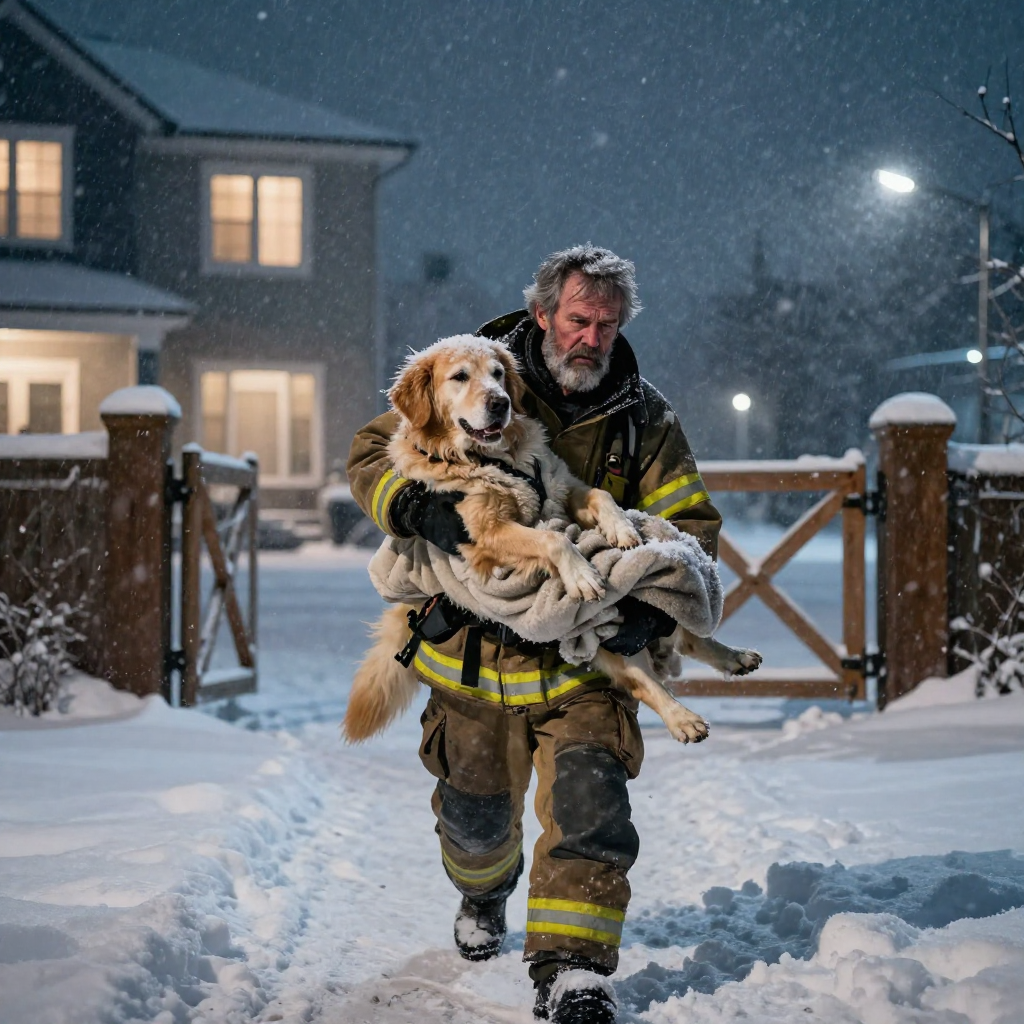
I dropped the tools. I took the wool blanket Martha gave me and wrapped it around him. I scooped him up. He was heavy, dead weight, but he felt frail, like a bird with hollow bones.
Then the back floodlights turned on.
The sliding glass door flew open. Miller came storming out, this time in a jacket, phone in his hand. His wife was behind him, looking terrified.
‘Hey!’ Miller screamed. ‘What the hell are you doing? That’s my dog! You can’t just—’
I turned to face him. I was holding the dog in my arms. I felt the animal’s faint, erratic heartbeat against my chest.
I didn’t yell. I didn’t scream. I went into what my crew used to call ‘Command Voice.’ It’s the voice you use when the building is collapsing and people need to move *now*.
‘Step back,’ I said. calm. Low. dangerous.
Miller froze. He lowered the phone slightly.
‘You’re stealing my property!’ he stuttered, trying to find his bravado.
‘I am confiscating evidence of a crime,’ I said. I walked toward him. He stepped back. He actually stepped back into the snow in his slippers.
‘You left a living creature to freeze,’ I said, walking right past him. I looked him dead in the eye. ‘And if you try to stop me, I will drop this dog, and I will show you exactly how helpless he felt. Do you understand me?’
I didn’t wait for an answer. I didn’t look back.
I carried the dog across the street, the wind at my back now, pushing me home. I could hear Miller shouting something about lawyers, about trespassing. Let him shout. Let him call the police. I wanted him to.
We got inside my mudroom. The warmth was instant. Martha was already there with warm towels and a heating pad. We laid him down on the floor. He wasn’t moving. His breathing was shallow, jagged gasps.
‘Is he…?’ Martha asked, her hand on his chest.
‘Not yet,’ I said. I started rubbing his limbs, trying to get the blood flowing. ‘Not on my watch.’
I looked out the window. Miller was standing on his porch, staring at my house. He looked angry. But he also looked small. He didn’t know it yet, but the storm wasn’t over. I wasn’t just going to save this dog. I was going to ensure that man never owned another living thing as long as he lived.
But first, I had to get a heartbeat strong enough to fight.
CHAPTER II
Martha didn’t say a word when I carried that shivering, skeletal mass of fur into our kitchen. She didn’t ask about the blood on my knuckles or the sledgehammer I’d left leaning against the mudroom door. She just moved. It was the choreography of forty years of marriage, a silent understanding of emergencies. She grabbed the old beach towels from the linen closet—the ones we used for the beach trips we haven’t taken in a decade—and began warming them in the dryer. I laid the dog on the linoleum, and for a long minute, I wasn’t sure if he was still with us. His ribcage was a series of sharp, jagged ridges under skin that felt like frozen parchment. He was breathing, but it was that shallow, hitching sound I’d heard too many times in smoke-filled hallways. It was the sound of a body deciding whether it was worth the effort to stay.
“Get the space heater,” Martha said, her voice low and steady. It was her own version of the Command Voice, the one she used when I came home from a double shift smelling like soot and failure. I obeyed. I positioned the heater a safe distance away, the orange coils beginning to glow and hum. The smell of wet dog and ozone filled the room. I looked at my hands. They were shaking. Not from the cold, but from the residual vibration of the sledgehammer and the sheer, vibrating heat of my own rage. I had spent thirty years of my life following protocols, filling out incident reports, and waiting for the proper authorities. Tonight, I had broken a man’s property and stolen his animal. I felt a strange, terrifying lightness in my chest, a sense that I had finally stepped off the map.
We worked in silence for an hour. We rubbed his limbs with the warm towels, trying to coax the blood back into the extremities. Martha used a turkey baster to drop warm beef broth into the side of his mouth. He swallowed, a reflexive, desperate gulp that made my throat tighten. This dog—this creature that Miller had treated like a piece of discarded machinery—was fighting. It was a pathetic, heroic struggle. Every time his eyes flickered, showing a sliver of cloudy brown iris, I felt a renewed surge of the Old Wound. It’s a memory I don’t talk about, not even to Martha. 1998, a house fire on 4th Street. A little girl named Sarah. I had her hand. I had her hand for three seconds through the smoke, and then the floor gave way. I saved twenty people that year, but I only ever think about the one whose hand slipped through mine. Standing over this dog, I realized I wasn’t just saving an animal. I was trying to rewrite a three-second failure from twenty-five years ago.
The blue and red lights arrived before the dog could even lift his head. They didn’t flash with the urgency of a fire call; they were slow, rhythmic, almost bored, reflecting off the falling snow against the kitchen window. Miller had called them. Of course he had. He was a man of small, petty rules, and I had broken the biggest one: I had touched his things. I stood up, my knees popping, and felt the weight of my seventy years. I looked at Martha. She was still on the floor, her hand resting gently on the dog’s flank. She didn’t look up. “Don’t let them take him back, Jack,” she said. It wasn’t a request. It was an order.
I opened the front door before they could knock. The cold air rushed in, a sharp reminder of the world outside this warm kitchen. Standing on my porch was Officer Vance. He was young, his uniform crisp, his face still holding that softness of someone who hasn’t seen enough to be cynical yet. I had mentored his father. I’d seen Vance grow up. Behind him, standing by the cruiser, was Miller. He looked ridiculous in his designer parka, pointing a gloved finger at me, his face twisted in a mask of indignant victimization. He wasn’t crying for his dog; he was crying for his pride.
“Chief,” Vance said, touching the brim of his hat. He didn’t call me Jack. He used the title, and in that moment, I knew I had the upper hand. The ‘Chief’ was a pillar of this community. The ‘Chief’ was the man who saved houses and pulled teenagers from car wrecks. Miller was just the guy who never mowed his lawn on time and complained about the noise of the snowplows.
“Evening, David,” I said, my voice dropping into that deep, resonant bass that used to command entire fire scenes. “It’s a hell of a night for a stroll.”
“Miller says you broke his fence and took his property,” Vance said, his eyes shifting toward the cruiser where Miller was pacing. “He’s pretty heated up. Talking about pressing charges for breaking and entering, theft, the whole works.”
I leaned against the doorframe, projecting a calm I didn’t entirely feel. This was the trigger. This was the moment where I could apologize, return the dog, and pay for the chain. Or I could burn the bridge. I thought of the way the dog had looked, chained to that rusted post. I thought of the secret I’d been keeping for months, something I’d discovered while serving on the town’s planning board—the fact that Miller’s ‘successful’ accounting firm was a hollow shell, that he was months behind on his taxes, and that he was facing a quiet foreclosure. I’d kept it to myself out of some misplaced sense of neighborly discretion. But discretion was a luxury for people who didn’t leave dogs to die in blizzards.
“He’s right,” I said loudly, making sure my voice carried over the wind to Miller. “I did break his fence. I used a pair of bolt cutters and a sledgehammer. And I’d do it again. But you aren’t here to arrest me for a hundred-dollar fence, David. You’re here because there’s an animal in my kitchen that’s currently a piece of evidence in a felony animal cruelty case.”
Miller surged forward, his boots crunching in the deep snow. “Evidence? You stole my dog! You’re a vigilante, Jack! You think you’re still the king of this town, but you’re just a retired old man with a hero complex!”
I didn’t look at him. I kept my eyes on Vance. “The temperature is eight degrees, David. Wind chill is minus fifteen. The dog was found without shelter, water, or food, chained to a post. Under State Statute 3.2, that’s aggravated cruelty. I didn’t steal him. I took him into protective custody as a former public official acting in an emergency capacity to prevent the loss of life. You can take my statement now, or you can explain to the Sheriff why you let a decorated Fire Chief get hauled in for saving a dying animal while a known tax-dodger screams on his front lawn.”
Vance blinked. He was caught in the middle, his loyalty to the law clashing with his respect for my uniform. But I wasn’t done. I was going to make Miller feel the same helplessness he’d inflicted on that dog. I was going to use every ounce of social capital I’d spent forty years earning to bankrupt his reputation.
“And David,” I added, my voice turning ice-cold. “While you’re at it, you might want to ask Mr. Miller why he hasn’t responded to the three municipal liens placed on his property last month. It seems his financial situation is as neglected as his dog. I’m sure the local paper would be interested in the connection between a man’s failing business and his sudden inability to care for his ‘property.’”
Miller stopped. The color drained from his face, replaced by a grey, sickly hue. He hadn’t known I knew. It was my secret, my leverage, and I had just detonated it in front of a police officer. It was a low blow. It was unprofessional. It was exactly what he deserved. The silence that followed was heavy, filled only by the howl of the wind. Miller looked around, suddenly realizing that the neighbors—the ones he’d spent years trying to impress—were watching from behind their curtains. He wasn’t the victim anymore. He was the villain of the neighborhood text chain.
“I want him off my property,” Miller hissed, but the fire was gone. He sounded small. Helpless.
“I’m on my property, Miller,” I said. “You’re the one standing in the street. David, are we done here? Or do I need to call the District Attorney? I believe he’s still on my Christmas card list.”
Vance sighed, a long, weary sound. He looked at Miller, then back at me. “Chief, I’m going to need you to come down tomorrow and give a formal statement. For now… just keep the dog inside. It’s too cold for anyone to be out here.”
He turned and walked back to his cruiser without another word to Miller. The cruiser’s lights stayed on for a moment, illuminating Miller standing alone in the snow, a man whose life was suddenly, irreversibly coming apart. I felt no pity. I felt a grim, dark satisfaction. I had used the law like a scalpel, and I had cut him deep.
I shut the door and went back to the kitchen. The heat was stifling now. The dog had moved. He was lying with his head on Martha’s lap. He wasn’t out of the woods, but his breathing was deeper, more rhythmic. Martha looked up at me, her eyes searching mine. She’d heard everything. She knew I’d used information I wasn’t supposed to have. She knew I’d bullied a man using my old title. She knew I had crossed a line I could never uncross.
“Is it over?” she asked.
“No,” I said, sitting heavily in the chair across from her. “It’s just starting.”
I spent the next few hours on the phone. I called Doc Aris, the vet who’d looked after our own dogs for years. I woke him up, but he didn’t mind once I told him what happened. I called Sarah’s father—not the Sarah from the fire, but the editor of the local Gazette. I told him the story. I gave him the details about the liens. I framed it as a story of a community hero saving a victim from a negligent, bankrupt owner. I was systematic. I was ruthless. I was using the same tactical precision I used to use to vent a roof or contain a hazmat spill. I was neutralizing Miller before he could even think about hiring a lawyer.
But as the night wore on and the adrenaline began to fade, a hollow feeling settled in my gut. I looked at the dog. He was an old dog, probably twelve or thirteen. Even if he survived tonight, he didn’t have much time left. I had essentially blown up my own moral standing, betrayed a professional secret, and weaponized my reputation to save a creature that was already at the end of its life. Was it worth it? I thought of the Old Wound. I thought of the smoke and the way that little girl’s fingers had felt—warm, then slipping away. This dog’s paw was cold, but it was still there. It was a trade-off I was willing to make.
Around 3:00 AM, the dog finally stood up. It was a shaky, pathetic movement. He wobbled on his thin legs, his tail giving a single, tentative wag before he collapsed back down. Martha cried. She didn’t sob; she just let the tears track down her face. I realized then that she’d been carrying her own version of the Old Wound. We both had. We’d spent our retirement being ‘nice,’ being ‘quiet,’ being the respectable couple on the corner. But the world wasn’t nice. The world was a place where things were left to freeze in the dark.
A moral dilemma began to gnaw at me. By exposing Miller’s finances, I was ensuring he would lose everything. His house, his business, his standing. I was doing exactly what I’d spent my career preventing: I was causing a total loss. Usually, my job was to save the structure. Tonight, I had set the fire myself. I had chosen to destroy a man to save an animal. There was no clean outcome here. If I succeeded, a man’s life was ruined. If I failed, the dog went back to a cold chain. I had picked the ‘wrong’ path to achieve a ‘right’ goal, and the weight of that choice felt heavier than the sledgehammer.
I walked to the window. The blizzard was peaking. White sheets of snow obscured the houses across the street, making it feel like we were the only people left in the world. I could see the dark shape of Miller’s house. He was probably sitting in the dark, realizing that the ‘Chief’ had just ended him. I felt a flash of something like guilt, but then I remembered the sound of the bolt cutters snapping that chain. I remembered the way Miller had looked at the dog—not as a living being, but as an annoyance. The guilt died a quick, cold death.
“Jack,” Martha whispered. “He’s sleeping.”
I went over and sat on the floor next to them. I put my hand on the dog’s head. His fur was drying, becoming soft. He smelled like my kitchen, like Martha’s perfume, like safety. He was helpless, and I was his only shield. But who was going to shield me from what I’d become? I had used my power not to protect, but to punish. I had become the judge and the executioner. I looked at my reflection in the dark oven door. I didn’t see the Chief. I saw an old man who had finally lost his patience with the world.
I knew what would happen in the morning. The story would be out. The police would be pressured by the public to file charges against Miller. The bank would see the headlines and accelerate the foreclosure. Miller would be broken. And I would have to stand in the middle of that wreckage and pretend I was the hero. But as the dog shifted in his sleep, his head resting on my knee, I knew I wouldn’t take back a single word. I had found something to fight for again, even if the cost was my own soul. The helplessness was gone, replaced by a cold, sharp clarity. Tomorrow, the world would see the fire I’d started, and for the first time in twenty-five years, I wasn’t going to put it out.
CHAPTER III
The silence of the morning after a blizzard is a specific kind of heavy. It isn’t the absence of sound; it’s the weight of the snow pressing down on the world, muffling everything until all you can hear is the blood pumping in your own ears. I sat in the armchair by the woodstove, watching the blue light of dawn creep across the floorboards. Martha was in the kitchen, her movements stiff and rhythmic. She was making coffee, but she hadn’t spoken to me since three in the morning. On the rug between us lay Shadow. The dog’s breathing was a wet, shallow rattle that seemed to sync up with the ticking of the clock on the mantel. Every few minutes, his paws would twitch, a ghostly remnant of a run he’d never take again.
My phone was on the side table, vibrating incessantly. I didn’t have to pick it up to know what was happening. The seeds I’d planted the night before—the whispers to Vance, the strategic mentions of Miller’s bank defaults to the neighbors who’d gathered in the snow—had sprouted into a forest fire. I’d used my ‘Command Voice’ to do more than save a dog; I’d used it to indict a man. By 8:00 AM, the local community board was a frenzy of outrage. Someone had posted a photo of Miller’s house with the word ‘MONSTER’ spray-painted across the garage door. My name was being invoked like a secular saint’s. *Chief Jack did what had to be done. Chief Jack saw the truth.* I felt a sickening surge of power, followed immediately by a cold, hollow dread. I had saved the dog, yes, but I had also opened a door I didn’t know how to close.
I looked at my hands. They were steady, the hands of a man who had pulled children from burning rafters, but they felt dirty. To destroy Miller, I had reached into the files I still had access to as a former board member of the local credit union. I’d leaked the truth about his insolvency, his failed business, his desperate attempts to keep his head above water. I told myself it was for the dog. I told myself a man who couldn’t feed a golden retriever didn’t deserve the shelter of a community’s respect. But as I watched Martha carefully tilt a bowl of water toward Shadow’s unresponsive mouth, I realized the lie. I hadn’t done it for the dog. I’d done it because Miller was an easy target for the anger I still carried for Sarah, for the daughter I couldn’t save from a fire twenty years ago. Miller was the surrogate for every failure I’d ever tucked away in the dark corners of my heart.
By mid-morning, the sun was blinding against the snow. I heard the sound of a truck pulling into the driveway, then another. I stood up, my knees popping, and went to the window. It wasn’t the police. It was a group of men from town—guys I’d coached, guys whose houses I’d inspected. They were carrying shovels and pieces of plywood. They weren’t there to help me clear my drive; they were looking toward Miller’s house across the street. Their faces were set in that grim, self-righteous mask that people wear when they think they’re doing God’s work by hurting someone else. ‘Jack!’ one of them called out, waving a hand. ‘We’re gonna make sure he knows he ain’t welcome here no more!’ I didn’t wave back. I felt a sudden, sharp chill. The mob didn’t need a leader anymore; I’d already given them the map.
Martha came up behind me, her hand resting lightly on my shoulder. She didn’t look out the window. She looked at me. ‘Is this what you wanted, Jack?’ she asked. Her voice was flat, stripped of its usual warmth. ‘To turn our street into a battlefield?’ I tried to find the words, the Chief’s words, the ones that justified the means with the end. But they wouldn’t come. ‘He was hurting the animal, Martha,’ I managed to say. She looked down at Shadow, who had stopped twitching and was now unnervingly still. ‘We’re all hurting, Jack,’ she whispered. ‘But we don’t all set fire to the neighbor’s house to keep ourselves warm.’ She turned and walked back to the kitchen, leaving me alone with the glare of the sun and the sound of shouting starting up across the road.
I watched as the men approached Miller’s porch. They weren’t being loud yet, but the energy was vibrating. They were pounding on the door, demanding he come out and face them. I saw a curtain twitch in Miller’s window, then go still. I should have gone out there. I should have told them to go home, that the law would handle it, that I’d overstepped. But I stayed behind the glass. I was the Chief. The Chief doesn’t admit he’s wrong in the middle of a crisis. And then, the front door of my own house clicked open. I hadn’t locked it after the last neighbor left. I turned, expecting another well-wisher, but the man standing in my entryway wasn’t a friend. It was Miller.
He looked different than he had in the snow. The fury was gone, replaced by a grey, ash-like exhaustion. He was wearing a thin jacket that wasn’t nearly enough for the cold, and his hands were trembling—not with rage, but with a deep, systemic fatigue. He didn’t look like a monster. He looked like a man who had been hollowed out from the inside. He didn’t look at me at first; his eyes went straight to the rug, to the golden shape lying there. He took a step forward, and I instinctively moved to block him, my chest heaving. ‘Don’t,’ I said, the Command Voice cracking. ‘You don’t get to touch him.’ Miller stopped. He looked up at me, and for the first time, I saw the reflection of my own cruelty in his eyes.
‘I didn’t come for the dog, Jack,’ Miller said. His voice was a paper-thin rasp. He pointed toward the window, toward the men who were now throwing snowballs and debris at his siding. ‘I came to ask you why. Why the bank records? Why tell them about the bankruptcy? That was supposed to be private. That was between me and the board.’ I felt the air leave the room. I’d broken federal privacy laws, used my status to ruin his last shred of dignity. ‘You were neglecting him,’ I said, but it sounded pathetic even to me. Miller shook his head slowly. ‘My wife died three months ago, Jack. Cancer. It took everything. Every cent, every minute, every bit of my mind. I forgot to eat. I forgot to sleep. And yeah, some days I forgot the dog.’
He took a shaking breath, leaning against the doorframe for support. ‘Shadow was her dog. Sarah’s dog.’ The name hit me like a physical blow. I froze. Miller continued, unaware of the internal earthquake he’d just triggered. ‘She named him after the way he followed her everywhere. I couldn’t look at him without seeing her. I didn’t want him to die, Jack. I just… I couldn’t figure out how to keep living myself.’ The silence that followed was suffocating. The dog on the rug, the namesake of my own lost daughter, let out a long, shuddering sigh. I realized then that I hadn’t rescued Shadow from Miller; I had stolen the last piece of a grieving man’s life because I was too cowardly to face my own grief.
I looked at Miller, and the ‘Chief’ persona crumbled into dust. I wasn’t the hero of this story. I was the antagonist. I was the man who had weaponized a tragedy to feel powerful again. ‘I didn’t know,’ I whispered, the words tasting like copper. Miller laughed, a dry, hacking sound. ‘You didn’t want to know. You wanted a villain. You wanted to feel like the big man again, pulling someone out of the wreckage. But there was no wreckage this time, Jack. Just a man who was drowning in the dark. And instead of a hand, you gave me a stone to hold.’ He turned his head toward the window as a loud *thwack* echoed from across the street—a rock hitting his front door.
‘They’re going to kill me, aren’t they?’ Miller asked, his voice devoid of emotion. ‘Not with their hands. With their eyes. With the way they’ll never let me work in this town again. You did that. You used your voice to bury me.’ I stepped toward him, an apology forming in my throat, but it was too late for apologies. The front gate groaned open, and a black sedan pulled into my driveway, cutting off the path of the men across the street. It was a car I recognized. The State Fire Marshal’s insignia was on the door. My heart plummeted. This wasn’t a social call. Someone had reported the breach of the credit union records. Or perhaps Martha had made a call I didn’t see.
A tall man in a dark overcoat stepped out of the car. It was Miller’s brother-in-law, a man I’d served with on the regional safety council. He didn’t look at the mob. He didn’t look at Miller’s house. He looked straight at my front door. He walked up the path with a deliberate, slow pace that signaled the end of an era. When he reached the porch, he didn’t knock; he just stood there, looking through the glass at me and Miller standing in the hallway. The authority I’d worn like a suit of armor for thirty years suddenly felt like a cage. The power had shifted. I was no longer the one asking the questions; I was the one who was going to have to answer for everything.
The Fire Marshal, David, entered without being invited. He looked at Miller, then at me, then at the dying dog on the rug. The air in the house turned clinical, cold. ‘Jack,’ David said, his voice quiet but carrying the weight of the state. ‘We received a formal complaint this morning. Regarding the unauthorized release of financial data and the incitement of a civil disturbance.’ He looked at the men across the street, who were now backing away, their bravado melting under the gaze of real, unyielding authority. ‘You’re a legend in this county, Jack. But you aren’t the law. You never were.’ I felt Martha’s presence behind me again. She wasn’t standing with me. She was standing apart, her face a mask of sorrow.
Miller didn’t say a word. He didn’t have to. The destruction was complete. He looked at Shadow one last time—a look of such profound, broken love that it made my chest ache. Then he turned and walked past David, out into the cold, toward his ruined house. He walked with his head down, a man who had lost his wife, his dog, and now his standing in the world, all because I needed to feel like a Chief again. David turned back to me, his expression unreadable. ‘There’s going to be an inquiry, Jack. The board is meeting tonight. You might want to get a lawyer. And you might want to think about why you did this.’ He paused, looking at the dog. ‘He’s gone, Jack. Look.’
I turned. Shadow was still. The wet rattle had stopped. The silence I had been so afraid of had finally arrived, and it was absolute. The dog I had ‘saved’ had died on my floor while I was busy destroying his owner. I knelt down beside the golden body, my hand shaking as I touched the cold fur. I had wanted a victory. I had wanted to prove that I could still stop the fire. But as the sirens of an approaching police cruiser began to wail in the distance, I realized I hadn’t stopped the fire at all. I was the one who had lit the match. I sat there on the floor, the hero of the town and the villain of my own soul, listening to the sound of my world falling apart, one snowflake at a time.
CHAPTER IV
The silence afterward was a physical thing, a pressure in my chest that made it hard to breathe. The sirens had faded, the crowd had dispersed, and Miller was gone, swallowed by the anonymity of a town that had turned on him in a heartbeat. Shadow lay still on my floor, a dark, furry monument to my hubris. I knelt beside him, the image of Sarah superimposed on his lifeless form.
The first call came from the mayor’s office. It was brief, to the point. I was suspended, pending a full investigation. My badge, my authority, everything I had built my life around, was gone. Just like that. I handed over my credentials to a young officer, his face a mask of pity and something else I couldn’t quite decipher. Disgust, maybe?
Word spread like wildfire. The news vans arrived, their cameras glinting in the winter sun. They wanted a statement, a soundbite, anything to feed the insatiable beast of public opinion. I stayed inside, the curtains drawn, the phone ringing incessantly. Each ring was a hammer blow, a reminder of the damage I had wrought.
My wife, Martha, moved like a ghost through the house. She didn’t yell, didn’t cry. Her silence was far more damning than any accusation. She made me a sandwich, placed it on the table, and walked away. I didn’t eat it. I couldn’t.
That night, I couldn’t sleep. Every time I closed my eyes, I saw Shadow, Sarah, Miller’s face, contorted in grief and rage. I saw the faces of the townspeople, their cheers turning to jeers as the truth unraveled. The weight of it all pressed down on me, suffocating me.
The next morning, David, the State Fire Marshal, arrived with two investigators. They were polite, professional, but their eyes held a clear message: this was serious. They went through everything – my records, my computer, my statements. They asked about Miller, about Sarah, about Shadow. I answered their questions, the truth feeling like poison on my tongue.
I knew what was coming. The charges were inevitable. Misuse of confidential information, abuse of power, maybe even something worse. I had broken the law, betrayed the trust of the community, and destroyed a man’s life. All because I couldn’t let go of the past.
My lawyer, a sharp woman named Ms. Chen, advised me to remain silent. “Let me handle this, Jack,” she said. “Anything you say can and will be used against you.” But silence felt like another form of betrayal. I had hidden behind my authority for too long. It was time to face the music, no matter how discordant.
The media circus continued. The local paper ran a series of articles, detailing my career, my accomplishments, and now, my downfall. The comments section was a cesspool of anger and condemnation. I was vilified, demonized, reduced to a caricature of a power-hungry tyrant. Some people defended me, citing my years of service, my bravery. But their voices were drowned out by the chorus of outrage.
Then came the lawsuit. Miller was suing me for defamation, invasion of privacy, and emotional distress. I didn’t blame him. I had taken everything from him. Money couldn’t replace what he’d lost, but it was the only thing I could offer.
Ms. Chen tried to negotiate a settlement, but Miller refused. He wanted his day in court. He wanted the world to know what I had done to him. And maybe, deep down, I wanted that too. I deserved to be held accountable.
Martha started sleeping in the guest room. We barely spoke. The house, once a haven of warmth and laughter, felt cold and empty. I knew I had hurt her deeply, not just with my actions, but with my silence, my withdrawal. I had built a wall around my grief, and she was trapped on the other side.
One evening, I found her sitting in Sarah’s old room, surrounded by photos and mementos. She looked up at me, her eyes red and swollen. “Why, Jack?” she asked, her voice barely a whisper. “Why did you do this?”
I didn’t have an answer. Not a good one, anyway. I mumbled something about Sarah, about grief, about trying to protect the community. But the words sounded hollow, even to my own ears.
“It’s not about Sarah,” she said, shaking her head. “It’s about you. It’s always been about you.” And in that moment, I knew she was right.
The trial began a few weeks later. The courtroom was packed. Miller sat across from me, his face pale and drawn. He avoided my gaze. I saw the pain etched on his face, the weariness in his eyes. I wanted to apologize, to beg for his forgiveness. But the words wouldn’t come.
The prosecution painted me as a bully, a man who abused his power to settle a personal vendetta. They presented evidence of my misuse of confidential records, my inflammatory statements, my role in inciting the harassment of Miller.
Ms. Chen argued that I had acted out of a genuine concern for the community, that I had been blinded by grief and clouded judgment. She tried to humanize me, to show the jury that I was more than just a monster.
But the damage was done. The truth was out there, plain for everyone to see. I had made a terrible mistake, a series of terrible mistakes, and I had to pay the price.
During a break in the trial, Miller’s lawyer approached me. He was a young man, earnest and determined. He said, “Mr. Thompson, my client doesn’t want your money. He wants you to understand the pain you’ve caused.”
I looked at him, confused. “What do you want me to do?”
“Tell the truth,” he said. “Tell the world why you did what you did. And then, apologize. Not to the court, not to the media, but to Mr. Miller.”
That night, I sat alone in my house, the weight of my actions pressing down on me. I thought about Sarah, about Miller, about Martha. I thought about the man I used to be, the man I had lost along the way.
I realized that I had been living a lie for years, hiding behind my grief, using my authority to control and manipulate those around me. I had never truly mourned Sarah. I had just used her death as an excuse to justify my own behavior.
The next day, I took the stand. I fired Ms. Chen, much to her shock. I told the judge that I wanted to speak freely, without legal representation.
I looked at Miller, his face still etched with pain. And then, I told the truth. I told the court about Sarah, about my grief, about my obsession with control. I told them about my misuse of confidential records, my inflammatory statements, my role in inciting the harassment of Miller.
I didn’t try to excuse my actions. I didn’t try to minimize my responsibility. I just told the truth, as honestly and as completely as I could.
When I was finished, I turned to Miller. “I am sorry,” I said, my voice cracking with emotion. “I am so, so sorry for what I’ve done to you. I can’t undo the pain I’ve caused, but I hope, someday, you can find it in your heart to forgive me.”
The courtroom was silent. Miller stared at me, his eyes filled with a mixture of anger, sadness, and something else I couldn’t quite decipher. Then, he nodded, a small, almost imperceptible gesture.
The judge sentenced me to community service and a hefty fine. It wasn’t enough to undo the damage I had caused, but it was a start. As I walked out of the courtroom, I saw Martha waiting for me. Her face was still sad, but there was a glimmer of hope in her eyes.
“Let’s go home, Jack,” she said.
But home wasn’t the same. The house felt different, colder. Martha and I still slept in separate rooms. The silence between us was thick and heavy. But at least, now, it was a silence born of honesty, not denial.
One day, I went to visit Sarah’s grave. I stood there for a long time, just staring at the headstone. I finally allowed myself to feel the grief, the raw, agonizing pain of losing my daughter. I cried, not the controlled, dignified tears of a fire chief, but the unrestrained sobs of a broken man.
As I stood there, I realized that Sarah was gone, but she would never be forgotten. And that I had to find a way to live with the pain, to honor her memory by becoming a better man.
I started volunteering at a local animal shelter. It wasn’t much, but it was something. I cleaned cages, walked dogs, and tried to make a difference in the lives of animals that had been abandoned and abused. It was a small act of redemption, a way to atone for my sins.
One day, I saw Miller walking down the street. He looked thinner, more worn than I remembered. I hesitated, wondering whether to approach him. Then, I took a deep breath and walked towards him.
“Mr. Miller,” I said. “Can I talk to you for a moment?”
He stopped and looked at me, his eyes wary. “What do you want, Thompson?”
“I just wanted to say… I’m truly sorry,” I said. “I know it doesn’t mean much, but I wanted you to know that I’m trying to make amends.”
He stared at me for a long moment. Then, he sighed. “It’s okay, Thompson,” he said. “I can’t forgive you, not yet. But I appreciate you saying that.”
He started to walk away. Then, he stopped and turned back to me. “You know,” he said, “Shadow was a good dog. He loved my wife very much.”
I nodded, tears welling up in my eyes. “I know,” I said. “I know.”
And as I watched him walk away, I knew that the road to redemption would be long and difficult. But for the first time in a long time, I felt a glimmer of hope. Maybe, just maybe, I could find a way to heal, to rebuild my life, to become the man I was meant to be.
CHAPTER V
The courtroom felt smaller than I remembered. Maybe it was the weight of everything that had happened, pressing down on me, making the air thick and hard to breathe. I sat there, not really hearing the lawyers drone on, their words swirling around me like smoke. My mind kept drifting back to Sarah, to Shadow, to Miller’s face that day in the street, contorted with pain and disbelief.
The sentence was… lenient, I suppose. Community service, a hefty fine, probation. The Fire Marshal’s investigation had been damning, but they seemed to take into account my… service record. As if years of putting out fires could somehow balance the fire I’d started in my own town.
Walking out of the courthouse, Martha was waiting. Her face was unreadable. She didn’t take my hand, didn’t offer a word of comfort. Just a curt nod towards the car. The drive home was silent. The kind of silence that screams louder than any argument.
That night, I couldn’t sleep. The faces swam before my eyes. Sarah, Shadow, Miller, even David, the Fire Marshal, his disappointment palpable. I got up, walked out to the porch. The air was cool against my skin. I sat there for hours, watching the sky lighten, the darkness slowly bleeding away.
Phase 1: Consequences and Confession
The first few weeks of community service were… humbling. Cleaning kennels at the animal shelter, the smell of disinfectant and desperation clinging to everything. I saw myself in those abandoned animals – lost, unwanted, paying the price for mistakes they didn’t even understand.
The other volunteers were… wary. They knew who I was. The man who’d ruined Miller, the ex-fire chief who’d abused his power. I could feel their judgment, their whispers following me as I swept and scrubbed. But slowly, grudgingly, some of them started to thaw. They saw I wasn’t there for show. I was there to work, to make amends, however small.
One day, Mrs. Davison, the head of the shelter, asked me to help with a particularly difficult case. A young pit bull, badly abused, terrified of human contact. He cowered in the corner of his cage, snarling at anyone who approached. “He needs someone patient,” Mrs. Davison said, her eyes meeting mine. “Someone who understands what it’s like to be afraid.”
I spent hours with that dog, just sitting outside his cage, talking to him in a low, gentle voice. No Command Voice, no orders, no expectations. Just quiet reassurance. Slowly, he started to trust me. He’d come to the front of the cage, sniff my hand. Eventually, he let me touch him. His fur was rough, his body thin and scarred. But in his eyes, I saw a flicker of hope.
One evening, after everyone else had left, I sat with the pit bull in the exercise yard. He was lying at my feet, his head resting on my leg. I stroked his fur, feeling the tension slowly drain from his body. And in that moment, it hit me. My grief for Sarah, my need to control, to rescue… it had become a weapon. I’d used it to justify my actions, to punish Miller, to try and fill the hole in my own heart. But all I’d done was create more pain, more suffering.
I buried my face in the dog’s fur, the tears finally coming, hot and heavy. I cried for Sarah, for Shadow, for Miller, for the dog at my feet, and for myself. I cried for everything I’d lost, everything I’d destroyed. And in that moment of utter brokenness, I felt a tiny spark of something new. Not forgiveness, not redemption, but… acceptance.
Phase 2: Reconciliation Attempts
I knew I had to try to make amends to Miller, however futile it might be. I found his new address through a mutual acquaintance – a small, run-down apartment on the other side of town. I drove there one afternoon, my hands clammy on the steering wheel.
I parked down the street, walked the rest of the way. His apartment building was bleak, the paint peeling, the windows grimy. I hesitated outside the door, my heart pounding in my chest. I almost turned around, almost ran. But I forced myself to knock.
The door opened a crack, Miller peering out. His face was gaunt, his eyes hollow. He looked… older. He stared at me for a long moment, recognition slowly dawning.
“What do you want, Thompson?” he said, his voice flat, devoid of emotion.
“I… I wanted to apologize,” I stammered. “For everything. For what I did.”
He just looked at me, his expression unchanged. “Apology accepted,” he said finally. “Now leave.”
The door slammed shut. I stood there for a moment, stunned. That was it? No anger, no recriminations, just… indifference. It was worse than I could have imagined.
I walked back to my car, feeling like a ghost. I’d expected anger, hatred, maybe even violence. But not this… emptiness. It was as if I’d ceased to exist for him. As if I’d become nothing more than a bad memory, a stain on his life he was trying to erase.
I drove home in a daze, the weight of my actions crushing me. I’d hoped for some kind of absolution, some sign that I could be forgiven. But all I’d received was a cold, empty dismissal.
That night, Martha and I had our first real conversation in weeks. I told her about my visit to Miller, about his reaction. She listened in silence, her face still unreadable.
“He’s never going to forgive you, Jack,” she said finally. “You took everything from him. You can’t expect him to just forget about it.”
I knew she was right. But it still hurt. “I just wanted him to know I was sorry,” I said, my voice barely a whisper.
“He knows,” she said. “But knowing isn’t enough.”
Phase 3: Acceptance and Loss
Time passed. The legal proceedings dragged on, a constant reminder of my mistakes. The community service continued, a slow, steady process of atonement. I kept working with the abused pit bull, slowly gaining his trust. We named him Lucky.
Martha and I started to rebuild our life, piece by piece. It wasn’t easy. The trust was broken, the scars were deep. But we were trying. We went to counseling, talked about Sarah, about my grief, about the things I’d done wrong. It was painful, but necessary.
One day, I got a call from Mrs. Davison at the animal shelter. Lucky had been adopted. A young couple, looking for a companion dog. They’d fallen in love with him instantly.
I felt a pang of sadness, but also a sense of… satisfaction. Lucky had found his forever home. He was going to be loved, cared for, protected. And I’d played a part in that.
That evening, I drove out to the cemetery. Sarah’s grave was overgrown with weeds. I knelt down, started pulling them out, my fingers digging into the earth.
“I messed up, Sarah,” I said, my voice cracking. “I tried to fix things, but I only made them worse. I thought I was doing what was right, but I was just… angry. And lost.”
I sat there for a long time, just talking to her, telling her about everything that had happened. About Shadow, about Miller, about Lucky, about Martha. About my mistakes, my regrets, my hopes for the future.
As the sun began to set, I felt a sense of… peace. Not happiness, not forgiveness, but a quiet acceptance. I couldn’t change the past. I couldn’t undo the damage I’d done. But I could learn from it. I could try to be a better person. I could honor Sarah’s memory by living a life of kindness and compassion.
Phase 4: Final Truth
One cold morning, I received a letter. It was postmarked from a town I didn’t recognize. Inside was a single sheet of paper. A short, handwritten note.
It was from Miller.
It read: “Shadow would have wanted you to know he forgave you. So did Sarah.”
That was all. No explanation, no elaboration. Just those two sentences.
I sat there, staring at the note, my hands trembling. Tears welled up in my eyes. Not tears of joy, not tears of relief, but tears of… understanding.
Shadow had forgiven me. Sarah had forgiven me. But could I forgive myself?
I folded the note carefully, placed it in my pocket. I knew I’d carry it with me for the rest of my life, a constant reminder of the pain I’d caused, and the possibility of redemption.
I stood up, walked over to Sarah’s grave. I ran my hand over the cold stone, tracing her name with my fingertips.
“I miss you, Sarah,” I whispered. “I’ll never forget you. And I’ll try to be worthy of your forgiveness.”
I turned and walked away, leaving the cemetery behind. The sun was shining, the sky was blue. The world felt… different. Not better, not perfect, but… possible.
I went back to the animal shelter. Mrs. Davison greeted me with a smile. “We have a new rescue,” she said. “A little terrier, abandoned in a park. She’s scared and lonely.”
I nodded. “I’ll take her,” I said.
I walked into the kennel, knelt down in front of the terrier’s cage. She cowered in the corner, her eyes wide with fear. I spoke to her in a low, gentle voice, offering my hand.
“It’s okay,” I said. “You’re safe now. I’m here to help.”
She sniffed my hand tentatively, then licked it. I smiled.
“Come on, little one,” I said. “Let’s get you out of here.”
I picked her up, held her close to my chest. She trembled in my arms, but she didn’t pull away.
As I walked out of the shelter, the sun on my face, the little terrier nestled in my arms, I knew I still had a long way to go. But I was finally on the right path. A path of kindness, compassion, and forgiveness. A path that would lead me, eventually, to peace.
We never truly escape the consequences of our choices; we just learn to live with them.
END.