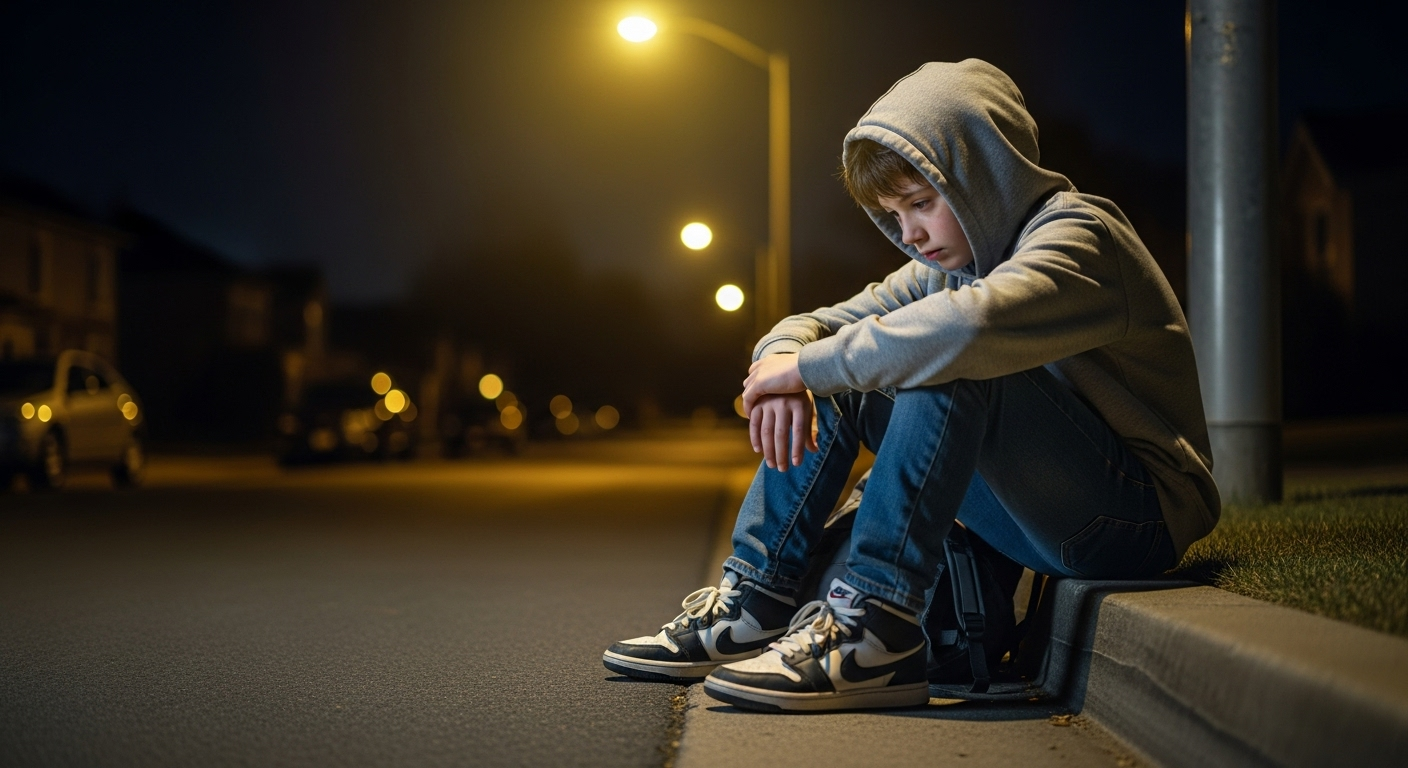
I Was Twelve Years Old, Standing in the Rain, Listening to the People Who Were Supposed to Love Each Other Tear Our Family Apart. I Couldn’t Take Another Second of the Screaming, So I Made a Decision That Would Change Everything Before the Sun Came Up.
PART 1: THE BREAKING POINT
Chapter 1: The War Zone
It wasn’t a dark and stormy night in the movies. It was just a Tuesday in October, the kind of day that feels gray even when the sun is out. I was walking home from detention—something stupid, I forgot my math textbook again—and the closer I got to our house on Elm Street, the heavier my backpack felt.
Most kids are afraid of monsters under the bed. I was afraid of the silence before the storm, and the storm itself.

I stood on the front porch. The paint was peeling on the railing; Dad had promised to fix that three summers ago. I could hear the TV on inside, the volume cranked up way too high. That was the first bad sign. They used the TV to drown out the noise of their own voices, but it never worked.
I took a breath, the cold autumn air stinging my lungs, and unlocked the door.
The moment the latch clicked, the sound hit me like a physical wave.
“…money we don’t have, David! Again! You did it again!”
That was Mom. Her voice wasn’t just loud; it was jagged. It sounded like she had been screaming for hours, her vocal cords shredded raw.
“I told you, it’s an investment! Why can’t you just trust me for once in your miserable life?”
Dad. His voice was lower, booming from his chest, vibrating the floorboards under my sneakers.
I stepped into the entryway, closing the door as softly as I could. Not that it mattered. They wouldn’t hear a bomb go off when they were like this. My stomach did that familiar flip-flop, a mix of nausea and adrenaline that I had been living with for three years.
I dropped my backpack by the coat rack. They were in the kitchen. I could see them through the archway. Mom was gripping the edge of the granite island so hard her knuckles were white. Her hair was messy, pulled back in a frantic bun. Dad was pacing, his face flushed a dark, dangerous red, waving a piece of paper in the air—probably a bank statement.
“Trust you?” Mom laughed, but it was a cruel, broken sound. “Trust you? Like I trusted you with the mortgage? Like I trusted you when you said you’d quit drinking?”
Crash.
Dad slammed his hand on the counter. A ceramic bowl wobbled and fell, shattering on the tile floor. Neither of them looked down. Neither of them looked at the door. Neither of them looked for me.
I stood there, frozen. I was wearing my muddy sneakers, standing on the nice rug Mom hated getting dirty, and she didn’t even notice. That’s when you know it’s bad. When you become invisible.
I felt tears prick the corners of my eyes, but I refused to let them fall. I was twelve. I was too old to cry about my parents fighting. That’s what I told myself, anyway. But inside, I felt like a little kid who just wanted to be held. I wanted them to stop. I wanted silence.
“I’m doing this for us!” Dad roared, stepping into her personal space.
“There is no ‘us’ anymore, David!” Mom screamed back, tears finally streaming down her face. “There is just you and your lies!”
Every word was a knife. And I was standing in the crossfire, bleeding out, and they didn’t even know I was in the room.
Chapter 2: The Departure
My heart was hammering against my ribs, a frantic rhythm that echoed the chaos in the kitchen. Thump-thump-thump.
I looked at the stairs. I could run up to my room, put on my noise-canceling headphones, and blast Eminem until my eardrums hurt. That’s what I usually did. I’d hide. I’d pretend I lived somewhere else, with a family from a sitcom where problems were solved in twenty minutes with a laugh track.
But today… today was different.
Maybe it was the detention. Maybe it was the gray weather. Maybe it was just the sheer, crushing weight of repetition.
I was tired.
That was the only word for it. I wasn’t scared anymore. I was exhausted. I was tired of the knot in my stomach. I was tired of walking on eggshells. I was tired of scanning Dad’s face when he came home to see if it was a “good night” or a “bad night.” I was tired of Mom crying in the bathroom with the shower running to hide the sound.
I looked at them one last time. Dad was pointing a finger in Mom’s face. Mom looked like she was shrinking, collapsing in on herself.
They didn’t need me. They were locked in their own private hell, and there was no room for a son in there.
I slowly turned around.
I picked up my backpack. It was heavy with textbooks, but it felt like the only anchor I had.
I reached for the door handle. My hand was trembling.
If I open this, if I leave, I don’t know when I’m coming back, I thought. The thought should have terrified me. The sun was setting. The streetlights were flickering on, casting long, eerie shadows down the suburban block. It was getting cold. I didn’t have a jacket, just my hoodie.
But the fear of the cold outside was nothing compared to the heat of the anger inside.
I turned the knob. The mechanism clicked.
Inside the kitchen, the screaming hit a fever pitch. “Get out then! If you hate it so much, just leave!” Dad yelled at Mom.
Okay, I whispered to no one. I will.
I opened the front door and stepped out. I didn’t slam it. I closed it with a gentle, final click.
The silence of the front yard was deafening. A dog was barking a few houses down. A car drove past, bass thumping. Normal sounds. Peaceful sounds.
I walked down the driveway, past the overgrown lawn. I didn’t look back at the window. I didn’t look for their silhouettes.
I turned left. I didn’t know where I was going. I just knew I couldn’t be there anymore. I was twelve years old, alone on the streets of my hometown, and for the first time in my life, I was running away.
The suburban sprawl of Ohio stretched out before me. Rows of houses that all looked the same, but I knew which ones were happy and which ones were faking it.
I checked my pocket. I had a library card, a house key I wouldn’t be using, and a crumpled five-dollar bill.
That was it. That was my survival kit.
I kept walking, my sneakers slapping against the pavement. The streetlights buzzed overhead. I passed the Miller’s house—they had a Golden Retriever that always barked. Tonight, even the dog was quiet.
A cold wind whipped up, cutting through my hoodie. I shoved my hands in my pockets and hunched my shoulders. I needed a plan.
I could go to my best friend Tyler’s house, but his parents asked too many questions. They were the “perfect” parents. They’d call Mom immediately.
I could go to the park, but the teenagers hung out there at night, smoking stuff I didn’t want to be around.
I just kept walking. One block. Two blocks. Three. The houses started to get smaller, the yards more cluttered. I was heading toward the edge of town, toward the highway.
Why? I don’t know. Maybe because the highway went somewhere else. Anywhere else.
As I crossed the intersection near the old gas station, a beat-up pickup truck slowed down next to me. The window rolled down.
My heart jumped into my throat.
Don’t look, I told myself. Just keep walking.
“Hey kid,” a voice rasped from the dark cab of the truck. “You look lost.”
I froze.
PART 2: THE COLD REALITY
Chapter 3: The Wolf in the Pickup Truck
I froze. My feet felt like they had suddenly been encased in cement blocks. The voice from the truck was gravelly, like tires rolling over loose stones. It wasn’t a friendly voice. It was the kind of voice that made the hair on the back of your neck stand up—a primal warning signal that dates back to when we were being hunted on the savannah.
I kept my head down, staring at the dirty asphalt illuminated by the truck’s headlights. Don’t engage, I thought. Just keep walking.
I took a step. The truck rolled forward, matching my pace. The engine purred with a low, menacing rumble.
“I’m talking to you, son,” the man said, louder this time. The window was rolled down halfway. I could smell stale cigarette smoke and something sweet, like old vanilla air freshener, drifting out into the cold night air.
I tightened my grip on my backpack straps until my fingers hurt. “I’m fine,” I muttered, trying to make my voice sound deeper than it was. “I’m just walking home.”
“Home is that way,” the man said, gesturing with a thumb back toward the nice suburbs I had just left. “You’re walking toward the highway. Ain’t nothing out there but roadkill.”
Panic started to bubble up in my chest. He had been watching me. Or maybe he just knew. Elm Street was the boundary line; everything past the gas station was industrial zoning and empty lots.
“I’m going to my friend’s house,” I lied. My heart was slamming against my ribs so hard I thought he could hear it.
The truck stopped completely, blocking my path slightly. The door creaked.
Run.
The command screamed in my brain. It wasn’t a thought; it was an impulse.
“Look, it’s freezing out here,” the man said, pushing the door open. A boot hit the pavement. “Let me just give you a ride. I’m not gonna hurt you. I’m a dad, too.”
That was the trigger. I’m a dad, too.
My own dad was the reason I was out here. Fathers weren’t safe. Fathers were the people who screamed until the windows shook. Fathers were the ones who made you feel small.
I didn’t wait to see his face. I didn’t wait to see if he was actually reaching for a weapon or just being a Good Samaritan with zero social awareness. I bolted.
I threw myself to the right, scrambling up a steep embankment of dead grass and weeds.
“Hey! Hey, kid, wait!” the man shouted. His voice sounded angry now.
I didn’t look back. I pumped my arms, my heavy backpack bouncing painfully against my spine. I slipped on the wet grass, my knee slamming into the ground, scraping raw against a hidden rock. I scrambled back up, ignoring the stinging pain, and crested the hill.
I found myself in the backyard of a dark, silent house. There was a chain-link fence on the other side.
I could hear the truck door slam shut. I heard heavy footsteps on the pavement below, but they didn’t follow me up the hill. He wasn’t chasing me. Not yet.
I sprinted across the yard, expecting a dog to burst out of nowhere, but silence reigned. I hit the chain-link fence at full speed. I tossed my backpack over, the heavy books making a loud thud on the other side, and scrambled up the metal mesh.
My hoodie snagged on the top wire. I yanked it free, hearing the fabric tear, and dropped to the ground on the other side.
I landed in an alleyway. It was darker here, away from the streetlights. I grabbed my bag and ran. I ran until my lungs burned, until the cold air felt like swallowing razor blades. I ran until the sound of the truck engine was just a ghost in my memory.
I ended up three streets over, hiding behind a large, green dumpster that smelled of rotting vegetables. I crouched there, gasping for air, clutching my chest.
I checked my surroundings. I was behind a strip mall now. The back doors of the shops were steel and locked tight.
I was safe from the man in the truck. But as my breathing slowed and the adrenaline faded, a new feeling washed over me.
The cold.
It seeped through my thin hoodie, biting into my skin. My knee was throbbing. My hands were shaking, not just from fear, but from the temperature dropping rapidly.
I looked at my watch. It was only 8:15 PM.
The night had barely begun.
I realized then that running away wasn’t an adventure. It wasn’t like the books where you find a secret hideout and live off apples. It was dirty, it was freezing, and it was terrifying.
But I couldn’t go back. If I went back now, Dad would be vindicated. He’d say, “See? You need me. You can’t survive without me.” He’d use my return as ammo in his war against Mom. Look at how he came crawling back.
No. I would rather freeze behind this dumpster than give him the satisfaction.
I stood up, my legs wobbly. I needed a plan. I needed somewhere warm, somewhere public where weird men in trucks wouldn’t bother me.
I saw a neon sign glowing in the distance, cutting through the fog like a lighthouse.
OPEN 24 HOURS.
It was a laundromat.
Chapter 4: The Neon Sanctuary
The “Spin & Suds” Laundromat was a box of fluorescent light in a sea of darkness. Through the glass front, I could see rows of yellow dryers tumbling colorful clothes. It looked warm. It looked normal.
I pushed the door open. A bell jingled overhead—a cheerful sound that felt out of place with my mood.
The air inside was thick and humid, smelling strongly of detergent and dryer sheets. It was heaven. The warmth hit my frozen face instantly, and I almost cried from the relief.
There were only two other people inside. An elderly woman reading a magazine while her clothes spun, and a guy in greasy mechanic coveralls folding towels in the back corner. Neither of them looked up.
I walked to the back, trying to look like I belonged there. I didn’t have any laundry. I was just a kid with a backpack and a torn hoodie.
I spotted a vending machine near the change dispenser. My stomach gave a loud growl, reminding me that I hadn’t eaten dinner. The fight at home had started before Mom could even put the pot on the stove.
I dug into my pocket and pulled out my crumpled five-dollar bill. Lincoln stared back at me, judging my life choices.
I fed the bill into the machine. It whirred and spat it back out.
Panic.
I flattened the bill against my thigh, trying to smooth out the wrinkles. Please working. Please work.
I tried again. This time, the machine accepted it. I pressed the buttons for a bag of honey BBQ chips and a bottle of water. The coils turned slowly, agonizingly, until the items dropped.
I retrieved my prize and found a plastic chair in the corner, hidden partially by a large industrial washer. I sat down, opened the chips, and ate.
I had never tasted anything so good. The salt, the crunch—it grounded me. For a moment, I wasn’t a runaway. I was just a kid eating a snack.
But the peace didn’t last.
I reached into my pocket and pulled out my phone. I had turned it off the moment I walked out the door, terrified they would track me.
I held the power button. The screen lit up. The Apple logo appeared.
As soon as it booted, the notifications flooded in like a tidal wave. The phone buzzed violently in my hand, over and over and over.
37 Missed Calls. 12 New Messages.
Most were from Mom. Two were from Dad.
I opened the messages, my thumb hovering over the screen.
Mom (7:45 PM): Where are you? Dinner is almost ready. Mom (8:00 PM): David, stop hiding. It’s not funny. Mom (8:10 PM): Please pick up. We stopped fighting. Please. Mom (8:30 PM): I’m calling the police.
My stomach dropped. Police.
That changed everything. If the police were looking for me, I couldn’t stay here. A lone kid in a laundromat at night? That was a red flag. If a patrol car rolled by and saw me, they’d scoop me up and drive me right back to the screaming house.
I looked at Dad’s text.
Dad (8:15 PM): You’re acting like a child. Get home now.
I stared at those words. Acting like a child.
I was a child. That was the point. I was twelve. I was supposed to be acting like a child. I was supposed to be worrying about Minecraft and math tests, not navigating the streets at night because my parents couldn’t act like adults.
Anger flared up again, hot and blinding, burning away the fear.
I powered the phone down. I wasn’t going back. Not tonight.
I grabbed my backpack. The warmth of the laundromat was seductive, but it was a trap. I needed a place where no one would look.
I walked back out into the cold. The wind felt even worse now that I had been warm.
I knew where to go. The high school baseball fields were only a few blocks away. My Little League team used to play there sometimes. I knew the visitors’ dugout was deep, made of concrete, and usually unlocked because the latch was broken.
It took me twenty minutes to walk there, sticking to the shadows, ducking behind cars whenever headlights swept the street.
I climbed the fence—my second fence of the night—and dropped onto the clay infield. It was pitch black.
I felt my way to the dugout. The concrete was freezing, radiating cold like a block of ice. I went to the far corner, where the wind couldn’t reach, and sat down on the bench.
I curled up into a ball, pulling my knees to my chest. I used my backpack as a pillow. I pulled my hood up tight over my head.
It was uncomfortable. It was cold. It was lonely.
I closed my eyes, trying to imagine I was in my bed. I tried to imagine the smell of my sheets, the hum of the heater vent.
But all I could hear was the wind rattling the chain-link fence. Clink. Clink. Clink.
I drifted into a restless, shivering sleep.
I don’t know how long I was out. Maybe an hour. Maybe two.
I woke up to a sound.
It wasn’t the wind.
It was the sound of footsteps crunching on the gravel of the baseball diamond.
Crunch. Crunch. Crunch.
They were slow. Deliberate. And they were getting closer to the dugout.
I stopped breathing. I pressed myself against the cold concrete wall, trying to merge with the shadows.
A beam of a flashlight sliced through the darkness, cutting across the grass, sweeping left and right.
“I know someone’s in here,” a voice called out.
It wasn’t the truck driver. It wasn’t Dad. It wasn’t a cop.
It was a kid’s voice.
Chapter 5: The Ghost in the Dugout
The flashlight beam hit my face, blinding me. I threw my hands up, squinting against the glare.
“Whoa, easy,” the voice said. The light dipped, pointing at my chest instead of my eyes.
My vision adjusted. Standing at the entrance of the dugout was a figure in a black hoodie. It wasn’t a cop. It wasn’t a man. It was a teenager.
I recognized him. It was Silas. He was a junior in high school, the kind of guy parents warned their kids about. He smoked behind the bleachers, drove a loud car, and rumors said he had been arrested for shoplifting.
He stepped into the dugout, the gravel crunching under his boots. He clicked the flashlight off, plunging us back into semi-darkness, illuminated only by the distant streetlamps.
“You’re the Miller kid, right?” Silas asked, leaning against the concrete wall. He didn’t sound mean. He sounded bored.
I nodded, shivering. “Yeah.”
“What are you doing here? It’s thirty degrees out.”
“Camping,” I lied. It was a pathetic lie.
Silas snorted. He reached into his pocket and pulled out a pack of cigarettes. He lit one, the flame illuminating his sharp features for a second. “Right. Camping without a tent or a sleeping bag. In October.”
He took a drag and exhaled a cloud of smoke that mixed with the freezing air. “Your folks fighting?”
The question was so direct, so casual, that it knocked the wind out of me. I looked down at my sneakers. “Yeah.”
Silas nodded slowly. ” figured. My old man used to throw plates. Yours looks like a yeller.”
He didn’t pity me. He didn’t offer to call the cops. He just understood. It was a strange kind of comfort, finding someone who knew the language of a broken home.
“You can’t stay here,” Silas said, flicking ash onto the floor. “Cops patrol this lot at 2 AM. They catch you, they haul you in, call your dad, and it gets worse. Trust me.”
“I have nowhere else to go,” I whispered. My teeth were chattering now.
Silas looked at me for a long moment. He sighed, dropped the cigarette, and crushed it with his boot. “Come on.”
“Where?”
“My car. The heater works. And I have a stash of Pop-Tarts.”
I hesitated. Stranger danger and all that. But Silas wasn’t a stranger, not really. He was a survivor of the same war I was fighting.
I grabbed my backpack and followed him.
Chapter 6: The Truth About Running
Silas’s car was a rusted Honda Civic parked behind the equipment shed. The inside smelled like fast food and cheap cologne, but when he turned the key, the heater blasted hot air that felt like a hug from God.
I sat in the passenger seat, my hands thawing out in front of the vent. Silas tossed me a foil packet of strawberry Pop-Tarts. I tore into it like a starving animal.
“So, what’s the plan?” Silas asked, drumming his fingers on the steering wheel.
“I don’t know,” I admitted, my mouth full of pastry. “California? New York? Just… away.”
Silas laughed, a dry, humorless sound. “Kid, you got five bucks and a library card. You ain’t making it to the state line.”
He turned to face me, his expression serious. “I ran away when I was fourteen. Made it to Cleveland. Slept under a bridge for three nights. You know what I learned?”
I shook my head.
“I learned that the world doesn’t care about you. At home, they scream at you, sure. But out here? You’re invisible. And invisible is dangerous.”
He pointed at the windshield, at the dark, empty parking lot. “You think you’re punishing them by leaving. You think they’re sitting there crying, realizing their mistake. And maybe they are. For tonight.”
“But tomorrow?” He paused. “Tomorrow, you’re just a statistic on a milk carton, and they’re still the same broken people.”
I felt a lump form in my throat. “So I just go back? Let them scream at me?”
“No,” Silas said firmly. “You go back. But you go back different. You stopped being their victim the second you walked out that door. You showed them you have a breaking point. That’s power.”
He checked his phone. “It’s 11 PM. Your mom posted on the neighborhood Facebook group. She’s begging people to check their sheds.”
My heart squeezed. Mom.
“She’s scared?” I asked, my voice small.
“She’s terrified,” Silas said. “Look, I’m not gonna tell you what to do. But if you sleep in this car, you wake up stiff and cold. If you go home… maybe they finally listen.”
I looked at the dashboard clock. 11:02 PM.
The anger had burned out hours ago. Now, there was just exhaustion. And a tiny, flickering hope that Silas was right. That maybe, just maybe, my absence had been loud enough to wake them up.
“Can you drive me?” I asked.
Silas put the car in gear. “Buckle up.”
PART 4: THE RETURN
Chapter 7: The Longest Driveway
The drive back to Elm Street took five minutes, but it felt like a lifetime. Silas didn’t play music. We just drove in silence through the sleeping suburbs.
When he turned onto my street, I saw it instantly.
My house was the only one with every single light blazing. It looked like a ship on fire in the middle of a dark ocean.
There was a police cruiser parked in the driveway. Its blue and red lights were off, but the presence of the vehicle made my stomach turn.
“Cops are there,” Silas noted. “Heavy.”
He stopped the car three houses down. “You want me to walk you up?”
“No,” I said. I unbuckled my seatbelt. “I have to do this myself.”
“Good luck, kid,” Silas said. “And hey—if it gets bad again… the dugout is always open.”
I nodded, stepped out of the warm car, and closed the door.
I walked toward the house. My legs felt heavy.
As I reached the driveway, the front door flew open.
Mom was standing there. She looked like a ghost. Her face was puffy, her eyes red-rimmed and wild. She was wearing a thin sweater, hugging herself against the cold.
She saw me.
For a second, nobody moved.
Then she let out a sound—a sob that was half-scream, half-relief—and ran down the porch steps. She didn’t care about her bare feet on the cold concrete.
She collided with me, dropping to her knees to hug me around the waist. She buried her face in my dirty hoodie, sobbing uncontrollably.
“Oh my god. Oh my god. You’re safe. You’re safe.”
I stood there, stiff at first, then slowly put my hand on her head. She was shaking.
Then Dad appeared in the doorway.
He looked older than he had this afternoon. His shoulders were slumped. The anger that usually radiated off him was gone, replaced by a gray, hollow fear. He saw me, and he let out a long, shaky breath, leaning against the doorframe as if his legs had given out.
The police officer stepped out behind him, looking relieved.
“Is this him?” the officer asked.
Dad nodded, tears tracking silently down his face. “Yeah. That’s him. That’s my son.”
Chapter 8: The Silence After the Storm
The police officer left after a brief talk. He told me I was lucky. He told my parents to “fix the environment.”
Then he was gone, and it was just the three of us in the living room.
It was quiet. But it wasn’t the tense, angry silence of before. It was a fragile silence. The kind you get after an explosion, when the dust is settling.
Mom sat on the couch, holding my hand so tight my fingers were numb. She wouldn’t let go. Dad sat in the armchair across from us, staring at the floor.
“I’m sorry,” Dad said. His voice was cracked. He didn’t look at me; he couldn’t. “We… I didn’t mean for you to think you had to leave.”
I looked at them. Really looked at them. They weren’t the giants I thought they were. They were just two tired, messed-up people who didn’t know how to handle their own lives.
“I’m not doing it anymore,” I said.
My voice was quiet, but it filled the room.
They both looked up.
“I’m not listening to the screaming anymore,” I told them. “If you guys want to fight, you do it somewhere else. Or I leave again. And next time, I won’t come back when the streetlights come on.”
It was a bluff—I had nowhere to go—but they didn’t know that. And looking at the fear in their eyes, I knew they believed me.
Mom squeezed my hand. “We know. We know, baby. We’re going to fix it. We promise.”
Dad nodded, wiping his eyes. “We’ll fix it.”
I didn’t know if they would. Adults lie. They promise things they can’t keep.
But as I walked up the stairs to my room that night, I realized something had changed. I wasn’t the scared little kid hiding under the headphones anymore. I had walked into the dark, faced the cold, and came back on my own terms.
I climbed into my bed. It was soft and warm.
Downstairs, it was dead silent. No TV. No shouting. Just peace.
I closed my eyes and finally, for the first time in years, I slept without listening for the storm.
[END OF STORY]