The Boy Who Emptied His Piggy Bank at the Bus Station: “One Ticket for Mom, Please”
Chapter 1: The Little Worker
The wind in Akron, Ohio, in late October has a way of finding the gaps in your clothes that you didn’t know existed. It’s a damp, gray chill that settles into the bones and stays there until May. For most people, the greyhound bus terminal on the south side of town was a place to leave, a place to pass through, or a place to avoid entirely. It smelled of diesel fumes, stale popcorn, and wet wool.
But for six-year-old Toby, it was his office.
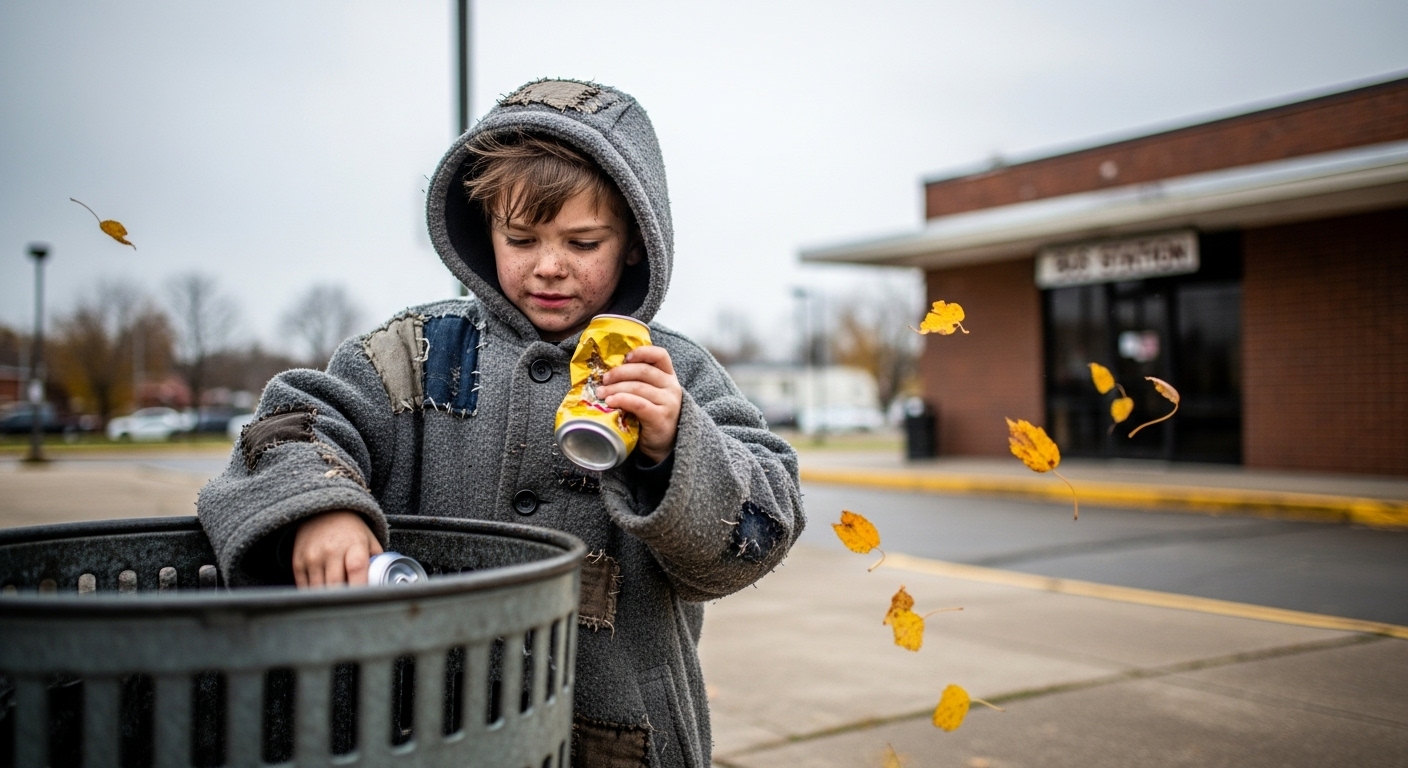
Toby was small for his age, a scrawny thing with hair the color of wheat straw and eyes that held the quiet, frantic intensity of a squirrel gathering nuts for winter. He wore a coat that had been blue once, but was now a vague shade of charcoal, patched at the elbows with squares of denim his father, Jack, had sewn on with thick, clumsy stitches.
It was 4:00 PM on a Tuesday. Other first graders were at home watching cartoons, or at the park chasing falling leaves. Toby was knee-deep in a trash can outside Bay 4.
“Excuse me,” a businessman in a trench coat muttered, tossing a paper coffee cup toward the bin.
Toby didn’t flinch. He waited for the man to walk away, then reached in with his small, gloved hand (mismatched mittens, one red, one black). He retrieved the cup. He shook it. Empty. He tossed it back. But underneath it, gleaming in the fluorescent light of the overhang, was a treasure.
An aluminum soda can. Mountain Dew.
Toby crushed it against the pavement with the heel of his sneaker—crinkle-crunch—and slid it into the heavy burlap sack he dragged behind him. Then, he spotted something else near the man’s footprint. A penny.
He picked it up, wiped the street grime off on his pants, and dropped it into the large glass pickle jar he kept guarded inside his backpack.
Clink.
The sound was music. It was the sound of progress.
Toby sat on a cold concrete bench, catching his breath. He pulled the jar out just to look at it. It was heavy now, filled with a chaotic mix of copper pennies, silver dimes, crushed dollar bills, and even a few quarters he’d found under the vending machines.
He didn’t count it. He just weighed it in his hands. It felt like hope.
His mind drifted back to The Night. It was always there, hovering in the back of his brain like a bruise that wouldn’t heal.
It was three years ago. He was only three, but he remembered the volume of the voices.
“I can’t do this anymore, Jack!” His mother’s voice, shrill and weeping. “I’m drowning here! Look at this house! Look at these bills!”
“Sarah, please,” his father’s voice, low and pleading. “I’m working double shifts. I’m trying. We just… we don’t have enough right now.”
“That’s the problem, Jack! We never have enough! We can’t afford a vacation. We can’t afford a new car. We can’t afford the life I was supposed to have!”
And then, the sentence that burned itself into Toby’s soul. His father had said it with a sob in his throat:
“I know, Sarah. I know we can’t afford you. But we love you.”
We can’t afford you.
Toby hadn’t understood the nuances of finance or marital strife. He understood the world in the simple terms of a child. You buy milk at the store. You buy gas for the car. If you don’t have money, you put the item back on the shelf.
Mom was the item. Dad didn’t have enough money. So, Mom had to go back to wherever she came from.
She had packed a bag and walked to this very bus station. She had gotten on the 5:00 PM bus to Cleveland, and she never came back.
Toby looked at the jar. He wasn’t mad at his dad. Dad was a mechanic who came home with grease under his fingernails and eyes red from exhaustion. Dad tried. But Dad was poor.
Toby tightened the lid on the jar. He wasn’t poor. Not anymore. He was a worker. He had been saving for six months, collecting the city’s refuse, turning trash into treasure.
“Almost time,” he whispered to the diesel-choked air. “I’m gonna buy you back, Mom.”
Chapter 2: The Collection
The next few weeks were brutal. The temperature dropped, and the bus station became a haven for those with nowhere else to go. The competition for cans got stiffer.
Toby learned to be invisible. He learned that if he stood too close to the ticket counter, the security guard, a heavy-set man named Mr. Henderson, would chase him off.
“Go home, kid!” Henderson would bark, his hand resting on his belt. “This ain’t a playground. You’re bothering the customers.”
But Toby always circled back.
One afternoon, a group of teenagers were hanging around the vending machines. They were loud, wearing varsity jackets, laughing at a joke Toby didn’t understand. Toby saw a quarter on the floor near the sneaker of the tallest boy.
He hesitated. A quarter was twenty-five pennies. It was a lot.
He crept forward, reaching for the coin.
“Whoa, look at the rat,” the tall boy sneered. He kicked Toby’s hand away.
Toby scrambled back, clutching his hand.
“What’s in the bag, rat boy?” the teenager asked. He grabbed Toby’s backpack.
“No! Please!” Toby cried, forgetting his rule about being invisible. “Give it back!”
The boy unzipped the bag and pulled out the pickle jar. The coins swirled inside.
“Look at this loot,” the boy laughed. “What are you saving for? Candy? A new brain?”
“It’s for my Mom!” Toby screamed, lunging for the jar.
The boy laughed and tossed the jar to his friend. They played keep-away for a minute, terrorizing the six-year-old, until the jar slipped from the friend’s hand.
It hit the linoleum floor.
THUD.
It didn’t break. It was thick glass. But the lid popped off. Coins scattered everywhere—rolling under benches, spinning under the boots of travelers.
“Scram!” Mr. Henderson’s voice boomed from across the lobby.
The teenagers ran, laughing.
Toby didn’t run. He dropped to his knees. He didn’t cry. He couldn’t afford to cry; tears blurred your vision, and he needed to see every penny.
He crawled on the dirty floor, amidst the gum wrappers and cigarette butts. He picked up the dimes. He chased a nickel that rolled near a woman’s high heel.
“Oh, you poor thing,” the woman said, reaching into her purse. “Here.” She tried to hand him a dollar.
Toby shook his head fiercely. “No, ma’am. I have to earn it. Dad says charity makes you weak.”
He gathered his fortune, scoop by scoop. He put it back in the jar. He counted it in his head as he worked. He had forty-two dollars and fifty cents.
Forty-two dollars. It was a fortune. It was more money than he had ever seen in one place. It had to be enough. A loaf of bread was two dollars. A toy car was five. A person? A person couldn’t cost more than forty, surely.
He looked up at the big clock on the wall. It was Tuesday. Mom left on a Tuesday.
He decided. Today was the day.
Chapter 3: The Transaction
Rain lashed against the sliding glass doors of the terminal, turning the world outside into a watery blur. Inside, the air was thick with the smell of wet coats and humidity.
The line for the ticket counter was long. People were grumpy. A baby was crying somewhere in the back.
Toby stood at the end of the line. He was so small that the person in front of him—a large man with a hiking backpack—didn’t even know he was there until Toby sneezed.
He waited for twenty minutes. His arms ached from holding the jar. His heart hammered against his ribs like a trapped bird. He rehearsed his speech. He had practiced it in the mirror every morning.
“One ticket, please. A return ticket.”
Finally, he was at the front.
The counter was high. Toby stood on his tiptoes. He heaved the pickle jar up.
CLUNK.
The sound echoed through the station. It cut through the murmur of the crowd.
Mrs. Higgins was behind the glass. She had worked at Greyhound for twenty years. She had gray hair pulled back in a tight bun, glasses on a chain, and a face that looked like it had forgotten how to smile around 1998. She was tired. Her feet hurt.
She looked over the counter, confused. She saw the jar. Then, she looked down and saw the top of a blonde head.
“What in the world?” she muttered. She leaned over. “Hey! You! Kid! You can’t leave your trash here.”
Toby jumped, then grabbed the edge of the counter and pulled himself up so his chin rested on the laminate surface.
“It’s not trash,” he said, his voice trembling but loud. “It’s money.”
Mrs. Higgins blinked. The people in line behind Toby started to crane their necks.
“Money?” Mrs. Higgins sighed. “Look, kid, the candy machine is over there. I don’t have time for games. Where are your parents?”
“I’m here for business,” Toby said. He unscrewed the lid. The smell of old copper wafted out. “I have forty-two dollars and fifty cents. I counted it three times.”
Mrs. Higgins softened, just a fraction. “Okay, big spender. You want a ticket to Cleveland? Or maybe Columbus?”
Toby shook his head violently.
“No, ma’am. I don’t want to go anywhere. I want to buy a return.”
“A return?” Mrs. Higgins adjusted her glasses. “You mean a round trip? You have to go somewhere to come back, honey.”
“No,” Toby insisted. “Not for me. For my Mom.”
The station got quieter. The person behind Toby stopped tapping his foot.
“She left,” Toby explained, his eyes wide and earnest. “She left on the five o’clock bus. Three years ago. My Dad… he said we couldn’t afford her. He said she was too expensive for us.”
Mrs. Higgins stopped typing. Her mouth opened slightly.
“But I worked,” Toby continued, pushing the jar forward. “I worked all autumn. I picked up cans. I have forty-two dollars. Is it enough? Can I buy her back now? I promise I’ll keep working if she costs more, but this is all I have right now.”
Chapter 4: The Crash
Silence. Absolute, suffocating silence descended on the Greyhound station.
The tick-tock of the wall clock seemed to boom like a cannon.
Mrs. Higgins stared at the boy. She looked at his patched elbows. She looked at the dirty jar of pennies. She looked into eyes that held a hope so pure and so fragile that she was terrified to speak.
She realized, with a sickening jolt, exactly what was happening. This child thought his mother was a layaway item. He thought she was something that had been repossessed due to lack of funds.
Mrs. Higgins felt tears prick her eyes, hot and sudden. She looked around for an adult, for anyone to save her from this moment. But there was no one. Just the crowd, watching, heartbroken.
“Honey…” she whispered. She came around from behind the glass. She knelt down on the dirty floor so she was eye-level with him.
“Honey, what’s your name?”
“Toby.”
“Toby,” she reached out and took his small, cold hands. “Toby… tickets don’t work that way.”
Toby’s face fell. “Is it not enough? I have a shiny rock too!” He let go of her hands and frantically dug into his pocket. He pulled out a piece of polished quartz and a red button. He slammed them on the counter next to the jar. “Take this too! Please! Just bring her back!”
“No, Toby, stop,” Mrs. Higgins said, her voice cracking. “It’s not about the money. You can’t… you can’t buy people back. If your Mommy left… a ticket won’t make her come home. Not if she doesn’t want to.”
The words hit Toby like a physical blow.
He stepped back. “But Dad said… he said we couldn’t afford her!”
“That’s just something grownups say when they are sad,” Mrs. Higgins wept. “It doesn’t mean money, baby. It means… it means she wanted a different life.”
Toby looked at the money. His life’s work. His hope.
If money couldn’t fix it, then nothing could.
The realization broke him.
He didn’t just cry. He wailed. It was a sound of pure, unadulterated grief that tore through the station. He grabbed the jar and tried to shove it into Mrs. Higgins’ hands.
“Take it! Make her come back! MAKE HER!” he screamed. The jar tipped. Coins spilled over the edge of the counter, cascading onto the floor in a loud, metallic crash that sounded like a breaking heart.
Toby fell to the floor, swimming in the spilled pennies, sobbing into the cold tile.
“I want my Mommy! I have the money! Why won’t she come back?”
The crowd stood paralyzed. A woman in the front row buried her face in her hands. The security guard, Mr. Henderson, took a step forward, wiped his eyes, and stayed back.
Chapter 5: The Real Hero
The automatic doors burst open.
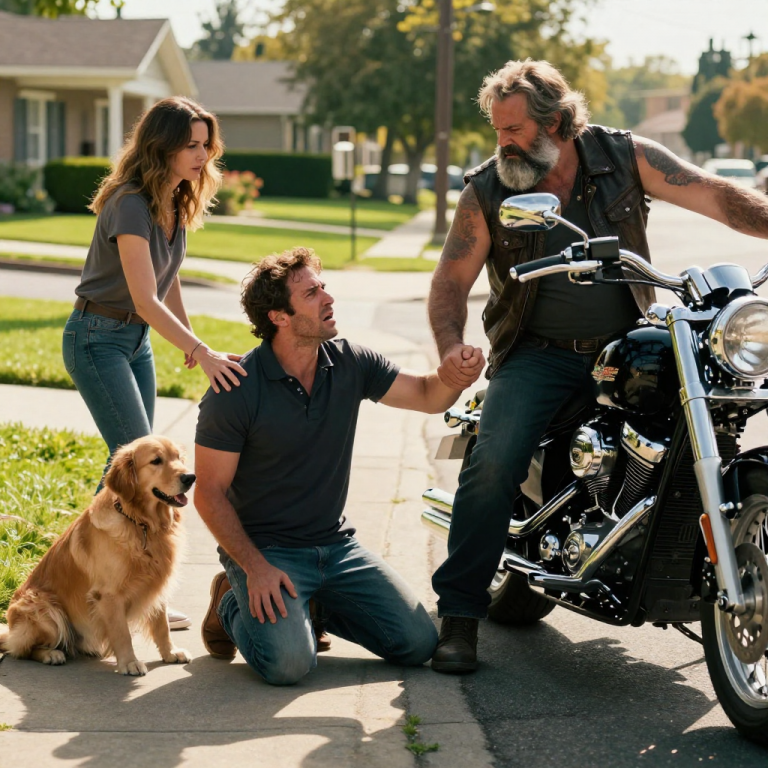
Jack ran in. He was wearing his mechanic’s jumpsuit, stained with grease and oil. He was frantic, wild-eyed. He had come home to an empty house and a missing piggy bank.
He heard the screaming before he saw the boy.
“Toby!”
Jack sprinted across the terminal. He saw the crowd. He saw Mrs. Higgins kneeling. He saw his son curled in a ball on the floor, surrounded by money.
Jack didn’t care about the scene. He didn’t care about the staring strangers. He slid on his knees across the floor, ignoring the impact, and scooped Toby up.
“I’ve got you,” Jack gasped, crushing the boy to his chest. “I’ve got you, son.”
Toby fought him. He pounded his small fists against his father’s grease-stained chest.
“I had enough!” Toby screamed. “I had forty-two dollars! Why won’t she come back? You said we couldn’t afford her! I fixed it! I fixed it, Daddy!”
Jack froze. The words cut him deeper than any knife. He looked at the scattered coins. He looked at Mrs. Higgins, who nodded tearfully.
He understood.
Jack grabbed Toby’s face gently, forcing the boy to look at him.
“Toby. Stop. Look at me.”
Toby hiccuped, his chest heaving. He looked at his father.
“I lied,” Jack said, his voice booming in the quiet station. “I lied to you, Toby. Or I said it wrong.”
Jack cried then. Unashamedly.
“She didn’t leave because of money, Toby. She left because she was empty inside, and she thought things could fill her up. But you… you are not empty.”
Jack gestured to the coins on the floor.
“You can’t buy her, son. You can’t buy love. If you have to buy it, it ain’t real.”
Toby sniffled. “But… but then we’re poor. And she won’t come back.”
“We ain’t poor,” Jack said fiercely. He pointed to his own chest. “Look at me. Am I here?”
Toby nodded.
“Did you have to pay me to come find you?”
Toby shook his head.
“Did you have to buy a ticket for me to hug you?”
“No.”
“That’s right,” Jack said, standing up and lifting Toby effortlessly into his arms. “I’m free. I’m right here. I’m never leaving. I don’t cost a penny, and I love you more than all the gold in the world. She lost a treasure, Toby. We didn’t.”
The crowd erupted. Not in applause, but in the shuffling of handkerchiefs and the sniffing of noses.
A man in a sharp business suit stepped forward. He looked wealthy. He pulled a hundred-dollar bill from his wallet.
“Sir,” the man said to Jack. “For the boy. For… ice cream. Or whatever.”
Jack looked at the money. Then he looked at Toby. He smiled—a real, tired, beautiful smile.
“Thank you,” Jack said. “But we’re okay. We have everything we need.”
Jack knelt down one last time. “Come on, Toby. Help me pick this up.”
Together, father and son picked up the pennies. They put them back in the jar.
“What are we gonna do with it?” Toby asked quietly, wiping his nose.
“We’re going to buy the biggest, most expensive pizza in town,” Jack said. “And we’re going to eat it together. Just us men.”
“With extra pepperoni?”
“Double pepperoni.”
Jack stood up, holding the jar in one hand and Toby’s hand in the other. They walked toward the exit, past the ticket counter, past the buses that went to Cleveland and everywhere else.
Toby didn’t look back at the buses. He looked up at his father, whose hand was rough and dirty and warm.
“Daddy?”
“Yeah, bud?”
“You’re worth more than forty-two dollars.”
Jack laughed, a sound that cleared the air. “Thanks, kid. You’re worth a million.”
They walked out into the rain, but they didn’t feel the cold. They had their own heat.