The Admiral called me a “lost PTA Dad” and mocked my cheap suit in front of the entire gala. He didn’t know the man he was laughing at was the “Iron Ghost”—and I was holding the file that could end his career.
PART 1: THE PTA DAD
The champagne tasted like metal in my mouth. Or maybe that was just the adrenaline, a familiar, coppery taste I hadn’t felt in five years.
I stood near the buffet table, nursing a glass of sparkling water I didn’t want, trying to make myself as small as possible. The Grand Ballroom of the D.C. Marriott was a sea of dress whites, gold braid, and the glitter of expensive jewelry. It smelled of prime rib, old money, and ego.
I didn’t belong here. I knew it. They knew it.
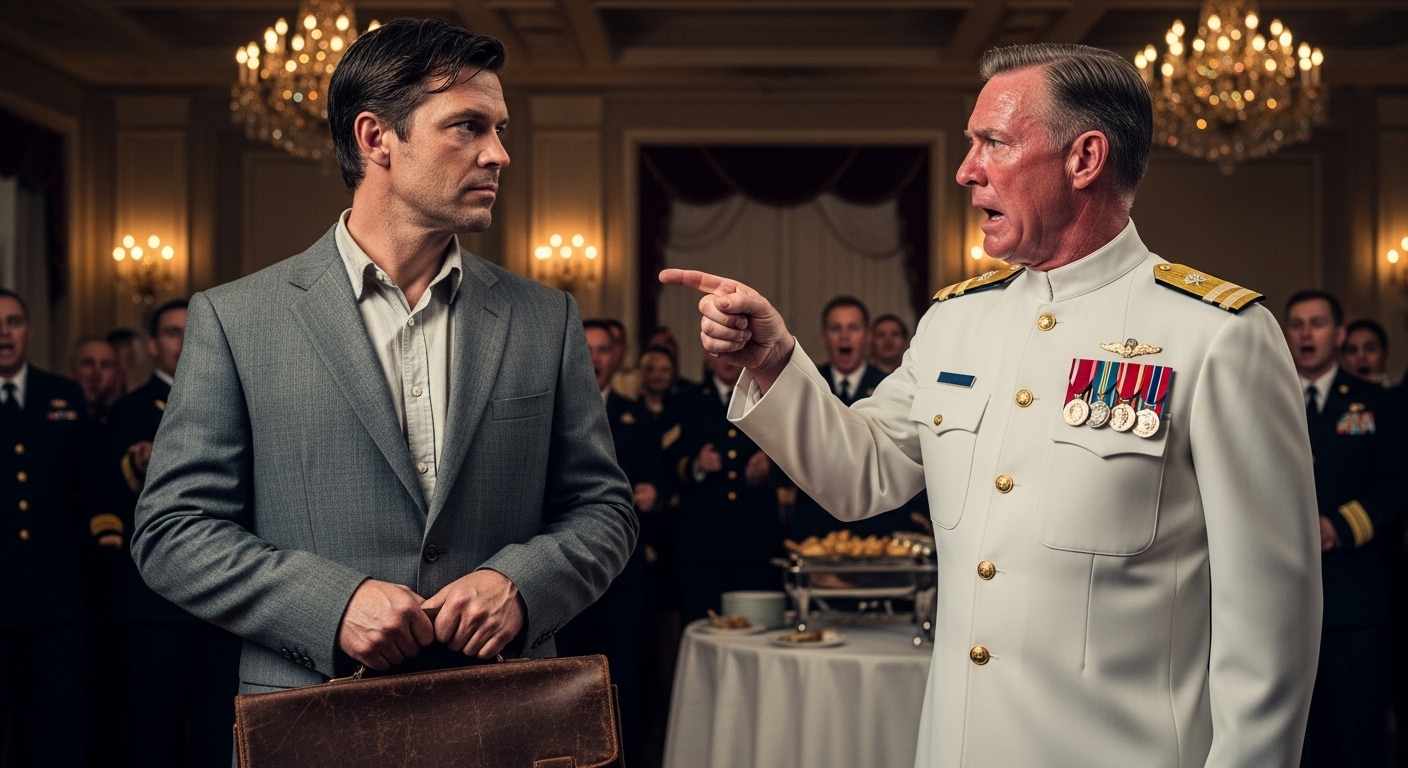
I was wearing a suit I’d bought off the rack at Macy’s three years ago. It was charcoal gray, a little tight in the shoulders, and the fabric had that slight, cheap sheen under the chandeliers. In one hand, I held a battered leather briefcase. In the other, a small white envelope.
I wasn’t there for the prime rib. I was there to deliver a check—a donation from a private fund I managed for the widows of Unit 7—to the gala’s organizer. I had intended to drop it off and vanish. That was always my specialty: vanishing.
But the organizer was delayed. So, I was stuck by the shrimp cocktail, waiting.
That’s when Admiral James Thornton spotted me.
Thornton was a man who took up space. He was loud, broad-shouldered, and decorated like a Christmas tree. He had never seen combat—everyone in the community knew that—but he played the political game better than anyone in the Pentagon. He was currently holding court with a circle of sycophantic junior officers and his wife, a woman who looked at anyone below the rank of Colonel as if they were a stain on the carpet.
I saw Thornton’s eyes slide over the room, looking for prey. He needed someone to belittle to inflate his own importance. His gaze landed on me.
He nudged a Commander next to him. “Check six,” he boomed, not bothering to whisper. “We have a straggler.”
The circle turned. Twelve pairs of eyes landed on my cheap suit.
“I didn’t know the waitstaff was allowed to mingle,” Thornton joked, swirling his Cabernet.
Laughter. Polite, nervous laughter from the juniors. Malicious laughter from the wife.
“Oh, stop it, James,” his wife tittered, pointing a manicured finger at me. “He’s not a waiter. Look at that suit. He clearly wandered in from a PTA meeting. He’s probably looking for the sign-up sheet for the bake sale.”
The laughter grew louder. I didn’t move. I didn’t flinch. I just offered a small, polite smile.
“Good evening, Admiral,” I said softly.
Thornton blinked. He expected me to be embarrassed. He expected me to scurry away. My calmness annoyed him. It was an affront to his dominance.
“You lost, pal?” Thornton stepped out of the circle, closing the distance. He was trying to intimidate me. He stood two inches taller than me in his polished shoes. “The valet parking is out front. Or are you here to fix the plumbing?”
“I’m waiting for General Mattis,” I said, keeping my voice level. “I have a delivery.”
Thornton looked at the battered briefcase. Then he looked at the envelope.
“A delivery?” He scoffed. “What is it? Uber Eats? Did the General order a pizza?”
The room exploded with laughter. Officers from nearby tables turned to see the commotion. Thornton was on a roll now, feeding off the energy. He was the alpha, and I was the punchline.
“Someone get this man a chair!” Thornton shouted to the room. “He looks tired. Being a suburban dad is hard work! Does he even know how to salute, or does he just wave like he’s at a soccer game?”
I felt a muscle twitch in my jaw. Just one.
I could have ended it then. I could have told him that while he was filing paperwork in 2004, I was bleeding out in a cave in the Hindu Kush. I could have told him that the “cheap” briefcase held secrets that would turn his face white.
But I didn’t. I just stood there. Waiting.
“Cat got your tongue?” Thornton sneered, leaning in close. His breath smelled of expensive wine and rot. “You know, this is a gala for heroes. For warriors. Not for civilians who buy their clothes at a discount outlet.”
“I know where I am, Admiral,” I said.
“Do you?” He poked a finger into my chest. “Then why don’t you be a good little civilian and run along? The adults are talking.”
That was the moment. The finger on the chest.
The air in the room seemed to freeze. A young Intelligence Officer, a Lieutenant Commander with a chest full of ribbons, had been walking by with a tray of drinks. He stopped dead.
He looked at me. He looked at my face—really looked at it. He looked at the faint, jagged white scar that ran from my earlobe down into my collar, usually hidden by a beard, but visible now that I was clean-shaven.
The Lieutenant Commander dropped the tray.
CRASH.
The sound of shattering glass silenced the room instantly.
Thornton spun around, furious. “What the hell is wrong with you, Commander? You’re cleaning that up!”
But the Commander wasn’t looking at the Admiral. He was staring at me. His face had drained of all color. He was trembling.
“Sir?” the Commander whispered. His voice cracked.
“Don’t address him!” Thornton snapped. “Address me!”
“No,” the Commander stammered, backing away. “No, no, no… that’s… that’s him.”
“Who?” Thornton demanded, annoyed. “The pizza guy?”
The Commander looked at Thornton with wide, terrified eyes.
“That’s not a civilian, Admiral,” the Commander whispered, but in the silence, it carried like a scream. “That’s the Iron Ghost.”
Part 2
The name hung in the air like toxic gas.
Iron Ghost.
For a second, nobody moved. It was as if the gravity in the room had suddenly doubled.
Admiral Thornton frowned. He was a political creature, not a field operator, but even he had heard the rumors. Everyone had. It was a campfire story for Navy SEALs. A ghost story for CIA paramilitaries. The Iron Ghost wasn’t a person; it was a myth. The operator who walked into North Korea alone and walked out with a defector. The man who dismantled a cartel cell in Juarez in a single night without firing a shot.
“What did you say?” Thornton asked, his voice losing its boom.
“Iron Ghost,” the Commander whispered again. He snapped into a rigid position of attention, his hand twitching as if he wanted to salute but was too terrified to move. “Ethan Cross. Retired. Tier One. Black Squadron.”
Thornton turned back to me. His smirk was faltering, the edges of his mouth twitching. He looked at my “dad suit” again. He looked at my soft demeanor. He tried to reconcile the man he had just poked in the chest with the monster from the stories.
“This?” Thornton laughed, but it sounded hollow, brittle. “This guy? You’re mistaken, Commander. Look at him. He’s… he’s nobody.”
I sighed. I carefully placed my glass of water on a nearby table.
“Ethan Cross,” I said quietly. My voice wasn’t loud, but it cut through the room like a razor blade. “And you’re right, Admiral. I am nobody. That was the point.”
I took a step forward.
Thornton took a step back. It was instinctive. A predator recognizing a bigger predator.
“You asked about the briefcase,” I said, lifting it slightly. “And the envelope.”
“I… I was just joking,” Thornton stammered. The sweat was breaking out on his forehead now. He could feel the eyes of the room shifting. The adoration was gone. The amusement was gone. It was replaced by a heavy, suffocating dread.
The other officers—the veterans, the ones who had seen real combat—were slowly backing away from Thornton. They were creating a perimeter. They wanted no part of the blast radius.
“This envelope,” I continued, tapping it against my palm, “contains a check for fifty thousand dollars. It’s for the widow of Master Sergeant Davis. Do you remember him, Admiral?”
Thornton swallowed hard. “I… the name sounds familiar.”
“It should,” I said. “You denied his request for extraction in Fallujah in 2006. You said the risk profile was too high. You were sitting in an air-conditioned office in Qatar when you made that call.”
The silence in the room was deafening. You could hear the hum of the HVAC system.
“Davis died waiting for a chopper that you cancelled,” I said. My voice remained perfectly flat. No anger. Just facts. “I was the one who had to carry his body four miles to the extraction point. I was the one who had to tell his wife why her husband wasn’t coming home.”
Thornton’s face went from red to a ghostly pale. He looked for an ally. He looked at his wife, but she was staring at the floor, clutching her purse, terrified.
“I… I followed protocol,” Thornton whispered.
“You followed politics,” I corrected.
I took another step. Thornton bumped into the buffet table behind him. A silver fork clattered to the floor.
“And this briefcase?” I patted the leather. “This doesn’t have a pizza in it, Admiral.”
I clicked the latches open. The sound was like a gunshot in the quiet room.
I didn’t open it all the way. I just reached in and pulled out a single, thin file. It wasn’t classified. It was a personnel record.
“General Mattis asked me to vet the candidates for the new Joint Chiefs appointment,” I said. “He wanted an outside perspective. Someone who doesn’t care about galas or cocktail parties.”
Thornton stopped breathing. The Joint Chiefs appointment was the promotion he had been campaigning for. It was the reason he was at this party. It was the reason he was preening.
“I’ve been watching you all night, James,” I said, using his first name. It stripped him of his rank. “I watched how you treat the waiters. I watched how you speak to your subordinates. I watched how you mocked a man you thought had no power.”
I held up the file.
“Leadership isn’t about the medals on your chest,” I said, addressing the room now. “It’s not about how loud you can yell or how expensive your suit is. Leadership is about who you are when you think no one is watching.”
I dropped the file on the buffet table next to the shrimp.
“I was going to recommend you,” I lied. “I thought maybe you had changed. Maybe the years had taught you humility.”
I looked him up and down, looking at the fear in his eyes.
“But I see you’re still the same coward who left Davis in the dirt.”
Thornton looked like he was going to vomit. His career wasn’t just over; it was incinerated. In front of the entire command structure of the US Navy, he had been dismantled by a man in a polyester suit.
I turned to the terrified Lieutenant Commander who had dropped the drinks.
“What’s your name, son?” I asked.
“Lieutenant… Lieutenant Evans, sir,” he squeaked.
“Clean up this glass, Evans,” I said gently. “And then get yourself a drink. You’re the only officer in this room with any situational awareness.”
“Yes, sir. Thank you, sir.”
I walked over to the organizer, who had finally appeared and was standing frozen by the door. I handed him the envelope.
“For the Davis family,” I said. “Make sure she gets it.”
“Yes, Mr. Cross. Absolutely.”
I turned back to the room one last time. Hundreds of decorated heroes, Admirals, Generals, and politicians were staring at me. Not one of them made a sound.
I looked at Thornton, slumped against the table, a broken man.
“Oh, and Admiral?” I called out.
He looked up, eyes wet.
“Next time you see a dad at a PTA meeting? Show some respect. You never know who he used to be.”
I picked up my briefcase and walked out.
The valet brought my car around. It was a 2018 Honda Accord. A dad car.
As I drove away, checking my mirrors out of habit, I let out a long breath. My hands were shaking slightly on the steering wheel. Not from fear. But from the memory of the rage I had suppressed.
I wasn’t the Iron Ghost anymore. I was just Ethan. I was going home to help my daughter with her math homework.
But as I merged onto the highway, I smiled.
It felt good to be a ghost one last time.