The Boy They Tried to Delete: A Bus Driver Finds a Frozen Child on a Porch and Exposes a Suburban Nightmare
Chapter 1: The Ghost in the Basement
The party upstairs sounded like a distant thunderstorm. Through the thin, uninsulated floorboards of the basement, eight-year-old Leo could hear the rhythmic thumping of bass-heavy music, the clinking of expensive glassware, and the high-pitched squeals of children laughing.
It was Brody’s second birthday.
Leo sat on a bare mattress in the corner of the unfinished basement. The air down here was damp and smelled of concrete dust and neglect. He pulled his knees to his chest, wrapping his thin arms around his shins in a futile attempt to conserve heat. He was wearing a t-shirt that was two sizes too small, the fabric tight under his armpits.
“Happy Birthday to you…”
The chorus of voices drifted down. Leo closed his eyes and hummed along silently, terrified that if he made a sound, She would hear him. She—Jessica Sterling, the woman he used to call Mommy.
Four years ago, the scene had been different. Leo remembered it with the painful clarity of a child who clings to memories as a survival mechanism. He remembered the balloons. He remembered Mark Sterling swinging him around in the air, calling him “Champ.” He remembered Jessica crying happy tears, telling everyone that their family was finally complete.
That was before the miracle. That was before Jessica got pregnant naturally, defying the doctors who said she never would. That was before Brody was born.
When Brody arrived, the light in the Sterling house shifted. It focused entirely on the golden-haired baby. Slowly, Leo was pushed into the shadows. First, his bedroom was turned into a nursery. Then, he was moved to the guest room. Then, three months ago, Mark had said they needed the guest room for Brody’s “playroom.”
“The basement is big, Leo,” Mark had said, not making eye contact. “It’s like your own apartment. You’re a big boy now. You need privacy.”
Privacy meant concrete walls. Privacy meant a single lightbulb. Privacy meant eating dinner alone on the stairs because Jessica didn’t want him “ruining the aesthetic” of the dinner table with his gloomy face.
The door at the top of the stairs creaked open. A slice of golden light cut through the gloom. Leo froze.
Jessica appeared at the top of the landing. She was wearing a shimmering white dress, looking like an angel, but her face was twisted in annoyance. She held a paper plate.
“Here,” she said, descending two steps and placing the plate on the floor. “Be quiet when you eat. The Petersons are here, and I don’t want you coming up to use the bathroom until they leave. Use the utility sink if you have to.”
Leo scrambled up the stairs as she turned to leave. He looked at the plate. A scoop of plain white rice and a single dried-out chicken wing—leftovers from the night before.
“Mommy?” Leo whispered.
Jessica stopped. Her back stiffened. She turned slowly, her eyes cold. “What did I tell you about calling me that when we have guests?”
“I just… can I have a piece of cake? Please?”
Jessica let out a sharp, incredulous laugh. “Cake? Cake is for family, Leo. Cake is for people who behave. Did you clean the garage like I asked?”
“Yes, but—”
“But nothing. You’re lucky we feed you at all with how ungrateful you are. Stay down here. And if I hear one sound—one single sound—you’re sleeping in the garage tonight.”
The door slammed shut. The lock clicked.
Leo stood in the dark, the smell of roasted chicken and vanilla cake teasing him from the cracks in the door. He picked up the cold chicken wing. He didn’t cry. Crying made his eyes puffy, and Mark hated puffy eyes.
He walked back to his mattress and reached under the pillow. He pulled out his only treasure: a small, die-cast toy car. It had a missing wheel. He had found it in the trash can three weeks ago, discarded because Brody had bored of it.
“Happy birthday to me,” Leo whispered to the darkness. “Happy birthday to me.”
Chapter 2: The View from the Rearview Mirror
Mrs. Betty Gable had been driving the sprawling suburban route of District 9 for twenty years. She knew every pothole, every stop sign, and every secret the neighborhood tried to hide behind its manicured hedges.
Betty was a woman built of iron and oak. At sixty-eight, she had the grip strength of a mechanic and eyes that missed nothing. She knew which kids were bullied, which ones were bullies, and which ones were hungry.
She had been watching Leo Sterling for months.
It was a Tuesday in early December. The Virginia winter had settled in with a biting frost. Betty sat in the driver’s seat, the heater blasting, watching the children board her bus.
The Sterling house was the biggest on the block—a colonial monstrosity with pillars and a three-car garage. Mark Sterling drove a brand-new Mercedes. Jessica Sterling wore coats that probably cost more than Betty’s annual salary.
And then there was Leo.
He climbed up the steps of the bus, his head down.
“Morning, Leo,” Betty said, her voice booming but warm.
“Morning, Mrs. Betty,” he murmured.
Betty frowned. She watched him walk down the aisle. He was wearing a windbreaker. A thin, nylon windbreaker. It was twenty-eight degrees outside. His hands were red and chapped. Under the jacket, his wrists looked like twigs.
He sat in the third row, alone. He always sat alone.
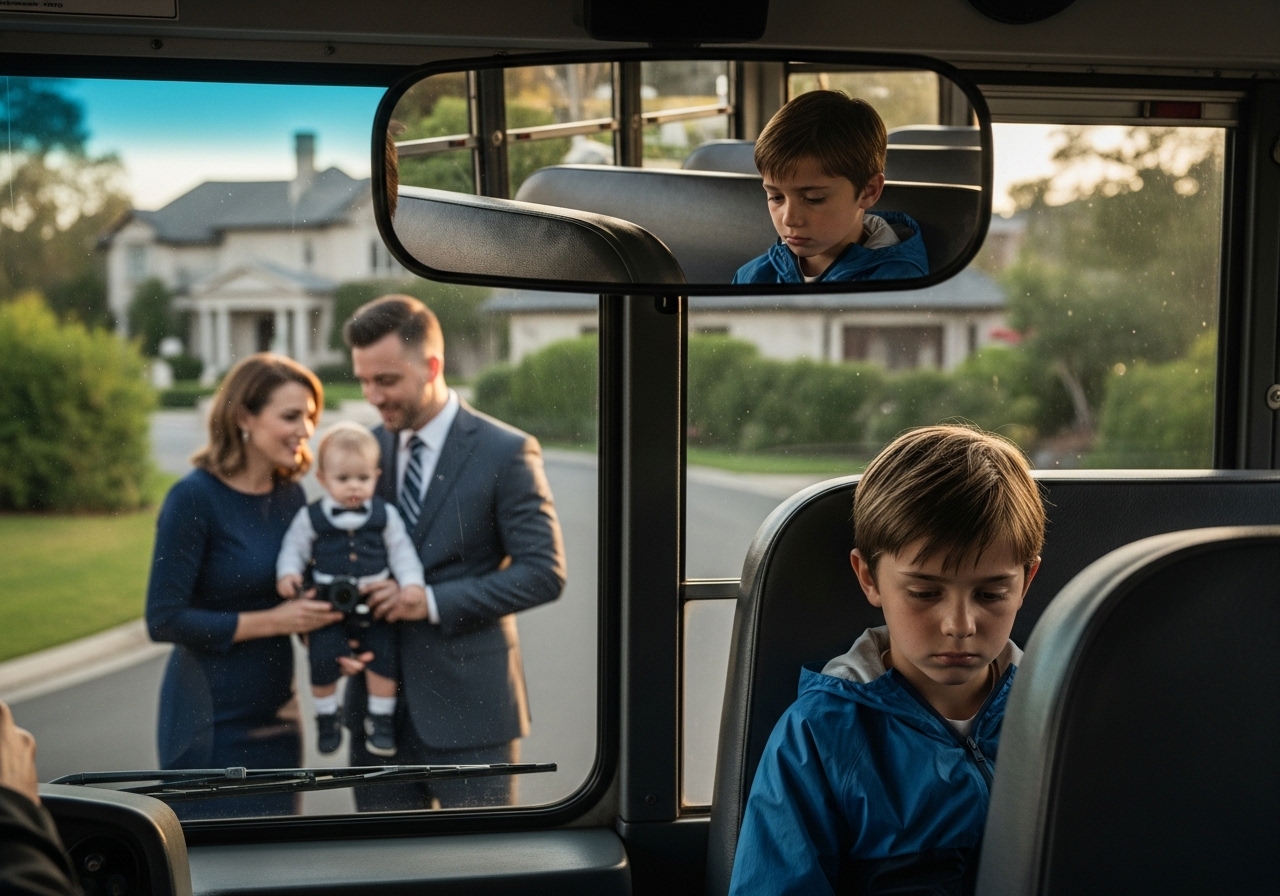
As the bus pulled away, Betty looked in the rearview mirror. She saw Leo reach into his pocket and pull out something small—a packet of saltine crackers. He nibbled on them like a terrified mouse.
Stealing from the cafeteria, Betty thought, her grip tightening on the steering wheel. Again.
That afternoon, Betty decided to do a “drive-by.” She finished her route, parked the bus at the depot, and got into her rusty Buick. She drove back to the Sterling neighborhood.
She told herself she was just being a nosy old woman. But her gut told her something was rotting in that big, beautiful house.
She pulled up across the street just as a photography van arrived. A team of people hopped out, carrying lights and cameras.
Betty rolled down her window. She watched as Mark and Jessica came out onto the front porch. They were dressed in matching burgundy cashmere sweaters. Little Brody, the toddler, was dressed like a miniature prince in a thick wool coat and a cute beanie.
They posed on the porch steps, surrounded by fake snow and evergreen garlands. They laughed. They hugged. They looked like a magazine cover.
Betty scanned the windows. Where is the boy?
Then she saw him.
In the side window of the house—the garage window—a small face was pressed against the glass. Leo. He was watching his family take their Christmas portrait without him.
A neighbor, Mrs. Higgins, was walking her dog and stopped to chat with Mark. Betty strained her ears to listen.
“Beautiful family, Mark!” Mrs. Higgins chirped. “But where’s the older one? Leo?”
Mark didn’t even flinch. He flashed a dazzling, practiced smile. “Oh, Leo? He’s… away at a behavioral camp for the holidays. He’s been having some… issues. Aggression, you know? It’s better for everyone if he’s in a structured environment.”
“Oh, you poor things,” Mrs. Higgins cooed. “It takes a saint to adopt these days.”
“We do our best,” Jessica sighed, clutching Brody tighter. “We just want him to get help.”
Betty felt bile rise in her throat. She looked back at the garage window. The face was gone.
“Camp, my foot,” Betty growled. She put the car in gear. She knew the look of a child who was being erased. She had seen it before, and she wasn’t going to let it happen on her watch.
Chapter 3: The Disposal
Christmas Eve was two days away, and a blizzard was hammering the East Coast. The snow was falling so thick and fast that the streetlights looked like hazy smears in the whiteout.
Inside the Sterling house, the atmosphere was tense.
“It’s done,” Mark said, closing his laptop. He took a sip of scotch. “I found a couple in Nebraska. They live off the grid. They take… difficult cases.”
Jessica was wrapping presents for Brody—a mountain of toys. “Do they ask questions?”
“No,” Mark said. “It’s a private re-homing forum. We just sign a power of attorney, drive him to a meeting point, and he’s their problem. We can tell the neighbors he’s staying at the school permanently.”
“Good,” Jessica said, cutting a piece of tape. “He’s ruining the vibe, Mark. Brody cries every time he sees him. It’s not fair to our real son to have that… darkness in the house.”
Downstairs, Leo was shivering. The basement had no heat. He had wrapped himself in the thin mattress cover, but the cold was seeping into his bones.
He needed water. The utility sink was broken; the pipe had frozen.
He crept up the stairs. He knew the rule: Don’t come up. But his throat felt like it was filled with sand.
He opened the door a crack. The house was warm. It smelled of cinnamon and pine. He slipped into the hallway, heading for the kitchen tap.
“What are you doing?”
Leo jumped. Jessica was standing there, holding a roll of wrapping paper like a weapon.
“I… I needed water,” Leo stammered.
“You’re tracking filth onto my hardwood floors!” Jessica shrieked. She grabbed his arm. Her fingernails dug into his skin. “I told you to stay down there!”
“I’m thirsty!” Leo cried out.
“Get out!” Jessica snapped. She dragged him to the back door—the one leading to the patio. “You want to cool off? Go outside. Maybe that will teach you to listen.”
She shoved him out into the snow and slammed the sliding glass door.
Leo spun around, banging on the glass. “Mommy! Please! It’s cold! I don’t have my shoes!”
Mark walked into the kitchen. “What’s the noise?”
“He’s throwing a tantrum,” Jessica said, turning the lock on the door. “Let him sit out there for five minutes. He needs to learn.”
Mark glanced at the boy in the snow, wearing only ragged sweatpants and a t-shirt. He shrugged. “Don’t let him in until he stops crying. I don’t want to hear it.”
Five minutes turned into twenty. The snow piled up on Leo’s bare feet. He stopped banging on the door because his hands were too numb to feel the glass. He curled into a ball on the welcome mat, the snow quickly burying him.
He closed his eyes. He didn’t feel cold anymore. He felt sleepy. Maybe this is the camp, he thought. Maybe I’m going to sleep now.
A pair of headlights cut through the storm.
Betty Gable was driving her Buick. She shouldn’t have been out. The roads were treacherous. But she had a feeling. A gnawing, terrible feeling that had kept her awake. She told herself she was just going to the 24-hour pharmacy, but she found herself turning onto the Sterling’s street.
She drove slowly, squinting through the windshield.
She saw the house. The windows were glowing warmly. And then, she saw the lump on the back patio. The house was on a corner lot, and the back porch was visible from the side street.
“What in the world…”
Betty stopped the car in the middle of the road. she threw the door open and ran. The wind nearly knocked her over.
She vaulted the low garden fence. She reached the lump. She brushed the snow away.
“Leo!”
He was blue. His lips were white. His eyes were half-open, staring at nothing.
“Oh, dear God,” Betty gasped. She ripped off her heavy down coat and wrapped it around him. He was light, so terrifyingly light. She scooped him up in her arms.
She didn’t run to her car. She marched to the sliding glass door.
Inside, she could see Mark and Jessica sitting on the sofa, drinking wine and watching TV.
Betty didn’t knock. She picked up a heavy cast-iron patio chair and smashed it through the glass door.
Chapter 4: The Eraser
The sound of shattering glass exploded through the living room. Jessica screamed, dropping her wine glass. Mark jumped up, his face pale.
“What the hell—”
Betty stepped through the broken door, wind and snow swirling around her, looking like an avenging angel in a flannel shirt. She held the semi-conscious boy in her arms.
“You monsters,” Betty hissed. Her voice was low, dangerous. “You absolute monsters.”
“He… he ran away!” Jessica stammered, backing up. “We were looking for him!”
“Liar!” Betty roared. “The door was locked! I saw you watching TV! You left him to die like a dog!”
“Get out of my house!” Mark shouted, trying to muster some authority. “I’m calling the police!”
“You better call them,” Betty spat. “Because if you don’t, I will. And I’m not leaving until they see this.”
She sat down on their expensive cream sofa, dirty snow boots and all, and pulled Leo tight against her chest, rubbing his arms vigorously. “Stay with me, Leo. Stay with Betty.”
The police arrived ten minutes later, along with an ambulance.
The scene was chaotic. Mark was trying to charm the officers, speaking in his ‘reasonable businessman’ voice.
“Officer, the woman is crazy. She broke into our home. Our son, Leo, has severe behavioral problems. He runs outside. We try to stop him, but—”
The officer, a young man named Davis, looked at Mark. Then he looked at the paramedics working on the blue-lipped boy on the sofa. Then he looked at Betty.
“He didn’t run away,” Betty said, her voice shaking with rage. She reached into her purse and pulled out a small, battered notebook. “I’ve been tracking it. For three months. September 12th: Leo came to school with a black eye. Said he fell. October 4th: Leo fainted in gym class from hunger. November 10th: Leo wearing summer clothes in freezing rain.”
She threw the notebook at Mark’s feet. “Read it.”
“This is harassment,” Jessica shrieked. “He’s not even her kid!”
“Officer,” Betty said, ignoring her. “Check the basement.”
“Why?” Officer Davis asked.
“Just check it.”
Officer Davis went downstairs. He was gone for two minutes. When he came back up, his face was hard as stone. He wasn’t looking at Mark with respect anymore. He was looking at him like he was garbage.
“You kept a child in that?” Davis pointed to the basement door. “There’s no heat. There’s a bucket for a toilet.”
“We’re renovating!” Mark argued, sweat beading on his forehead.
“I found this,” Davis said. He held up a sheaf of papers. They were old receipts, scraps of mail. On the back of them were drawings.
One drawing stood out. It was done in pencil. It showed four stick figures. A big man, a big woman, a small baby. And a fourth figure—a boy. But the boy was drawn faintly, and then aggressively erased. Smudged out until the paper was nearly torn.
Underneath, in messy handwriting, it read: Sorry I am extra.
The silence in the room was deafening.
Officer Davis walked over to Mark. He pulled out his handcuffs. “Turn around. Hands behind your back.”
“You can’t do this!” Jessica screamed as a female officer grabbed her arm. “We’re good parents! Look at Brody! Look at this house!”
“We’re looking,” Betty said, holding Leo’s hand as the paramedics lifted him onto the gurney. “We see everything now.”
As Mark was shoved toward the door, his laptop—which had been sitting open on the coffee table—buzzed. A notification popped up on the screen, visible to everyone.
New Message from Re-Home-Underground: Regarding ‘Subject L’. We have a buyer willing to take him tomorrow. Price: Free.
Officer Davis looked at the screen. He looked at Mark with pure disgust. “Attempted trafficking,” he muttered. “You folks are going away for a long, long time.”
Chapter 5: The Permanent Spot
Six months later.
The Virginia summer was in full swing. Cicadas buzzed in the trees, and the air smelled of cut grass and honeysuckle.
Betty Gable’s backyard was not manicured like the Sterlings’. It was wild and colorful, full of unruly tomato plants, sunflowers that touched the sky, and a sprinkler that swept back and forth across the lawn.
Leo was running through the water.
He looked different. The hollow cheeks were filled out. His skin was tanned, not gray. He was wearing bright red shorts and a superhero t-shirt that fit him perfectly.
He ran through the spray, shrieking with laughter—a real, belly-shaking laugh that sounded like music to Betty’s ears.
She sat on the back porch, snapping beans into a bowl. She had fought hard for this. The court battle had been messy. The Sterlings were in prison, awaiting trial on multiple felony counts. But the system wanted to put Leo in a group home.
Betty had refused. She cashed in her retirement. She hired a lawyer. She pestered the judge until he relented. Kinship doesn’t always mean blood, she had told the court. I found him. He’s mine.
“Betty! Watch this!” Leo yelled. He did a clumsy cartwheel on the wet grass, landing on his butt.
“I give it a ten!” Betty shouted, clapping.
Leo ran over, dripping wet, and hugged her. He didn’t flinch anymore when she raised her hand. He didn’t hide food under his pillow anymore.
“Go get dried off,” Betty said, brushing wet hair from his forehead. “We have an appointment.”
“Doctor?” Leo asked, his face falling.
“No. Something better.”
Twenty minutes later, a photographer arrived. Not a fancy team with lights, but a young woman with a kind smile.
Betty had put on her best floral dress. She dressed Leo in a crisp button-down shirt and khakis.
“Okay,” the photographer said. “Just sit on the swing. Put your arm around her.”
Leo sat next to Betty on the porch swing. He hesitated. He looked at the camera lens, and for a split second, the shadow returned to his eyes. The fear of being cropped out. The fear of being the “extra” one.
“Betty?” Leo whispered.
“Yeah, kid?”
“Is this for the newspaper?”
“No,” Betty said. She reached out and pulled him close, her arm solid and heavy around his shoulders. “This is for the living room wall. Right in the center. Where the TV used to be.”
Leo looked up at her. “The center?”
“That’s right,” Betty said, looking him dead in the eye. “Nobody gets cropped out of this family, Leo. Nobody gets erased. You’re the picture. You understand?”
Leo looked at the camera. The fear evaporated. He leaned his head onto Betty’s sturdy shoulder. He didn’t just smile with his mouth; he smiled with his whole face.
Click.
The flash went off. It captured a moment of pure, undeniable truth. A boy who had been thrown away, and the woman who had caught him.
It was the most beautiful picture Betty had ever seen.