THE GIRL IN THE KILL ZONE: I Broke Protocol To Save Her, And It Cost Us Everything.
PART 1
Chapter 1: The Ghost District
The heat in Fallujah isn’t just a weather condition; it’s an enemy combatant. It’s a physical weight that sits on your shoulders, pressing down on your Kevlar, trying to drive you into the dirt. It was 115 degrees in the shade, but there was no shade in District 3. There was only rubble, dust, and the blinding glare of the sun bouncing off shattered concrete.
We called this sector “The Graveyard,” not because of the bodies, but because of the buildings. Everything here was dead. The shops were gutted skeletons. The apartment blocks were hollowed-out husks, their facades ripped away by tank rounds and airstrikes, exposing the intimate lives of the people who used to live there—a couch hanging off a precipice, a child’s bike crushed under a slab of roof.

My squad, Lima-6, was moving in a staggered column formation, hugging the walls. We were five days into a patrol that was supposed to last twelve hours. We were exhausted, smelled like ammonia and unwashed bodies, and our nerves were frayed like old rope.
“Watch your intervals,” I whispered into the comms. My throat felt like I’d swallowed a handful of glass.
“Copy, Sergeant,” Miller replied. Miller was my point man, a kid from Ohio who looked like he should still be bagging groceries, not clearing rooms in the most dangerous city on earth. But he had eyes like a hawk and instincts that had saved my life twice already.
We were hunting a ghost. Intelligence reports claimed a high-value target, a bomb-maker known as “The Engineer,” was operating out of a basement in this grid. But so far, we hadn’t seen a soul.
That was the problem.
In a city of 300,000 people, emptiness is terrifying. When the locals vanish, it means they know something you don’t. It means the hammer is about to drop. The streets were too quiet. No cars. No prayer calls. No stray dogs barking. Just the crunch of our boots on broken glass and the rhythmic heavy breathing of the men behind me.
We reached the corner of what used to be a market. Now, it was a cratered wasteland. I signaled for a halt. We took a knee, weapons scanning the high ground.
“I don’t like this, Sarge,” Miller murmured, keeping his rifle trained on a dark window across the street. “It’s too quiet. It feels staged.”
“I know,” I said, wiping sweat from my eyes. “Keep your head on a swivel. If it feels wrong, it is wrong.”
That was the rule. Intuition in war isn’t magic; it’s your subconscious processing a thousand tiny details your conscious mind misses. The lack of trash on a specific patch of road. The way the birds aren’t flying. The fresh dirt on an old pile.
We were sitting in a pressure cooker, waiting for the lid to blow.
Chapter 2: The Voice in the Dust
I was checking my map, trying to figure out our next waypoint, when the sound cut through the dead air.
“Sir?”
My head snapped up. Behind me, I heard safety catches click off. Every barrel in the squad swung toward the open street.
“Contact front?” Miller hissed, his voice tight.
“Hold fire,” I ordered. “I don’t see a target.”
We waited. ten seconds. Twenty seconds. The silence rushed back in, heavier than before. Had I imagined it? Heat exhaustion can make you hear things. It can make you see things.
Then, it came again.
“Sir… help?”
It was faint, barely a whisper, carried on a gust of hot wind. It was high-pitched. Trembling.
“That’s a kid,” whispered Corporal Davis, my heavy gunner. “Sarge, that’s a little girl.”
I brought my ACOG scope up to my eye. The sound was coming from a mound of debris about forty yards away, right in the middle of the intersection. It was a kill box—a perfect intersection where four streets met. Anyone who walked out there would be visible from thirty different windows.
“I see movement,” I said, my pulse spiking.
From a gap in the concrete slabs, a hand emerged. It was small, caked in gray dust, the fingers splayed wide. It clawed at the air, desperate and weak.
“Sir…”
The voice broke on the last word, turning into a sob.
The squad shifted uneasily. We were Marines. We were trained to kill, to destroy, to advance. But we were also Americans. We were raised on the idea that you protect the weak. You don’t leave a child buried in a hole.
“We gotta go get her,” Davis said, starting to rise.
“Get down!” I barked, grabbing his shoulder strap and yanking him back into the dirt. “Use your head, Marine. Look at where she is.”
“She’s buried, Sarge!”
“She’s in the exact center of the intersection,” I said, forcing my voice to stay calm. “Why is she there? Why is she alive? We leveled this block three days ago. If she was buried then, she’d be dead. If she’s there now, someone put her there.”
The realization hit the squad like a physical blow.
“Bait,” Miller said, his face paling.
“It’s a trap,” I agreed. “Classic ambush. They put a kid out there, wait for us to play hero, and then detonate an IED or open up with snipers. They want us to walk out there.”
“So we just leave her?” Davis asked, looking at me with horror. “We just watch her die?”
The hand waved again, slower this time. “Water… please…”
That one word—water—hit me in the gut. I have a daughter back in Texas. She’s seven. The same age that voice sounded. I imagined my daughter, buried in the dark, thirsty, terrified, calling out for her dad, and having a group of men watch her die because they were afraid.
I looked at the kill zone. I looked at the windows. I looked at the hand.
“Sarge?” Miller asked.
I knew the protocol. The protocol said you call EOD (Explosive Ordnance Disposal). You call for a robot. You wait four hours for clearance. By then, she’d be dead, or the sun would be down and we’d be blind.
“I’m going,” I said.
“Sarge, you can’t,” Miller said. “It’s suicide.”
“I’m going,” I repeated, shedding my assault pack to lighten my load. “Miller, Davis, set up a base of fire. Watch the rooftops on the south side. If anything—anything—pops up, you turn it into sawdust. Jones, get on the radio, call for a QRF (Quick Reaction Force).”
“Sarge…”
“That’s an order,” I snapped. I checked my rifle. I checked my sidearm.
I looked at the open street. It was only forty yards. A ten-second sprint. Or a lifetime.
“Cover me,” I said.
I stood up, left the safety of the wall, and stepped into the Annihilation Zone.
PART 2
Chapter 3: The Longest Walk
The moment my boot hit the asphalt of the intersection, the atmosphere changed. It felt like the air pressure dropped. I was no longer a hunter; I was prey. I could feel the eyes on me. Hundreds of dark windows, jagged holes in walls, ventilation shafts—any one of them could be housing the barrel of a Dragunov sniper rifle.
I didn’t run. Running triggers the predator instinct. If you run, they shoot. I walked. I kept my weapon tight in my shoulder, scanning, moving with a deliberate, fluid pace.
One step. Scan left. Two steps. Scan right.
My heart was beating so hard I could hear the blood rushing in my ears, drowning out the wind. Every instinct in my body was screaming at me to dive for cover, to curl up in a ball. My brain was flashing images of my wife, my daughter, my front porch.
Don’t think about home, I told myself. Stay here. Stay in the dirt.
“Twenty yards, Sarge,” Miller’s voice came over the earpiece. “We have eyes on the high ground. Nothing moving yet.”
“Copy,” I whispered.
The hand in the rubble had stopped moving. That terrified me more than the sniper threat. Had she passed out? Had she died in the thirty seconds it took me to decide?
I got closer. The smell hit me then. It wasn’t just dust. It was the smell of decay, mixed with something sweet—maybe spilled fuel.
I reached the edge of the rubble pile. It was a crater, caused by a 500-pound bomb some weeks ago. The concrete slabs were piled like a house of cards.
“I’m here,” I said, my voice sounding strange and loud in the open. “I’m here, sweetheart. Don’t move.”
I peered over the edge of the slab.
My stomach dropped.
It wasn’t a simple burial. It was a nightmare construction. There was a small cavity under the slab, a pocket of air. Inside, a young Iraqi girl, maybe eight years old, was pinned. Her legs were crushed under a steel beam. Her face was caked in blood and dust, her eyes wide with a terror that looked almost animalistic.
But that wasn’t what made me freeze.
Duct-taped to her chest was a black box with wires running down to a pressure plate beneath the beam that pinned her. And in her hand—the hand she had been waving—was a deadman’s switch. A trigger.
If she let go, it blew. If I moved the beam, it blew.
She looked at me, her eyes locking onto mine. She didn’t speak. She just held that trigger, her knuckles white.
“Sarge?” Miller asked in my ear. “Status?”
I stared at the wires. I stared at the girl.
“Trap,” I whispered. “It’s a live rig. She’s the detonator.”
Chapter 4: The Engineer’s Joke
“Back away, Sarge. Now.” Miller’s voice was urgent. “Get out of there.”
I couldn’t move. The girl was looking at me. She wasn’t crying anymore. She was trembling, her thumb slipping on the plastic switch. If that switch clicked, we would both be vaporized.
“What’s your name?” I asked her in broken Arabic. “Shoo is-mik?”
She blinked, tears cutting tracks through the dust on her cheeks. “Nour,” she whispered.
“Okay, Nour. I’m going to help you. Look at me. Don’t look at the box.”
I knelt down. This was insane. I was kneeling in the open, in the middle of a kill zone, trying to disarm a human bomb while a sniper was probably laughing at me through a scope.
Why hasn’t he shot me yet?
The question nagged at me. If this was a trap, the shooter should have dropped me the moment I stopped moving. Why wait?
Unless…
Unless the sniper wasn’t the threat. Unless the bomb was the show.
“Miller,” I said into the comms. “Do not fire unless you take contact. I’m going to try to neutralize the switch.”
“Sarge, EOD is twenty mikes out. Wait for the robot.”
“She can’t hold it that long, Miller! Look at her hand. She’s fading.”
Nour’s head was drooping. She was going into shock. If she passed out, her grip would relax, and the circuit would close.
I reached out and gently placed my hand over hers. Her skin was burning hot. My large, gloved hand completely engulfed her tiny, dusty fist.
“I’ve got you,” I said. I squeezed her hand, clamping her thumb down on the button. “I’m holding it now. You can relax.”
She looked at me, confusion in her eyes. She didn’t understand the English, but she understood the tone. She relaxed her grip slightly. I took the tension.
Now I was the one holding the bomb.
I looked at the wiring on her chest. It was complex. Red, blue, yellow. It wasn’t a hasty job; it was the work of a professional. The Engineer.
I pulled my multi-tool from my vest with my free hand. I had to cut the power source before I could move the beam.
CRACK.
The sound of the gunshot arrived a split second after the bullet impacted.
Dust exploded inches from my face. A sniper round slammed into the concrete slab right next to my head.
“CONTACT!” Miller screamed. “Taking fire! North side, third floor!”
The world erupted.
My squad opened up. The roar of the SAW (Squad Automatic Weapon) tore through the silence. Bullets chewed up the facade of the building across the street.
I flinched, curling my body over Nour to shield her. Another round pinged off the rebar above us.
“Sarge! You’re pinned! Pop smoke!”
I couldn’t pop smoke. I couldn’t reach my grenades. I had one hand clamping a bomb trigger and the other holding a knife. I was a sitting duck.
“Suppress him!” I yelled. “Give me thirty seconds!”
The air around me turned into a hornet’s nest of snapping bullets and flying concrete. I looked down at the wires. My hands were shaking.
Red or blue? It’s always the cliché. But in real life, the colors don’t mean anything. You have to trace the detonator.
I traced the yellow wire. It went to the battery pack. If I cut it, the circuit should die. Unless it was a collapsing circuit, in which case cutting it would detonate the vest.
The girl, Nour, screamed as the noise of the battle intensified. She tried to thrash.
“No! No! Stop!” I yelled, pinning her down with my forearm. “Don’t move!”
I looked at the battery. It was a 9-volt. Simple.
I took a breath. The sniper rounds were getting closer. He was dialing in. The next one would go through my back.
I clamped the wire cutters around the yellow wire.
“Forgive me,” I whispered.
I squeezed the pliers.
Snip.
Chapter 5: The Impossible Math
I squeezed my eyes shut. I waited for the heat. I waited for the pink mist.
One second. Two seconds.
Nothing.
I opened my eyes. The little light on the black box on Nour’s chest had gone dark. The circuit was dead. I let out a breath that sounded like a dying animal. I had guessed right. Or maybe I had just gotten lucky. In war, there’s no difference.
But the celebration lasted exactly half a second.
THWACK.
A bullet smashed into the concrete slab right next to my ear, spraying sharp stone fragments into my cheek. The sniper wasn’t stopping. He was adjusting for windage. He had me dialed in.
“Sarge! We can’t hold them down!” Davis screamed over the radio. “We’re taking RPG fire from the east! You need to move!”
“I can’t move!” I yelled back, not bothering with the radio, just screaming into the dusty air. “She’s still pinned!”
I grabbed the steel beam crushing Nour’s legs. It was an I-beam, part of the building’s collapsed skeleton. It probably weighed four hundred pounds.
“Nour, I’m going to pull you,” I gritted out. “This is going to hurt.”
She looked at me, her dark eyes wide with shock. She didn’t nod. She just stared.
I wedged my shoulder under the beam and pushed. I pushed with everything I had. I pushed until I felt the veins in my neck bulge and my vision went starry. The beam groaned. It shifted maybe an inch.
It wasn’t enough.
“AGHH!” Nour screamed as the metal shifted on her crushed bones.
I dropped the beam. It was too heavy. I was strong, but I wasn’t Superman. I looked at the distance to safety. Forty yards. It might as well have been forty miles.
I was stuck in the open with a wounded child, a disabled bomb, and a sniper who was taking his sweet time dissecting me.
Then, I saw movement in my peripheral vision.
“Miller! No!” I screamed.
Miller had left the wall. He wasn’t in cover. He was sprinting across the open intersection, zig-zagging like a madman, bullets kicking up dust at his heels.
“Get back!” I roared.
He didn’t listen. He dove into the crater, sliding in the dirt next to me. He was panting, his eyes wild.
“You needed a lift, Sarge?” he grinned, though his face was pale as a sheet.
“You idiot,” I said, grabbing his vest. “You insubordinate idiot. You’re going to get killed.”
“We’re already dead if we stay here,” Miller spat, grabbing the other end of the beam. “On three. One. Two. THREE!”
Chapter 6: Running Through Hell
We heaved. The adrenaline of imminent death is a powerful drug. We roared, straining against the steel, our boots slipping in the blood and dust.
The beam lifted. Four inches. Six inches.
“Pull her!” Miller screamed at me, holding the weight of the world on his shoulders. “Pull her out, Sarge!”
I let go of the beam with one hand, grabbed Nour by the back of her shirt and her belt, and yanked. She came free, sliding out of the hole like a ragdoll.
“Drop it!”
Miller let the beam slam back down. The ground shook.
“She’s clear!” I yelled. “Go! Go! Go!”
But the enemy had been waiting for this. The moment we stood up, the ambush went from a simmer to a boil.
An RPG hissed through the air—a distinctive sound like tearing canvas. It slammed into the storefront behind us. The concussion wave knocked me flat. My ears rang with a high-pitched whine that drowned out the world.
I couldn’t hear the gunfire anymore. I could only feel it. I felt the thud of bullets impacting the ground around us. I felt the heat of the explosion.
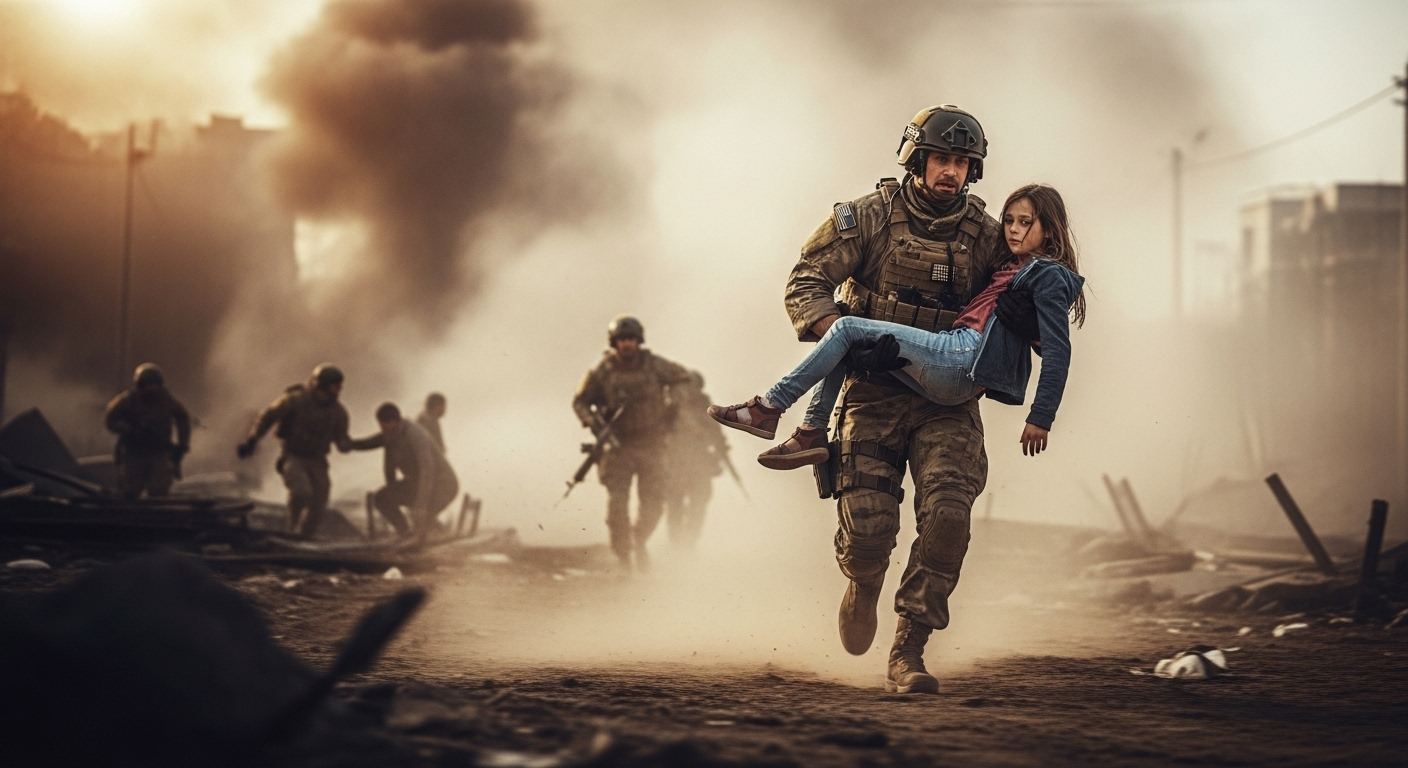
I scrambled up, grabbing Nour. She was light, terrifyingly light. I threw her over my shoulder in a fireman’s carry.
“Move, Miller! Move!” I couldn’t hear my own voice.
We ran.
It’s hard to describe what it’s like to run when you know people are trying to kill you. Your legs feel heavy, like they’re moving through molasses. Your back itches, anticipating the bullet. You feel naked.
I saw the corner of the wall where the rest of the squad was firing. Muzzle flashes were blooming like strobe lights. Davis was standing fully exposed, pouring lead from his machine gun to cover our retreat.
Ten yards.
Dust exploded on my left.
Five yards.
I saw Miller stumble. He jerked forward, like someone had shoved him from behind. But he didn’t fall. He kept pumping his legs, his face twisted in a grimace.
Two yards.
I threw myself and the girl behind the concrete wall. We crashed into the dirt, a tangle of limbs and gear. Miller dove in right behind me, landing hard on his chest.
“We’re clear! They’re clear!” Davis yelled. “Pop smoke! We’re bugging out!”
Purple smoke grenades hissed, filling the street with a thick, opaque cloud. We had cover. We had the girl. We were alive.
I rolled over, gasping for air, checking Nour. She was unconscious but breathing.
“Miller,” I wheezed. “You good? That was… that was crazy.”
Miller didn’t answer.
Chapter 7: The Cost of a Life
Miller was lying on his stomach, his face turned to the side in the dirt. His hands were still gripping his rifle.
“Miller?”
I crawled over to him. I grabbed his shoulder to roll him over.
His gear was slick. My hand came away red. bright, arterial red.
“Medic!” I screamed. The sound tore from my throat, raw and primal. “DOC! GET UP HERE!”
We rolled him over. The bullet had found the gap. The one inch of vulnerability between the back of his vest and his armpit. It was a sniper round. It had gone straight into the chest cavity.
Miller’s eyes were open, staring up at the blinding white sun of Fallujah. He was trying to speak, but pink froth bubbled at his lips.
“Don’t… talk,” I stammered, pressing my hands over the wound, trying to hold the blood inside him. It was like trying to hold back a river with a sieve. “You’re good, buddy. You’re good. Stay with me.”
Doc was there in seconds, ripping open packages of gauze, his hands moving with practiced, frantic speed.
“He’s losing pressure!” Doc yelled. “I can’t get a seal!”
“Miller, look at me!” I slapped his face lightly. “Eyes on me, Marine! That’s an order!”
Miller’s gaze drifted. He looked at me, then he looked past me, at the little girl lying in the dust nearby.
A faint, weak smile touched his lips.
“She… okay?” he whispered. The words were wet and gurgling.
“She’s fine,” I choked out, tears cutting through the grime on my face. “You saved her, Miller. You did good.”
He nodded, just a fraction of an inch. His grip on my arm tightened, then loosened.
The light in his eyes didn’t fade slowly like in the movies. It just switched off. One second he was Miller, the kid from Ohio who loved bad jokes and old cars. The next second, he was just a body.
The chaos of the battle raged on around us. Gunfire, shouting, the radio squawking. But in that small circle of dirt, there was only silence.
I sat back on my heels, my hands covered in the blood of the man who had just saved my life.
I looked at Nour. She was awake now, watching us with terrified eyes. She didn’t understand the words, but she understood the scene. She saw the blood. She saw the stillness.
She started to cry. Softly at first, then a wailing keen that pierced right through my heart.
Chapter 8: The Weight of the Silence
We got back to the FOB (Forward Operating Base) two hours later. The QRF had come in with Bradleys and cleared the street, but it was too late for Miller.
They loaded Miller’s body bag onto the helicopter first. Then they loaded Nour. She was going to the surgical hospital in Baghdad. She would live. She would lose a leg, but she would live.
I sat on the ramp of the Humvee, smoking a cigarette I didn’t want. My hands were still shaking. I hadn’t washed the blood off yet. I didn’t want to. It felt like betraying him to wash it off.
Captain Hayes walked up to me. He looked tired.
“You did a hell of a thing out there, Sergeant,” he said quietly. “Intelligence says that girl was the daughter of a local sheikh. Saving her might have just bought us some goodwill in this sector. Might save lives down the road.”
I looked at the Captain. I looked at the black body bag waiting on the tarmac.
“It cost us Miller,” I said. My voice was flat. Dead.
“I know,” Hayes said. “That’s the math. It’s ugly math.”
I took a drag of the cigarette.
People back home call us heroes. They watch the movies. They see the flag waving and the music swelling. They don’t see the trade.
They don’t see that to save a stranger’s child, I had to sacrifice my brother.
I thought about the silence in the Annihilation Zone. I thought about how I had walked into that trap because of a voice. A human voice in a dead city.
I closed my eyes and I could still feel Miller’s hand on the beam, lifting the weight I couldn’t lift alone.
I saved the girl. But every time I close my eyes, I don’t see her face. I see Miller’s hand reaching out. Not to ask for help, but to offer it.
War doesn’t have winners. It just has survivors who have to carry the ghosts of the ones who were better than them.
I dropped the cigarette and crushed it under my boot.
“Let’s go home,” I whispered to no one.
But I knew part of me never would. Part of me was still back there, in the dust of District 3, holding a deadman’s switch and praying for a miracle that came with a price tag I couldn’t afford.