He Saw His Sister’s ‘Death Echo’ and Tried to Warn His Family. They Locked Him in His Room to ‘Calm Him Down’.
The snow fell in heavy, wet curtains, muffling the world outside the Miller family’s two-story colonial. It was the kind of deep, dead-of-winter cold that seeped through windowpanes and made the old house groan. Inside, ten-year-old Thomas “Tommy” Miller sat on the floor of his bedroom, his knees drawn to his chest, staring at an empty goldfish bowl.
Tommy was a sensitive boy, quiet and observant, burdened with a secret that felt as heavy as the snow blanketing the neighborhood. He didn’t just see the world; he saw the echoes of its departure.
The first time had been with Sunny, his goldfish. A week ago, he’d come home from school and found a pale, shimmering, translucent version of Sunny, the color of moonlight, hovering in the corner of the tank. The real Sunny, bright orange and very much alive, was swimming circles near the little plastic castle. The “Echo” just watched him. It didn’t swim. It didn’t move. It just watched.
Tommy had run to his mother, Sarah, tugging on her sleeve. “Mom, Sunny has a ghost.”
Sarah, warm and loving but deeply practical, had laughed, a short, tired sound. She was trying to get dinner on the table. “Honey, fish don’t have ghosts. He’s probably just tired. Did you feed him?”
Three days later, Tommy came down to find the real Sunny floating, pale and still, on the surface of the water. The Echo was gone.
The second time was Mrs. Petrov.
His elderly neighbor, a woman of eighty with a garden full of roses, had been weeding her flowerbed in the late autumn chill. Tommy, playing on the lawn, saw it. A pale, silvery Echo of Mrs. Petrov, standing on her own porch, her translucent hands folded, watching her living self dig in the dirt.
He ran inside, his breath catching. “Dad, Mrs. Petrov has a shadow! It’s on the porch, but she’s in the garden!”
His father, David, a good man perpetually stressed about finances, was in the basement. The rattling clang-RUMBLE-clang of their aging furnace punctuated his response. “That’s nice, son,” he’d called up, his voice muffled. “Just… just stay out of her way. Let her work.”
Two days after that, the ambulance came. Mrs. Petrov had passed peacefully in her sleep.
Tommy learned the rule: The Echoes came a few days before. They didn’t talk. They didn’t interact. They just… watched. They were omens, silent and terrifying, and no one believed him. His parents had chalked it up to “anxiety” and “a vivid imagination” after Mrs. Petrov died. They had started talking about therapy again.
Now, the house was filled with the sounds of a normal, chaotic Tuesday night. From the basement, the furnace gave a particularly violent CLANG, followed by David’s muffled curse. “One more winter, you piece of junk,” he muttered, loud enough to be heard through the floor vents. “Just one more.”
“Chloe, for the last time, put that phone down and set the table!” Sarah called from the kitchen.
Chloe, fifteen and surgically attached to her smartphone, sighed the long-suffering sigh of a teenager. “In a second, Mom. I’m just answering…”
“Now, Chloe! Your brother’s already downstairs… Tommy! Dinner!”
Tommy stood up, the memory of Sunny’s pale Echo making his stomach clench. He didn’t want to go down. He didn’t want to face his family, who looked at him with that mixture of love and worried concern. He was the “fragile” one.
He walked down the carpeted stairs, his hand trailing on the banister. The smell of garlic bread and spaghetti sauce filled the air. It was warm. It was normal.
He reached the bottom of the steps. His family was in the kitchen, a bright, warm rectangle of light. Sarah was at the stove, David was leaning against the counter, rubbing his temples, and Chloe was, as always, staring at her phone, her thumbs a blur.
Tommy stopped. His blood didn’t just run cold; it evaporated.
Standing in the kitchen doorway, partially obscuring the refrigerator, was a pale, shimmering Echo. It looked exactly like his sister, Chloe—same hoodie, same messy bun—but it was the color of dust and moonlight. It was perfectly still, its head tilted, its silent eyes fixed on the real Chloe, who was giggling at a text message.
It was watching her.
The glass of water in Tommy’s hand slipped. It shattered on the hardwood floor, the sound impossibly loud, the ice cubes scattering like diamonds.
“Tommy!” David snapped, his stress level already at its peak. “What did I say about running? Clean that up.”
But Tommy couldn’t move. He couldn’t breathe. All he could see was the shimmering, silent phantom in the doorway. He pointed, his finger trembling.
“MOVE!” he shrieked, a raw, primal sound of terror. “CHLOE, GET OUT! GET OUT OF THE KITCHEN!”
The entire family froze. Chloe dropped her phone. Sarah spun around, the wooden spoon clattering.
“Tommy, what in God’s name—” David started.
“GET OUT!” Tommy screamed again. He grabbed his sister’s arm, yanking her with a strength he didn’t know he possessed. He pulled her back, into the dining room, stumbling over the broken glass.
Chloe ripped her arm away, her face a mask of shock and teenage fury. “What is wrong with you? You’re a total psycho!”
“Tommy, stop it! You scared her half to death!” Sarah cried, rushing over.
David grabbed Tommy by the shoulders, his face stern. “Thomas. That is enough. Apologize to your sister.”
“No! No, you don’t understand!” Tommy was sobbing now, his body shaking. “I saw her shadow! The one like Mrs. Petrov! It was right there! It was in the kitchen, and it was watching her!”
The room went dead silent. Chloe’s anger faded, replaced by a creeping unease. David and Sarah shared a look—not of belief, but of a deep, familiar, and profound concern. It was the look that meant Tommy wasn’t “just being a kid.” It was the look that meant Dr. Reeves’s phone number was about to be pulled from the fridge.
“Oh, honey,” Sarah said, her voice strained, pulling him into a hug he didn’t want. “There’s nothing there. You just… you startled yourself. You’re overtired.”
“I am NOT!” Tommy pushed away from her. “It was there! She’s going to… she’s going to…” He couldn’t say the word.
“Bed,” David said, his voice flat and final. “Now. You’ve done enough for one night. Go to bed.”
“But Chloe—”
“I’ll be fine, you creep,” Chloe spat, though her voice trembled. “I’ll be fine. You’re just crazy.”
Tommy looked at the faces of his family. His practical mother, his frustrated father, his dismissive sister. They were looking at him, but they weren’t seeing him. They were seeing a problem. A thing to be fixed.
He was a prophet, and they were all deaf.
The next two days were a form of hell. Tommy was grounded for “frightening his sister.” Sarah had, in fact, made an appointment with Dr. Reeves, a child psychologist.
“He’s regressing, David,” Tommy heard her whisper on the phone in the kitchen. “Yes… just like after Mrs. Petrov… He’s having visions again. He’s so anxious…”
David, for his part, tried the “fix-it” approach. He sat Tommy down. “Look, son. There are no such things as shadows. Or Echoes. Or whatever you’re calling them. It’s not real. Your brain is playing a trick on you. You’re scaring your sister, and you’re scaring your mother. You have to stop.”
“But Dad, it’s real,” Tommy insisted, his voice small.
“No,” David said, his frustration rising. “It’s not. And I don’t want to hear another word about it. Is that clear?”
It was clear. No one would help. He would have to save Chloe himself.
Tommy became his sister’s shadow, a ten-year-old guardian angel with a terrified expression. He watched her constantly. The Echo hadn’t left. It was still there, always in the kitchen, always watching.
This new, obsessive behavior was, to his family, confirmation of his instability.
He followed Chloe to the bathroom. He saw her plug in her hairdryer, the cord dangling perilously close to the water-filled sink. His heart seized. Fire. Water. Electricity.
He lunged forward and ripped the plug from the wall.
“MOM!” Chloe screamed, clutching her towel. “Get him out of here! He’s a creep!”
Later, he found her in her bedroom, a new scented candle lit on her nightstand. He saw the flame, saw the curtains nearby. Fire. That’s it. He grabbed the candle, ran to the bathroom, and doused it under the faucet, the hot wax hissing.
“TOMMY!” Chloe was apoplectic. “That was new! Dad, he’s destroying my stuff! He’s a freak!”
The family conflict had reached a boiling point. Tommy was a “creep,” a “weirdo,” a “baby.” He was isolated, watching as the person he was trying to save grew to hate him more and more, all while his parents scheduled his mental evaluation.
He was exhausted. He hadn’t slept in two days. He was failing.
That night, he lay in his bed, staring at the ceiling. The house was quiet. He just needed to check one more time. He needed to see if the Echo was still there.
He crept out of his room. The hallway was dark, the only light a dim nightlight near the stairs. He tiptoed down.
He peeked around the corner into the kitchen.
His heart, which he thought couldn’t possibly beat faster, slammed against his ribs.
The Echo of Chloe was still there, by the refrigerator, silent and watchful.
But it was no longer alone.
Standing by the stove, her pale form shimmering in the dark, was the Echo of his Mother.
And standing by the back door, his arms crossed, was the Echo of his Father.
A cold, suffocating dread, far worse than anything he had felt before, washed over him. He staggered back, his hand over his mouth.
He realized his mistake. He had been so focused on Chloe, he hadn’t understood. The danger wasn’t for Chloe. It was for all of them.
He looked at the three silent, shimmering figures. They weren’t looking at their living counterparts, who were asleep upstairs.
All three Echoes, in perfect, terrifying unison, were staring at the basement door.
Tommy didn’t just scream. He howled.
He flew up the stairs, a primal wail ripping from his throat. He burst into his parents’ bedroom, flipping on the light.
“THEY’RE HERE! THEY’RE HERE FOR ALL OF YOU!”
Sarah sat bolt upright, clutching her chest. “Tommy! My God!”
“THE SHADOWS! THEY’RE IN THE KITCHEN! MOM’S SHADOW! DAD’S SHADOW! THEY’RE ALL LOOKING AT THE BASEMENT!”
David, jolted from a deep sleep, was at the end of his rope. This wasn’t anxiety. This was a complete breakdown. He had tried to be patient. He had tried to be rational. He was done.
“That’s it!” he roared, climbing out of bed. His face, usually kind, was dark with anger and exhaustion. “I have had it! You are hysterical, and you are scaring your mother to death!”
He grabbed Tommy by the arm. “No! Dad, you have to listen!” Tommy cried, struggling.
“You’re going to your room, and you’re going to stay there!” David dragged him down the hall.
“NO! PLEASE, DAD! IT’S THE BASEMENT! IT’S THE FURNACE!”
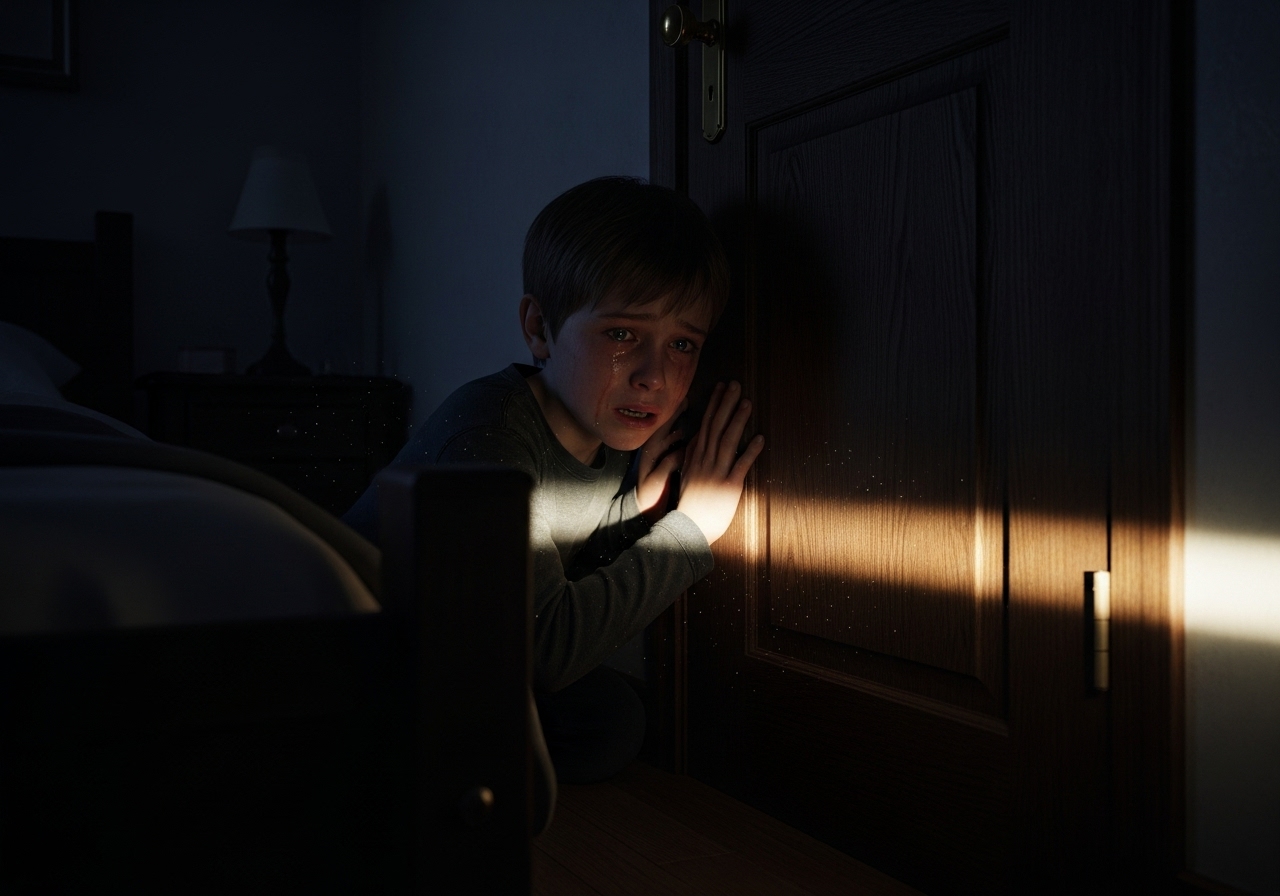
“You will stay in here, and you will calm down!” David pushed him into his bedroom. Tommy tried to run back out, but David was stronger. He pushed the boy back, closed the door, and with a heavy sigh, he turned the simple key lock on the outside.
Click.
The sound of the lock was a final, terrible betrayal.
Tommy slammed his fists against the door. “NO! DAD! LET ME OUT! PLEASE! YOU’RE ALL GOING TO DIE!”
“When you are calm, Thomas, we will let you out!” David called through the door, his voice shaking with a mixture of anger and regret.
Tommy heard his father’s footsteps recede. He heard him go back to his room, heard his parents’ muffled, worried voices. Then, silence.
He was alone. He had failed.
He sank to the floor, sobbing, his face pressed against the cold wood of the door. He sat there for minutes, maybe an hour, lost in a sea of despair.
Then, through his sobs, he smelled it.
It was faint. Oily. Acrid. It was the smell of hot, dusty metal. It was the smell that sometimes came from the floor vents, but this was stronger.
He scrambled to his feet and went to his window. The snow was still falling. He looked down. His window was directly over the side of the house where the basement access was. He saw the rectangular, ground-level basement window. The “DANGER – HOT” sticker on the glass was peeling and bubbled, as if from intense heat.
He looked up, at the roofline directly above the chimney flue.
The entire roof was a blanket of thick, white snow. Except for one patch. A perfect, five-foot-square patch directly over the furnace room. It was melted bare. The shingles were dark and wet, steaming slightly in the frigid air.
The furnace.
The Echoes were right.
He ran back to the door and pounded. “LET ME OUT! IT’S THE FURNACE! IT’S POISON!”
No one answered. They were asleep. Or…
A new, colder terror hit him. What if they weren’t just asleep?
He had to get out. He looked around his room, frantic. His eyes landed on his piggy bank. It was a heavy, ceramic T-Rex.
He didn’t hesitate. He grabbed it, lifted it high, and smashed it on the floor. Ceramic and coins exploded across his carpet. He ignored the mess and grabbed the largest, sharpest shard.
He ran to the door. It was an old, simple lock. He jammed the pointed ceramic shard into the keyhole, twisting and prying. He was crying, his fingers slipping. “Come on, come on…”
The cheap metal mechanism gave. Click.
The door swung open.
He ran into the hallway. The house was silent. Too silent.
“Mom? Dad?” he called.
No answer.
He ran downstairs. The kitchen was empty, save for the three pale, silent Echoes, who all turned their heads to watch him.
He ran to the living room. His family was there. His parents must have been woken by his first scream and come downstairs, only to be lulled to sleep. They were having a “family movie night” to calm down, just as the plot dictated. The TV was on, a forgotten movie playing to an empty room.
Sarah was curled on the love seat. Chloe was sprawled on the rug. David was in his big recliner.
They were all asleep.
“Mom!” Tommy ran and shook her. “Wake up!”
Sarah groaned, a low, thick sound. Her eyes fluttered but didn’t open.
“Dad! Wake up!” He slapped his father’s face.
David’s head just lolled to the side. He was breathing, but it was a shallow, frightening rasp.
They weren’t asleep. They were drowsy. They were being poisoned.
Tommy ran to the basement door and ripped it open. A wave of suffocating, chemical heat blasted him in the face. It wasn’t smoke. It was something worse. It was the smell of incomplete combustion, of deadly, colorless carbon monoxide, pouring into the house. He looked down the stairs. The ancient furnace in the darkness was glowing a dull, cherry red.
He slammed the door shut.
He ran back to the living room. He couldn’t carry them. He couldn’t wake them. The smoke detectors, designed for smoke, were silent.
He was going to die. They were all going to die.
He looked at his sleeping family. He looked at the giant bay window that overlooked the front yard, its glass slick with condensation.
He had one last chance.
He grabbed the heavy, glass centerpiece from the dining room table—a wedding gift, his mother had always said. He lifted it over his head, his small arms straining. He looked at his father, his mother, his sister.
“I’m sorry,” he whispered.
And with all his strength, he hurled it through the bay window.
The sound was a catastrophic explosion. The glass shattered, imploding, then exploding outward. The house alarm, triggered by the vibration, began to shriek.
A wall of frigid, 0-degree air blasted into the room, a life-giving shock of oxygen.
The combination of the sound, the alarm, and the freezing cold did what Tommy couldn’t.
David jolted awake, disoriented, gasping. “Wha—SARAH!”
Sarah and Chloe woke up, screaming, confused.
David’s eyes focused on Tommy, who was standing amid the broken glass, holding his arm. His first, fog-addled thought was not of danger, but of betrayal.
“TOMMY!” he roared, lunging to his feet. “WHAT DID YOU DO?!”
He lunged for his son, his face a mask of pure, unadulterated rage. But as he crossed the room, he was hit by the blast of fresh, clean, freezing air. It cleared his head in an instant.
He stopped. He gagged, the thick, acrid poison in the room suddenly overpowering. His anger vaporized, replaced by a pure, adrenalized terror. He saw the red glow from the crack under the basement door.
“Get out,” he whispered, his eyes wide. He grabbed Sarah. “GET OUT! NOW!”
The family, choking and confused, stumbled out the broken window, collapsing onto the snow-covered front lawn. Neighbors’ lights were flicking on. Sirens, triggered by the alarm, wailed in the distance.
They huddled together, wrapped in blankets provided by a neighbor, as the fire trucks rolled up. A fireman in a full mask and tank went into the house with a detector. He came out a minute later, his face grim.
He walked over to David. “Sir, you’re the luckiest man in this county. The heat exchanger on that old furnace of yours was cracked wide open. It’s been pouring carbon monoxide into this house for… well, for a while. This place was a death trap. Whoever broke that window,” he gestured to the shattered opening, “gave you just enough fresh air to wake up. Another ten minutes… well.”
David and Sarah said nothing. They just turned and looked at Tommy.
He was sitting on the ambulance bumper, a paramedic checking him for cuts.
Sarah’s face crumpled. She wasn’t cold. She was shaking with a grief and a gratitude that was too big for words. David’s “fix-it” mentality was broken, shattered along with the window.
There was no need for “I told you so.” The truth of what had almost happened, of how wrong they had been, was a horrifying, suffocating thing.
They went to Tommy. They didn’t speak. David sat on one side, Sarah on the other. They pulled him between them, holding him so tight he could barely breathe. They were just rocking him, their faces buried in his hair, crying silently into the cold, clean dawn.
As the sun began to rise, painting the snow a pale, icy pink, Tommy looked back at his broken house.
On the front lawn, near the ambulance, he saw them. The three Echoes. His father’s, his mother’s, his sister’s. They were no longer looking at the house.
One by one, they turned their pale, shimmering faces to him. They looked at him, not with malice, or sadness, but with what felt like a silent, simple acknowledgment.
Then, as the first rays of the sun hit the lawn, they faded away.