THE BIKER SAVED ME FROM BULLIES, THEN HANDED ME A BACKPACK HOLDING A SECRET MY MOTHER HAD HIDDEN FOR SIX YEARS
Chapter 1: The Silver Scar
The sound of duct tape tearing is a specific kind of violence when the room is silent. It’s a jagged, screeching rip that announces your poverty to anyone within a fifty-foot radius.
I tried to do it slowly, inch by painful inch, huddled under the fluorescent hum of Mr. Henderson’s homeroom. My backpack, a navy blue canvas relic that had survived my brother before me, was currently on life support. The bottom seam had blown out yesterday, dumping my pre-algebra textbook into a puddle of slush on 4th Street. Last night, my mom had sat at the kitchen table, her eyes ringed with the purple shadows of a double shift, and performed surgery on the bag with the only thing we had: a roll of industrial-grade silver duct tape.
“It’s just for two weeks, Leo,” she’d whispered, smoothing the tape down with hands that smelled of diner bleach and fried onions. “Once I get the overtime pay from the truck stop, we’ll go to the mall. We’ll get you the Nike one. The black one with the air cushion straps. I promise.”
I knew it was a lie. Not a malicious one—Mom didn’t have a malicious bone in her body—but a survival lie. The kind you tell to get through the night. Two weeks would turn into a month. The truck stop shifts would go to paying the electric bill, or the heating oil, or the unexpected dent in the ’04 Corolla.
So, I sat there in the back row, applying a fresh strip of silver tape to the gaping wound in the canvas.
Rrrrrip.
Twenty-five heads turned.
“Nice luggage, Leo,” Kyle Miller’s voice floated from the row behind me. It wasn’t a shout; it was a casual, confident drawl. The voice of a kid who had never worn a hand-me-down in his life. “Is that the ‘Dumpster Diver’ fall collection? I heard it’s big in Europe.”
A ripple of giggles moved through the room like a contagion. I felt the heat climb up my neck, that prickly, suffocating burning sensation that starts at the collarbone and sets your ears on fire. I didn’t turn around. I just pressed the tape harder, my thumbnail digging into the sticky adhesive, willing the bell to ring.
“Leave him alone, Kyle,” whispered Sarah, a girl two rows over. But her defense was weak, half-hearted. Nobody wanted to be in Kyle’s crosshairs.
Kyle kicked the back of my chair. A dull, rhythmic thud.
“I’m serious, man. My dad could hire you to haul our trash. You’ve already got the gear for it.”
Mr. Henderson looked up from his newspaper at the front of the room. He adjusted his glasses, looked directly at me—not at Kyle—and sighed. “Leo, put the arts and crafts away. Class is starting.”
Of course. I was the disruption.
The rest of the day was a blur of anxiety. Every time I stood up, I checked the bottom of the bag. Every time I walked through the hallway, I hugged it to my chest like a bomb that might go off. The tape was holding, but my dignity wasn’t.
By the time the final bell rang at 3:00 PM, my shoulders ached from the tension. I had one goal: get to the yellow bus waiting in the loop without incident. If I could make it to the bus, I was safe. The bus driver, Mrs. Gable, was a terrifying woman with a mustache who didn’t tolerate bullies.
I packed up quickly. I slid my binder in gently, treating the bag like it was made of spun glass. I zipped it up. I stood.
I made it to the double doors leading to the parking lot. The cool autumn air hit my face, smelling of wet asphalt and impending rain. Freedom was fifty yards away.
But predators know the migration routes of their prey.
Kyle was waiting by the bike racks. He was flanked by Mason and Tucker, his two lieutenants. They leaned against the brick wall, backpacks casually slung over one shoulder—pristine North Face bags, stiff and new.
“Hey, Trash-Man,” Kyle called out.
I kept walking, eyes on the pavement. Don’t engage. Don’t stop. Just keep walking.
“I’m talking to you, Leo.”
Kyle stepped into my path. He didn’t shove me; he just existed in my space, forcing me to stop or run into him. I stopped.
“What do you want, Kyle?” My voice sounded thin, reedy.
“I want to help,” Kyle grinned, a shark-like expression that didn’t reach his eyes. “I feel bad. Seeing you walk around with that thing… it’s embarrassing for the whole school. We have standards here.”
He reached out and grabbed the top handle of my backpack.
“Let go,” I said, gripping the straps.
“What’s in here anyway? Your house? Your dinner?” He yanked.
“Stop!”
“Let’s see what trash looks like!”
He pulled hard. I pulled back.
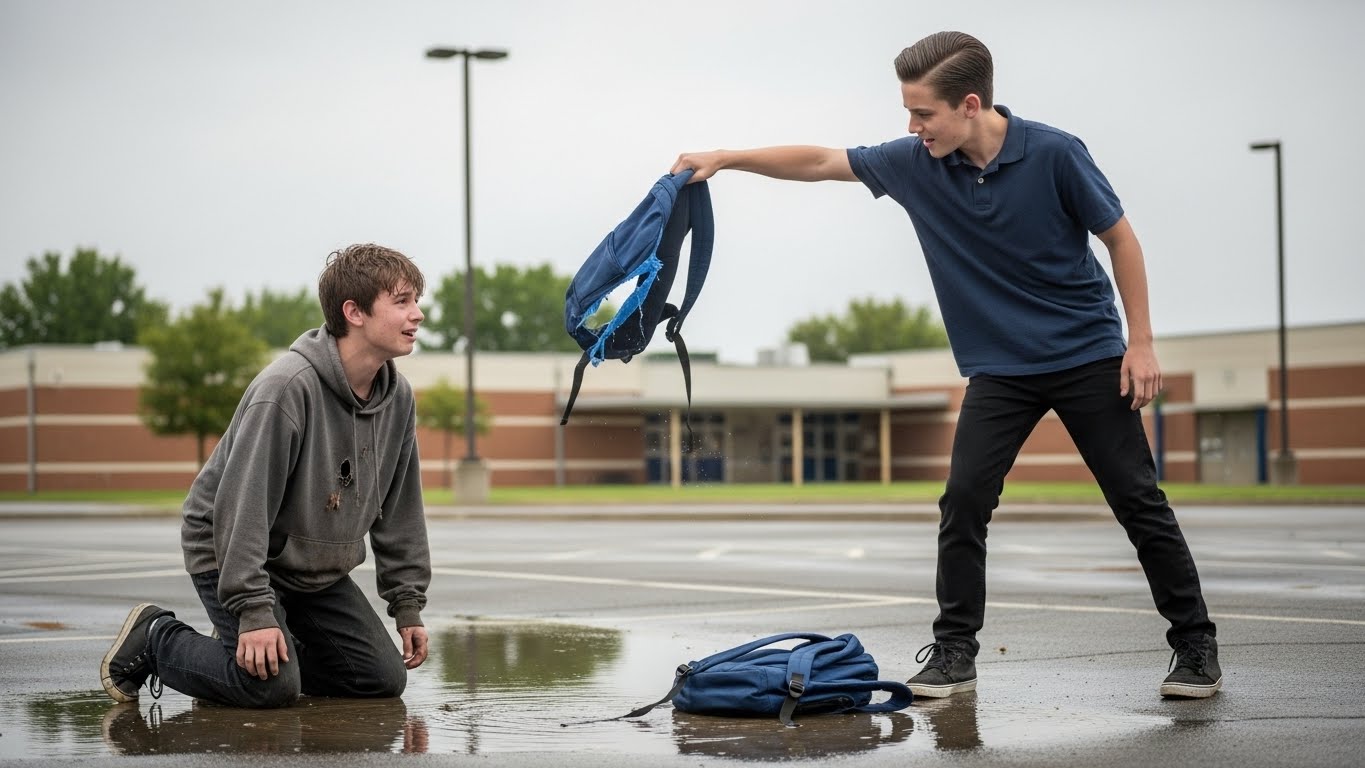
The sound was sickening. It wasn’t the tape this time. It was the rot of the old fabric giving way. The main shoulder strap, worn thin by five years of textbooks and gravity, snapped clean off the body of the bag.
The backpack hit the wet asphalt with a heavy, wet crunch.
The tape split. My binder slid out into a muddy puddle. My pencil case cracked open, scattering cheap blue ballpoints like shrapnel across the sidewalk. My gym clothes—a t-shirt with holes in the armpits—spilled out for everyone to see.
“Oops,” Kyle said, stepping back with mock surprise. “Looks like your garbage finally fell apart. Honestly, I did you a favor.”
Mason and Tucker laughed, a low, cruel sound. A circle of kids had started to form, phones out, recording.
I stood there, staring at my ruined things in the mud. I felt a tear hot and sharp in the corner of my eye. I bit the inside of my cheek until I tasted copper. I would not cry. Not in front of them.
“Pick it up,” Kyle commanded, kicking my history textbook. It slid further into the grime. “Clean up your mess, janitor.”
Chapter 2: The Iron Horse
I dropped to my knees. The cold water from the pavement soaked instantly through the denim of my jeans, chilling me to the bone. My hands were shaking uncontrollably as I reached for the textbook, trying to wipe the grit off the cover with my sleeve.
It was hopeless. The pages were already warping. Mom couldn’t afford a replacement fee.
“Look at him,” Mason sneered. “Begging on his knees. That’s where you belong, Leo.”
I reached for a pen, my fingers slipping in the mud.
That’s when the ground started to vibrate.
It began as a low hum, a resonance that I felt in my teeth before I heard it. Then came the sound—a guttural, rhythmic growl, like a large animal breathing in a cave. It grew louder, deeper, turning into a thunderous roar that drowned out the laughter of the crowd.
The air suddenly smelled of high-octane gasoline and hot exhaust.
The circle of kids broke apart. Kyle looked up, annoyance flashing across his face.
A shadow fell over us. A massive, jagged shadow that stretched long across the wet asphalt.
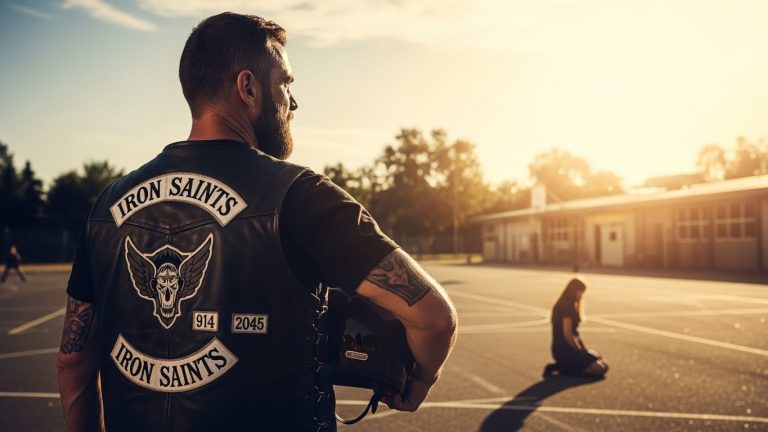
Idling at the curb, not ten feet away, was a machine that looked like it had been forged in a war zone. It was a Harley, but stripped of all the shiny chrome that dentists like on the weekends. This bike was matte black, scarred, and menacing. It had high handlebars and saddlebags that looked like they were made from thick, weathered hide.
But the bike wasn’t the scary part. The rider was.
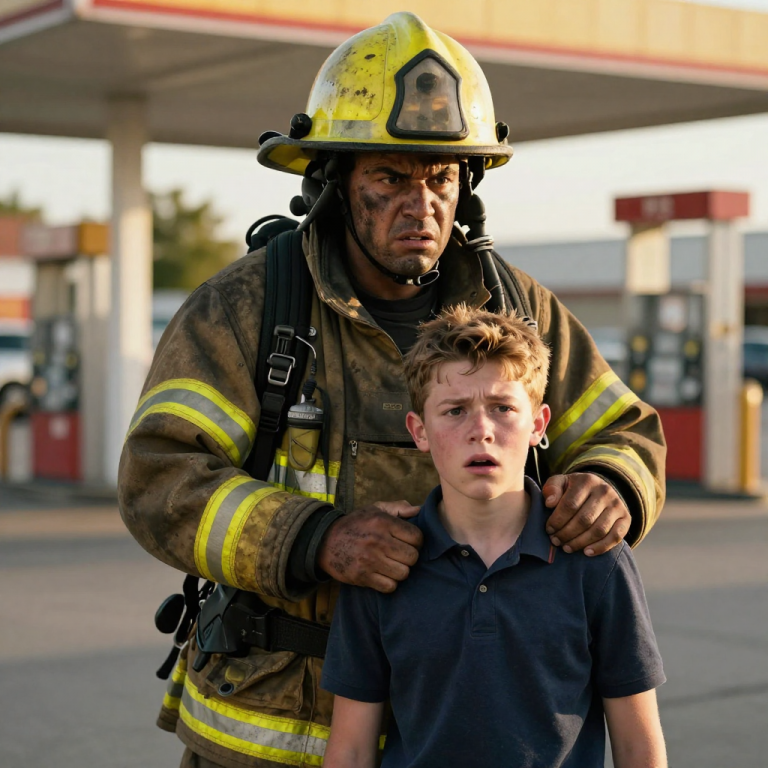
He was a mountain of a man. He sat on the bike with the ease of someone who lived in the saddle. He wore a leather cut—a vest—over a black hoodie. The leather was gray with age, covered in patches I didn’t recognize, though one on the chest said “VETERAN” in stark white letters. His arms were tree trunks, covered in faded ink that disappeared under his sleeves. He wore dark aviator sunglasses that hid his eyes completely, and a thick, salt-and-pepper beard covered the lower half of his face.
He kicked the kickstand down. CLANG. The sound rang out like a gunshot.
The engine died, leaving a ringing, heavy silence in its wake.
Kyle, who had been six feet tall a moment ago, seemed to shrink. He took a subtle step back. “Let’s go,” he whispered to Mason.
“Stay,” the biker said.
His voice was like gravel tumbling in a dryer. Low. rumbly. Absolute.
The biker swung a heavy boot over the seat and dismounted. He walked toward us. His boots were heavy combat style, caked in road dust. Every step was deliberate. He didn’t walk like a regular person; he walked like he owned the ground beneath his feet.
He stopped right in front of Kyle. The man towered over the twelve-year-old, blocking out the sun.
“You break it,” the biker said, raising a gloved hand and pointing a thick finger at my ruined bag in the mud, “you buy it. That’s the code.”
Kyle’s arrogance evaporated. He looked like a deer in headlights. “I… it was an accident. The bag was old. It just… broke.”
The biker didn’t move. He didn’t blink. He just tilted his head slightly, staring at Kyle through those black lenses. “I saw you pull it. I saw you laugh.”
“I… I…” Kyle stammered.
The biker turned his back on Kyle, dismissing him entirely, and looked down at me.
He crouched. Up close, the smell of him was intense—leather, tobacco, gasoline, and something metallic. He reached up and took off his sunglasses.
I expected eyes that were cold or angry. Instead, I saw startlingly blue eyes, surrounded by deep crinkles of exhaustion. There was a jagged, pale scar running from his left temple down into his beard.
He looked at the taped-up, ruined bag in the mud. Then he looked at my face. He studied me, scanning my features as if he were looking for something specific.
“Get up, soldier,” he said softly.
It wasn’t a command; it was an invitation. I stood up, my knees trembling, mud dripping from my pants.
“That bag served its tour,” the man said, looking at the blue canvas corpse. “You held onto it as long as you could.”
He reached behind him, to the bike. He unbuckled a strap on his saddlebag and pulled something out.
It was a backpack. But not a school backpack. It was olive drab, made of thick, heavy tactical nylon. It had rows of webbing on the front, heavy-duty zippers, and a Velcro patch on the top that bore a subdued American flag. It looked like it could survive a bomb blast. It looked like something a hero would carry.
He held it out to me.
“Trade you,” he said.
I stared at it. It was beautiful. “I… I don’t have any money, sir.”
The biker cracked a half-smile, revealing a gold tooth. “Didn’t ask for money. I said a trade. Your old bag for this one. I need some scrap fabric for oil rags anyway.”
“But… yours is expensive.”
“And yours is broken,” he countered. He stepped closer, lowering his voice so only I could hear. “Besides, this one is heavy. You think you can carry the weight?”
I looked at Kyle, who was watching with his mouth open, pale and silent. I looked back at the giant man. I straightened my spine.
“Yes, sir.”
He handed it to me. It was heavy. Much heavier than an empty bag should be. It felt solid. Secure.
“Good man,” he said. He leaned in, his hand gripping my shoulder. His grip was like iron. “Check the front pocket when you get home. Just you. Nobody else. There’s something in there that belongs to you. Should have gotten it to you six years ago, but… life gets in the way.”
Six years ago?
Before I could ask what he meant, he stood up to his full height and turned back to Kyle.
“This kid is under my protection now,” the biker rumbled. He leaned down into Kyle’s face. “You mess with his gear, you mess with my squad. We clear?”
Kyle nodded frantically, his voice gone. “Clear. Yes. Clear.”
“Walk away,” the biker said.
Kyle and his friends scrambled backward, tripping over themselves to get to the buses.
The biker turned back to me one last time. He tapped two fingers to his forehead in a salute. Then he turned, mounted his bike, and fired the engine. With a roar that shook my chest, he peeled out of the parking lot, leaving me standing in the exhaust, clutching a military bag that felt like a shield.
Chapter 3: The Ghost in the Canvas
I didn’t take the bus. I didn’t want to explain the bag to anyone, and I definitely didn’t want to sit near Kyle.
I walked the two miles home, hugging the olive-green backpack to my chest rather than wearing it. It felt precious. It felt dangerous. The weight of it was comforting, a solid pressure against my ribs.
The biker’s words echoed in my head with every step. Should have gotten it to you six years ago.
Six years ago, I was six. That was the year the world ended. That was the year Dad left.
Mom never talked about it much. She just said he “couldn’t handle the pressure” and “went his own way.” She said he was a drifter, a man with itchy feet who didn’t know how to be a father. Over the years, that image had solidified in my mind: a coward who packed a bag and walked out the door while I was sleeping, leaving Mom to double shifts and duct-taped backpacks.
I reached our apartment complex, a cluster of peeling beige buildings near the highway. I climbed the three flights of stairs, my key ready.
The apartment was silent. Mom was at the diner until 9:00 PM tonight. The air inside was stale, smelling of old carpet and the faint chemical scent of cleaning spray.
I went straight to my room and locked the door. I placed the tactical backpack on my bed. In the dim light of the afternoon sun filtering through my blinds, it looked out of place—too rugged, too serious for a room with superhero posters and a sagging mattress.
My heart was hammering against my ribs.
Check the front pocket.
I ran my fingers over the rough nylon. I found the zipper to the front administrative pocket. It was heavy-duty, with a paracord pull.
I unzipped it slowly.
Inside, tucked tightly into a mesh compartment, was a package wrapped in oilcloth. It was about the size of a thick paperback book.
I pulled it out. The oilcloth was tied with a piece of twine. My hands were trembling so bad I could barely undo the knot.
The cloth fell away.
It was a bundle of letters. And on top of the letters sat a small, velvet box.
I picked up the box first. The hinge creaked. Inside lay a medal. It was shaped like a star, bronze, hanging from a red ribbon. I didn’t know much about medals, but this one looked heavy. Important.
I set it down and picked up the letters. There were maybe twenty of them. The envelopes were yellowed, wrinkled as if they had been carried in a pocket for a long time.
I looked at the handwriting on the top envelope.
To Leo. My Little Lion.
My breath hitched. The world tilted on its axis.
I knew that handwriting. I had seen it on old birthday cards—the ones from my 3rd, 4th, and 5th birthdays, before they stopped coming.
It was Dad’s handwriting.
But there was no stamp. No postmark. Just a date scrawled in the corner of the top envelope.
November 12th, 2019.
I froze.
Dad left in June of 2019. Mom said he went to California to work on oil rigs and just never called back. She said he forgot us.
But this letter was dated five months after he left.
I ripped the envelope open. A folded piece of lined paper fell out. A Polaroid photo fluttered to the bedspread.
I picked up the photo. It was grainy. It showed two men standing in front of a dusty humvee in a desert. They had their arms around each other’s shoulders, grinning through dirt and sweat.
One of them was the biker—Jax. He looked younger, his beard shorter, but the scar was there.
The other man was my father.
He was wearing camouflage. He was holding a rifle. He looked tired, but he was smiling.
I turned the photo over. On the back, in Dad’s handwriting: “Brothers. Kandahar. 2019.”
My stomach dropped. Kandahar? Mom said California. She said oil rigs. She never said anything about the army. She never said anything about a war.
I unfolded the letter. My eyes raced over the words, blurring with tears I hadn’t realized were falling.
“Dear Leo,
If you are reading this, it means I broke my promise. It means I didn’t make it back to fix the roof or teach you how to throw a spiral.
Jax is going to bring this to you. Trust him. He’s the reason I’m writing this, and I’m the reason he’s breathing.
Your mother is going to be angry. She wanted to protect you from the truth. She told me to leave, Leo. She told me if I signed up for another tour, I couldn’t come back. She didn’t want a soldier for a husband. She wanted safety. But I couldn’t watch what was happening over here and do nothing.
I didn’t run away from you, son. I ran toward the fire. And I’m sorry.
There’s something else you need to know. The money. I sent it all. Every paycheck. I sent it to an account she swore she’d keep for your college. If she told you we’re broke, then we need to have a very different conversation.”
I lowered the paper. The room was spinning.
The duct tape. The spilled milk. The hole in my shoe. The constant panic about rent.
I sent it all.
The front door of the apartment clicked open.
“Leo? Baby? I got off early!” Mom’s voice called out, cheerful and tired. “I brought leftover pie!”
I sat on the bed, the medal in one hand, the letter in the other, and the heavy military bag sitting like a judge between us.
My life wasn’t just a struggle. It was a lie. And the biker hadn’t just given me a backpack. He had given me a grenade.Chapter 4: The Lie That Kept Us Warm
“Leo? What is that?”
Mom stood in the doorway, her uniform apron still tied around her waist, a plastic container of diner pie in her hand. Her eyes went from my face to the bed—to the olive-drab bag, the scattered letters, and the bronze star gleaming in the velvet box.
The color drained from her face so fast I thought she might faint. She dropped the pie. The plastic cracked against the floorboards, cherry filling bleeding out onto the carpet like a wound.
“Where did you get that?” she whispered.
“A man gave it to me,” I said, my voice trembling with a rage I didn’t know I had. I stood up, holding the letter like a weapon. “He said he should have given it to me six years ago.”
Mom took a step forward, reaching out. “Leo, give me those. You don’t understand—”
“I understand that you lied!” I shouted. The sound shocked us both. I never yelled at Mom. We were a team. Us against the world. But now the team felt like a sham. “You said he ran away! You said he was a coward who went to work on oil rigs and forgot us!”
“He did run away!” Mom snapped, her eyes filling with sudden, hot tears. “He chose them over us, Leo! He had a family. He had a son. And he signed up for another tour? He volunteered to go back to that hellhole? That is leaving, Leo. That is abandoning your family.”
“He was a soldier!” I thrust the photo at her. “Look at him! He wasn’t on an oil rig. He was in Kandahar. He was fighting!”
Mom looked at the photo, and a sob broke through her chest. She sank onto the edge of my bed, burying her face in her hands. “I know,” she mumbled into her palms. “I know where he was.”
“Why did you lie?”
She looked up, her mascara running in dark streaks. “Because it hurts less to hate a deadbeat than to mourn a ghost, Leo. If you thought he was a jerk who didn’t care, you’d move on. But if you knew… if you knew he was a hero who loved you, but still chose the war… you’d spend your whole life waiting by the window. I couldn’t watch you wait for a man who wasn’t coming back.”
I felt the anger deflate, replaced by a cold, confusing hollow. “He’s dead, isn’t he?”
She nodded slowly. “Four years ago. An IED. There was no body to send home. Just… paperwork.”
The room was silent, save for the hum of the refrigerator in the kitchen. I looked down at the letter in my hand. The ink looked so fresh.
“What about the money?” I asked quietly.
Mom frowned, wiping her eyes. “What money?”
“The letter,” I said, reading from the page. “I sent it all. Every paycheck. I sent it to an account she swore she’d keep for your college.”
I looked at Mom. “He says he sent money. For years.”
Mom stood up, her confusion genuine. “Leo, I never saw a dime. After he deployed that second time, I cut off contact. I was so angry. I returned his letters unopened. But money? We’ve been eating ramen and working double shifts for six years. Do you think if I had his army pay, I’d let you walk to school with duct tape on your bag?”
She grabbed my shoulders. “I lied about why he left. I own that. But I would never steal from you. I never got any money.”
I looked at her worn-out shoes. Her cracked hands. She was telling the truth.
But the letter was the truth, too. Dad didn’t lie.
“Someone is lying,” I whispered.
I grabbed the tactical backpack.
“Where are you going?” Mom cried.
“To find the biker,” I said. “To find the rest of the story.”
Chapter 5: The Ledger
I didn’t know where the biker lived, but I knew where he’d be. In a town this small, guys with bikes like that only congregated in one place: The Iron Horse, a dive bar and garage out by the interstate, past the old lumber yard.
It was dark now. The streetlights flickered, buzzing ominously. I walked fast, the heavy military bag thumping against my back. It was starting to rain again.
When I got to the garage, the air was thick with classic rock and cigarette smoke. A row of motorcycles sat out front, glistening in the wet night.
I saw it. The matte black beast.
I walked into the open bay of the garage. Jax was there, wrenching on the front fork of a bike. He wasn’t wearing his sunglasses now. He looked older in the harsh fluorescent light, the scar on his face vivid and angry.
He saw me and stopped. He set the wrench down with a clink.
“You read it,” he said. It wasn’t a question.
“My dad is dead,” I said.
Jax nodded slowly. He wiped his greasy hands on a rag. “He was a good man, Leo. The best I ever served with. He took shrapnel so I could get to cover. That’s why I’m here. I owed him a life.”
“My mom said she never got the money,” I said, cutting straight to the point. I pulled the letter out of the front pocket. “He says he sent everything. But we’re broke. We’re poor. My mom is killing herself working two jobs. She didn’t know about any money.”
Jax’s eyes narrowed. The sorrow in his face vanished, replaced by something sharp and dangerous. “She didn’t get it?”
“No.”
Jax walked over to a battered metal filing cabinet in the corner of the garage. He yanked the bottom drawer open and pulled out a thick, leather-bound ledger. He slammed it onto a workbench.
“Your dad knew your mom was angry,” Jax said, flipping through pages. “He knew she was sending his letters back. So he didn’t send the checks to the house. He didn’t want her tearing them up out of spite.”
“Then where did he send them?”
“He set up a trust,” Jax said. “An informal one. We had a buddy back home. A ‘suit.’ Someone local who handled finances for a few of the guys in the unit. Your dad sent his wire transfers to this guy every month. The deal was, the guy holds it, invests it, and releases it when you turn eighteen—or if your mom needed it for an emergency.”
Jax stopped at a page. He tapped a line item.
Sgt. Walker – Monthly Allotment – $2,500.
The list went down the page. Month after month. Year after year. Even after Dad died, the survivor benefits and insurance payout went to the same routing number.
“That’s over a hundred grand,” I whispered. My knees felt weak.
“Who is the guy?” I asked. “Who has the money?”
Jax looked at me, his expression unreadable. “A prominent guy in town. A banker. Real estate guy. He’s the one who handles the veteran accounts.”
“What’s his name?”
Jax pointed to the signature at the bottom of the document.
Robert Miller.
My blood ran cold.
Miller.
Kyle Miller’s dad.
The image of Kyle earlier that day flashed in my mind. The expensive North Face bag. The new sneakers. The way he sneered at my taped-up poverty. “I heard the ‘Dumpster Diver’ collection is big in Europe.”
He wasn’t just bullying me because I was poor. He was living like a king on the money my father died to earn.
I felt a roar build up in my throat, a sound I had never made before. “Kyle’s dad,” I spat out. “He stole it.”
Jax closed the ledger. The sound was like a gavel coming down.
“He didn’t just steal it, kid,” Jax growled, reaching for his leather cut and pulling it on. “He embezzled from a fallen soldier. In my world, we have a specific punishment for that.”
Jax grabbed a helmet from the shelf and tossed it to me.
“Put that on.”
“Where are we going?” I asked, catching it.
Jax kicked his bike starter. The engine roared to life, spitting blue flame.
“We’re going to a PTA meeting,” Jax said, his voice cold as ice. “Mr. Miller has a withdrawal to process.”
Chapter 6: The Glass House
The Miller house was a mansion on the hill—the kind of place with a circular driveway and pillars that looked like they belonged on a bank. Rain lashed against my helmet visor as I clung to Jax’s back. The ride had been terrifying and exhilarating. I wasn’t Leo the poor kid anymore. I was riding a dragon.
Jax cut the engine at the bottom of the driveway so we could roll up silently. The house was blazing with lights. Through the massive front window, I could see a dinner party in progress. People in suits and cocktail dresses were holding wine glasses, laughing.
I saw Kyle in the window. He was sitting on a sofa, playing on a brand-new iPad, ignoring the adults.
“Stay behind me,” Jax said. He adjusted his gloves. He looked like a nightmare coming out of the dark.
We walked up the front steps. Jax didn’t knock. He didn’t ring the doorbell.
He kicked the double oak doors right below the lock.
CRACK.
The door flew open, splintering the frame.
The conversation inside died instantly. twenty faces turned toward the foyer.
Robert Miller stood at the head of the dining table. He was a tall man, polished, with a expensive haircut and a glass of red wine in his hand. He looked like an older version of Kyle—smooth, arrogant.
“What on earth?” Miller shouted, stepping forward. “Who do you think you are? I’m calling the police!”
Jax stepped into the light. He was dripping wet, dirty, and terrifying. I stepped out from behind him, wearing the oversized military backpack.
Kyle looked up from his iPad. His eyes went wide. “Leo?”
“You know this trash?” Miller asked his son, then turned back to Jax. “Get out of my house before I shoot you.”
“You remember me, Bob?” Jax asked. His voice was calm, which made it scarier.
Miller squinted. Then, recognition flickered in his eyes. Fear followed immediately. “Jax? I… I haven’t seen you in years. I thought you were still overseas.”
“I was,” Jax said, walking into the room. The guests parted like the Red Sea. “I was busy burying my friend. Leo’s dad.”
Miller swallowed hard. “That… that was a tragedy. A terrible loss.”
“Yeah,” Jax said. He reached into his vest and pulled out the ledger. He tossed it onto the dining table. It slid across the polished wood and knocked over a wine glass. Red wine spilled onto the white tablecloth like blood.
“We’re here to close the account, Bob.”
Miller’s laugh was nervous, high-pitched. “I don’t know what you’re talking about. Whatever business we had, it was years ago.”
“The trust,” Jax said. “The survivor benefits. The combat pay. The money Sergeant Walker sent home to his boy so he wouldn’t have to tape his backpack together.”
The room went deathly silent. The guests looked from Jax to Miller.
“I… there were fees,” Miller stammered, sweat beading on his forehead. “Market downturns. Bad investments. The money is gone, Jax. It’s complicated.”
“Gone?” Jax asked. He looked around the opulent room. He looked at the crystal chandelier. He looked at Kyle’s iPad.
“It doesn’t look gone,” I said. My voice was small, but it cut through the silence. “It looks like you’re wearing it.”
Miller turned purple. “You listen here, you little gutter-rat—”
Jax moved. He didn’t punch Miller. He just grabbed him by the lapels of his expensive Italian suit and slammed him against the wall. A painting fell and shattered.
“Careful,” Jax whispered, his face inches from Miller’s. “That’s my soldier you’re talking to.”
“Mason! Tucker!” Miller yelled, panic taking over. “Call the Sheriff!”
“Sheriff’s already here,” a voice boomed from the doorway.
Everyone turned. A man in a beige uniform was standing in the broken doorway. But he wasn’t looking at Jax. He was looking at Miller.
“I was patrolling nearby and heard the door go,” the Sheriff said. He looked at the ledger on the table, then at Miller. “Bob, tell me you didn’t steal from a KIA.”
Miller slumped in Jax’s grip.
Jax let him go. Miller slid to the floor, weeping.
“It was just sitting there,” Miller sobbed. “Nobody asked for it. Nobody knew!”
I looked at Kyle. He wasn’t sneering anymore. He looked small. He looked at his dad on the floor, then at me.
“Your dad bought you a nice life, Kyle,” I said, adjusting the straps of the green bag. “But he bought it with my dad’s life.”
Jax put a hand on my shoulder. “Let’s go, Leo. The Sheriff can handle the trash.”Chapter 7: The Long Way Home
The ride back to the apartment was quieter. The rain had stopped, leaving the streets slick and reflecting the red taillights of the cars ahead. I leaned against Jax’s back, the vibration of the engine humming through my chest.
We didn’t go straight inside when we arrived. Jax killed the engine and sat there for a moment, staring at the peeling paint of my building.
“I have to tell you the rest,” he said, his voice rough. He didn’t turn around. He just gripped the handlebars tight, his knuckles white.
“The rest?” I asked.
“You asked why it took six years,” Jax said. He took a deep breath. “The day your dad died… we were pinned down. He didn’t just take shrapnel for me, Leo. He ran into the open to draw fire so the medic could get to me. I was bleeding out. I watched him fall.”
He paused, and I saw his shoulders shake once.
“I spent two years in a hospital in Germany. Learning to walk again. Learning to think straight. When I got out, I was… broken. I couldn’t come here. I couldn’t look your mother in the eye and tell her that her husband was dead because I was too slow.”
He turned his head then, looking at me over his shoulder. The streetlamp illuminated the wet track of a tear cutting through the road dust on his face.
“I was a coward, Leo. I held onto that backpack for four years after I got out. Every day I told myself, ‘Today I’ll go.’ And every day I couldn’t do it. Until today. I saw you at the school. I saw you fighting a battle you were too small for. And I realized… I couldn’t save the father, but maybe I could serve the son.”
I looked at this giant, terrifying man who scared the life out of everyone in town. He looked so human. So fragile.
“You’re not a coward,” I said. I reached out and touched the patch on his vest—the one that said ‘In Memory of Sgt. Walker’. “You brought him home.”
Jax swallowed hard and nodded. “Let’s go see your mom. She has some checks to sign. The Sheriff texted me. Miller is talking. He’s going to liquidate everything to pay you back. Every cent.”
When we walked into the apartment, Mom was sitting at the kitchen table, staring at the photo of Dad. When she saw Jax, she didn’t scream. She didn’t cry.
She stood up, walked over to the scary biker who smelled like gasoline and violence, and hugged him.
They held each other for a long time—two people who had loved the same ghost, finally sharing the weight of the grief.
“Thank you,” she whispered.
“I’m sorry,” he rasped.
“It’s okay,” she said, pulling back and wiping her eyes. She looked at me. “We’re okay.”
That night, for the first time in six years, I didn’t worry about the rent. I slept with the olive-green backpack on the floor next to my bed. It was open. The letter was on my nightstand.
I wasn’t the poor kid anymore. I was the son of a hero.
Chapter 8: The New Formation
Six months later.
The spring sun was warm on the pavement of the school parking lot. The snow was gone, replaced by the smell of blooming dogwood and fresh cut grass.
I sat on the brick wall by the entrance, waiting for the bus.
“Hey, Leo.”
I looked up. It was Kyle.
He looked different. He wasn’t wearing the pristine North Face jacket anymore. He was wearing a generic hoodie from Target. He looked tired. His dad was awaiting trial, and the “mansion on the hill” was currently in foreclosure. They were living in a condo on the other side of town now.
“Hey, Kyle,” I said.
He looked at my feet. “I… uh… I’m sorry about the bag. Back then.”
“It’s fine,” I said. And I meant it. I didn’t hate him. It’s hard to hate someone when you see how fast their world can crumble. “How are you holding up?”
Kyle shrugged. “It’s weird. Being… you know. Normal.”
“You get used to it,” I said. “Builds character.”
Kyle managed a weak smile. He walked to the bus, head down.
A low rumble shook the air.
The conversation in the courtyard stopped. Heads turned.
Jax rolled up to the curb on the black Harley. But he wasn’t alone. behind him were three other bikes—big, loud cruisers ridden by guys in similar vests.
Jax revved the engine, a sound that cracked the air like a whip. He waved at me.
“Shotgun!” he yelled.
I grinned, grabbing my bag. Not the taped-up blue one. The olive drab tactical pack. The one that had been to Kandahar and back.
I walked over to the bike.
“Who are they?” I asked, nodding at the other riders.
“This?” Jax pointed a thumb at the bearded men behind him, who were all grinning at me. “This is the squad. They served with your dad, too. They heard you made honor roll. figured we’d escort you to the pizza place to celebrate.”
“You don’t have to do that,” I said, feeling my face heat up—but in a good way this time.
“We don’t have to,” one of the other bikers called out. “We get to. That’s the mission.”
I climbed onto the back of Jax’s bike. I buckled the helmet.
As we pulled out of the school lot, the wind hitting my face, I looked back at the kids standing on the sidewalk. They weren’t laughing. They were watching with respect.
I tightened my grip on the straps of my backpack.
People think a backpack is just something to hold your books. But they’re wrong. Sometimes, it holds your history. Sometimes, it holds your pain.
And if you’re lucky, sometimes it holds the love of a father who never really left.
The End.