I CRAWLED THROUGH BURNING RUBBLE FOR A SOUND I PRAYED WASN’T MY IMAGINATION, AND WHEN I DRAGGED THE SURVIVOR INTO THE LIGHT, THE CROWD’S REACTION BROKE ME.
The heat wasn’t just temperature anymore; it was a physical weight, a heavy, suffocating blanket that pressed against my turnout gear and tried to squeeze the air from my lungs. My knees scraped against the jagged remains of what used to be a hallway. Every inch forward was a negotiation with gravity and structural failure. The darkness was absolute, broken only by the angry orange glow of embers that danced in the peripheral vision of my facepiece, swirling like fireflies in a graveyard.
“Sound off!” I tried to yell, but the regulator in my mouth turned the words into a mechanical garble. I was alone in this section. Captain Miller had ordered a defensive retreat five minutes ago, but I had heard something. A sound that didn’t belong to the fire. Fires have a specific vocabulary—the crackle of dry wood, the roar of updrafts, the groan of steel losing its temper. This sound was different. It was organic. It was desperate.
I dragged myself forward, my gloved hands testing the floor before putting weight on it. The debris was unstable—chunks of drywall, shattered glass, and the charred skeletons of furniture. Smoke choked the air so thickly that my flashlight beam just bounced back at me, a solid white wall of particulate matter. My low-air alarm wasn’t vibrating yet, but I knew I was pushing the limit. The heat seeping through my knee pads felt like kneeling on a skillet.
*Whimper.*
There it was again. Faint. Thread-thin. It cut through the chaotic symphony of destruction like a razor wire. It wasn’t the sound of a timber shifting. It was a cry for help.
“I’m coming!” I shouted inside the mask, the sound vibrating in my own skull. “Call out! Make noise!”
Silence returned, heavier than before. I crawled faster, ignoring the snag of a twisted rebar that tore at my shoulder patch. The urgency in my chest tightened. If that was a child… if that was someone trapped under this mess while the roof prepared to come down on top of us… the thought was a cold spike of adrenaline in my bloodstream.
I reached a pile of collapsed structural lumber. A massive beam, likely a main support timber from the second floor, had come down at an angle, creating a precarious void space underneath. The whimper came from there. It was a wet, terrified sound, vibrating with the kind of fear that language can’t capture.
I jammed my shoulder under the edge of the timber. It was solid oak, old and dense, probably weighed three hundred pounds on its own, plus whatever debris was piled on top of it. I gritted my teeth, planting my boots into the ash-slicked floor. This was the job. This was the only thing that mattered. The politics, the budget cuts, the sleepless nights—it all vanished. There was only the weight, and the life underneath it.
I pushed. My quads burned. The tendons in my neck felt like they were snapping. “Come on,” I growled, a primal noise tearing from my throat. The timber groaned, shifting an inch. Dust rained down, blinding me further. I shifted my leverage, using my legs, using every ounce of strength I had left in a body that had been running on caffeine and adrenaline for twelve hours.
With a final, agonizing heave, I tossed the heavy timber aside. It crashed into the drywall with a thud that shook the floorboards.
I scrambled into the space, ripping my glove off to feel for a pulse, for skin, for a limb. My hand brushed against fur. Thick, matted, soot-covered fur.
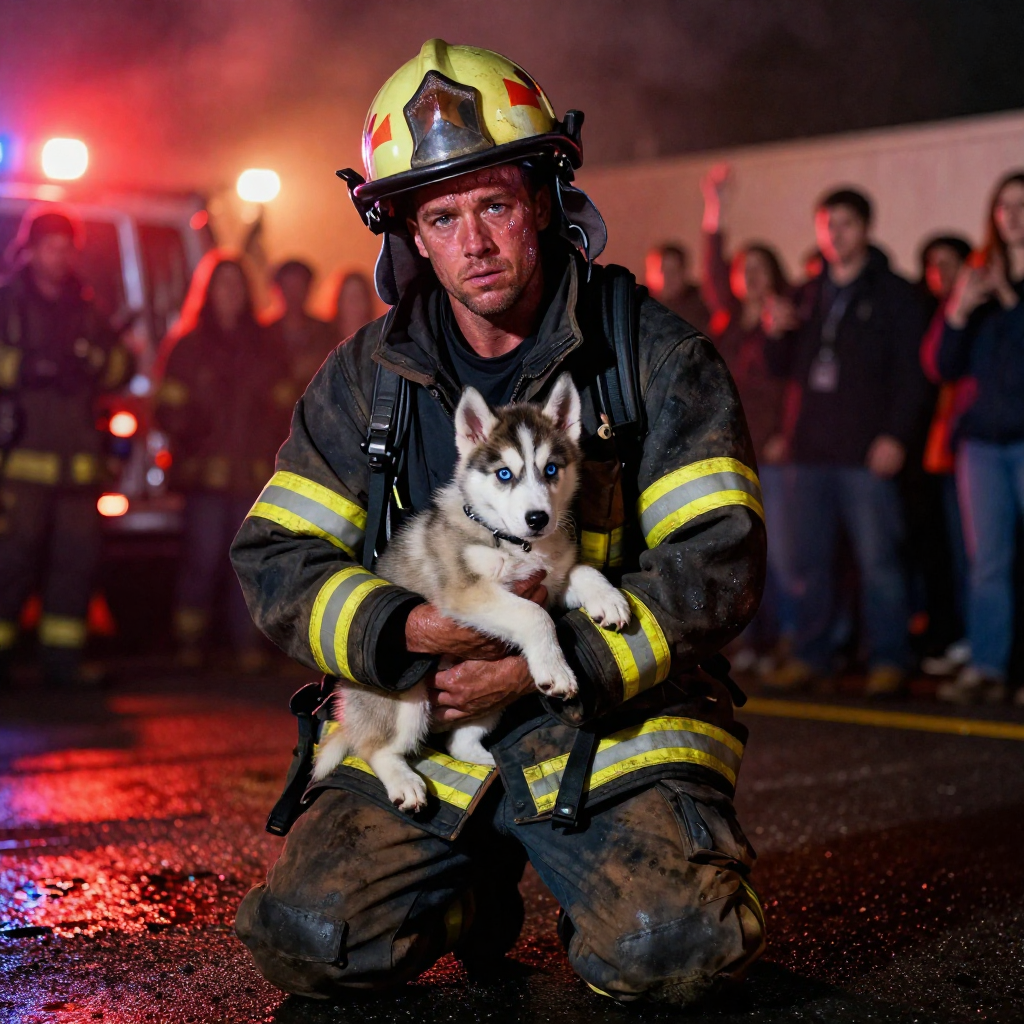
I blinked, wiping the sweat from my eyes inside the mask. Two blue eyes, wide with absolute terror, stared back at me from the darkness. It wasn’t a child. It was a husky pup, pinned by the debris, its legs splayed, shaking so violently it was vibrating the floor.
For a split second, I felt a jolt of confusion. I had risked my life, ignored a retreat order, and nearly thrown my back out for a dog. But then the pup let out that sound again—that high-pitched, heartbreaking whimper—and the confusion vanished. Life is life. Fear is fear. In the middle of an inferno, you don’t ask for ID.
“I got you, buddy. I got you,” I whispered, though he couldn’t hear me through the mask. I scooped him up. He was dead weight, paralyzed by shock. I tucked him into my turnout coat, zipping it halfway up to shield his head from the heat and the falling embers. He buried his snout into my chest, trembling against my ribs.
The retreat was harder. The adrenaline was fading, replaced by the crushing fatigue of the exertion. The heat seemed to have doubled. The structure groaned above us, a warning that our time was borrowed. I crawled one-handed, the other arm cradling the bundle of fur against my heart. The smoke was lowering, banking down to the floor, forcing me to get my belly flat against the hot debris.
I saw the light ahead—the rectangular outline of the front door, broken and hanging off its hinges. It looked like a portal to another universe. Blue flashing lights pulsed against the smoke, rhythmic and blinding.
I pushed through the threshold, stumbling as I hit the front steps. The transition was violent. One second, I was in a suffocating oven; the next, the cool night air hit me like a slap in the face. I ripped my mask off, gasping, my lungs burning as they expanded fully for the first time in twenty minutes.
I fell to my knees on the wet pavement, the water from the hoses creating a muddy slurry around me. I unzipped my coat.
The moment the husky’s head popped out, gasping for the fresh air, coughing out a puff of grey smoke, the world exploded.
The crowd had been held back behind the yellow tape—neighbors, onlookers, people who had watched their homes threaten to burn. When they saw the dog, when they saw the soot-stained white fur against my blackened gear, a roar went up. It was deafening. It wasn’t polite applause. It was a visceral, guttural cheer. People were screaming, pointing, hugging each other.
I looked down at the pup. He looked up at me, his tongue lolling out, ash coating his whiskers. He licked the soot off my chin.
A paramedic rushed over, not to me, but to the dog, placing a small oxygen mask over the pup’s snout. A woman in the crowd broke through the line, sobbing, her hands over her mouth. I watched her run toward us, her eyes fixed on the dog.
I sat back on my heels, my chest heaving, listening to the applause wash over me. I felt small. I felt heavy. I looked at the burning building behind me, then at the reunion in front of me. The crowd was cheering for a miracle. I just wanted a drink of water. I wiped my face with a dirty hand, leaving a streak of clean skin, and for the first time that night, I let out a breath that didn’t hurt.
CHAPTER II. The air outside the burning tenement was not as fresh as I had hoped it would be. It was thick with the smell of wet soot, melted plastic, and the metallic tang of high-pressure water hitting scorching brick. My lungs felt like they were lined with sandpaper. Every breath was a conscious, painful effort that rattled deep in my chest. I sat on the rear bumper of Engine 42, my helmet on the ground between my heavy boots, my head hanging low. The weight of the turnout gear felt like it was trying to push me through the pavement. I was shaking, a fine tremor in my hands that I couldn’t stop no matter how hard I gripped my knees. The adrenaline was receding, leaving behind a cold, hollow ache that made my bones feel brittle. I didn’t want to look up. I didn’t want to see the flashing lights or the people. I just wanted to be invisible for an hour. But visibility is the tax you pay for surviving when everyone is watching. I felt a shadow fall over me, and then a hand, light and trembling, touched my shoulder. I looked up and saw her. She was younger than she had seemed through the smoke—maybe mid-twenties, with tangled blonde hair and eyes that were bloodshot from crying. She was clutching the husky puppy to her chest so tightly I thought she might bruise him. The dog, whom she called Bear, looked remarkably unfazed, his blue eyes blinking at the world while his fur remained matted with my own sweat and the grime of the floor. Thank you, she whispered, and the word seemed to break something inside her. She sank to her knees right there on the wet asphalt, the dog still in her arms. I didn’t know what to do. My training covered backdrafts and structural integrity, but it didn’t tell me how to handle a woman kneeling in the dirt because I had chosen a dog over my own safety. You should get him to a vet, I said, my voice sounding like it belonged to a much older man. He inhaled a lot of smoke. She nodded, her face buried in the puppy’s neck, her sobs finally breaking through. Her name was Elena, I would later learn, and Bear was the only thing she had left of a brother she’d lost a year ago. That was the first weight I had to carry—the realization that I hadn’t just saved a pet; I had unwittingly become the custodian of her last thread of sanity. It made my chest tighten with a familiar, ugly pressure. It reminded me of my father, a man who had spent thirty years in the service only to die in a kitchen fire because his partner decided to be a hero instead of a teammate. My father always said that a firefighter who forgets the team is just an arsonist with a badge. And here I was, being thanked for the very thing he would have despised. Before I could say anything more, the silence of our small circle was shattered. The peripheral world surged in. A news crew from a local affiliate pushed past the police line, their camera light blindingly bright against the dark street. Mr. Firefighter, just a moment! a woman in a crisp trench coat shouted, thrusting a microphone toward my face. We saw you come out. What was going through your mind when you went back in? Was it a split-second decision? I stared at the lens, feeling a surge of nausea. I looked over at Captain Miller. He was standing twenty feet away, his arms crossed over his chest, his face a mask of stone. He hadn’t said a word to me since I stepped out of the building. He didn’t have to. The way he looked at me told me exactly what was coming. I had ignored a direct order to retreat. I had put every man on my crew at risk because they would have had to come in and get me if the roof had come down a minute earlier. I turned back to the reporter, my mouth dry. I thought I heard something, I said, and it wasn’t a lie, but it wasn’t the whole truth either. The truth was my secret, a secret that had been rotting in the back of my mind for months. I had been noticing the silence for a while now. Not total silence, but a softening of the world. High frequencies were gone. The hiss of the radio, the chirp of the PASS device, the specific pitch of a captain’s whistle—it was all becoming a dull hum. I hadn’t reported it because the department would have pulled me off the line and stuck me behind a desk in fire prevention, and I didn’t know who I was if I wasn’t the man in the coat. If I admitted I didn’t hear the retreat order, I’d have to admit why. If I admitted I heard it and ignored it, I was a rogue. Either way, the career I had built to honor my father was on the verge of collapsing. The reporter didn’t care about my inner turmoil. She saw a story. You’re being called the ‘Puppy Hero’ on social media already, she said with a practiced, predatory smile. Someone caught the whole thing on their phone. It’s gone viral. Millions of views in less than twenty minutes. What do you have to say to the people calling you a symbol of hope? I looked at Elena, who was looking at me with a terrifying kind of worship. I looked at Miller, who was now walking toward me, his boots clicking rhythmically on the pavement. I felt like I was drowning in the air. I’m just a guy who did his job, I muttered, standing up and trying to push past the camera. But then the triggering event happened—the moment the floor fell out from under me for the second time that night. Miller didn’t wait for the camera to stop rolling. He didn’t wait for privacy. He stepped into the light of the news crew, his voice cold and loud enough for every microphone to catch. He did more than his job, didn’t you, Jack? Miller said, his eyes drilling into mine. He did so much of his job that he forgot how to listen to his radio. He forgot that a ‘retreat’ order isn’t a suggestion. The reporter’s eyes lit up. She smelled blood. Captain, are you saying there’s an investigation into this rescue? Miller didn’t blink. Every action has a consequence, he said, looking directly at me. We don’t celebrate insubordination in this department, no matter how many ‘likes’ it gets on the internet. He turned and walked away, leaving me standing there in the glare of the camera, the hero narrative curdling in real-time. The crowd that had been cheering moments ago went silent. I could see the confusion on Elena’s face, her gratitude turning into a frantic sort of worry. She reached out to touch my arm again, but I flinched away. I couldn’t look at her. I couldn’t look at any of them. I felt the old wound opening up—the memory of my father’s funeral, the rows of uniforms, the heavy silence of a man who died because someone thought they knew better than the rules. I had become the very thing that killed him. And the worst part was, I didn’t know if I had done it because I wanted to save that dog, or because I was too proud to admit I couldn’t hear the world ending around me. I walked toward the truck, my legs feeling like lead. I had saved a life, but in the process, I had set fire to my own. The secret of my hearing loss was no longer just a private fear; it was now the only thing that could save me from a disciplinary hearing that would strip me of my rank, but revealing it would end my life as a firefighter anyway. I was trapped in a room with no exits, and the smoke was starting to rise.
CHAPTER III
The hallway outside the hearing room smelled of floor wax and stale coffee. It was a sterile, institutional scent that felt like a funeral home. I sat on a hard plastic chair, my hands clasped between my knees, watching the dust motes dance in a sliver of morning light. I could see the vibrations of the heavy doors as people moved inside, but the sound was a dull, underwater thrum. My hearing aid was pushed as far into my ear canal as it would go, the volume cranked until the world hissed with static.
I looked down at my dress uniform. The wool was thick and scratchy. The medals felt heavy, like lead weights pinned to my chest. I felt like a fraud. A ‘Puppy Hero’ waiting to be dismantled. Every person who walked by gave me a nod—some with pity, some with a strange, hungry kind of admiration. They didn’t know I was a ghost already.
Elena was there. She sat three chairs down, clutching a small canvas bag. She looked smaller than she had at the scene, her eyes rimmed with red. She kept looking at me, her mouth opening as if to say something, then closing again. She was my biggest fan and my greatest threat. She was the witness who would testify to my heroism, and in doing so, she would unknowingly bury me.
Captain Miller walked past. He didn’t look at me. He looked straight ahead, his jaw set like granite. He looked like a man about to perform an execution. He entered the room, and the heavy doors clicked shut behind him. That click was the last thing I heard clearly. Everything else started to dissolve into the hum.
The bailiff opened the door and gestured for us to enter. The room was a theater of judgment. Three senior chiefs sat behind a raised mahogany bench. They were the grey-beards, the men who had spent thirty years breathing smoke. They knew the rules because they had written them in blood. I took my seat at the small table to the left. To my right, the department’s legal counsel shuffled papers. The air in the room felt thin, as if the oxygen was being sucked out of it.
Chief Halloway, the center man on the board, cleared his throat. I saw his lips move. I focused, leaning forward, my heart hammering against my ribs. ‘Firefighter Jack Mercer,’ he said, his voice coming through the static of my ears. ‘This is a formal inquiry into the events of the fire at 422 West Pine. Charges include insubordination, violation of direct safety orders, and reckless endangerment of department personnel.’
I nodded. I didn’t trust my voice. I looked at the table. The grain of the wood was intricate, a maze I couldn’t escape. Halloway called Captain Miller to the stand first. This was the moment the trap would spring. Miller stood up, walked to the podium, and placed his hands on the edges. He looked like he was holding the weight of the entire department together.
‘Captain Miller,’ Halloway said. ‘Describe the command structure at the scene.’
Miller spoke with a flat, rhythmic precision. He described the building’s structural integrity. He described the ‘mayday’ conditions. He described the moment he looked me in the eye and told me to retreat. He didn’t sound angry. He sounded like a man reading a weather report. That was what hurt the most. He wasn’t out for blood; he was just stating facts. He was the personification of the rulebook I had set on fire.
‘And Firefighter Mercer’s response?’ Halloway asked.
‘He didn’t acknowledge,’ Miller said. ‘He turned his back on the exit and disappeared into the smoke. I repeated the order three times over the radio. There was no response. He went rogue.’
I felt the eyes of the board on me. They weren’t looking at a hero. They were looking at a liability. They were looking at the man who makes families attend funerals. My father’s funeral flashed in my mind—the white gloves, the folded flag, the way the wind had whipped the black veil over my mother’s face. My father had been a hero, too. And he had been just as deaf to the warnings as I was.
Then it was Elena’s turn. She was called as a character witness for the defense, though I had no defense. She walked to the stand, her steps hesitant. She looked at me and tried to smile. It was a small, fragile thing. She turned to the board, her voice trembling but determined.
‘Jack saved my life,’ she began. ‘Not just my dog’s life. He saved mine. I was ready to run back into that building. I was screaming for someone to help. I was right there, on the sidewalk, screaming at him as he went in. I was so close I could have touched his gear.’
Chief Halloway leaned forward. ‘You were shouting at him, Ms. Vance? Before he entered the building?’
‘Yes,’ she said, nodding eagerly. ‘I was screaming his name. I was telling him exactly where the dog was. I was right behind him. But he was so focused. He was like a machine. He didn’t even turn around. He didn’t even flinch. Even when the sirens were going and everyone was yelling, he just kept going. It was like he was in his own world.’
I felt a cold sweat break out on the back of my neck. She thought she was describing bravery. The board saw something else. They saw a man who couldn’t hear a woman screaming three feet behind him. Halloway looked at Miller, then back at me. The silence in the room became heavy, a physical pressure on my eardrums.
‘Firefighter Mercer,’ Halloway said. ‘Ms. Vance says she was screaming at you from a very short distance. Did you hear her?’
I opened my mouth. The lie was right there. I could say the smoke was too thick. I could say the sirens were too loud. I could say I was focused. But the weight of the medals on my chest was too much. I looked at Miller. He was watching me, his eyes narrowed. He wasn’t waiting for a lie. He was waiting for the truth he already knew.
‘No, sir,’ I said. My voice sounded thin in the large room. ‘I didn’t hear her.’
‘And the radio?’ Halloway pushed. ‘Captain Miller says he issued the retreat order three times. Did you hear the radio?’
I looked at the high-frequency speaker on the wall. I looked at the hearing aid hidden in my ear. The ‘Old Wound’ wasn’t just my father’s death. It was the fear of being nothing without the uniform. It was the fear of the silence. But the silence had caught up to me. It was here, in this room, and there was nowhere left to hide.
‘I heard a noise,’ I said. ‘But I couldn’t make out the words. I thought it was static.’
‘Static?’ Halloway’s voice rose. ‘The Motorola APX is the gold standard for clarity, Mercer. You’re telling me you had a equipment failure?’
‘No, sir,’ I said, standing up. The chair scraped against the floor, a sound I felt more than heard. ‘The equipment was fine. It’s my ears. I’m losing my hearing. I’ve been losing it for two years.’
The room went dead. I saw Elena’s face drop. I saw the board members exchange looks of pure, unadulterated shock. This wasn’t just a violation of orders anymore. This was a systematic deception. I had been riding on a truck, entering burning buildings, and carrying the lives of my brothers in my hands while I couldn’t even hear them calling for help.
‘You’ve been operating with hearing loss?’ Halloway’s voice was a whisper of steel. ‘You’ve been falsifying your annual medicals?’
‘I had a friend in the clinic,’ I said. The words felt like stones falling from my mouth. ‘He helped me pass. I just… I couldn’t leave. This is all I am.’
I expected an explosion. I expected Halloway to scream. Instead, he just sat back, looking at me with a profound, weary disappointment. He looked at me like I was a broken tool that had to be discarded. Then he looked at Miller. ‘Captain, were you aware of Firefighter Mercer’s condition?’
Miller didn’t hesitate. He stood up again. He didn’t look at the board. He looked at me. ‘I suspected it,’ he said. ‘Six months ago, I noticed him tilting his head during briefings. I saw him watching lips instead of eyes. I tried to give him an out. I offered him a desk job twice. He refused.’
I stared at him. He had known. All those months of him being a ‘hard-ass,’ all those times he had ridden my back about the smallest details—it wasn’t because he hated me. He was trying to push me toward the exit before I went out in a box.
‘On the day of the fire,’ Miller continued, his voice cracking for the first time. ‘I gave that retreat order knowing he might not hear it. I wanted to see if he would look for me. I wanted to see if he was still a part of the team, or if he was just a man chasing a ghost. When he didn’t turn around, I knew. I had to report him. If I didn’t, I’d be the one burying the next person he didn’t hear.’
The twist of it hit me like a physical blow. Miller wasn’t my enemy. He was the only one who had truly been looking out for me. He had used the ‘Puppy Hero’ scandal to force this hearing. He had invited the media scrutiny to ensure the department couldn’t just sweep my insubordination under the rug. He had forced the truth out into the light because he knew I wouldn’t do it myself.
‘Mercer,’ Halloway said, his voice cold and final. ‘You are hereby suspended indefinitely, effective immediately. We will move for permanent termination and a full investigation into the medical fraud. You are lucky no one died. You are very, very lucky.’
I didn’t wait for them to dismiss me. I turned and walked out. The hearing room doors swung shut behind me with a heavy, muffled thud. I walked through the lobby, past the reporters who were already sensing the shift in the air, past the firefighters who were looking at me with new, suspicious eyes. I was no longer the hero. I was the guy who had lied to them.
I made it to the parking lot before Elena caught up to me. She was crying. ‘Jack, I’m so sorry,’ she sobbed. ‘I didn’t know. I was just trying to help. I didn’t mean to tell them you couldn’t hear.’
I stopped at my truck. I looked at her, and for the first time, I didn’t feel the need to be the savior. I didn’t feel the need to be the man in the heavy coat who fixes everything. I reached into my ear, pulled out the hearing aid, and looked at it. It was a tiny, expensive piece of plastic that had been my lifeline and my cage.
‘It’s okay, Elena,’ I said. And I realized I couldn’t even hear my own voice clearly. ‘It’s better this way. I was tired of listening for things that weren’t there.’
I got into the truck and started the engine. I didn’t look back at the station. I didn’t look at the medals on my chest. I drove. I drove until the city sounds faded away. I drove until the only thing I could hear was the vibration of the road beneath the tires. My career was over. My reputation was in tatters. My father’s legacy was a cautionary tale.
But as the silence settled over me, I felt a strange, terrifying lightness. The lie was gone. The ‘Old Wound’ was finally open to the air. I reached up and unpinned the medals from my wool jacket, one by one, and dropped them into the cup holder. They clinked together—a small, sharp sound that I could just barely hear. It was enough.
CHAPTER IV
The silence after the gavel hit felt absolute, even though I knew logically there were sounds all around me: the rustle of clothing, the shuffling of feet, hushed whispers. But in my head, it was just…empty. The hearing room seemed to stretch, the faces blurring into a sea of judgment. I saw Miller, his expression unreadable, a mask he’d perfected over years of command. Elena was there too, her eyes filled with… something. Pity? Regret? I couldn’t tell, and honestly, I didn’t want to know.
They suspended me, of course. Indefinitely. The word echoed in my skull, a death knell for everything I had been, everything I thought I was. Firefighter Jack Mercer. Gone. Reduced to… what? A fraud? A liability? The guy who risked lives because he couldn’t admit he was broken?
I walked out of that room a different man. The weight of the secret, the constant strain of pretending, had finally lifted. But in its place was something heavier: the weight of reality. I was deaf. Or, at least, deafeningly hard of hearing. And I was no longer a firefighter.
Outside, the media was a swarm. Flashing cameras, shouted questions, a cacophony I could barely process even with my hearing aids cranked to the max. I kept my head down, pushing through the crowd, a pariah in the city I’d sworn to protect.
My apartment felt cavernous, empty even with all my stuff. I sat on the edge of the bed, staring at my turnout gear hanging in the closet. The uniform. My identity. I didn’t touch it. I couldn’t.
The phone rang. I ignored it. It rang again. And again. Finally, I yanked the cord from the wall. Silence. Blessed, hollow silence.
The news cycle devoured me for a few days. “Hero to Zero,” one headline screamed. “Deaf Firefighter Endangers Lives,” another proclaimed. The comments sections were a cesspool of outrage and condemnation. People I’d never met felt entitled to judge me, to dissect my life, to declare me a villain.
Then, as quickly as it began, it faded. The media moved on to the next scandal, the next tragedy. I was old news. Forgotten.
But I wasn’t forgotten by everyone.
The first visitor was Danny. He showed up at my door, a six-pack of cheap beer in hand and a sheepish look on his face.
“Hey, Jack,” he said, shuffling his feet. “Heard what happened. Figured you could use a… you know.”
We sat in silence for a long time, drinking beer and staring at the wall. Danny didn’t offer any platitudes, didn’t try to tell me everything would be alright. He just sat there, a solid presence in my swirling vortex of shame and self-pity.
“Miller knew, didn’t he?” I finally asked.
Danny nodded. “He suspected for a while. Said he saw you missing calls, misreading signals. He was worried.”
“Worried enough to let me keep risking my life, and everyone else’s?”
“He was trying to protect you, Jack. In his own messed-up way. He thought… he hoped… you’d come clean on your own.”
Protect me? By publicly humiliating me? By ending my career?
I didn’t say it out loud. I just took another swig of beer.
My mother called every day, her voice thick with worry. She didn’t understand the technicalities of the hearing or the department regulations. All she knew was that her son, her hero, was hurting. I tried to reassure her, to tell her I was fine. But my voice sounded hollow, even to my own ears.
“Come home, Jack,” she pleaded. “Just for a little while. Let me take care of you.”
I couldn’t. Going back would be an admission of defeat, a confirmation of everything the world was saying about me. I was broken, but I wasn’t helpless. I had to figure this out on my own.
The hardest part was the silence. Not the literal silence of my hearing loss, but the silence of the firehouse. The camaraderie, the jokes, the shared meals, the adrenaline-fueled calls. All gone. Replaced by… nothing.
I started taking long walks, wandering aimlessly through the city. I watched the fire trucks scream past, sirens blaring, heading towards emergencies I could no longer be a part of. The pang of longing was sharp, almost physical.
One afternoon, I found myself in front of the firehouse. I stood across the street, watching my former colleagues go about their duties. Miller was there, barking orders, his face etched with the same grim determination I’d always admired. I wanted to go over, to talk to him, to explain… something. But I couldn’t. The shame was too great.
I turned and walked away.
A week after the hearing, I got a letter. It was from the Department, informing me that my pension was being reviewed. There were… questions… about my eligibility, given the circumstances of my departure. Translation: they were trying to screw me over.
The anger flared, hot and familiar. They had taken my career, my reputation, my sense of self-worth. Now they wanted my money too?
I called a lawyer. His name was Stern, and he sounded as jaded and cynical as I felt. He listened to my story, his fingers drumming on his desk.
“You have a case,” he said. “But it’s going to be a fight. They’ll try to paint you as a liar, a cheat. Are you ready for that?”
Was I? I didn’t know. But I knew I couldn’t let them win. I had to fight back, not just for myself, but for everyone who had ever been unfairly judged, unfairly punished.
“I’m ready,” I said.
The meeting with Miller happened a few days later. He called me, his voice curt and professional.
“Mercer, I need to see you. My office. Tomorrow. 1000 hours.”
I almost hung up. I didn’t want to face him, to endure his disappointment, his judgment. But I knew I had to. This was unfinished business.
I arrived at his office at precisely 1000 hours. The firehouse was eerily quiet. The usual bustle of activity was muted, replaced by a sense of… anticipation? Or maybe that was just my paranoia.
Miller’s office was the same as I remembered it: spartan, functional, filled with the scent of old coffee and burnt rubber. He sat behind his desk, his gaze intense.
“Close the door, Mercer,” he said.
I did. The click echoed in the small room.
“I didn’t do you any favors, did I?” he asked, cutting straight to the chase.
“No, sir. You made my life a living hell.”
“Maybe. But you were already living in hell, Jack. You just weren’t admitting it.”
He leaned back in his chair, his eyes searching mine.
“I knew about your hearing loss, Jack. Not the extent of it, but I knew something was wrong. I saw the signs. The missed calls, the misinterpreted orders. I should have forced you to get checked out, I know that. But I didn’t. I was afraid of what they’d find. Afraid of losing you.”
“So you let me keep risking my life?”
“I thought you were managing. I thought you were compensating. I was wrong.”
He sighed, running a hand through his thinning hair.
“The hearing… it was a mess. But it was also the only way. You were never going to admit the truth on your own. You were too stubborn, too proud.”
“So you sacrificed me?”
“I gave you a choice, Jack. A hard choice, but a choice nonetheless. You could have kept lying, kept pretending. But you didn’t. You faced the music. And that takes courage.”
I didn’t say anything. I didn’t know what to say.
“I’m sorry it had to end this way, Jack,” he said, his voice softening. “You were a damn good firefighter. One of the best I ever had.”
“Thanks,” I mumbled.
“Don’t thank me. I failed you. I should have protected you better.”
He stood up, walked over to the window, and looked out at the city.
“What are you going to do now, Jack?”
“I don’t know,” I said. “Sue the department, I guess. Try to get my pension back.”
“That’s not what I meant,” he said, turning back to me. “What are you going to do with your life? Now that you’re not a firefighter anymore.”
I shrugged.
“Figure it out,” he said. “You’re a smart guy, Jack. You’ll find something. Just don’t let this break you.”
I left his office feeling… lighter. Not happy, not relieved, but lighter. Miller hadn’t absolved me of my sins, hadn’t magically fixed everything. But he had offered me something: a glimpse of understanding, a flicker of hope.
Elena called a few days later. I almost didn’t answer. I was still angry, still resentful. But something made me pick up the phone.
“Jack?” she said, her voice hesitant.
“Yeah,” I said, my voice flat.
“I… I wanted to apologize,” she said. “For what happened at the hearing. I didn’t mean to…”
“Reveal my secret?” I finished for her.
“Yes,” she said, her voice barely a whisper. “I was just… I was so grateful. And I wanted everyone to know what you had done. I didn’t realize…”
“It’s okay, Elena,” I said. “It’s done. It doesn’t matter.”
But it did matter. It mattered a lot.
“I was wondering,” she said, “if you’d like to… I don’t know… get coffee? Or something?”
I hesitated.
“I’m starting a sign language class,” she continued, “and I was wondering if you would like to join me.”
I looked at the phone, then back at my turnout gear in the closet. The silence was deafening.
“Okay,” I said. “Coffee sounds good.”
My first morning as a civilian was… strange. I woke up to silence, not the blare of the alarm or the crackle of the radio. I got dressed in normal clothes, not my uniform. I walked to the coffee shop, not to the firehouse.
Elena was already there, waiting for me. She smiled when she saw me, a genuine, unburdened smile.
“Hi, Jack,” she said.
“Hi, Elena,” I said.
We sat in silence for a moment, sipping our coffee.
“So,” she said, “are you ready to learn some sign language?”
I smiled.
“I think so,” I said.
And in that moment, surrounded by the quiet murmur of the coffee shop, I realized something: my life as a firefighter was over, but my life was not. It was just… different. Quieter, perhaps. But not over.
The world was still full of sounds, even if I couldn’t hear them all. And it was still full of possibilities, even if I couldn’t see them all yet. It was okay. I was okay.
The silence was okay.
CHAPTER V
The first few weeks after the hearing felt like being underwater. Everything was muffled, not just the sounds, but the world itself. I went through the motions: woke up, ate something (usually nothing), walked the dog, stared at the TV. The phone rang a few times, but I mostly let it go to voicemail. Danny left a couple of messages, full of nervous energy and forced optimism. My mom called every day, her voice tight with worry, but I couldn’t bring myself to talk for long. What was there to say? That my life was over? That everything I’d worked for was gone? That I was useless?
Elena’s invitation to the sign language class hung over me like a challenge. Part of me wanted to ignore it, to retreat further into myself. But another part, a stubborn, flickering ember, knew that I couldn’t stay like this forever. I owed it to myself, to my dad, to at least try.
The first class was a disaster. I felt clumsy and self-conscious, surrounded by people who seemed to pick up the signs with ease. Elena was there, of course, her smile warm and encouraging. But even her presence couldn’t completely quell the rising panic. I stumbled over the simplest gestures, my hands feeling foreign and awkward. The instructor, a deaf woman named Sarah, was patient, but I could see the frustration in her eyes. After an hour, I was ready to bolt.
“It’s okay,” Elena said, as we walked out of the community center. “It takes time. You’re learning a whole new language.”
“I’m no good at it,” I mumbled, avoiding her gaze. “I should just quit.”
Elena stopped walking and gently touched my arm. “Don’t say that, Jack. You’re just getting started. And besides,” she added with a playful grin, “I need a practice partner.”
I looked at her, really looked at her, and saw the genuine sincerity in her eyes. She wasn’t just being polite; she actually wanted me there. And maybe, just maybe, I wanted to be there too.
Phase 1: Facing Reality
The next few months were a slow, painstaking process of adaptation. I continued to attend the sign language classes, struggling through the grammar and vocabulary. Elena was my constant companion, patiently correcting my mistakes and offering words of encouragement. We spent hours practicing together, in coffee shops, in the park, even at my kitchen table. Slowly, gradually, the signs began to make sense. The awkwardness faded, replaced by a sense of accomplishment. It wasn’t just about learning a new language; it was about learning to communicate in a different way, to connect with people on a deeper level.
I started to meet other deaf and hard-of-hearing people, attending social events and workshops. I listened to their stories, their struggles, and their triumphs. I learned about the challenges they faced, the discrimination they endured, and the resilience they demonstrated. I began to see my own hearing loss in a new light, not as a personal failing, but as a shared experience, a part of a larger community.
One afternoon, Elena took me to a local school for the deaf. The energy was palpable the moment we walked through the door. Children were signing and laughing, their faces alight with joy. I watched them interact, communicating effortlessly in their native language, and a wave of emotion washed over me. It was a sense of belonging, of acceptance, that I hadn’t felt in years.
Later that day, as we were driving home, I turned to Elena and said, “Thank you.”
“For what?” she asked, smiling.
“For everything,” I replied. “For not giving up on me. For showing me that there’s more to life than just firefighting.”
Elena squeezed my hand. “You would have found your way eventually, Jack. You’re stronger than you think.”
I wasn’t so sure about that, but her words gave me hope. Hope that I could build a new life, a life that was different, but not necessarily worse, than the one I had lost.
Phase 2: Finding New Purpose
As my sign language skills improved, I started volunteering at the community center, helping to teach introductory classes. I discovered that I had a knack for explaining things clearly and patiently, breaking down complex concepts into manageable steps. The students seemed to appreciate my perspective, my understanding of the challenges they faced.
One day, Sarah, the instructor from my first sign language class, approached me with an idea. “Jack,” she said, “I’ve been thinking. We need more firefighters who know sign language. What if you were to develop a training program, teaching first responders how to communicate with deaf and hard-of-hearing individuals in emergency situations?”
The idea resonated with me immediately. It was a way to combine my past experience with my new skills, to use my knowledge to make a real difference in the world. I spent weeks researching and developing the curriculum, drawing on my own experiences and the insights of the deaf community.
The training program was a success. Firefighters from all over the city signed up, eager to learn how to better serve their communities. I taught them basic sign language, emergency communication protocols, and cultural sensitivity. I shared my own story, my own struggles, and my own triumphs.
One evening, after a particularly successful training session, Captain Miller showed up at the community center. I was surprised to see him, but I greeted him with a cautious nod.
“Mercer,” he said, his voice softer than I remembered. “I wanted to see what you were up to.”
I led him into the classroom, where the firefighters were practicing their signs. He watched them for a few minutes, his expression unreadable.
“You’re good at this,” he said finally. “You’ve found your calling.”
“Maybe,” I replied. “Or maybe I’m just trying to make up for lost time.”
He looked at me, his eyes filled with a mixture of regret and admiration. “You were a damn good firefighter, Jack. The best I ever had.”
“Thanks, Captain,” I said, offering him my hand. “I appreciate that.”
He shook my hand firmly, then turned and walked away. As I watched him go, I realized that I had finally forgiven him, not for what he had done, but for what he had forced me to become.
Phase 3: Confronting the Past
Accepting my deafness wasn’t a single moment of revelation; it was a gradual process of letting go. Letting go of the anger, the resentment, the self-pity. Letting go of the dream I had held onto for so long. Letting go of the fear that I was somehow less of a person because I couldn’t hear.
One day, I visited my father’s grave. I hadn’t been there in years. I stood in front of the headstone, staring at his name, and a wave of sadness washed over me. I realized that I had spent so much time trying to live up to his expectations, trying to be the son he wanted me to be, that I had forgotten who I was.
“Dad,” I said, my voice barely a whisper, “I’m not you. I’m not a hero. I’m just me.”
And in that moment, I felt a sense of peace that I hadn’t felt in a long time. I didn’t need to be a hero. I didn’t need to prove anything to anyone. I just needed to be myself.
I started to think about my future, not in terms of what I had lost, but in terms of what I could create. I enrolled in a college course on deaf education, eager to learn more about the field. I started attending advocacy meetings, fighting for the rights of deaf and hard-of-hearing individuals. I found my voice, not in shouting or commanding, but in listening and understanding.
Elena continued to be my rock, my confidante, my best friend. We spent countless hours together, exploring the city, attending cultural events, and simply enjoying each other’s company. Our relationship deepened, evolving from a friendship into something more.
One evening, as we were sitting on my porch, watching the sunset, Elena turned to me and said, “Jack, I love you.”
I looked at her, my heart swelling with emotion. “I love you too, Elena,” I replied.
And in that moment, I knew that I had found my home, not in a firehouse, but in the arms of a woman who loved me for who I was, not for who I used to be.
Phase 4: A New Beginning
The years passed, and my life continued to evolve. I became a certified deaf educator, working with children and adults of all ages. I developed new training programs for first responders, expanding my reach and impact. I became a vocal advocate for the deaf community, speaking at conferences and lobbying for legislation.
Elena and I got married, surrounded by our family and friends. It was a joyous occasion, filled with love and laughter. We built a life together, a life that was full of purpose, meaning, and connection.
One day, I received a letter from the fire department. It was an invitation to attend a ceremony honoring retired firefighters. I hesitated for a moment, then decided to go.
As I walked into the firehouse, I was greeted by a chorus of familiar faces. Danny was there, beaming with pride. Captain Miller was there, his expression surprisingly warm. They all welcomed me with open arms, acknowledging the contributions I had made to the department.
During the ceremony, Captain Miller stepped up to the podium. “Jack Mercer,” he said, his voice resonating through the room, “you were a hero, not just for the people you saved, but for the example you set. You taught us the importance of courage, dedication, and service. And you taught us that even in the face of adversity, we can always find a way to make a difference.”
As he spoke, I felt a wave of emotion wash over me. I had come full circle. I had lost my hearing, my career, and my sense of identity. But I had found something even more valuable: a new purpose, a new community, and a new love.
I realized then that my deafness wasn’t a limitation; it was a gift. It had opened my eyes to a world I never knew existed, a world of beauty, connection, and resilience.
I learned that true strength wasn’t about physical prowess or unwavering hearing; it was about the ability to adapt, to overcome, and to find meaning in the midst of suffering.
Years later, standing in a classroom full of eager students, each signing their names with focused determination, I understood that my life hadn’t ended when the sirens faded; it had just begun again in a different language. The silence, once a symbol of loss, had become a canvas for a new kind of expression.
It made me stop and think; the quiet can be just as loud as the loudest bell.
END.