THEY STOLE MY HEARING AID AND PLAYED CATCH WITH IT WHILE THE CURATOR CALLED ME ‘DEFECTIVE,’ BUT THEY DIDN’T KNOW THE ADMIRAL WAS WATCHING.
The world didn’t fade away; it was ripped out of my head. One second, I was listening to the hum of the air conditioning and the polite shuffle of loafers on marble floors. The next, there was a high-pitched feedback squeal—a sharp *pop*—and then, a terrifying, suffocating silence.
I spun around, my hand flying to my left ear. It was empty. The sudden absence of sound made me dizzy, my equilibrium thrown off balance as if the floor had tilted beneath my feet.
“Oops,” a voice mouthed. I couldn’t hear the tone, but I saw the shape of the word.
It was Julian. Of course, it was Julian. He was standing three feet away, holding my hearing aid—my lifeline, my connection to reality—between his thumb and forefinger like it was a dead insect. He was grinning. Behind him, his two friends, Clara and Trent, were covering their mouths, their shoulders shaking in what I knew was laughter.
“Give it back,” I said. I think I said it. When my hearing aid is out, I can’t hear my own voice. I don’t know if I’m whispering or screaming. I can only feel the vibration in my throat. The panic started to rise in my chest, hot and acidic.
Julian held the device up to the light. It was a beige piece of plastic, unglamorous and medical. To him, it was a toy. To me, it was the only reason I could attend the encrypted history lectures at the National Archive without a translator.
I reached for it, lunging forward.
Julian stepped back effortlessly, tossing the device over my head to Trent.
I spun around, stumbling. My depth perception always gets weird when the sound goes. I almost tripped over a velvet rope. Trent caught it with one hand, mocking a baseball pitcher’s wind-up.
“Please,” I begged. My hands were shaking. “It’s not a game. It breaks easily. Please.”
I saw Trent’s lips move. *Catch, monkey. Catch.*
He threw it back to Clara. I ran toward her, but I was too slow. I was always too slow for them. They were the golden children of the museum’s board members—tall, athletic, untouched by the kind of genetic lottery that had taken my hearing when I was six. I was just the charity case, the quiet girl who spent too much time looking at the enigma machines in the back room.
Clara feigned a throw to the left, then lobbed it high over my head back to Julian.
I tried to jump for it. I really did. But I landed awkwardly on the slick marble. My sneaker squeaked—I felt the vibration of the friction—and I crashed into a pedestal.
A ceramic vase wobbled. It didn’t fall, but the noise of my impact must have been loud because heads turned. People in expensive coats stopped looking at the paintings and started looking at the spectacle.
Julian caught the hearing aid and held it above his head, taunting me. I was on my knees, gasping for air, tears blurring my vision. The silence was absolute. It was a prison.
Then, I saw a pair of polished black shoes stop inches from my face.
Relief washed over me. An adult. Someone in charge. I looked up, wiping my eyes, expecting to see a security guard who would make them stop.
It was Mr. Vance, the museum curator. He was a tall, thin man who always looked like he smelled something unpleasant. He wasn’t looking at Julian. He wasn’t looking at the thieves.
He was looking down at me with pure, unadulterated disgust.
He said something. I shook my head, pointing to my ear. “I can’t hear you,” I choked out. “They took my…”
Mr. Vance leaned down. He exaggerated his lip movements, speaking slowly, like I was a toddler.
*”You. Are. Causing. A. Scene.”*
I blinked, stunned. “They stole my hearing aid,” I pointed at Julian, who had quickly shoved the device into his pocket and put on an angelic, innocent face.
Mr. Vance didn’t even turn to look at them. He looked at the scuff mark my shoe had made on the floor. He looked at the slightly crooked pedestal.
*”This is a place of quiet reflection,”* Vance’s lips moved sharp and fast. *”Not a playground for… damaged goods.”*
I froze. I saw the word *damaged*. I saw the intent behind it.
“I need my device,” I whispered, my voice breaking.
*”You need to leave,”* Vance mouthed. *”You are disturbing the patrons. We cannot have defective children running around screaming in a sanctuary of high culture.”*
Defective.
He didn’t say it with a slur. He said it with the clinical detachment of a man sorting rotten fruit from the fresh. He pointed a long, bony finger toward the exit.
Julian and his friends were snickering behind him. They had won. They always won.
I stood up, my legs trembling. The silence felt heavy now, pressing against my eardrums. I was going to be kicked out. I would have to walk home in silence, unable to hear traffic, unable to hear the world, humiliated and small.
I turned to go. I had no fight left in me.
But the heavy oak doors at the front of the gallery didn’t just open. They were thrown wide.
Even in my silence, I felt the change in the room. The vibration of heavy, synchronized footsteps shuddered through the floorboards. It was a rhythmic thumping, powerful and disciplined.
Mr. Vance stopped pointing. His mouth fell open.
I turned back.
Walking through the doors was a wall of white.
Six Naval Officers. Full dress whites. Gold braid. Ribbons that stacked up to their shoulders. They didn’t walk; they marched. The crowd parted instantly, instinctively moving out of the way of that kind of power.
In the lead was a man I recognized from photographs in the secure files, but never in person. Admiral Halloway. Four stars on his collar. A face carved out of granite. He looked like he could stop a battleship with a glare.
He didn’t look at the art. He didn’t look at the crowd.
His eyes were locked on me.
No, not just me. He scanned the scene—me, crying and deaf. Mr. Vance, pointing. Julian, smirking in the background.
The Admiral stopped three feet from us. The five officers behind him snapped to a halt in perfect unison.
Mr. Vance stuttered, his composure crumbling. I saw him say, *”Admiral? We weren’t expecting—”*
The Admiral ignored him entirely. He walked past the curator as if he were a piece of furniture. He walked straight up to Julian.
Julian was tall for his age, but he shrank under the shadow of the four-star Admiral.
Admiral Halloway held out a hand. He didn’t speak. He just waited.
Julian’s smirk vanished. His face went pale. He fumbled in his pocket, his hands shaking, and pulled out my beige hearing aid. He dropped it into the Admiral’s massive palm.
The Admiral looked at the device. Then he looked at me. He smiled—a sad, gentle smile that didn’t match the terrifying power of his uniform.
Then, he did something unthinkable.
He closed his fist around my hearing aid.
I gasped.
He squeezed. I saw the muscles in his forearm cord as he crushed the plastic. When he opened his hand, my lifeline was nothing but shards of plastic and battery acid. He dusted the debris onto the pristine museum floor.
Mr. Vance looked like he was going to have a heart attack. *”That was—”*
The Admiral turned to one of his aides, a Lieutenant Commander carrying a silver briefcase. The aide stepped forward, popped the case, and held it out.
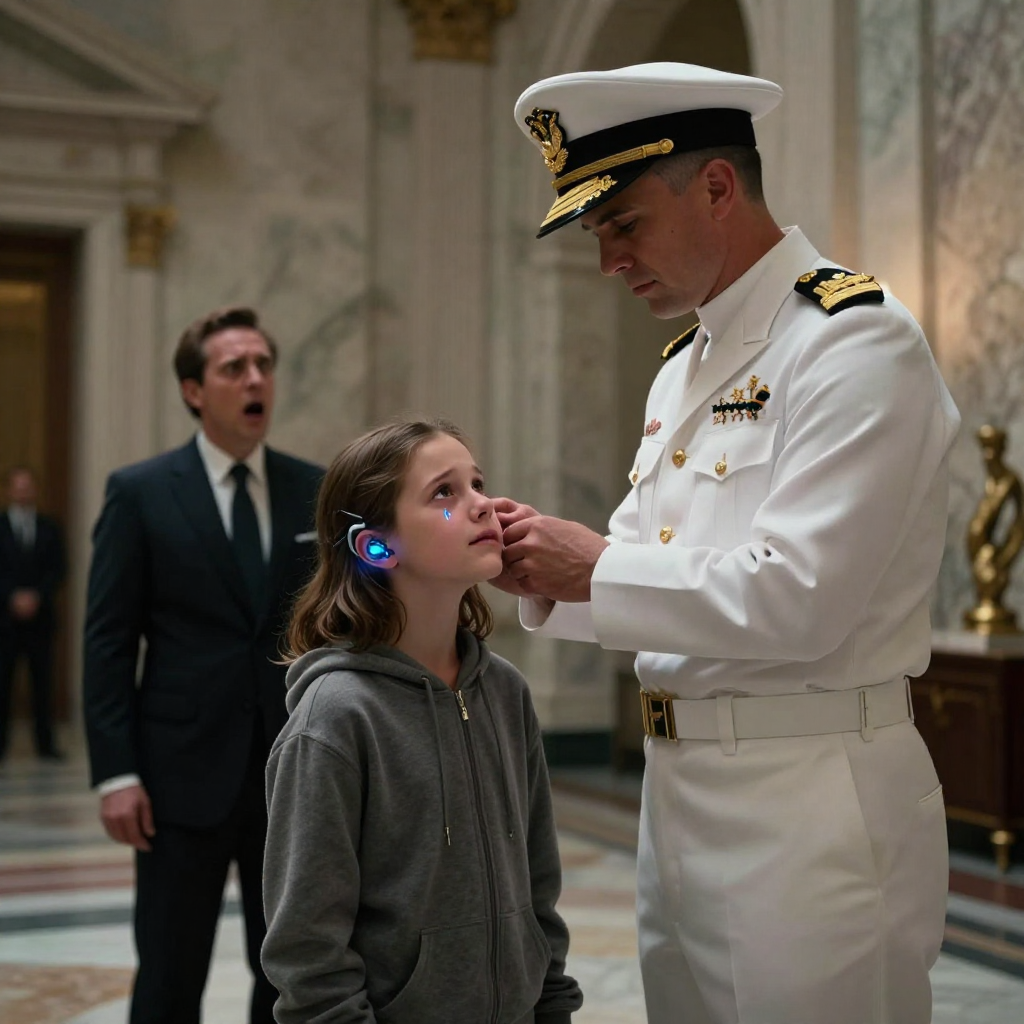
Inside sat a device that looked nothing like my old beige plastic. It was sleek, black, and pulsed with a faint blue light.
The Admiral picked it up. He stepped toward me, kneeling down on one knee so he was eye-level. He placed the device gently into my ear.
He tapped the side of it.
*Click.*
Sound rushed back in. But not the muffled, tinny sound of my old aid. This was crystal clear. I could hear the hum of the lights. I could hear the breathing of the people around us. I could hear the terrified heartbeat of Mr. Vance.
“Can you hear me, Agent Maya?” the Admiral asked. His voice was deep, warm, and resonated in my chest.
“Yes,” I whispered. “It… it sounds like music.”
“It’s the MK-9 tactical auditory processor,” the Admiral said, standing up to his full height. “Classified. We use it for sonar interpretation. It’s fitting for the best code-breaker the Naval Youth Program has ever seen.”
The room went dead silent.
“Code-breaker?” Mr. Vance squeaked. “She’s… she’s a child. She’s defective.”
The Admiral turned slowly. The warmth vanished from his eyes, replaced by a cold, tactical fury. He loomed over the curator.
“Defective?” the Admiral roared. The sound echoed off the high ceilings. “This girl cracked the Vigenère-intercept in three hours. It took my best cryptologists three weeks. She is a National Asset.”
The Admiral took a step forward, forcing Vance to step back.
“And you,” the Admiral pointed at the floor. “You just humiliated a federal agent on active duty.”
“I… I didn’t know,” Vance stammered, sweat beading on his forehead. “This is a private museum, sir. We reserve the right—”
“Wrong,” the Admiral cut him off. He pulled a folded document from his jacket. “Check your deed, son. This building sits on historic federal land leased to the city. A lease that contains a strict clause regarding discrimination against government personnel.”
The Admiral dropped the paper on the floor, right on top of the crushed remains of my old hearing aid.
“Pack your things,” the Admiral said, his voice dropping to a terrifyingly calm register. “As of 0900 hours, your lease is revoked. You’re being evicted.”
He turned his back on Vance, looked at me, and offered me his arm.
“Come on, Maya,” he said. “We have a cipher to solve. And the President wants to meet the girl who saved the Atlantic Fleet.”
I looked at Julian, who was trembling. I looked at Vance, who was staring at the eviction notice in horror.
I took the Admiral’s arm. And for the first time in my life, I didn’t walk with my head down.
CHAPTER II
The door of the black SUV shut with a heavy, pressurized thud that seemed to swallow the world. For a moment, I was back in the familiar vacuum—the silence I had inhabited since the age of six, where the only rhythm was the vibration of my own heart against my ribs. But then, the Admiral reached over and tapped a small, recessed button on the side of the device nestled behind my ear.
It didn’t just turn on. It woke up.
A surge of sensory input flooded my brain, so sharp and crystalline that it felt like a physical impact. This wasn’t the tinny, digitized approximation of sound my old hearing aid provided. This was something else. I could hear the microscopic whine of the vehicle’s electrical system. I could hear the Admiral’s sleeve rubbing against the leather of his seat—a sound that, to me, felt as loud as a landslide. Most terrifyingly, I could hear the city outside, but not as a blur of noise. I could distinguish the individual frequencies of cellular signals bouncing off the glass, a rhythmic pulsing that my brain began to translate into data without me even trying. It was as if I had been looking at the world through a keyhole and someone had suddenly torn down the entire wall.
“Steady, Maya,” Admiral Halloway said. His voice was no longer a vibration I had to read from his lips; it was a rich, gravelly resonance that carried weight and history. “The NAL-7 isn’t just a hearing aid. It’s a bridge. Your brain is already wired for complex pattern recognition. We’re just giving you the raw feed.”
I gripped the edge of the seat, my knuckles turning white. My head spun. The ‘National Acoustic Link’ was a piece of hardware I had only heard rumors of in the labs at Fort Meade. It was designed for deep-field intercepts, capable of isolating a single voice in a crowded stadium or picking up the keystrokes of a laptop through a concrete wall. And now, it was part of me.
“It’s… it’s too much,” I whispered. My own voice sounded foreign to me, deeper and more certain than the one I imagined in my head.
“You’ll adjust. You have to,” Halloway replied, his eyes fixed on the rain-streaked window. “Because the people who just humiliated you in that gallery? They aren’t just spoiled children of the elite. Their parents are the reason we’re here.”
As the car pulled away from the curb, leaving the Sterling Gallery behind, I felt a familiar, cold ache in my chest—my old wound. It wasn’t just about the bullying today. It was the memory of the academy, the way the instructors looked at me when I told them I wanted to be in Signal Intelligence. They saw a ‘defect.’ They saw a liability. I remembered Professor Aristhone leaning over my desk, his breath smelling of stale coffee, telling me that a deaf woman in the field was like a blind man trying to be a sniper. He’d said I should stick to archival work, where the silence wouldn’t get anyone killed. That rejection had become the marrow in my bones. It was the reason I pushed myself to see the code others missed, to find the ghost in the machine. I wasn’t just a code-breaker; I was a woman trying to prove that her silence was a superpower, not a cage.
Halloway had been the only one who saw it differently. I remembered our first meeting three years ago. I was working a dead-end job as a data entry clerk for a logistics firm, spending my nights hacking into secure government servers just to see if I could. He hadn’t come to arrest me. He had come to my small, cramped apartment, sat on a milk crate, and watched me work.
“You’re not just reading the data,” he had said then. “You’re feeling the architecture of it.”
Now, in the back of the SUV, that architecture was everywhere.
“The Sterling family,” Halloway began, his tone shifting into his ‘briefing’ voice. “Julian’s father is Senator Elias Sterling. His mother, Elena, runs the gallery. On the surface, they are pillars of the community. But our department has been tracking a series of high-level data leaks. Encrypted naval movements, tactical coordinates, even the NAL schematics. We’ve traced the origin point to the very building you were just standing in.”
I looked at him, my brow furrowing. “The gallery? It’s a public space.”
“Exactly. The perfect place for a dead drop,” Halloway explained. “They use the digital frames on the walls. High-resolution art that contains steganographic code. Thousands of visitors walk by every day, and among them, a handler simply snaps a photo of a painting. Inside those pixels is enough information to sink a carrier group.”
I felt a chill that had nothing to do with the air conditioning. Julian and his friends hadn’t just been bullying me; they were the shield, the social camouflage that kept the gallery ‘untouchable.’ And I had walked right into the middle of it.
“But there’s a problem, Maya,” Halloway continued, his voice dropping an octave. “We can’t get a warrant. The Sterlings are too well-connected. If we move officially, the data will be wiped before we hit the door. We need someone who can get close, someone who can hear the signal before it’s even sent.”
I realized then that this was my secret—the one I had kept even from Halloway. During my nights at the Navy lab, I hadn’t just been breaking the codes they gave me. I had been developing a ‘Ghost Protocol’—a series of unauthorized backdoors I’d built into the Navy’s own surveillance grid. I had told myself it was for efficiency, but the truth was more primal. I wanted to be able to see everything, to never be caught off guard again. If Halloway knew I had bypassed federal firewalls for my own personal access, I’d be in a cell, not a government vehicle.
“The NAL device,” I said, my voice trembling slightly. “You didn’t just give it to me to help me hear. You gave it to me so I could intercept the gallery’s local network from the street.”
“I gave it to you because you’re the only one who can process that much noise,” he corrected.
Suddenly, the device in my ear flared. A high-pitched, rhythmic clicking sound began to override the ambient noise of the car. It was coming from a passing sedan—a sleek, silver Mercedes. I recognized the silhouette in the back seat. It was Julian. He was holding a tablet, his face illuminated by the blue light of the screen.
“Admiral,” I said, my hand flying to my ear. “I’ve got something.”
“Isolate it,” Halloway commanded.
I closed my eyes. I didn’t need to see; the NAL allowed me to ‘visualize’ the signal. It looked like a jagged, pulsing vein of electricity. I reached out with my mind, using the Ghost Protocol I had secretly installed on my internal interface. I felt the resistance of the Sterling family’s private encryption. It was sophisticated, layered with ‘traps’ that would alert the user if someone tried to breach it.
Then came the moral dilemma that felt like a knife in my gut.
As I delved deeper into the stream, I didn’t just find military data. I found Julian’s personal messages. I saw a thread between him and his mother. Elena Sterling wasn’t just a traitor; she was a mother trying to pay off a massive, hidden debt to a foreign syndicate that was threatening Julian’s life. Julian didn’t know the extent of it, but he was being used as a courier.
If I triggered the ‘Kill Command’—a scorched-earth digital strike I had designed to expose the server to every intelligence agency simultaneously—I would stop the leak. But I would also ensure Julian and his mother were arrested tonight, and the syndicate would likely follow through on their threats. The Sterlings were monsters, yes, but they were being crushed by bigger monsters. If I waited, I might find the syndicate, but the naval data would be gone, potentially costing thousands of lives.
“Maya? What do you see?” Halloway’s voice was urgent.
I could feel the sweat bead on my forehead. The clicks in my ear were accelerating. They were uploading. The ‘National Asset’ inside me wanted to obey the Admiral. The girl who had been pushed to the floor by Julian wanted to watch him burn. But the woman who knew what it felt like to be trapped in a world that didn’t care about you… she hesitated.
“They’re uploading the coordinates for the Pacific Fleet’s winter maneuvers,” I whispered. “Right now. From Julian’s tablet.”
“Can you stop it?”
“I can do more than stop it,” I said. “I can broadcast the source. I can make it so they can never hide again. But Admiral… if I do this, there’s no turning back. It’s public. It’ll be on every news feed in the city within seconds. The Sterlings will be destroyed before the police even arrive.”
“Do it,” Halloway said, his face a mask of cold resolve. “They chose their side.”
I looked out the window. We were stopped at a red light. To our left, a giant digital billboard overlooked the city square. People were walking by, umbrellas up, oblivious to the digital war being fought in the air around them.
My finger hovered over the virtual trigger in my mind. I thought about the museum. I thought about the look of disgust on Mr. Vance’s face. I thought about the silence I had lived in for twenty years.
I pushed the command.
It was sudden. It was public. It was irreversible.
In an instant, every screen within a four-block radius—the digital billboard, the displays in shop windows, the phones in the hands of pedestrians—flickered and died. For three seconds, there was a haunting, static-filled silence. And then, the data began to dump.
It wasn’t just code. I had programmed the Ghost Protocol to translate the data into something the public could understand. Faces, bank statements, and the glaring, unmistakable header of the Department of Defense flashed across the giant billboard in the square. Julian’s face, captured by his own tablet’s camera, appeared next to a list of offshore account numbers.
I watched as the silver Mercedes swerved to the curb. People on the sidewalk stopped, their mouths agape, pointing at the screens. The ‘invincibility’ of the Sterling family evaporated in the glow of a million pixels. I heard the sound of a dozen sirens beginning to wail in the distance, a sound that the NAL amplified until it felt like the city itself was screaming.
Julian scrambled out of the car, looking up at the billboard where his own private messages—the ones about the debt, the ones about his mother’s fear—were scrolling for the world to see. He looked small. He looked terrified. He looked exactly how I had felt on the floor of the gallery.
“It’s done,” I said, my voice flat.
I had won. I had protected the fleet. I had dismantled my bullies. But as I sat in the dark of the SUV, listening to the cacophony of a lives being shattered, I realized I had also exposed my own hand. The Ghost Protocol was now visible to the Navy’s monitors. I had used a federal asset to perform a vigilante execution.
Halloway looked at me, and for the first time, there was a flicker of something like fear in his eyes. He realized what I had done. He realized that the ‘National Asset’ he had created was no longer under his control.
“What have you done, Maya?” he asked, his voice barely a whisper.
“I gave them what they wanted,” I replied, leaning back into the shadows. “I made sure everyone heard them.”
The car sped up, moving away from the chaos, but the sound of the sirens followed us, a permanent addition to my new, loud world. I had crossed a line. I was no longer just a code-breaker. I was a target. And the silence I had once hated now felt like the only safe place left on earth—a place I could never go back to.
CHAPTER III
The world was no longer silent. It was a screaming, digital furnace.
I stood on the balcony of the gallery, watching the screens across the city square. My face wasn’t on them, but my soul was. Every line of the Ghost Protocol was a signature. It was the rhythm of my thoughts translated into a weapon.
Julian Sterling’s face was frozen on a massive billboard. Not the handsome, sneering face he showed the world. It was a grainy still from a hidden camera. He was handing a drive to a courier. The metadata—the proof of treason—scrolled beneath him like a confession.
The crowd below was a sea of upturned faces. I could hear them now. Not just their voices, but the frantic beat of their hearts. The NAL-7 was processing everything. It was too much. The sound of a thousand gasps felt like a physical weight against my eardrums.
Then, the feedback started.
It wasn’t a sound from the street. It was an internal ping. A high-frequency pulse originating from the Navy’s secure server. They had found the source. They weren’t looking for the Sterlings anymore. They were looking for the architect of the dump.
“Maya, get out of there.”
Halloway’s voice cracked in my ear through the encrypted channel. It wasn’t the calm, fatherly tone he’d used before. It was sharp. It was terrified.
I didn’t move. I watched Elena Sterling being led out of the gallery by two men in suits. She looked small. For the first time, she looked like she could be hurt. I felt a surge of cold triumph, but it was quickly swallowed by a notification on my HUD.
*Threat Detected: Biological Signature Match. Ghost Protocol Identified. Status: Rogue Asset.*
They had tagged me. The very agency that gave me my hearing had labeled me a criminal.
I turned and ran toward the service stairs. My boots thudded against the concrete. The NAL-7 filtered out the echo, giving me a clean map of the building’s vibrations. I could hear the tactical teams three floors down. Their movements were synchronized. Professional.
“Maya, listen to me carefully,” Halloway said. “The Oversight Committee has flagged the protocol. They think you’re working with the syndicate. You have to shut it down.”
“I can’t shut it down, Admiral,” I whispered, my voice sounding strange in my own head. “It’s live. It’s everywhere. They’re seeing the truth.”
“The truth doesn’t matter if you’re dead,” he snapped.
I reached the basement level. The air was thick with the smell of damp stone and old paper. I could hear the hum of the city’s power grid through the walls. I felt like I was walking through a giant, living circuit.
I exited into a narrow alleyway. The rain had started, a fine mist that hissed against my skin. To my ears, each droplet was a tiny explosion. I turned toward the docks, the only place where the radio interference might give me a moment of peace.
As I moved, I saw the black SUVs pulling onto the street. They didn’t have sirens. They didn’t need them. They had my GPS coordinates hard-coded into the NAL-7.
I realized then that the processor wasn’t just a gift. It was a tracking device. A leash I had willingly put around my own neck.
I reached a warehouse near Pier 42. It was abandoned, a hollow shell of rusted steel and broken glass. I went inside and climbed the gantry, seeking high ground.
Minutes later, the heavy doors groaned open.
A single figure walked in. No tactical gear. No weapons drawn. It was Admiral Halloway. He looked older in the dim light of the warehouse. His shoulders were slumped, but his eyes were bright with an intensity that made me shiver.
“You did it, Maya,” he said. His voice echoed, bouncing off the corrugated metal walls. “You destroyed them. The Sterlings are finished.”
“Then why are they hunting me?” I asked. I stayed in the shadows of the upper walkway.
“Because the Ghost Protocol is too good,” he said. He stepped further into the center of the floor. “It’s a masterwork of subversion. It bypasses every firewall we have. The Pentagon is terrified of it.”
I looked down at him. “I built it because I didn’t trust the system. I built it because I knew people like Julian would always find a way to hide. You told me to use my gift, Admiral.”
He sighed, a long, weary sound. “I knew you were building it, Maya. I’ve known for months.”
The air seemed to leave my lungs. “What?”
“I watched every line of code you wrote,” Halloway said. He didn’t look ashamed. He looked proud. “I couldn’t authorize a dump like that. The bureaucracy, the political ties the Sterlings have… it would have been buried in minutes. But a rogue agent? A genius girl with a grudge? That’s a narrative that works.”
He had used me. Every word of encouragement, every sympathetic nod about my past—it was all a setup. He didn’t want to help me find my voice. He wanted me to be his untraceable scalpel.
“You baited me,” I said. My hands were shaking. “You let me get bullied. You let me feel that shame again, knowing I would lash out.”
“I gave you the tools to win,” he countered. “And you did win. But now, we have to clean this up. Give me the master key to the Ghost Protocol. I can tell the Committee I’ve contained the breach. You can go back to the lab. We can say the NAL-7 malfunctioned.”
“Go back to being your puppet?” I felt a coldness settle over me. It was deeper than the silence I used to live in.
“It’s the only way you survive this, Maya. Look around you.”
Through the warehouse windows, I saw the red and blue lights reflecting off the wet pavement. They were surrounding the building. The entire weight of the state was pressing against the doors.
“I’m not a malfunction,” I said.
Suddenly, the heavy hum of a different frequency cut through the NAL-7’s feed. It was a drone, but not a Navy one. It was something heavier, more advanced.
A voice boomed from the rafters, amplified by the building’s own structure.
“Admiral Halloway, stand down.”
Halloway froze. He looked up, his face paling.
A woman stepped out of the shadows at the opposite end of my walkway. She wore a charcoal suit and a badge I didn’t recognize—The Strategic Oversight Council. Behind her, three specialists in tech-neutralizing gear moved with lethal efficiency.
“The Council has been monitoring this operation for weeks,” the woman said. Her voice was like ice. “Admiral, you have exceeded your mandate. You used a classified medical prototype to incite a domestic data breach for personal career advancement.”
“I was taking down a traitor!” Halloway shouted.
“You were manufacturing a crisis so you could solve it,” she replied. She turned her gaze to me. “Maya. You are in possession of state property. The NAL-7 is a weapon. You have used it to compromise national security.”
I looked from the woman to Halloway. They both wanted the same thing. They wanted the power I had created. They wanted the silence I had finally broken to be their own private secret.
“I’m not giving it to either of you,” I said.
I reached into the interface of my arm-mounted terminal. I didn’t go for the delete command. I went for the distribution command.
“If you do this, Maya,” Halloway yelled, his voice desperate, “you’ll never hear again! I’ll trigger the remote kill-switch on the NAL-7. You’ll be back in the dark!”
I looked at him. I remembered the feeling of being pushed in the gallery. I remembered the way Julian had looked at me like I was a broken toy. And I realized that the silence wasn’t my enemy. Being a tool for men like this was.
“Then let it be dark,” I said.
I didn’t wait for him to react. I initiated the final phase of the Ghost Protocol. It wasn’t just a data dump of the Sterlings anymore. It was the blueprints for the NAL-7. It was the logs of Halloway’s surveillance. It was the truth of how the state used people like me.
I hit ‘Enter’.
The NAL-7 screamed in my ears—a final, agonizing burst of white noise. It was the sound of a thousand voices all speaking at once, then falling into a sharp, singular tone.
And then, nothing.
The world went black. Not my eyes, but my ears. The hum of the warehouse, the rain on the roof, the shouting of the Admiral—it all vanished.
I was back in the silence.
But I wasn’t the same girl. I stood on the gantry, watching the Oversight Council members scramble. Halloway was on his knees, his face buried in his hands. The power had shifted. They had the building, but the information was gone. It belonged to the world now.
I saw the woman in the suit look up at me. She was saying something, her mouth moving in frantic shapes. I didn’t need to hear her to know what she was feeling. It was fear.
I climbed down the back ladder, moving through the shadows I knew so well. In the silence, I was faster. In the silence, I was invisible.
I walked out the back door, past the soldiers who were looking for a ‘rogue asset’ with high-tech ears. They didn’t see the girl in the hoodie. They didn’t see the person who had just dismantled their world.
I walked until the lights of the city were behind me. The Sterlings were ruined. Halloway was exposed. The technology that was supposed to ‘fix’ me was dead in my skull.
I sat on a bench by the water, watching the sun begin to rise over the harbor. I couldn’t hear the waves, but I could see the light dancing on the surface.
I reached up and touched the cold casing of the NAL-7 behind my ear. It was just a piece of metal now.
I wasn’t a code-breaker for the Navy. I wasn’t a victim for the Sterlings. I was just Maya. And for the first time in my life, the silence didn’t feel like a prison. It felt like a clean slate.
I pulled a small, backup drive from my pocket. The only piece of the Ghost Protocol that hadn’t been uploaded. The piece that contained the encryption keys for the city’s entire surveillance network.
I looked at it for a long time.
I knew what Halloway would say. He’d say I was a traitor. He’d say I was dangerous.
He was right. I was dangerous. Because I finally knew exactly what my silence was worth.
CHAPTER IV
The silence crashed back. Not the familiar, comfortable silence I’d known my whole life, but something thicker, heavier. A silence born of trauma, of betrayal, of the kill switch Admiral Halloway had so casually flicked. It wasn’t just the absence of sound; it was the echo of what I’d heard, the phantom symphony of lies and manipulations that still vibrated in my skull. I was deaf again, yes, but also…exposed. Stripped of the weapon they’d given me, the weapon I’d turned against them.
The city itself seemed to hold its breath. The data dump – *my* data dump – had detonated like a sonic bomb. Every screen, every news feed, every whispered conversation seemed to carry fragments of the truth I’d unleashed. The Sterlings were in custody, their empire crumbling. Halloway’s career was over. The Navy, the Strategic Oversight Council…they were all scrambling, backpedaling, trying to contain the damage. But the genie was out of the bottle, and I was the ghost who’d uncorked it.
They called me a traitor, a hero, a vigilante. The media churned out headlines, each more sensational than the last. Online forums buzzed with conspiracy theories and fervent debates. Some hailed me as a champion of the oppressed, a David battling a corrupt Goliath. Others branded me a dangerous radical, a threat to national security. But none of them knew me. None of them understood the price I’d paid.
My apartment was no longer safe. I packed a bag – clothes, cash, my old notebooks, the encryption key – and slipped out into the night. The city’s surveillance grid was my playground now, a digital labyrinth I could navigate with ease. I was a ghost, unseen, unheard, but always watching. I found refuge in the forgotten corners of the city, the hidden alleys and abandoned warehouses where the marginalized and the invisible eked out their existence. These were my people, the ones who had always been silenced, the ones who understood the true cost of power.
**Phase 1: The Public Fallout**
The repercussions were swift and brutal. The media frenzy was relentless, a 24/7 barrage of speculation and condemnation. Every aspect of my life was dissected, analyzed, and twisted to fit a narrative. My deafness, my service record, my relationship with Halloway – it was all fodder for the insatiable news cycle. The Navy, desperate to distance itself from the scandal, issued a statement denouncing my actions as a rogue operation. They painted me as a disgruntled employee, a lone wolf driven by personal vendettas.
The online backlash was even more vicious. Trolls and conspiracy theorists flooded social media with hateful messages, accusing me of treason, espionage, and even terrorism. They dug up old photos, fabricated stories, and spread rumors about my mental state. I became a pariah, a symbol of everything that was wrong with the system. Even some members of the deaf community, initially supportive, began to question my methods. They worried that my actions would reinforce negative stereotypes and undermine their fight for equality.
The Strategic Oversight Council, meanwhile, launched a full-scale investigation into the NAL-7 program. They seized all records, interviewed every person involved, and promised to hold those responsible accountable. But it was all a charade, a carefully orchestrated attempt to regain control of the narrative. They knew that the truth was far more damaging than anything I had revealed, and they would stop at nothing to keep it buried.
The public reaction was a chaotic mix of outrage, fear, and morbid curiosity. Protests erupted in front of Navy headquarters and government buildings. Hacktivists launched cyberattacks against corporate websites and military servers. The city was on edge, simmering with unrest. It was a powder keg waiting to explode.
**Phase 2: The Personal Cost**
The silence was a constant reminder of what I’d lost. Not just my hearing, but my sense of purpose, my connection to the world. I was adrift, alone in a sea of noise that I could no longer perceive. The exhaustion was bone-deep, a heavy weight that dragged me down with every step. I slept in abandoned buildings, ate when I could, and tried to avoid detection. Every shadow seemed to conceal a threat, every stranger a potential enemy.
Guilt gnawed at me. Had I done the right thing? Had I made things better, or simply unleashed more chaos? The faces of the people I’d hurt – Julian, Elena, even Halloway – haunted my dreams. I knew they were not innocent, but I also knew that I had played a part in their downfall. Was justice worth the price?
The isolation was the hardest part. I missed the camaraderie of my fellow code-breakers, the shared sense of purpose, the simple pleasure of conversation. I longed to connect with someone, to share my burden, but I knew that it was too dangerous. Anyone who associated with me would be putting themselves at risk.
Even my own family was out of reach. I couldn’t contact my sister, couldn’t risk exposing her to the fallout. I imagined her watching the news, seeing my face plastered across the screen, wondering what had happened to her little sister. The thought of her pain was almost unbearable.
The world saw me as a hero, a symbol of resistance. But inside, I was broken, lost, and terrified.
**Phase 3: New Event**
I was hiding in an abandoned subway station, trying to decipher a new series of encrypted messages that had surfaced online. They seemed to be related to a black market auction of stolen military technology, including components of the NAL-7. Someone was trying to profit from the chaos, and I knew I had to stop them.
As I worked, I noticed a young girl huddled in the corner, watching me with wide, curious eyes. She couldn’t have been more than ten years old, and she was clearly living on the streets. Her clothes were dirty, her face was smudged with grime, and she clutched a tattered teddy bear to her chest.
I hesitated, unsure whether to approach her. I knew that getting involved would be risky, but I couldn’t ignore her. She reminded me of myself, a vulnerable child lost in a world that didn’t care.
I signed to her, asking if she was okay. She stared at me blankly for a moment, then shook her head. She was deaf too.
I sat down beside her and offered her some food. She accepted it cautiously, her eyes never leaving mine. We sat in silence for a while, just two deaf people sharing a moment of connection in the heart of a noisy city.
Then, she pulled out a small, battered tablet and began to type. *They took my voice,* she wrote. *They said I was a burden.*
My heart clenched. I knew exactly what she meant. The world had a way of silencing those who were different, of marginalizing those who didn’t fit in.
*Who took your voice?* I signed.
She typed a single word: *Sterling.*
Elena Sterling. Even from behind bars, she was still casting a long shadow.
The girl explained that she had been part of a clinical trial for a new hearing aid, funded by the Sterling Foundation. The trial had been a disaster, leaving her permanently deaf and with severe neurological damage. When her parents tried to sue, they were silenced, threatened, and forced to disappear. Now, she was alone, living on the streets, hunted by Sterling’s henchmen.
I knew what I had to do. I couldn’t save everyone, but I could save her. I would use my skills, my knowledge, and my silence to protect her from the people who had taken her voice.
This girl, this forgotten victim of the Sterlings, became my new purpose. She was living proof that the fight wasn’t over, that the corruption ran deeper than I had ever imagined.
**Phase 4: Moral Residues**
The news of the black market auction broke, fueled by anonymous tips that could only have come from me. The authorities raided the warehouse, seized the stolen technology, and arrested several key players. But the masterminds behind the operation remained at large, hidden in the shadows, pulling the strings.
The Strategic Oversight Council, desperate to salvage its reputation, launched a new initiative to support victims of corporate malfeasance. They offered financial assistance, counseling services, and legal representation to anyone who had been harmed by the Sterlings or their associates. But it was too little, too late. The damage had been done.
The girl, whose name was Lily, began to heal. She found a safe place to live, enrolled in a school for the deaf, and started to rebuild her life. But the scars of her trauma remained, a constant reminder of the injustice she had suffered.
Julian Sterling, stripped of his wealth and power, reached out to me through an intermediary. He wanted to meet, to apologize, to explain. I hesitated, unsure whether I could face him. But I knew that I needed closure, that I couldn’t move on until I had confronted him.
We met in a deserted park, far from the prying eyes of the media. He looked gaunt and憔悴, his eyes filled with remorse. He told me that he had been living in a gilded cage, blinded by privilege and power. He claimed that he had been unaware of his mother’s crimes, that he had been manipulated and used.
I didn’t know whether to believe him. But I saw the pain in his eyes, the genuine regret in his voice. He had lost everything, and he knew that he deserved it.
He signed, slowly and deliberately, *I’m sorry, Maya. I was wrong.*
I signed back, *It’s over, Julian. But it’s not forgotten.*
I walked away, leaving him alone in the park. I didn’t forgive him, but I understood him. We were both victims of a system that valued power over people, profit over justice. The difference was that I had found a way to fight back. And I wasn’t done yet.
My silence had become my weapon, my shield, my sanctuary. It allowed me to see the world more clearly, to hear the whispers of the oppressed, to move unseen through the corridors of power. I was a ghost, a guardian, a silent protector of the vulnerable. And I would continue to fight, until justice was served.
CHAPTER V
The rain tasted like ash. I hadn’t felt rain on my tongue in what felt like a lifetime, not really. When I had the super hearing, the rain was just another assault, another layer of noise I couldn’t escape. Now, it was just rain. Cold, clean, almost cleansing.
I was in Detroit. Not by choice, exactly. More like necessity had pushed me here, a current carrying a broken raft. The encryption key for the city’s surveillance grid was my only real bargaining chip, and Detroit needed it more than most places. Crime was a hydra here, chop off one head, three more grew back. The cops were… overwhelmed. Or complicit. Or both.
I watched Lily from across the playground. She was laughing, her hands flying as she signed to another girl. A new friend. It had taken months, but she was finally starting to heal. The nightmares were less frequent, the clinging less desperate. I still woke her up sometimes, just to hold her. To remind her that I was there. That she was safe. Safer, anyway.
I hadn’t seen Julian since the courtroom. The memory was a splinter under my skin, throbbing with a pain I couldn’t quite name. Guilt? Satisfaction? Disgust? Probably all of the above. He’d looked… smaller. Defeated. Elena hadn’t looked at anyone. She just stared straight ahead, her face a mask of ice.
Hiding in plain sight was my new superpower. I changed my hair, my clothes, my name. Maya was gone. I was… someone else. Someone quieter. I still used the skills Halloway had given me, but now it was on my terms. I found kids like Lily, kids who were falling through the cracks. Kids the system had forgotten. I gave them a place to stay, food to eat, a reason to hope. It wasn’t much, but it was something.
One evening, a shadow fell across my doorway. I knew who it was before I saw him.
Julian.
He looked… different. Older. The arrogance was gone, replaced by something I couldn’t quite decipher. Weariness, maybe. Or regret.
He didn’t speak. He just stood there, his eyes searching mine. I almost didn’t recognize him. Prison, or whatever deal he’d cut, had stripped away the veneer, leaving something raw and exposed.
He held out a small, worn book. A collection of poetry. He’d remembered.
“I… I wanted to return this,” he signed, his movements clumsy and hesitant. “And… I wanted to say I’m sorry. For… everything.”
I took the book. My fingers brushed his. A spark, faint but undeniable.
I didn’t say anything. What was there to say?
“I understand if you can’t forgive me,” he continued, his voice barely a whisper. “I don’t expect it. But… I needed you to know.”
He turned to leave. I watched him go, the rain blurring his figure in the distance. Forgiveness wasn’t something I could offer easily. Maybe not at all. But I could acknowledge his remorse. And maybe, just maybe, that was enough.
Later that night, I opened the book. A single line was underlined in one of the poems: “The wound is the place where the Light enters you.”
I closed the book. The rain continued to fall.
My work with the city’s forgotten was slow, grinding, often thankless. I used the surveillance grid to anticipate danger, to guide resources, to be a silent hand reaching out in the darkness. I couldn’t stop all the bad things from happening, but I could make a difference. One person at a time.
One afternoon, I got a call from a contact downtown. There was a problem at one of the shelters. A group of men were harassing the residents, making threats, trying to intimidate them. They didn’t like the