I WAS SELLNG ROSES TO SAVE MY SISTER WHEN A BILLIONAIRE KICKED MY BASKET, BUT THE HOST HAD A SECRET THAT CHANGED EVERYTHING.
The smell of crushed rose petals still haunts me. It is a scent that should be beautiful, sweet, and evocative of love, but for me, it smells like shame. It smells like the cold marble floor of the Grand Hawthorne Hotel and the metallic tang of fear in the back of a hungry throat.
I was eight years old. I shouldn’t have been there. I knew that. The Grand Hawthorne was a place for people who didn’t look at price tags, people whose shoes didn’t have cardboard insoles to keep out the damp. But desperation makes you bold, and love makes you reckless. My sister, Elara, was at home in our drafty basement apartment, her chest heaving with every breath, the green light on her oxygen tank flickering low. We had run out of cylinders two days ago. She was breathing shallowly, her lips turning that terrifying shade of pale blue that appeared in my nightmares. I needed forty dollars. Just forty. That was the price of a refill on the black market where no one asked for insurance papers we didn’t have.
So, I took the roses. I had salvaged them from the dumpster behind a florist shop earlier that day—blooms that were slightly wilted, petals curling just enough to be unsellable to the rich, but beautiful enough for a desperate boy to believe they held value. I trimmed the stems with a rusty kitchen knife, tied them with a piece of red ribbon I found in the gutter, and arranged them in a wicker basket my mother had woven before she died.
I slipped into the gala through the kitchen loading dock. The steam and chaos of the catering staff gave me cover. When I pushed through the heavy swing doors into the ballroom, the silence hit me first, followed by the music. It was a string quartet, playing something mournful and expensive. The room was a sea of black tuxedos and shimmering gowns, the light from the crystal chandeliers fracturing into a million rainbows that hurt my tired eyes.
I made myself small. I moved along the edges of the room, the basket heavy on my arm. “Roses?” I whispered to a passing couple. “Fresh roses? For the lady?”
They didn’t hear me. Or rather, they chose not to hear me. It is a specific skill of the wealthy to look right through the poor, as if we are made of glass, or smoke. I tried again. And again. My heart hammered against my ribs. I thought of Elara gasping for air. I had to sell them. I had to.
Then I saw him. A man standing near the center of the room, holding a glass of champagne that sparkled like liquid gold. He was tall, with a face that looked like it had been carved from granite, surrounded by a circle of people laughing too loudly at his jokes. He looked important. He looked like forty dollars wouldn’t mean anything to him.
I approached him, my hands trembling. “Excuse me, sir,” I said, my voice cracking. “Would you buy a rose? It’s… it’s for my sister. She’s sick.”
The man turned. The laughter in the circle died instantly. He looked down at me, his eyes scanning my oversized coat, my dirt-stained knees, the scuffed sneakers. He didn’t look at the flowers. He looked at me with a kind of sterile disgust, like I was a cockroach that had scurried onto his dinner plate.
“How did you get in here?” he asked. His voice wasn’t loud, but it carried. The string quartet seemed to falter.
“I just need to sell one,” I pleaded, stepping closer. “Please. They’re beautiful.”
“Security is getting lax,” he said to the woman beside him, swirling his drink. Then he looked back at me, a cruel smirk touching his lips. “You think this is a flea market, boy? Look around you. This is elegance. This is refinement. You are… pollution.”
“Please,” I whispered, the tears stinging my eyes. “My sister…”
“Poverty is a disease,” he interrupted, his voice rising now, drawing the attention of the room. “And I don’t want to catch it. You’re a scam artist. A little grifter playing on sympathy. It’s pathetic.”
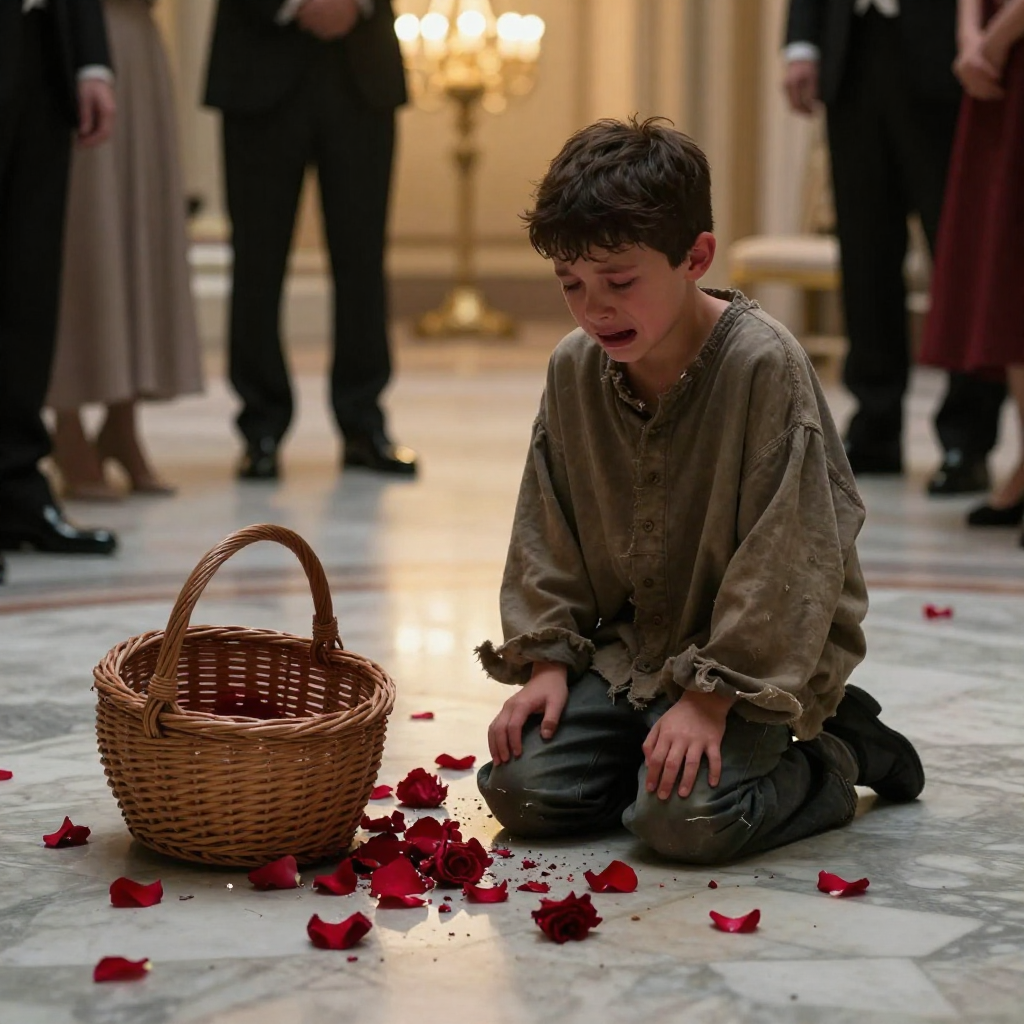
And then, he moved. It happened in slow motion. He drew his leg back, the polished black leather of his shoe gleaming under the lights, and he kicked. He didn’t kick me; he kicked the basket.
The wicker crunched. The force of the blow sent the basket flying from my hands. It hit the floor with a hollow thud, spilling the roses everywhere. Stems snapped. Petals exploded across the pristine white marble like splashes of blood.
“Oops,” the man said. He didn’t look sorry. He looked satisfied.
The room went dead silent. The music stopped. hundreds of eyes were on me. I felt a heat rise in my cheeks that burned hotter than any fever. I dropped to my knees. I didn’t say a word. I couldn’t. The lump in my throat was too big. I just started gathering them. My hands shook as I reached for the broken stems, trying to fit the severed heads back onto the stalks, as if I could fix them by sheer will. As if I could fix my life, my sister’s lungs, my empty pockets, just by wishing it so.
“Leave it,” the man sneered. “You’re tainting the elegance of the room. Go back to the gutter.”
I kept picking them up. One by one. A crushed red bud. A snapped white bloom. I was crying now, silent, hot tears dripping onto the ruined flowers. I calculated the loss in my head. No oxygen. No breath for Elara. I had failed her.
“I said, get out!” the man barked, stepping forward as if to kick me this time.
Suddenly, a heavy sound echoed through the hall. It was the feedback of a microphone being tapped. Thump. Thump.
Everyone froze. The man froze. I looked up through my blurry vision.
On the stage, standing alone in the spotlight, was the host. Mr. Elias Thorne. The reclusive billionaire who had founded this charity, the man everyone was here to impress. He was a ghost of a man, rarely seen in public, known for his cold business acumen. He wasn’t looking at the crowd. He was looking at me.
He didn’t speak to the audience. He walked down the stairs of the stage. The crowd parted for him like the Red Sea. He walked with a heavy, deliberate gait, his cane tapping against the floor. He walked straight past the wealthy man, straight past the stunned onlookers, and stopped in front of me.
The wealthy man, suddenly nervous, let out a breathless chuckle. “Mr. Thorne, I was just handling this intruder. Security was—”
Mr. Thorne ignored him. Slowly, painfully, the billionaire lowered himself to one knee. His suit probably cost more than my entire apartment building, but he knelt directly on the dirty floor, right amidst the scattered debris of my roses.
He reached out a hand—a hand that was old, veined, and trembling slightly—and picked up a broken rose.
“I was an orphan too,” he said. His voice wasn’t amplified by the microphone anymore, but in the silence of the room, it roared. He looked at me, and for the first time that night, I saw eyes that didn’t look through me. They looked at me.
He tucked the broken rose into his lapel pocket. Then he stood up, offering me his hand. I took it. His grip was warm and solid. He pulled me to my feet, dusting off my knees with his own hands.
Then, he turned to the man who had kicked me.
Mr. Thorne raised the microphone to his lips again. The wealthy donor was pale now, sweating under the lights.
“You,” Mr. Thorne said. The word hung in the air like an executioner’s blade. “You donated ten thousand dollars tonight. You did it to get your name on a plaque. You did it to look good.”
“Mr. Thorne, I…” the man stammered.
“Silence,” Thorne commanded. “You called this boy trash. You called poverty a disease. You forgot where you came from, or perhaps you never knew. But I know. I know what it is to be hungry. I know what it is to be invisible.”
Thorne reached into his pocket and pulled out a checkbook. He ripped the check the donor had given him earlier in half, the sound sharp and final. He let the pieces flutter to the floor, landing on top of the crushed petals.
“I am taking your name off the building,” Thorne said, his voice hard as iron. “And I am donating ten million dollars in this boy’s name to the pediatric respiratory wing. He has done more for the dignity of this room by simply existing than you have with your entire life’s fortune.”
The donor opened his mouth, but no sound came out.
Mr. Thorne turned to the security team standing by the doors. “Guards,” he said, pointing a shaking finger at the man in the tuxedo. “Throw the real trash out.”
CHAPTER II
The air inside the limousine didn’t smell like the world I knew. It didn’t smell like the damp rot of our basement apartment, or the metallic tang of the oxygen tanks that were Elara’s life support, or the charcoal smoke of the street vendors. It smelled of nothing, a sterile, expensive vacuum that felt heavier than the smog outside. I sat on the edge of the buttery leather seat, my knees pulled together, clutching the empty wicker basket that had once held the crushed roses. I felt like a stain on a masterpiece. Elias Thorne sat opposite me, his silhouette framed by the passing neon lights of the city. He didn’t look like a savior then; he looked like a man who was haunted by a ghost I couldn’t see.
“The hospital,” Thorne said into a small intercom. His voice was calm, but there was a vibration in it, a low-frequency hum of authority that made the driver pull away from the curb with a jolt. I watched the gala disappear behind us, the lights of the ballroom flickering like dying stars. Mr. Sterling was back there somewhere, probably standing on the sidewalk in his expensive suit, realizing that a single moment of cruelty had cost him his place in the sun. But I couldn’t find it in me to feel triumphant. I was terrified. The $10 million he had pledged in my name felt like a mountain of gold that was about to crush me. I was eight years old. I didn’t know what ten million meant, only that it was a number too big for a boy who sold flowers to pay for air.
We moved through the city in a silence that was thick and suffocating. I looked down at my hands—they were stained with the sap of the broken roses, the dark green residue looking like old bruises. I tried to wipe them on my trousers, but then I remembered these were the only clothes I had, and I didn’t want to make them worse. Thorne watched me. He didn’t offer a tissue. He didn’t offer words of comfort. He just watched, his eyes reflecting the streetlamps as they strobed past the tinted glass.
“Why?” I whispered. The word felt small in the vastness of the car.
Thorne leaned forward, the shadows shifting across his face. “Because I know what it’s like to have your heart trampled before you’ve had a chance to use it, Leo.” He used my name. I hadn’t told him my name. I realized then that a man like Elias Thorne didn’t need to be told things; he simply knew them. He reached into his pocket and pulled out a small, silver pocket watch. He flipped it open, the clicking sound sharp in the quiet cabin. “The world thinks it’s built on money. It’s not. It’s built on the moments where you decide whether to be a boot or a neck. Sterling chose to be a boot. I’m choosing to be the ground you stand on.”
Phase Two: The public irreversible event happened when we reached the St. Jude Medical Center. This wasn’t the free clinic where I usually took Elara, the one with the twelve-hour wait times and the peeling wallpaper. This was the spire of glass and steel where the city’s elite went to live forever. As the limousine pulled into the emergency bay, Thorne didn’t wait for the valet. He stepped out and reached back for me. I took his hand, his skin feeling like cold parchment.
“Where is she?” he asked.
“She’s… she’s at the apartment,” I stammered. “The tank is almost empty. I have to go to her.”
“No,” Thorne said, and his grip tightened. It wasn’t a violent grip, but it was absolute. He turned to the head of security who was already running toward us. “Send a medical transport to the East District, Sector 4. Find Elara Vance. Bring her here. Now. Top floor. My private wing.”
The security guard hesitated, his eyes darting to my tattered clothes and my empty basket. “Sir, the private wing is for—”
“The private wing is mine,” Thorne interrupted, his voice dropping to a level that made the air feel thin. “And the boy is mine. If she isn’t in a bed within twenty minutes, I will buy this hospital and fire every person whose name I can remember. Do I make myself clear?”
This was the triggering event. It was the moment my life was severed from the gravity of my past. People were watching—nurses, patients, reporters who always hovered near Thorne’s shadow. They saw a billionaire claiming a street urchin as his own. They saw the protocol of the city’s most prestigious institution buckle under the weight of one man’s will. From that second on, I was no longer Leo the flower boy. I was the Thorne Ward. It was public. It was recorded. And it was irreversible.
Phase Three: We waited in the glass-walled lobby of the private wing. I felt like a bug in a jar. Thorne stood by the window, looking out at the city he owned. He seemed to have forgotten I was there until I reached into my pocket and pulled out the one thing I had left of my parents—a small, tarnished copper locket. It had fallen out of my basket during the scuffle with Sterling, and I had managed to scoop it up. I opened it, looking at the faded photo of a woman with a smile that looked like Elara’s.
Thorne turned around. His eyes locked on the locket. For a moment, his composure cracked. He walked over and knelt in front of me, just as he had at the gala. But this time, his face wasn’t filled with righteous anger; it was filled with an old, jagged pain.
“Where did you get that?” he asked, his voice barely a whisper.
“It was my mother’s,” I said. “She died at the refinery. In the big fire.”
Thorne reached out, his fingers trembling as he touched the edge of the copper. This was the Old Wound. I saw it in his eyes—a memory of fire, of smoke, of a debt that could never be repaid. He pulled his hand back as if the metal had burned him. He had a secret, I realized. He didn’t just help me because of Sterling. He helped me because he was running from something.
“The Sterling Refinery,” he murmured. “I was the lead architect on that project. Thirty years ago.”
I froze. The refinery fire was the reason my parents were gone. It was the reason the air in the East District was poisoned, the reason Elara’s lungs were failing. The Sterling family had owned the land, but Elias Thorne had built the cages. He was the one who designed the ventilation systems that failed. He was the one who signed off on the cheap materials to save the budget.
This was the Moral Dilemma. The man who was currently paying for my sister’s life was the same man who had architected the disaster that necessitated her rescue. If I walked away now, Elara would die in that basement. If I stayed, I was taking blood money from the man who had orphaned us. I looked at the elevators. The doors opened, and a gurney was rushed out. Elara was on it, her face pale, a high-tech mask over her mouth. She looked so small, surrounded by the flurry of white coats.
“Leo?” she gasped through the mask, her eyes finding mine.
I had to choose. I looked at Thorne. He knew that I knew. I saw the confession in his silence. He was offering me a life of luxury as a penance for the lives he had helped extinguish. I could denounce him, tell the doctors to stop, take my sister back to the gutter where we were ‘clean’ but dead. Or I could step into his world, accept the lie, and give her a chance to breathe.
“I’m here, Elara,” I said, stepping toward her gurney. I didn’t look back at Thorne, but I felt him exhale behind me. I had made my choice. I had traded my resentment for her survival.
Phase Four: The years that followed were a blur of transformation. Thorne kept his word. He became my mentor, my guardian, and eventually, my shadow. He moved us into his estate, a place of marble and silence. Elara grew stronger, her lungs healing under the care of the world’s best specialists, though she would always carry a slight wheeze—a permanent reminder of where we came from.
Thorne taught me everything. He taught me how to read a balance sheet, how to spot a lie in a boardroom, and how to use wealth as a weapon. He treated me like the son he never had, but there was always a distance between us. We never spoke of the refinery again. It was a ghost that sat at the dinner table with us, a secret shared in the quiet clinking of silverware. I grew tall, my hands no longer stained with rose sap but with the ink of contracts. I became the face of Thorne Industries, the ‘miracle boy’ the press loved to write about.
But the weight of that night at the gala never left me. I realized that Thorne’s mentorship was a golden cage. He wasn’t just teaching me to be a leader; he was grooming me to take over the burden of his guilt. He wanted me to be the one to finally make the company ‘good,’ so he could die with a clear conscience.
I remember one evening, ten years after the gala. We were standing on the balcony of his penthouse, the same city lights twinkling below us. Thorne was older now, his hair a shock of white, his breathing labored. He leaned on his cane and looked at me.
“You’ve done well, Leo,” he said. “Tomorrow, we announce the acquisition of the Sterling estates. We’re turning their old refineries into parks. Into hospitals.”
I looked at him, and for the first time, I didn’t see the billionaire. I saw a man trying to buy his way into heaven with my life. I was twenty-five years old, successful, wealthy beyond imagination, and I felt more like an orphan than I ever had on the streets.
“Is it enough, Elias?” I asked. “Does the park fix the lungs of the children who grew up there?”
He didn’t answer. He couldn’t. The moral dilemma had evolved. I was no longer the boy needing to be saved; I was the man who had to decide whether to continue the legacy of a man built on a foundation of hidden graves. I had the power now, but the power was a gift from my enemy. Every breath Elara took was a breath paid for by the man who had taken our parents’ breath away.
As I stood there, looking out over the empire I was set to inherit, I realized the final truth of that night with the roses. Mr. Sterling had been a monster who showed his teeth. But Elias Thorne was a monster who showed his heart, and that was far more dangerous. The gala had been the beginning of my fortune, but it was also the end of my innocence. I had won the world, but I had lost the right to hate the people who broke it.
I looked down at my hands. They were clean, manicured, and steady. But in the reflection of the glass, I could still see the eight-year-old boy with the wicker basket, standing in the rain, waiting for someone to notice him. And I knew that no matter how many millions I spent, I would never be able to buy back the boy I was before the first rose was crushed.
CHAPTER III
The hospital room smelled like stale ozone and expensive regrets. Elias Thorne, the man who had bought my loyalty and my silence with a ten-million-dollar check, was finally breaking. The rhythmic beep of the cardiac monitor was the only thing keeping the silence from swallowing us whole. I sat in the designer chair by his bed, my hands resting on my knees. These were the hands of an executive now. They were clean, soft, and manicured. They didn’t look like the hands that used to scrub soot from Elara’s face after our parents died in the fire.
Elias gripped my wrist. His skin felt like wet parchment. He looked at me with eyes that were clouded by morphine and a decade of secrets. He didn’t ask about the company. He didn’t ask about his legacy. He whispered one name: ‘The Eastgate Refinery.’ It was the site of the disaster. The place where my parents had been turned into memory and ash. He was looking for absolution, but I had none to give him. I had spent years as his shadow, his protege, his golden boy. I had lived in the house built on the foundation of my family’s tragedy. Every meal I ate, every suit I wore, and every surgery that saved Elara’s life had been a payment for a debt Thorne could never actually settle.
I watched him struggle for breath. I thought about the files I had hidden in my office—the blueprints that proved he knew the refinery’s pressure valves were faulty six months before the explosion. He had chosen profit over people, and then he had chosen me as a way to quiet his conscience. I was his most successful charitable project. I was his living monument to ‘redemption.’ But looking at him now, I didn’t feel pity. I felt a cold, hard clarity. The man was dying, but the lie was still very much alive.
Then the door opened. It wasn’t the nurse. It was Julian Sterling. He was the son of the man who had tossed a coin at my feet at the gala ten years ago. Julian had inherited his father’s sneer and his talent for cruelty. He didn’t look at the dying man in the bed. He looked straight at me. He was holding a thin, silver tablet. He looked like a man who had finally found the weapon he’d been searching for. He walked to the foot of the bed, his expensive shoes clicking on the linoleum like a countdown.
‘It’s over, Leo,’ Julian said. His voice was a low, jagged rasp. ‘I found it. I found the original safety reports. My father always suspected Thorne was hiding something behind that saintly facade of his. It took ten years, but I finally have the paper trail that connects the refinery disaster directly to Thorne’s personal signature.’ Julian leaned over the bed, looking at the gasping old man. ‘You didn’t just fail to maintain that plant, did you, Elias? You intentionally bypassed the safety protocols to hit the quarterly targets. You killed those people for a stock bump.’
Julian turned his gaze back to me. ‘And you, the little rose boy. You’ve known, haven’t you? You’ve been living in this penthouse of lies while the families of the other victims were rotting in the slums. You’re not a success story, Leo. You’re a collaborator.’ He tapped the screen of the tablet. ‘I’m giving you one hour. Transfer the controlling interest of Thorne Industries to the Sterling Group, or this goes live to every major news outlet in the country. You can keep the money, but the name Thorne will become synonymous with mass murder. And you’ll be the face of the cover-up.’
He left the room as quickly as he had entered. The silence that followed was heavier than before. I looked at Elias. He was staring at me, his eyes wide with a desperate, silent plea. He wasn’t asking me to save him. He was asking me to save the company. He wanted me to take the deal. He wanted me to stay the ‘Thorne Ward’ forever, to bury the truth under a new layer of corporate acquisition. If I signed the papers, the Sterling family would own us, but the world would never know the truth. Elara would stay safe. Our lifestyle would remain intact. We would be wealthy, powerful, and utterly hollow.
I stood up. My legs felt heavy, as if I were wading through the very mud I had climbed out of years ago. I walked to the window. Below me, the city was a grid of light and motion. Thousands of people were going about their lives, unaware that their world was built on a series of small, calculated betrayals. I thought of Elara. She was at the recovery center, finally walking again, finally breathing without the help of a machine. If I blew this apart, I would be taking away the very thing that had saved her. I would be dragging her back into the dirt.
But then I remembered the smell of the smoke. I remembered the way my mother had pushed us toward the window as the ceiling collapsed. She hadn’t done that so I could become a shield for the man who killed her. She hadn’t died so I could wear a five-thousand-dollar suit and lie for a living. The moral weight of the last ten years suddenly shifted, crushing the gratitude I had felt for Thorne. It wasn’t charity. It was a ransom. He had bought my life to replace the ones he had stolen.
I went to my office in the hospital wing. My hands were steady as I logged into the Thorne Industries mainframe. I didn’t look for the transfer documents Julian wanted. I looked for the encrypted archive where Thorne had hidden the ‘Ghost Files.’ I had found them months ago but hadn’t had the courage to open the final lock. Now, the key was simple. It was the date of the fire. The moment I entered the numbers, the screen flooded with red. Internal memos. Payoffs to local inspectors. Photos of the damaged valves that were never replaced.
I heard a commotion in the hallway. Voices were rising. The Board of Directors had arrived, alerted by Julian’s threats. They burst into the room—a sea of gray suits and panicked expressions. These were the men who had guided Thorne’s hand for decades. They didn’t care about the deaths; they cared about the share price. ‘Leo, don’t be a fool,’ one of them hissed. ‘We can settle with Sterling. We can buy his silence. Do not touch those files. If you leak that data, the company is liquidated. Thousands of jobs will be lost. Your sister’s trust fund will be seized as part of the legal fallout. You will have nothing.’
I looked at them. They were the architects of this reality. They were the ones who had helped Thorne build a wall of gold around his crimes. ‘You’re right,’ I said, my voice sounding strange in my own ears. ‘I will have nothing. For the first time in ten years, I’ll be able to see my own reflection without wanting to look away.’ I moved my finger toward the ‘Broadcast’ command. This wasn’t just a leak to the press; it was a total system dump to the International Regulatory Commission. It was the ‘Explosion’ that should have happened a decade ago.
Just as I was about to click, the door was flung open by the hospital security. Behind them stood a woman I recognized from the news—Amara Vance, the head of the Federal Oversight Committee. She wasn’t here to negotiate. She had a federal warrant in her hand. The intervention of a higher authority had finally arrived, triggered by an anonymous tip Julian had sent earlier to pressure the board. But Julian had miscalculated. He thought the feds would be a threat I’d run from. He didn’t realize they were the only exit I had left.
‘Leo Thorne?’ she asked, her voice cold and professional. ‘We have reason to believe you are in possession of evidence regarding the Eastgate Refinery disaster. Step away from the computer.’ The board members began to scramble, shouting about attorney-client privilege. Julian stood in the corner, his face pale. He realized he had lost his leverage. He couldn’t blackmail me if the authorities were already in the room.
I didn’t step away. I looked Amara Vance in the eye. ‘I’m not Leo Thorne,’ I said. I felt the name fall off me like a layer of dead skin. ‘My name is Leo Miller. My parents died in that refinery. And I’m not just in possession of evidence. I’m the one who’s sending it.’ With one final, decisive motion, I hit the key. The progress bar moved with agonizing slowness. One percent. Five percent. The board members tried to lung for me, but the federal agents stepped in, blocking their path. The room descended into a chaos of shouting and static.
On the screen, the files began to disappear from our servers, reappearing on the public portals of the Regulatory Commission. The truth was out. It was a digital wildfire, jumping from server to server, hitting news desks from London to Tokyo. I watched as the value of Thorne Industries began to crater in real-time on the monitor. Billions of dollars in market cap vanished in seconds. The empire was dissolving. The hospital room, the expensive suit, the prestige—it was all evaporating.
I looked over at the bed. Elias Thorne was watching the screen. He saw his life’s work being dismantled by the boy he had tried to mold into his image. He didn’t look angry. He looked relieved. It was as if the weight he had carried for ten years had finally been transferred to the world. He took one long, shuddering breath, and the line on the monitor went flat. The machine’s high-pitched drone filled the room, a singular, piercing note that drowned out the shouting of the lawyers and the agents.
Julian Sterling approached me, his eyes burning with hatred. ‘You’ve ruined us all,’ he spat. ‘You think this makes you a hero? You’re a beggar again, Leo. You’ll be lucky if you aren’t in a cell next to the board. You’ve destroyed your sister’s future for a headline.’ He wanted me to flinch. He wanted to see the regret. But I felt a strange, buoyant lightness. I was back in the mud, but the mud was honest.
I walked past him, past the agents, and past the sobbing board members. I didn’t take anything with me. Not my phone, not my wallet, not the keys to the penthouse. I walked out of the hospital and into the night air. For the first time in a decade, the air didn’t taste like ozone. It tasted like rain. The public screens on the street were already flashing my face. ‘THORNE HEIR EXPOSES MASSIVE COVER-UP.’ ‘THE ROSE BOY SPEAKS.’ I wasn’t the golden heir anymore. I was the witness. I was the victim who had finally stopped playing the part of the beneficiary.
I found Elara waiting for me in the garden of her clinic. She had seen the news. She was standing on her own two feet, leaning slightly against a stone bench. Her face was pale, but her eyes were clear. She knew what this meant. We were going back to the beginning. We would have to fight for every cent, for every breath, and for a name that wasn’t stained with blood. She reached out and took my hand. Her palm was rough, a reminder of our childhood. ‘You did it,’ she whispered.
‘I ended it,’ I corrected her. The sirens were getting closer. The police, the press, the lawyers—they were all coming for me. The ‘Thorne’ legacy was a smoking ruin, and I was the one standing in the center of the wreckage. I had spent ten years being a monument to a man’s guilt. Now, I was just a man. I had no money, no title, and no protection. But as I looked at the flashing lights reflected in the puddles on the street, I realized I finally had something Thorne could never buy. I had the truth, and for the first time in my life, I wasn’t afraid of the fire.
CHAPTER IV
The silence after Thorne’s death was deafening. It wasn’t the peaceful hush of mourning, but the heavy, expectant quiet before a storm. The storm of legal battles, public outrage, and personal reckoning. The Ghost Files were out, and they were tearing through everything.
Elara and I holed up in a cheap motel on the outskirts of the city. The kind where the ice machine was always broken and the vending machines only dispensed stale chips. It was a far cry from the Thorne penthouse, but somehow, it felt… right. Like shedding a skin that never truly fit.
We watched the news coverage with a detached fascination. Thorne Industries, once a titan, was crumbling before our eyes. The Sterling family, initially triumphant, were now scrambling to distance themselves from the wreckage, their blackmail attempt exposed for what it was – a desperate power grab. Amara Vance and the Federal Oversight Committee were hailed as heroes, their faces plastered across every news outlet.
I kept waiting for the triumphant feeling to wash over me, the sense of justice served. But it never came. Instead, there was just this hollow ache, a deep weariness that settled in my bones. I’d destroyed an empire, exposed a killer, and ruined my own life in the process. And for what? For a truth that felt more like a curse than a blessing.
Elara tried to be strong, but I saw the cracks. The way she flinched at the sound of a news report, the haunted look in her eyes when she thought I wasn’t watching. We were orphans again, stripped of everything we thought we knew about ourselves and each other. The money, the power, the illusion of security – all gone.
**Public Fallout**
The lawsuit hit first. A class action suit filed by the families of the refinery workers who had died in the fire, a fire my own father was one of those workers. The suit named Thorne Industries, of course, but it also named me, as Thorne’s heir and the one who knowingly perpetuated the cover-up. The media pounced, painting me as a villain, a traitor to my own people. “Orphan Prince Turns on His Benefactor,” one headline screamed. “Blood Money: How Leo Maxwell Profited from His Parents’ Grave.”
Then came the whispers, the accusations, the hate mail. People I’d never met felt entitled to judge me, to condemn me for choices they couldn’t possibly understand. I was a pariah, an outcast. Even the few friends I thought I had disappeared, unwilling to be tainted by my association. Only Mr. Abernathy, Thorne’s old lawyer, stood by me, a stoic, unwavering presence in the chaos.
I tried to avoid going out, but Elara needed groceries. The first time we went to a supermarket, I felt like everyone was staring. A woman recognized me, her face twisting with disgust. “You’re that Thorne kid, aren’t you?” she spat. “You should be ashamed of yourself.” I wanted to disappear, to melt into the linoleum floor. Elara grabbed my hand, her grip surprisingly strong. “Let’s go,” she said, her voice tight. We left the groceries behind and fled back to the motel, our faces burning with shame.
**Personal Cost**
The worst part was the guilt. It gnawed at me, day and night. I knew I’d done the right thing, but the cost was so high. My parents were dead, Thorne was dead, and now our lives were in ruins. Elara and I were alone, adrift in a world that seemed determined to punish us for the sins of our benefactor.
Elara started having nightmares. I’d wake up to her screams, her body shaking with terror. She’d see the fire, hear the cries of the dying workers. I held her, trying to soothe her, but I knew my own nightmares were just as bad. We were both haunted by the ghosts of Thorne Industries, by the legacy of greed and corruption that had poisoned our lives.
I stopped sleeping, afraid of what I might dream. I spent my nights staring at the ceiling, replaying the events of the past few weeks in my mind. Thorne’s confession, the confrontation with Julian Sterling, the release of the Ghost Files. Each memory was a fresh wound, a reminder of everything I’d lost.
One morning, Elara found me staring at a bottle of pills. I hadn’t intended to take them, but the temptation was there. A way to escape the pain, to silence the voices in my head. Elara didn’t say anything, she just took the bottle from me and flushed them down the toilet. Then she held me, and we both cried until we couldn’t cry anymore.
**New Event**
A letter arrived a few weeks later. It was from Amara Vance. She wrote that she understood what I’d gone through, the impossible choices I’d been forced to make. She said that the Federal Oversight Committee was investigating the possibility of compensating the victims of the Thorne Industries disaster, and that she wanted my help.
I was hesitant. I didn’t trust anyone anymore, especially not politicians. But Elara convinced me to meet with her. “What else do we have to lose?” she asked, her voice weary.
Amara Vance was different in person than she appeared on television. She was younger, more vulnerable. She told me that she’d grown up in a refinery town, that she’d seen firsthand the damage that corporations could inflict on communities. She said that she wanted to make sure that the victims of Thorne Industries got the justice they deserved.
She asked me to testify before Congress, to tell my story. To explain why I’d released the Ghost Files, even though it meant destroying my own life. I refused. I couldn’t face the public again, the judgment, the hate. But Amara Vance was persistent. She argued that my testimony could make a difference, that it could help prevent similar tragedies from happening in the future.
Finally, I agreed, but on one condition: that Elara could be there with me. I couldn’t do it alone. The day of the testimony was the most terrifying day of my life. The room was packed with reporters, cameras flashing, the air thick with tension. I sat beside Elara, my hands clammy, my heart pounding in my chest.
Amara Vance introduced me, her voice calm and steady. I stood up, took a deep breath, and began to speak. I told them about my parents, about Thorne Industries, about the Ghost Files. I told them about the guilt, the shame, the pain. I told them everything.
The questions were brutal. The congressmen grilled me, trying to catch me in a lie, to discredit my testimony. But I stood my ground, answering each question honestly, refusing to back down. Elara sat beside me, her presence a source of strength, a reminder of why I was doing this.
After hours of questioning, it was finally over. I walked out of the hearing room, exhausted but strangely…relieved. I’d faced my demons, and I’d survived. But the hearing had unexpected consequences. Julian Sterling, desperate to salvage his reputation, leaked information to the press, claiming that Amara Vance and I were having an affair, that my testimony was nothing more than a political stunt to further her career. He provided fabricated emails and photos, painting a picture of corruption and deceit.
The media went wild. The narrative shifted. Amara Vance was no longer a hero, but a villain. I was no longer a victim, but a co-conspirator. The class action suit was jeopardized, the investigation stalled. The victims of Thorne Industries were once again denied justice.
**Moral Residues**
I wanted to scream, to lash out, to fight back. But I was too tired. I’d given everything, and it still wasn’t enough. The world was a cruel, unfair place, and I was just a pawn in someone else’s game.
Amara Vance called me, her voice strained. She apologized for putting me in this position, for dragging me into her political battles. I told her it wasn’t her fault, that the Sterlings would have found a way to destroy us anyway. But the damage was done. Her career was in ruins, and my reputation was shattered beyond repair.
The class action suit was eventually settled, but for a fraction of what the victims deserved. The Sterlings walked away with their fortunes intact, their power undiminished. Elias Thorne’s legacy of greed and corruption lived on, poisoning the lives of everyone it touched.
Elara and I were left with nothing but each other, and the bitter taste of injustice. We moved to a small town in the middle of nowhere, far away from the city, from the media, from the memories that haunted us. We found a small house with a garden, and we started to rebuild our lives, one day at a time.
I found work as a handyman, fixing things around the town. Elara started teaching art to children. We were no longer Leo Maxwell and Elara Thorne, but just Leo and Elara, two orphans trying to find their way in the world. We were scarred, broken, but not defeated. We had each other, and that was enough. Or, at least, it had to be.
CHAPTER V
The Greyhound coughed us up onto a cracked sidewalk in Harmony Creek, Iowa. Harmony Creek. The name tasted like irony, a cheap candy coating on a bitter pill. Elara gripped my hand, her knuckles white. We had three suitcases between us, a few hundred dollars scraped together from selling off the last of the ‘good’ clothes Thorne had bought us, and the crushing weight of a past we couldn’t outrun.
The air smelled like corn and something vaguely metallic, a ghost of the refineries we’d left behind. I looked at Elara. Her eyes, usually so bright, were clouded with exhaustion and a familiar fear. We were alone again, truly alone, stripped bare of everything except each other.
The first few weeks were a blur of cheap motels, dead-end job interviews, and the gnawing anxiety of being recognized. Every sideways glance felt like an accusation. Every news headline about the Thorne scandal felt like a punch to the gut. We’d become experts at blending in, at making ourselves invisible.
I found work at a dusty hardware store, sweeping floors and stocking shelves. Elara, with her quick mind, managed to land a job as a waitress at the only diner in town, a greasy spoon called ‘The Blue Plate Special.’ The tips were meager, but the owner, a woman named Marge with a heart as big as her apron, took a liking to Elara. She slipped her extra food and offered a kind word when she looked like she might shatter.
One evening, after a particularly grueling shift, I came home to find Elara sitting on the edge of the bed, a stack of newspapers spread out around her. Her face was pale.
‘They’re still at it, Leo,’ she said, her voice barely a whisper. ‘The Sterlings. They’re… they’re suing the victims now. Claiming the refinery was up to code, that it was all an… accident.’
Rage, cold and familiar, coiled in my stomach. I wanted to scream, to break something, to lash out at the injustice of it all. But I looked at Elara, at the exhaustion etched on her face, and I knew that wasn’t the answer. Violence, even the verbal kind, wouldn’t bring back our parents. It wouldn’t ease the pain of the victims. It would only consume us.
‘We can’t let them get away with it, Leo,’ Elara said, her voice hardening with a resolve I hadn’t seen in a while. ‘We know the truth. We have to do something.’
I didn’t know what to do. We were nobodies, two orphans with a tainted past and no resources. How could we possibly fight the Sterlings, with their endless wealth and power?
***
The answer, as it often does, came in the most unexpected way. One afternoon, while I was unloading a shipment of garden supplies, a woman approached me. She was weathered and worn, her eyes filled with a quiet sadness. Her name was Martha, and she was one of the refinery victims. She’d lost her husband in the fire.
‘I know who you are, Leo,’ she said, her voice gentle. ‘I know what you did. You tried to do the right thing.’
I braced myself for anger, for accusation. But it didn’t come. Instead, she reached out and took my hand.
‘We’re not giving up,’ she said. ‘We’re going to fight them. But we need help. We need someone who understands.’
That was the turning point. It wasn’t about revenge, or justice, or even clearing our own name. It was about helping these people, these families who had lost everything because of Thorne’s greed and the Sterlings’ complicity.
Elara and I started attending community meetings, listening to the stories of the victims. We learned about their struggles, their pain, their unwavering determination. We helped them organize, offering what little legal knowledge we had gleaned from Thorne’s lawyers.
It was slow, grinding work. The Sterlings’ lawyers were relentless, using every trick in the book to delay and discredit the victims. But we persisted, fueled by a sense of purpose we hadn’t felt since… well, since before Thorne had entered our lives.
We realized we didn’t need Thorne’s money to make a difference. We didn’t need power or influence. We just needed to be there, to listen, to support, to fight alongside these people who had become our family.
One evening, Elara came to me with an idea. ‘Remember how we used to sell roses, Leo? Before Thorne? We could do that again. We could raise money for the victims.’
It seemed like a small thing, a drop in the ocean. But it was a start. We pooled our meager savings and bought a few dozen roses from a local florist. We set up a small stand in the town square, a simple wooden table with a hand-painted sign: ‘Roses for Remembrance.’
***
The response was overwhelming. People lined up to buy roses, not just out of sympathy, but out of solidarity. They knew our story, they knew what we were trying to do. And they wanted to help.
We weren’t just selling roses. We were selling hope. We were selling a sense of community. We were selling the idea that even in the face of overwhelming injustice, it was possible to fight back, to make a difference.
The money we raised wasn’t enough to cover all the legal fees, but it was enough to keep the lawsuit alive. More importantly, it gave the victims a sense of empowerment, a sense that they weren’t alone.
Julian Sterling, predictably, tried to interfere. He sent his lawyers to harass us, to threaten us, to try to shut us down. But we refused to be intimidated. We knew we were on the right side of history. And we had the support of the community behind us.
One afternoon, Julian himself showed up at our rose stand. He was dressed in an expensive suit, his face contorted with anger.
‘You think you can win, Leo?’ he sneered. ‘You think you can beat me? You’re nothing but a couple of orphans.’
I looked at him, at the years of privilege and entitlement etched on his face. And I felt a sense of pity, not for myself, but for him.
‘We’re not trying to beat you, Julian,’ I said, my voice calm. ‘We’re just trying to help these people. We’re trying to make things right.’
He laughed, a harsh, grating sound. ‘You’re a fool, Leo. You’ll never win.’
He turned and walked away, his expensive shoes clicking on the pavement. I watched him go, feeling nothing but a quiet sense of determination.
***
The lawsuit dragged on for months, but eventually, we won. It wasn’t a complete victory. The Sterlings managed to avoid admitting any direct responsibility for the fire. But they were ordered to pay a significant settlement to the victims.
It wasn’t enough to bring back their loved ones, but it was enough to help them rebuild their lives. It was enough to give them a sense of closure.
Elara and I used our share of the settlement to establish a foundation to help other victims of corporate greed. We called it the ‘Harmony Creek Fund,’ a reminder of the small town that had given us a second chance.
We continued to sell roses, not just for fundraising, but as a symbol of hope and resilience. We expanded our operation, enlisting the help of other victims. We turned it into a collective, a community-owned business that provided sustainable livelihoods for those who had lost everything.
One evening, as I was closing up the rose stand, Martha approached me. She was smiling, a genuine smile that reached her eyes.
‘You know, Leo,’ she said, ‘you and Elara… you’ve brought more than just money to this town. You’ve brought hope. You’ve brought us together.’
I looked at her, at the faces of the other victims, at the sense of community that had grown out of tragedy. And I realized that she was right.
We hadn’t found wealth or power or even justice. But we had found something more important: a sense of purpose, a sense of belonging, a sense that even in the darkest of times, it was possible to find light.
Elara joined us, placing a hand on my shoulder. The air was cool, carrying the scent of roses and freshly turned earth.
We stood there, side by side, watching the sun set over Harmony Creek. The future was uncertain, but for the first time in a long time, I felt a sense of peace. We had lost so much, but we had also gained something invaluable: the knowledge that true wealth lies not in money or power, but in integrity and community.
We were just two orphans, selling roses on a street corner. But we were also something more: survivors, fighters, beacons of hope in a world that often seemed hopeless.
The faces of our parents were etched in our minds, a constant reminder of what had been lost, and what we were fighting for. Their love and their sacrifice would never be forgotten.
As the stars began to appear in the night sky, I knew that we were finally home.
We weren’t running anymore.
We were building.
And we were doing it together.
The scent of roses hung heavy in the air, a promise of beauty amidst the ashes. It was the scent of a new beginning, a testament to the enduring power of the human spirit.
The work would be hard, the road long. There would be setbacks and disappointments. But we would face them together, with courage and compassion, knowing that even the smallest act of kindness could make a difference.
Julian Sterling, with all his wealth and power, would never understand what we had found. He would continue to chase after empty dreams, forever trapped in his gilded cage. But we were free.
Free to live, free to love, free to make a difference.
And that was all that mattered.
Years later, Harmony Creek would be known for its roses. For the resilience of its people. And for the two orphans who had shown them that even in the face of unimaginable loss, it was possible to find hope.
Elara squeezed my hand, her eyes shining with unshed tears.
‘We did it, Leo,’ she whispered. ‘We finally did it.’
I smiled, a genuine smile that came from deep within my soul.
‘We did it together, Elara,’ I said.
The roses smelled sweeter than ever.
And as I looked up at the stars, I knew that our parents were watching over us, their hearts filled with pride.
Even in death, they were still guiding us, still inspiring us, still loving us.
And that was enough.
The fight was over. The healing had begun. And the future, though uncertain, was filled with hope.
The scent of roses would forever remind us of the power of community, the importance of integrity, and the enduring strength of the human spirit.
The sun rose the next morning, casting a golden glow over Harmony Creek. It was a new day, a new beginning.
And we were ready.
The faces of the people we had helped, the lives we had touched, were etched in our hearts, a constant reminder of the importance of our work.
We would never forget the past, but we would not be defined by it.
We were survivors. We were fighters. We were beacons of hope.
And we would continue to sell roses, one bloom at a time, until the world was filled with beauty and compassion.
There was still work to be done, wounds to heal, battles to fight.
But we were no longer alone.
We were a community. We were a family. We were Harmony Creek.
And we would face the future together, with courage and conviction, knowing that even the smallest act of kindness could make a world of difference.
I smiled, a smile of quiet satisfaction, a smile that reflected the peace that had finally settled within my soul.
The roses smelled sweeter than ever.
And as I looked up at the sky, I knew that we had finally found our way home.
The weight of the past began to lift, replaced by a sense of hope and purpose.
We had lost everything, but we had also gained everything.
We had found ourselves.
And we were ready to face whatever the future held, together.
The scent of roses would forever remind us of the power of love, the importance of forgiveness, and the enduring strength of the human spirit.
There were still tears to be shed, but they were tears of healing, tears of gratitude, tears of hope.
We had come a long way from the streets of the city, from the clutches of Elias Thorne, from the darkness of our past.
We had found our way to Harmony Creek, a place where we could finally be ourselves, a place where we could finally make a difference.
And as I looked at Elara, at the light in her eyes, I knew that we were exactly where we were supposed to be.
We were home.
We were finally home.
It didn’t erase the pain, but it gave it a purpose.
The ghosts were still there, but they no longer haunted us.
They were a part of us, a reminder of where we had come from, and what we had overcome.
And as I looked at the faces of the people we had helped, I knew that our parents would be proud.
Their love and their sacrifice had not been in vain.
We had honored their memory, not with wealth or power, but with integrity and compassion.
And that was the greatest legacy of all.
That we could still find beauty, even in the ashes.
The wind carried the scent of roses, a whispered promise of hope.
And for the first time in a long time, I believed it.
I believed that we could build a better world, one rose at a time.
And that was a legacy worth fighting for.
We had found a way to make amends.
We had turned our pain into purpose.
And that was the greatest victory of all.
Standing beside my sister in Harmony Creek, selling roses again, I understood that wealth isn’t what you have, but what you give, what you leave behind for others to cherish.
That’s what I realized that day.
Our parents would have been proud.
That was the truth.
We were home.
The thorns protect the roses, and the roses masked the thorns.
END.