THEY FROZE ME AND LAUGHED, BUT THEY FORGOT I AM NOT WHO THEY THINK I AM. NOW, THEY WILL KNOW WHAT REAL COLD FEELS LIKE.
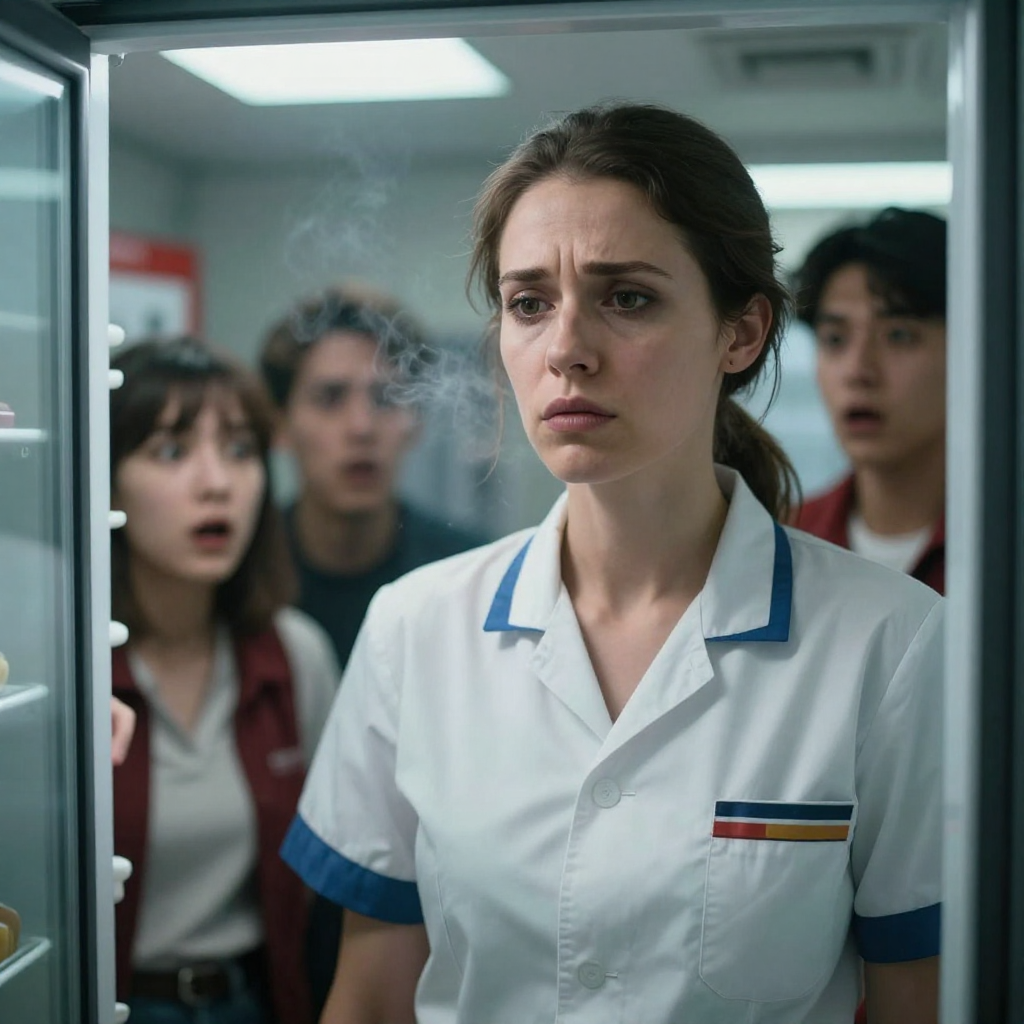
The latch clicked shut with a finality that echoed in the sudden, chilling silence. Through the small, reinforced glass window in the freezer door, I saw their faces—smirking, expectant. I recognized the glint of malice in Sarah’s eyes, the nervous energy in Mark’s fidgeting hands, and the dull, almost vacant amusement on David’s face. They thought this was a joke, a prank gone slightly too far, maybe. They didn’t understand. None of them did.
I’d worked at the diner for almost five years, ever since I’d arrived in this town, hoping for a fresh start. The ‘Sunshine Diner’ – a cruel irony, really, considering the perpetual cloud that seemed to follow me. Five years of greasy burgers, lukewarm coffee, and forced smiles, all to keep a roof over my head and food on the table. I was the invisible woman, the one who cleaned up after everyone else’s messes, the one who listened to their complaints and never voiced my own. Sarah, Mark, and David – the golden children of this small town, the ones who’d never known a day of real hardship. They saw me as nothing more than a fixture, a background character in their perfectly curated lives.
It started small, the taunts, the petty thefts of my tips, the constant reminders that I was somehow less than them. I ignored it, mostly. I needed the job, and I’d learned long ago that some battles weren’t worth fighting. But it had escalated in recent weeks. The whispers turned to open mockery, the thefts to blatant displays of power. And today, it had culminated in this – a forced confinement in the industrial freezer, a spectacle for their twisted entertainment.
The cold was immediate, biting into my skin, stealing my breath. I wrapped my arms around myself, trying to conserve what little warmth I had. My thin diner uniform offered no real protection against the sub-zero temperatures. Panic began to creep in, a cold, clammy hand squeezing my heart. I could see them through the glass, their laughter muffled but unmistakable. Sarah raised her phone, filming. Of course, she was. They wanted proof, a memento of their cruelty.
But beneath the fear, something else began to stir. A deep, ancient anger, a cold fury that had been dormant for years, threatened to erupt. They thought they knew me, these privileged children. They saw only the meek, unassuming waitress, the silent observer. They had no idea who I truly was, what I was capable of. They had no idea what I had survived.
Time seemed to warp and bend in the freezer. The cold intensified, numbing my fingers and toes. My breath crystallized in the air, forming a swirling cloud around my face. I focused on slowing my breathing, on controlling the rising tide of panic. I thought of my grandmother, her weathered face, her strong hands. She had taught me how to survive, how to endure the unimaginable. She had told me stories of our ancestors, of their resilience, their strength, their unwavering spirit. These stories were my armor, my shield against the encroaching cold.
I remembered Siberia. Not from my own life, but from the stories. Generations of my family, sent to the gulags for simply being who they were. The cold was a constant companion there, a tool of oppression, a weapon of despair. But it had also forged something unbreakable within them, a spirit that refused to be extinguished.
As the minutes ticked by, I began to see things with a chilling clarity. Sarah, Mark, and David weren’t just tormentors; they were symptoms of a much larger disease. A disease of apathy, of cruelty, of unchecked privilege. They were the products of a society that valued appearances over substance, that rewarded those who conformed and punished those who didn’t. And I, in my silence, in my invisibility, had allowed it to fester.
I closed my eyes, focusing on that inner fire, that ancient rage. I would not be a victim. I would not let them break me. I would survive this, and I would make them understand the consequences of their actions. The cold was still there, but it no longer felt like a threat. It felt like a challenge, a test. And I was ready to meet it.
I began to move, slowly at first, stamping my feet, swinging my arms. I needed to keep the blood flowing, to fight the encroaching numbness. I focused on the image of their faces, their smug, self-satisfied expressions. That image fueled me, gave me strength. I would not give them the satisfaction of seeing me broken.
Then, something shifted. It wasn’t a physical sensation, but something deeper, something almost spiritual. I felt a surge of power, a sense of clarity that transcended the cold, the fear, the anger. I understood, in that moment, that I was not defined by my circumstances, by the labels others had placed upon me. I was more than the sum of my past traumas, more than the meek waitress at the Sunshine Diner. I was a survivor, a warrior, a force to be reckoned with.
The hour mark came and went. I could hear their muffled voices outside the door, their laughter growing more nervous, more strained. They were expecting to find a frozen corpse, a testament to their cruelty. But they were wrong. So very wrong.
The door swung open, and light flooded the freezer. Sarah, Mark, and David stood there, their faces a mixture of shock and apprehension. They expected to see me crumpled on the floor, defeated. Instead, they found me standing tall, my eyes blazing with a cold fire that mirrored the Siberian winters of my ancestors. I stared at them, and for the first time, they saw me. Really saw me. And in their eyes, I saw something flicker: fear.
“Had enough?” I asked, my voice low and steady, each word laced with a chilling calm. The question hung in the air, unanswered. They didn’t know what to say. They didn’t know what to do. They had underestimated me, and now, they were about to pay the price.
CHAPTER II
The freezer door swung open, flooding the small space with the diner’s warm, greasy air. I blinked against the sudden brightness, the cold receding like a tide pulled back from the shore. Sarah, Mark, and David stood there, their faces a mix of shock and something I couldn’t quite decipher. Fear, maybe? It was hard to tell. My body still trembled, but a strange calm had settled over me, a quiet strength I didn’t know I possessed. The Siberia my grandmother spoke of wasn’t just a place on a map; it was a part of me, a resilience buried deep within my blood. I stepped out, my legs stiff, my gaze unwavering. They flinched. Good.
“Fun’s over,” I said, my voice surprisingly steady. The words hung in the air, a stark contrast to the laughter and taunts that had echoed through the freezer door just moments before. Sarah opened her mouth, probably to deliver some cutting remark, but I cut her off. “Don’t. Just… don’t.” I walked past them, each step deliberate, each breath a conscious act of defiance. The diner seemed different now, the familiar smells of coffee and bacon somehow sharper, more real. Walter, the old man who always sat at the counter nursing a cup of black coffee, watched me with an unreadable expression. He nodded slightly, a silent acknowledgment of something I couldn’t yet understand.
I needed to get out. Needed to breathe air that hadn’t been chilled to near-freezing. I grabbed my purse from the back room, ignoring the stares of my coworkers. As I reached the door, Walter called out, “Anna, wait.” I turned, surprised. He rarely spoke, usually just offering a grunt or a brief nod. “You have… you have your grandmother’s eyes,” he said, his voice raspy but kind. “She was a strong woman.” I stared at him, confused. How did he know my grandmother? I didn’t have time to ask. I had to leave, to escape the suffocating atmosphere of the Sunshine Diner. “I… I have to go,” I stammered, and hurried out into the afternoon sun.
The air outside was a balm on my frozen skin, but the chill inside me lingered. I walked without direction, my mind racing, trying to make sense of what had just happened. The cold wasn’t just a physical sensation; it was a metaphor for the way I had allowed myself to be treated, the way I had shrunk myself to fit into the small, mean-spirited world of the Sunshine Diner. But something had shifted in that freezer, something had broken. I couldn’t go back to being the person I was before. I couldn’t.
That night, I couldn’t sleep. Every time I closed my eyes, I saw the faces of Sarah, Mark, and David, their laughter echoing in my ears. But I also saw Walter, his eyes filled with a knowing that unsettled me. Who was he? And what did he know about my grandmother? The questions swirled in my mind, adding to the already overwhelming sense of unease. I tossed and turned, replaying the events of the day, searching for answers, for some kind of explanation. But there was none. Just the cold, hard reality of what had happened, and the unsettling feeling that my life was about to change in ways I couldn’t yet imagine.
My phone buzzed on the nightstand, jolting me awake. It was a text from Sarah: “We need to talk.” I stared at the message, a knot forming in my stomach. What did she want? An apology? An explanation? Or something else entirely? I didn’t want to talk to her, didn’t want to relive the humiliation and fear of the freezer. But I knew I couldn’t avoid it forever. I had to face them, had to confront the people who had tried to break me. I texted back: “Okay. Tomorrow. Diner. Before work.”
***
The next morning, I arrived at the Sunshine Diner before dawn. The air was still cool, the sky just beginning to lighten. I saw Sarah, Mark, and David sitting at a booth in the back, their faces pale in the dim light. They looked like guilty children, caught with their hands in the cookie jar. I walked over to the booth, my heart pounding in my chest. I tried to project the calm, strong facade from the freezer, but inside, I was terrified.
“What do you want?” I asked, my voice sharper than I intended. Sarah spoke first, her voice trembling slightly. “We… we’re sorry, Anna. We didn’t mean for it to go that far.” “Didn’t mean for it to go that far?” I repeated, my voice rising. “You locked me in a freezer! You filmed it! You laughed! How much further did you want it to go?” Mark chimed in, his voice placating. “It was just a joke, Anna. We didn’t think it would actually… you know…” I cut him off. “Didn’t think? You didn’t think at all! You just wanted to humiliate me, to make yourselves feel better by putting me down.” David, who had been silent until now, finally spoke. “We’re under a lot of pressure, Anna. Mr. Henderson is riding us hard. The diner is failing, and he’s threatening to fire us all.”
His words surprised me. I knew the diner wasn’t doing well, but I hadn’t realized how much stress they were under. It didn’t excuse their behavior, but it did offer a glimpse into their motivations. “So, what?” I asked. “You decided to take it out on me?” Sarah sighed. “We know it was wrong, Anna. We’re really sorry. We just… we don’t want to lose our jobs.” The old wound. My family had lost everything, multiple times. I knew what that desperation felt like. A secret; I had savings, enough to help, to keep the diner afloat. A moral dilemma. I could help them, save their jobs, but it would mean forgiving them, forgetting what they had done. Could I do that? Could I put their needs before my own anger and pain?
Walter walked in, disrupting the tense silence. He glanced at our group, his eyes lingering on me for a moment before he sat at the counter. Mr. Henderson emerged from the kitchen, his face grim. “What’s going on here?” he demanded. “Why aren’t you working?” Sarah, Mark, and David exchanged nervous glances. I knew what I had to do. I had to make a choice, a choice that would define who I was, who I wanted to be. I took a deep breath and spoke. “We were just discussing the new menu, Mr. Henderson,” I said, my voice calm and steady. “We have some ideas that we think will really help the diner.” He looked skeptical, but the flicker of hope in his eyes was undeniable. “Alright,” he said. “Let’s hear them.”
***
We spent the next hour brainstorming, coming up with new dishes, new promotions, new ways to attract customers. Sarah, Mark, and David were surprisingly creative, their fear of losing their jobs fueling their energy and ideas. I contributed my own suggestions, drawing on my knowledge of traditional Siberian cuisine, adding a unique twist to the diner’s offerings. Mr. Henderson listened intently, occasionally offering his own input. By the end of the hour, we had a solid plan, a roadmap for revitalizing the Sunshine Diner. He seemed impressed, even cautiously optimistic. “Alright,” he said. “Let’s try it. If this works, you’ll all get a bonus.”
As he walked away, Sarah, Mark, and David turned to me, their faces filled with gratitude. “Thank you, Anna,” Sarah said, her voice sincere. “You didn’t have to do that.” “Yeah,” Mark added. “We really appreciate it.” I shrugged. “We all need this job,” I said. “We’re all in this together.” But deep down, I knew it was more than just about the job. It was about forgiveness, about compassion, about choosing to see the good in people, even when they had hurt me. It was about breaking the cycle of cruelty and negativity that had plagued the Sunshine Diner for so long. I had made my choice. I had chosen to help them.
But the relief was short-lived. As we were preparing for the breakfast rush, Walter approached me. “I need to talk to you, Anna,” he said, his voice urgent. “It’s about your grandmother.” My heart skipped a beat. What did he know? And why was he so interested in my family history? I followed him to a quiet corner of the diner, my mind racing with questions and anxieties. He turned to me, his eyes filled with a mixture of sadness and determination. “Your grandmother,” he said, “she wasn’t just a strong woman. She was a freedom fighter. She fought against the Soviet regime, and she paid the price for it.” He paused, taking a deep breath. “And so did I. I was one of her comrades. We were betrayed, captured, and sent to the gulags. I escaped, but she… she never made it out.”
His words hit me like a punch to the gut. My grandmother, a freedom fighter? A political prisoner? It was a revelation that shattered everything I thought I knew about my family. “But… why didn’t she ever tell me?” I asked, my voice trembling. Walter sighed. “She wanted to protect you, Anna. She didn’t want you to carry the burden of her past. She wanted you to have a normal life, a life free from fear and persecution.” He reached into his pocket and pulled out a small, tarnished silver locket. “She gave me this before we were captured,” he said. “She told me to give it to you if I ever found you.” He opened the locket, revealing a tiny portrait of my grandmother, her eyes filled with a fierce determination that mirrored my own. “She wanted you to know,” Walter said, “that her spirit lives on in you. That you are her legacy.”
I took the locket, my fingers tracing the delicate engraving. A wave of emotion washed over me, a mixture of grief, pride, and a newfound sense of purpose. My grandmother’s story, her courage, her sacrifice, it was all a part of me now. And I couldn’t ignore it any longer. I looked at Walter, his face etched with the pain of the past. “What happened after you escaped?” I asked. “Why did you come here?” He hesitated for a moment, his eyes filled with a deep sadness. “I came here to find her family,” he said. “To make sure they were safe. But I was too late. Her husband had died, and her daughter… your mother… she had disappeared. I searched for years, but I couldn’t find her. I thought I had lost them forever. Until I saw you, Anna. Until I saw your grandmother’s eyes.”
He had been watching over me this whole time. But why didn’t he reveal himself? “Why didn’t you say anything?” I asked. Walter looked down. “I wasn’t sure if you were ready to know the truth. About your grandmother, about your family. About me…” He paused. “The people who betrayed us back then… they are still out there, Anna. Powerful people. People who will stop at nothing to protect their secrets.” My blood ran cold. This was bigger than I thought. The danger my grandmother had tried to protect me from, it wasn’t just a memory; it was still a very real threat. And now, because of Walter, because of the locket, because of my grandmother’s eyes, I was caught in the middle of it. The triggering event, the words that would change everything, came next. Walter’s voice was barely above a whisper, yet the diner seemed to fall silent. “They know you are here, Anna. They know who you are. They are coming for you.”
CHAPTER III
The bell above the diner door chimed. Not the usual, friendly ding, but a loud, almost aggressive clang. Three men walked in. Not customers. They moved with a purpose that screamed danger. Dark suits. Sunglasses, even inside. The kind you see in movies.
My heart hammered. Walter stiffened beside me at the counter. He knew. He definitely knew.
One of the men scanned the diner. His eyes stopped on me. A chill ran down my spine. This was it. They’d found me.
“Looking for someone?” I asked, trying to keep my voice steady. My hands were shaking so badly I gripped the counter.
The man smirked. “We’re looking for a waitress. A very special waitress.”
Sarah, Mark, and David exchanged nervous glances. They sensed it too. Something was terribly wrong. The air thickened, heavy with dread.
“I’m the waitress,” I said. “What do you want?”
The man stepped closer. “We want what belongs to us.” His eyes flickered to the locket around my neck. My grandmother’s locket.
Walter pushed himself off the stool. “Leave her alone,” he growled. His voice was surprisingly strong.
The man laughed. “You? What are you going to do, old man?” He nodded to the other two men. They moved to flank Walter. David flinched. He looked like he wanted to disappear.
“This doesn’t concern you,” the man said to me. “Just hand over the locket, and we’ll be on our way.”
My mind raced. Give them the locket? What was so important about it? And what did they want it for? My grandmother… what did she do?
I thought of Siberia. Of the cold. Of my grandmother’s strength. A strength I felt stirring within me now.
“No,” I said. “I won’t give it to you.”
The man’s face hardened. “You’re making a mistake.”
“Maybe,” I said. “But it’s my mistake to make.”
He signaled to his men. “Take it from her.”
Everything happened fast. Walter threw a punch. It connected with one of the men’s jaws. The other man grabbed Walter from behind. I shoved the first man back. He stumbled. I saw my chance.
I ran. Towards the back of the diner. Towards the freezer.
The freezer. My prison. But now, maybe, my sanctuary.
I heard them crashing after me. Yelling. Sarah screamed. Mark was trying to dial 911.
I slammed the freezer door shut and locked it. The familiar cold washed over me. But this time, it didn’t scare me. It empowered me.
I wasn’t trapped. I was safe. For now.
I leaned against the door, panting. Listening. The men were pounding on the door. Shouting threats.
“Open the door!” the man yelled. “Or we’ll burn this place to the ground!”
Burn the diner? They would hurt everyone? I couldn’t let that happen. I had to do something. But what?
I looked around the freezer. Boxes of frozen food. Ice cream. Nothing I could use as a weapon. Except…
The meat cleaver. Hanging on the wall. For cutting steaks.
I grabbed it. The cold steel felt heavy in my hand. But it also felt…right.
This wasn’t me. I was a waitress. Not a fighter. But my grandmother was a fighter. And her blood flowed in my veins.
The pounding on the door intensified. They were going to break it down.
I took a deep breath. And waited.
The door splintered. The men burst in. The leader pointed a gun at me.
“Last chance,” he said. “Give me the locket.”
I raised the meat cleaver. “No.”
He fired. The bullet whizzed past my ear. I flinched, but I didn’t drop the cleaver.
I charged. I swung the cleaver. It connected with his arm. He screamed and dropped the gun.
The other two men rushed me. I ducked under a punch and kicked one in the stomach. He doubled over. The other one grabbed me. I wrestled free and slashed at him with the cleaver. He cried out and backed away.
I stood there, panting, the meat cleaver dripping with blood. The men stared at me in shock. They hadn’t expected this. A waitress fighting back?
The leader, clutching his arm, snarled. “You’ll regret this.”
Suddenly, the diner doors burst open. Police officers flooded the room, guns drawn.
“Freeze!” one of them yelled. “Drop your weapons!”
The men didn’t hesitate. They threw their hands up in the air. The police swarmed them, handcuffing them.
I lowered the meat cleaver, my body trembling. The adrenaline faded, leaving me weak and shaky.
A police officer approached me. “Are you okay, ma’am?”
I nodded, unable to speak. My gaze drifted to the back of the diner. Sarah, Mark and David stood behind the counter, huddled together. Walter was on the floor, being helped up by another officer.
Then I saw her. Standing near the door. Watching me. A woman in a dark suit. But it wasn’t the same suit as the men. This one was tailored, expensive. Power radiated from her like heat.
She made eye contact with me. A ghost of a smile played on her lips. And then she was gone.
Everything fell apart after the police came. The leader and his goons were arrested, but something felt unfinished. Why did they want the locket so badly? Who was the woman watching from the doorway? Was the danger really over?
Walter was hurt badly, but he refused to go to the hospital until he spoke with me. He told the police he was family. They let him sit with me in the back of the ambulance.
“They know,” he croaked. “They know about you.”
“Who knows?” I asked, my voice trembling.
“The organization,” he said. “The ones your grandmother fought against. They’re still out there. And they’re more powerful than ever.”
“But why me?” I asked. “Why now?”
Walter coughed, blood flecking his lips. “The locket,” he said. “It’s not just a piece of jewelry. It’s a key. It unlocks something they desperately want to keep hidden.”
“What does it unlock?” I pressed him.
He shook his head weakly. “I can’t tell you. It’s too dangerous. You have to find out for yourself.”
“But how?” I pleaded. “I don’t know anything about this!”
He reached into his pocket and pulled out a small, folded piece of paper. “This is a name,” he whispered. “Someone who can help you. But be careful. Trust no one.”
He pressed the paper into my hand. His eyes fluttered closed. And then he was gone. The paramedics shouted, the ambulance lurched, and the world tilted on its axis.
I stared at the piece of paper in my hand. A name. A lifeline. But also a warning. Trust no one. How could I trust anyone when I didn’t even know who to trust myself?
I looked down at my hands, still stained with blood. Was this who I was now? A fighter? A target? A descendant of a Siberian freedom fighter?
The diner was a crime scene. Yellow tape cordoned off the entrance. Sarah, Mark, and David stood huddled together across the street, watching. Their faces were pale and drawn.
I walked over to them. “I’m sorry,” I said. “I didn’t mean for any of this to happen.”
Sarah shook her head. “It’s not your fault, Anna. We saw what happened. You were amazing.”
“But the diner…” Mark said, his voice choked with emotion. “It’s ruined.”
“We’ll rebuild,” David said, his voice surprisingly firm. “We’ll make it better than ever.”
I looked at them, surprised. They had changed. They weren’t the same people who had locked me in the freezer. They had seen something tonight. Something that had shaken them to their core.
“I have to go,” I said. “I have to find out what this is all about.”
“Be careful, Anna,” Sarah said. “Please.”
I nodded. And then I walked away. Leaving the diner behind. Leaving my old life behind. Stepping into the unknown.
I found a cheap motel on the outskirts of town. I needed a place to think. A place to plan. A place to be alone.
I sat on the edge of the bed, staring at the locket in my hand. My grandmother’s locket. The key to a mystery that could cost me my life.
I opened the piece of paper Walter had given me. A name was scrawled across it in faded ink:
“Boris Volkov.”
I didn’t know who he was. Or where to find him. But I knew one thing. I had to find him. He was my only hope.
I started to pack. A few clothes. Some cash. The locket. And the meat cleaver. Just in case.
As I closed my suitcase, I saw something glinting on the floor. A small, silver object. I picked it up. It was a bullet. The one that had whizzed past my ear in the freezer.
I stared at it for a long moment. Then, I slipped it into my pocket. A reminder of what was at stake. A reminder of what I was fighting for.
I checked out of the motel. The sun was rising, casting long shadows across the parking lot. I got into my car and started the engine.
I had no idea where I was going. Or what I would find. But I knew I couldn’t run. I had to face the truth. No matter how dangerous it might be.
I drove out of town, leaving everything I knew behind. The diner. My job. My friends. My old life.
I was Anna, the waitress. But I was also Anna, the granddaughter of a Siberian freedom fighter. And I was ready to fight for my freedom, too.
I drove all night, fueled by adrenaline and fear. I stopped only for gas and coffee. I didn’t dare sleep. I was afraid of what I might dream.
By morning, I was in another state. A state I had never been to before. A state where no one knew me.
I pulled into a small town and found a diner. I needed to eat. And I needed to ask questions.
The waitress was friendly. She poured me a cup of coffee and smiled. “You look like you’ve had a long night,” she said.
“You have no idea,” I said.
I took a sip of the coffee. It was strong and bitter. Just what I needed.
“I’m looking for someone,” I said. “A man named Boris Volkov.”
The waitress’s smile faded. She looked at me, her eyes filled with concern.
“Boris Volkov?” she said. “Honey, you don’t want to mess with him.”
“Why not?” I asked.
“He’s a dangerous man,” she said. “He’s involved in things you don’t want to know about.”
“I need to find him,” I said. “It’s important.”
The waitress hesitated. Then, she leaned in close and whispered, “Go to the old warehouse on the edge of town. Ask for Dimitri. He’ll know where to find Boris.”
“Thank you,” I said.
I finished my coffee and paid the bill. The waitress watched me as I left, her face etched with worry.
I found the old warehouse easily. It was a crumbling brick building, surrounded by weeds and broken glass. It looked abandoned.
I parked my car and walked towards the entrance. The door was open, creaking in the wind.
I took a deep breath and stepped inside. The air was thick with dust and the smell of decay. I could hear rats scurrying in the shadows.
“Hello?” I called out. “Dimitri?”
A voice answered from the darkness. “Who’s there?”
A figure emerged from the shadows. A large man with a scarred face and a menacing glare.
“I’m looking for Boris Volkov,” I said, my voice trembling.
The man’s eyes narrowed. “Why do you want to find him?”
“I need his help,” I said. “It’s about my grandmother.”
The man hesitated. Then, he nodded. “Wait here,” he said. “I’ll see if he’s available.”
He disappeared back into the darkness. I stood there, alone in the warehouse, my heart pounding in my chest.
What was I getting myself into? Was I making a mistake? Was Boris Volkov really the man who could help me? Or was he just another danger waiting to trap me?
The man returned. “Boris will see you now,” he said. “Follow me.”
I followed him through the maze of the warehouse, past piles of junk and broken machinery. Finally, we reached a door. The man knocked.
A voice from inside said, “Enter.”
The man opened the door and stepped aside. I took a deep breath and walked into the room.
It was a small, sparsely furnished office. A desk, a chair, a lamp. And a man sitting behind the desk.
Boris Volkov. He was older than I expected. His face was lined and weathered. His eyes were cold and calculating.
He gestured for me to sit down. I sat.
“I understand you’re looking for me,” he said, his voice raspy.
“Yes,” I said. “My name is Anna. My grandmother was…”
“I know who your grandmother was,” he interrupted. “A troublemaker. A rebel.”
“She fought for freedom,” I said.
“Freedom is a luxury,” he said. “One that few can afford.”
“I need your help,” I said. “People are after me. They want something my grandmother left me.”
He raised an eyebrow. “And what is that?”
I reached into my pocket and pulled out the locket. I held it out to him.
He took the locket and examined it closely. His eyes widened.
“Where did you get this?” he asked, his voice suddenly sharp.
“It was my grandmother’s,” I said. “She gave it to my mother, and my mother gave it to me.”
He stared at the locket for a long moment. Then, he looked at me, his eyes filled with a mixture of fear and respect.
“You have no idea what you have,” he said. “This locket… it’s the key to everything.”
He handed the locket back to me. “I will help you,” he said. “But you must do exactly as I say.”
“I will,” I said. “I promise.”
He leaned back in his chair and smiled. A cold, cruel smile.
“Good,” he said. “Because your life depends on it.”
The next few days were a blur. Boris took me to safe houses, taught me how to shoot a gun, and drilled me on the history of the organization my grandmother had fought against.
I learned about their goals. Their methods. Their ruthlessness. I learned that they were everywhere. In every country. In every government. Controlling everything from behind the scenes.
And I learned that my grandmother had been their greatest enemy. She had uncovered their secrets. Exposed their lies. And nearly brought them down.
That’s why they were after me. They wanted to silence me. To destroy my grandmother’s legacy. To make sure her secrets died with me.
“You have a choice, Anna,” Boris said one night. “You can run and hide. Or you can fight back. What will it be?”
I thought about my grandmother. About her courage. About her sacrifice. And I knew what I had to do.
“I’ll fight,” I said. “I’ll finish what she started.”
Boris smiled. “That’s what I wanted to hear,” he said. “Now, let’s get to work.”
Boris had a plan. A daring plan. A plan that could expose the organization once and for all. But it was also a plan that could get us killed.
We spent weeks preparing. Gathering information. Recruiting allies. Stockpiling weapons.
Finally, the day arrived. The day we would strike back against the organization.
We met at a secret location. A deserted warehouse on the outskirts of the city. I looked around at the faces of my fellow fighters. They were a motley crew. Former soldiers. Hackers. Activists. All united by their hatred of the organization.
Boris gave us a pep talk. “Today, we fight for freedom,” he said. “Today, we fight for justice. Today, we fight for Anna’s grandmother. Let’s show them what we’re made of!”
We cheered and raised our weapons. We were ready.
We split into teams and headed out. Our target was a heavily guarded government building. The headquarters of the organization in this country.
We arrived at the building and began our assault. We breached the security perimeter, disabled the cameras, and fought our way inside.
The fighting was intense. The organization’s security forces were well-trained and heavily armed. But we were determined. We fought with everything we had.
I saw Boris take down three guards with a single burst of gunfire. I saw Dimitri crush a man’s skull with his bare hands. I saw my fellow fighters fall, but they kept getting up. They refused to be defeated.
I fought my way to the main server room. The heart of the organization’s operations. I had to shut it down. Erase their data. Expose their secrets.
I reached the server room door and blasted it open with my shotgun. Inside, I found a lone technician frantically typing at a keyboard.
“Stop!” I yelled.
The technician ignored me. He kept typing. I fired a warning shot. He jumped and turned around.
“Don’t do this,” he pleaded. “They’ll kill me.”
“They’re going to kill you anyway,” I said. “Unless you help me.”
The technician hesitated. Then, he nodded. “What do you want me to do?”
“Shut it down,” I said. “Erase everything.”
The technician started typing. The screens flickered and went dark. The servers powered down. The organization’s data was gone.
“It’s done,” the technician said. “I did it.”
Suddenly, the door burst open. The woman in the dark suit stepped into the room. The one I’d seen at the diner.
“Hello, Anna,” she said, her voice cold and menacing. “We meet again.”
She raised a gun and pointed it at me.
“It’s over,” she said. “You can’t win.”
“It’s never over,” I said. “As long as there’s someone willing to fight.”
I raised my gun and pointed it at her.
“Let’s finish this,” I said.
Before either of us could fire, Dimitri burst into the room, and grabbed the woman. I heard a gunshot. The next thing I knew, Dimitri was dead, and the woman disappeared.
I ran to Boris and we escaped together before reinforcements arrived. The mission was a success, but at a great cost. Dimitri and many others were dead. But what lay ahead of me was more dangerous than the night had been.
I had to make things right.
CHAPTER IV
The silence after the explosions was the worst. Not the ringing in my ears, though that was persistent, but the silence in Boris’s eyes. The kind of silence that settles after a war, when the cost is tallied not in numbers, but in the hollow spaces left behind. We’d hit them hard, maybe even crippled them for a while, but at what price? I looked around at the makeshift triage we’d set up in the gutted remains of their headquarters. The air hung thick with the smell of blood and burnt wiring. I saw men and women I’d known for only a few weeks, their faces pale and drawn, tending to wounds with a grim efficiency that spoke of too much practice. Boris stood apart, a statue carved from exhaustion, staring into the middle distance. He hadn’t said a word since we’d pulled back. That’s when I knew we hadn’t won.
I tried to find some solace in the fact that we were alive, but it felt like a hollow victory. Walter was still in the hospital, unconscious. I didn’t even know if he’d make it. And now…now I had to face the truth of what I’d become. A killer. Just like my grandmother. I thought of the faces of the men I’d fought, the fear in their eyes before…before I’d silenced them. Were they so different from me? Were they just cogs in a machine, like I was now? The locket felt heavy against my chest, a cold weight of responsibility and death.
I wanted to run. I wanted to disappear, to go back to my old life, where the biggest problem was a rude customer or a late paycheck. But I knew I couldn’t. Not anymore. I’d crossed a line, and there was no going back. I was in this now, whether I liked it or not.
***
The news coverage was…surreal. At first, it was all breathless speculation. Anonymous sources claiming a terrorist attack, government denials, the usual dance. Then, slowly, fragments of the truth began to emerge. Whispers of a shadowy organization, rumors of a power struggle, veiled references to my grandmother and her past. The diner, once a quiet neighborhood fixture, became a temporary media circus. Reporters swarmed the place, shoving microphones in people’s faces, desperate for a sound bite, a story, anything to fill the insatiable void of the 24-hour news cycle. I saw Mrs. Petrova, bless her heart, standing her ground, refusing to say a word without my permission. I felt a surge of gratitude, but also a pang of guilt. I’d dragged her into this, exposed her to this madness.
The internet, of course, was a whole other beast. Conspiracy theories bloomed like toxic mold. Some people hailed me as a hero, a freedom fighter standing up to the establishment. Others branded me a dangerous radical, a terrorist threat. There were even those who claimed the whole thing was a hoax, a staged event designed to…well, I couldn’t even begin to understand their reasoning. The vitriol, the hatred, the sheer volume of it all was overwhelming. I shut off my phone, unplugged the television, and tried to block out the noise, but it was no use. It was everywhere, seeping into every corner of my life.
My family…they were terrified. My mother called me every hour, begging me to turn myself in, to cooperate with the authorities, to just make it all stop. I couldn’t explain to her what was happening, not really. She wouldn’t understand. All she saw was her daughter, her sweet, quiet Anna, suddenly transformed into…this. A fugitive. A rebel. A killer. I hated myself for putting her through this.
Even worse was the silence from my brother. We had always been close, but he wouldn’t answer my calls. I knew he must have seen the news reports, read the online comments. I imagined his disappointment, his fear, the shame he must be feeling. I had become a stranger to him. A disgrace.
***
Boris finally spoke three days after the attack. We were sitting in a safe house, a cramped, anonymous apartment in a forgotten corner of the city. The silence between us had become a heavy, suffocating presence.
“They know about the locket, Anna,” he said, his voice rough. “They know what it is.”
I stared at him, my heart pounding in my chest. “What is it, Boris? What does it do?”
He hesitated, his gaze fixed on the worn carpet. “It’s…a key. A key to something they want very badly. Something they’ve been searching for for a long time.”
“What are you talking about? What key?”
He sighed, running a hand through his thinning hair. “It’s a long story, Anna. A story that goes back to your grandmother, to Siberia, to a secret that was buried long ago.”
“Tell me,” I demanded. “Tell me everything.”
He looked at me, his eyes filled with a mixture of weariness and regret. “I should have told you sooner. But I was afraid. Afraid of what you would do.”
“Afraid of me?” I asked, incredulous. “After everything I’ve done for you?”
“It’s not about you, Anna,” he said softly. “It’s about the locket. It has a power…a power that can corrupt even the best of us.”
I didn’t understand. What power could a simple piece of jewelry hold? But I saw the fear in his eyes, the genuine concern etched on his face. And I knew, deep down, that he was telling the truth.
“We have to decide what to do,” Boris said quietly. “We can run, try to hide. Or we can fight. But if we fight, we have to be prepared to pay the price.”
The weight of his words settled on me, heavy and cold. Run or fight. Hide or die. It was all the same, wasn’t it? Either way, I was trapped. The locket had become a curse, a burden I couldn’t escape.
Then, the door burst open. Two figures stood in the doorway, guns drawn. But they weren’t the enemy. It was Irina and Dimitri, two of Boris’s most trusted people. They looked grim.
“Boris,” Irina said, her voice tight. “We have a problem. A big problem.”
Boris tensed. “What is it?”
“They’ve taken Walter,” Dimitri said. “They know he knows something about the locket. They want to trade him for you.”
My blood ran cold. They had Walter. My last connection to my old life, the one person who had believed in me from the start. They were using him to get to me. To get to the locket.
***
That night, I dreamt of my grandmother. I saw her standing in the snow, her face resolute, her eyes burning with defiance. She held the locket in her hand, her fingers wrapped tightly around it. She didn’t say a word, but I knew what she wanted me to do. Fight. Never give up. Protect the locket, no matter the cost.
I woke up in a cold sweat, my heart pounding. Walter. I couldn’t let them hurt him. I wouldn’t let them use him against me. I had to do something. But what?
Boris was pacing the room, his face etched with worry. He knew what was at stake. He knew that Walter’s life hung in the balance.
“We have to go after him,” I said, my voice trembling. “We have to save him.”
Boris stopped pacing and looked at me, his eyes filled with a mixture of admiration and despair. “It’s a trap, Anna. They want us to come. They’ll be waiting for us.”
“I don’t care,” I said, my voice rising. “I’m not going to let him die. Not for this stupid locket.”
Boris sighed. “I know. But we have to be smart. We can’t just rush in there blindly.”
He spent the next few hours planning, strategizing, trying to find a way to rescue Walter without walking into a slaughterhouse. Irina and Dimitri helped, their faces grim, their movements precise. They were soldiers, trained to fight, to kill, to survive. But even they looked shaken by the situation. They knew the odds were stacked against us.
As dawn approached, we prepared to leave. I strapped on my weapons, my hands shaking. I felt a knot of fear in my stomach, but also a sense of determination. I was ready to face whatever lay ahead. I was ready to fight for Walter, for my grandmother, for myself.
Before we left, Boris stopped me. He held out his hand, offering me something. It was a small, silver pistol, the kind my grandmother used to carry.
“Take it,” he said. “You might need it.”
I hesitated, then took the gun. It felt cold and heavy in my hand. A tool of death. But also a symbol of defiance.
“Be careful, Anna,” Boris said, his voice soft. “Don’t let them break you.”
I nodded, my eyes filled with tears. “I won’t,” I said. “I promise.”
We left the safe house and stepped into the cold, gray morning. The city was still asleep, unaware of the battle that was about to unfold. I took a deep breath and prepared to face the darkness. But as we approached the warehouse where Walter was being held, I saw something that made me stop dead in my tracks. I saw a figure standing in the shadows, watching us. A figure I recognized. It was my brother.
***
He looked lost, confused, terrified. He raised his hands, palms open, as if to show he meant no harm. “Anna,” he said, his voice barely a whisper. “Please…don’t do this.”
I stared at him, my mind reeling. What was he doing here? How did he know where to find me? Was he working with them?
“What are you doing here?” I asked, my voice cold.
He took a step closer, his eyes pleading. “I just want you to stop. This isn’t you, Anna. This isn’t who you are.”
“You don’t understand,” I said, my voice shaking. “They have Walter. I have to save him.”
“It’s a trap,” he said. “They’ll kill you.”
“I don’t care,” I said. “I have to try.”
He shook his head, tears streaming down his face. “Please, Anna. Please listen to me. I don’t want to lose you.”
His words hit me hard, like a physical blow. I looked at his face, saw the pain and the fear in his eyes. And I realized that he was right. This wasn’t me. I had become someone else, someone I didn’t recognize. Someone consumed by anger and violence.
But I couldn’t stop now. Not when Walter’s life was on the line.
“I’m sorry,” I said, my voice breaking. “But I have to do this.”
I turned away from him and started walking towards the warehouse. I could feel his eyes on me, his silent plea. But I couldn’t turn back. I had made my choice.
As I approached the entrance, I saw the glint of metal in the shadows. They were waiting for me. The trap was set. And I was walking right into it.
But then, my brother screamed. A shot rang out, and he crumpled to the ground. Boris and the others opened fire, and all hell broke loose. I stood there frozen, my mind unable to process what had just happened. My brother…shot. By them? Or by us? I didn’t know. I only knew that everything had just gotten a whole lot worse.
I ran to him, ignoring the bullets whizzing past my head. I knelt beside him, my hands trembling as I checked for a pulse. He was alive, but barely. Blood soaked his shirt, and his face was pale. He looked up at me, his eyes filled with pain and confusion.
“Anna…” he whispered. “Why?”
I didn’t know what to say. I had dragged him into this, put him in harm’s way. And now, he was dying. Because of me.
“I’m so sorry,” I said, tears streaming down my face. “I didn’t want this to happen.”
He smiled weakly, his eyes closing. “It’s okay,” he whispered. “Just…be careful.”
And then, he went limp.
I screamed, a primal scream of rage and grief. I didn’t know who shot him, but I knew who was responsible. Me. This was my fault. All of it. The locket, the organization, Walter, my brother…it was all my fault.
I stood up, my body trembling with fury. I didn’t care about the trap, about the danger, about anything. All I wanted was revenge. I wanted to make them pay for what they had done.
I charged into the warehouse, guns blazing, a one-woman army fueled by grief and rage. I didn’t care if I lived or died. All that mattered was making them suffer. And as I fought, I knew that I had crossed a line. There was no going back now. I was no longer Anna, the waitress. I was something else. Something darker. Something broken.
Later, after the smoke cleared, after the last shot was fired, after the bodies were counted, I sat alone in the darkness, holding the locket in my hand. Walter was safe, rescued. Boris and the others were tending to their wounds, their faces grim. But I couldn’t celebrate. My brother was gone. And I knew that I would never be the same.
I opened the locket, my fingers trembling. Inside, there was a small piece of paper, folded neatly. I unfolded it and read the words written in my grandmother’s handwriting.
“The truth is not in the locket, Anna. It’s in your heart.”
I stared at the words, my mind struggling to comprehend their meaning. The truth is not in the locket…What did she mean? Was this all a lie? Was there nothing of value in the locket, after everything that had happened?
***
The days that followed were a blur of funerals, interrogations, and recriminations. My brother was given a hero’s funeral, the media portraying him as an innocent bystander caught in the crossfire of a brutal gang war. I didn’t correct them. What was the point? The truth wouldn’t bring him back.
The police questioned me relentlessly, trying to piece together the events that had led to the shootout at the warehouse. I told them nothing, of course. I couldn’t trust them. I didn’t trust anyone anymore.
Walter was recovering in the hospital, but he was changed. The experience had aged him, hardened him. He looked at me with a mixture of gratitude and pity. He knew what I had lost. He knew what I had become.
Boris and the others went underground, disappearing back into the shadows from which they had emerged. They had won a battle, but the war was far from over. The organization was still out there, lurking in the darkness, waiting for their chance to strike again.
I was alone. My family was gone, my friends were scattered, my life was in ruins. The locket was all I had left. And I didn’t even know what it was for.
I sat in my apartment, staring at the locket, wondering what to do next. Should I run? Should I hide? Should I try to find out what my grandmother had meant by her cryptic message? Or should I just give up, turn myself in, and let them lock me away forever?
As I sat there, lost in my thoughts, there was a knock on the door. I hesitated, my hand reaching for the gun under my pillow. Who could it be? The police? The organization? Or someone else entirely?
I took a deep breath and opened the door. Standing there, on the threshold, was a woman I had never seen before. She was tall and elegant, with piercing blue eyes and a stern expression. She wore a dark suit and carried a briefcase. She looked like a lawyer, or a businesswoman. But there was something about her that made me uneasy.
“Anna,” she said, her voice crisp and professional. “My name is Agent Thorne. I’m with the CIA. We need to talk.”
Agent Thorne. The CIA. What did they want with me? And how did they know about the locket? I had a feeling that my life was about to get a whole lot more complicated.
CHAPTER V
The fluorescent lights of the motel buzzed, an incessant drone that matched the frantic hum in my own head. Agent Thorne sat across the small table, his face unreadable, a mask of professional detachment. The locket lay between us, cold and inert on the cheap Formica surface. Outside, the Arizona desert stretched into an endless night, mirroring the vast emptiness that had taken root inside me since Michael… since everything. Thorne wanted the locket, or rather, what he thought it represented: a key, a weapon, some kind of leverage. He didn’t understand. None of them did.
“We know more about your grandmother than you might think, Ms. Petrova,” Thorne said, his voice low and steady. “Her activities in Siberia, her connections to the dissident movement… she was a formidable woman.” Formidable. The word felt hollow, inadequate to describe the woman I barely knew, the woman whose legacy had detonated my life. “She entrusted you with this for a reason. We believe it contains information crucial to national security.”
National security. It always came down to that, didn’t it? A justification for everything, for the lies, the violence, the collateral damage. Michael was collateral damage. My life was collateral damage. I looked at the locket, the silver tarnished, the inscription worn smooth from years of handling. What secrets did it hold? What power? And what was I supposed to do with it?
I pushed the locket towards Thorne. “Take it,” I said, my voice flat. “It’s just a piece of metal. It didn’t protect my brother. It didn’t save anyone.” He raised an eyebrow, surprised by my sudden compliance. He probably expected a fight, a negotiation, something. But I was done fighting. I was tired of running. Let them have their secrets, their power games. I just wanted it to be over.
Thorne carefully picked up the locket, examining it closely. “Are you sure about this, Ms. Petrova? This is your chance to do the right thing.”
“The right thing?” I laughed, a harsh, bitter sound. “What’s that? Letting you use me to further your own agenda? Letting more people get hurt? No, Agent Thorne. I’m done doing what other people tell me is right.”
He smiled, a thin, humorless expression. “We could offer you protection, a new identity… a fresh start.”
A fresh start. The words dangled in the air, tempting, alluring. But a fresh start meant leaving everything behind, erasing the past, pretending that Michael never existed. I couldn’t do that. I wouldn’t.
I stood up, pushing my chair back with a screech. “I need to get some air,” I said, and walked out of the motel room, leaving Thorne and the locket behind. The desert air was cool against my skin, a welcome contrast to the stifling atmosphere inside. I walked away from the motel, away from the CIA, away from everything, not knowing where I was going, but knowing that I couldn’t stay there, trapped in their web of deceit.
The engine coughed, sputtered, then finally died. I was stranded on a dusty road miles from nowhere, the rental car a useless metal shell baking under the relentless Arizona sun. It felt fitting, somehow. A perfect metaphor for my life. Stranded. Broken down. Going nowhere.
I got out of the car, shielding my eyes from the glare. The heat shimmered off the asphalt, distorting the landscape into a hazy mirage. I could see the faint outline of mountains in the distance, jagged peaks against the clear blue sky. They looked ancient, immutable, indifferent to my plight. Walter always used to say that mountains have memories. I wonder what these mountains have seen?
A truck rumbled down the road, kicking up a cloud of dust. I waved it down, hoping for a ride, any ride. The driver, a weathered old man with a grizzled beard and a baseball cap, eyed me with suspicion. I told him my car had broken down, that I needed to get to the nearest town. He grunted, then opened the passenger door.
“Hop in,” he said, his voice raspy. “Nearest town’s about fifty miles that way.” He jerked his thumb towards the horizon.
The truck smelled of dust and diesel, a familiar, comforting scent. I sat in silence as we drove, watching the landscape blur past. Red rocks, scrub brush, the occasional Joshua tree. It was a desolate, unforgiving place, but there was a stark beauty to it as well. A sense of freedom, of emptiness, of possibility.
“You look like you’ve seen better days,” the old man said, breaking the silence.
I managed a weak smile. “You could say that.”
“Life’s a bitch,” he said, matter-of-factly. “But it keeps on comin’.”
I looked at him, surprised by his bluntness. “What do you do when you can’t take it anymore?”
He shrugged. “You keep on goin’. What else are you gonna do?”
He dropped me off at a gas station on the outskirts of a small town. I thanked him, then went inside to call a tow truck. While I waited, I bought a bottle of water and a candy bar. I sat outside on a bench, watching the cars go by. Ordinary people, living ordinary lives. I wondered if they had any idea what was really going on in the world, the secrets and lies that lurked beneath the surface.
That’s when it hit me. The realization. The locket wasn’t a key or a weapon. It was a symbol. A symbol of resistance, of defiance, of hope. My grandmother didn’t give it to me to unlock some hidden treasure or to unleash some devastating power. She gave it to me to remind me who I was, where I came from, what I was capable of.
The locket represented her courage, her unwavering commitment to justice, her refusal to be silenced. And now, it was my turn to carry that torch.
The tow truck arrived, a rusty behemoth that looked like it had seen better days. The driver, a burly man with tattoos covering his arms, hooked up my rental car and towed it away. I climbed into the cab of the truck, and we drove in silence to a repair shop in town.
While the mechanics worked on my car, I went to the local library. I used a public computer to research the organization that had been hunting me, the one my grandmother had fought against. I found articles, documents, leaked memos, all pointing to a vast network of corruption and conspiracy.
I knew what I had to do. I had to expose them. I had to use the information I had to bring them down. It wouldn’t be easy. It would be dangerous. But I couldn’t stand by and do nothing. Not anymore.
I started writing. I wrote about my grandmother, about her fight for freedom, about the sacrifices she made. I wrote about Michael, about his innocence, about his senseless death. I wrote about the organization, about their crimes, about their lies. I wrote about the locket, about its symbolism, about its power to inspire hope and resistance.
I sent my story to journalists, to bloggers, to anyone who would listen. I knew that the organization would come after me, that they would try to silence me. But I was ready. I was no longer afraid.
Days turned into weeks. I moved from town to town, staying one step ahead of my pursuers. I lived on cheap motel food and lukewarm coffee. I slept with one eye open, always watching my back. But I kept writing. I kept telling my story. And slowly, but surely, people started to listen.
The media picked up my story. Investigations were launched. Indictments were handed down. The organization began to crumble, its secrets exposed, its power diminished.
It wasn’t a victory. Not really. Michael was still gone. My life was still shattered. But I had done something. I had made a difference. I had honored my grandmother’s legacy. I had fought for justice.
I knew that I would never be truly free. I would always be looking over my shoulder, always waiting for the other shoe to drop. But I had found a purpose. I had found a reason to keep going.
One evening, I found myself standing on a windswept cliff overlooking the Pacific Ocean. The sun was setting, painting the sky in vibrant hues of orange, pink, and purple. The waves crashed against the rocks below, a constant, rhythmic roar.
I took out the locket, the one I had retrieved from Thorne after the organization’s downfall. It was no longer a symbol of fear or loss. It was a symbol of hope and resilience. I held it in my hand, feeling its weight, its warmth. I closed my eyes and thought of my grandmother, of Michael, of all the people who had suffered at the hands of the organization.
I opened my eyes and looked out at the ocean. The sun had dipped below the horizon, leaving a trail of fire in its wake. The sky was darkening, the stars beginning to appear. I took a deep breath, filling my lungs with the salty air. And I smiled.
The peace I felt wasn’t happiness. It wasn’t joy. It was the quiet acceptance of what is, the understanding that even in the darkest of times, there is always hope. There is always the possibility of resistance. There is always the chance to make a difference.
I knew that my journey was far from over. But I was ready for whatever came next. I was ready to face the future, whatever it held. Because I knew that I was not alone. I had my grandmother’s spirit, Michael’s memory, and the locket’s enduring symbol of hope to guide me.
I dropped the locket into the ocean. It sank quickly, disappearing into the depths. But its message remained, etched in my heart, forever guiding my path forward. The waves erased the ripples. The symbol had done its work. I turned away from the ocean, ready to disappear again, too. There was work to do, people to wake up. I’d become my grandmother, in a way. Maybe that was her plan all along. I smile to myself as I began the next phase of my life. END.