I never thought a piece of yellow nylon rope would be the only thing standing between me and the end. The rain didn’t just fall; it screamed. In Asheville, we’re used to the mountains holding us, but that night, the French Broad River decided to take us back.
CHAPTER 1: THE SKY FALLS ON ASHEVILLE
The humidity in Western North Carolina usually feels like a warm, heavy blanket, but that Tuesday, it felt like a wet shroud. By 4:00 PM, the sky over the Blue Ridge Mountains hadn’t just turned gray; it had turned a bruised, sickly purple, the color of a fresh hematoma. I stood on my porch, clutching a mug of black coffee that had gone cold an hour ago, watching the gutters on my 1940s bungalow surrender. They weren’t just overflowing; they were screaming under the weight of a deluge that felt biblical.
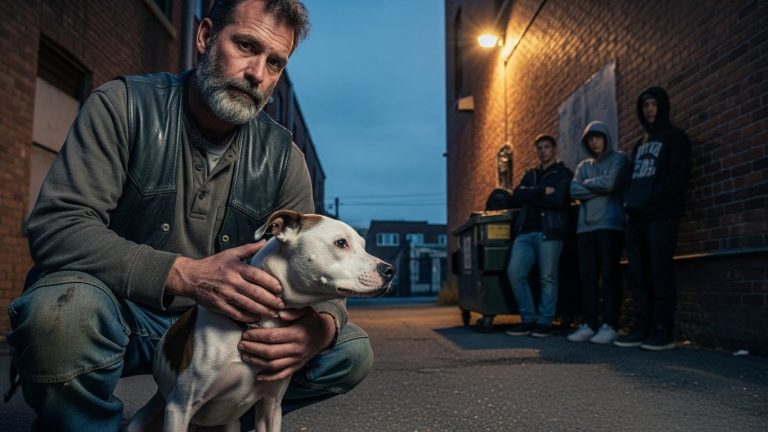
My name is Elias Vance. Most folks in town just call me “The Dog Man,” a title I earned after fifteen years in Animal Control and another five running a small-scale rescue for the “unadoptables”—the biters, the shiverers, the ones the world had given up on. At fifty-two, my knees creaked like floorboards in an old house, and my heart… well, the docs at Mission Hospital had been using words like “atrial fibrillation” and “low ejection fraction” for months. They told me to take it easy. They told me a stressful day could be my last. They told me that my heart was essentially a tired old engine running on its last liter of oil.
But the mountains don’t care about a cardiologist’s notes. When the French Broad River decides to reclaim its floodplain, it doesn’t ask for your medical history.
The “creek” at the edge of my property, usually a silver thread you could hop over without wetting your boots, was now a roiling, chocolate-brown vein of destruction. It was swallowing the treeline, inch by inch. I looked down at Barnaby, my one-eyed Pitbull mix, who was pressed against my shin. He wasn’t barking. He was vibrating—a low-frequency hum of animal intuition that told me we were in deep trouble. Barnaby had been through a lot before I found him tied to a dumpster in West Asheville, but he had never seen the sky fall like this.
The rain wasn’t dropping; it was horizontal, driven by winds that whipped the ancient oaks until they groaned. Then the power went. It didn’t flicker or brown out. It just died. The hum of the refrigerator, the buzz of the TV—all gone, replaced by a roar of water that sounded like a freight train idling in my backyard. In the sudden silence of the house, I heard it. A high-pitched, frantic yapping coming from three houses down.
That was Sarah’s place. Sarah was a neonatal nurse who worked double shifts at the VA, and she had three Golden Retrievers—Molly, Bear, and Little Bit. She’d messaged me three hours earlier, her words frantic and misspelled, saying she was stuck at the hospital because the main artery into town had collapsed. She was begging me to check on them.
I looked at the water. It was already over the bottom step of my porch. It was moving fast, carrying tires, plywood, and a child’s plastic slide. My chest gave a sharp, familiar pinch—a reminder that my “ticker” was a ticking clock. I felt the sweat on my palms, and it wasn’t just from the humidity. It was the cold sweat of a man who knew he was about to do something either very brave or very stupid.
“Not today,” I whispered to the empty air, mostly to convince myself.
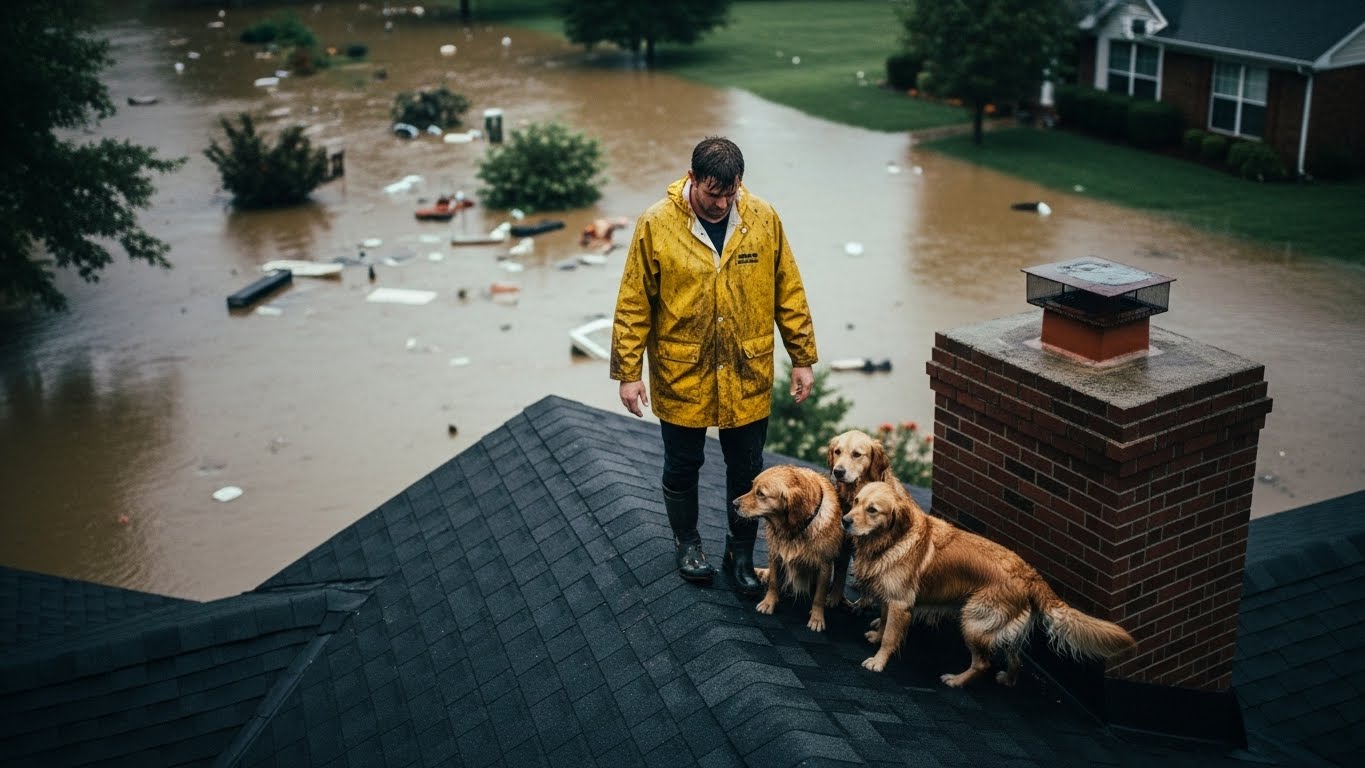
I grabbed my heavy-duty yellow rain slicker, the one that smelled like wet canvas and old memories. I reached into the mudroom and pulled out a fifty-foot coil of nylon climbing rope I’d kept since my younger days hiking the AT. I tied one end to the sturdy iron railing of my porch, cinching it with a triple-overhand knot that I tested with my full weight. The other end I looped around my waist, double-bolting the climbing carabiner.
I looked at Barnaby. “Stay on the kitchen island, buddy. Don’t you move. If the water gets to the counter, you jump on the fridge. You hear me?”
Barnaby gave a single, sharp “woof,” his one good eye tracking my every move. I stepped off the porch. The cold hit me like a physical blow, a literal punch to the gut that knocked the breath right out of my lungs. The water was already at my hips, the current tugging at my legs with the strength of a thousand hands. I wasn’t just walking; I was fighting for every inch of Appalachian soil.
CHAPTER 2: THE WEIGHT OF THE WATER
The world was a different place once you were waist-deep in it. Every step was a gamble. Beneath the surface, the familiar landscape of my neighborhood had turned into a minefield. I felt a submerged mailbox bruise my thigh, and then a floating branch nearly took my eye out. The rain was so dense it felt like I was swimming through a cloud of liquid lead.
I reached the edge of Sarah’s property, but the “yard” was gone. In its place was a churning eddy of debris. I could see the Goldens. Through the front window of her ranch-style home, three frantic faces were pressed against the glass. Molly, the oldest, was pawing at the pane so hard I thought she’d break it. Little Bit was standing on a floating sofa, her head tilted back as she howled a sound of pure, unadulterated terror.
“I’m coming!” I roared, though the wind snatched the words from my mouth before they could even reach my own ears.
I reached the porch, my muscles screaming. My heart started that familiar, terrifying skip-step, fluttering in my chest like a trapped bird. It’s a sensation of utter vulnerability, knowing your own body is sabotaging you while you’re trying to save another. Focus, Elias. Deep breaths. Don’t let the panic in.
I couldn’t get the front door open; the pressure of the water was holding it shut like a tombstone. I waded around to the side, where a large oak tree leaned precariously over the roof. I used the rope to hoist myself up onto a garden bench that was miraculously still anchored, then pulled myself onto the shingles.
The roof was slick with moss and rain, a treacherous slope. I crawled toward the chimney, gasping for air, my lungs burning. I used my heavy boot to kick in a small attic window, the glass shattering inward.
“Molly! Bear!”
The barking turned to frantic whines. I lowered myself into the dark, stifling heat of the attic. The water was gushing in through the lower floor, rising through the floorboards. The dogs were huddled on top of a tall dresser in the hallway, the water licking at their paws. They looked at me with eyes that asked a question I wasn’t sure I could answer.
I grabbed Bear first. He was eighty pounds of dead weight and wet fur. I tucked him under one arm, using the other to haul us both back up into the attic and through that narrow window. My shoulder popped—a sharp, white-hot flash of pain—but I didn’t let go. I got him onto the roof, tied him to the chimney with a short lead I’d brought, and turned back for the others.
By the time I got Little Bit and Molly up there, I was shaking. Not just from the cold, but from the sheer exhaustion of a body that was redlining. I slumped against the brick of the chimney, the three dogs huddled against my sides, their wet warmth the only thing keeping me conscious.
I looked back toward my house. The yellow nylon rope tied to my waist was taut, disappearing into the brown abyss. My house was still standing, but the water was now at the window line.
“We’re okay,” I wheezed, patting Bear’s head. “We’re okay.”
But then, across the street, I saw a flicker of movement. It was Old Man Jenkins. He was standing on his porch, the water at his chest, holding his ancient Beagle, Buster, over his head like a sacred offering. Jenkins was eighty if he was a day, a veteran who had survived Korea only to be trapped by a creek in North Carolina. He was losing his footing.
The rope around my waist was fifty feet. Jenkins was sixty feet away.
My heart did that thing again—a long, agonizing pause followed by a thud that felt like a hammer against my ribs. My vision blurred for a second, spots of light dancing in the rain. I looked at the dogs on the roof. They were safe for now. I looked at Jenkins. His head dipped below the surface, then came up sputtering.
I stood up on the slick shingles, my legs wobbling like a newborn colt’s. I reached for the carabiner at my waist. If I unclipped this rope, I had no lifeline. If I went back into that current without a tether, I was as good as dead. My doctor’s voice echoed in my head: Elias, your heart can’t handle a sudden surge of adrenaline. You have to stay calm.
“Sorry, Doc,” I muttered.
I unclipped the rope.
CHAPTER 3: THE GHOST OF THE CURRENT
The moment the carabiner snapped open, I felt a strange sense of weightlessness. It was the freedom of the condemned. Without the yellow line connecting me to my porch, I was just another piece of debris in the flood. I slid down the roof and plunged back into the water.
It was deeper now. The current had picked up speed, carrying the heavy scent of gasoline and uprooted pine. I struck out toward Jenkins’ house, but my arms felt like they were made of lead. Every stroke was a battle against the “skip-thud” in my chest.
“Jenkins!” I screamed, but the water filled my mouth, tasting of silt and salt.
Halfway across the street, I saw something that stopped my breath. A young man, maybe twenty-five, was standing on the second-story balcony of the modern apartment building next to Jenkins’ house. This was Caleb—a kid who’d moved from Charlotte a few months ago. He was holding a cell phone, filming. His face was a mask of pure, paralyzed terror.
“Caleb! Help him!” I yelled, pointing toward Jenkins.
Caleb looked at me, then at the churning water, then back at his phone. He didn’t move. He was a “digital native” lost in a physical nightmare. He wasn’t a bad kid, just a terrified one, frozen by the realization that the world wasn’t behind a screen anymore.
“I can’t!” he shrieked. “The current… it’s too fast!”
“I’m fifty-two with a bad heart, kid! Get down here!”
He didn’t budge. I realized then that I was on my own.
I reached Jenkins just as his grip on the porch railing failed. He went under, still holding Buster. I lunged, my hand catching the collar of Jenkins’ flannel shirt. I pulled with everything I had, my heart screaming in protest. It felt like my chest was being crushed by a hydraulic press.
I managed to drag him toward a sturdy trellis on the side of his house. “Grab it!” I choked out.
Jenkins, gasping and spitting water, clung to the wood like a drowning man to a cross. He still had Buster tucked under his other arm. The Beagle was silent, eyes wide, shivering so hard I could feel it through the water.
“Get… get the dog… to the roof,” Jenkins wheezed. “I can’t… hold him… and climb.”
I took Buster. The dog was surprisingly heavy, or maybe I was just that weak. I looked up at the roof of Jenkins’ porch. It was lower than Sarah’s, but the climb looked like Everest. I tucked Buster into the front of my rain slicker, zipping it up so only his head poked out.
I started to climb the trellis. The wood groaned. My heart wasn’t just skipping now; it was racing, a chaotic, fluttering mess that made my head spin. Just one more step. Just one more.
I reached the edge of the porch roof and shoved Buster onto the flat surface. The dog scrambled away from the edge, shaking himself. I turned back to help Jenkins, but as I reached down, the world tilted.
A massive log, a stripped oak trunk at least twenty feet long, came barreling down the street like a battering ram. It hit the trellis with a sound like a gunshot. The wood disintegrated. Jenkins let out a muffled cry as he was swept away from the house.
“No!” I lunged for him, my fingers brushing his sleeve, but the current was too fast.
He was gone. In the blink of an eye, the man who had lived on this street for forty years was swallowed by the brown maw of the French Broad.
I stood there on the edge of the porch roof, my hand extended into the empty air. The adrenaline that had been propping me up suddenly vanished, leaving a hollow, aching void. My chest didn’t just hurt anymore; it felt like it was exploding.
The “skip-thud” stopped. For a long, terrifying second, there was nothing. No heartbeat. Just the roar of the rain.
Then, a jagged, agonizing bolt of lightning seemed to strike me from the inside. I fell to my knees on the shingles, my vision tunneling down to a single point of light. I looked across the street toward Sarah’s roof, where the three Goldens were watching me. I looked at Buster, who was licking my hand.
I collapsed onto the wet roof, the cold rain washing over my face. My last thought before the darkness took me wasn’t about the water or the dogs. It was about the yellow rope, still tied to my porch, swaying in the current like a ghost.
CHAPTER 4: THE GRAY SPACE BETWEEN
The world didn’t come back all at once. It leaked in through the edges of my vision, a dull, thrumming gray that smelled of ozone and wet dog. For a long time, I wasn’t Elias Vance anymore. I was just a collection of sensations: the sandpaper texture of shingles against my cheek, the rhythmic thud of rain on my skull, and a coldness so deep it felt like my bones had turned to ice. My chest felt like an empty cavern where a fire had recently burned out, leaving nothing but acrid smoke and cooling embers.
I blinked, and the gray sharpened into the shape of a snout. Buster. The old Beagle was sitting inches from my face, his long, velvet ears soaked through, his breath smelling of canned liver and age. He let out a small, tentative whine and licked the bridge of my nose.
“I’m… I’m here, buddy,” I rasped. The sound of my own voice was a shock. It sounded like two stones grinding together.
I tried to move my left arm, but it was a heavy, useless thing, pinned under my torso. A pins-and-needles sensation crawled up my neck. I knew the signs. This wasn’t just a “skip-thud” anymore. This was the big one, the one the docs had warned me about during those long, sterile afternoons in the cardiology wing. My heart was a bruised boxer, leaning against the ropes, waiting for the final bell.
I rolled onto my back, a groan tearing its way out of my throat. The sky was still a churning mess of purple and black, but the light was fading. Night was coming, and in the mountains, night during a flood is a death sentence.
“Elias! Elias, can you hear me?”
The voice was high, feminine, and vibrating with a terror that cut through the roar of the water. I turned my head slowly, every movement a monumental effort. Across the narrow, churning channel that used to be a suburban street, a woman was leaning over a second-floor balcony. It was Elena, a doctoral student from the university who had moved in six months ago. She was always quiet, the kind of neighbor who gave a polite nod while carrying groceries and then disappeared behind her door. Now, her face was ghost-white, her dark hair plastered to her cheeks.
“Jenkins…” I managed to choke out. “He’s… he’s gone, Elena.”
She let out a sob that was lost to the wind, her hands gripping the iron railing of her balcony. “I saw. I saw it all. I’m so sorry, Elias. I was too scared to move. I just… I froze.”
“The dogs,” I said, ignoring the apology. Guilt was a luxury we didn’t have time for. I pointed a trembling hand toward Sarah’s roof. Molly, Bear, and Little Bit were still there, huddled around the chimney, their gold fur looking like a beacon in the gloom. “They’re still over there. And Barnaby… he’s in my house.”
I looked toward my bungalow. The water was now licking at the eaves. My heart shattered in a way medical science couldn’t explain. Barnaby was on the kitchen island, but if the foundation shifted, if the house groaned and gave way like Jenkins’ trellis…
“The water’s still rising!” Elena screamed. She wasn’t wrong. The porch roof I was lying on felt unstable, vibrating with the impact of submerged objects. “A propane tank just went past! Elias, you have to get higher!”
I tried to sit up, and the world spun. My heart did a frantic, chaotic dance—v-fib, maybe? Or just the final spasms of a dying muscle. I looked at Buster. The dog was looking at me with such profound trust it made my eyes sting. He didn’t know I was a broken man with a failing engine. He just knew I was the one who had pulled him out of the dark.
“I can’t… I can’t get to you, Elena,” I shouted back, gasping for air. “You have to stay there. The building is concrete. You’re safe for now.”
“But the dogs! And you! You’re turning blue, Elias!”
I looked at my hands. She was right. My fingernails were a dull, sickly shade of indigo. Cyanosis. My blood wasn’t carrying enough oxygen because the pump was failing. I needed a hospital. I needed a nitro tab. I needed a miracle.
But all I had was a Beagle and a view of a tragedy.
I thought about Martha. My Martha had been gone five years, taken by a cancer that was as relentless as this flood. She used to say that I had “too much heart” for my own good, that I took on the world’s pain like it was my personal responsibility. If she could see me now, she’d be furious. She’d be telling me to save myself.
But Martha was also the one who brought home the first stray we ever rescued—a mangy, half-dead Mutt she found in a Kroger parking lot. “Elias,” she had said, “we aren’t defined by how we live when the sun is out. We’re defined by who we are when the storm hits.”
I took a deep, shuddering breath that felt like swallowing glass. “Okay, Martha,” I whispered. “One more round.”
I looked at the gap between the porch roof and the main part of Jenkins’ house. It was a four-foot jump to a higher ledge. Under normal circumstances, I could do it in my sleep. Now, it looked like a leap across the Grand Canyon.
“Buster, go!” I shoved the dog toward the higher roof. He scrambled up, his claws scratching at the wood, and then he turned back, looking down at me.
I gripped the edge of the shingles, my good arm shaking. I hauled myself up, inch by agonizing inch. My heart was a drum being played by a madman. Thud-skip. Thud-thud-skip. I felt the blackness pulling at the corners of my vision again.
“Don’t you dare,” I hissed at myself. “Don’t you dare quit.”
I made it to the ledge. I lay there for a minute, my face pressed into the wet wood, listening to the scream of the wind. And then, I heard a new sound. A low, rhythmic thrum-thrum-thrum that wasn’t my heart.
It was an engine.
CHAPTER 5: THE BOATMAN’S BURDEN
Through the sheets of rain, a shape emerged from the darkness of the flooded treeline. It was a flat-bottomed aluminum jon boat, the kind every fisherman in Western North Carolina keeps in their garage. It was being tossed like a toy, the small outboard motor screaming as it fought the current.
In the back, gripping the tiller with white-knuckled intensity, was Marcus.
Marcus was the local vet, a man who had spent thirty years stitching up hunting dogs and delivering calves. He was seventy, with a face like a topographical map of the Appalachians and a temper that could peel paint. He was also the only man I knew who was crazier than me.
“Elias! You stubborn old mule!” Marcus bellowed as he maneuvered the boat toward the roof.
He was being assisted by a younger man I didn’t recognize—maybe a volunteer or a nephew. They were using oars to fend off a floating refrigerator that was threatening to crush the hull.
“Marcus!” I tried to stand, but my legs were like jelly. I slumped back against the siding. “Jenkins… he’s gone! I couldn’t hold him!”
Marcus’s face hardened, a flicker of grief passing through his eyes before he masked it with professional grit. “I know, Elias. We saw his hat a mile downstream. There’s nothing you could’ve done. Now get in the damn boat before the house comes down!”
The boat bumped against the eaves of the porch. The younger man reached out, his hand steady. “Come on, sir. We’ve got you.”
“The dogs,” I said, pointing toward Sarah’s roof. “And Barnaby. My house. You have to get them first.”
Marcus swore, a long string of mountain profanity that would have made a sailor blush. “Elias, look at yourself! You’re gray! You’re having a cardiac event right in front of me. We get you, then we get the dogs.”
“No!” I roared, the effort sending a spike of pain through my jaw. “The current is getting faster. If you take me to the staging area now, you won’t make it back for them. Sarah’s roof is sagging. Look at it!”
We all looked. The weight of the three Goldens and the relentless pressure of the water against the foundation was causing the ranch house to tilt. The chimney, where they were tied, was beginning to crack.
Marcus looked at me, then at the dogs, then back at me. He knew I was right. In a disaster, the math is cruel. You save who you can, when you can. If they spent twenty minutes getting me to safety and back, the Goldens would be under ten feet of water.
“Marcus, please,” I whispered. “I’m already on the way out. Those dogs have a whole life ahead of them. Go get them. Then come back for me and Buster.”
Marcus stared at me for what felt like an eternity. The rain lashed between us, a cold curtain of reality. He looked at the younger man, who was watching him for a cue.
“You’re a fool, Elias Vance,” Marcus said, his voice breaking. “A goddamn, beautiful fool.”
He gunned the motor. The boat spun away from Jenkins’ roof, heading toward Sarah’s house. I watched as they navigated the treacherous debris field. I saw the younger man reach up and grab Little Bit, then Molly, then Bear. They were terrified, snapping and whining, but Marcus knew how to handle them. He threw a heavy moving blanket over Molly to calm her down.
“We’re coming back!” Marcus yelled over the roar. “Stay right there!”
I watched them disappear into the gloom, heading toward the high ground near the old elementary school. The silence that followed was heavier than the storm. It was just me, Buster, and the ghost of Jenkins.
I looked over at my house. The water was now flowing over the kitchen counters. I could see Barnaby through the window. He was standing on the very top of the refrigerator, his one eye fixed on the spot where he’d last seen me. He wasn’t barking. He was waiting.
“I’m coming, Barnaby,” I whispered, though I knew it was a lie. I couldn’t even stand up.
The pain in my chest changed. It wasn’t a sharp spike anymore; it was a heavy, dull pressure, like an elephant was sitting on my lungs. My left arm was completely numb now. I felt a strange warmth spreading through my body, a false heat that told me my system was shutting down.
I leaned my head back against the house and closed my eyes.
“Hey, Elias?”
It was Elena again. She was still there, a silent witness to the end of the world.
“Yeah, Elena?”
“Why do you do it? Why for the dogs? You could have stayed on your porch. You could have waited.”
I thought about all the dogs I’d seen in the shelters. The ones that had been beaten, the ones that had been left in the woods to starve, the ones that had been used for fighting. I thought about how, despite everything humans had done to them, they still looked at us with a hope that was almost holy.
“Because they don’t have a choice, Elena,” I said softly. “We’re the ones who built the world this way. We’re the ones who brought them into it. If we don’t look out for the ones who can’t speak for themselves, then what the hell are we even doing here?”
The roof beneath me gave a sickening lurch.
CHAPTER 6: THE BREAKING POINT
A sound like a cannon shot echoed through the valley. A mile upstream, the old Swannanoa dam had finally surrendered. A wall of water, ten feet high and choked with the wreckage of a lumber yard, was barreling toward our street.
I saw it coming—a white, ghostly line in the darkness, a roar that drowned out even the wind.
“Elena! Get inside! Get to the highest point!” I screamed.
She disappeared from the balcony just as the surge hit.
The impact was cataclysmic. Jenkins’ house didn’t just flood; it disintegrated. The porch roof I was on was torn away from the main structure like a piece of cardboard. I felt myself being launched into the air, the world a chaotic blur of dark water and white foam.
I hit the water hard. The cold was a physical shock that restarted my heart for a split second, a jolting THUD that felt like a lightning strike. I was underwater, spinning, my lungs burning for air. I felt something heavy strike my shoulder—a piece of timber, maybe—and then I was being dragged down by the weight of my own heavy boots.
Surface. You have to surface.
I kicked with everything I had left. My head broke the water, and I gasped, drawing in a mouthful of spray. I was moving fast—twenty, thirty miles an hour. I was a leaf in a hurricane.
I saw a flash of yellow. The rope.
By some miracle of physics and fate, the nylon rope I’d tied to my porch was still anchored. It was stretched tight across the street, vibrating with the tension of the current. It was a thin, golden line in a world of brown.
I reached out, my fingers clawing at the water. I missed. The current spun me around.
Again. Try again.
The next time I swung past, I didn’t just reach; I lunged. My hand closed around the nylon. It felt like a hot iron rod, the friction searing my palm, but I didn’t let go. I wrapped my arm around it, locking my elbow.
The force of the water trying to pull me away was incredible. It felt like my arm was being pulled out of its socket. But I was anchored. I was held by the very thing I had unclipped earlier. The other end was still tied to my porch. My house.
I looked toward the bungalow. It was still there, held by some miracle of 1940s craftsmanship and a deep foundation. The water was up to the roofline now.
I started to pull myself along the rope, hand over hand. Every movement was a battle against the “elephant” on my chest. I couldn’t breathe. My vision was nothing but a kaleidoscope of red and black spots.
One more pull. For Barnaby.
I reached the porch railing. It was underwater, but I could feel it. I hauled myself up, my body heavy as lead. I climbed onto the roof of my own house, collapsing onto the shingles.
I looked through the small attic window I’d left open for ventilation. There, just inches from the glass, was Barnaby. The water had reached the ceiling of the kitchen. He was treading water, his nose pressed against the top of the window frame, gasping for the small pocket of air that remained.
I didn’t have a hammer. I didn’t have my boots anymore—the current had stripped them off. I looked at my fist. It was small and weak, the skin blue and translucent.
I looked at the brick chimney of my own house. I grabbed a loose brick from the top, the mortar crumbling in my hand.
I slammed the brick against the window. The glass didn’t break. I slammed it again. And again. My heart was a stuttering mess, a failing engine that was finally, truly dying.
“Please,” I sobbed, the word lost in the rain. “Just… one… more… time.”
With a roar that came from the very bottom of my soul, I swung the brick. The glass shattered.
Barnaby didn’t hesitate. He lunged through the opening, his wet fur scratching my face as he scrambled onto the roof. He stood over me, barking at the storm, a one-eyed warrior who refused to back down.
I lay there on the roof, the rain washing the blood from my knuckles. I had no more strength. I had no more heart. I looked up at the sky, and for the first time in hours, the rain began to slow.
But as the silence grew, I realized something.
The house was moving.
The surge from the dam had undermined the foundation. I could hear the wood screaming, the nails pulling free from the joists. The house was tilting, sliding off its base and into the main channel of the river.
I closed my eyes and pulled Barnaby close. “It’s okay, buddy,” I whispered into his ear. “We’re going for a ride.”
CHAPTER 7: THE UNMOORED HEART
The sound of a house breaking free from its foundation is something you don’t just hear; you feel it in your teeth. It’s a sickening, tectonic groan, the sound of a thousand nails weeping as they’re wrenched from the wood. My little bungalow, the place where Martha and I had picked out paint swatches and argued over where to put the bookshelf, was no longer a home. It was a barge.
“Hold on, Barnaby!” I screamed, digging my fingers into the asphalt shingles until my nails bled.
The house lurched, tilted at a forty-five-degree angle, and then slid with a violent splash into the main channel of the French Broad. For a moment, we were submerged, the cold water surging over the peak of the roof, threatening to sweep us into the dark. But then, the air trapped in the attic acted like a buoy. We bobbed up, spinning slowly in the mid-river current.
Everything was different out here in the middle of the flood. The banks were gone, replaced by a jagged shoreline of half-submerged telephone poles and the skeletal remains of drowned trailers. I saw a silver sedan pinned against a bridge piling, its headlights still flickering underwater like the eyes of a dying deep-sea creature.
My heart was no longer a drum; it was a ghost. The pain had moved past the “crushing weight” stage and into a strange, rhythmic thrumming that made the world feel distant and soft. I wasn’t scared anymore. That was the truly terrifying part—the fear had washed away, leaving only a profound, crystalline clarity.
I looked at Barnaby. He was huddled against my chest, his wet fur smelling of swamp and survival. He looked at me with that one soulful eye, and I realized he wasn’t looking for a way out. He was just looking at me. I was his whole world, even as mine was dissolving into silt.
“I’ve got you, buddy,” I whispered, though my voice was so thin it barely made it past my lips. “I won’t let go.”
We drifted past the old mill, the current taking us toward the I-240 bridge. If the house hit one of those concrete pylons, it would shatter like a glass bottle. I could see people on the bridge—shadowy figures silhouetted against the strobing blue and red lights of emergency vehicles. They were pointing. They were probably filming.
There I was, the “Dog Man,” a viral spectacle on a floating roof, drifting toward the end of the line.
Suddenly, a bright searchlight cut through the rain, blinding me. It bounced off the churning water, creating a halo of white fire.
“Elias! Get to the edge! The edge of the roof!”
It was Marcus again. The jon boat was back, but it was taking on water. The motor was coughing, a rhythmic chug-sputter that told me it was choked with debris. They were fighting the current, trying to match the speed of the floating house.
“He’s not going to make it, Marcus!” the younger man yelled. “The house is spinning! We can’t get close enough!”
“Get the net!” Marcus roared back.
The younger man reached for a long-handled landing net, the kind used for hauling in heavy muskies. He leaned out over the gunwale, his boots slipping on the aluminum floor.
“Elias! Throw the dog! Throw him into the net!”
I looked at the gap. It was ten feet of churning, violent water. If I missed, Barnaby would be gone in a second. If I hit the water with him, I didn’t have the strength to pull him back up.
“I can’t!” I tried to yell, but it came out as a wheeze.
“You have to!” Marcus screamed, his face contorted with effort as he wrestled the tiller. “The bridge is coming, Elias! Five hundred yards! If you hit those pylons, it’s over!”
I looked ahead. The massive concrete pillars of the interstate bridge loomed like the legs of a giant. The water was piling up against them in a “V” of white foam, a terminal pressure point.
I looked at Barnaby. “You gotta go, buddy. You gotta go to Marcus.”
I stood up. It was the hardest thing I’d ever done. My legs were numb, and the world was tilting, not just because of the house, but because my brain was starving for oxygen. I picked up eighty pounds of Pitbull mix, my muscles screaming, my heart doing a final, desperate stutter-step.
I waited for the house to spin. I waited for the boat to dip.
“Now!” Marcus yelled.
I didn’t think. I just pushed. I gave Barnaby everything I had left—every bit of love, every ounce of my remaining life. He flew through the air, his legs paddling, and landed with a heavy thud in the center of the boat. The younger man lunged, pinning him down so he wouldn’t jump back in.
“Got him! We got him!”
The relief that washed over me was so intense it felt like a physical warmth. I fell back onto the shingles, my chest finally, mercifully, going quiet. The “elephant” had finished its job.
“Now you, Elias! Give me your hand!”
The boat was inches away now. I could see Marcus’s weathered hand reaching out, his fingers trembling. I could see the desperation in his eyes.
I tried to reach. I really did. But my arm wouldn’t move. It was like I was made of stone. The boat hit a submerged log and jarred away, the gap widening to six feet, then ten, then twenty.
“Elias! No!”
I watched the boat shrink as the current pulled me toward the bridge. I saw Barnaby standing at the transom, barking, his voice lost to the roar of the river.
The house hit the pylon with the force of a bomb. I felt the shingles disintegrate beneath me. I felt the cold, dark water embrace me like an old friend. And then, for the first time in a long time, the pain stopped.
CHAPTER 8: THE WAKE OF THE STORM
The first thing I smelled wasn’t the river. It was the scent of industrial-strength lemon cleaner and the faint, metallic tang of an oxygen mask.
I opened my eyes. The ceiling was white—a flat, sterile white that hurt my brain. There was a rhythmic beep… beep… beep… coming from my left. I recognized it. It was the sound of a heart monitor. My heart. It was still beating.
“He’s awake,” a voice whispered.
I turned my head. My neck felt like it was full of rusty staples. Sarah was sitting in a plastic chair by the bed, her face pale and lined with exhaustion. She still had her nurse’s scrubs on, but they were wrinkled and stained.
“The dogs?” I croaked. My throat felt like I’d swallowed a handful of gravel.
Sarah burst into tears. She grabbed my hand—the one that wasn’t hooked up to an IV—and squeezed it. “They’re safe, Elias. Every single one of them. Molly, Bear, Little Bit… even Buster. Marcus got them to the elementary school. And Barnaby… he’s at the clinic. He wouldn’t stop barking until Marcus let him sleep in the breakroom.”
I let out a breath I felt like I’d been holding for a lifetime. “Jenkins?”
Sarah’s face fell. She shook her head slowly. “They found him this morning. Five miles down in Marshall. He… he didn’t make it. But Elias, they found Buster on that roof because of you. He’s alive because you didn’t give up.”
I looked out the window. The rain had stopped. The sun was cutting through the clouds, lighting up the Blue Ridge Mountains in a way that made them look like they were covered in emeralds. It was beautiful, and it was devastating. I knew the town was in ruins. I knew my house was a pile of splinters somewhere in the French Broad. I knew I had a long, hard road ahead of me with a heart that was held together by spit and prayers.
“Marcus said you unclipped your rope,” Sarah said, her voice trembling. “He said you had to have known what would happen.”
“I knew,” I said softly.
“Why?”
I thought about the feeling of Barnaby’s fur against my face. I thought about the look in Bear’s eyes on that roof. I thought about the way the world looks when everything is stripped away—the cars, the houses, the money, the phones—and all that’s left is the pulse of another living thing.
“Because the rope was holding me back,” I said. “And they needed me to move.”
A few hours later, the door to the room creaked open. Marcus walked in, looking like he’d aged ten years in forty-eight hours. He was leading a very familiar, one-eyed dog on a leash.
Barnaby didn’t wait for permission. He let out a joyful yelp and scrambled onto the hospital bed, his tail thumping against my legs like a drumbeat. He licked my face, his tongue warm and rough, and for the first time since the sky fell on Asheville, I started to cry.
I wasn’t the “Dog Man” because I was a hero. I was the “Dog Man” because they were the only ones who knew who I really was. They didn’t care about my failing heart or my empty house. They just cared that I was there.
The doctors tell me I’ll need a transplant eventually. They tell me I have to “take it easy.” But as I lay there with Barnaby’s head on my chest, watching the sun set over the mountains, I knew I’d never take it easy again. Because as long as there’s a storm, there’s someone—or something—waiting to be found in the dark.
And I still have a little bit of heart left for that.
In the face of a disaster, most people record the moment on their phones, but Elias Vance chose to drop his lifeline to save those who couldn’t save themselves. If you were in his shoes, knowing your own life was at risk, would you have unclipped that rope?