I Sacrificed My Only Chance at a Family to Save a Stranger. I Thought My Life Was Over… Until 50 Bikers Showed Up at My Hiding Spot.
Chapter 1: The Golden Hour
The digital clock on the bank tower read 7:43 AM. To anyone else in the sleepy town of Redwood, Oregon, it was just another Tuesday. To ten-year-old Caleb Foster, it was the countdown to the end of his world—or the beginning of a new one.
Caleb sat on a discarded milk crate in the alleyway behind the public library, his breath pluming in the crisp autumn air. His hands, small and chapped from the cold, smoothed out the wrinkles in his only button-down shirt. It was two sizes too big, salvaged from a donation bin three months ago, but he had washed it in the gas station sink just for today.

Today was the interview.
10:00 AM. The Redwood Adoption Center. 28 Maple Street.
It wasn’t a guarantee. Caleb knew the statistics. He had read them in the library computers during the fifteen minutes of internet time he was allowed per day. Boys his age, especially “system kids” who had run away, were statistically invisible. They were the ghosts of the foster care system. But a social worker named Mrs. Gable had miraculously flagged his file. She said there was a couple interested. A real couple. With a house. And a backyard.
Caleb checked his backpack for the fiftieth time. It was a faded navy blue JanSport with a broken zipper, but its contents were more valuable to him than gold. Inside, nestled between a stolen toothbrush and a pair of spare socks, was his “kit.”
Three rolls of gauze. A bottle of antiseptic. A roll of medical tape. A pair of sharp sewing scissors. And three heavy hardcovers: Gray’s Anatomy, The Merck Manual, and Emergency Medicine: A Comprehensive Study.
He had borrowed them—permanently—from the library reference section. The librarians knew. They had to know. But they never stopped the quiet, skinny boy who sat in the corner reading about arterial bleeds while other kids read comic books. Caleb didn’t want to be a superhero. He wanted to be a doctor. Like his mom.
His mom. The memory hit him like a physical blow. The smell of hospital soap. The way she used to practice bandaging on his teddy bear. She died when he was five, leaving him to a father who didn’t exist and a system that didn’t care. Medicine was the only thing that made him feel like she wasn’t entirely gone. If he could fix things—broken skin, broken bones—maybe he could fix the broken parts of his life.
“Focus,” he whispered to himself. “Eye contact. Firm handshake. ‘Yes, ma’am.’ ‘No, sir.'”
He shouldered his backpack. 8:15 AM. It was a forty-minute walk to the center. He wanted to be early. Being early meant you were responsible. Responsible kids got adopted.
Caleb stepped out onto Elmwood Avenue. The morning sun was blinding, reflecting off the chrome bumpers of parked cars. The suburbs were waking up. He saw kids his age walking to school, complaining about homework, swinging lunchboxes. They walked in a different reality than he did. They walked on pavement; he felt like he was walking on a tightrope.
He was three blocks away from the bus stop when the air shattered.
It wasn’t a car crash. It was louder. A sharp, thunderous BOOM that vibrated in Caleb’s chest.
Fifty yards ahead, a massive delivery truck swerved violently. One of its rear tires had blown out—not just a flat, but a catastrophic failure. The explosion of pressurized rubber sent heavy, steel-belted debris flying like shrapnel from a grenade.
Caleb flinched, ducking instinctively. Car alarms started blaring. Brakes screeched.
Then, the silence that follows a disaster. And then, the scream.
It was a sound that scraped against the soul—a mother’s scream. Caleb looked up. The debris hadn’t hit a car. It had hit the sidewalk.
A little girl, maybe six years old with pigtails, lay crumpled on the concrete. She wasn’t moving. A jagged piece of the tire tread, reinforced with steel wire, lay a few feet away.
Caleb froze.
He looked at the bank clock. 8:47 AM.
If he stopped, he would miss the bus. If he missed the bus, he’d have to walk the long way. He would be sweaty, dirty, and late. Late meant irresponsible. Irresponsible meant no family. No home. Just the alleyway and the cold.
Run, his survival instinct whispered. It’s not your problem. Someone else will help. Look, people are coming out of their houses.
But they weren’t helping. The neighbors were freezing, hands over their mouths, paralyzed by the shock of seeing a child so still, so much blood pooling on the gray pavement.
“Save who you can, Caleb. Always.”
His mother’s voice. It wasn’t a memory; it was a command.
Caleb cursed, a harsh word for a ten-year-old, and dropped his backpack. He didn’t run to the bus stop. He ran to the girl.
He slid on his knees next to her, ignoring the sting of the concrete tearing through his jeans. The mother was there now, wailing, trying to pick the girl up.
“Don’t move her!” Caleb barked. His voice sounded strange—commanding, authoritative, not like a child’s voice at all. “If her neck is injured, you’ll paralyze her. Let me see.”
The woman was so hysterical she didn’t question him. She just rocked back, sobbing.
Caleb’s eyes scanned the girl. Airway: clear. Breathing: shallow. Circulation: rapid pulse. The source of the blood was a deep laceration on her scalp, just above the temporal artery. Head wounds bled a lot, he knew that from Chapter 4 of Emergency Medicine, but this was pouring.
“Okay, okay,” Caleb muttered. He zipped open his bag. His hands, usually shaking from hunger or cold, were suddenly rock steady.
Gauze. Antiseptic.
He ripped the package open with his teeth. He placed the thick pad directly over the wound and pressed down. Hard.
The girl whimpered.
“I know,” Caleb whispered, leaning close to her ear. “I know it hurts. I’m sorry. But I have to stop the red stuff, okay? You’re gonna be okay. What’s your name?”
No answer. She was slipping into shock.
“Keep talking to her!” Caleb yelled at the mother. “Don’t let her sleep!”
“Jasmine!” the mother cried, gripping the girl’s hand. “Jasmine, look at mommy!”
Caleb checked his watch. 9:15 AM.
He pushed harder on the wound. His arms burned. The blood was seeping through the first layer of gauze. He added a second layer. Don’t lift. Never lift. Just add more pressure.
Minutes turned into agony. He could hear sirens in the distance, but they were far away. The police station was on the other side of town.
Then, a new sound. A low rumble that grew into a roar.
Caleb didn’t look up. He was counting Jasmine’s heartbeats. One, two, three…
The roar became deafening. The ground vibrated. Shadows fell over him. The smell of exhaust and leather mixed with the metallic scent of blood.
The Iron Falcons.
Caleb knew them. Everyone knew them. The local motorcycle club. They weren’t just guys who rode bikes; they were a brotherhood. And right now, twenty of them were parking their Harleys in the middle of the street, blocking traffic.
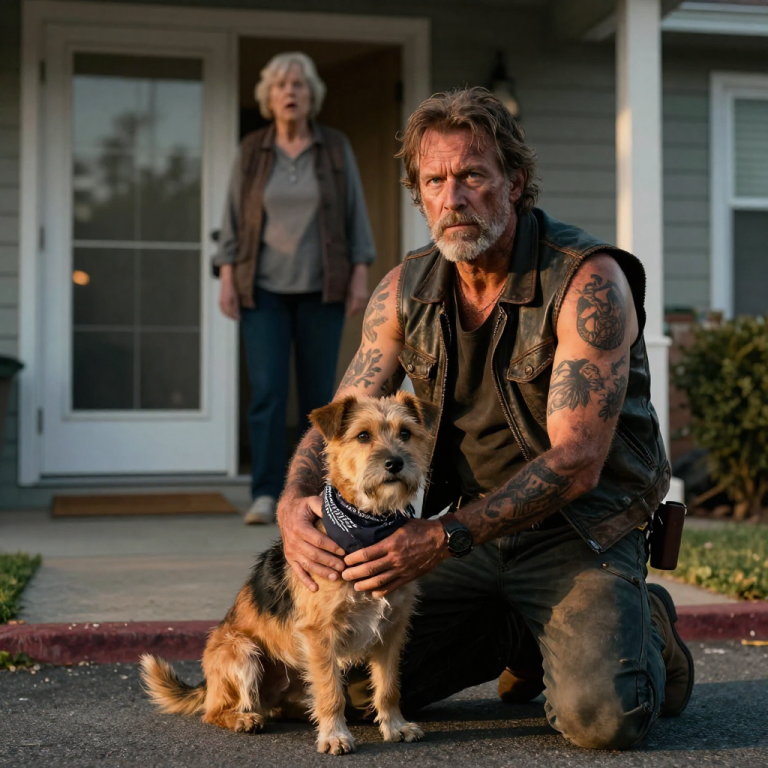
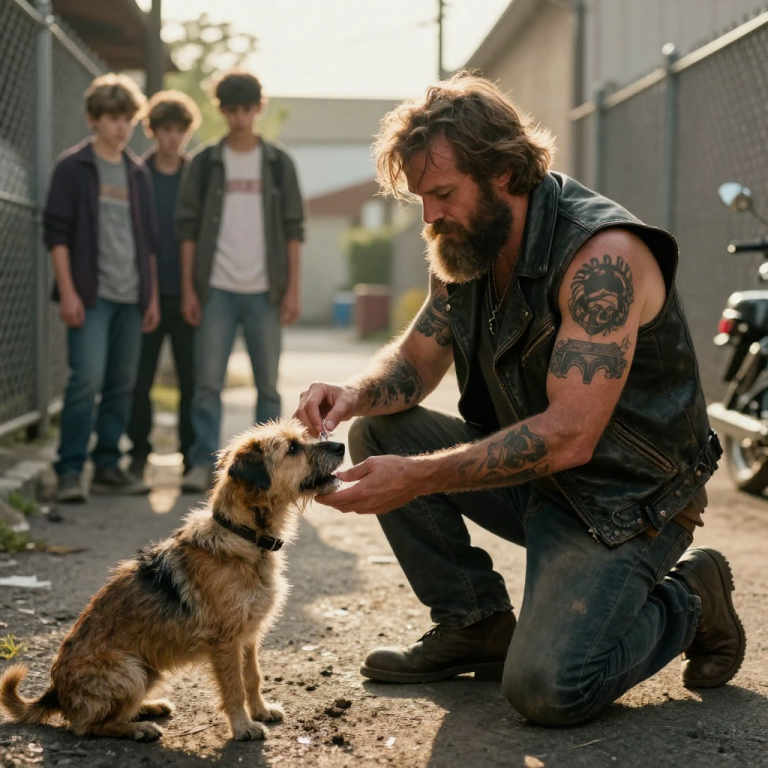
A man jumped off the lead bike while it was still moving. He was a giant—six-foot-four, beard like a viking, arms as thick as tree trunks covered in ink.
“Jasmine!”
The scream that tore from the biker’s throat was worse than the mother’s. It was the sound of a lion seeing its cub hurt.
Grant Carter hit the sidewalk with enough force to crack it. He shoved through the crowd of neighbors. When he saw Caleb, he stopped dead.
He saw a scrawny boy in oversized clothes, hands covered in his daughter’s blood, pressing down on her skull with a focus that was terrifyingly adult.
“What are you doing to her?” Grant growled, panic making him aggressive.
“Saving her,” Caleb said. He didn’t look up. “She has a laceration on the temporal artery. If I let go, she bleeds out in three minutes. The ambulance is two minutes away. Do not touch me.”
Grant froze. The authority in the boy’s voice cut through the chaos. The giant biker fell to his knees, his hands hovering, trembling, afraid to interfere.
“Is she…?”
“She’s alive,” Caleb said. “But her pulse is dropping.”
The ambulance finally shrieked around the corner.
“EMT!” Caleb shouted, finally looking up. ” laceration, heavy blood loss, possible concussion. I’ve been applying direct pressure for twelve minutes.”
The paramedics swarmed in. A woman with kind eyes took Caleb’s place. “I got it, son. Good job. Let go.”
Caleb pulled his hands away. They were red and sticky.
He stood up, his legs wobbling. The adrenaline was crashing. He looked at the bank clock.
9:58 AM.
The interview.
He looked at his hands. He looked at his clothes. Covered in blood. Dirt on his knees. He looked like a street rat involved in a crime.
There was no way. Even if he teleported there, he couldn’t walk in like this.
He had missed it.
The social worker, Mrs. Gable, had told him: This is your last shot, Caleb. If you don’t show up, they mark you as ‘non-compliant.’ You age out of the priority list.
It was gone. The house. The backyard. The family.
Grant was busy lifting Jasmine onto the gurney, weeping openly, kissing her forehead. The other bikers were surrounding them, a wall of leather.
Nobody was looking at Caleb.
“I’m sorry, Mom,” he whispered to the sky.
He grabbed his backpack, turned toward the alleyway, and ran.
Chapter 2: The Ghost of Elmwood Avenue
Caleb didn’t stop running until his lungs burned like they were filled with broken glass. He ended up three miles away, in an abandoned construction site near the old railyard—his backup “safe zone” for when the library was closed.
He collapsed against a stack of drywall, sliding down until he hit the dusty floor. He didn’t cry. He wanted to, but he had learned a long time ago that crying dehydrated you and gave you a headache, and neither of those things helped you survive.
Instead, he stared at his hands. The blood had dried into dark, flaky patches. Jasmine’s blood.
“She’s alive,” he told himself. “That’s the trade. You traded a family for a life.”
It was a good trade. A noble trade. Any doctor would make it.
But God, it hurt. It hurt worse than hunger.
He pulled the crumpled piece of paper with the adoption center’s address out of his pocket. 10:00 AM. It was now 11:30. He slowly tore the paper into tiny strips, letting them fall like confetti onto the dirty concrete.
“Goodbye, backyard,” he whispered. “Goodbye, dad.”
Meanwhile, at Redwood General Hospital, the atmosphere was electric with tension. The waiting room was filled to capacity, not with sick patients, but with the Iron Falcons. They paced the hallways, their boots heavy on the linoleum, terrifying the nurses and security guards.
But they weren’t causing trouble. They were waiting.
Inside the trauma room, Grant Carter held his daughter’s hand. Jasmine was awake. She was pale, and a large white bandage covered the side of her head, stitched with twenty staples, but she was awake.
“Daddy?” her voice was a croak.
“I’m here, baby. Daddy’s here. You’re safe.” Grant kissed her knuckles, tears leaking into his beard. “You scared me, Jazzy. You really scared me.”
“The boy,” she whispered.
Grant frowned. “What boy?”
“The boy with the backpack,” Jasmine said, her eyes fluttering. “He held my head. He told me stories so I wouldn’t sleep. He said… he said he had to go to a meeting, but he wouldn’t leave me. Where is he?”
Grant felt a chill go down his spine. He looked at the trauma surgeon, Dr. Aris.
“The kid saved her, Grant,” Dr. Aris said, looking at the chart. “The cut nicked an artery. If someone hadn’t applied that kind of consistent, localized pressure immediately… she would have bled out before the ambulance got there. Whoever that kid was, he knew exactly what he was doing. He’s a hero.”
Grant remembered the boy. Small. Scared. The oversized shirt. The desperation in his voice when he said ‘Do not touch me.’
And then he remembered seeing the boy run.
Grant stood up. He walked out of the trauma room and into the waiting room. Fifty bikers stopped talking and looked at him.
“She’s gonna make it,” Grant said.
A collective sigh of relief swept through the room. Men who could bench press motorcycles were wiping their eyes.
“But,” Grant’s voice hardened, “we have a debt to pay.”
He looked at his VP, a man named Tank. “The boy. The one on the sidewalk. Did anyone talk to him?”
Tank shook his head. “No, boss. In the chaos… he just vanished. I saw him grab a blue backpack and bolt down the alley.”
“He saved Jasmine’s life,” Grant said, his voice trembling with intensity. “And he ran away like he was scared of us. Or scared of something else.”
Grant pulled out his phone. “I want him found. I don’t care if you have to knock on every door in Redwood. I don’t care if you have to check every school. Find the boy with the blue backpack. Find him, and bring him to me.”
The Iron Falcons didn’t ask questions. They moved.
The hunt began at noon. It wasn’t a manhunt; it was a rescue mission.
Bikers split into teams. They went to the scene of the accident first. They asked the neighbors.
“Did you see the kid?”
“Yeah,” Mrs. Gabley from number 42 said. “Scrawny thing. Always walking around with his nose in a book. I think I’ve seen him near the library.”
Team Bravo went to the library.
The head librarian, Mrs. Higgins, took off her glasses when the bikers walked in. She wasn’t afraid. She looked sad.
“You’re looking for Caleb,” she said softly. “Caleb Foster.”
“You know him?” a biker asked.
“He lives… around,” she said, choosing her words carefully. “He’s homeless, sir. Been on his own for years. Smartest child I’ve ever met. Reads medical textbooks like they’re fairy tales.” She looked at the clock. “He was supposed to be at the Adoption Center this morning. He told me yesterday. He was so excited. He finally had an interview.”
The biker froze. “What time was the interview?”
“Ten o’clock.”
The biker looked at his watch. It was 1:00 PM.
“He missed it,” the biker whispered into his radio. “Grant… we found out why he ran. He had an adoption interview. He missed it to stop the bleeding.”
On the other end of the line, sitting by his daughter’s bed, Grant closed his eyes. The weight of the boy’s sacrifice hit him like a physical blow. A homeless kid, with one chance to get off the streets, had thrown it away for a stranger.
“Where is he now?” Grant asked, his voice thick.
“Librarian says he sleeps behind the old construction site on 4th. Or the alley behind here.”
“Rally up,” Grant said, standing up. “We’re going to get him.”
Chapter 3: The Broken Soldier
Caleb was no longer at the construction site. The hunger had forced him to move. He was sitting on the curb across the street from the Redwood Adoption Center.
It was closed for the day. The lights were off.
He just sat there, staring at the brick building. He wasn’t sure why. Maybe he hoped that if he stared hard enough, time would rewind. Maybe Mrs. Gable would come out and say, ‘It’s okay, Caleb, we waited.’
But nobody came out.
The sun was setting, casting long, orange shadows across the parking lot. It was getting colder. Caleb pulled his knees to his chest. He was shivering, partly from the temperature, partly from the blood loss—not his, but the shock of seeing so much of it.
He felt hollow. The adrenaline was gone, leaving behind a deep, aching sadness.
“I tried, Mom,” he whispered to the empty street. “I really tried to be good.”
Then, the ground started to shake again.
At first, Caleb thought it was a truck. But the sound was distinct. The syncopated rumble of V-twin engines. Lots of them.
He looked up. Turning the corner onto Maple Street was a column of light. Headlights. Dozens of them.
The Iron Falcons.
Caleb’s heart hammered against his ribs. They found me.
Panic seized him. Why were they here? Did he do something wrong? Did Jasmine die? Were they coming to blame him? To hurt him for not saving her fast enough?
He grabbed his backpack to run, but his legs were like lead. He was too tired. Too hungry.
The bikes pulled up to the curb, forming a semi-circle around him. The engines cut off, one by one, until the only sound was the ticking of cooling metal and Caleb’s ragged breathing.
Grant Carter stepped off the lead bike.
He looked different than he had this morning. The terror was gone from his face, replaced by a grim determination. He still had blood on his jeans—his daughter’s blood.
Caleb scrambled backward, pressing his back against the cold brick of the closed adoption center.
“I’m sorry!” Caleb blurted out, his voice cracking. “I’m sorry if I hurt her! I tried my best! I followed the manual!”
Grant stopped. The big man looked at the terrified boy, shrinking against the wall like a beaten animal. It broke his heart.
Grant didn’t shout. He didn’t puff out his chest. Instead, he did something no one expected.
He knelt down on the sidewalk.
He lowered himself until he was eye-level with Caleb. He took off his sunglasses. His eyes were red-rimmed.
“Son,” Grant said softly. “You didn’t hurt her. Jasmine is alive. She’s awake. She’s asking for you.”
Caleb blinked, tears spilling over. “She is?”
“The doctors said you saved her life,” Grant continued. “They said if you hadn’t stopped, she wouldn’t be here.”
Grant reached out a hand, palm up. An offering.
“We heard you had somewhere to be this morning,” Grant said. “A meeting here?” He nodded at the building behind Caleb.
Caleb looked down at his shoes. “Yeah. I… I was supposed to get a family. But I was late.”
“You traded your family for mine,” Grant said. The emotion in his voice was raw, vibrating in the air. “You gave up your shot to save my little girl.”
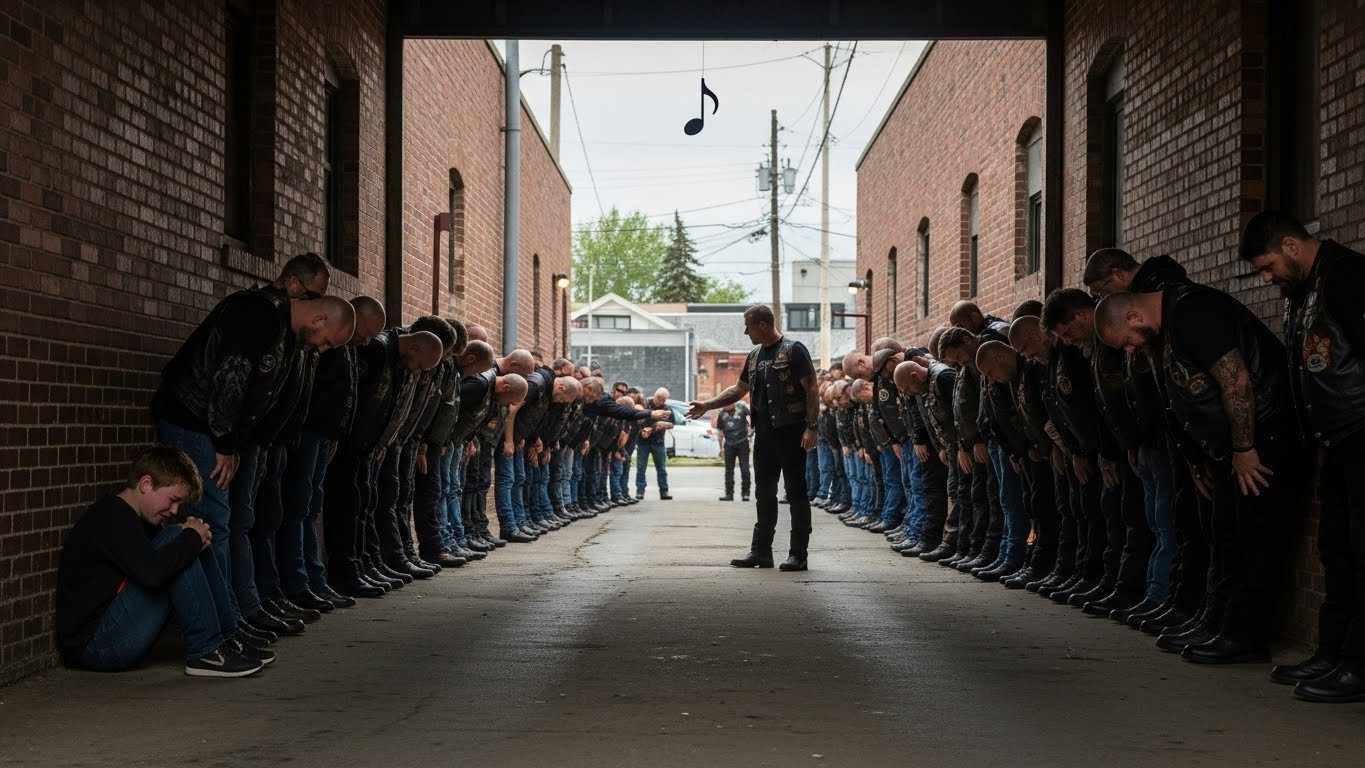
The other bikers had dismounted. They were standing quietly, heads bowed. Some of the toughest men in Oregon were openly wiping tears from their faces.
“I couldn’t leave her,” Caleb whispered. “Mom said to save who you can.”
“Your mom raised a good man,” Grant said. “Where is she? I want to thank her.”
“She died,” Caleb said simply. “Four years ago.”
Grant closed his eyes for a second, composing himself. When he opened them, there was a fire in them—not of anger, but of fierce, protective love.
“Well,” Grant said, his voice thickening. “I think the system got it wrong today, Caleb. You didn’t miss your chance at a family.”
Grant looked back at the Iron Falcons. Fifty men nodded in unison. A silent vote. A pact.
Grant turned back to Caleb. “You just found a bigger one.”
“What do you mean?” Caleb asked, wiping his nose with his sleeve.
“I mean,” Grant said, “you’re coming home with us. We’re gonna fix this. I promise you, Caleb. We are going to fix everything.”
Chapter 4: Building a Sanctuary
The next morning, the Redwood Department of Child Services opened its doors at 8:00 AM sharp. At 8:01 AM, the receptionist nearly dropped her coffee mug.
Grant Carter walked in. He was wearing a fresh shirt, but he still looked like a mountain of a man. Behind him was Caleb, looking small and clean (Grant had let him shower at the clubhouse and given him a t-shirt that went down to his knees).
And behind them, filling the waiting room, filling the hallway, and spilling out into the parking lot, were the Iron Falcons. They stood with their arms crossed, silent, respectful, but undeniably present.
Mrs. Gable, the social worker, hurried out of her office. “Mr… Carter? What is going on?”
“We’re here to file for emergency foster placement,” Grant said, placing a thick stack of papers on the counter. “For Caleb Foster.”
Mrs. Gable looked at Caleb, then at the biker. “Mr. Carter, that’s… that’s a complicated process. Background checks, home studies…”
“I have my background check here,” Grant said, tapping the pile. “I own my own business. No felony convictions. Clean record. I have character references from the Mayor, the Chief of Police, and Dr. Aris at the hospital.”
He leaned in closer.
“This boy saved my daughter’s life yesterday,” Grant said, his voice low and intense. “He missed his interview with you to do it. He has been sleeping behind a library for three years while this town looked the other way. That ends today. He comes home with me. Tell me what I need to sign.”
Mrs. Gable looked at Caleb. She saw the hope in the boy’s eyes—a fragile, terrified hope. She looked at the army of bikers outside, ready to riot if they were told ‘no’.
She smiled. “Let’s go to my office.”
While the paperwork was being expedited—at record speed—the Iron Falcons were not idle.
Grant had made a call. “Get the house ready.”
While Grant was at the agency, twenty bikers descended on Grant’s suburban home. It was a nice house, but it was a bachelor pad with a room for a six-year-old girl. It wasn’t ready for a ten-year-old boy genius.
They went to work with the precision of a military strike team.
“Paint!” Tank yelled, pointing to the spare guest room. “Blue. A nice, calm blue. Not too dark.”
“Furniture!” Another team hauled a solid oak bed frame up the stairs.
“Books!” This was the most important part. Grant had told them about the library.
Three bikers went to the local bookstore and bought out the entire science section. Gray’s Anatomy, Guyton and Hall Textbook of Medical Physiology, encyclopedias, biographies of famous surgeons.
They built custom shelves in the room. They filled them. They bought a desk and a high-quality reading lamp. They bought a laptop.
Jasmine, who had been discharged and was resting on the couch downstairs, supervised.
“He needs a nightlight,” she told Tank. “It’s scary in the dark when you’re alone.”
Tank, a man who had a tattoo of a skull on his neck, nodded solemnly. “You got it, princess. Star Wars or superheroes?”
“Superheroes,” she decided.
By 6:00 PM, when Grant’s truck pulled into the driveway, the house was transformed.
Caleb stepped out of the truck. He was clutching his old backpack tight. He looked at the house. It had a porch. It had a yard. It was real.
“Go on,” Grant said, nudging him gently. “Go inside.”
Caleb walked in. The house smelled like lemon polish and spaghetti sauce. Jasmine ran—well, wobbled—off the couch and hugged him around the waist.
“You came!” she squealed.
“Hey,” Caleb said, awkwardly patting her back. “Careful with your stitches.”
“Come see your room!” she grabbed his hand.
Caleb let himself be dragged up the stairs. Grant followed close behind.
When they opened the door to the bedroom, Caleb stopped breathing.
It wasn’t just a room. It was a sanctuary. The walls were a soft slate blue. The bed looked like a cloud. But it was the wall of books that caught his eye.
He walked over to the shelves slowly, as if walking on holy ground. He ran his fingers over the spine of a brand-new medical dictionary. It cracked as he opened it. The smell of new paper wafted up.
“Is this…” Caleb choked up. “Is this for real?”
“It’s all yours, kid,” Tank said from the doorway, wiping his eyes with a bandana. “We figured you needed your own library. One that doesn’t close at 5 PM.”
Caleb turned around. He looked at Grant. He looked at the bikers crowding the hallway. He looked at Jasmine.
For four years, he had been invisible. He had been a ghost.
Today, he was seen.
He dropped his backpack. He didn’t need the survival kit anymore.
“Thank you,” Caleb whispered.
That night, at dinner, Caleb ate three servings of spaghetti. Grant watched him, noticing how Caleb subtly tried to hide a bread roll in his napkin—a habit from the streets.
Grant didn’t say anything. He just reached over, took the roll, buttered it, and put it back on Caleb’s plate, along with two more.
“There’s plenty, Caleb,” Grant said softly. “The fridge is always open. You never have to hide food in this house. You hear me? Never again.”
Caleb nodded, tears dripping into his pasta. He took a bite of the bread. It tasted like home.
But as Caleb finally fell asleep in a bed that was warm and safe, he didn’t know that the story wasn’t over. The news of what he did was starting to spread. And outside the safety of this new home, the world was preparing to react in ways none of them could predict. Fame was coming. And with it, a new set of challenges that would test the Iron Falcons like never before.
Chapter 5: The Weight of Kindness
The first three weeks were harder than Grant expected. Not because Caleb was bad—he was the opposite. He was too good. He was a ghost in the house, trying to be invisible, trying to earn his keep.
Caleb woke up at 5:00 AM every morning. He made his bed with military precision. He cleaned the bathroom before anyone else was up. He would sit at the kitchen table, hands folded, waiting for permission to eat breakfast.
It broke Grant’s heart every single day.
One night, at 2:00 AM, Grant heard a scream.
He bolted out of bed, grabbing the baseball bat he kept by the nightstand, and ran to Caleb’s room. Jasmine was already standing in the hallway, clutching her teddy bear, looking terrified.
Caleb was thrashing in his bed, tangled in the sheets.
“No! I don’t have it! I didn’t take it!” he was yelling in his sleep.
Grant dropped the bat and sat on the edge of the bed. He didn’t shake the boy. He knew better than to startle a kid who had lived on the streets. He just placed a heavy, warm hand on Caleb’s back.
“You’re safe,” Grant rumbled, his voice low and steady like a diesel engine. “You’re in the blue room. You have a door with a lock. The Falcons are outside. Nobody is coming for you.”
Caleb woke up with a gasp, sweat soaking his t-shirt. He looked at Grant, wild-eyed, then curled into a ball, ashamed.
“I’m sorry,” Caleb whispered. “Please don’t kick me out.”
Grant lay down on top of the covers, right next to him. “I’m not going anywhere, kid. Go back to sleep.”
Grant stayed there until dawn.
Two days later, the Iron Falcons told Grant it was time for the “intervention.”
“We told him we’re having a club meeting,” Tank said. “Bring him to the clubhouse.”
Caleb was nervous. He thought he was in trouble. He put on his best button-down shirt and combed his hair until it was flat.
When they walked into the Iron Falcons’ clubhouse, it wasn’t a smoky bar filled with beer. It was set up with rows of chairs.
And it wasn’t just bikers.
There were doctors in white coats. There were nurses. There was the administrator from Redwood General Hospital. There were news cameras.
Caleb froze in the doorway. “What… what did I do?”
The hospital administrator, a sharp woman named Mrs. Vance, stepped forward.
“Caleb,” she said, her voice echoing in the silent room. “We heard about the boy who performed a textbook compression on a temporal artery laceration using nothing but library knowledge.”
She motioned to the screen behind her. It showed a bank account balance.
“The medical community of Oregon has been talking. We don’t like it when future surgeons are sleeping in alleyways.”
She smiled. “This is an educational trust. It’s fully funded. Private school starting this fall. Pre-med program at the University of Oregon. And a reserved spot at OHSU Medical School, provided you keep your grades up.”
Caleb’s knees gave out. Grant caught him before he hit the floor.
“You’re paying for me to be a doctor?” Caleb choked out.
“We’re investing in a colleague,” Dr. Aris, the trauma surgeon, called out from the crowd. “See you in the OR in about twelve years, kid.”
Caleb buried his face in Grant’s leather vest and sobbed. For the first time in his life, the tears weren’t from pain. They were from relief. The weight of the world, which he had carried on his ten-year-old shoulders, was finally gone.
Chapter 6: The Gavel Drops
Six months later, the Redwood County Courthouse was packed.
Usually, adoption hearings are private, quiet affairs. Maybe a few family members. A social worker.
Not this one.
The bailiff had to open the overflow seating. The back of the courtroom was a sea of black leather. The Iron Falcons had shown up in full force. They sat silently, holding their helmets, looking more serious than a jury.
Judge Marilyn Stone looked over her glasses at the scene. She had been a family court judge for thirty years. She had seen the worst of humanity.
Today, she was seeing the best.
“I have the petition here,” Judge Stone said, opening the file. “Grant Carter petitioning to adopt Caleb Foster.”
She looked at Caleb. He was sitting at the plaintiff’s table, wearing a suit that Grant had bought him. Jasmine was sitting right next to him, drawing on a notepad.
“Caleb,” the Judge said gently. “Do you understand what this means? It means Mr. Carter becomes your father. Legally. Permanently. It means you don’t go back to the system.”
Caleb stood up. He wasn’t the scared kid from the alley anymore. He stood straight.
“Yes, Your Honor.”
“Is this what you want?”
Caleb looked at Grant. He looked at the man who had sat by his bed during nightmares, who had learned how to cook gluten-free pancakes because Caleb’s stomach was sensitive, who had taught him how to throw a baseball.
“More than anything,” Caleb said.
Judge Stone smiled. She picked up her gavel.
“I’ve read the report, Caleb. I know what you did on Elmwood Avenue. I know what you sacrificed.” Her voice wavered slightly. “In all my years on the bench, I have never seen a child more deserving of a home.”
She slammed the gavel down. BANG.
“Petition granted. Caleb Foster, you are now Caleb Carter.”
The courtroom erupted.
It wasn’t polite applause. It was a roar. Fifty bikers cheered. Jasmine jumped up and tackled Caleb in a hug. Grant grabbed Caleb and squeezed him so hard Caleb’s feet left the floor.
“My son,” Grant whispered into his hair. “My son.”
Outside the courthouse, the news crews were waiting. They wanted a statement. They wanted the “hero kid” to say something.
Caleb stepped up to the microphones. He held Jasmine’s hand with his left hand and Grant’s hand with his right.
“I just want to say one thing,” Caleb said to the cameras. “If you see a kid alone… if you see someone who looks like they don’t belong… don’t look away. Please. Just don’t look away.”
Chapter 7: The Ripple Effect
Years move fast when you’re happy.
Caleb Carter was no longer a headline. He was a teenager. He was the captain of the debate team. He was top of his class in Biology AP.
But he never forgot.
Every Saturday morning, Caleb didn’t sleep in. He went back to the library.
He started a program called “Caleb’s Code.”
It started small—just Caleb teaching basic first aid to a few homeless kids he knew from the old days. But with the backing of the Iron Falcons, it grew.
Grant and the club secured a warehouse. They turned it into a shelter and training center.
Caleb taught them: “Save who you can. Always.”
He taught street kids how to clean wounds so they wouldn’t get infected. He taught them CPR. He taught them that they had value.
On the five-year anniversary of the accident, Caleb and Jasmine walked back to the spot on Elmwood Avenue.
They were fifteen and eleven now.
Caleb placed a single white orchid on the sidewalk where the tire had blown out.
“Do you ever regret it?” Jasmine asked softly. “Missing that meeting?”
Caleb looked at the concrete. He remembered the blood. He remembered the fear. Then he looked at his sister. He looked at the life he had.
“I didn’t miss the meeting, Jaz,” he smiled. “I was exactly where I was supposed to be.”
Grant watched them from his truck parked down the street. He turned to Tank.
“We did good, brother,” Grant said.
“Yeah,” Tank grunted, checking his phone. “But we ain’t done. The kid got into Johns Hopkins. We gotta start fundraising for his flight expenses. I ain’t letting him fly coach.”
Chapter 8: The Doctor Is In
Twelve years later.
The emergency room at Redwood General was a war zone. It was a Friday night, full moon. Car crashes, overdoses, fights.
“Trauma One! Incoming!” the nurse yelled. “Ten-year-old male. Hit and run. Severe head trauma. BP is crashing!”
The double doors burst open. The paramedics wheeled the gurney in. The boy was small, pale, and bleeding heavily from a scalp wound.
Panic rose in the room. The residents were freezing up. There was too much blood.
“Clear the way!”
A man stepped into the trauma bay. He was tall, confident, with a stethoscope draped around his neck. His ID badge read: Dr. Caleb Carter, Chief Resident.
Caleb looked at the boy. For a split second, he didn’t see a stranger. He saw Jasmine. He saw himself.
He saw the fear.
“I need suction,” Caleb commanded, his voice calm and steady—the same voice that had commanded a hysterical mother on a sidewalk sixteen years ago. “Type and cross for four units. Get me a stapler. I’m going to control the bleed.”
He worked with blinding speed. His hands, now large and strong, moved with a grace that looked like magic. He found the artery. He clamped it. He stabilized the pressure.
The monitor stopped beeping frantically and settled into a steady rhythm. Beep… beep… beep.
“He’s stable,” Caleb said, exhaling.
He stepped back, peeling off his gloves.
Later that night, Caleb walked into the waiting room. A terrified father was sitting there, his head in his hands. He looked like he hadn’t slept in days. He looked poor. His clothes were worn.
“Mr. Evans?” Caleb said.
The man looked up, eyes filled with terror. “Is he…?”
“He’s going to be fine,” Caleb smiled. “We stopped the bleeding. He’s sleeping.”
The father broke down sobbing. He grabbed Caleb’s hand. “Thank you. I don’t have… I don’t have insurance, doctor. I don’t know how I’m going to pay you.”
Caleb looked at the man’s worn-out shoes. He looked at the backpack by the man’s feet.
Caleb reached into his pocket. He pulled out a card for Caleb’s Code Foundation.
“Don’t worry about the bill,” Caleb said. “It’s already taken care of. And if you need a place to stay while he recovers… call this number. Ask for Grant. Tell him his son sent you.”
Caleb walked out of the hospital doors and into the cool night air.
A motorcycle was waiting at the curb. An old man with a gray beard and a leather vest was sitting on it, holding an extra helmet.
“Rough shift, Doc?” Grant asked.
Caleb caught the helmet Grant tossed him. He looked back at the hospital, then at his dad.
“Saved who I could,” Caleb said, swinging his leg over the bike.
“Always,” Grant replied.
The engine roared to life, and father and son rode off into the night, leaving the world a little better than they found it.