THEY THOUGHT THEY WERE UNTOUCHABLE BECAUSE OF THEIR FATHERS’ MONEY, BUT WHEN THEY CORNERED A HELPLESS STRAY AND BEGAN THE UNTHINKABLE
Chapter 1: The Ghost in the Garage
The phantom pain in my left knee usually flared up right before a storm, a dull, throbbing reminder of a night in the Hindu Kush that I tried very hard to forget. But today, the sky over Annapolis was a mocking, brilliant blue, the kind of clear that makes everything look like a postcard. I shifted my weight, the cold concrete of the garage floor biting into my joints. I’m forty-two years old, but in “military years,” I might as well be eighty. My body is a map of places I shouldn’t have survived, held together by titanium, scar tissue, and a stubborn refusal to quit.
I’m Caleb Miller. To my neighbors in this manicured slice of Maryland suburbia, I’m the “Quiet Guy.” I’m the guy who keeps his lawn trimmed to exactly two inches, never hosts a barbecue, and nods politely but never stays to chat about the local school board or the rising cost of property taxes. They don’t know about the night in 2014 when I carried my best friend through a mile of hostile fire while my own lungs were screaming for air. They don’t know about the shrapnel still nestled near my spine, a tiny piece of metal that hums when I get too close to an MRI machine.
And they definitely don’t know about Bear.
Bear was a Belgian Malinois. My K9 partner. My shadow. He was eighty pounds of muscle, teeth, and unconditional loyalty. He saved my life three times—once by sniffing out a pressure plate I was an inch from stepping on, and twice by taking down an insurgent before I could even draw my sidearm. When a roadside IED took him in 2018, it felt like my soul had been ripped out through my chest. I walked away with a limp and a discharge paper; Bear didn’t walk away at all. He stayed in the dust of a country that didn’t care about him.
Since then, I’ve stayed away from dogs. The grief is a heavy rucksack I’m tired of carrying, and I didn’t want the responsibility of something that loved me that much again. I moved here to disappear into the mundane rhythm of civilian life. I took a job as a logistics consultant—I move boxes and data across screens. It’s boring, it’s safe, and it doesn’t require me to care if the “cargo” makes it home alive.
But the world has a way of finding you, even when you’re hiding under a layer of suburban grease and silence.
I was tightening a bolt on an old Toro lawnmower, the smell of 10W-30 and stale gasoline filling the garage, when the first yelp hit me. It wasn’t a normal dog noise. It wasn’t a “feed me” bark or a “there’s a squirrel” chirp. It was sharp, desperate, and high-pitched. It was the sound of something that knew it was about to die.
It triggered a flash—a jagged, unwelcome memory of Bear’s low whine when he’d get a thorn in his paw, or worse, the sound he made in those final seconds. My heart rate spiked, jumping from a resting sixty to a combat-ready hundred in a heartbeat. I stood up, wiping my hands on a grease-stained rag, my breath hitching in my chest.
Outside, the neighborhood was too quiet. It was that eerie 3:30 PM lull when the high schoolers are home but the parents are still trapped in DC traffic. I stepped out onto the driveway, the sun hitting my eyes.
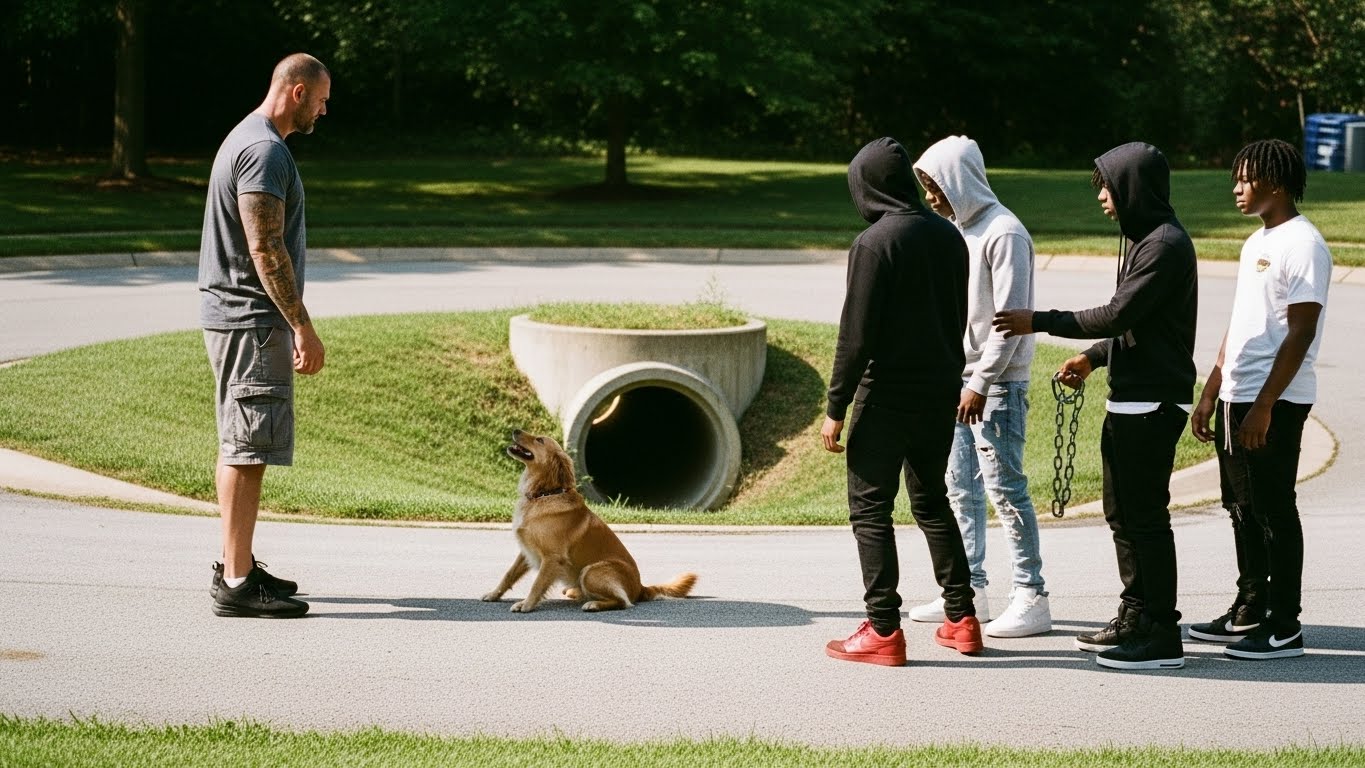
The noise was coming from the “Dead Zone”—a wooded cul-de-sac at the end of the block where the developers had run out of money. There’s a massive concrete storm drain there, surrounded by overgrown weeds and rusted chain-link. It’s where the local teens go to feel like rebels.
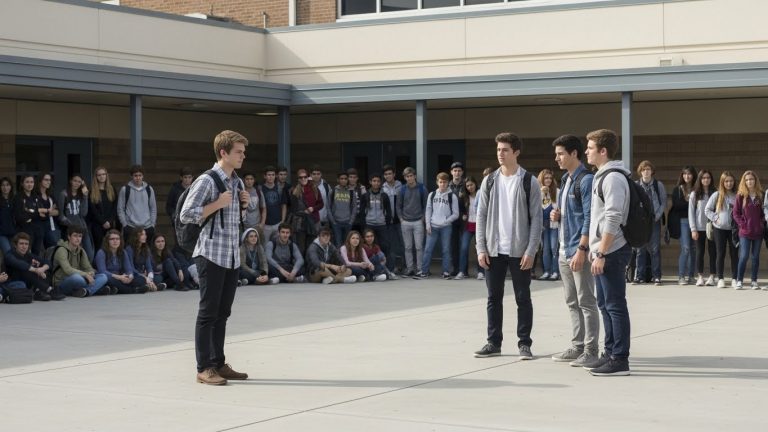
I saw them through the shimmering heat haze. Four boys. They were wearing “the uniform”—designer hoodies, sagging jeans, and sneakers that cost more than my first truck.
Jaxen Thorne was the one in the middle. I knew his father, Richard Thorne. Richard was the kind of man who’d sue a neighbor over a fence being three inches too high. He was a power-broker, a guy who used his wealth like a blunt instrument. Jaxen was a chip off the old block—arrogant, soft around the middle but hard in the eyes, and currently holding a heavy galvanized steel chain.
“Come on, stupid! Fight back!” Jaxen yelled. His voice was high, cracking with a cruel sort of excitement.
Beside him, a kid named Tyler was filming on a smartphone, his face twisted in a grin. Another kid was throwing jagged pieces of broken asphalt, aiming for the dog’s ribs.
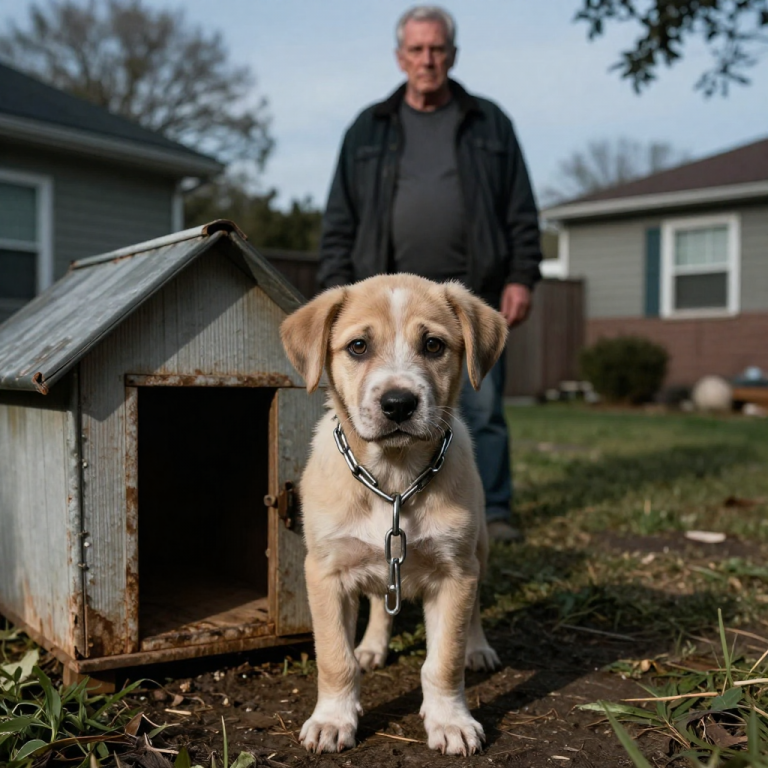
The dog was a Golden Retriever mix, maybe a year old. It was scrawny, its ribs visible under a matted, dusty coat. It was backed into the corner of the concrete retaining wall, cowering. It wasn’t snarling. It wasn’t biting. It was just trying to shrink, to become a shadow, to disappear into the stone.
“Jax, hit him again!” Tyler egged him on, adjusting the angle of the phone. “The views on this are gonna be insane. We’ll call it ‘Cleaning up the Streets.'”
Jaxen grinned, winding the chain around his fist. “Yeah. Let’s see if this mutt has any fight in him, or if he’s just a coward like the rest of the trash in this town.”
I felt the familiar heat creeping up the back of my neck—the “red zone.” My vision narrowed until all I could see was the target. The world around me—the Volvos, the hydrangeas, the peaceful American dream—dissolved. I wasn’t Caleb the consultant anymore. I was Chief Miller. And I was back on mission.
I started walking.
Chapter 2: The Line in the Sand
My boots made a steady, rhythmic thud-thud-thud on the asphalt. I wasn’t running. You don’t run when you want to project total dominance. You move like a predator that knows the prey has nowhere to go. My left knee ached, but I ignored it. I ignored everything except the kid with the chain.
“That’s enough,” I said.
I didn’t scream. I used my “Command Voice”—a tone forged in the chaos of firefights and deck-clearing drills. It’s a sound that doesn’t ask for attention; it demands it. It vibrates in the listener’s chest.
The boys froze. Jaxen turned around, the chain dangling from his hand, the metal links clinking softly. He looked me up and down. He saw a guy in a grease-stained grey T-shirt and cargo shorts. He saw a middle-aged man with a limp. He didn’t see the Navy SEAL Trident tattooed on my shoulder, hidden by the sleeve. He didn’t see the thousand-yard stare. He just saw an “old man” interfering with his fun.
“Mind your own business, Mr. Miller,” Jaxen said, his voice dripping with that specific brand of suburban bravado that comes from never having been punched in the face. “We’re just dealing with a stray. It’s a public nuisance. My dad says these things carry diseases.”
“The dog is cowering, Jaxen,” I said, stepping closer. I was ten feet away now. I could see the dog’s eyes—wide, showing the whites, fixed on the chain with a look of pure, primal horror. “Drop the chain. Walk away. This is your only warning.”
Tyler, the kid with the phone, kept recording, turning the lens toward me. “Look at this, guys. Old man Miller thinks he’s a hero. You gonna call the cops, pops? My dad’s on the city council. He’ll have you evicted before the sun goes down for harassing minors.”
Jaxen laughed, emboldened by the camera and his friend’s words. He looked back at the dog, then back at me. A cruel, defiant glint lit up his eyes. He wanted to show off. He wanted to prove he was the alpha in this little concrete arena.
“I don’t think I’m done playing yet,” Jaxen said.
In a sudden, jerky movement, he swung the chain. He didn’t swing it at me. He swung it at the dog’s head.
The “clink” of the metal hitting the dog’s ear and the agonizing, soul-shattering scream that followed broke the last of my restraint. That sound… it was the sound of every innocent person I couldn’t save. It was the sound of Bear’s final breath.
In two seconds, the distance between us closed.
I didn’t punch him. If I’d punched him with the force behind my rage, I would have broken his jaw, and in this neighborhood, that would mean a prison cell. Instead, I used a standard joint-lock. I grabbed Jaxen’s wrist with a grip that had spent years hauling heavy machinery and climbing ropes. I twisted, just enough to make the radius and ulna groan in protest.
The chain clattered to the concrete. Jaxen let out a pathetic whimper.
“Hey! Let go of him! That’s assault!” the other kids shouted, but they didn’t move. They saw my face. People say that when a man who has lived in the dark for too long gets angry, his eyes go flat. Like a shark’s. There’s no light in them, only the calculation of the next strike.
I shoved Jaxen back. He stumbled, his expensive sneakers sliding on the loose gravel, and landed hard on his rear in the dirt.
“I said walk away,” I whispered. The quietness of my voice was more terrifying than the shout. It was the sound of a fuse burning down.
Jaxen scrambled up, his face a mottled mess of red and white. He was shaking—part rage, part genuine, bone-deep fear. “You touched me! You’re dead, you hear me? My dad is gonna destroy you! I’m calling the police!”
“Your dad isn’t here, Jaxen,” I said, stepping between them and the dog. I felt the dog’s weight against my calf—a trembling, furry heat. “But I am. And if you or your little film crew ever come near this animal again, you won’t be worried about your dad. You’ll be worried about what I’m going to do to you when the cameras aren’t rolling.”
The dog whimpered behind me, pressing its body against my leg as if trying to hide inside my shadow. It was the first time I’d felt a dog’s touch in five years. The warmth of its fur sent a jolt through me that felt like an electric shock, waking up nerves I thought had gone dead.
“Go,” I commanded.
They retreated, shouting insults, promising lawsuits, their bravado crumbling with every step they took toward the safety of their paved driveways. But as I watched them disappear, I knew this wasn’t over. In a town like this, the “privileged” don’t take “no” for an answer. They don’t handle being humiliated by a “nobody.”
I turned around and knelt in the dirt. My knee screamed in protest, but I ignored it. The dog backed away at first, its tail tucked so tight it was touching its belly, its ears pinned back.
“Hey,” I said, my voice softening, reaching back for a version of myself I thought I’d buried in the sand of Iraq. “Hey, buddy. It’s okay. The bad guys are gone. I’ve got the watch now.”
I reached out a hand, palm up. Slowly. The dog sniffed my fingers, its body shaking so hard I could hear its teeth rattling. Its nose was cold, but its breath was ragged and hot. I saw the blood then—a jagged, ugly cut on its ear where the chain had clipped him.
But it wasn’t just a stray. Around its neck was a frayed, purple nylon collar. No tags, no names. Just a piece of cheap fabric that hinted someone, somewhere, might have cared once.
As I looked into its eyes—amber and clouded with pain—I saw a reflection of my own life. A soldier with no unit. A creature that had been beaten by a world it didn’t understand.
“Come on,” I said, standing up and beckoning him. “Let’s get you cleaned up. My house is a mess, but it’s safe.”
The dog hesitated, looking at the woods, then at me. It took one tentative step. Then another. When we reached my driveway, it stopped, looking at the garage as if expecting another trap. I waited. I didn’t rush him.
Finally, the dog followed me inside. I didn’t know it yet, but Jaxen Thorne was already on the phone with his father, Richard. And by tomorrow morning, the quiet life I had built as a shield was going to be shattered.
Chapter 3: The Storm Breaks
Inside the house, the dog—who I’d tentatively started calling “Echo” in my head, because he was just a ghost of a dog—sat on my kitchen linoleum. He looked out of place against the sterile, minimalist decor of my life. I didn’t have much—a table, two chairs, a couch I rarely sat on.
I grabbed my old medic kit from the hall closet. I’d kept it fully stocked out of habit. Force of habit is a hell of a thing.
“Stay,” I said softly.
Echo didn’t move. He watched me with those big, soulful eyes as I pulled out the antiseptic and a clean gauze pad. When I touched his ear, he flinched, a low whine vibrating in his throat, but he didn’t snap. He let me work.
“You’re a good boy,” I muttered. The words felt foreign in my mouth. I hadn’t praised anything in years. “Much better than those punks out there.”
As I taped the bandage, a heavy, rhythmic thudding came from my front door. It wasn’t a neighborly knock. It was the sound of someone who thought they owned the air I was breathing.
I stood up, my muscles coiling. I looked at the clock. Twenty minutes. Jaxen had moved fast.
I opened the door. Richard Thorne stood there, looking exactly like I expected. He was wearing a tailored navy suit that probably cost more than my car, his silver hair perfectly coiffed. Behind him, Jaxen stood with his arms crossed, a smug, “you’re-in-trouble-now” look plastered on his face. Behind them, a local police cruiser sat at the curb, its lights off but its presence felt.
“Caleb Miller?” Richard said, his voice a polished baritone that he usually reserved for courtrooms.
“Thorne,” I replied, leaning against the doorframe. I didn’t invite them in.
“My son tells me you assaulted him today,” Richard said, stepping closer, trying to use his height to intimidate me. I’ve had mountain insurgents hold AK-47s to my head; a lawyer in a suit didn’t even move the needle on my heart rate. “He says you grabbed him, threatened him, and stole a dog that he was trying to ‘relocate’ for the safety of the neighborhood.”
“Your son was beating a defenseless animal with a chain, Richard,” I said, my voice flat. “I stopped a crime. If you want to talk about assault, let’s talk about the felony animal cruelty charges I’m currently documenting.”
Richard’s face flushed a deep, angry purple. “Don’t you dare lecture me on the law, Miller. I know your type. Ex-military. Probably got a ‘condition.’ You think you can bring your battlefield tactics into a civilized neighborhood? You’re a liability. You touched a minor. That’s a one-way ticket to a lawsuit that will take everything you own.”
Jaxen piped up from behind him. “Yeah! And the dog is a stray! It bit me! We have it on video!”
I looked at Jaxen. “The video shows you swinging a chain, kid. I’d be careful who you show that to.”
Richard stepped into my personal space, his finger pointed at my chest. “Give me the dog, Miller. We’re taking it to the shelter—or the vet to be put down. It’s a menace. And then, you and I are going to talk about how quickly you can pack your bags and leave this community.”
I looked down at his finger, then back up at his eyes. I felt the “Chief” coming back out.
“First,” I said, my voice dropping an octave, “take your hand off my property. Second, that dog isn’t going anywhere. He’s mine now. And third…”
I leaned in, just enough so only Richard could hear me. “I’ve seen men like you in every corner of the world. You think money makes you a king. But out here, in the real world, you’re just a man who raised a coward. If you want this dog, or if you want me, you’re going to have to come through me. And trust me, Richard—you aren’t equipped for that.”
Richard recoiled as if I’d slapped him. He opened his mouth to speak, but the look in my eyes stopped him. It was the look of a man who had nothing left to lose and the skills to make sure everyone else lost first.
“We’ll see what the police have to say,” Richard hissed. He turned to the cruiser at the curb. “Officer! This man is being non-compliant and aggressive!”
The officer, a young guy named Miller (no relation), stepped out of the car. He looked uncomfortable. He’d probably dealt with Richard’s “emergencies” before.
“Mr. Miller,” the officer said, walking up the driveway. “Can we just hand over the dog and settle this quietly? Mr. Thorne is willing to drop the assault charges if you just cooperate.”
I looked at the officer, then back at the kitchen where Echo was peeking around the corner, his bandaged ear making him look small and vulnerable.
“No,” I said. “The dog stays. And if Mr. Thorne wants to sue, tell him to bring a lot of pens. He’s going to be signing a lot of paperwork.”
The officer sighed. “Caleb, don’t make this harder than it has to be.”
“It’s already hard, Officer,” I said. “It’s been hard for a long time.”
I shut the door in their faces and locked it. My hands were shaking—not from fear, but from the sheer adrenaline of the confrontation. I turned around to find Echo sitting right at my feet. He looked up at me, and for the first time, he wagged his tail. Just once. A small, tentative thump against the floor.
The war had followed me home. And for the first time since Bear died, I had something worth fighting for.
Chapter 4: The Neighborhood Watch
The next morning, the silence of the suburbs felt like the pressure in a room right before a flashbang goes off. I didn’t sleep. I spent the night in a kitchen chair, my back to the wall, watching the front door while Echo slept on a pile of my old sweatshirts. He snored—a soft, rhythmic sound that reminded me I wasn’t alone.
By 8:00 AM, the “Suburban Siege” had begun.
It started with the phone. My boss at the logistics firm, a man who usually only calls to complain about shipping delays in Dubai, sounded like he’d swallowed a lemon.
“Caleb,” he said, his voice tight. “I’ve got Richard Thorne on my other line. He’s a major donor to the board, and he’s talking about ‘instability’ and ‘violent tendencies.’ He’s sent over a video of you… accosting his son?”
“He’s sending an edited clip, Mark,” I said, staring out the window at a black SUV idling across the street. “His son was torturing a dog with a chain. I stopped it.”
“I don’t care about the dog, Caleb! I care about the PR. Take a week. Unpaid. If this doesn’t blow over, we’re going to have to make your position… redundant.”
Click.
I stared at the dead phone. Twenty years of service, five years of corporate loyalty, and it all vanished because a lawyer didn’t like being told “no.”
I went to the front porch to get the mail. A bright orange sticker was plastered to my front door. HOA Violation: Unauthorized Animal and Nuisance Behavior. Below it was a handwritten note: We don’t want your kind here. Move out.
I looked across the street. Mrs. Gable, a woman who usually spent her mornings deadheading roses, looked at me and immediately turned her back. The “Quiet Guy” was now the “Dangerous Vet.”
But then, a beat-up Subaru pulled into my driveway. A woman stepped out. She looked to be in her late thirties, wearing scrubs and a look of grim determination. This was Sarah Vance, the local veterinarian I’d seen at the grocery store but never spoken to.
“I saw the video,” she said, walking up to me. She didn’t look scared. She looked pissed. “The real one. My daughter was there. She filmed the whole thing from behind the drainage pipe because she was too scared to jump in. She saw what you did.”
She handed me a thumb drive. “That’s the unedited footage. Jaxen Thorne didn’t just ‘play’ with that dog. He was trying to kill it for a TikTok trend.”
“Why are you helping me?” I asked, my hand closing over the drive.
Sarah looked at the orange sticker on my door and spat on the ground. “Because I hate bullies. And because I know that dog. He’s been a stray in the woods for a month. People call him ‘The Ghost.’ No one could catch him. The fact that he’s in your house right now tells me everything I need to know about you, Caleb Miller.”
“He needs a vet,” I said, stepping aside to let her in.
“That’s why I’m here,” she replied. “But you better buckle up. Thorne isn’t just coming for your job. He’s pulling the ‘Dangerous Veteran’ card. He’s contacted the local news. They’re going to paint you as a ticking time bomb.”
I looked at Echo, who was tentatively wagging his tail at Sarah. “Let them. I’ve survived worse than a news cycle.”
Chapter 5: Echoes of the Past
The afternoon news segment was a masterclass in character assassination. They didn’t mention the dog. They showed a photo of me from my final tour—bearded, dusty, holding a carbine. They called me “A troubled veteran with a history of combat-related outbursts.” They interviewed Richard Thorne, who looked like a grieving father on camera.
“We just want our neighborhood to be safe for our children,” Thorne said, wiping an invisible tear. “We can’t have men with… specialized training… snapping in our cul-de-sacs.”
Inside my house, the air felt thick. Echo was lying on the rug, his ear freshly stitched by Sarah. He sensed my tension. He got up, walked over, and rested his heavy head on my knee.
I looked down at him. “They’re trying to make me the monster, buddy. Just like they made you the ‘nuisance.'”
The ethical dilemma gnawed at me. If I stayed and fought, I’d drag Sarah and her daughter into the crossfire. If I left, Thorne won, and Echo would likely end up in a high-kill shelter or worse. My training told me to “break contact” when overwhelmed. But my heart—the piece of it that still belonged to Bear—told me to hold the line.
That night, the shadows moved.
I was in the kitchen making coffee when I saw the flicker of a flashlight in the backyard. Then, the sound of glass shattering in the living room.
I didn’t turn on the lights. I didn’t scream. I went into a low crouch, my hand finding the heavy Maglite I kept on the counter. Echo let out a low, guttural growl I hadn’t heard before. It wasn’t the sound of a victim. It was the sound of a protector.
“Stay,” I hissed.
I moved through the house like a ghost. I knew every creak in the floorboards. In the living room, two figures were climbing through the broken window. They were wearing dark hoodies, but I’d recognize those sneakers anywhere.
“Get the dog,” one whispered. “Jaxen said to bring the collar back so we can show him.”
They weren’t here for me. They were here to finish what they started with Echo.
The rage that hit me wasn’t cold this time. It was white-hot. It was the feeling of a perimeter being breached. I waited until the first one was fully inside.
I didn’t use a weapon. I used the environment. I kicked a heavy ottoman into the first kid’s shins. As he went down, I was on him. I grabbed the front of his hoodie and slammed him against the wall—not enough to kill, but enough to remind him that he was made of glass and I was made of iron.
“You’re in the wrong house,” I whispered into his ear.
The second kid—Tyler, the one with the phone—tried to run back out the window. But Echo was there. The dog didn’t bite. He just stood on the windowsill, baring his teeth, a low vibration coming from his chest that sounded like a idling chainsaw. Tyler froze, hovering between the dog and me.
“Please!” the kid I was holding whimpered. “It was Jaxen’s idea! He said you wouldn’t do anything because the cops are watching you!”
“Jaxen was wrong,” I said.
I pulled my phone out and hit record. “Now, you’re going to tell me exactly who sent you, what you were planning to do to the dog, and whose idea it was to edit that video. If you do, I might let you leave before the police arrive. If you don’t… well, I have a very large backyard and a very hungry dog.”
I wasn’t going to hurt them. But they didn’t know that. They saw the “monster” the news had promised them. And they started talking.
Chapter 6: Siege Mentality
By 2:00 AM, I had it all. A full confession on video. The names of the kids, the admission that Jaxen had paid them to break in, and the truth about the dog’s “attack.”
But I knew the police wouldn’t be enough. Richard Thorne owned the local precinct. If I called 911, the evidence would “disappear” before the morning sun.
I needed a bigger stage.
I called the only person I could trust. “Sarah? It’s Caleb. I need you to get your daughter’s unedited footage ready. We’re going live.”
“Live where?” she asked, her voice sleep-heavy.
“Everywhere.”
I spent the rest of the night setting up. I used my old military laptop, the one with the encrypted drive. I reached out to a few guys from my old unit—guys who had gone into private security and tech.
“Chief? Is that you?” Marcus, my former comms tech, answered on the second ring.
“Marcus. I need a favor. I have a video file. I need it to hit every local news station, every social media group in Maryland, and the state attorney’s office simultaneously. Can you do it?”
“For you, Chief? I’ll make it go viral before your coffee gets cold. What’s the sitrep?”
“A rich man thinks he can hunt a dog in my backyard,” I said, looking at Echo, who was now sleeping soundly at my feet, his head resting on my boot. “I’m about to show him the difference between a lawyer and a SEAL.”
As the sun began to peek over the horizon, I sat on my front porch. I didn’t hide. I didn’t wait for the shadows. I sat in my rocking chair, Echo sitting regally beside me, his bandage a badge of honor.
At 7:00 AM, Richard Thorne’s Porsche pulled into the cul-de-sac. He stepped out, looking triumphant, followed by two officers and a man in a suit I didn’t recognize—probably a process server.
“Caleb Miller!” Thorne shouted, walking up the driveway with a smirk. “I hope you’ve enjoyed your last night in this house. We have a court order for the removal of that animal and a restraining order that says you need to be fifty yards from any minor in this neighborhood.”
I didn’t stand up. I just took a sip of my coffee.
“You’re late, Richard,” I said.
Thorne paused, his smirk flickering. “What?”
“Check your phone,” I said.
One of the police officers reached for his belt, pulling out his personal device. His face went pale. He looked at Thorne, then at me, then back at the screen.
“Sir,” the officer whispered, handing the phone to Thorne. “You… you need to see this.”
On the screen was the video of the two kids in my living room, crying and confessing to everything. It was spliced with Sarah’s daughter’s footage—the clear, high-definition shot of Jaxen Thorne laughing as he whipped a helpless dog with a chain. The caption, scrolling in bright red letters across the bottom, read: PROMINENT ATTORNEY’S SON EXPOSED IN ANIMAL CRUELTY COVER-UP. MILITARY VET FRAMED.
It had been shared fifty thousand times in three hours. The comments were a firestorm of public outrage.
Richard Thorne’s face didn’t just turn red; it turned a terrifying shade of grey. His hand shook as he watched his son—his legacy—confess to a felony.
“This… this is a fabrication!” Thorne screamed, but his voice sounded thin, brittle.
“It’s the truth, Richard,” I said, finally standing up. Echo stood with me, his shoulders square. “And the truth is a funny thing. Once it’s out of the bag, you can’t sue it back in.”
I walked down the porch steps, stopping just a foot away from him. I didn’t need to be loud. I just needed to be certain.
“The police are here to do their job now,” I said, looking at the officers. “And I think they have a lot of questions for your son. And maybe a few for you about witness tampering and filing false reports.”
The two officers looked at each other. They weren’t Thorne’s friends anymore. They were civil servants in a very public spotlight.
“Mr. Thorne,” the lead officer said, his voice cold. “We’re going to need you to come down to the station. And we’re going to need to speak with Jaxen. Immediately.”
As they led a crumbling Richard Thorne away, he looked back at me one last time. There was no power left in his eyes. Only the realization that he had picked a fight with a man who had nothing left to lose—and a dog who had everything to gain.
I looked down at Echo. “I think it’s time for breakfast, buddy.”
He barked. A real bark. Deep, healthy, and full of life.
Chapter 7: The Weight of the Silence
The aftermath of a storm is never as quiet as people think. There’s the drip of water from the eaves, the snapping of broken branches, and the low hum of the world trying to reset itself.
In the weeks following the viral explosion, my cul-de-sac became a different kind of war zone. News vans stayed for three days, their satellite dishes pointed at the sky like accusing fingers. Richard Thorne was indicted on three counts of witness tampering and filing a false police report. Jaxen was facing felony animal cruelty and breaking and entering. Because of the public pressure, the “privileged” defense didn’t work this time. The community that had turned its back on me suddenly started leaving casseroles and “Thank You” cards on my porch.
I threw the cards away. I didn’t want their gratitude any more than I wanted their judgment.
The real struggle was happening inside the four walls of my house. Now that the adrenaline had bled out of my system, the old ghosts started coming back. My knee throbbed with a vengeance, and the silence of the house felt heavier than usual.
Echo was healing physically. His fur was growing back over the scar on his ear, and he’d gained five pounds of healthy weight. But he still jumped at the sound of the toaster. He still slept with one eye open, always positioned so he could see the door.
One night, a summer thunderstorm rolled through Annapolis. The first crack of lightning sounded like a mortar round hitting the pavement. I woke up in a cold sweat, my heart hammering against my ribs, my hand reaching for a weapon that wasn’t there.
I was gasping for air, the smell of cordite and dry dust filling my mind, when I felt a weight on my chest.
It wasn’t a nightmare. It was Echo.
He had jumped onto the bed—something I’d strictly forbidden—and was sitting directly on my chest. He wasn’t shaking. He was looking down at me, his amber eyes steady and calm in the flashes of lightning. He let out a soft, huffing breath and licked the salt from my forehead.
He wasn’t asking for protection. He was providing it.
“I’m okay, buddy,” I whispered, my voice cracked and raw. “I’m okay.”
For the first time since Bear died, I didn’t push the dog away. I wrapped my arms around his neck and buried my face in his fur. We stayed like that until the sun came up, two broken soldiers holding each other together while the rest of the world slept.
Chapter 8: The Final Watch
The morning was crisp, the kind of day that makes you feel like you can actually breathe again. I stood in my garage, but I wasn’t fixing a lawnmower. I was packing a rucksack.
I wasn’t leaving for good, but I was leaving the “Quiet Guy” behind. Sarah Vance had helped me find a local K9 rescue that needed a trainer—someone who understood the specific trauma of working dogs and the men who led them. It was a reason to wake up that didn’t involve logistics spreadsheets.
I walked out to the driveway. The orange “Violation” sticker was gone, replaced by a small, hand-painted sign a neighborhood kid had left: Good Dogs Live Here.
I looked down at Echo. He was sitting by the passenger door of my truck, his tail thumping rhythmically against the gravel. He didn’t look like “The Ghost” anymore. He looked like he belonged.
I reached into my pocket and pulled out a new collar. It wasn’t cheap purple nylon. It was heavy-duty leather, tactical grade, with a brass plate riveted to the center.
I knelt down, my knee clicking, and buckled it around his neck. I ran my thumb over the engraving. It didn’t just say his name. It had my phone number and four words that I lived by: Never Walk Alone Again.
I stood up and looked at the Thorne house across the street. It was for sale. The windows were dark, the power stripped away by the very arrogance that had built it.
I realized then that I hadn’t just saved a dog. In the process of protecting something vulnerable, I’d accidentally protected myself. I’d stopped hiding in the shadows of my past and started standing in the light of my present.
I opened the truck door, and Echo leaped into the seat with the grace of a seasoned pro. He looked out the window, his ears up, ready for the next mission.
I climbed in, shifted into gear, and drove away from the cul-de-sac. As I looked in the rearview mirror, I didn’t see a “troubled veteran” or a “loner.” I saw a man with a partner.
The war was over. The healing had finally begun.
I reached over and ruffled Echo’s ears. He leaned into my hand, a soft whine of contentment escaping him.
“Ready?” I asked.
He barked—a sharp, clear sound that echoed off the houses and rose into the clear blue sky.
“Yeah,” I whispered, stepping on the gas. “Me too.”
If you saw someone hurting a defenseless animal, would you have the courage to step in even if it meant losing your job and your reputation? Or is it safer to mind your own business in today’s world?