The Stray Cat Kept Stealing My Food and Running Away. I Followed Him to a Ruined Factory and Found a Nightmare Behind the Wall.
Part 1
Chapter 1: The Thief in the Night
It was the kind of cold that hurts your bones—a typical Tuesday night in Detroit when the wind whips off the river and turns the whole city into an icebox. I was sitting on my porch, wrapped in three layers of flannel and a heavy canvas coat, trying to eat a ham sandwich.
My name is Mike. I didn’t have much. Since the auto plant laid me off eleven months ago, my life had shrunk down to the essentials: keeping the heat on, finding odd jobs, and staying out of trouble. It was mostly just me, the silence of a neighborhood that had seen better days, and Rusty.
Rusty was this beat-up, orange tabby cat that showed up about six months ago. He was a survivor, just like everything else in this city. One ear was torn, looking like a jagged piece of felt, his tail was crooked near the tip, and he had a serious attitude problem. I wasn’t a “cat guy.” I barely had enough money to feed myself, let alone a pet. But he stuck around, sleeping under my porch steps, and eventually, we came to an understanding. I’d give him the scraps; he’d keep the rats out of my crawlspace. It was a business transaction, or so I told myself.
But that Tuesday, Rusty was acting weird.
Usually, he’d eat whatever I gave him right there on the porch, purring like a broken diesel engine. He was possessive about food. You didn’t touch Rusty when he was eating. But that night, when I tossed him a piece of ham—good ham, the expensive stuff I shouldn’t have bought with my tight budget—he didn’t eat it.
He snatched it up in his jaws, looked at me with those intense, intelligent green eyes, and bolted.
“Hey! Where you going with that?” I yelled, crumbs falling from my mouth.
He didn’t stop. He vanished into the shadows of the alleyway that ran between my house and the boarded-up duplex next door. I stared after him for a minute, shivering. I figured maybe he was saving it for later, burying it somewhere. Or maybe he had a girlfriend he was trying to impress. I finished my sandwich, rubbed my hands together to get the circulation back, and went inside.
The next night, it happened again.
I had leftover chicken from a sale at the grocery store. I pulled the meat off the bone and put a small plastic bowl down for him. Rusty appeared from the darkness as soon as the smell hit the air. But instead of diving in, he sniffed it, carefully picked out the biggest, juiciest piece of meat with surgical precision, and took off running. He didn’t take a single bite. He just ran, his orange tail disappearing into the snow.
Now, I was getting annoyed. And honestly? I was getting suspicious.
Rusty was a scavenger. Scavengers don’t share. They eat until they burst because they never know when the next meal is coming. For a street cat to carry fresh meat away into the freezing dark without swallowing it first… that went against every instinct nature gave him.
Chapter 2: Into the Dead Zone
On the third day, the snow was coming down hard. A real Michigan blizzard was settling in. The streetlights were flickering, buzzing with that electric hum that sounds like anxiety.
I decided to test him. I heated up a hot dog—literally my dinner—and cut it in half. The steam rose up in the freezing air. I threw a piece to him.
Same thing. Snatch. Run.
Something in my gut twisted. It wasn’t just curiosity anymore; it was a strange, pulling feeling. A feeling that I was missing something important. A feeling that Rusty wasn’t just being weird—he was trying to tell me something.
I grabbed my heavy coat, pulled my beanie down low over my ears, and grabbed a heavy-duty flashlight from the kitchen drawer.
“Alright, you little thief,” I muttered, locking my door and stepping out into the swirl of white. “Let’s see where you’re taking my groceries.”
I picked up his trail easily enough at first. His paw prints were fresh in the snow, small depressions leading away from the safety of the houses. He was heading toward the “Dead Zone”—the nickname we locals had for the old industrial park four blocks over.
It was a dangerous place. Collapsed roofs, rusted metal that could slice through a boot, and people you didn’t want to run into after dark. Drug deals went down there. Bad things happened there.
The wind was howling, covering his tracks almost as fast as he made them. I had to jog to keep the orange blur of his fur in sight. He was moving with a purpose I’d never seen before. He wasn’t prowling or sniffing around. He was on a mission. He moved in a straight line, ignoring the other scents of the city.
He led me past the fenced-off chemical plant, through a jagged hole in a chain-link fence that snagged my jacket, and toward the ruins of what used to be a textile factory. It was just a skeleton of a building now, jagged concrete walls sticking up like broken teeth against the gray sky.
My breath was coming in short, painful clouds. My boots felt heavy. “Rusty, this better be good,” I whispered to myself, looking around nervously. It was too quiet here. The city sounds were muffled by the distance and the thick walls of the ruins.
I saw Rusty stop at the base of a massive, cracked retaining wall at the far edge of the property. This wall used to hold back the earth for a loading dock, but now it was just a crumbling monolith covered in graffiti and dead vines.
I stayed back, hiding behind a rusted dumpster, watching.
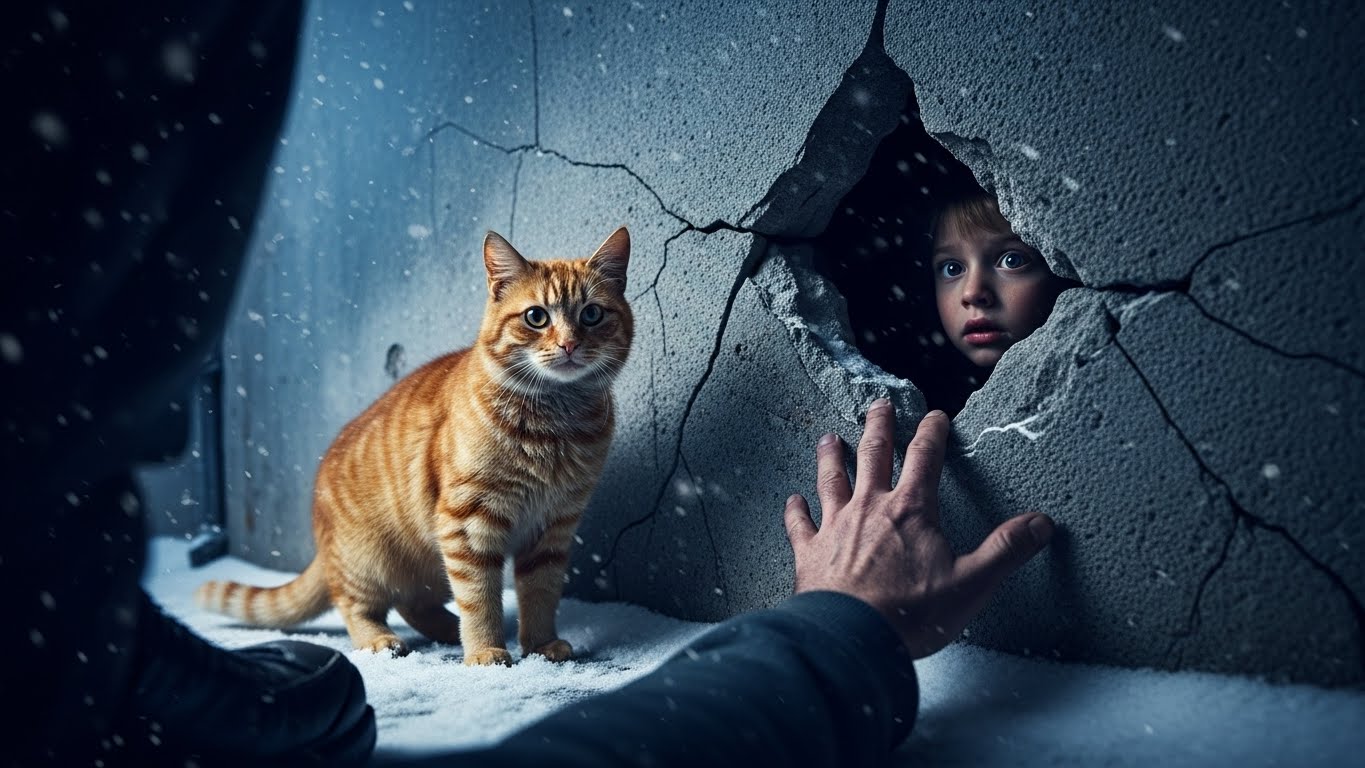
Rusty paced back and forth in front of a small fissure in the concrete—a crack barely big enough for a raccoon, located near the ground where the foundation had settled and split. He let out a low, distinct “meow.”
It wasn’t a beg. It wasn’t a mating call. It was a signal.
He pushed the piece of hot dog into the hole with his paw, shoving it deep into the darkness.
Then, he sat back in the snow, wrapped his tail around his paws, and waited.
I held my breath. Was he feeding kittens? That had to be it. A litter of kittens freezing to death in the wall. It was sweet, actually. I felt my annoyance melt away.
I stepped out from behind the dumpster, the snow crunching loudly under my boots. Rusty whipped his head around and hissed at me, arching his back, standing guard over the crack in the wall.
“Easy, buddy,” I whispered, raising my hands. “I just want to see. I can help.”
I walked up to the wall. Rusty swiped at my leg, claws out, but I ignored him. I crouched down in the snow, the cold soaking instantly into my jeans. I clicked on my flashlight and aimed the beam into the dark, jagged hole.
“Here kitty, kitty,” I whispered, expecting to see glowing animal eyes reflecting the light.
I didn’t hear a meow.
I heard a crunch. A slow, weak chewing sound.
I leaned closer, putting my ear against the cold concrete.
And then, I heard a sound that stopped my heart cold. It wasn’t a kitten. It wasn’t a raccoon.
It was a sniffle. A human sniffle.
“Mommy?” a voice whispered. A tiny, trembling voice. “Did you come back?”
Part 2
Chapter 3: The Impossible Discovery
The flashlight shook in my hand so hard the beam danced wildly against the concrete. I felt like I had been punched in the stomach. The air in my lungs froze.
I dropped to my knees, shoving my face as close to the crack as I could without scraping my skin on the jagged rebar.
“Hello?” I choked out. My voice sounded foreign, high-pitched and terrified.
There was silence from the hole. The chewing stopped. Then, a small, terrifying shuffle of movement.
I angled the light deeper into the fissure. The crack was narrow, maybe four inches wide at the opening, but it opened up into a hollow space behind the retaining wall—probably an old drainage void or a structural gap that had widened over decades of neglect.
At first, all I saw was trash, old candy wrappers, and rubble. But then, way back in the recess of the hollow wall, about four feet deep, a blue eye blinked at me.
A child.
There was a little boy squeezed inside the wall. He couldn’t have been more than five years old. He was curled into a tight ball, wrapped in dirty yellow insulation foam that he must have pulled from the debris. He was clutching the half-hot dog Rusty had just brought him with filthy, trembling fingers.
“Oh my god,” I gasped. I scrambled backward in the snow, my mind unable to process what I was seeing. A kid. A human child. encased in concrete in the middle of a blizzard.
Rusty stopped hissing. He looked at me, then looked at the hole, and let out a soft trill. He nudged my hand with his cold nose. It was like he was saying, Finally. You finally understood.
I scrambled back to the hole. “Hey,” I said, trying to make my voice gentle, though I was shaking. “Hey, buddy. My name is Mike. You’re okay. I’m going to get you out.”
The boy didn’t answer. He just stared at the light, shielding his eyes. He looked incredibly pale, his skin almost translucent against the dirt.
“How… how did you get in there?” I asked.
“The bad man put me here,” the boy whispered. His voice was so quiet I had to strain to hear it over the wind. “He said if I make a noise, he’ll come back.”
Rage, hot and blinding, flooded my system. Someone had put him there? This wasn’t an accident. This was a tomb.
“The bad man isn’t coming back,” I promised, my voice hardening. “I’m here now. And I’m not leaving.”
Chapter 4: The Fortress of Concrete
I assessed the situation. The hole was way too small for him to crawl out of. He must have been shoved in through a larger opening somewhere else, or maybe the earth had shifted and trapped him.
“Can you see another way out?” I asked.
“No,” he whimpered. “It’s dark.”
I tried to reach my arm in, but the concrete was jagged and tight. I could barely get my wrist past the opening. I needed to break the wall.
I stood up and looked around frantically. I was in an abandoned factory. There had to be something. A pipe. A brick. Anything.
I found a rusted length of steel rebar sticking out of a pile of rubble nearby. It was heavy, about three feet long. I grabbed it, adrenaline giving me strength I didn’t know I had.
“Okay, listen to me,” I shouted into the hole. “I’m going to make some noise. It’s going to be loud. But I need you to move back. Move as far back as you can. Cover your head with that yellow fluff. Do you understand?”
“Yes,” the tiny voice replied.
I waited until I heard him shuffle back.
Clang.
I swung the rebar against the edge of the crack. Sparks flew. The vibration jarred my arms all the way to my shoulders, but the concrete barely chipped. This was industrial-grade stuff, built to last a hundred years.
Clang.
“Come on!” I screamed, swinging again. A chunk of concrete the size of a fist broke off. It wasn’t enough.
I pulled out my phone. My hands were numb, and the screen was wet with snow. I dialed 911.
“911, what is your emergency?”
“I found a kid!” I yelled. “I found a kid trapped in a wall! He’s freezing to death!”
“Sir, calm down. What is your location?”
“The old textile plant! In the Dead Zone! Near the… near the river!” I didn’t know the address. This place hadn’t had an address in twenty years.
“Can you give me a cross street?”
“Just track my phone! Please! He’s starving! Send everyone!”
I dropped the phone in the snow and grabbed the rebar again. I couldn’t wait for them. The temperature was dropping. The kid was lethargic. Hypothermia was setting in.
Rusty was pacing around my feet, meowing loudly now, sensing the panic.
I swung the rebar again and again. My hands were blistering. My breath came in ragged sobs. Clang. Clang. Crack.
Chapter 5: The Race Against Time
Ten minutes passed. It felt like ten years. I had managed to widen the hole by maybe two inches. My arms felt like jelly.
“Are you okay in there?” I yelled, shining the light back in.
The boy wasn’t eating the hot dog anymore. He was slumped over.
“Hey! Stay awake!” I shouted. “Talk to me! What’s your name?”
“Leo,” he whispered.
“Leo. That’s a strong name. Leo the Lion. You like lions?”
“I like… cats,” he mumbled. “The orange kitty is my friend.”
Tears stung my eyes. “Yeah. Rusty is a good friend. He told me where you were, Leo. He saved you.”
I heard sirens in the distance. The wail grew louder, bouncing off the empty buildings.
“You hear that, Leo? The cavalry is coming. Just hang on.”
I didn’t stop swinging. I couldn’t. I hit the wall until my hands bled. I hit it until the rebar bent.
Finally, blue and red lights flashed against the snow. A police cruiser skidded around the corner, followed by a massive fire truck.
I waved my arms frantically, the flashlight beaming into the sky. “Over here! Over here!”
Three firefighters jumped out, carrying heavy gear. A police officer ran toward me, hand on his holster.
“He’s in the wall!” I pointed. “He’s a little boy. He’s trapped!”
The firefighters didn’t ask questions. They saw the desperation in my face. They saw the small hole. One of them, a giant of a man, shined a high-powered light inside.
“Sarge! We got a positive! Pediatric victim, trapped in a confined space!”
The mood shifted instantly from caution to high-intensity action. They brought out the “Jaws of Life”—the hydraulic spreaders usually used to rip open crashed cars.
“Step back, sir,” the firefighter told me.
“Get him out,” I begged. “Please.”
Chapter 6: The Breach
I watched as they inserted the tips of the hydraulic spreader into the crack I had widened. The machine whirred, a high-pitched mechanical whine. The concrete groaned.
Crack.
A massive spiderweb fracture shot up the wall.
“Careful! Don’t collapse the void!” the sergeant yelled.
They worked with agonizing slowness, chipping away pieces, stabilizing the structure so it wouldn’t crush Leo.
Rusty didn’t run away from the noise. He sat right next to me, watching the firefighters. I reached down and scooped the cat up into my jacket. He was shivering. I held him close, burying my face in his dirty fur.
“We’re almost there,” the firefighter said. “I can see his legs.”
With one final heave, a large slab of concrete gave way. The opening was now about two feet wide.
The firefighter reached in. He moved slowly, gently. “I’ve got him. I’ve got him.”
He pulled Leo out.
The boy was limp. He was covered in dust, insulation fibers, and filth. He looked so small in the firefighter’s arms.
Paramedics were there instantly. They wrapped him in thermal blankets. They put an oxygen mask on his tiny face.
“Is he…?” I couldn’t finish the sentence.
“He’s got a pulse,” the medic shouted. “It’s weak, but it’s there. Let’s move! Go! Go!”
They loaded him into the ambulance. The doors slammed shut. The siren wailed, and they sped off toward the hospital.
I stood there in the snow, the adrenaline crashing out of me. I fell to my knees. The police officer put a hand on my shoulder.
“You did good, son,” he said. “You saved him.”
I looked down at Rusty, who was poking his head out of my jacket. “No,” I said, my voice cracking. “I didn’t save anyone. He did.”
Chapter 7: The Aftermath
The next few days were a blur of police statements and news crews.
They found out who Leo was. He had been reported missing two weeks ago. His stepfather—a man with a long history of violence—had taken him. The police found the stepfather two states away. He confessed. He had put the boy in the wall to hide him, planning to come back for a ransom or… well, the police didn’t say what the alternative was. But he had sealed the main entrance with bricks, leaving only that crack for air.
Leo had survived for fourteen days. Fourteen days in the dark.
And the only reason he survived was because a stray cat had smelled him, or heard him, and decided to share his food.
I went to visit Leo in the hospital a week later. He was still weak, but he was sitting up, eating Jell-O. His biological mother was there. She cried when she saw me. She hugged me so hard I thought she’d break my ribs.
“Thank you,” she sobbed. “Thank you for bringing my baby back.”
“Don’t thank me,” I said. I was holding a carrier. “Thank him.”
I opened the carrier door. Rusty stepped out. I had given him a bath (which was a war in itself), and he looked like a brand-new cat. His orange fur was fluffy, his eyes bright.
Leo’s face lit up. “Kitty!”
Rusty jumped up onto the hospital bed. The nurses usually wouldn’t allow it, but for this cat? They made an exception.
Rusty walked right up to Leo, sniffed his hand, and head-butted his chest. Leo giggled, wrapping his arms around the cat.
Chapter 8: A New Family
The story went viral. “The Hero Cat of Detroit.” People from all over the world sent money, cat food, and toys.
But the best part wasn’t the fame.
Leo’s mom and I stayed in touch. We became friends. And Leo? He wanted to see Rusty every day.
I couldn’t leave Rusty on the street anymore. Not after that. He lived inside with me now. He had his own heated bed, premium food (no more ham sandwiches), and he was the king of the house.
But here’s the thing that sticks with me.
Humans—people like Leo’s stepfather—are capable of evil that I can’t even comprehend. We can be cruel. We can discard life like it’s trash.
But an animal? A stray cat that has known nothing but hunger and cold? He had more humanity in his little clawed paw than that man had in his entire body.
Rusty could have eaten that food. He was starving. He was freezing. But he didn’t. He gave it away to someone who needed it more.
Sometimes, late at night, I look at Rusty sleeping at the foot of my bed. I think about that crack in the wall. I think about the darkness. And I realize that miracles don’t always come from the sky with angels and trumpets.
Sometimes, a miracle is just a hungry stray cat who refuses to let a child die alone.