I HEARD A SOUND NO LIVING THING SHOULD EVER MAKE.
CHAPTER 2: THE WEIGHT OF BREATH
The ride to the emergency vet was the longest ten minutes of my life. I had the dog—who I was already starting to call ‘Buddy’ in my head—tucked against my chest, one hand on the handlebar and the other steadying his limp body. Every time I hit a pothole, I felt his ribs shift. Every time the engine roared, I looked down to see if his eyes were still open. They weren’t. They were closed, his head lolling against my leather vest, his tongue still that terrifying shade of lavender.
I pulled into “Thorne’s Veterinary & Emergency Care” at a speed that probably would have earned me a reckless driving charge if the cops weren’t already busy protecting Councilman Vance’s interests. I didn’t bother with the kickstand; I leaned the bike against the curb and ran through the glass doors, the dog’s blood staining my white t-shirt.
“I need help!” I yelled.
The waiting room was quiet. A woman with a shivering Chihuahua looked at me like I was a home invader.
Behind the counter was a girl no older than Sarah, but her eyes held a weariness Sarah would never know. Her name tag said Chloe. She looked at the dog, then at me, and her face went white.
“Is he…?”
“He’s breathing. Barely. Get a doctor,” I barked. I didn’t mean to be harsh, but the adrenaline was souring in my gut.
A side door swung open, and out stepped a woman in forest-green scrubs. She was in her late thirties, her hair pulled back in a messy bun, with sharp, intelligent eyes that didn’t blink at the sight of my tattoos or my grease-stained hands. This was Dr. Aris Thorne.
“Table two. Now,” she commanded, not wasting a single second on questions.
I followed her into the back. The air was cold and smelled of bleach and old grief. I laid the dog down on the stainless steel table. Under the harsh fluorescent lights, he looked even worse. The fur around his neck wasn’t just matted; it was gone, replaced by a raw, weeping ring of red flesh where the nylon had chewed into him. There were cigarette burns on his flanks—old ones, scabbed over, and new ones, still blistering.
Aris moved with a clinical, lethal efficiency. She pressed a stethoscope to his chest, her brow furrowed. “He’s in shock. Hypotensive. Chloe, get me a 20-gauge catheter and a bag of warmed LRS. Now!”
I stood back, my hands hanging uselessly at my sides. I felt out of place. I felt like the violence I carried inside me was vibrating in this clean, quiet room.
“What happened?” Aris asked, her voice steady as she shaved a patch of fur on the dog’s front leg to find a vein.
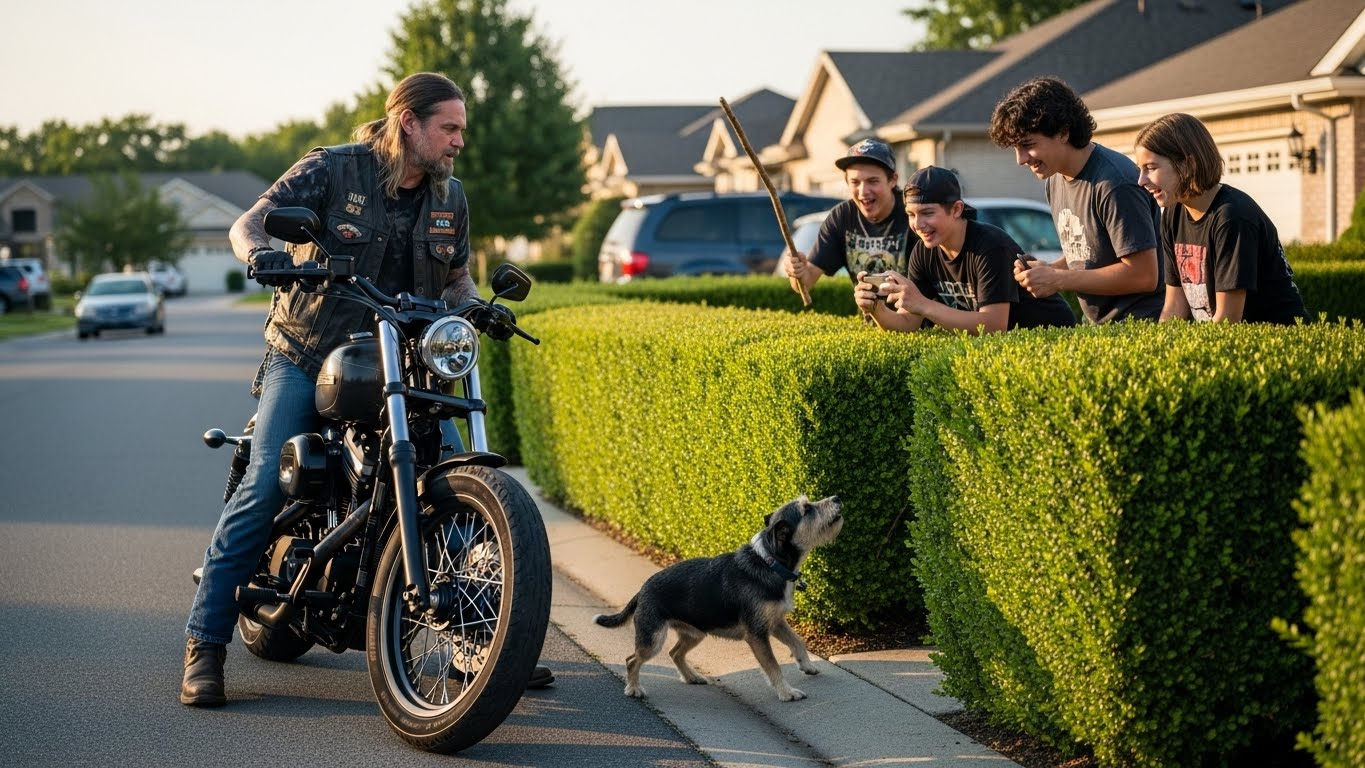
“Kids,” I said. The word felt like a shard of glass in my throat. “Tied him to a pole. They were… they were filming it.”
Aris paused for a fraction of a second, her needle hovering over the skin. Her jaw tightened, a small muscle jumping in her cheek. “Oakhaven’s finest, I assume?”
“Tyler Vance and his crew.”
She didn’t look surprised. She just sighed, a sound full of exhaustion. “Of course. The golden boy. His father bought this clinic’s new X-ray machine last year. He thinks that gives him a license to let his son be a monster.”
She found the vein, and the clear fluid began to drip into the dog’s system. She started cleaning the neck wound, her movements gentle despite the grimness of the task.
“He’s severely malnourished,” she noted, her voice dropping an octave. “He’s been on the streets for weeks, maybe months. And he’s been abused long before today, Mr…?”
“Jax,” I said. “Just Jax.”
“Well, Jax, you did a good thing. Most people would have just turned up their music and kept riding.”
“I’m not most people,” I muttered.
I looked at the dog. For the first time, his eyes fluttered open. They weren’t focused, but they were dark, deep pools of liquid sorrow. He looked at me, and for a heartbeat, I wasn’t in Georgia.
I was back in the Helmand Province, 2012. I was kneeling in the dust, holding a stray pup we’d named Tango. Tango had been our early warning system, our mascot, our only link to a world that didn’t involve IEDs and sandstorms. And then, one afternoon, Tango had stepped where he shouldn’t have. I’d held him just like this, watching the light fade from his eyes while the sun set over a landscape that wanted us all dead.
I’d failed Tango. I wasn’t going to fail this one.
“Will he make it?” I asked.
Aris didn’t answer right away. She was checking the dog’s temperature. “The physical wounds will heal. The infection in his neck is nasty, but we can fight that with antibiotics. The real question is the internal damage. Not just the organs, Jax. The spirit. Sometimes, they just decide they don’t want to be in a world that treats them like this.”
“He wants to live,” I said, my voice firmer than I felt. “He screamed. You don’t scream like that if you’ve given up. You scream because you’re pissed off that it’s happening.”
Aris looked up at me, a ghost of a smile touching her lips. “I like that theory. Let’s hope you’re right.”
The door to the clinic suddenly slammed open in the front. I heard Chloe’s voice, high and nervous.
“Sir, you can’t go back there! Dr. Thorne is in the middle of a procedure!”
“I don’t give a damn! Where is he? Where’s the guy who assaulted my son?”
The voice was booming, authoritative, and laced with the kind of entitlement that only comes with a six-figure salary and a seat on the town council.
Arthur Vance.
I felt the familiar heat rise in the back of my neck. My heart rate slowed down—not out of calm, but out of a tactical shift. This was a different kind of combat.
Aris looked at the door, then at me. “Jax, stay here. I’ll handle Arthur.”
“No,” I said, stepping toward the swinging doors. “He’s not here for the vet. He’s here for the biker.”
I walked out into the lobby. Arthur Vance was a man who looked like he’d been carved out of expensive ham. He was wearing a polo shirt tucked into pleated khakis, his face a shade of purple that matched the sunset. Tyler was standing behind him, his wrist in a makeshift sling, looking smug. Sarah was there too, hiding behind her father, who I recognized as the local high school principal.
“There he is!” Tyler pointed a trembling finger at me. “That’s him, Dad! He attacked us! He’s got a knife!”
Arthur stepped forward, his chest puffed out. “You’ve got a lot of nerve, Miller. I know who you are. The town’s resident charity case. You think because you wore a uniform you can lay hands on my son?”
I stood there, my arms crossed, leaning against the doorframe. I didn’t say a word. I just let him bark.
“I’ve already called Sheriff Miller,” Arthur continued, stepping closer until he was in my personal space. He smelled of scotch and expensive cigars. “You’re going to jail for assault, brandishing a weapon, and God knows what else. And as for that flea-bitten mutt? It’s being handed over to animal control to be put down. It’s a menace.”
At the mention of the dog, something in me snapped. Not the loud, explosive kind of snap—the quiet, cold kind. The kind that happens right before a storm.
“The dog was tied to a pole, Arthur,” I said, my voice a whisper that cut through his shouting. “Your son was strangling it for a video. Your son is a sociopath in training.”
“Don’t you talk about my son!” Arthur roared, raising a hand as if to jab a finger into my chest.
I didn’t move an inch. “If you touch me, Arthur, you’d better make it count. Because I’ve been hit by professionals, and you look like a man who gets winded walking to his mailbox.”
The room went dead silent. Chloe behind the desk let out a tiny gasp.
Arthur’s hand shook in the air. He looked around, realizing that for the first time in Oakhaven, his status didn’t mean a damn thing to the person he was facing.
“You’re done in this town, Miller,” Arthur hissed, his voice trembling with rage. “I’ll see your shop shuttered by the end of the week. I’ll have the bank pull your lease. You’ll be back under whatever bridge you crawled out of.”
“Maybe,” I said. “But the dog stays here. And if you try to touch him, you’re going to find out exactly why they gave me those medals you love to talk about on Veterans Day.”
The front door opened again. This time, it was the Law.
Sheriff Miller—no relation, though we’d known each other since we were kids—stepped in. He looked at Arthur, then at me, then at the blood on my shirt. He let out a long, weary sigh.
“Alright,” the Sheriff said, putting his hat on the counter. “Who wants to tell me the truth first? And Arthur, if you lie to me again like you did about that hit-and-run last year, I’m putting you in the back of the cruiser.”
Arthur’s face went from purple to a sickly grey.
I looked back through the glass of the surgery door. Aris was still there, her hand resting on the dog’s head. The dog’s tail gave one single, weak thump against the metal table.
The fight was just beginning.
CHAPTER 3: THE PRICE OF TRUTH
The Sheriff’s office in Oakhaven smelled like stale coffee and floor wax. It was a small, cramped space that felt even smaller with Arthur Vance pacing the floor like a caged tiger.
I sat on a hard plastic chair, my hands cuffed in front of me. Sheriff Miller—Jim to anyone who wasn’t in trouble—sat behind his desk, rubbing his temples. He hadn’t booked me yet, but he had to follow the procedure. Arthur had filed a formal complaint of felony assault and “menacing with a deadly weapon.”
“He’s a loose cannon, Jim!” Arthur shouted, slamming his hand on the wooden desk. “Look at my son’s wrist! It’s bruised! He’s traumatized! This man is a violent vagrant who shouldn’t be allowed near children.”
Jim looked at me. “Jax, you want to tell me your side? Again?”
“I already told you,” I said, my voice flat. “The kid was killing an animal. I stopped him. I used the minimum amount of force required to neutralize a threat to a helpless living being. You saw the dog, Jim. You saw the rope marks.”
“The dog is property, Jax,” Jim said, his voice laced with a sadness that told me he hated the words coming out of his own mouth. “In the eyes of the law, it’s a stray. A nuisance. Interfering with someone else’s… ‘activities’ with a stray isn’t a legal defense for physical assault.”
“Activities?” I felt the rage bubbling up again. “Is that what we’re calling torture now? Is that what Oakhaven stands for?”
Arthur sneered. “My son was clearing out a pest. He’s a hero, really. Making the neighborhood safer. This… this animal attacked him first.”
“That’s a lie,” I said. “And you know it. Sarah was filming. Where’s the phone, Arthur? Let’s see the footage.”
The room went quiet. Arthur’s eyes flickered for a fraction of a second—a tell. He knew about the video. And he knew exactly what was on it.
“The phone was destroyed,” Arthur said smoothly. “By you. When you attacked them. Another charge to add to the list: destruction of private property.”
Jim sighed and looked at the clock. “I have to hold you for twenty-four hours, Jax. Unless someone posts bail. But with a felony charge, the judge won’t set that until tomorrow morning.”
I looked out the small, barred window. The sun was setting, casting long, bloody shadows over the town. I thought about Buddy, lying on that cold metal table. I thought about the way he’d looked at me—not with hope, but with a silent question. Why is this happening?
“I’m not staying here,” I said, standing up. The cuffs clinked.
“Sit down, Jax,” Jim warned, his hand moving toward his belt. “Don’t make this worse.”
“You know me, Jim,” I said, stepping closer to the desk. “We played football together. I watched you marry Linda. You know I don’t start fights. But you also know I finish them. If you put me in a cell while those kids are out there laughing about what they did, you aren’t a lawman. You’re just a glorified bouncer for the Vance family.”
Jim’s face hardened. He looked at Arthur, then back at me. Before he could speak, the heavy door to the station swung open.
It was Aris. She was still in her scrubs, but she was holding a tablet in her hand. She looked like she was on a mission.
“You might want to see this, Sheriff,” she said, her voice echoing in the quiet office.
“Doctor, this is a police matter,” Arthur snapped. “Get out.”
Aris ignored him. She walked straight to Jim’s desk and turned the tablet around. “One of my assistants, Chloe, is friends with Sarah on Snapchat. Sarah thought she’d deleted the story, but Chloe had already screen-recorded it. She was too scared to show it to me at first, but she couldn’t live with it.”
Jim hit play.
The video was shaky, but the audio was crystal clear. You could hear Tyler laughing as he pulled the rope. You could hear the dog’s horrific, human-like scream. And then, you could hear Tyler’s voice: “Dad said if I kill it, he’ll buy me those new rims for the BMW. He said the town needs to be cleaned up anyway.”
The silence that followed was absolute.
Arthur’s face went from grey to a ghostly, translucent white. He reached for the tablet, but Jim swiped it away.
Jim watched the whole thing. Twice. When he looked up, the weariness was gone. In its place was a cold, professional steel.
“Arthur,” Jim said, his voice dangerously low. “Get out of my office.”
“Now, wait a minute, Jim—”
“I said, get out,” Jim stood up, his hand resting on his holster. “Before I decide to look into that ‘incentivizing animal cruelty’ comment your son made. I’m dropping the charges against Jax. And Tyler? Tell him not to leave the house. I’ll be coming by later with some paperwork for a juvenile detention hearing.”
Arthur tried to muster his usual bravado, but it was gone. He looked like a man who had just seen his empire crumble. He turned and slunk out of the office without a word.
Jim walked around the desk and unlocked my cuffs. “I’m sorry, Jax. I should have known.”
“Don’t be sorry,” I said, rubbing my wrists. “Just make it stick.”
I turned to Aris. “How is he?”
Her expression softened, but the worry was still there. “He’s stable. But he’s not eating. He’s just… lying there. I think he’s waiting for something.”
“I’m coming with you,” I said.
We walked out into the cool night air. Oakhaven looked the same—the white picket fences, the manicured lawns—but to me, it felt like a graveyard. A place where cruelty was tucked away behind closed doors and expensive cars.
When we got back to the clinic, it was dark. Aris led me to the back. Buddy was in a large floor kennel now, lined with soft blankets. He was awake, his head resting on his paws.
I knelt down in front of the gate. “Hey, buddy.”
He didn’t move. He didn’t wag his tail. He just looked at me with those deep, ancient eyes.
“He’s given up, Jax,” Aris whispered from the doorway. “I’ve seen it before. They survive the trauma, but they lose the will to keep going. He’s spent his whole life being a ‘nuisance.’ He doesn’t know what it’s like to be anything else.”
I reached through the bars. I didn’t try to pet him—I didn’t want to startle him. I just left my hand there, palm up.
“I know what that’s like,” I said, my voice barely a whisper. “To feel like the world is just a series of things trying to break you. To feel like you’re just a ghost in your own life.”
I stayed there for an hour. Then two. Aris eventually went to her office to catch some sleep on the sofa.
Around 3:00 AM, I felt something. A cold, wet nose touched my palm.
I held my breath. Buddy slowly, painfully, dragged his body toward the gate. He rested his chin on my hand. A long, shuddering breath escaped him, and for the first time, he closed his eyes in a way that didn’t look like he was waiting for a blow.
“I’m not going anywhere,” I told him. “And neither are you. We’re going to show this town what happens when you try to break something that refuses to stay down.”
But as I sat there in the dark, I knew the Vances wouldn’t go quietly. A man like Arthur doesn’t lose; he just changes tactics. And I knew that by morning, the fight wouldn’t just be in the Sheriff’s office. It would be at my front door.
CHAPTER 4: THE SOUND OF MERCY
The next morning, the sun rose over Oakhaven with a deceptive, golden warmth. But when I pulled my bike up to my small engine repair shop, the reality of Arthur Vance’s threat was painted in red.
“LEAVE TOWN, ANIMAL” was spray-painted across my garage door. My front window had been shattered, a heavy brick lying among the shards of glass on the workshop floor. Next to the brick was a formal notice from the property management company—my lease was being terminated, effective immediately, citing “criminal activity on the premises.”
I didn’t feel the rage I expected. I just felt a profound, heavy silence. I’d seen cities burned to the ground in the name of power. A broken window and a spray-can were nothing but the desperate gasps of a dying ego.
I didn’t clean the glass. I didn’t call the police. I just got back on my Harley and rode to the clinic.
When I walked in, the atmosphere was different. There were two men in uniforms I didn’t recognize standing at the counter—County Animal Control. And standing next to them was Arthur Vance, looking smugger than ever, flanked by a man in a sharp suit holding a briefcase.
“There he is,” Arthur said, his voice dripping with mock concern. “The man who thinks he’s above the law.”
Aris was standing in the doorway to the back, her face tight with fury. “Jax, they’re here to take him. Arthur filed a claim that the dog is a ‘public safety hazard’ and has a history of aggression.”
“He hasn’t even stood up yet,” I said, walking toward the men. “How can he be a hazard?”
The taller officer, a man with a “just following orders” look in his eyes, cleared his throat. “Sir, we have a signed affidavit from three witnesses—the boys from yesterday—stating the dog attacked them first. Under county code, we have to seize the animal for a fourteen-day rabies observation and a temperament assessment. Usually, with a stray that shows ‘unprovoked aggression,’ the assessment ends in euthanasia.”
“Unprovoked?” I laughed, a dry, bitter sound. “I have video of them strangling him.”
“The video shows an intervention,” the lawyer interrupted. “It doesn’t show what happened before the camera started rolling. My client’s son was simply trying to restrain a dangerous animal that had already bitten him.”
It was a setup. A perfect, legal trap. They weren’t just trying to hurt me; they were going to kill the only witness to their children’s cruelty.
“You aren’t taking him,” I said. I stepped in front of the door to the back.
“Mr. Miller, move aside,” the officer said, his hand resting on his catch-pole. “Don’t add ‘obstructing a public official’ to your problems.”
The clinic door opened. I expected more of Arthur’s cronies, but instead, an elderly woman walked in. It was Mrs. Gable, my neighbor from across the street. She looked frail, clutching a floral-print purse, but her eyes were like flint.
“I saw it,” she said. Her voice was thin but carried through the room like a bell.
Arthur turned, his eyes narrowing. “Mrs. Gable, this doesn’t concern you. Go back to your garden.”
“I saw it all, Arthur,” she continued, stepping into the center of the room. “I saw your boy and his friends bring that dog there in the back of Tyler’s truck. The dog wasn’t aggressive. It was wagging its tail, Arthur. It thought they were going to play. And then I saw what they did. I’ve lived in this town for sixty years, and I’ve stayed quiet about a lot of things. I stayed quiet when you cheated on your taxes, and I stayed quiet when your boy hit that mailbox last winter.”
The room went dead silent. Arthur’s face turned a mottled, bruised purple.
“But I won’t stay quiet while you kill a soul just to protect a lie,” she said. She reached into her purse and pulled out a small, old-fashioned digital camera. “I don’t have Snapchat. But I have a zoom lens. And I have photos of your son holding that dog down while Sarah took her pictures.”
The lawyer looked at Arthur. The confidence in his face vanished. He knew a lost cause when he saw one.
“This is… this is hearsay,” Arthur stammered, but even he didn’t believe it.
“It’s evidence, Arthur,” I said, stepping toward him. “And if those officers take that dog, the next place Mrs. Gable and I are going is the Atlanta news stations. I don’t think Oakhaven’s ‘Councilman of the Year’ wants the whole state to see what his son does for ‘fun.’”
The Animal Control officers looked at each other. They weren’t paid enough to be part of a PR nightmare. “We’ll… we’ll need to review this new evidence,” the tall one said, backing away. “Come on, Steve. Let’s go.”
They left. The lawyer followed close behind, whispering frantically into Arthur’s ear.
Arthur stood there for a moment, looking at me, then at Mrs. Gable, then at the floor. He didn’t say a word. He just turned and walked out, his shoulders slumped for the first time in his life. The power he’d spent decades building had been dismantled by a biker and an old lady with a camera.
I turned to Mrs. Gable. “Thank you.”
She patted my hand, her skin like parchment. “Don’t thank me, Jax. I should have come out of my house sooner. I’ve been a bystander for too long.”
I went to the back. Aris was kneeling by Buddy’s kennel. She’d opened the door.
Buddy was sitting up. He looked exhausted, his neck bandaged, but his eyes were clear. When he saw me, he didn’t cower. He didn’t whimper.
He took one shaky step forward. Then another.
He walked right up to me and leaned his weight against my leg. It wasn’t a lean of weakness; it was a lean of belonging. I reached down and buried my hand in his fur. For the first time in years, the tension in my own chest—the tightness that had been there since the war—finally let go.
“He’s yours, Jax,” Aris said softly, wiping a tear from her cheek. “I think you’re the only person he trusts.”
“I think we’re both a bit broken,” I said. “We’ll fit right in together.”
A week later, I moved my tools out of the shop. I didn’t mind. I found a new place two towns over, a little further out in the country where there was more room to run.
I loaded the last of my gear onto the truck, my Harley strapped into the back. Buddy was sitting in the passenger seat of the cab, his head out the window, his ears flopping in the breeze. He looked healthy. He looked whole.
As I drove past the “Welcome to Oakhaven” sign for the last time, I didn’t look back at the broken windows or the spray-paint. I looked at the dog beside me.
People think heroes are the ones who win the wars. But I’ve learned that the real heroes are the ones who refuse to let the world turn them into monsters, no matter how hard it tries.
The “rot” in Oakhaven didn’t disappear that day, but it was a little less heavy. Because somewhere in that town, a dog’s scream had been replaced by the sound of a tail thumping against a porch, and a man who had lost his way finally found his road home.
Sometimes, the only way to heal a broken heart is to save a life that’s been broken even worse than your own.