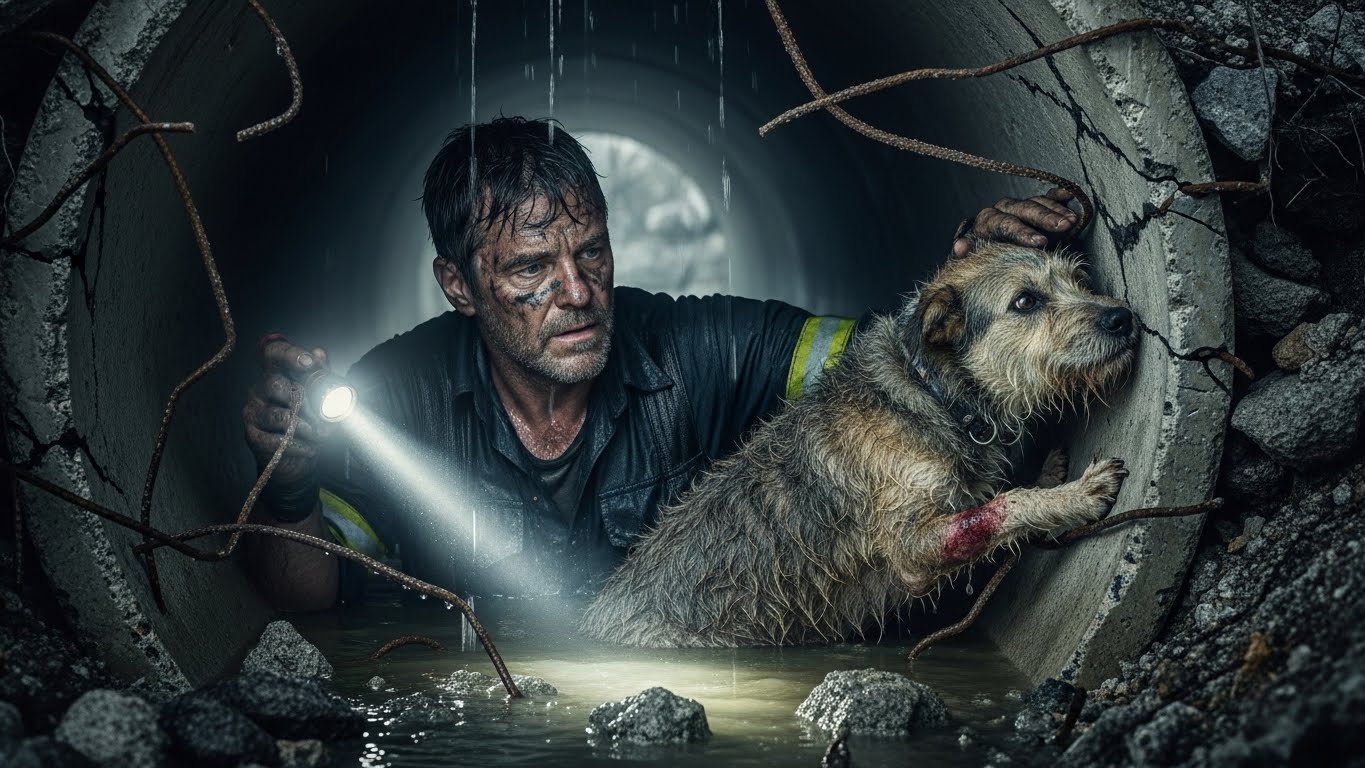
They told me to stay back. ‘It’s just a stray,’ they said. But when I heard that sound—a scream that wasn’t human but carried more pain than any person I’d ever saved—I knew I had to go in.
CHAPTER 2: The Weight of the Earth
The silence that follows a collapse is worse than the noise of the crash. It’s a heavy, pulsating thing that presses against your eardrums until you think they might pop.
For a few seconds, I couldn’t feel my legs. I couldn’t feel the dog. All I could feel was the crushing weight of the Georgia red clay and the icy grip of the rising water. The drainage pipe hadn’t just collapsed; it had become a tomb.
“Hey,” I croaked. My mouth was full of grit. “Hey, buddy. You still with me?”
A wet nose poked my cheek. A low, shaky whimper vibrated against my chest. The dog was alive. He was pinned between my torso and a slab of concrete that had slanted downward, creating a small, triangular pocket of air.
We were breathing, but for how long?
I tried to move my right arm. A lightning bolt of pain shot from my shoulder to my fingertips. Dislocated. I’d done it before, sliding down a ladder in ’21. I knew the drill. I gritted my teeth, found a solid edge of the pipe, and slammed my shoulder forward.
The pop was sickening. I screamed into the darkness, the sound bouncing off the wet walls and dying in the mud. But my arm was back in the socket.
I reached out, feeling the dog’s fur. He was shivering violently—hypothermia was setting in.
“I’ve got you,” I whispered. “I’m not leaving you. I promise.”
I meant it. And that was the problem. A year ago, at the Miller Street fire, I had made the same promise to a little girl named Maya. I’d told her I was right behind her. I’d told her the smoke wouldn’t catch us. I was wrong. I carried her out, but she never opened her eyes again. That was the ‘incident’ Miller kept throwing in my face. The reason I was one mistake away from being kicked off the force.
I looked down at the blue sneaker clutched in my hand. Leo.
Leo was the kid everyone in the neighborhood knew. He had thick glasses and a laugh that sounded like a tea kettle. He’d come by the station sometimes with his mom, bringing us burnt chocolate chip cookies. If that shoe was in this pipe, Leo was nearby. And if Leo was in these pipes during a flash flood…
I didn’t let myself finish that thought.
“C’mon, boy,” I said to the dog. “We gotta dig.”
Using the crowbar I’d somehow managed to keep hold of, I began to scrape at the wall of mud sealing the pipe. It was slow, back-breaking work. Every time I cleared a handful of muck, more slid down to take its place. The water was now at my waist, cold enough to turn my skin blue.
Above us, I could hear muffled sounds. The heavy thrum of a Diesel engine. The whirr-whirr of a K-12 saw. They were digging from the other side.
“JAX! CAN YOU HEAR ME?”
It was Sarah. Sarah Jenkins. She was a rookie, barely twenty-three, with more heart than the rest of the department combined. She’d been my shadow for the last six months.
“I’M HERE!” I yelled, my voice cracking. “I’VE GOT THE DOG! THE PIPE IS STABLE FOR NOW, BUT THE WATER IS RISING! GET THE PUMP TRUCK OVER THE GRATE!”
“Copy that, Jax! Hold on! The Chief is… he’s losing his mind, man. He’s saying the ground is too unstable for a heavy rescue.”
“Tell the Chief to kiss my ash!” I roared. “There’s a kid missing, Sarah! I found Leo’s shoe! Tell him Leo might be down here!”
The silence that followed was longer this time. Then, the sound of the saw intensified. They weren’t just digging for a rogue firefighter and a stray dog anymore. They were digging for the heartbeat of Oak Ridge.
For forty minutes, I fought the mud. My fingernails were torn, my muscles were on fire, and the dog—I’d started calling him ‘Bones’ because of how thin he was—stayed tucked under my chin, his breathing shallow. He never tried to leave. He just watched me with those intelligent, amber eyes.
Finally, a sliver of light broke through.
A Halligan tool punched through the mud, followed by the gloved hand of a firefighter.
“I see him! I see Jax!”
Hands grabbed me. They pulled me through a hole barely wide enough for a man. I refused to let go of Bones. I dragged him out with me, his broken leg dangling, his body limp.
When we broke the surface, the rain was still screaming down. I was hauled onto the grass, the bright LED scene lights blinding me. A dozen faces leaned over me—paramedics, neighbors, cops.
Chief Miller was standing right there. His face was a mask of fury and relief, a combination that usually meant a long suspension was coming.
“You idiot,” Miller spat, though his hand was steady as he helped me sit up. “You absolute, Grade-A moron.”
“The shoe, Chief,” I gasped, holding up the tattered blue sneaker. “It was in the pipe. The dog had it. He was holding onto it like it was a lifeline.”
The crowd went silent. Mrs. Gable let out a sob. Behind her, a woman—Leo’s mother, Elena—collapsed to her knees.
“My baby,” she wailed. “Where is my baby?”
Miller took the shoe, his eyes softening for a split second before the hard edge returned. He looked at the dog, who was now being tended to by a paramedic who clearly didn’t care about ‘department protocol’ regarding animals.
“The pipe leads to the old creek bed,” Miller said, his voice low. “But it also branches off into the old distillery tunnels from the 1920s. If the kid fell in further up…”
“The dog wasn’t coming from the creek,” I said, wiping mud from my eyes. “He was facing the tunnels. He was trying to lead me into them, not out.”
Bones let out a sharp, pained bark. He struggled against the paramedic, trying to crawl toward the dark opening of the secondary tunnel, the one the city had supposedly sealed off ten years ago.
“Look at him,” I said, pointing. “He knows. He knows where Leo is.”
“Jax, you’re in shock,” Miller said. “Your shoulder is wrecked, and you’ve got a possible concussion. You’re going to the hospital. The search teams will handle the tunnels.”
“The search teams don’t know those tunnels, Chief! Half of them aren’t even on the city maps!” I stood up, my knees wobbling. I felt a surge of nausea, but I pushed it down. “That dog has been living in those woods. He knows every inch of the underground. If we don’t follow him now, the next time the tide rises, that kid is gone.”
“I said no!” Miller shouted.
But then, something happened.
Bones, with his front paws, dragged himself toward me. He bit down gently on the hem of my soaked turnout pants and tugged. Then he looked at the tunnel, and then back at me. He wasn’t just a dog. He was a witness.
The neighbors were watching. The cameras were rolling. In the distance, the sirens of the state police were getting closer.
I looked at Sarah. She was already holding a fresh oxygen tank and a high-lumen flashlight. She didn’t say a word. She just handed them to me.
“Jax,” Miller warned. “If you go back down there, you’re finished. I mean it. Hand over your badge now, or stay on this grass.”
I didn’t even hesitate. I reached into my pocket, pulled out the silver shield that had been my life for over a decade, and dropped it into the Georgia mud.
“Keep it,” I said. “I’ve got a job to do.”
I picked up Bones—all forty pounds of shivering, broken soul—and headed back toward the dark.
CHAPTER 3: The Heart of the Labyrinth
The air in the tunnels didn’t taste like rain anymore. It tasted like copper, wet rot, and the heavy, metallic tang of industrial runoff.
I moved with a flashlight clamped between my teeth, my good arm cradling Bones against my chest, and my injured shoulder screaming in a language of pure fire. Sarah followed three paces behind me. She shouldn’t have been there. She was risking her career, her pension, and her life. But when I’d looked back at the tunnel entrance, she was already clicking her helmet light on.
“Chief’s gonna have our heads on a pike, Jax,” she whispered, her voice echoing off the slimy brick walls.
“He’ll have to find us first,” I grunted, the words vibrating against the flashlight.
We were deep under the “Luxury Heights” development, a posh expansion of Oak Ridge that had been the Mayor’s pride and joy for the last two years. The maps said these tunnels were dry, sealed with reinforced concrete back in ’15. But as the water swirled around my shins, carrying plastic medical waste and dark, oily slicks, it was clear the maps were a lie.
Bones let out a sharp, urgent yip. He was squirming, his nose pointed toward a narrow bypass where the brickwork had been replaced by modern, cheap corrugated steel.
“Wait,” Sarah said, sweeping her light over the ceiling. “Jax, look at the supports. These aren’t city-grade. This is… this is ‘handyman’ work. Someone’s been using these tunnels.”
“Later,” I said. “Leo first.”
We pushed deeper. The sound of the storm outside was a distant, rhythmic thumping, like the heartbeat of a giant. Here, the only sound was the slosh-slosh of our boots and the ragged breathing of a dying dog.
Then, I heard it.
A tiny, rhythmic tapping. Clack. Clack. Clack.
It wasn’t a machine. It was a rock hitting metal.
“Leo!” I yelled, my voice cracking. “Leo, can you hear me? It’s Jax! From the fire station!”
Silence. Then, a voice so small it barely carried over the trickle of water.
“I… I can’t get my leg out.”
We ran. We didn’t care about the unstable ceiling or the slippery floor. We rounded a bend and my flashlight beam landed on a sight that will stay burned into my retinas until the day I die.
The tunnel opened into a small, vaulted chamber. In the center, Leo was huddled on a narrow ledge of crumbling brick. His lower leg was pinned beneath a massive, rusted iron gate that had fallen from its hinges. The water was inches from the top of the ledge. In another twenty minutes, he’d be submerged.
But he wasn’t alone.
Lying next to him, curled around his shivering body to keep him warm, was another dog. A smaller, older terrier that looked like a skeleton covered in gray fur. The dog was dead. It had clearly been dead for days, but it had died in a circle, providing a tiny island of warmth for the boy.
“Jax!” Leo sobbed, his glasses cracked and hanging off one ear. “Barnaby wouldn’t wake up. He stayed with me, but he won’t wake up!”
Bones let out a sound I can only describe as a sob. I set him down on the ledge, and he immediately dragged his broken body over to Leo, licking the boy’s face with a frantic, desperate love.
“Is that… is that Barnaby?” I asked, my heart breaking.
“No,” Leo cried, clutching Bones’ neck. “This is Rex. He… he went missing last winter. Everyone said he ran away to the woods to die. But he found me, Jax. He found me and he brought you.”
I looked at Rex—the dog I’d been calling Bones. He wasn’t a stray. He was Leo’s first dog. The one the whole neighborhood thought had disappeared months ago.
“Sarah, get the hydraulic jack,” I ordered, my voice trembling. “We’re getting him out. Now.”
As Sarah worked the jack, the iron gate began to groan. I braced my back against the wall and pulled Leo toward me, shielding him as the rusted metal finally gave way.
But as the gate lifted, the light from my flashlight hit the space behind where the gate had been.
It wasn’t a wall. It was a dump site.
Thousands of blue plastic barrels were stacked in the darkness, many of them rusted through, leaking a thick, neon-green sludge into the water that fed directly into the town’s secondary reservoir. The labels on the barrels were clear: Crosby Chemicals.
Crosby Chemicals. The Mayor’s primary donor. The company Chief Miller’s brother worked for as a lead engineer.
“Oh my god,” Sarah whispered, her light trembling. “They aren’t just diverting runoff. They’re hiding toxic waste under the suburbs. That’s why the ground is so soft. The chemicals are eating the limestone.”
“That’s why Rex disappeared,” I realized, looking at the dog. “He must have followed the scent of the rot, got trapped, and lived down here in the woods, trying to find a way to tell someone.”
Suddenly, the tunnel vibrated. A massive tremor that knocked Sarah off her feet.
“The main line just blew!” Sarah screamed. “The pressure from the rain… the whole chamber is going to go!”
I grabbed Leo in one arm and Rex in the other.
“Sarah, go! Run!”
“What about the other dog? Barnaby?” Leo shrieked, reaching for the dead terrier.
“I’ve got him, Leo. I’ve got everyone,” I lied. There was no time. The walls were weeping mud. I grabbed the collar of the dead dog—a small, leather band—and tucked it into my pocket. “He’s with us in spirit, kid. Move!”
We sprinted back through the maze. The water was no longer a trickle; it was a wall. A black surge of sludge and debris was chasing us down the corridor.
I could see the light of the exit—the hole we’d climbed through. But there was someone standing there.
Chief Miller. He wasn’t holding a rescue line. He was holding a remote detonator for the emergency seal-valves.
“Chief!” I yelled. “We’ve got the kid! Open the secondary grate!”
Miller looked at me. His face wasn’t angry anymore. It was hollow. He looked at the toxic barrels visible in the distance behind us. He knew what we’d seen. He knew that if we came out, his life, his brother’s life, and the town’s reputation were over.
“I’m sorry, Jax,” Miller mouthed.
He reached for the button.
Rex, the dog with the broken leg, the dog who had been starved and beaten by the elements, did something impossible. He lunged out of my arms, launched himself through the rising water, and clamped his teeth onto the Chief’s wrist through the gap in the concrete.
Miller screamed, dropping the detonator. It fell into the mud outside.
“GO!” I shoved Leo through the hole toward Sarah’s reaching arms.
I scrambled out behind them, dragging Rex with me just as the secondary tunnel collapsed in a roar of white water and stone.
The impact threw us all onto the muddy bank. I rolled over, gasping for air, clutching Rex to my chest.
Silence returned to Oak Ridge. But this time, it was the silence of a grave being opened.
The neighbors were there. The news cameras were there. And standing over us, clutching his bleeding wrist, was Chief Miller.
I stood up, shaking, covered in toxic filth and the blood of a dog who wouldn’t quit. I reached into my pocket and pulled out the blue sneaker and the leather collar of the dog that didn’t make it.
I didn’t look at the cameras. I looked at the crowd.
“You want to know why this town is sinking?” I said, my voice echoing in the rain. “It’s not the storm. It’s what you’ve been building your homes on top of.”
I turned to Miller, who was trembling.
“You can have the badge, Chief. But you’re going to need a lawyer more than a firefighter.”
Rex let out one final, weary bark and rested his head on my boot. He was exhausted, broken, and muddy. But for the first time in months, he was home.
CHAPTER 4: The Echoes of Oak Ridge
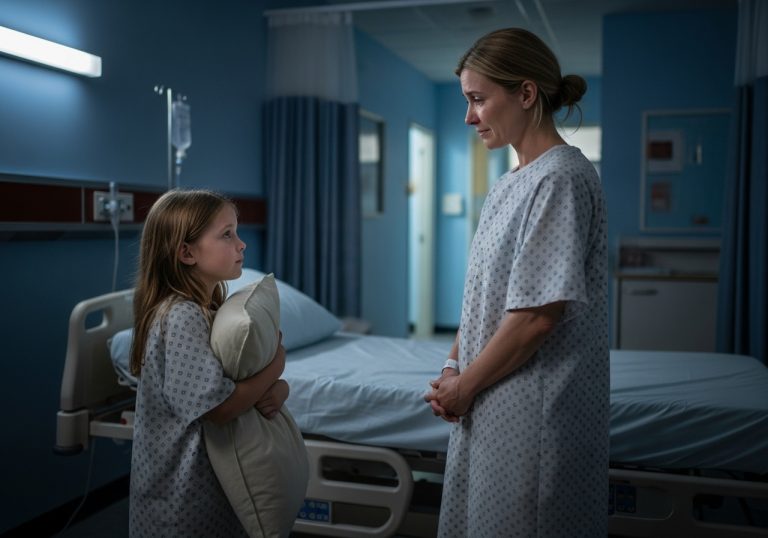
The antiseptic smell of the Georgia Memorial Hospital always reminded me of failure. It was the scent of white floors, hushed voices, and the sterile cold that followed a fire you couldn’t put out. But this morning, as I sat in a plastic chair in the waiting room of the veterinary wing, the smell was different. It smelled like a beginning.
My right arm was in a sling, a complex web of bandages holding my shoulder together. My lungs burned with every breath—a souvenir from the toxic fumes in the tunnel—but for the first time in years, the weight behind my ribs was gone.
The news was playing on the mounted TV in the corner, the volume turned low.
“…a scandal that has rocked the state,” the reporter said, standing in front of the now-sealed drainage pipe in Oak Ridge. “What began as a daring rescue of an eight-year-old boy has exposed a decade-long conspiracy of illegal toxic waste dumping. Mayor Higgins resigned this morning, and former Fire Chief Robert Miller remains in custody, facing multiple felony counts of endangerment and conspiracy…”
I looked down at my hands. The dirt was gone, scrubbed away by a nurse with a sympathetic smile, but my nails were still jagged and broken.
“Jax?”
I looked up. Elena, Leo’s mother, was standing there. She looked like she hadn’t slept in a week, but her eyes were bright. She walked over and hugged me, careful of my shoulder. She didn’t say ‘thank you.’ She didn’t have to. The way she held onto my jacket told me everything.
“He’s asking for him,” she whispered. “Leo won’t eat his Jell-O unless the dog is there.”
“How is he?” I asked, my voice still a gravelly wreck.
“The doctors say he’s a miracle. Dehydrated, a few infections from the water, but his leg is going to be fine. They’re moving him to a regular room this afternoon.” She paused, her voice trembling. “He told me what happened down there, Jax. He told me how the dog—how Rex—kept him warm. He said Rex whispered to him.”
I leaned my head back against the wall. “Dogs don’t whisper, Elena. They just stay. Sometimes, staying is the loudest thing you can do.”
I stood up, my joints popping, and followed her down the hall to the surgical recovery unit. Through the glass partition of the ICU, I saw him.
Rex was lying on a heated pad, a massive cast on his hind leg. He was hooked up to an IV, his ribs still visible through his shaved fur, but his head was up. His amber eyes were fixed on the door. When he saw me, his tail gave a single, weak thump against the pad.
The vet, a young guy named Dr. Aris with a tired but kind face, stepped out to meet us.
“He’s a fighter, Jax. I’ve never seen a dog with that much systemic trauma keep his spirit. Those chemicals in the water… they should have shut his kidneys down months ago when he was living in the woods. But it’s like he was holding out for something.”
“He was,” I said. “He was holding out for Leo.”
“Well,” the vet smiled, “he’s clear for visitors. Just keep him calm.”
I walked in and sat on the floor next to the recovery pad. I didn’t care about the hospital’s rules or my ruined jeans. I just laid my hand on Rex’s head. His fur was soft now, cleaned of the oil and the mud.
“You did it, buddy,” I whispered. “You brought him home.”
Rex let out a long, contented sigh and closed his eyes, leaning his weight into my palm. We stayed like that for a long time—a broken man and a broken dog, finding a weird kind of peace in the quiet.
A knock at the door startled me. I looked up to see Sarah Jenkins standing there. She wasn’t in her uniform. She was wearing a hoodie and jeans, looking younger than her twenty-three years. She held out a manila envelope.
“The board met this morning,” she said, her voice tight. “They fired the interim Chief. The one the Mayor appointed to replace Miller.”
“And?”
“And they want you back, Jax. Not as a captain on probation. They want to talk to you about the Chief’s position. They’re calling it a ‘reconstruction of public trust.’ They say they need a man who knows the difference between a direct order and a moral one.”
I looked at the envelope. It represented everything I’d worked for since I was nineteen years old. The pension, the respect, the badge. A year ago, I would have killed for this. I would have traded my soul for that silver shield to be polished and back on my chest.
But then I looked at Rex. I thought about the darkness of those tunnels and the way the ‘system’ had been perfectly willing to let a dog and a boy die to protect a bottom line.
“I can’t do it, Sarah,” I said softly.
Her eyes widened. “What? Jax, this is what you wanted. You’re a hero. The whole town is wearing ‘Team Rex’ t-shirts. You could run for Mayor if you wanted to.”
“That’s the problem,” I said, scratching Rex behind the ears. “I don’t want to be a hero in a system that requires heroes to break the law just to do what’s right. I spent fourteen years running into fires, Sarah. I’m tired of the heat.”
“So what are you going to do?”
I looked at the dog. “I think I’m going to open a sanctuary. Somewhere out past the suburbs, where the air is clean and the ground is solid. A place for the strays. The ones people ignore. The ones who have stories no one wants to hear.”
Sarah looked at me for a long time, then she slowly nodded. She took the envelope back. “I figured you’d say that. That’s why I brought this, too.”
She reached into her pocket and pulled out a small, heavy object. It was my old badge—the one I’d dropped in the mud. She’d cleaned it. It shone like a mirror in the fluorescent light.
“Keep it,” she said. “Not as a job. Just as a reminder. You didn’t save that dog because you were a firefighter, Jax. You saved him because you were you.”
She turned to leave, but stopped at the door. “By the way, the neighborhood association is paying for all of Rex’s medical bills. And Barnaby… the other dog?”
My throat tightened. “Yeah?”
“They’re building a small memorial park near the creek. It’s going to be called ‘Barnaby’s Landing.’ A place for kids to play. They’re making sure the water is tested every week.”
I couldn’t speak. I just nodded.
Three weeks later, I was standing on the porch of a farmhouse ten miles outside of Oak Ridge. The air smelled of pine and damp earth, the good kind of damp.
The screen door creaked open, and Leo came running out, his cast replaced by a walking brace. He wasn’t limping as much today.
“Jax! Jax! Look!”
Behind him, Rex came trotting out. He had a permanent limp, a hitch in his giddy-up that would always be there, but he was fast. He had gained ten pounds, and his coat was thick and shiny. He carried a tennis ball in his mouth, dropping it at my feet with a look of pure, unadulterated expectation.
“He wants to play, Jax,” Leo laughed, throwing himself into a lawn chair.
I picked up the ball. My shoulder was still stiff, but the range of motion was coming back. I looked out over the rolling hills, at the three other dogs we’d already taken in—a blind Beagle, a terrified Pitbull mix, and an old Lab that no one wanted.
They were all barkless, but they weren’t silent. They were living, breathing proof that nothing is ever truly lost if someone is willing to look in the dark for it.
I threw the ball. Rex took off, his mismatched gait a beautiful, chaotic dance across the grass.
People ask me sometimes if I miss the sirens. They ask if I miss the rush of the adrenaline, the feeling of the heat on my face, the brotherhood of the station.
I tell them I found a different kind of brotherhood. One that doesn’t need a badge or a uniform. One that speaks in tail wags and wet noses and the quiet, steady rhythm of a heart that refused to stop beating when the world tried to bury it.
I saved a dog that nobody wanted. But in the end, it was the dog who saved the man I had forgotten how to be.
The screams in the dark are gone now. All that’s left is the sound of the wind in the trees and the heavy, happy breathing of a friend who never let go.
And for the first time in my life, that’s more than enough.