Chapter 1: The Golden Cage
The bleachers at Oak Creek High were supposed to be empty on a Friday evening. The game was over, the floodlights were buzzing off, and the sun was setting in a bruise-colored streak across the California sky.
I was sitting on the bottom row, clutching my sketchbook against my chest, waiting for Liam.
Liam Sullivan was the opposite of everything in this town. Oak Creek was all shiny Teslas, varsity jackets, and old money that whispered instead of talked. Liam was quiet, drove a rusted 2004 Ford truck, and had a crooked smile that made me feel like I was the only person on Earth. We were both outcasts here—me, Maya, the scholarship girl from the trailer park, and him, the Colonel’s son who refused to join the football team because he preferred playing Chopin on the piano.
“Well, look what we have here. The stray cat.”
My stomach dropped. I knew that voice. It was the sound of entitlement.
I looked up to see Brody standing at the chain-link fence. Brody was the captain of the baseball team, rich, cruel, and used to getting whatever he wanted because his daddy owned half the car dealerships in the county. He was still wearing his dirty uniform, tapping a heavy wooden baseball bat against his cleats. Thwack. Thwack. Thwack.
He wasn’t alone. Four of his teammates—guys with necks as thick as tree trunks and grins that promised nothing but trouble—fanned out behind him.
“Leave me alone, Brody,” I said, standing up. “I’m just waiting for a ride.”
“A ride?” Brody sneered, stepping onto the gravel dust of the dugout. “From who? That little wimp Liam? You know, you rejected me for him, Maya. That hurts my feelings.”
“He treats me with respect,” I said, my voice shaking. “Something you wouldn’t understand.”
Brody’s eyes darkened. He hated being told no. He swung the bat casually, cutting the air inches from my face. I flinched, stepping back until my spine hit the cold aluminum of the dugout wall.
“Respect?” Brody laughed. “Let’s see how much respect he has when we’re done with him.”
“What do you mean?”
Brody didn’t answer. He signaled to his friends. They moved in a circle, trapping me.
“We’re just gonna have a little batting practice,” Brody whispered, leaning in close enough that I could smell the Gatorade and tobacco on his breath. “And you’re the trophy.”
Chapter 2: The Sound of Cracking Bone
“Maya!”
Liam’s voice rang out from the parking lot.
I saw him running. He wasn’t big—he was a musician, not a linebacker. But when he saw the five baseball players surrounding me, saw the bat in Brody’s hand, he didn’t hesitate. He didn’t stop to call 911. He sprinted.
“Get away from her!” Liam yelled, vaulting over the low fence.
Brody turned around slowly, a wolfish grin spreading across his face. “Finally. The guest of honor.”
Liam rushed in, shoving one of the linemen aside to get to me. He grabbed my arm, placing his body between me and Brody. “Are you okay?” he breathed, his eyes scanning my face for bruises.
“Liam, we have to go,” I whispered, terrified. “They have bats.”
“Nobody’s going anywhere,” Brody said. He nodded to his friends. “Hold him.”
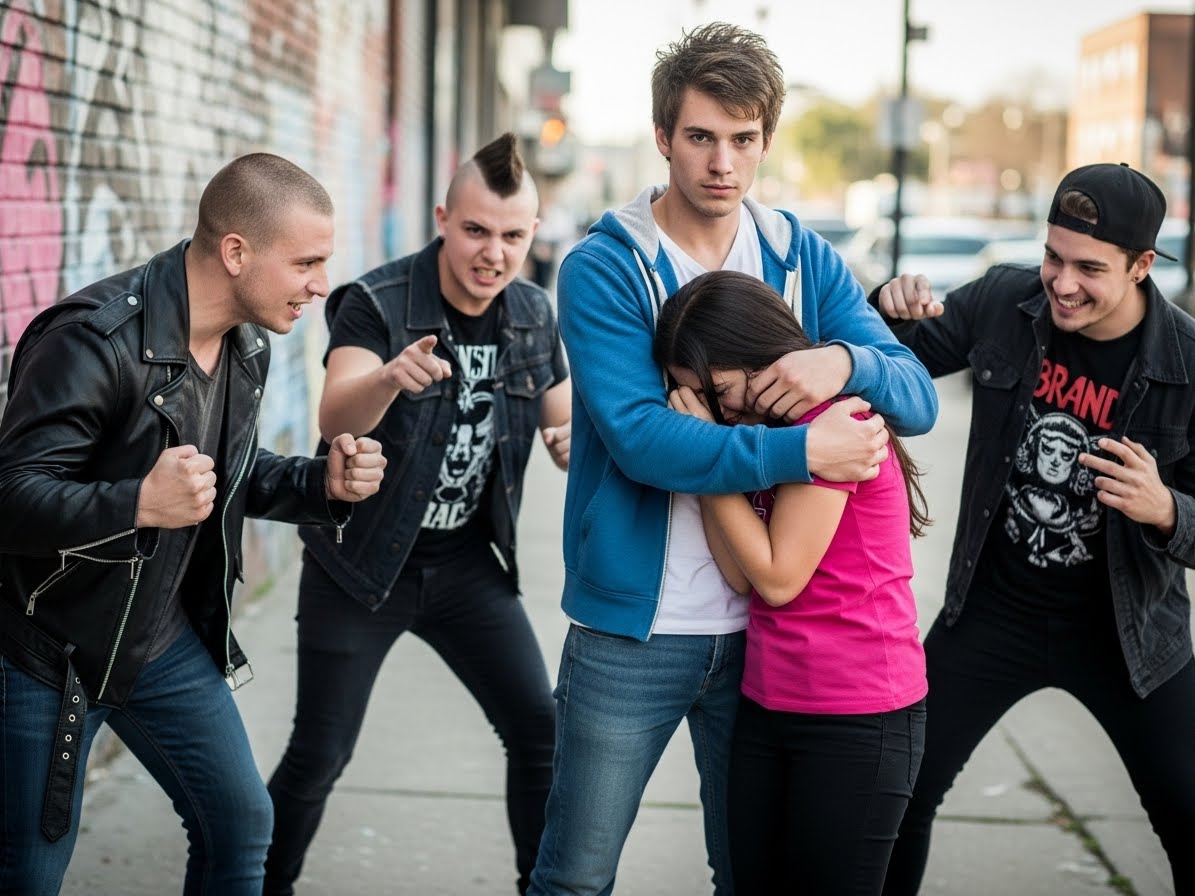
Two of the guys grabbed Liam’s arms. Liam struggled, kicking and thrashing, but he was outnumbered and outweighed by fifty pounds of muscle on each side. They pinned him to the chain-link fence, spreading his arms wide like a crucifix.
“Let her go!” Liam screamed, straining against their grip. “Touch her and I’ll kill you!”
“You?” Brody laughed. He walked up to Liam, weighing the heavy wooden bat in his hands. “You’re an embarrassment to this town, Sullivan. Your dad’s a war hero, a Lieutenant Colonel, and you? You play piano. You’re soft.”
Brody swung.
He didn’t aim for the head. He aimed for the ribs.
CRACK.
The sound was sickening. It sounded like a dry branch snapping in a winter storm.
Liam’s scream was cut short as the air was forcibly ejected from his lungs. He slumped forward, held up only by the guys pinning his arms.
“Liam!” I screamed, trying to run to him, but another guy shoved me back onto the dirt.
“That’s one,” Brody said, adrenaline making his eyes manic. “Let’s see if we can get a home run.”
“Stop! Please stop!” I begged, sobbing now. “You’re hurting him!”
Brody didn’t listen. He wound up again.
Thud. This one hit Liam’s thigh. Liam groaned, his face pale, sweat instantly breaking out on his forehead. He looked at me, pain swimming in his eyes.
“Run, Maya,” he wheezed, blood trickling from his lip. “Just run.”
He was taking a beating for me. He was going to die right here on this dusty field.
Brody raised the bat high over his head for a final, crushing blow. “Say goodnight, piano man.”
Then, the ground started to tremble.
It wasn’t an earthquake. It was the roar of engines. Heavy, diesel engines.
Headlights—blinding, white, military-grade LEDs—crested the hill behind the outfield, flooding the field with light so bright it turned the twilight into noon.
Brody froze, the bat held high. “What the…”
A loudspeaker crackled, booming with a voice that sounded like tectonic plates shifting.
“DROP THE WEAPON. NOW!”
Chapter 3: The Rules of Engagement
The chain-link fence in the outfield didn’t open. It was flattened.
A massive Humvee, painted in desert camo, plowed through the metal fence as if it were made of tissue paper. The screech of tearing metal was drowned out by the roar of the engine.
Behind it came two transport trucks.
Brody lowered the bat, squinting into the blinding lights. “Is that… the cops?”
“No,” Liam whispered, a pained smile touching his bloody lips. “That’s Dad.”
The doors of the transport trucks flew open. Soldiers poured out. Not police officers. Not campus security. These were active-duty Marines from the nearby base, dressed in full combat fatigues, boots pounding the dirt in perfect synchronization.
Thirty of them.
They didn’t run like a mob. They moved like a machine. Within ten seconds, they had formed a perimeter around the baseball diamond.
Brody’s friends released Liam immediately. Liam crumpled to the ground, clutching his side.
“Stay down!” a soldier shouted, leveling a rifle—not at Liam, but at Brody.
Brody dropped the bat. It landed in the dust with a dull thud. The arrogance evaporated from his face, replaced by the primal terror of a boy who realizes he is no longer the biggest predator in the jungle.
The Humvee door opened.
Lieutenant Colonel Marcus Sullivan stepped out.
He was in his fifties, hair silver and high-and-tight, wearing his fatigues. He didn’t have a weapon drawn. He didn’t need one. He walked onto the field with a terrifying calmness. He walked past the trembling baseball players, past Brody, and knelt directly beside his son.
“Liam,” Sullivan said, his voice surprisingly gentle. “Report.”
“Ribs… broken, I think,” Liam gasped. “Leg… bad. They were… hurting Maya.”
Sullivan looked at me. I was still on the ground, shaking.
“Are you injured, Maya?” he asked.
“No, sir,” I stammered. “Liam protected me.”
Sullivan nodded. He touched his radio. “Medic. Front and center. Get my son to the infirmary. Check the girl.”
“Yes, sir!” A medic with a red cross on his arm sprinted forward.
Sullivan stood up. He adjusted his collar. Then, he turned slowly to face Brody.
Brody was backing away, his hands up. “Sir… listen… we were just messing around. It was a game. We’re on the baseball team. We didn’t mean—”
Sullivan didn’t yell. He walked until he was three inches from Brody’s face. Sullivan was six-foot-two, a veteran of three combat tours. Brody was just a high school bully in a polyester uniform.
“You broke his ribs,” Sullivan said. The volume of his voice was conversational, which made it infinitely scarier. “With a bat.”
“It was an accident!” Brody squeaked. “He fell!”
“My men have been watching from the hill for three minutes,” Sullivan said. “We were returning from maneuvers. We saw everything.”
Sullivan looked at the other four boys. They were shaking so hard their cleats were rattling on the gravel.
“You boys like to fight?” Sullivan asked. “You like 5-on-1 odds?”
Silence.
“I asked a question!” Sullivan roared. The sound made everyone jump.
“No, sir!” the boys screamed in unison.
“Good,” Sullivan said, his voice dropping back to that icy calm. “Because you just attacked a dependent of a military officer on federal land borders. Do you know what that makes you?”
Brody shook his head, tears streaming down his face.
“It makes you insurgents,” Sullivan whispered. “And we have a very specific protocol for insurgents.”
Sullivan snapped his fingers.
Four Marines stepped forward, zip-ties in their hands.
“Wait!” Brody yelled. “My dad is the Mayor! You can’t arrest me!”
Sullivan smiled. It was a cold, shark-like smile.
“Son,” Sullivan said, “tonight, I’m not arresting you. I’m detaining you as a hostile combatant until the MPs arrive. And your daddy the Mayor? He can come pick you up at the Base brig. Assuming he can get past the gate.”
Sullivan turned to his men.
“Secure them. Face down in the dirt. If they move, treat them as a threat.”
“Hoorah!” thirty voices shouted at once.
As Brody was slammed face-first into the dirt, crying for his mother, I crawled over to Liam. The medic was wrapping his ribs.
Liam looked at me and grinned through the blood. “I told you… my dad is intense.”
I held his hand, watching the flashing lights of the military convoy. “He’s perfect.”
But the night wasn’t over. Mayor Sterling—Brody’s dad—was about to find out that money doesn’t buy you rank.
Chapter 4: The Pianist’s Hands
The Naval Hospital was sterile, white, and smelled of antiseptic—a sharp contrast to the dust and blood of the baseball field.
I sat in the uncomfortable plastic chair next to the bed, holding Liam’s hand. His knuckles were bruised, and there was an IV line taped to his forearm. His chest was wrapped heavily in bandages to support his three broken ribs.
“Stop looking at me like I’m a ghost, Maya,” Liam whispered, his voice raspy. He tried to smile, but his split lip made it a grimace.
“You jumped in front of a bat,” I said, my voice trembling. “For me. You could have been killed.”
“Better me than you,” he said simply. Then, his eyes darted to his hands. He flexed his fingers slowly. “Doctor said no permanent nerve damage. I can still play. Might be a few months, though.”
The door opened. The air in the room instantly became heavier.
Colonel Sullivan walked in. He had traded his combat gear for his service dress uniform—crisp khaki, ribbons perfectly aligned on his chest. He looked like a statue carved from granite.
He walked to the foot of the bed and stared at his son. For a long, agonizing minute, he didn’t say a word.
I felt the urge to stand up, to apologize, to leave. I was the reason his son was broken.
“Dad,” Liam broke the silence. “I know what you’re going to say. I should have de-escalated. I should have—”
“You held the line,” Sullivan interrupted. His voice was low, devoid of its usual command bark.
Liam blinked. “What?”
“You were outnumbered five to one. You had no weapon. You engaged a superior force to protect a civilian,” Sullivan said. He walked to the side of the bed and placed a hand on Liam’s shoulder. It was a rare, tender gesture. “You didn’t run. You didn’t flinch. I’ve seen Marines with less guts than you showed today, son.”
Liam’s eyes welled up. For years, he thought his father was disappointed in him for choosing music over the military.
“Rest now,” Sullivan said. “I have business to attend to.”
“What kind of business?” I asked, speaking up for the first time.
Sullivan turned to me. His eyes were steel blue. “The kind that requires a shovel.”
Chapter 5: The Shark in the Tank
The waiting room of the base detention center was tense.
I had insisted on coming with the Colonel. I couldn’t sit still. I needed to see that justice was being done.
But justice in a small town is often bought.
The double doors swung open, banging against the wall. A man in a three-piece Italian suit stormed in, followed by a frantic-looking personal attorney.
It was Mayor Sterling. Brody’s father.
He had the same predatory jawline as his son, but his eyes were colder, more calculating. He spotted Colonel Sullivan standing by the front desk and marched over, his face purple with rage.
“Sullivan!” Sterling shouted, his voice echoing off the tile floors. “Have you lost your damn mind? You kidnapped my son!”
Colonel Sullivan didn’t turn around immediately. He finished signing a document on the sergeant’s clipboard, then slowly capped his pen. He turned to face the Mayor.
“I didn’t kidnap anyone, Mr. Mayor. I detained a violent assailant on a federal approach route.”
“Violent assailant? He’s a boy! It was a schoolyard scuffle!” Sterling spat. “And you brought a platoon of Marines? That’s abuse of power! That’s martial law! I’ll have your stars for this. I’ll have you court-martialed before sunrise!”
“Your son used a deadly weapon,” Sullivan said calmly. “He broke three ribs. If he had hit Liam in the head, we’d be at the morgue right now, not the brig.”
“My son has a future!” Sterling yelled, pointing a finger at Sullivan’s chest. “He has scouts coming from UCLA next week! You think I’m going to let some piano-playing sissy and his trailer-trash girlfriend ruin his scholarship?”
The room went silent.
I felt the blood drain from my face. Trailer-trash. The words stung like a slap.
Sullivan’s expression didn’t change, but his posture shifted. He stood taller. He took one step forward, entering Sterling’s personal space.
“Careful, Mayor,” Sullivan whispered. “You are speaking about the victims.”
“I’m speaking about leverage,” Sterling hissed, lowering his voice so only we could hear. “You let Brody go. Now. Drop the charges. Or I make some calls. I know about the zoning permits for the base expansion. I know about the water rights. You want to play war? I can cut the power to this entire base with a signature.”
It was a naked threat. The Mayor was using the town’s infrastructure to hold the military base hostage.
“And as for you,” Sterling turned his sneer on me. “Maya, isn’t it? My wife sits on the board of the scholarship fund. It would be a shame if they found an… administrative error… in your application. You’d be back in the trailer park by Monday.”
I gasped. He was threatening my future. My only way out of poverty.
“Let him go,” I whispered to Sullivan, tears stinging my eyes. “Please. It’s not worth it. I can’t lose school.”
Sterling smiled. It was the smile of a man who had never lost.
“Smart girl,” Sterling said.
Chapter 6: The Art of War
Sullivan looked at me. He saw the fear. He saw the resignation.
He looked back at Sterling.
“Sergeant,” Sullivan barked.
“Sir!” The desk sergeant snapped to attention.
“Release the prisoner to his father,” Sullivan said.
Sterling let out a scoff of triumph. “Finally. Some common sense.”
“But,” Sullivan continued, his voice cutting through the Mayor’s victory lap, “log the release under ‘Pending Civil Transfer’. And make sure the dash-cam footage from my Humvee is uploaded to the cloud server. The secure one.”
“Already done, sir,” the Sergeant said.
Brody was brought out from the back. He looked less tough without his bat. He was crying, his uniform torn, snot running down his nose. When he saw his dad, he wailed. “Daddy! They put me in handcuffs!”
“It’s okay, son. We’re leaving,” Sterling said, wrapping an arm around Brody. He shot one last look at Sullivan. “You made the right choice, Colonel. Stick to marching. Leave the politics to the big boys.”
They walked out. The heavy doors clicked shut.
I sank onto a bench, burying my face in my hands. “He won. He always wins.”
“Maya, look at me,” Sullivan said.
I looked up. The Colonel wasn’t defeated. He was smiling. It was a terrifying, cold, tactical smile.
“In the military, we call that a ‘feint’,” Sullivan said. “I let him think he won the skirmish so he would expose his flank.”
“I don’t understand,” I sniffled. “He’s going to take my scholarship. He’s going to hurt Liam.”
“He threatened a federal officer,” Sullivan said, pulling his phone out. “And he tried to blackmail a military installation. And he did it all in the lobby of a federal building.”
Sullivan pointed to the ceiling.
In the corner, a small black dome camera blinked with a red light.
“Audio and video,” Sullivan said. “High definition.”
My eyes went wide.
“He just admitted to corruption, blackmail, and conspiracy to obstruct justice on tape,” Sullivan said. “But that’s just the appetizer.”
“What’s the main course?”
“The dash-cam footage from the field,” Sullivan said, his voice hardening. “It shows Brody swinging the bat. But the audio… the audio picked up something else. It picked up what his friends said while we were detaining them. They were scared. They started talking.”
“Talking about what?”
“About the other kids,” Sullivan said darkly. “It seems Liam wasn’t the first. There was a kid last year. Put in a coma. The police ruled it a ‘hit and run’. Brody’s friends admitted it was a ‘batting practice’ gone wrong.”
Sullivan put his cap back on.
“Sterling thinks he’s fighting a high school dispute,” Sullivan said, walking toward the door. “He doesn’t realize he just started a war with the United States Marine Corps. Go home, Maya. Get some sleep. Tomorrow, we go on the offensive.”
I watched him walk out. For the first time in my life, I didn’t feel like the poor girl from the wrong side of the tracks.
I felt like I was part of a platoon. And we were about to burn the Mayor’s castle to the ground.
Chapter 7: Operation Glass House
The Oak Creek Scholarship Gala was the event of the year. It was held in the ballroom of the country club—a place of crystal chandeliers, overpriced champagne, and fake smiles.
Mayor Sterling stood at the podium, basking in the applause. He looked invincible in his tuxedo. His wife sat in the front row, wearing diamonds that cost more than my mother’s trailer.
I stood in the back, near the kitchen doors, holding Liam’s hand. He was still bandaged under his suit, leaning heavily on a cane, but he was upright.
“You ready?” Liam whispered.
“No,” I admitted. “But your dad is.”
“And finally,” Mayor Sterling boomed into the microphone, “I want to announce the recipient of this year’s ‘Excellence in Athletics’ scholarship. My son, Brody Sterling!”
Brody walked onto the stage, limping slightly—a fake limp for sympathy. The crowd cheered. It was sickening. They were celebrating a monster.
Then, the lights flickered.
The giant projection screen behind the stage, which displayed the town logo, turned black.
A heavy static noise cut through the speakers, silencing the applause.
“Technical difficulties,” Sterling laughed nervously. “If we have an engineer in the house…”
“We have a recording in the house.”
The voice didn’t come from the speakers. It came from the back of the room.
Colonel Sullivan walked down the center aisle. He was wearing his Dress Blues—the full ceremonial uniform of the Marine Corps, medals stacked high on his chest, a sword at his hip. He looked like the Angel of Death.
Behind him walked two men in dark suits. They weren’t Marines. They wore windbreakers with three yellow letters on the back: FBI.
“Sullivan, get out!” Sterling shouted, his composure cracking. “Security!”
“Sit down, Mayor,” Sullivan commanded. His voice projected to the back of the room without a microphone.
The screen behind Sterling flickered to life.
It wasn’t a slideshow of Brody’s baseball stats. It was the grainy, high-definition footage from the detention center lobby.
Sterling’s voice filled the ballroom: “I know about the water rights… I can cut the power to this entire base… I’ll have you court-martialed…”
The wealthy donors in the crowd gasped. Threatening a military base was federal treason.
Then, the video cut. It switched to the dash-cam footage from the baseball field.
The room watched in horrified silence as Brody swung the bat. They heard the sickening CRACK of Liam’s ribs. They heard Brody laughing.
And then, the final nail in the coffin. The audio recording of Brody’s friends in the back of the transport truck.
“Dude, if the cops find out about the kid from last year… the one we put in a coma… Brody said his dad paid the chief to lose the evidence…”
The silence in the ballroom was absolute. You could hear the ice melting in the glasses.
Brody stood on stage, frozen, his face the color of paper. Mayor Sterling looked like he was having a stroke.
Colonel Sullivan stopped at the edge of the stage. He looked up at the Mayor.
“Mayor Sterling,” Sullivan said, his voice calm and cold. “You threatened the United States Military. You conspired to cover up attempted murder. And you tried to blackmail a federal officer.”
Sullivan stepped aside. The two FBI agents moved forward.
“Robert Sterling,” the lead agent said, climbing the stairs. “You are under arrest for racketeering, federal extortion, and conspiracy.”
“And you,” the second agent pointed at Brody. “Brody Sterling. You’re under arrest for two counts of aggravated assault with a deadly weapon.”
“No!” Sterling screamed as they cuffed him. “Do you know who I am?! I run this town!”
“Not anymore,” Sullivan said. “Now, you’re just Inmate Number 452.”
As they dragged the Sterlings—father and son—off the stage in front of the entire town, nobody clapped. Nobody cheered. They just watched the dynasty crumble.
Liam squeezed my hand. “He did it. He actually did it.”
Chapter 8: The Symphony of the Brave
Three months later.
The winter chill had settled over Oak Creek, but for the first time in years, the town felt warm. The shadow of the Sterling family was gone. The corruption trial was all anyone talked about on the news.
But tonight, the only noise that mattered was music.
I sat in the front row of the school auditorium. Beside me sat Colonel Sullivan. He wasn’t in uniform tonight. He was wearing a soft flannel shirt and jeans. He looked younger, less burdened.
On stage, a single spotlight illuminated the grand piano.
Liam walked out. He didn’t need the cane anymore, though he still moved with a slight stiffness in his side—a permanent reminder of the night he stood his ground.
He sat at the bench. He didn’t look at the audience. He looked at me. Then, he looked at his father.
He began to play.
It wasn’t Chopin. It wasn’t Beethoven. It was something new. Something he had written during his recovery.
It started soft, melancholic—the sound of loneliness, of being an outcast. Then, the tempo shifted. It became chaotic, dark, heavy chords crashing like a baseball bat against bone. The fear. The pain.
And then, the resolution. A powerful, swelling melody. The sound of engines roaring. The sound of hope arriving.
It was beautiful. It was a story told in eighty-eight keys.
As the final note faded into the silence, the auditorium erupted. People were standing. Cheering. Not because Liam was the Colonel’s son, but because he was brilliant.
I looked over at Colonel Sullivan.
The man who had led battalions into war, the man who was made of iron and stone, was wiping a tear from his cheek.
“He’s good,” Sullivan whispered, his voice thick. “He’s really damn good.”
“He gets his bravery from you,” I said softly.
Sullivan shook his head. “No, Maya. I faced enemies because I had a tank and a platoon behind me. Liam faced them with nothing but his bare hands and a love for you.”
He looked at his son on stage taking a bow.
“He’s the bravest man I know.”
After the show, we met outside in the crisp night air. Liam hugged his dad—a real hug, tight and lingering.
“Good set, kid,” Sullivan said, patting Liam’s back. “By the way, Maya… I have something for you.”
Sullivan reached into his truck and pulled out a letter. It was thick. The return address was the University of California Art Department.
“The new scholarship board reviewed the applications,” Sullivan said with a wink. “Turns out, they found some ‘errors’ in the previous rejections. They were very impressed with your portfolio.”
I tore it open. Full ride.
I screamed and jumped into Liam’s arms. He spun me around, laughing, wincing slightly as his ribs stretched, but not letting go.
“We made it,” Liam whispered in my ear. “We’re out.”
I looked over Liam’s shoulder at the Colonel. He was leaning against his truck, lighting a cigar, watching us with that quiet, protective gaze.
I pulled my sketchbook out of my bag. I had finally finished the drawing I started that night on the bleachers.
It showed a piano in a field of rubble. And standing guard over it, shielding it from the storm, was an iron soldier.
I walked over and handed it to him.
“Thank you, Colonel,” I said. “For saving us.”
He looked at the drawing, then tucked it into his shirt pocket, right over his heart.
“Dismissed, soldier,” he smiled. “Go be happy. That’s an order.”
[END]