I Left My Wife For A Merger. 6 Years Later, I Found 3 Versions Of Me Digging In The Mud At Her Grave.
Chapter 1: The Ghosts in the Dirt
The driver, a man named Cobb who knew better than to speak to me when the partition was up, idled the Maybach at the rusted iron gates.
“Wait here,” I said, my voice sounding rusty.
I stepped out. The air smelled of wet pine and decaying leaves. It was appropriate. Everything here felt like it was dying, except for my suit. Italian wool, tailored in Milan, completely out of place in this forgotten corner of upstate New York.
It had been six years. Six years since I chose the merger over the marriage. Six years since I told Elena that her “artistic poverty” was suffocating my ambition. I became the youngest billionaire in the tech sector. She became a memory I drowned in scotch and 80-hour workweeks.
When I got the call that she had passed—an aneurysm, sudden and cruel—I didn’t come to the funeral. I couldn’t. I sent flowers that cost more than her rent. But today, on her birthday, I finally had the courage to visit.
I navigated the rows of crooked headstones, my dress shoes sinking slightly into the soft, damp earth. I clutched a single white lily. Elena used to hate red roses. She said they were clichés for people who didn’t know how to love.
I found her plot near the back, under the shade of a massive, weeping willow. But I stopped ten feet away.
There was movement.
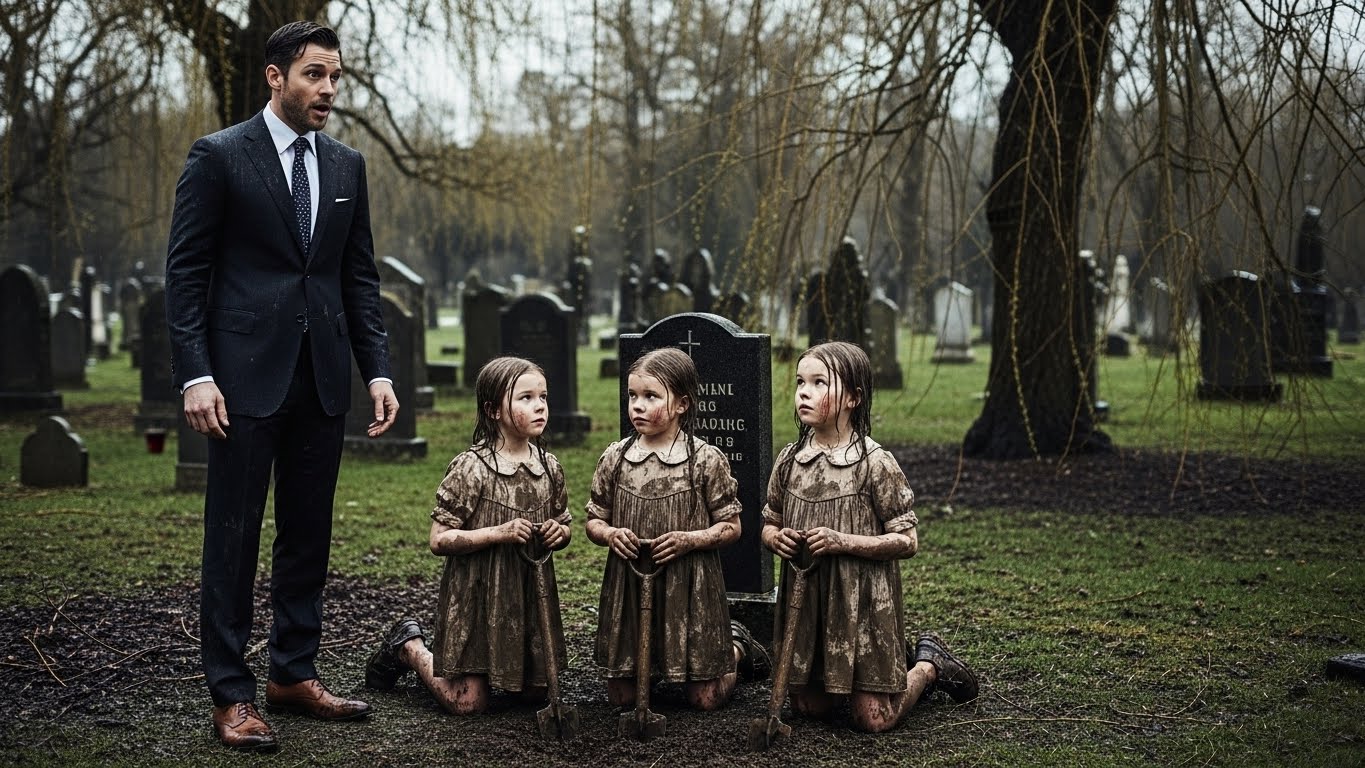
At the foot of her grave, the earth had been churned up. Three small figures were huddled there. Children.
I squinted. They were covered in mud—literally caked in it. Their dresses, which looked like hand-me-downs from the 90s, were stained brown. They were digging with their bare hands, patting the dirt into mounds.
“Hey,” I called out, my instinct to protect my property—or in this case, Elena’s resting place—kicking in. “You shouldn’t be playing there.”
The three heads snapped up in unison.
My breath hitched in my throat. It felt like someone had swung a sledgehammer into my sternum.
They were identical. Three girls. Maybe five or six years old.
But that wasn’t the shock.
The shock was the eyes.
They had eyes the color of polished amber. Elena’s eyes. But they had my chin. My stubborn, squared-off jawline that I saw in the mirror every morning while shaving.
One of them, the one in the center with a streak of mud across her forehead like war paint, stood up. She wiped her hands on her dress, making it worse.
“We aren’t playing,” she said, her voice high and clear, cutting through the wind. “We’re planting.”
“Planting?” I choked out, taking a step closer.
“Mommy likes sunflowers,” the girl on the left whispered, holding up a packet of seeds that looked wet and ruined. “But we don’t have a shovel.”
“Who…” I couldn’t finish the sentence. My heart was hammering against my ribs, a chaotic rhythm I couldn’t control. “Who are you?”
The middle girl tilted her head. It was a gesture so familiar it made my knees weak. Elena used to do that when I was lying to her.
“I’m Lily,” she said. She pointed to her left. “That’s Rose.” She pointed to the right. “That’s Violet.”
Lily. Rose. Violet.
Flowers.
I remembered a conversation from a lifetime ago. Lying in a studio apartment on a mattress on the floor. If we ever have girls, Julian, I want them to be named after the garden I’ll never have in the city.
“Where is your father?” I asked, the words tasting like ash.
The three of them looked at each other. A silent communication passed between them.
“We don’t have a daddy,” Rose said softly, looking back down at the mud. “We just have Auntie Sarah.”
Chapter 2: The Math of Regret
“Get away from them!”
The scream tore through the quiet cemetery air like a gunshot.
I spun around. Running toward us from the direction of a battered Honda Civic parked on the grass verge was a woman. She was wearing a faded denim jacket and jeans that had seen better days. Her hair was frizzy, tied back in a messy bun.
It was Sarah. Elena’s older sister. The one who had told me, on the day I left, that I was selling my soul for a stock price.
She didn’t slow down. She threw herself between me and the girls, her arms spread wide like a bird protecting its nest. She was panting, her face flushed with rage and terror.
“Sarah,” I said, holding up my hands. “I just—”
“Don’t you speak to them,” she hissed. Her eyes were red-rimmed. She looked exhausted, aged twenty years in the six I had been gone. “You don’t get to look at them, Julian. You don’t get to breathe the same air as them.”
I looked past her, at the three little girls who were now huddled together behind her legs, peeking out with those amber eyes. My eyes.
“Sarah,” I said, my voice trembling. I pointed a shaking finger at the trio. “How old are they?”
“Go to hell,” she spat.
“How old are they, Sarah!” I roared, the control I was famous for in the boardroom evaporating instantly.
The shout startled the girls. Violet began to cry.
Sarah’s face crumbled, but her eyes stayed hard as flint. She stepped forward, getting right in my face. She smelled like cheap laundry detergent and old grief.
“They turned five last week,” she whispered, the words lethal.
I did the mental math. It was instant. It was undeniable. I left six years ago. Elena would have been…
“She was pregnant,” I whispered. The realization brought me to my knees. Literally. I sank onto the wet grass, ruining the Italian wool. “When I left… she was pregnant.”
“She didn’t know until two weeks after you walked out the door,” Sarah said, her voice shaking with suppressed fury. “She tried to call you, Julian. Three times.”
I froze.
I remembered the calls. Unknown number. Upstate area code. I was in the middle of the initial public offering negotiations. I had told my assistant to block all unsolicited calls. Distractions, I had called them.
“I… I didn’t know,” I stammered.
“Because you didn’t want to know!” Sarah yelled. She turned back to the girls, her voice instantly softening. “Come on, babies. Get in the car.”
“Wait,” I said, scrambling to stand up. “You can’t just take them. Those are… they are my…”
Sarah spun around, her finger jabbing into my chest hard enough to bruise.
“They are nothing to you,” she snarled. “You are a stranger. You are the man who broke their mother’s heart and left her to raise triplets alone on an art teacher’s salary. You see those clothes? You see that car? That’s what we have. But we have love. We have memories of her.”
She leaned in close, her whisper terrifyingly cold.
“You have billions, Julian. Go hug your money. Because you are not taking these girls.”
She scooped up Violet, grabbed Lily and Rose by the hands, and marched toward the Honda.
I stood there, the rain starting to fall harder, mixing with the mud on my shoes. I watched them drive away, the exhaust pipe rattling, leaving me alone with a cold gravestone and the realization that I had just lost more in five minutes than I had earned in a lifetime.
Chapter 3: The Checkbook Reflex
I didn’t let them go. I couldn’t.
I got back into the Maybach, soaked and shivering. Cobb looked at me in the rearview mirror, his eyes wide with a question he didn’t dare ask.
“Follow that Honda,” I ordered, my voice low and dangerous. “Don’t get too close. Just don’t lose them.”
We trailed them for ten miles, away from the town center, past the suburban tract housing, and into a part of the county I didn’t even know existed. The roads turned from asphalt to cracked gravel.
They pulled into the driveway of a small, peeling duplex. The porch slumped to the left like a stroke victim. There was a tricycle in the yard with one wheel missing.
I watched from a distance as Sarah hustled the girls inside. The house looked cold. It looked small. It looked impossible for four people.
I pulled out my phone. My thumb hovered over my lawyer’s contact. The “shark.” He could have custody papers drawn up in an hour. He could bury Sarah in legal fees until she tapped out.
That was the Julian Vance way. Identify the obstacle. Buy it or destroy it.
But then I saw the light turn on in the front window. Through the thin curtains, I saw Sarah kneeling down, wiping the mud off Violet’s face with a washcloth. She was laughing. She kissed Violet’s nose.
I put the phone away.
I grabbed my checkbook.
I walked up the cracked concrete path and knocked on the door.
It opened instantly, as if Sarah had been waiting for me. She blocked the doorway, her body a physical shield.
“I called the police,” she said flatly. “They’re ten minutes out.”
“I don’t care,” I said. I pulled a check from my jacket pocket. I had already scribbled on it in the car. “Sarah, look at this place. Look at the roof. It’s rotting.”
I held out the check. It was for five million dollars. Enough to buy this entire neighborhood ten times over.
“Take it,” I said, trying to sound reasonable, but sounding desperate. “For them. They shouldn’t be living like this. They need… things. Schools. Clothes. A yard with grass, not gravel.”
Sarah looked at the check. Her eyes widened slightly at the number of zeros. For a second, I thought I had won. Everyone has a price, right? That’s what Wall Street taught me.
She reached out and took the check.
I let out a breath I didn’t know I was holding. “Good. Now, we can discuss a visitation sched—”
Riiip.
The sound was sharp and final.
Sarah tore the check in half. Then in quarters. She let the pieces flutter down onto the muddy doormat like confetti.
“You think this fixes it?” she asked, her voice trembling not with fear, but with disgust. “You think you can just pay for the six years you missed? You think five million dollars buys you the right to be ‘Dad’?”
“It buys them a future!” I argued, my frustration boiling over. “I can give them the world, Sarah!”
“Elena wanted to give them the world, too,” Sarah said quietly. “But she died worrying about the electric bill because you were too busy ‘conquering markets’ to answer the phone.”
She took a step closer, pushing me back with sheer force of will.
“They don’t need your money, Julian. They need a father. And frankly? You don’t look like you have the stomach for that job.”
She slammed the door in my face.
I stood there, staring at the torn pieces of five million dollars in the mud. For the first time in my life, my net worth was absolutely zero.
Inside, I heard small footsteps running to the door.
“Who was that, Auntie?” It was Lily’s voice.
“Nobody, baby,” Sarah replied. “Just a salesman.”
I walked back to the car, the rain soaking through my shirt. I wasn’t a salesman. But I knew I had to make the pitch of my life. And money wasn’t going to be the currency.
Chapter 4: The Man in the Khakis
I spent that night in the Maybach parked three blocks away, curled up in the backseat like a stray dog in a luxury kennel. I didn’t sleep. Every time I closed my eyes, I saw Elena’s face. Then I saw the girls. Then I saw the torn check in the mud.
My lawyer, Marcus, called at 6:00 AM. “Julian, I have the custody petition drafted. We can hit her with ‘unfit living conditions’ by noon. We’ll crush her.”
” shred it,” I said, my voice raspy.
“Excuse me?”
“I said shred it, Marcus. If you file a single paper, you’re fired.”
I hung up. I realized then that I had been trying to acquire my family like a hostile takeover. It was the only language I spoke. But this wasn’t a boardroom. This was a battlefield of the heart, and I was unarmed.
At 8:00 AM, the local hardware store opened. I was the first one in. I bought a toolbox, lumber, roofing shingles, and three small, child-sized gardening sets. I traded my Italian wool suit for a pair of stiff Carhartt pants, a flannel shirt, and work boots. I looked like a billionaire trying to dress up for Halloween as a lumberjack, but it was the best I could do.
I pulled up to the duplex. The Honda was gone—Sarah must have taken them to school.
Good.
I went to work.
I didn’t hire a contractor. I didn’t call a crew. I climbed the ladder myself. I spent four hours stripping the rotting shingles off the porch roof. My hands, soft from years of signing documents and holding whiskey glasses, blistered within the hour. By noon, they were bleeding.
I didn’t care. The physical pain was a relief. It drowned out the noise in my head.
At 3:30 PM, the Honda rattled up the driveway.
I was on the roof, hammering the last shingle into place. I froze.
Sarah got out, looking exhausted. The girls piled out of the back, chattering like little birds.
“Auntie Sarah! Look!” It was Lily. She pointed up at me. “It’s the salesman!”
Sarah looked up. Her jaw dropped. She took in the new lumber, the fixed tricycle in the yard, the bags of premium potting soil stacked by the door.
She stormed over to the ladder as I climbed down. I wiped the sweat from my forehead with a dirty sleeve.
“What are you doing?” she demanded. She didn’t yell this time. She sounded confused.
“The roof was leaking,” I said, leaning the hammer against the wall. “I fixed it.”
“I didn’t ask you to.”
“I know.”
“I can’t pay you.”
“I know.”
We stared at each other. The hostility was still there, a wall of ice between us, but there was a crack in it.
“Why?” she asked.
I looked over her shoulder at the girls. They were inspecting the child-sized shovels I had left by the door. Violet picked one up and hugged it.
“Because I can’t buy the time back,” I said, my voice breaking. “And I can’t buy you. So I’m going to earn it. One shingle at a time.”
Sarah crossed her arms. She looked at my bleeding hands. She looked at the roof.
“You missed a spot on the gutter,” she said dryly.
Then she turned and walked inside. “Girls, inside. Homework.”
She didn’t invite me in. But she didn’t call the police.
It was a start.
Chapter 5: The Sunflower Oath
For the next two weeks, I became a fixture.
I arrived at 7:00 AM. I left at 7:00 PM. I fixed the leaking faucet in the kitchen (Sarah let me in for that, watching me like a hawk). I repaired the fence. I mowed the patch of weeds they called a lawn.
But the real work happened in the dirt.
The girls were suspicious at first. But curiosity is a powerful force in a five-year-old.
It was Saturday morning. I was digging the garden bed for the sunflowers. I was on my knees, elbow-deep in manure and topsoil.
“You’re doing it wrong.”
I looked up. It was Lily. The leader. The brave one.
“Am I?” I asked.
“Mommy said you have to talk to the dirt,” she said matter-of-factly. “You have to ask it nicely to hold the seeds.”
Rose and Violet were hiding behind her.
“I didn’t know that,” I said. “What should I say?”
Lily stepped closer. She crouched down beside me. Her little knees sank into the soil. She smelled like strawberry shampoo and milk.
“Say: ‘Please, Mr. Dirt, take care of these babies,'” she instructed.
“Please, Mr. Dirt,” I repeated, feeling ridiculous and holy all at once. “Take care of these babies.”
Rose giggled. She stepped forward. Then Violet.
For the next hour, we planted. I showed them how to space the seeds. They showed me how to cover them with a “blanket” of soil.
“Why do you have boo-boos on your hands?” Rose asked, touching a bandage on my thumb.
“I’m not used to working,” I admitted.
“What do you do?” Lily asked. “If you don’t work?”
“I… I move money around,” I said. It sounded hollow even to my own ears.
“That sounds boring,” Violet whispered.
“It is,” I said. “It’s very boring.”
“Do you have a daddy?” Lily asked suddenly. The question was a sniper shot.
I stopped digging. I sat back on my heels. Sarah was watching from the kitchen window. I could feel her eyes.
“I did,” I said. “But he wasn’t very nice.”
“Our daddy is lost,” Rose said. “Auntie Sarah says he got lost in the Big City and forgot the map to come home.”
My heart shattered into a million pieces. Lost. That was Sarah’s mercy. She hadn’t told them I was a monster. She told them I was lost.
I looked at the three of them—dirt on their noses, hope in their amber eyes.
“Maybe…” I started, my throat tight. “Maybe he’s trying to find the map. Maybe he’s looking for it right now.”
Lily narrowed her eyes. She studied my face. For a second, I thought she knew. She had Elena’s intuition.
“He better hurry,” she said sternly. “The sunflowers are gonna grow soon. He’ll miss it.”
“I think he knows that,” I whispered. “I think he knows that better than anything.”
Chapter 6: The Fever Breaking
The truce broke three days later.
It was 2:00 AM on a Tuesday. I was in the Maybach, dozing. I refused to leave the neighborhood. I told myself it was for security, but the truth was, I couldn’t bear to be away from them.
A banging on the glass woke me.
It was Sarah. She was wearing pajamas, her hair wild, her face pale with terror.
I unlocked the door.
“It’s Violet,” she choked out. “She can’t breathe. The asthma… the inhaler isn’t working.”
I didn’t ask questions. I was out of the car in a second. I ran into the house.
Violet was on the couch, her small chest heaving, a terrifying wheezing sound coming from her throat. Her lips were turning blue. Lily and Rose were huddled in the corner, crying silently.
I scooped Violet up. She was burning hot and light as a feather.
“The car,” I barked at Sarah. “Now!”
We sped to the nearest ER. I drove like a maniac, breaking every traffic law in the state of New York. Sarah sat in the back, holding Violet, whispering prayers.
“Stay with me, baby. Stay with me.”
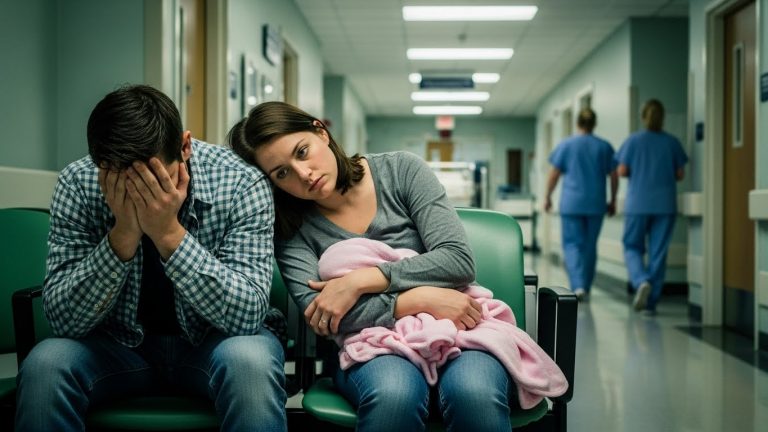
When we burst into the ER, it was chaos. A waiting room full of people. A nurse behind glass who didn’t look up.
“Please!” Sarah screamed, running to the desk. “She can’t breathe!”
“Take a number, ma’am,” the nurse said, not even looking at Violet. “We have a three-hour wait.”
“She doesn’t have three hours!” Sarah sobbed.
I stepped forward.
I didn’t yell. I didn’t get angry. I became Julian Vance, CEO.
I placed my hand on the counter. The heavy gold Rolex on my wrist clattered against the laminate. I leaned in.
“Her name is Violet Vance,” I said, my voice low, calm, and terrifying. “She is in respiratory distress. You will open those doors, and you will get a doctor. If anything happens to her because you made her wait for a number, I will not sue this hospital. I will buy it, and I will turn this emergency room into a parking lot.”
The nurse looked up. She saw the suit (I had started changing back for emergencies). She saw the eyes. She saw the absolute certainty that I could and would destroy her world.
“Code Blue, Pediatric!” she yelled into her radio, slamming a button.
Doors flew open. A team swarmed us. They took Violet.
Sarah collapsed into a plastic chair, shaking uncontrollably.
I stood over her, feeling useless again. The power I had just wielded felt dirty. It saved her, yes. But it was the same power that had kept me away for six years.
I sat down next to Sarah. I didn’t touch her. I just sat.
“She has Elena’s lungs,” Sarah whispered after a long time. “Weak lungs.”
“Is she… is this common?”
“Twice a year,” Sarah said. She wiped her eyes. “Last time… last time I didn’t have the copay. We had to wait until she passed out before they admitted her.”
She turned to look at me. Her eyes were searching mine.
“You got them to move,” she said. “You made them listen.”
“It’s the only thing I’m good at,” I said bitterly. “Bullying people.”
“Tonight,” Sarah said softly, “it was enough.”
We sat in silence for another hour until the doctor came out. Stabilized. Sleeping. She was going to be okay.
Sarah let out a sob of relief and leaned her head back against the wall. She looked at me, really looked at me, for the first time without hatred.
“Elena didn’t hate you, you know,” she said.
The words hit me like a physical blow.
“She should have,” I said.
“She was disappointed,” Sarah corrected. “She used to say, ‘Julian thinks he needs to conquer the world to be worthy of standing in it. He doesn’t know he’s already enough.'”
Tears stung my eyes. I looked away.
“I wasn’t enough,” I whispered. “I’m still not.”
“No,” Sarah agreed. “You’re not. You’re a stranger who fixed a roof. But…” She took a deep breath. “Violet is asking for you.”
My head snapped up. “What?”
“She woke up. She asked for the Man in the Khakis.” Sarah stood up. “Go in there, Julian. Don’t be the billionaire. Just be the man who held her when she couldn’t breathe.”
I walked toward the double doors. My legs felt heavier than they ever had walking into a board meeting.
This was the real test.
Chapter 7: The Map Home
The hospital room was dim, lit only by the glow of the monitors. The steady beep-beep-beep was the only sound in the world.
Violet looked tiny in the hospital bed, swallowed by the white sheets. An oxygen mask covered half her face.
I stood by the door, terrified. I had negotiated billion-dollar acquisitions in rooms full of sharks, but walking those ten feet to her bedside felt like walking to my execution.
I sat on the edge of the chair.
Her eyes fluttered open. The amber iris, hazy with medication, found mine.
“Mr. Khakis,” she mumbled behind the mask.
“Hey, flower,” I whispered. My voice was thick, unrecognizable. “I’m here.”
She lifted a hand. It was bruised from the IV line. She pointed to the plastic bag of personal effects sitting on the bedside table.
“My bag,” she wheezed.
I reached over and opened it. Inside was her dirty dress, her shoes, and a small, battered sketchbook with a cardboard cover.
“Open it,” she whispered.
I opened the book. It was filled with crayon drawings. Crude, colorful, chaotic. There were pictures of three girls. Pictures of a woman with long hair—Elena. Pictures of a big yellow sun.
“The end,” Violet said. “Go to the end.”
I flipped to the back pages.
My heart stopped.
The last ten pages weren’t drawn by a child. They were sketches in charcoal. Masterful, delicate, full of life. Elena’s hand.
They were sketches of me.
Me sleeping on our old mattress. Me laughing at a joke she made. Me focused, staring at a laptop.
And the final drawing… it was a sketch of a man in a suit, standing tall, looking out at a horizon. But he wasn’t alone. In the drawing, three small girls were holding his coattails, anchoring him to the ground.
Underneath, in Elena’s looping handwriting, was a caption: The King who is lost. One day, he will find his way back to the castle.
I stared at the drawing. The charcoal blurred as hot tears finally spilled over, running down my face, dripping onto the paper.
She hadn’t told them I was a villain. She hadn’t poisoned them against me. She had turned my absence into a fairy tale, a legend of a King who was simply… lost. She had held the door open for me, even from the grave, praying I would walk through it before it was too late.
“Mommy drew the King,” Violet whispered, her eyes closing again. “You look like him. But you look sadder.”
I took her small, cold hand in mine. I pressed it against my forehead.
“I was sad,” I choked out. “I was so sad, Violet. But I think… I think I found the map.”
“Good,” she breathed, drifting back into sleep. “Tell the King to hurry up. We’re waiting.”
I sat there for the rest of the night, holding her hand, staring at Elena’s drawing. The merger, the stock price, the penthouse in Manhattan—it all turned to dust. This was the only asset that mattered. And I had almost liquidated it.
Chapter 8: The Harvest
Four Months Later
The New York sun in late August is unforgiving, but the sunflowers loved it.
They were six feet tall now, a golden army marching along the back fence of the duplex. They nodded in the breeze, heavy with seeds.
I wiped the sweat from my neck with a bandana. I was grilling burgers. The smoke stung my eyes, but I didn’t mind.
“Uncle Julian! Watch this!”
I looked up. Lily was hanging upside down from the new jungle gym I had built in the yard. Rose was pushing Violet on the swing.
“Careful!” Sarah called out from the porch. She was drinking iced tea, her feet propped up on the railing. She looked younger. The lines of stress around her eyes had smoothed out.
I flipped a burger.
I wasn’t “Uncle Julian” anymore. Not really. But we hadn’t forced the “Dad” title yet. We were letting it grow, like the flowers. Natural. Slow. Strong.
I had stepped down as CEO. I kept my shares, kept my board seat, but I handed the daily operations to my COO. The market panicked for a day, then stabilized. They called it a “personal sabbatical.”
I called it “waking up.”
I bought the house next door to the duplex. We knocked down the fence between the yards. I wasn’t just a visitor; I was a neighbor. I was a driver for school runs. I was the guy who checked for monsters under the bed.
“Burgers are up!” I yelled.
The girls scrambled over, a whirlwind of energy and laughter. We sat at the picnic table—Sarah, me, and the three of them.
“I have a question,” Rose said, wiping ketchup off her chin.
“Shoot,” I said.
“Tomorrow is Show and Tell at school,” she said. “The theme is ‘My Family.'”
My stomach tightened. These moments were always a minefield.
“Okay,” I said cautiously. “What are you going to show?”
Rose looked at Lily. Lily looked at Violet.
Violet reached under the table and pulled out the battered sketchbook. She opened it to the charcoal drawing of the King.
“We want to bring this,” Violet said.
“And…” Rose hesitated. She looked at me, her amber eyes searching. “We want to bring you. If you’re not… too busy.”
The world went silent. The birds stopped singing. The wind stopped blowing.
“Me?” I asked, my voice barely a whisper.
“Yeah,” Lily said, shrugging as if it wasn’t the most important sentence ever spoken in the history of the universe. “We have to explain who the King is. Since he’s not lost anymore.”
I looked at Sarah. She was smiling, a soft, genuine smile. She nodded.
I looked back at the girls. My daughters.
“I’m not busy,” I said, my voice thick with emotion. “I will never be too busy.”
Epilogue
Later that evening, as the sun set, painting the sky in purples and oranges, I went to the cemetery alone.
The mud was gone, replaced by summer grass. The grave was well-tended.
I placed a single, giant sunflower from our garden against the headstone.
“I found them, El,” I whispered to the wind. “And they found me.”
I touched the cold stone.
“You were right. The poverty wasn’t yours. It was mine. I was the poorest man on earth.”
I stood up, adjusting my flannel shirt.
“But not anymore. I’m the richest man alive.”
I turned and walked away, leaving the Maybach behind. I walked home, toward the duplex where the lights were on, and where three little girls were waiting to hear a bedtime story about a King who finally came home.