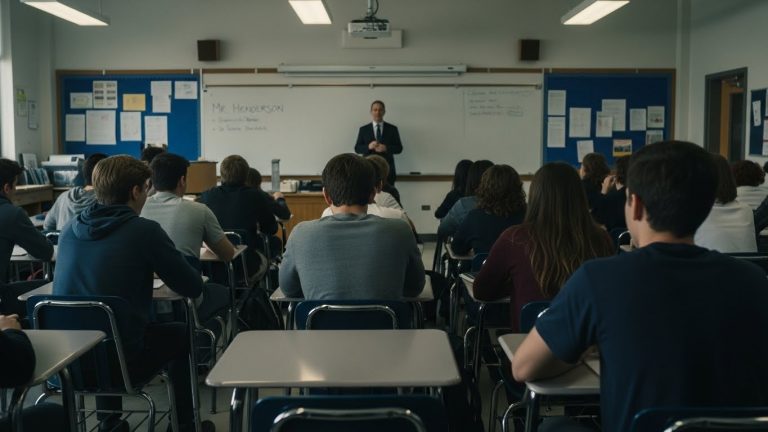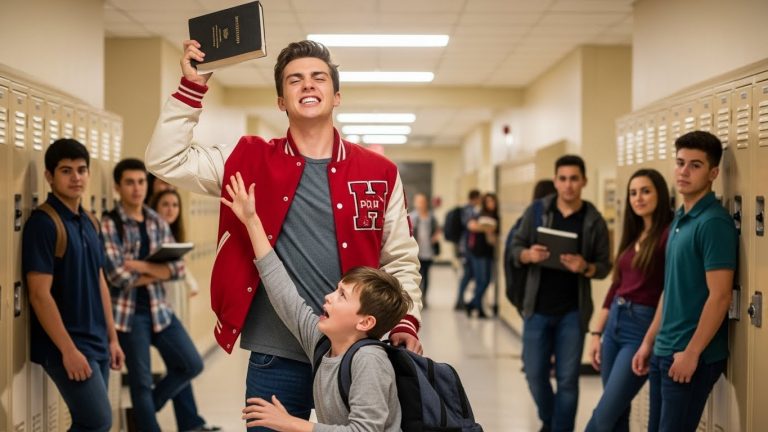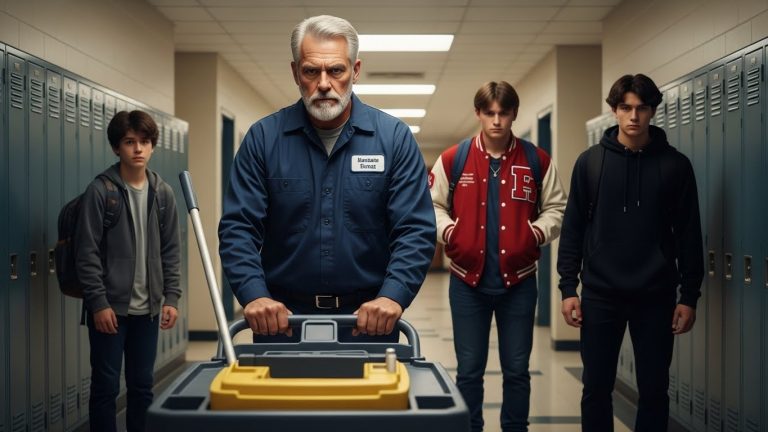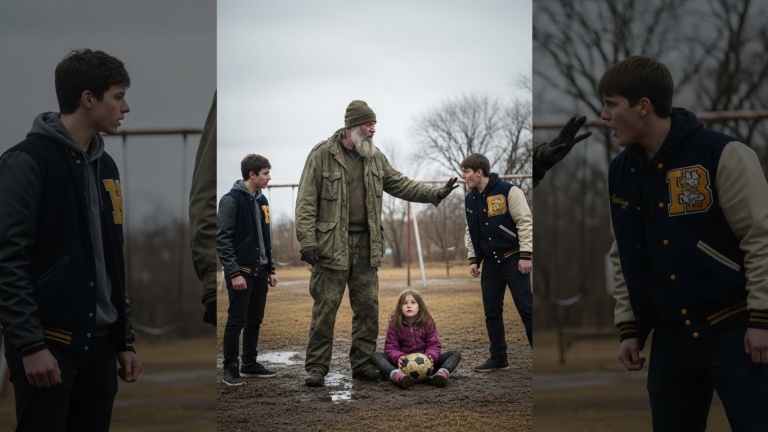
THEY THOUGHT SHE WAS AN EASY TARGET. THEY DIDN’T SEE THE MONSTER SITTING IN THE TRUCK.
PART 1
CHAPTER 1: THE PERIMETER
I hate high schools.
They smell like desperation, hormones, and cheap body spray.
I was sitting in my beat-up Ford F-150, the engine idling just enough to keep the A/C whispering against the humid Ohio afternoon. It was 2:45 PM on a Tuesday in scorching mid-September. The asphalt of the Lincoln High parking lot was radiating heat waves that made the horizon wobble like a mirage in the desert.
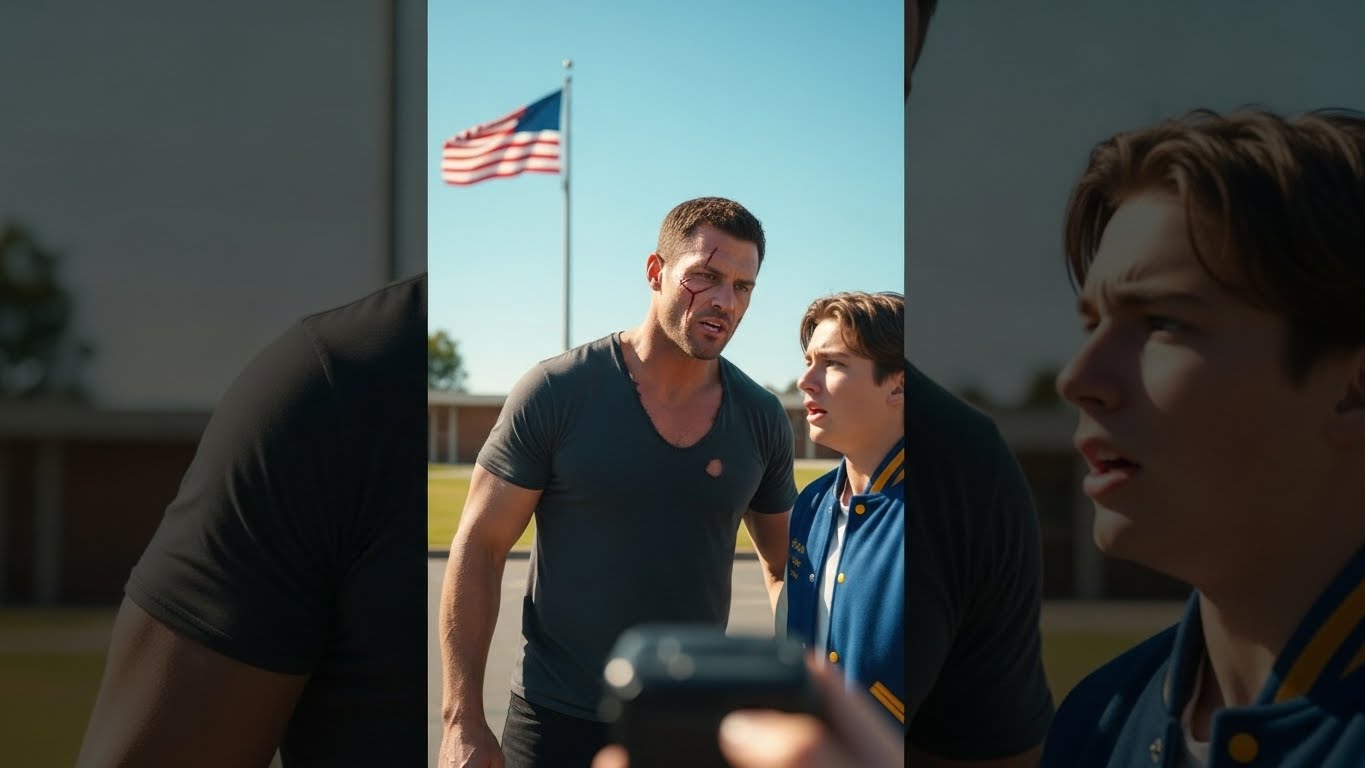
To anyone walking by, I was just a guy. Maybe a little too rough around the edges for this manicured suburb where the lawns were measured in millimeters. I had a jagged scar running from my left ear down to my jawline—a permanent souvenir from a botched extraction in the Korangal Valley—and my knuckles were covered in thick calluses that never quite healed. I wore aviator sunglasses, not to look cool, but because my eyes were always moving.
Scanning. Assessing. Analyzing.
Old habits don’t die. They don’t even fade. They just wait for a trigger.
I had been back in the States for three months. My sister, Karen, had begged me to stay with her in this quiet town. She said she needed help with her daughter, Lily, since her husband took off. She said I needed “reintegration.” She thought painting the fence and mowing the lawn would fix the wiring in my head.
What I needed was a perimeter I could control and a mission objective that didn’t involve navigating the social hierarchy of American teenagers. But here I was, doing pick-up duty because Karen was pulling a double shift at the hospital.
“Just pick her up, Miller,” Karen had said this morning, handing me the keys. “She’s having a hard time. Just be there. And please, don’t scare the neighbors.”
I checked the mirrors. Three o’clock: A soccer mom in a Honda Odyssey, distracted, texting with both hands. Low threat. Nine o’clock: Two teachers smoking near the dumpsters, looking exhausted. No threat.
Then the bell rang.
It wasn’t a gentle chime; it was a jarring buzzer that reminded me of a prison lockdown. The double doors of the main entrance burst open, and the flood of students poured out. It was chaos. Loud, colorful, chaotic energy.
I scanned the crowd for the asset—Lily. She was easy to miss. She was small for sixteen, hiding inside an oversized gray hoodie despite the ninety-degree heat. She walked with her head down, clutching a large sketchbook against her chest like it was a ballistic shield protecting her vitals.
She was hugging the brick wall, trying to stay invisible. I knew that tactic. It’s what you do when you’re in hostile territory without backup and your comms are down. You minimize your silhouette.
My hands tightened on the steering wheel until the leather creaked. I didn’t like the way she walked. It wasn’t just shyness; it was fear.
She was almost to the sidewalk when the pack intercepted her.
Three boys. Two girls.
They looked like they walked straight out of a casting call for “Entitled Suburban Nightmares.” Letterman jackets, perfect hair, expensive sneakers that cost more than my first car. They moved with the arrogance of people who have never been punched in the face and don’t believe it’s possible.
The leader was a tall kid with blonde hair and a lacrosse stick slung over his shoulder. I clocked him immediately. The Alpha. The one the others looked to for permission to laugh.
He stepped in front of Lily, blocking her path to the parking lot.
I sat up straighter in the cab. My pulse didn’t speed up. It actually slowed down. That’s what happens when the switch flips. The noise of the world—the traffic, the radio, the wind—fades out, and everything becomes geometry and physics. Distance. Velocity. Force. Trajectory.
I rolled down the window. The sounds drifted in, carried by the hot breeze.
“…trash…”
“…orphan clothes…”
I couldn’t hear every word, but I saw Lily flinch. She tried to step around them to the left. The blonde kid side-stepped, blocking her again. He was smiling. It wasn’t a friendly smile. It was a predator’s grin.
One of the girls, a redhead holding a massive red slushie from the cafeteria, circled behind Lily. Flanking maneuver.
I reached for the door handle.
Don’t engage, Miller, I told myself. They are children. Civilians. You are not downrange. There are laws here.
But my body wasn’t listening to civilian logic. My body was remembering the rules of engagement: Protect the asset. Neutralize the threat.
The redhead tipped the cup.
It happened in slow motion for me. The thick, red sugary sludge cascaded over Lily’s head. It soaked her hair, ran down her face, ruined the gray hoodie, and splashed onto the sketchbook she was clutching.
The pack erupted in laughter. It was a cruel, hyena-like sound that echoed across the asphalt.
Lily didn’t scream. She didn’t fight back. She just stood there, freezing, shaking, as the red liquid dripped onto her cheap canvas sneakers. She looked small. Broken.
The blonde kid pulled out his phone. He was filming her.
“Smile for the story, loser!” he shouted. “This is going viral!”
That was it.
The switch locked into place.
I opened the truck door. I didn’t slam it. I stepped out, my combat boots hitting the pavement with a heavy, solid thud. I adjusted my watch.
I wasn’t Uncle Miller anymore. I was Sergeant First Class Miller, 3rd Special Forces Group. And I was about to educate these kids on the true definition of fear.
CHAPTER 2: ZERO DISTANCE
The distance between my truck and the group was exactly fifty yards.
I covered it in silence.
I didn’t run. Running attracts attention. It triggers a chase response. Predators don’t run until the final strike; they stalk. I walked with a long, fluid stride, my center of gravity low, my shoulders loose.
People usually get out of my way without knowing why. It’s pheromones or body language—something primal that signals danger to the lizard brain. The crowd of students parting for their buses split for me like the Red Sea. They stopped talking as I passed.
The laughter from the bullies was dying down, replaced by confused murmurs. They sensed the shift in the atmosphere before they saw me. The air had gotten heavier.
Lily was wiping her eyes, the red slushie looking disturbingly like blood on her pale skin. She dropped her sketchbook. It landed in a puddle of the sticky mess, the pages soaking up the liquid. Her art. Her escape.
“Aww, is the baby gonna cry?” the blonde kid mocked, zooming in with his phone, oblivious to the shadow falling over him.
“Hey,” I said.
I didn’t shout. I didn’t need to. My voice is gravel and sandpaper, the kind of voice that cuts through background noise like a jagged knife.
The blonde kid spun around. “Who the hell are—”
He stopped.
I was standing three feet from him. Close enough to smell the peppermint gum on his breath and the fear sweating out of his pores. Close enough to see the sudden dilation of his pupils as he looked up—and up—at me. I’m six-four, two hundred and forty pounds of functional muscle, built for hauling gear up mountains, not for sitting in classrooms.
I took off my sunglasses slowly and hooked them onto my shirt collar. I looked him dead in the eye. I didn’t blink.
“Phone,” I said.
The kid, let’s call him Brad—he looked like a Brad—tried to regain his composure. He looked around at his friends for backup, but they were shrinking back. He puffed out his chest, trying to make himself look bigger.
“Excuse me? This is free property, old man. You can’t tell me what to do. I have rights.”
I took one step forward. Just one. I invaded his personal space, collapsing his comfort zone entirely.
“I said, phone.”
The other kids in the pack took a collective step back. They looked at each other, waiting for a cue. But Brad was paralyzed. He was looking at my eyes.
They say eyes are the window to the soul. I don’t know about that. But I know that when normal people look into my eyes, they see things they don’t understand. They see the reflection of burning vehicles. They see the emptiness. They see a total absence of hesitation.
“You… you can’t touch me,” Brad stammered, his voice cracking on the last syllable. “My dad is on the school board. He’s a lawyer. He’ll sue you into the ground.”
“Your dad isn’t here,” I said softly, leaning down slightly. “I am.”
I held out my hand. Palm open. Expectant.
Brad’s hand shook as he lowered the phone. He didn’t want to give it up—it was his weapon, his shield—but his survival instinct was screaming at him. Submit. He placed the iPhone in my hand.
I looked at it. The screen was still recording. I tapped ‘Stop’. Then ‘Delete’. Then ‘Recently Deleted’. Then ‘Delete All’.
I dropped the phone.
It didn’t break, but it hit the pavement with a final, plastic clack that sounded like a gunshot in the silence.
I stepped over the phone and looked at the girl—the redhead. She was holding the empty plastic cup, her mouth agape, her arrogance evaporated.
“Pick it up,” I said, pointing to Lily’s ruined sketchbook lying in the red puddle.
“I… I didn’t mean to…” she started, tears welling up instantly. Typical. Aggressors always turn into victims the second they face resistance. “It was just a joke.”
“Pick. It. Up.”
She scrambled down, ruining her manicure on the rough asphalt, and grabbed the soggy book. She held it out to me with trembling hands, getting red slushie on her expensive white blouse.
I took the book gently. I wiped the cover with the hem of my shirt. Then I turned to Lily.
She was staring at me, her eyes wide, shock overriding her embarrassment. She looked at me like I was a stranger. Maybe I was.
“Get in the truck, Lily,” I said. My voice changed. It wasn’t the command voice anymore; it was softer, the voice I used to use to calm rookies.
“Uncle Miller?” she whispered.
“Truck. Now.”
She hurried past me, head down, clutching her backpack, trying to disappear again.
I turned back to the pack. Brad had found his courage again now that my back had been turned for a second.
“You’re crazy!” Brad yelled, stepping back to a safe distance, about twenty feet away. “You’re a psycho! I’m calling the cops! You assaulted me!”
I paused. I slowly turned my head.
The entire schoolyard was silent. A hundred kids were watching. Teachers were frozen by the doors, unsure if they should intervene or call SWAT.
I walked up to Brad one last time. I moved so fast he flinched and covered his face. But I didn’t hit him. I leaned in close, right by his ear, and whispered something only he could hear.
“You think this is a game, kid. You think because you’re in a suburb, you’re safe. But if you ever—ever—look at her again, I won’t be the uncle picking her up from school. I’ll be the nightmare you see when you close your eyes. I will find you, and I won’t ask for your phone next time.”
I pulled back. Brad’s face was the color of chalk. He had wet himself. A small dark patch was spreading on his khaki pants.
I turned around and walked away.
But as I reached the truck, my internal radar pinged. I felt eyes on me. Not the kids. Not the teachers. Something else.
Across the street, parked in the deep shadow of an oak tree, was a black sedan. Chevy Malibu. Tinted windows. No front plates.
It wasn’t a parent. It wasn’t a teacher.
The window rolled down just an inch. A long lens glinted in the sunlight.
They weren’t watching the kids. They were watching me.
I got into the truck and slammed the door.
“Buckle up, Lily,” I said, putting the truck in gear and peeling out of the lot a little too fast.
“Uncle Miller… who was that?” she asked, looking back at the boys I had just terrified, then at the car across the street.
“Nobody,” I said, my eyes fixed on the rearview mirror and the black sedan that was now pulling out into traffic behind us. “Just static.”
But I knew the truth. My past hadn’t just faded away. It had followed me home. And now, thanks to a high school bully, I had exposed my position.
The mission had just changed.PART 2
CHAPTER 3: EVASIVE MANEUVERS
The inside of the truck was silent, save for the hum of the tires on the hot asphalt and the ragged breathing coming from the passenger seat.
Lily was shivering. It wasn’t the air conditioning. It was the adrenaline crash. The sugar from the slushie was starting to dry, making her hair stiff and sticky. She smelled like artificial cherry and fear.
I kept my eyes moving. Windshield. Side mirror. Rearview.
The black sedan was still there. Two cars back. Maintaining a perfect tactical distance. They weren’t trying to pull me over, and they weren’t trying to run me off the road. They were observing.
“Uncle Miller?” Lily’s voice was small. “You scared them.”
“Good,” I said, my eyes flicking to the rearview again. The sedan changed lanes when I did. Smooth. Professional. “Fear is a teacher, Lily. Sometimes it’s the only one people listen to.”
“But… Brad’s dad really is a lawyer. He’s going to come after you.”
I almost laughed. A lawyer? I was worried about a wet-work team from a black-ops division I wasn’t technically supposed to know existed. A suburban lawyer was about as threatening as a golden retriever.
“Let me worry about the legal system,” I said. “Right now, we need to get you cleaned up.”
I signaled left. The sedan signaled left.
“We’re not going home?” Lily asked, looking out the window as I turned away from our neighborhood.
“Taking the scenic route,” I lied. “Traffic looks bad on Main.”
I needed to verify the threat level. If they followed me home, the house was burned. If I could shake them here, in the labyrinth of suburbia, I might buy us some time.
I took a sharp right into a residential subdivision—one of those cookie-cutter neighborhoods where every house is beige and every lawn is perfect. I accelerated. Not enough to attract a cop, but enough to close the gap.
“Hold on,” I muttered.
I took three quick left turns. In the surveillance world, three lefts equal a circle. If someone is still behind you after that, they aren’t lost. They’re hunting.
I checked the mirror. The black sedan turned the corner.
Confirmed.
“Who are you looking at?” Lily asked, twisting in her seat. She was smarter than I gave her credit for. She had noticed my obsession with the mirrors.
“Nobody,” I said, my grip tightening on the wheel. “Just checking my six.”
“Your six?”
“It means watching your back. It’s… just a habit.”
I needed to lose them without causing a scene. I couldn’t start a high-speed chase with a sixteen-year-old in the passenger seat. I needed a choke point.
I remembered a strip mall about two miles up. It had a grocery store with a loading dock in the back that exited onto a parallel service road. It was tight, but the truck could fit.
“Lily, I need you to put your head down,” I said, keeping my voice calm.
“What? Why?”
“Just do it. Pretend you’re looking for something on the floor. Now.”
The command in my voice made her obey instantly. She bent forward.
I gunned it.
The V8 engine roared as I shot through a yellow light just as it turned red. The cross-traffic honked, a chorus of angry suburbanites, but I was already through.
I checked the mirror. The sedan had been caught by the light. They were stuck behind a wall of traffic.
This was my window. Usually, you have about thirty seconds before a professional team reacquires visual contact.
I whipped the truck into the strip mall parking lot, ignoring the “One Way” signs. I slalomed between parked cars, heading straight for the back of the ‘Save-A-Lot’.
“Uncle Miller, you’re driving crazy!” Lily squeaked from the floorboard.
“Just a shortcut,” I grunted.
I hit the alleyway behind the store. It was narrow, lined with dumpsters and stacks of pallets. I didn’t slow down. The truck bounced violently over a pothole. I threaded the needle between a delivery truck and a brick wall with inches to spare.
We popped out on the service road on the other side. I immediately turned right, away from the main drag, and merged into the flow of traffic on a busy four-lane avenue.
I checked the mirrors.
Nothing. Just a soccer mom in a minivan and a guy in a plumbing van.
The black sedan was gone.
I let out a breath I didn’t know I was holding. My heart rate, which had spiked to maybe eighty beats per minute, dropped back to a resting fifty-five.
“You can sit up now,” I said.
Lily pulled herself up, rubbing her head. “That was not a shortcut. That was… that was like Fast and Furious.”
“Don’t watch those movies,” I said automatically. “They’re unrealistic.”
She looked at me, really looked at me, for the first time since I’d moved in. The red slushie was drying on her cheek, cracking like old paint.
“You’re not just a mechanic, are you?” she asked. “Mom says you fixed trucks in the Army. But mechanics don’t drive like that. And they don’t make Brad Stevens wet his pants just by whispering.”
I kept my eyes on the road, constantly scanning for the black sedan.
“I fixed a lot of things, Lily,” I said quietly. “Trucks were just part of it.”
“What did you whisper to him?”
I glanced at her. She looked tougher than she felt. There was a steel in her eyes that reminded me of my sister.
“I told him the truth,” I said. “That the world is a lot bigger and scarier than his daddy’s law firm.”
We drove the rest of the way in silence, but the air in the cab had changed. She wasn’t just my niece anymore. She was part of the unit. And I wasn’t just her weird uncle. I was her protector.
But as we pulled into the driveway of Karen’s modest two-story house, I didn’t feel relief. I felt the itch between my shoulder blades that comes when you know you’re in the crosshairs.
I had lost the tail, but I hadn’t lost the war. They knew where I lived.
CHAPTER 4: THE SAFE HOUSE
The house looked normal.
That was the most dangerous thing about it. The hydrangeas were blooming in the front yard. A bicycle was leaning against the porch railing. It was the picture of the American Dream.
But to me, it was a tactical nightmare. Too many windows. Wood-frame construction that wouldn’t stop a 9mm round, let alone a rifle caliber. Multiple points of entry. No perimeter fence.
“Go inside,” I told Lily as I killed the engine. “Lock the door behind you. Do not open it for anyone but me or your mom.”
“Uncle Miller, you’re scaring me,” Lily said, her hand on the door handle. “Is this because of the bullies? Brad isn’t going to come here.”
“It’s not about Brad,” I said, scanning the rooflines of the neighboring houses. “Just do it, Lily. Please.”
She nodded, sensing the seriousness in my tone, and ran inside.
I didn’t go in immediately. I walked around the truck. I checked the wheel wells. I checked the undercarriage.
Nothing. No tracking bugs.
That meant they were tracking me electronically. My phone? No, I used a burner. The truck’s GPS? It was an ’04 model, too old for factory tracking.
I walked to the edge of the lawn. I looked up and down the street. It was quiet. A dog barked in the distance. A sprinkler hissed three lawns down.
I went inside.
The cool air of the house hit me. It smelled like lemon pledge and fabric softener. It smelled like safety. It was a lie.
Lily was in the kitchen, wiping the red goop off her face with a wet paper towel. She had taken off the ruined hoodie, revealing a vintage band t-shirt underneath. Her arms were thin, pale.
“I’m sorry about the sketchbook,” I said, leaning against the counter. I kept away from the windows.
“It’s okay,” she said, scrubbing at a stain on her neck. “It was almost full anyway. I… I should have fought back.”
“No,” I said firmly. “You did the right thing. You survived. Fighting when you’re outnumbered and outgunned isn’t bravery, Lily. It’s suicide. You wait for your moment. Or you wait for backup.”
She stopped scrubbing and looked at me. “You were my backup.”
“Always,” I said.
“Why are you so… intense?” she asked. “Mom says you have PTSD. She says the war made you jumpy.”
“Your mom loves to diagnose people,” I said. “I’m not jumpy. I’m prepared.”
“Prepared for what? It’s suburbia, Miller. The biggest danger here is high cholesterol.”
I walked over to the window and peered through the blinds. A gray van had just parked down the street. Repair man? Or surveillance?
“You’d be surprised,” I muttered.
“What did you mean about ‘static’?” she asked. “In the car. You said the other car was ‘static’.”
I turned to her. I had to tell her something. If things went south, she needed to know the stakes.
“In my old job,” I began, choosing my words carefully, “we had a term for things that interfere with the mission. Noise. Distractions. We called it static. But sometimes, static isn’t just noise. Sometimes it’s a signal.”
“And that car was a signal?”
“Maybe.”
I walked to the hallway closet. I pushed aside the vacuum cleaner and the winter coats until I reached the back. There, hidden under a pile of old blankets, was a black duffel bag.
My ‘Go-Bag’.
I unzipped it. Inside was the hardware of my past life. A glock 19. Three spare magazines. A KA-BAR knife. A sat phone. Cash. Passports.
I checked the chamber of the Glock. Empty. I loaded a magazine and racked the slide. The sound was a metallic clack-clack that felt like home.
“Uncle Miller?” Lily was standing in the doorway. Her eyes went wide when she saw the gun. “Oh my god. Is that real?”
“It’s insurance,” I said, tucking the weapon into the waistband of my jeans at the small of my back, covering it with my shirt.
“Mom hates guns,” she whispered. “She’ll freak out.”
“Mom doesn’t need to know,” I said. “Listen to me, Lily. Go upstairs. Shower. Change. Pack a bag.”
“Pack a bag? Are we going on vacation?”
“Just pack it. Essentials only. Clothes, toothbrush, charger. Do it now.”
She hesitated, then saw the look on my face. It wasn’t the uncle look. It was the soldier look. She turned and ran up the stairs.
I went back to the living room. I needed to secure the perimeter. I checked the front door lock. It was a flimsy deadbolt that could be kicked in by a teenager. I wedged a heavy oak chair under the handle.
Then my burner phone buzzed in my pocket.
I froze.
Nobody had this number. Nobody. I had bought the phone with cash at a gas station three towns over. I hadn’t made a single call on it yet.
I pulled it out. The screen displayed a number I didn’t recognize. Area code 703. Northern Virginia.
Langley. Or the Pentagon.
My thumb hovered over the answer button. If I answered, I confirmed I was alive. I confirmed I was active.
But if I didn’t answer, they would just keep coming.
I pressed the green button and held the phone to my ear. I didn’t say anything. I just listened.
“Sergeant Miller,” a voice said. It was digital, distorted. “You’ve been a very hard man to find.”
“I wasn’t hiding,” I said, my voice low.
“The incident at the school was… messy,” the voice said. “Viral videos tend to complicate things. We saw you.”
“Who is this?”
“Friends. Or enemies. That depends on you.”
“I’m retired,” I said. “I’m out.”
” nobody is ever really out, Miller. You still have the file, don’t you?”
My blood ran cold. The File.
“I don’t know what you’re talking about.”
“Don’t play games. We know you took the drive from Kandahar. We know what’s on it. And now that you’ve popped your head up in this nice little suburb… we’re coming to get it.”
“If you come near this house,” I growled, “I will burn everything down.”
“We’re already here, Miller.”
The line went dead.
I looked out the window.
The gray van down the street slid its door open.
Four men stepped out. They weren’t wearing repair uniforms. They were wearing tactical vests and carrying suppressed rifles.
They were moving toward the house.
“Lily!” I screamed, my voice tearing through the quiet house. “Get down!”
Glass shattered in the kitchen as the first flashbang came through the window.CHAPTER 5: CONTROLLED CHAOS
BANG.
The sound wasn’t a noise; it was a physical blow. A flashbang grenade generates about 170 decibels and a million candela of light. Even from the kitchen, the concussive wave rattled my teeth and turned the world into a washout of white ringing silence.
My combat hearing protection was gone. My ears screamed. But my body didn’t need to hear to know what to do.
“Lily!” I shouted, but I couldn’t hear my own voice.
I scrambled up the stairs on all fours, staying low to avoid the fatal funnel of the hallway. The front door splintered inward. I felt the vibration through the floorboards.
Boots. Heavy boots. Multiple bogies.
I reached the landing just as Lily stumbled out of her room, her hands clamped over her ears, her mouth open in a silent scream. She was disoriented, blinded by the flash.
I didn’t hug her. There was no time for comfort. I grabbed the back of her shirt and yanked her down to the floor, covering her body with mine.
Thwip-thwip.
Two rounds tore through the drywall where she had been standing a second ago. Suppressed fire. They weren’t here to talk. They were here to sanitize the site.
My vision was clearing. The white spots were fading into the gray smoke drifting up from the living room.
“Crawl,” I hissed into her ear. “Bathroom. Now.”
She was frozen. Terror does that. It disconnects the brain from the legs.
I slapped her leg. Hard. “Move, Lily! Or you die here!”
She gasped, looked at me with wide, terrified eyes, and started to crawl.
I rolled onto my back, raising the Glock 19. I aimed through the banister rails. A shadow moved at the bottom of the stairs. A helmet. Night vision goggles.
I didn’t hesitate. I squeezed the trigger twice.
Crack-crack.
The shadow crumpled. No scream. Just the sound of gear hitting the floor.
“One down,” I counted internally. “Three to go.”
I scrambled backward into the bathroom and kicked the door shut. It was a hollow core door—useless for cover, but it broke the line of sight.
“Get in the tub,” I ordered.
Lily scrambled into the porcelain bathtub. It was cast iron. Good cover.
“Uncle Miller, you shot him,” she sobbed, curling into a ball. “You killed a person.”
“He wasn’t a person, Lily. He was a threat.”
I checked the window. It overlooked the backyard garage roof. A twelve-foot drop. Doable for me. Risky for her. But the stairs were compromised.
I threw open the window. The humid air rushed in.
“We’re going out the window,” I said.
“What? No! I can’t!”
“They are coming up the stairs, Lily. You have three seconds to decide.”
I heard the creak of a floorboard outside the door.
I grabbed a heavy bottle of shampoo from the shelf and hurled it at the door. It hit with a loud thud.
The shooters reacted instantly. Bullets shredded the door, punching holes through the wood and shattering the mirror above the sink. Glass rained down on us.
I grabbed Lily by the waist, hoisted her up, and pushed her out the window.
“Jump to the roof! Roll when you hit!”
She tumbled out, screaming. I heard her land on the shingles of the garage roof with a heavy thump.
I vaulted after her just as the bathroom door was kicked in. I didn’t look back. I hit the roof, rolled to absorb the impact, and came up in a crouch.
Lily was sliding down the slope of the roof, scrabbling for a grip. I lunged and caught her wrist just before she went over the edge to the concrete driveway below.
“I got you,” I grunted, hauling her up.
We slid down the side of the garage to the rain gutter. It groaned under our weight.
“Drop,” I said. “It’s six feet. Bend your knees.”
We dropped.
We hit the driveway running. My truck was parked in the driveway, blocked in by the gray van the shooters had arrived in.
“We can’t take the truck!” Lily yelled. “We’re trapped!”
“We’re not taking my truck,” I said, pointing to the backyard fence. “We’re taking the neighbor’s.”
Mr. Henderson, the retired dentist next door, had a pristine 1970 Chevrolet Chevelle that he kept under a tarp. He rarely drove it. He always left the keys in the sun visor because “this is a safe neighborhood.”
I kicked the wooden fence. The rotten planks gave way. We scrambled through the hole into the neighbor’s yard.
I ripped the tarp off the car. It was cherry red. Beautiful.
“Get in!”
I jumped into the driver’s seat. I flipped the visor. Keys. Thank you, Mr. Henderson.
I cranked the engine. The V8 roared to life with a throatier growl than my truck.
I threw it in reverse just as two tactical officers came running around the side of Karen’s house. They raised their rifles.
“Get down!”
I slammed the gas. The Chevelle shot backward, smashing through Mr. Henderson’s white picket fence. The rear tires smoked as they hit the asphalt of the street.
Bullets pinged off the rear bumper and shattered the back window. Glass sprayed over the back seat.
I spun the wheel, threw it into drive, and floored it.
The car fishtailed, then gripped. We launched down the suburban street like a rocket, leaving the gray van and the shooters in the dust.
I checked the mirror. They were scrambling to their van.
“Are you hit?” I shouted over the roar of the engine and the wind rushing through the broken window.
Lily was patting her chest, checking her arms. “No… I don’t think so. I have glass in my hair.”
“Good. Keep your head down.”
I took the first right, then a left, weaving through the labyrinth of the subdivision. We needed distance. And we needed to ditch this car as soon as possible. A bright red classic muscle car was the opposite of stealth.
But for now, it was the only thing keeping us alive.
CHAPTER 6: GHOSTS OF THE PAST
We drove for twenty minutes in silence, the wind howling through the shattered rear window. I navigated toward the industrial district on the south side of town—an area of rusted warehouses and abandoned factories where a red Chevelle might not stick out quite as much as it did in the suburbs.
My hands were steady on the wheel, but my mind was racing.
They had found me too fast. That meant a leak. A big one. The only people who knew I was in this town were my sister and the VA administration.
“Uncle Miller,” Lily’s voice broke the silence. She was sitting up now, picking shards of safety glass out of her jeans. She looked pale, like a ghost. “Who were those men?”
I sighed. I couldn’t lie to her anymore. The “mechanic” cover was blown to hell.
“They are cleaner units,” I said. “Private contractors. Mercenaries hired to tie up loose ends.”
“Loose ends? Is that what we are?”
“That’s what I am. You… you’re just collateral damage. And I am so sorry, Lily.”
She turned to me. Her eyes were red-rimmed but dry. She was processing the trauma differently than I expected. She wasn’t crying; she was getting angry.
“You said they wanted ‘The File’. What file?”
I pulled the car into the shadow of a derelict textile factory. I killed the engine. The sudden silence was heavy.
“Three years ago,” I began, staring at the cracked dashboard, “my unit was deployed to a valley in Afghanistan that wasn’t on any official map. Our mission was to extract a High-Value Target. A warlord.”
“And?”
“We got him. But we also found something else. He wasn’t just a warlord. He was a bagman. He was holding onto servers—hard drives full of transaction records.”
I looked at Lily. “Billions of dollars, Lily. Taxpayer money that was supposed to go to infrastructure, schools, hospitals in the war zone. Instead, it was being funneled back into the US. Into shell companies. Into politicians’ pockets. Into ‘black budget’ projects that don’t officially exist.”
Lily’s mouth fell open slightly. “You found proof of corruption?”
“I found proof of treason,” I corrected. “High-level treason. My commanding officer, Captain Reeves… he wanted to burn it. He said it was above our pay grade. He said it would get us killed.”
“Did it?”
“Reeves died three days later. ‘IED attack.’ But there was no IED. It was a precision strike. That’s when I knew. The rot went all the way to the top.”
“So you took the evidence,” she guessed.
“I took one drive. A solid-state drive encrypted with military-grade protocols. I hid it. I figured it was my insurance policy. As long as I had it, and they didn’t know where it was, they wouldn’t kill me because they needed the key.”
I hit the steering wheel in frustration. “I thought if I disappeared, if I retired and lived a quiet life, they would let it go. I thought I could wait them out.”
“But you beat up Brad,” Lily said quietly. “And you went viral.”
“Yeah. Facial recognition software scans social media 24/7. Even a grainy video from a kid’s phone. It flagged me. It pinged my location. And they sent the cleaning crew.”
“So they aren’t going to stop,” Lily said. It wasn’t a question.
“No. They can’t. If that drive gets released, governments fall. People go to prison for life. They will burn this whole town to get it.”
Lily looked out the window at the desolate factory yard. “What about Mom?”
The blood drained from my face.
Karen.
I had been so focused on getting Lily out that I hadn’t thought about the hospital. If they knew where I lived, they knew who my sister was. They would use her as leverage.
“We have to call her,” Lily said, panic rising in her voice again. “We have to warn her!”
I pulled out the burner phone. I hesitated. Using it could triangulate us again. But we had no choice.
I dialed Karen’s cell.
It rang. Once. Twice. Three times.
Pick up, Karen. Pick up.
“Hello?”
It wasn’t Karen.
The voice was smooth, calm, and male. It was the same voice from the encrypted call earlier.
“Miller,” the voice said. “I assume you’re still alive. You’re a persistent pest.”
My hand crushed the phone. “Where is she?”
“Dr. Miller is currently… indisposed. She’s a very dedicated doctor. She didn’t want to leave her patients, but we insisted.”
“If you touch her,” I whispered, the rage boiling in my gut like lava, “I will find you. And I will peel the skin off your face while you’re still breathing.”
“Colorful,” the man said, sounding bored. “But let’s talk business. We have the sister. You have the drive. I think a trade is in order.”
“I don’t have the drive on me,” I lied.
“Then go get it. You have six hours. Meet us at the old railyard west of town. Midnight. Alone. If you bring the police, she dies. If you try to run, she dies. If you’re late… well, you get the picture.”
“I’ll be there,” I said.
“Bring the girl, too,” he added. “We need to make sure the whole family is reunited.”
The line clicked dead.
I lowered the phone slowly. Lily was watching me, trembling. She knew. She could see it in my eyes.
“They have her,” she whispered.
“Yes.”
“What are we going to do?” She started to cry, big, heaving sobs. “We can’t fight them, Uncle Miller. You have a pistol. They have machine guns and body armor!”
I reached out and put a hand on her shoulder. I squeezed it, firm and grounding.
“We aren’t going to fight them fair, Lily,” I said. “We don’t play by their rules anymore.”
“Then what do we do?”
I looked at the rusted gate of the factory. I thought about the cache I had buried three years ago, not far from here, just in case the “Go-Bag” wasn’t enough. I thought about the skills I had learned in places the news never talked about.
“We go on the offensive,” I said. “They think they captured a doctor to use as bait for a retired soldier. They don’t realize they just declared war on a man with nothing left to lose.”
I started the Chevelle.
“Where are we going?” Lily asked, wiping her nose.
“To the hardware store,” I said, my face setting into a hard mask. “And then, to hell.”