I Found A Paralyzed Boy Tied To A Bus Stop Bench In A Storm. The Note In His Pocket Said “He Is Broken”—So I Tracked Down His Parents And Did The Unthinkable.
Chapter 1: The Boy in the Rain
The rain wasn’t just falling; it was hammering against my visor like handfuls of gravel.
It was one of those Midwest storms that turns the sky purple and makes the asphalt look like a black mirror. I was riding my Harley down Route 9, about ten miles outside the city limits. It’s a stretch of road that feels like the end of the world—just flickering streetlights, closed-down gas stations, and acres of overgrown fields.

I should have pulled over. Any sane person would have. But I just wanted to get home, crack open a beer, and forget the double shift I’d just pulled at the plant.
That’s when I saw it.
At first, I thought it was a pile of trash bags left on the bus stop bench. People dump illegal waste out here all the time. But as my headlight swept across the metal shelter, the “trash” moved.
A shiver went down my spine that had nothing to do with the cold.
I downshifted, the engine roaring as I slowed, my tires hissing on the wet pavement. I swung the bike around, illuminating the bus stop with my high beam.
My heart hammered against my ribs. It wasn’t trash.
It was a boy.
He couldn’t have been more than ten years old. He was slumped sideways on the metal bench, soaked to the bone. He was wearing a thin windbreaker that was plastered to his skin, and—this is the part that made me almost drop my bike—he wasn’t sitting up. He was propped up.
There was a bungee cord wrapped around his chest, securing him to the back of the bench so he wouldn’t fall over.
“Hey!” I yelled, killing the engine and kicking the stand down. The silence that followed was heavy, filled only by the aggressive drumming of the rain on the metal roof of the shelter.
The boy didn’t answer. He didn’t even look up.
I ran over, my boots splashing in the puddles. “Hey, kid! Are you okay?”
I reached him and touched his shoulder. He was freezing. Not just cold—ice cold. His lips were a terrifying shade of blue. I knelt in front of him, trying to block the wind with my body.
“Can you hear me?” I asked, looking into his eyes.
They were wide open, staring at nothing, glassy and terrified. He started to make a sound—a low, guttural moan—but he didn’t speak. His hands were curled tight against his chest, spastic and stiff.
I looked down at his legs. They dangled uselessly, his sneakers hovering inches above the muddy concrete. There was no wheelchair. No walker. Nothing.
Someone had carried him here. Someone had tied him here like a dog. And someone had left him to die in the freezing rain.
Panic started to rise in my throat. I fumbled for my phone, my wet gloves making it hard to grip. No signal. Of course. We were in the dead zone between counties.
“Okay, okay, listen to me,” I said, my voice shaking with a mix of adrenaline and rage. “I’m not gonna hurt you. I’m Jack. I’m gonna get you warm.”
I started to undo the bungee cord. It was wrapped tight, cutting into the cheap fabric of his jacket. As the tension released, the boy’s body went limp, falling forward into my arms. He was dead weight.
“I got you, buddy. I got you,” I whispered, holding him close to share whatever body heat I had left.
That’s when I felt something crinkle in his pocket.
I hesitated, then reached into his jacket. My fingers brushed against a Ziploc bag. Inside, there was a folded piece of notebook paper.
I pulled it out, shielding it from the rain with my hand. I angled it toward the headlight of my bike. The handwriting was neat. Cursive. The kind of handwriting you see on a grocery list or a birthday card.
I read the words, and the world seemed to stop spinning. The sound of the rain faded into a dull buzz. All I could hear was the blood pounding in my ears.
The note didn’t ask for help. It didn’t explain a tragedy. It was two sentences. Two sentences that turned my confusion into a cold, murderous fury.
“He is broken. We are done.”
I stared at the paper. Then I looked at the boy, shivering violently against my chest, unable to speak, unable to walk, unable to understand why the people who were supposed to love him had tied him to a bench in a storm.
I looked back at the empty road.
“They didn’t just lose you,” I growled, my voice sounding unfamiliar to my own ears. “They threw you away.”
I wasn’t just going to save him.
I was going to find them.
Chapter 2: The Name Tag
The ride to the nearest ER was the longest twenty minutes of my life.
I had strapped the boy—who I still only knew as “the kid”—to my chest using the same bungee cord that had bound him to the bench, reinforcing it with my leather belt. It was crude, but I couldn’t risk him falling off.
I felt every shiver that racked his small body. I drove with one hand on the handlebars and the other pressing his head against my back, trying to shield him from the wind.
When I burst through the automatic doors of County General, dripping wet and carrying a limp child, the place erupted. Nurses swarmed us. Security guards stepped forward and then stepped back when they saw my face.
I must have looked like a madman. Soaked leather, wild eyes, shaking with rage.
“Hypothermia!” I roared. “He was outside. He can’t walk.”
They took him from me. I watched them cut the wet windbreaker off his rigid arms. I watched them wrap him in heated blankets. I watched the doctors swarm around him, shouting vitals that meant nothing to me but sounded bad.
A nurse, a heavy-set woman with kind eyes, gently pushed me toward the waiting room. “Let them work, honey. You need to dry off.”
“I’m not leaving him,” I said.
“Just stand back. Please.”
I retreated to the wall, sliding down until I hit the floor. My hands were trembling. I pulled the Ziploc bag out of my pocket again.
“He is broken. We are done.”
The cruelty of it was suffocating. It wasn’t an act of desperation. It was a transaction. A return policy.
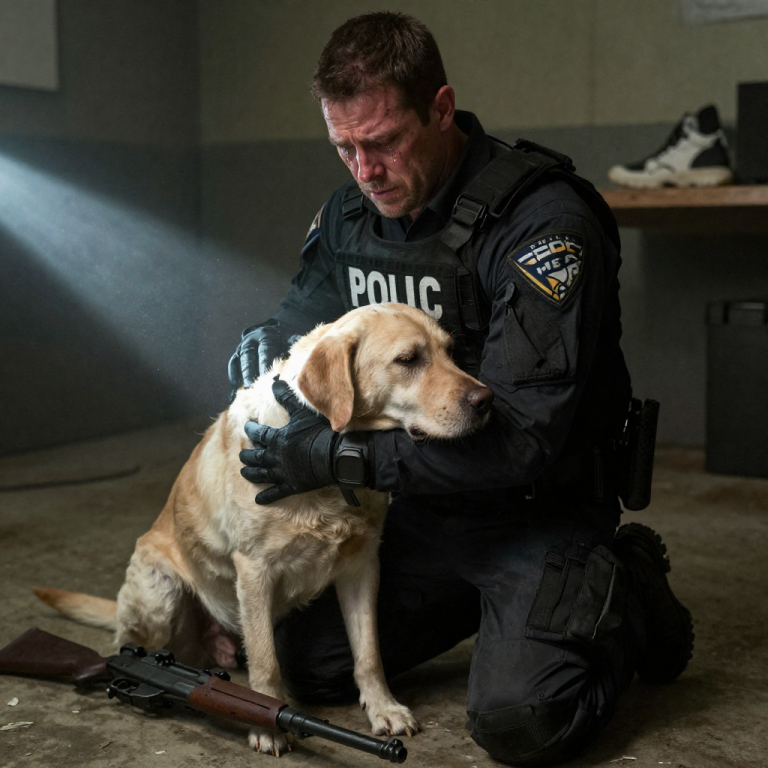
A police officer arrived about fifteen minutes later. Officer Miller. I knew him from around town—decent guy, by the book. He took one look at the note and his face went pale.
“Who does this?” Miller whispered, rubbing his jaw. “Do we have an ID?”
“No,” I said. “He can’t talk. Or he wouldn’t. He’s non-verbal, I think.”
Miller sighed, flipping open his notebook. “I’ll call Social Services. They’ll put him in the system once he’s stable. We’ll run prints, maybe check missing persons, though…” He gestured to the note. “I doubt anyone reported him missing.”
“They didn’t,” I said, standing up. “They dumped him.”
Just then, the nurse walked over holding the tattered remains of the windbreaker I’d found him in.
“Sir?” she asked me. “We found this sewn into the collar. It might help.”
She handed me a fabric label. It wasn’t a standard size tag. It was an iron-on label, the kind fussy parents put on expensive school uniforms.
It read: Leo Vance. 422 Oak Creek Drive.
I stared at the address. Oak Creek.
That wasn’t just a neighborhood. That was the neighborhood. Gated driveways, manicured lawns, private security. The kind of place where people worry about their HOA fees more than their grocery bills.
“Vance,” Miller said, looking over my shoulder. “I think I know that name. Richard Vance. Real estate developer. Big money.”
“Big money,” I repeated, my voice low. “And they couldn’t afford to take care of him?”
Miller put a hand on my chest. “Jack, look at me. I see that look in your eyes. Do not go there. Let me handle this. I’ll send a squad car over to notify the parents.”
“Notify them?” I laughed, a harsh, barking sound. “You think they don’t know he’s gone? They wrote the note, Miller!”
“We need proof. We need procedure. Go home, Jack.”
Miller walked away to make a call.
I looked at the double doors where little Leo lay, fighting for his life because his parents decided he was “broken.”
I walked out of the hospital. But I didn’t go home.
I got back on my bike.
Chapter 3: The Golden Cage
The rain had stopped, leaving behind a thick, humid mist.
Oak Creek Drive was only six miles away, but it felt like a different planet. As I turned past the stone pillars marking the entrance to the subdivision, the flickering streetlights of Route 9 were replaced by elegant, gas-style lamps lining the smooth streets.
Every lawn was perfect. Every house was a mansion. It was quiet. Peaceful.
It made me sick.
I found 422 Oak Creek Drive easily. It was a sprawling colonial with white pillars and a three-car garage. The lights were on downstairs.
I killed the engine a block away and coasted to a stop in the shadows. I didn’t want to announce my arrival just yet. I wanted to see them. I wanted to see what kind of monsters could eat dinner in a warm house while their son froze to death ten miles away.
I walked up the driveway, sticking to the grass to silence my boots.
The house was active. I could see silhouettes moving behind the sheer curtains. They weren’t grieving. They weren’t frantically calling the police.
They were packing.
A medium-sized U-Haul truck was parked halfway up the driveway, its back ramp extended. I watched from behind a perfectly trimmed hedge as a man—tall, wearing a polo shirt and khakis—walked out of the front door carrying a stack of boxes.
He looked… relieved. He was whistling.
A woman followed him out. She was holding a glass of wine in one hand and a decorative vase in the other. She said something to the man, and he laughed.
He actually laughed.
I felt the blood rushing to my head, hot and pounding. They were erasing him. They were moving on. “New start,” right?
I crept closer, moving toward the open garage door. I needed to know. I needed to be sure before I did what I was about to do.
Inside the garage, it was organized chaos. Boxes labeled “Kitchen,” “Master Bedroom,” “Office.”
And then I saw it.
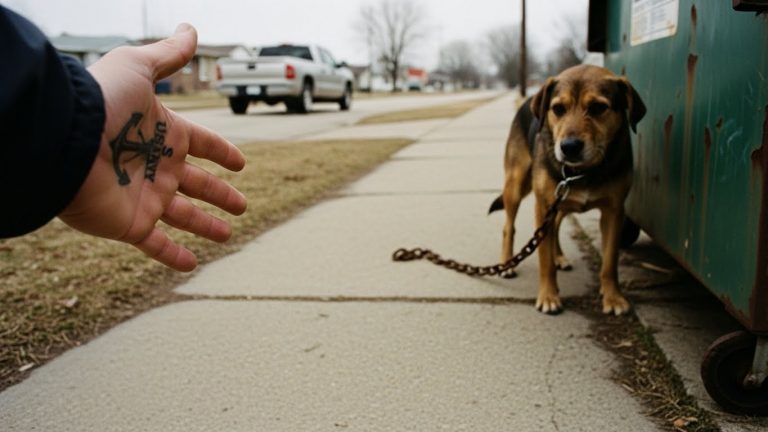
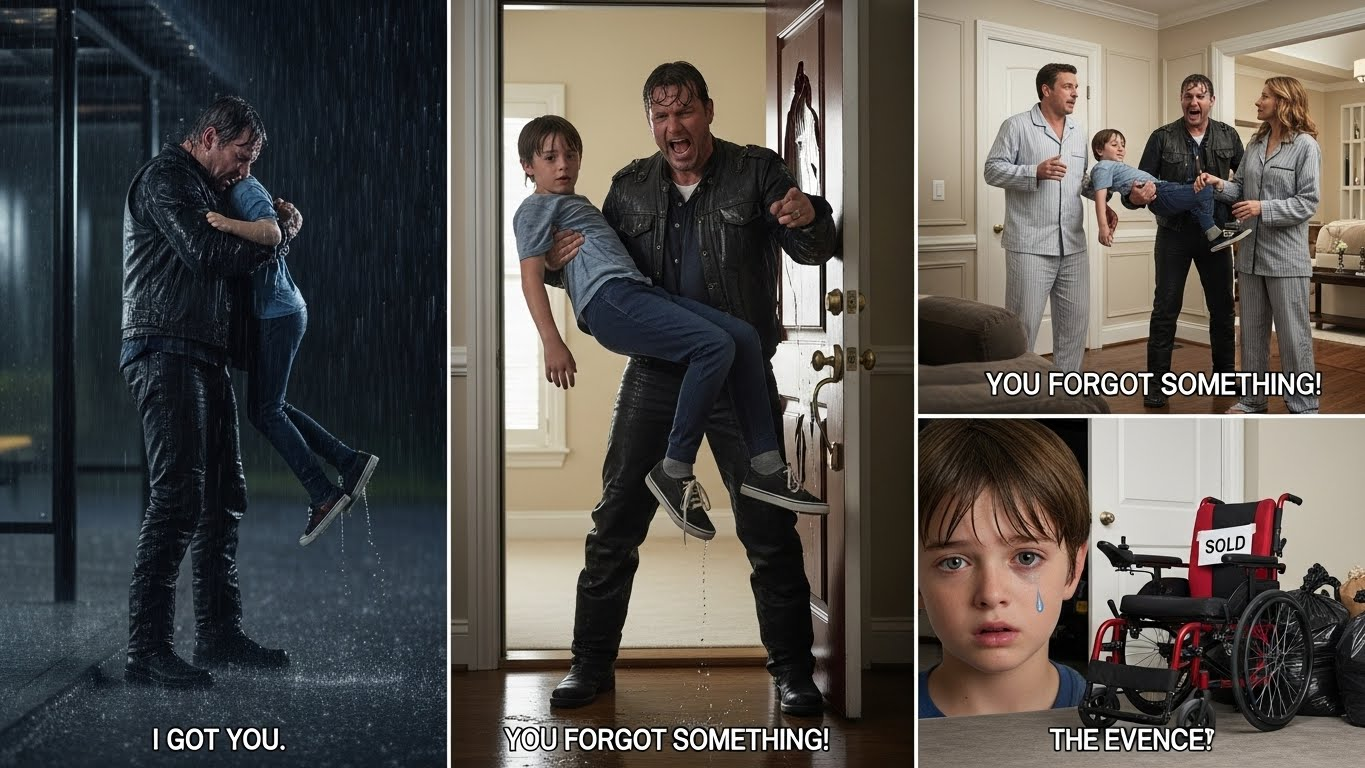
In the corner, pushed aside near the recycling bins and the trash bags, was a wheelchair.
It wasn’t a standard hospital chair. This was a custom molded chair, bright red, with off-road tires and expensive padding. It looked brand new.
But it wasn’t being packed.
Taped to the back of the seat was a piece of cardboard with black marker scrawled across it:
FOR SALE – $200. OBO.
They weren’t just leaving him. They were selling his legs for pocket change.
I looked at the U-Haul. I looked at the wine glass in the woman’s hand. I looked at the “For Sale” sign.
Something inside me snapped. The thin tether of rationality that had kept me from kicking down their door broke.
I stepped out of the shadows and into the harsh light of the driveway motion sensors.
“Hey!” I shouted.
The man dropped the box he was holding. It crashed to the ground, shattering whatever was inside. The woman gasped, spilling wine down her white blouse.
They both spun around to face me.
“Who the hell are you?” the man demanded, stepping forward. He tried to look tough, but I saw the fear in his eyes. He saw the biker cut, the boots, the anger radiating off me like heat waves.
I didn’t answer. I just walked toward them, slow and steady.
“I said get off my property!” he yelled, his voice cracking. “I’m calling the police!”
“Go ahead,” I said, my voice dangerously calm. “Call them. Ask them how Leo is doing.”
The color drained from both of their faces instantly. It was as if I had slapped them. The woman put her hand over her mouth, the glass slipping from her fingers and smashing on the driveway.
“You…” the man stammered. “You found…?”
He didn’t finish the sentence. He didn’t ask “Is he okay?” He didn’t ask “Where is he?”
He looked at the U-Haul. He was calculating. He was wondering if he could still get away.
“He’s alive,” I said, closing the distance. “No thanks to you.”
Chapter 4: The Confrontation
“Listen, buddy,” the man—Richard—stammered, putting his hands up in a placating gesture. “You don’t understand. It’s complicated. You don’t know what it’s like.”
“I know what a storm feels like,” I said, stopping three feet from him. “I know what a bungee cord feels like when it cuts into your skin. And I know what a coward looks like.”
“We didn’t hurt him!” the woman shrieked, finding her voice. It was high and defensive. “We took him to a safe place! The bus stop is near the shelter! Someone was supposed to find him!”
“A safe place?” I pointed back toward the road. “Route 9? In a thunderstorm? He was hypothermic. He was dying.”
“He’s a burden!” Richard shouted, his facade cracking, revealing the ugly truth beneath. “Do you have any idea? Ten years! Ten years of diapers, and feeding tubes, and specialists. We have no life! We have no money left! He’s empty inside, just a shell!”
“He’s a little boy,” I said.
“He’s broken!” Richard screamed, echoing the note. “The doctors said he’d never improve. We wanted a life. We deserve a life!”
He poked a finger at my chest. “You have no right to judge us. You take him if you’re such a saint. See how long you last.”
I looked at his finger on my chest. Then I looked at the “For Sale” sign on the wheelchair in the garage.
“You sold his chair,” I said softly.
“What?” Richard blinked, confused by the sudden shift.
“You dumped him in a storm without his ability to move,” I said, stepping closer, forcing him back. “And then you put a price tag on his legs. Two hundred dollars. That’s what your son is worth to you? Two hundred bucks and a clean getaway?”
“It’s just equipment,” Richard spat. “He doesn’t need it anymore.”
“No,” I said, my hands balling into fists. “He doesn’t need you anymore.”
I saw the siren lights flashing against the trees down the street. Miller must have made the call. The police were coming.
Richard heard them too. Panic set in. He turned toward the truck cab. “Sarah, get in the truck. We’re leaving.”
“You’re not going anywhere,” I said, blocking his path.
“Get out of my way!” Richard lunged at me. He was big, but he was soft. He had country club muscle, not work muscle.
He threw a clumsy punch at my jaw. I didn’t even flinch. I caught his wrist in mid-air. I squeezed. I felt the bones grind together.
He screamed, dropping to his knees.
“You like tying people up?” I whispered, leaning down into his face. “You like leaving helpless people in the cold?”
I looked at the bungee cords holding the furniture in the back of their open U-Haul.
“Let’s see how you like it.”
I dragged him toward the truck. Sarah was screaming, fumbling with her phone, but she didn’t try to stop me. She was terrified.
“Let go of me! That’s assault!” Richard wailed.
“It’s justice,” I grunted.
By the time the police cruisers screeched into the driveway, blue and red lights flooding the pristine white house, the scene was set.
Officer Miller jumped out of his car, hand on his holster. “Jack! Step away!”
Then he stopped.
He saw Sarah sobbing on the front steps.
And he saw Richard.
I hadn’t hurt him. Not really. But I had used the heavy-duty tie-down straps from their own moving truck. Richard was secured tightly to the metal railing of his own front porch.
He was safe. He was uninjured. But he was trapped. Exposed. Helpless.
I stood next to my bike, lighting a cigarette, my hands shaking just a little.
“He’s all yours, Miller,” I said as the officers swarmed the porch. “I just made sure he wouldn’t run away. You know… like he did to his son.”
Miller looked at Richard, then at the “For Sale” sign on the wheelchair, then back at me. He slowly took his hand off his gun.
He didn’t arrest me. He nodded.
“Go back to the hospital, Jack,” Miller said quietly. “The boy woke up.”
I dropped the cigarette and crushed it under my boot.
“He spoke?” I asked, hope surging in my chest.
“No,” Miller said. “But he smiled when the nurse mentioned a guy on a motorcycle.”
I didn’t wait to see them cuff the parents. I didn’t care about them anymore. Their life was over. The neighborhood would know. The news would know. They were done.
I revved the Harley. I had somewhere to be.
Leo was waiting.
Chapter 5: The Silent Language
The hospital smelled like antiseptic and floor wax, a stark contrast to the smell of rain and gasoline that usually clung to me. I stood in the doorway of Room 304, holding my helmet in both hands like a shield.
Inside, Leo looked smaller than I remembered.
Without the bulky, soaked jacket, he was frail. His skin was pale against the white sheets, and tubes ran from his arm to a beeping monitor. But he was warm. He was dry.
And he was awake.
I stepped inside, my heavy boots squeaking on the linoleum. “Hey, buddy,” I whispered.
His head turned slowly. Those big eyes locked onto mine. There was no fear this time. Just recognition.
A middle-aged woman in a grey suit was standing by the window, tapping on a tablet. She looked up, eyeing my leather cut and the road grime on my jeans. She didn’t look impressed.
“You must be the man who found him,” she said, her tone neutral. “I’m Mrs. Gable. Child Protective Services.”
“Is he okay?” I asked, ignoring her scrutiny.
“He’s stable. Malnourished, dehydrated, and recovering from hypothermia. But he’s a fighter,” she said. Then she softened, just a fraction. “He hasn’t taken his eyes off the door since he woke up. I think he was waiting for you.”
I walked to the bedside. I didn’t know what to do. I’m a mechanic. I fix engines. I don’t fix broken kids.
“I brought you something,” I said awkwardly.
I reached into my pocket and pulled out a patch. It was a spare one from my club—a simple wing design. I placed it on the bedside table.
Leo’s hand twitched. It was a spastic, jerky movement, but he managed to slide his fingers across the sheet until he touched the patch. His mouth curved up. It wasn’t a perfect smile—one side lagged a bit—but it was the most beautiful thing I’d ever seen.
“He likes motorcycles,” Mrs. Gable observed, surprised.
“He likes the noise,” I said, remembering how the roar of my engine had seemed to calm him at the bus stop. “It drowns out the quiet.”
“Jack, is it?” Mrs. Gable asked. “We need to talk about what happens next. The parents are in custody. They’re being charged with child abandonment and endangerment. They won’t be seeing him again.”
“Good,” I growled. “Let them rot.”
“The problem is,” she continued, “Leo has high needs. Cerebral palsy, non-verbal, requires assistance with feeding and hygiene. Finding a foster placement for a child with his profile… it’s difficult. He’ll likely go to a state-run group home three counties over.”
I looked at Leo. He was stroking the embroidered wings on the patch with his thumb.
A group home. An institution. A place where he’d be a number, a job, a burden to underpaid staff. He’d just be “the broken kid” again.
“No,” I said. The word was out of my mouth before I even thought about it.
Mrs. Gable looked at me over her glasses. “Excuse me?”
“No group home,” I said, my voice firmer this time. “He’s not going into the system to get lost.”
“There aren’t many options, Mr…”
“Jack,” I said. “And there is one option.”
I looked at Leo, and for the first time, he made a sound. It was a soft hum, a vibration in his throat, as he looked right at me. He knew.
“I’ll take him.”
Chapter 6: The Village of Leather and Steel
“You’re out of your mind, Jack.”
That’s what my landlord said. That’s what my boss said. That’s what Mrs. Gable said, repeatedly.
“You’re a single man, living in a one-bedroom apartment, working sixty hours a week at a plant. You have a criminal record for bar fights in your twenties. You ride a motorcycle. You are not a candidate for emergency foster care.”
She was right. On paper, I was a disaster.
But I had something the state didn’t have. I had a brotherhood.
I walked into the clubhouse that Friday night. The air was thick with smoke and rock music. These were big, scary men. Men who looked like they’d sooner punch you than hug you. But they were my family.
“I need help,” I said, cutting the music.
I told them the story. I told them about the rain, the bus stop, the note. I told them about the “For Sale” sign on the wheelchair.
By the time I finished, the room was dead silent. Big Tiny, our Sergeant at Arms, wiped a tear from his cheek and slammed his fist on the bar.
“Not on our watch,” Tiny rumbled. “What do you need?”
“I need a house inspection. I need a ramp. I need a room. I need to prove to the state that this kid has a village.”
And that’s when the magic happened.
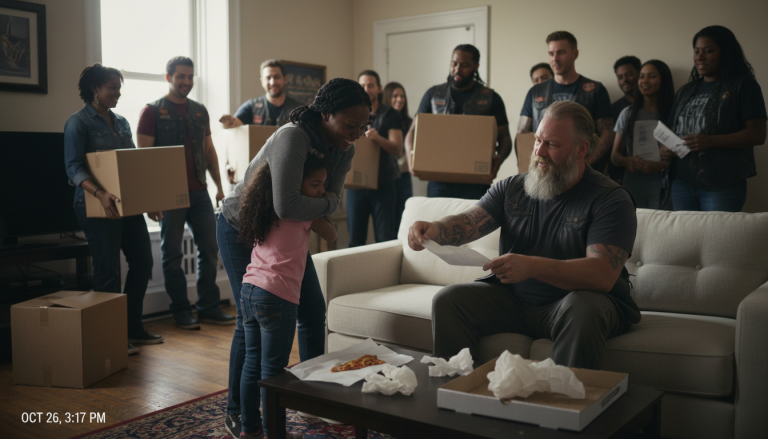
For the next week, forty bikers descended on my small rental house. It was like a military operation.
We didn’t just build a ramp; we built a fortress of accessibility. Tiny, who was a carpenter by trade, widened the doorways. Moose, our electrician, installed safety lights and sensors. The guys’ wives and girlfriends (“The Old Ladies,” as they affectionately called themselves) came in and scrubbed the place until it sparkled. They bought sheets with spaceships on them. They stocked the fridge.
We found a pediatric specialist who rode a Ducati to write a letter of recommendation. We pooled money to buy the best wheelchair on the market—not a used one, a custom titanium rig that looked like a race car.
When Mrs. Gable came for the home inspection four days later, she expected a bachelor pad covered in grease.
Instead, she found a home.
She walked through the widened doors. She saw the grab bars in the bathroom. She saw the schedule on the fridge where the guys had signed up for shifts to help me watch Leo while I worked.
She walked into the backyard and saw twelve bikers standing there, arms crossed, waiting.
“Who are they?” she asked, her eyes wide.
“That’s his family,” I said. “He’s got me. And he’s got forty uncles who will break the legs of anyone who ever tries to hurt him again.”
Mrs. Gable looked at the bikers. Then she looked at the checklist on her clipboard. She tapped her pen against her chin, fighting a smile.
“It’s unconventional,” she admitted. “Highly irregular.”
“He doesn’t need regular,” I said. “He needs love. And we got plenty of that.”
She signed the paper.
“Bring him home, Jack.”
Chapter 7: The Definition of Broken
The transition wasn’t easy. I won’t lie and say it was a Disney movie.
There were nights when Leo cried for hours, frustrated by his inability to tell me what was wrong. There were diaper changes that made me gag. There were feeding struggles where more food ended up on the floor than in his mouth.
There were times, at 3:00 AM, when I sat on the edge of my bed, exhausted, wondering if Richard Vance was right. Wondering if I was in over my head.
But then, the morning would come. I’d walk into his room, and Leo’s face would light up like a sunrise. He’d make his happy sound—a high-pitched squeal that meant “I see you.”
We developed our own language. One blink for yes, two for no. A grunt for hungry. A hand squeeze for “I love you.”
The court date for permanent guardianship came six months later.
Richard and Sarah Vance were there. They were out on bail, looking significantly less polished than they had that night in the driveway. Their lawyer was a slick guy in a thousand-dollar suit who tried to argue that I was unfit.
“Your Honor,” the lawyer said, pacing the courtroom. “Mr. Jack Reynolds is a factory worker with a history of violence. He associates with a motorcycle gang. He has no medical training. My clients made a mistake in a moment of extreme stress, but they are the biological parents. They have the financial means to provide professional care.”
The judge, a stern woman with grey hair, looked over her spectacles at me. “Mr. Reynolds? What do you have to say?”
I stood up. I didn’t have a suit. I wore my best button-down shirt and my clean jeans.
“Your Honor,” I began, my voice steady. “They said Leo was broken. That was their defense. That he was a shell.”
I turned to look at Richard. He couldn’t meet my eyes.
“But I’ve learned something in the last six months. Leo isn’t broken. He feels everything. He laughs when the wind hits his face. He cries when he watches sad movies. He loves strawberry ice cream and hates peas.”
I took a breath.
“The lawyer talks about my history of violence. Yeah, I’ve fought. I’ve fought for things that matter. And I’m fighting for him.”
I pointed at the Vances.
“They had the money. They had the mansion. They had everything. And they threw him away like trash because he wasn’t perfect. I don’t have much money. I don’t have a mansion. But I have a home. And in my home, nobody gets left behind.”
I looked at the judge.
“You want to know who is broken in this room? It’s not the boy in the wheelchair. It’s the people who gave birth to him and didn’t have the heart to love him.”
The courtroom was silent. Even the court reporter had stopped typing.
The judge looked at the Vances. Then she looked at me. She banged her gavel.
“Petition for termination of parental rights granted. Full guardianship awarded to Mr. Reynolds.”
The Vances didn’t cry. They just looked relieved to be rid of the “problem.”
But as I walked out of that courtroom, I wasn’t alone. The hallway was lined with leather vests. My brothers. And right in the middle, sitting in his titanium chair, wearing a miniature leather cut with “PROSPECT” stitched on the back, was Leo.
He saw me and let out the loudest squeal I’d ever heard.
Chapter 8: The Open Road
It’s been two years since that stormy night.
If you drive down Route 9 today, past that old bus stop, you might see us.
I still ride the Harley. But it looks a little different now.
Attached to the side is a custom-built sidecar. It’s reinforced with a roll cage, padded with memory foam, and equipped with a five-point harness. It’s painted bright red to match the bike.
Leo is twelve now. He’s gained weight. His cheeks are rosy. He’s still non-verbal, but he’s the loudest member of our club.
We ride every Sunday. The wind in our faces, the engine roaring beneath us. When we hit the highway, Leo throws his head back and laughs—a pure, unadulterated sound of joy that cuts through the noise of the world.
People stare. Sometimes they take pictures. Sometimes they look confused. A big, tattooed biker and a disabled kid in a sidecar.
I don’t care what they think.
I remember the note. “He is broken.”
I look down at him in the sidecar. He catches my eye and gives me a thumbs-up—a gesture it took him three months of physical therapy to master.
He isn’t broken. He just needed a different kind of mechanic to help him run.
We pull up to a stoplight. A car next to us rolls down the window. A woman looks at Leo, then at me.
“He looks happy,” she says, smiling.
I rev the engine, feeling the vibration rattle through the frame, connecting me to the machine, to the road, and to my son.
“Yeah,” I say, pulling down my visor as the light turns green. “He’s not just happy. He’s free.”
We take off, leaving the bus stop—and the past—far behind us in the rearview mirror.
THE END.