They Threw A Heavy Metal Bottle At My Daughter’s Spine And Laughed While She Crumbled To The Ground—But When The “Rich Mom” Called Me Trash, I Showed Her Exactly What A Soldier’s Rage Looks Like.
Chapter 1: The Stranger in the Mirror
The silence was the hardest thing to get used to.
For the last eighteen months, the soundtrack of my life had been a cacophony of organized chaos: the deafening roar of C-130 Hercules engines taxiing on gravel runways, the rhythmic, bone-jarring thud of combat boots marching in unison, and the distant, unpredictable crack of gunfire that kept your nerves pulled tight as piano wire.
Now? Now there was just the hum of the air conditioner in my beat-up 2012 Ford F-150 and the cheerful, mocking chirp of a robin perched on a pristine oak tree.
I sat in the pickup line at Oak Creek Elementary, gripping the steering wheel until my knuckles turned a ghostly white. My hands were rough, the skin dry and calloused, shaking with a tremor I couldn’t quite control. It wasn’t fear. I didn’t do fear anymore. It was adrenaline—a leftover survival mechanism that didn’t know how to switch off just because I was back in a zip code where the biggest threat was a gluten allergy.
I glanced at the rearview mirror. Sergeant Sarah Jenkins stared back. I looked older than thirty-two. There were new lines etched around my eyes, and a faint, jagged white scar ran along my jawline—a souvenir from a piece of shrapnel in Kandahar. I wasn’t wearing my fatigues today; I had traded them for a generic grey hoodie and jeans that felt too loose, but I still felt like I was wearing a neon sign that screamed ‘She doesn’t belong here.’
It was 3:00 PM. The sun was shining with an aggressive brightness that hurt my eyes.
I was here for Lily.
The last time I saw her, she was six. She had been crying, clinging to my leg at the deployment terminal, begging me not to go. I had peeled her fingers off one by one, promising her that Mommy was going to do a job so we could buy a house. A real house. Not the cramped apartment we’d been evicted from after Mark died.
Mark. Just thinking his name sent a dull ache through my chest. When he died in that car accident, he left us with nothing but debt and a hole in the universe. The Army was my frantic, desperate answer to poverty. It was the only way to keep Lily fed and clothed, even if it meant leaving her in the care of my older sister, Jenna.
But Jenna was sick now. The cancer had come back fast and hard, and I had been granted compassionate reassignment to come home.
I was back. But I didn’t feel like a mother. I felt like a weapon that had been placed in a nursery.
The school bell rang, a shrill sound that made me jump.
Doors burst open, and a flood of color and noise spilled out. Kids everywhere. Screaming, laughing, running. I scanned the crowd, my eyes moving in a grid pattern, sector by sector. Habit.
Then I saw her.
Lily.
She was standing near the chain-link fence, far away from the main cluster of children. She looked smaller than I remembered. Fragile. She was eight years old now, but she carried her shoulders hunched forward, curling in on herself like she was bracing for a blow. She was wearing a pink backpack that looked too big for her, and she was clutching something to her chest—a worn-out, grey stuffed rabbit. Mr. Hopps. I had mailed that to her from base six months ago.
My heart hammered against my ribs, a painful, frantic rhythm. Get out of the car, Sarah. Go hug her.
But I froze. I watched. I needed to assess the terrain. I needed to know she was safe before I engaged.
A group of three boys, older, probably fifth graders, circled around the bike rack near where Lily stood. They were loud, projecting that specific brand of confidence that comes from expensive sneakers and parents who tell them they are the center of the universe.
One of them stood out. He had a buzz cut and a cruel, twisted grin. He was holding a heavy, yellow hydro-flask style water bottle by its plastic handle loop. He was swinging it in a circle, building momentum.
I saw the trajectory before it happened. It’s a habit you don’t lose—calculating vectors, speed, impact.
“Hey, Orphan!” the kid yelled.
The word cut through the glass of my truck window. Orphan.
Lily didn’t look up. She just hugged the rabbit tighter, burying her face in its synthetic fur. She knew this drill. This wasn’t the first time.
“I said, hey! Are you deaf like your aunt is dying?”
The cruelty of it took my breath away.
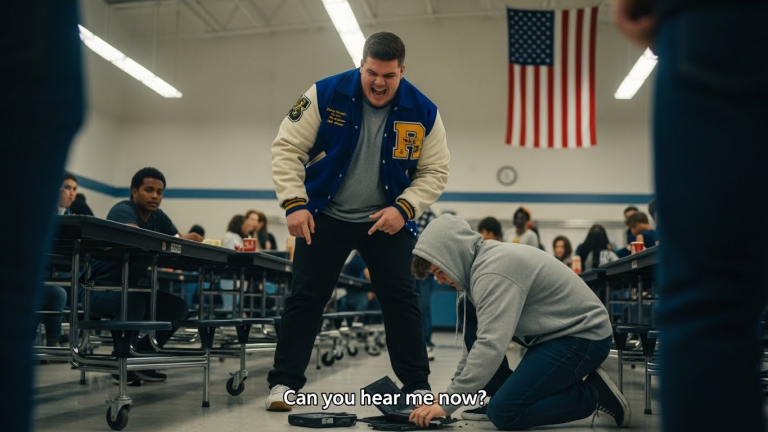
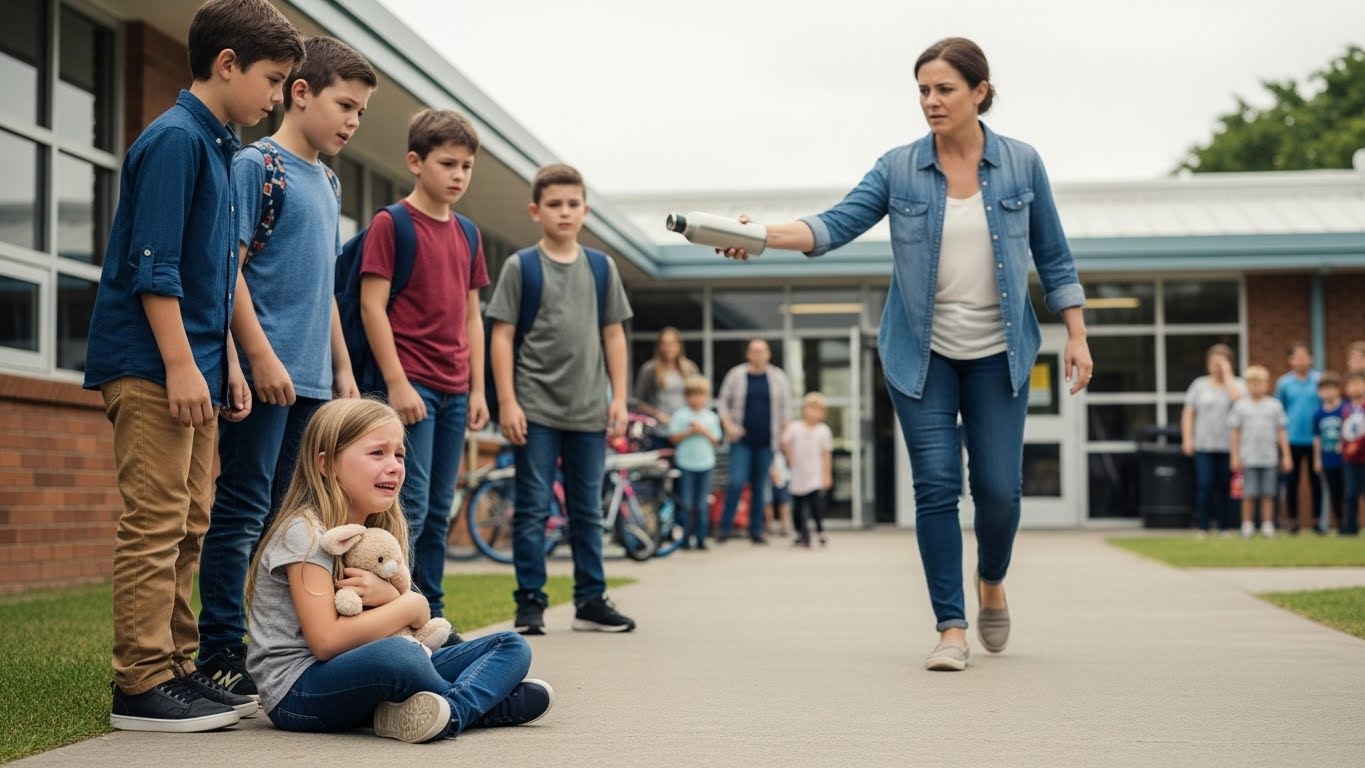
The boy wound up his arm like a baseball pitcher. He didn’t toss the bottle. He didn’t drop it. He hurled it.
The heavy metal bottle, filled with water, cut through the air like a missile.
Thwack.
The sound was sickening. A dull, meaty thud as the metal base slammed squarely into the middle of Lily’s back, right between her shoulder blades.
She didn’t scream. She just gasped, a sharp, ragged intake of air like the wind had been knocked out of her soul. She crumbled forward onto the asphalt, her knees hitting the ground hard. Mr. Hopps tumbled into a muddy puddle.
The boys exploded into laughter. It wasn’t innocent, schoolyard laughter. It was the hyena-like cackle of predators who know there are no consequences.
“Bullseye!” the buzz-cut kid shouted, high-fiving his friend. “Right in the spine!”
Something inside me snapped.
It wasn’t the hot, fiery rage people describe in books. It wasn’t a red mist. It was the opposite. It was cold. It was absolute zero. It was the clinical, detached focus of a soldier entering a kill box.
The world slowed down. The birds stopped chirping. The other parents fading into a blur of background noise. The only sound was the blood rushing in my ears and the singular objective forming in my mind: Neutralize the threat.
I opened the car door.
Chapter 2: The Rules of Engagement
I didn’t run. You don’t run unless you’re under direct fire. Running signals panic. Walking signals authority.
I moved across the parking lot, my combat boots hitting the pavement with a heavy, deliberate rhythm. Left. Right. Left. Right.
Parents were standing around in clusters, sipping iced lattes and checking their Apple Watches. Some of them turned when they heard the thud of the bottle. They saw Lily on the ground. They saw her curling into a ball of pain.
And then—they looked away.
They looked away.
They adjusted their sunglasses, turned their backs, and went back to discussing Pilates schedules and kitchen renovations. A child was down, and they chose blindness.
That indifference ignited a cold fury in my gut that was far more dangerous than the anger I felt toward the boy. The boy was a child acting out. These adults were accomplices.
I reached Lily first. She was sobbing silently, her small body shaking, clutching her back.
“Lily,” I whispered, dropping to one knee beside her. The asphalt was hot against my jeans.
She flinched. She violently recoiled, shielding her head with her arms.
“Don’t hit me,” she whimpered.
My heart shattered into a thousand jagged pieces. “No, baby. It’s me. It’s Mom.”
She paused. Slowly, she lowered her arms and looked up. Her face was streaked with tears and dirt. Recognition took a second to push through the pain and fear.
“Mommy?” her voice cracked, thin and fragile. “You… you’re real?”
“I’m real, baby. I’m here. I’m home.” I reached out and gently touched her shoulder. She felt so thin. “Did he hurt your back?”
“It burns,” she cried. “It hurts to breathe.”
“Stay here,” I commanded softly. “Do not move.”
“Mom, don’t,” she whispered, grabbing my wrist. Her hand was so small in mine. “That’s Tyler. His mom is Mrs. Vance. She… she gets people in trouble. Aunt Jenna said we can’t make her mad.”
“Mrs. Vance,” I repeated the name, tasting the venom in it. So, this was the hierarchy. The Queen Bee and her untouchable prince.
“I’m not Aunt Jenna,” I said, standing up.
The metal water bottle was rolling near my boot. It was heavy, dented from the impact. I bent down and picked it up. It was cold steel, solid and unforgiving. It felt like a grenade in my hand.
Tyler and his friends were still laughing, high-fiving near a massive, pristine white SUV parked in the loading zone—engine idling, taking up two spaces. A woman was standing there.
Mrs. Vance.
She was the caricature of suburban wealth. Designer yoga pants, a cashmere wrap, oversized sunglasses that cost more than my monthly base pay. She was typing furiously on her phone, leaning against the car, completely ignoring the fact that her son had just assaulted a child ten feet away.
I walked toward them. The crowd of parents parted. Maybe it was the look on my face. Maybe it was the way I carried myself—shoulders back, chin down, eyes locked on the target.
“Hey!” I said.
My voice wasn’t loud, but it had a tone I used for insubordinate privates. It cut through the noise of the playground like a knife through silk.
Tyler froze. He looked at me, then at the bottle in my hand. He smirked. A carbon copy of his mother’s entitlement. “That’s mine. Give it back.”
“Tyler!” His mother, Mrs. Vance, finally looked up from her phone. She scanned me up and down—my cheap hoodie, my work boots, the scar, the messy bun. Her nose wrinkled in visible disgust.
“Excuse me? Who are you?” she asked, her voice dripping with condescension. “Give my son his property.”
She held out a manicured hand, fingers adorned with diamond rings, expecting compliance. She was used to people obeying her.
I didn’t hand it over. I stepped into her personal space. I breached the perimeter. I stood close enough that she had to tilt her head back to look at me. Close enough that she could smell the stale airplane coffee and the raw, dangerous exhaustion radiating off me.
“Your son,” I said, my voice terrifyingly calm, “threw this at my daughter’s spine. She is on the ground. She can’t stand up.”
Mrs. Vance scoffed, a short, dismissive sound. She glanced briefly at Lily, then back at her nails. “Oh, please. Don’t be dramatic. Boys will be boys. They were just playing catch. If your daughter is too fragile for public school, maybe you should keep her in whatever trailer park you crawled out of.”
The playground went silent. The chatter stopped. Every eye turned to us.
I tightened my grip on the bottle. The metal creaked under the pressure of my hand.
“Fragile?” I asked softly.
I took a step closer, forcing her to take a step back against her shiny, white Range Rover.
“I just spent eighteen months in a place where eight-year-olds carry AK-47s because they have to defend their homes,” I said, my voice low, vibrating with suppressed violence. “My daughter isn’t fragile. She’s alone. Because I was deployed serving the country that allows you to stand here in your two-hundred-dollar leggings and raise a son who thinks assault is funny.”
Mrs. Vance’s face flushed red. The embarrassment of being spoken to like this—by someone who looked like me—was too much for her.
“How dare you speak to me like that?” she screeched, her voice rising an octave. “Do you know who my husband is? I’m on the PTA board! I’ll have you arrested for harassment! Give me the bottle right now, you psycho!”
She reached out to snatch it from my hand.
I didn’t let go. I pulled it back.
“You want the bottle?” I asked.
I looked at the heavy steel cylinder. I looked at her perfect, undented, eighty-thousand-dollar car.
“Here.”
I raised my arm.
SLAM.
I brought the metal bottle down onto the hood of her white SUV with every ounce of frustration, grief, and rage I had held back for two years.
CRUNCH.
The sound was thunderous. The metal of the bottle bit deep into the expensive pearl-white paint, crumpling the hood, shattering the clear coat, and leaving a massive, jagged crater.
“There,” I said, dropping the bottle into the dent I had just created. It rolled and settled in the valley of twisted metal.
I leaned in, my face inches from hers. She was trembling now, her mouth open in shock.
“Now we have a problem,” I whispered. “Call your husband.”
Chapter 3: Collateral Damage
The silence that followed the impact was absolute.
For three seconds, nobody moved. The dent in the Range Rover stared up at us like an open wound, ugly and undeniable. Mrs. Vance stared at it, her brain unable to process the violence that had just occurred against her precious property.
Then, the screaming started.
“You… you animal!” Mrs. Vance shrieked, backing away as if I were a rabid dog. She fumbled for her phone, her hands shaking so badly she dropped it on the asphalt. “You destroyed my car! You crazy bitch! Someone call the police! Call 911!”
Tyler, the bully, wasn’t laughing anymore. His face had gone pale, his eyes wide. He looked from the car to me, and for the first time, I saw fear. Genuine fear. Good. He needed to learn that actions had reactions.
But then I looked past them. I looked at Lily.
She hadn’t moved from the ground, but she was sitting up now. She wasn’t looking at me with pride. She wasn’t looking at me like I was a hero.
She was looking at me with terror.
Her eyes were wide saucers, fixed on my clenched fists. She was trembling. She had seen violence before—she had seen her father die—but she had never seen me like this. I had become the monster to fight the monsters.
That look hit me harder than any bullet ever could. It pierced through the adrenaline and soldier-mode, hitting the soft, rotting center of my guilt.
What have you done, Sarah?
“Police are on their way!” a man shouted from the crowd. A tall dad in a polo shirt, phone to his ear, looking at me with righteous indignation. “Stay right there!”
I didn’t try to run. I stood my ground, placing myself physically between Mrs. Vance and Lily.
“Mom…” Lily whimpered.
I turned to her, softening my face, trying to hide the tremor in my hands. “It’s okay, Lily. Get your bag. Come here.”
“You’re going to jail,” Tyler whispered, finding his voice again now that the adults were rallying around him. “My dad’s gonna put you in jail for life.”
“Quiet, Tyler,” I said, not even looking at him.
I walked over to Lily and scooped her up. She flinched again, but then melted into me, burying her face in my neck. She smelled like strawberry shampoo and playground dust. She was heavy—heavier than when I left. I held her tight, using her weight to ground me, to stop me from shaking.
The school doors banged open again. This time, it was authority.
Principal Henderson came rushing out, flanked by a security guard. He was a small man with a nervous energy, wearing a suit that was too large for him.
“What is going on here?” he demanded, looking between the sobbing Mrs. Vance and the dented car.
“She attacked me!” Mrs. Vance pointed a trembling finger at me. “That maniac! My son was just standing here, and she came out of nowhere with a weapon and smashed my car! Look at it! That’s five thousand dollars of damage!”
Henderson turned to me. He saw the scar. He saw the boots. He hesitated.
“Is this true?” he asked.
“Her son threw a metal flask at my daughter’s spine,” I said, my voice flat. “I returned the property. It slipped.”
“It slipped?” Mrs. Vance screeched. “She smashed it! She’s dangerous! She shouldn’t be allowed near children!”
Sirens wailed in the distance, getting louder.
“Ma’am, I need you to step away from the vehicle,” the security guard said, putting a hand on his belt. He was treating me like a threat. Like an insurgent.
I held Lily tighter. “I’m not going anywhere until my daughter is safe.”
“She’s not safe with you!” Mrs. Vance yelled. “You’re unstable! I know who you are. You’re Jenna’s sister, the one who abandoned her kid to go play Rambo. No wonder the girl is a mess.”
The words struck deep. Abandoned.
I felt Lily stiffen in my arms. She heard it. She heard the accusation that I knew had been whispered in this town for two years.
Two squad cars pulled into the lot, lights flashing blue and red, bouncing off the pristine white paint of the ruined SUV.
I took a deep breath. This was it. The real war was just starting. I wasn’t fighting insurgents anymore. I was fighting the system, the money, and the perception that I was just a broken soldier who didn’t know how to be a mother.
An officer stepped out of the first car. He was older, grey-haired, with a face that had seen too much. He looked at the car. He looked at Mrs. Vance. Then he looked at me, holding my daughter like a shield.
“Everyone calm down,” the officer said, walking over slowly. “I want hands where I can see them.”
I shifted Lily to my hip and raised my free hand.
“Officer!” Mrs. Vance was on him immediately. “Arrest her! Assault! Destruction of property! Terroristic threats!”
The officer held up a hand to silence her. He walked up to me. He looked at my boots. He looked at the dog tags that had slipped out of my hoodie when I bent down.
“Service member?” he asked quietly.
“Sergeant Sarah Jenkins. 101st Airborne. Just back.”
He nodded, a flicker of recognition in his eyes. But his face remained stern. “Sergeant, put the child down. We need to talk about why there’s a crater in that lady’s hood.”
I lowered Lily to the ground. She clung to my leg.
“It’s okay, baby,” I told her, though I wasn’t sure if it was true. “Mommy has to talk to the police.”
“Don’t leave me,” she whispered.
“I’m not leaving,” I promised. But as the officer guided me toward the cruiser, placing a hand on my shoulder, I saw Mrs. Vance smiling. It was a cold, victorious smile.
She knew what I was just beginning to realize: In this war, I didn’t have the firepower. She had the money, the status, and the community. And I had just given her the perfect weapon to take my daughter away from me.
I sat in the back of the cruiser, the door open, my legs hanging out. The radio crackled.
What have I done?
I looked at Lily, standing alone again near the fence, looking small and terrified. I had come home to save her. But looking at the dented car and the angry crowd, I realized I might have just destroyed the only life she had left.Chapter 4: The Paper Shield
The interrogation room didn’t smell like fear. It smelled like stale donuts and floor wax.
I sat on a metal chair that was bolted to the floor, my hands resting on the cold steel table. I wasn’t handcuffed—Officer Miller, the grey-haired man who had driven me in, had spared me that indignity in front of Lily—but I felt bound all the same.
“You have a clean record, Sarah,” Miller said, sitting across from me. He was tapping a pen against a thick file folder. “Honorable discharge pending. Commendations for valor. But you also have a charge of Second-Degree Malicious Mischief hanging over your head. And a woman in the lobby who wants your head on a platter.”
“She assaulted my daughter,” I said, my voice raspy. “Her son threw a projectile. It was assault.”
“It was a ten-year-old boy throwing a water bottle,” Miller sighed, rubbing his temples. “In the eyes of the law, that’s a playground incident. What you did? Smashing the hood of an eighty-thousand-dollar Range Rover? That’s a violent felony if she pushes the damages high enough.”
I clenched my jaw. “I didn’t touch her. I touched the car.”
“Doesn’t matter. You scared the hell out of the PTA queen of Oak Creek.” Miller leaned forward. “Look, I get it. I did two tours in the Gulf. I know the switch. You see a threat, you neutralize it. But you aren’t in Kandahar anymore, Sergeant. You’re in suburbia. The rules are different here. Here, the person with the best lawyer usually wins.”
The door opened.
My sister, Jenna, walked in.
If I looked like a soldier, Jenna looked like a ghost. She was thirty-five but looked fifty. Her skin was translucent, pale as paper, and she wore a thick knit scarf to hide the hair loss from the chemo. She walked with a cane now.
“Jenna,” I started, standing up.
“Sit down, Sarah,” she snapped. Her voice was weak, but the anger in it was sharp.
She sat next to Miller. She didn’t look at me. She looked at the file. “Is she being charged?”
“Mrs. Vance is pressing charges,” Miller said softly. “But… given the circumstances, and Sarah’s service, the DA might be lenient. However, Mrs. Vance has also called CPS.”
The air left the room.
“CPS?” I whispered. “Child Protective Services? Why?”
“She claims you are mentally unstable,” Miller said, his eyes full of pity. “She claims you exhibited ‘violent, uncontrolled rage’ in the presence of a minor. She’s questioning your fitness to parent.”
I slammed my hand on the table. “I was protecting her!”
“You smashed a car with a steel bottle, Sarah!” Jenna turned to me, tears streaming down her hollow cheeks. “You’ve been back for three days. Three days! And you’re already about to get Lily taken away?”
“I didn’t…” I trailed off.
“You didn’t think,” Jenna whispered. “You think you can just march in here and fight everyone? Mrs. Vance runs this town. Her husband is a partner at the biggest law firm in the city. You have nothing, Sarah. We have nothing. I am dying. I can’t fight them. I needed you to come home and be a mother, not a warrior.”
Her words hit me harder than any shrapnel.
Officer Miller stood up. “I’m releasing you on your own recognizance for tonight. But stay away from the Vances. Do not go near that school. And for God’s sake, get a grip, Sarah. Or you’re going to lose that little girl for real.”
Walking out of the station, the evening air felt cold. Lily was waiting in the lobby, sitting on a plastic chair, swinging her legs. When she saw me, she didn’t run to me. She looked at Jenna.
“Auntie Jenna?” she asked. “Can we go home?”
She didn’t ask me.
I walked behind them to Jenna’s rusted sedan, feeling like a ghost in my own life.
Chapter 5: Strangers in the Living Room
Jenna’s house was small. It was a two-bedroom ranch that smelled of old carpet, boiled cabbage, and sickness.
It was silent.
We sat at the small kitchen table. Lily had gone straight to her room—my old room—and closed the door.
Jenna was counting out her pills. Orange bottle after orange bottle. The sound of the pills rattling was the only noise in the house.
“How bad is the pain?” I asked, looking at her shaking hands.
“Not as bad as the headache you gave me today,” she muttered. She swallowed three pills dry. Then she looked at me. “Sarah, you have to fix this. You have to apologize.”
“Apologize?” I laughed, a harsh, bark-like sound. “To that woman? She called us trash, Jenna. Her son hurt Lily.”
“And now Lily is the daughter of the ‘crazy lady,'” Jenna said. “You don’t understand how it works here. Reputation is everything. If the other moms decide Lily is unsafe to be around because of you, she will be isolated. Completely.”
Jenna reached across the table and took my hand. Her skin was cold and dry.
“I don’t have much time left, Sarah,” she whispered. The raw honesty of it choked me up. “Maybe three months. Maybe less. When I go, you are all she has. If you are in jail, or if the state decides you have PTSD and can’t parent… she goes into the system. Do you want that? Do you want Lily to be an orphan for real?”
“No,” I whispered. Tears burned my eyes. “I just… I don’t know how to turn it off, Jen. I see a threat, and I react. I spent two years training my brain to keep people alive.”
“You’re not keeping her alive by making enemies,” Jenna said. “You have to swallow your pride. You have to be smaller. Please.”
I nodded. “Okay. I’ll fix it.”
I stood up and walked down the hallway to Lily’s room. The door was slightly ajar.
I pushed it open.
Lily was sitting on the floor, holding Mr. Hopps. She had tried to clean the mud off him, but he was still stained grey and brown. She was whispering to him.
“It’s okay, Hopps,” she was saying. “Mom didn’t mean to be scary. She’s just… loud. Like the thunder.”
My heart broke.
I knocked gently. “Hey, Lil.”
She jumped. She looked at me with those wide, wary eyes.
“Can I come in?”
She nodded slowly.
I sat on the floor, keeping a distance between us. “I’m sorry about today. I shouldn’t have smashed the car. That was… wrong.”
Lily picked at the ear of the rabbit. “Tyler says you kill people.”
The air left my lungs. “Tyler doesn’t know me.”
“He said you were in the war. He said you have a gun and you’re going to shoot up the school.” She looked up at me, her lip trembling. “Is that true, Mommy? Are you going to hurt my friends?”
“No!” I moved closer, desperate to hug her, but I stopped myself. “No, baby. I was a soldier. My job was to protect people. I went away to keep bad things from happening. I would never, ever hurt you or your friends.”
“But you looked so mad,” she whispered. “You looked like the monsters in my dreams.”
I reached out and touched her hand. She didn’t pull away this time, but she didn’t hold back either. Her hand was limp.
“I promise,” I said, my voice shaking. “I’m going to be better. No more fighting. I’m just going to be Mom. Okay?”
She nodded, but her eyes didn’t believe me.
That night, I lay on the lumpy couch in the living room. I couldn’t sleep. Every time I closed my eyes, I saw the dent in the car. I saw Mrs. Vance’s smirk. I saw Lily flinching.
I got up and checked the locks on the front door. Then the back door. Then the windows. Three times.
I was safe. The perimeter was secure.
But the enemy wasn’t outside. The enemy was already inside the wire.
Chapter 6: The Escalation
The next morning, I woke up with a plan. Strategy.
Jenna was right. I couldn’t fight this with force. I had to fight it with diplomacy. I would go to the school. I would speak to Principal Henderson calmly. I would explain the bullying. I would show him the bruise on Lily’s back—a dark, ugly purple mark that had bloomed overnight.
I dressed in the softest clothes I had—a beige sweater and clean jeans. No boots. Sneakers. I put my hair down. I tried to look less like a sergeant and more like a suburban mom.
I drove Lily to school. She was quiet in the passenger seat.
“Have a good day, baby,” I said as we pulled up. “I love you.”
“Bye,” she said softly, hopping out.
I parked the truck and walked to the main office. I took deep breaths. Calm. Rational. Civilian.
I walked into the office. The secretary, a woman with glasses on a chain, looked up. Her eyes went wide. She immediately picked up the phone.
“Principal Henderson?” she whispered, staring at me. “She’s here.”
A moment later, Henderson came out. He didn’t invite me into his office. He stood behind the counter, using it as a barrier.
“Ms. Jenkins,” he said, his voice tight. “You shouldn’t be here.”
“I need to speak to you about my daughter,” I said, forcing a smile. “About the bullying. Lily has a massive bruise on her back.”
“We are investigating the incident,” Henderson said quickly. “But right now, the priority is safety. Given yesterday’s… display, we have had multiple complaints from parents. They don’t feel safe with you on campus.”
“I’m not a threat,” I said, my hands balling into fists at my sides. I forced them open. “I was defending my child.”
“Mrs. Vance has filed a temporary restraining order,” Henderson said, dropping the bomb. “It hasn’t been served yet, but we’ve been notified. She claims you threatened her life.”
“That’s a lie,” I said, my voice rising.
“Ms. Jenkins, please lower your voice,” Henderson said, looking around nervously. “Because of the legal situation, and the disruption… we think it’s best if Lily takes a few days off. Until things cool down.”
I stared at him. “You’re suspending my daughter? She’s the victim!”
“It’s not a suspension. It’s an administrative leave for her safety.”
“For her safety?” I stepped forward to the counter. “Or because you’re afraid of Brenda Vance?”
“Ms. Jenkins, if you don’t leave, I will have to call the School Resource Officer.”
I felt the heat rising in my chest. The familiar, dangerous heat. But then I remembered Jenna’s face. You have to be smaller.
I swallowed the rage. It tasted like bile.
“Fine,” I said. “I’ll go.”
I turned and walked out.
As I walked past the playground, I saw them. Recess.
Tyler was there. He was standing on top of a bench, holding court. A group of kids were gathered around him. Lily was standing about twenty feet away, alone.
Tyler saw me walking to my truck. He pointed.
“Look!” he yelled. “There’s the psycho! Watch out, she’s got a bomb!”
The kids screamed and scattered, laughing.
Lily looked at me. She looked at the kids running away from her mother.
And then, Tyler walked up to Lily. He shoved her. Not hard, but enough to make her stumble.
“Get away from us,” he sneered. “My mom says your mom belongs in a cage. And you belong in the trash.”
Lily didn’t fight back. She didn’t look at me for help. She just lowered her head and walked away, toward the far edge of the field, completely alone.
I stood by the chain-link fence, my fingers gripping the metal until they bled.
Diplomacy had failed. Being small had failed.
Mrs. Vance didn’t want an apology. She wanted to erase us.
My phone buzzed in my pocket. It was an unknown number.
“Hello?” I answered, my eyes still fixed on my daughter’s lonely figure.
“Is this Sarah Jenkins?” A crisp, professional female voice.
“Yes.”
“This is Mary Thorne from Child Protective Services. We’ve received an emergency report regarding the welfare of your daughter. I need you to be at your residence at 2:00 PM today for a home inspection and interview.”
The line went dead.
I looked at Tyler, laughing on the bench. I looked at the school that had turned its back.
They thought they had me cornered. They thought they could use the system to crush a soldier.
They forgot one thing.
You don’t corner a soldier. You just give them a target rich environment.
I got in my truck. I wasn’t going home to clean. I was going to find out exactly what Mrs. Vance was hiding. If she wanted a war, I’d give her a war. But this time, I wouldn’t use my fists.
I’d use the one thing people like her feared more than violence.
The truth.Chapter 7: The Ghost in the Machine
The clock on the wall ticked like a countdown timer on a bomb. 1:55 PM.
I sat in Jenna’s living room, straightening the magazines on the coffee table for the tenth time. Jenna was in the armchair, pale and struggling to breathe, but she had put on a nice blouse and a wig. She was trying to look like a capable guardian.
“Just let me do the talking, Sarah,” Jenna wheezed. “If you get angry, we lose.”
At 2:00 PM sharp, the knock came.
Mary Thorne, the CPS caseworker, was a woman who looked like she was made of sharp angles and stern judgment. She carried a clipboard and walked in without smiling.
“Ms. Jenkins,” she said, looking around the small, cluttered house. Her eyes lingered on the pill bottles on the counter. “I understand there was an incident involving a weapon at the school.”
“It was a water bottle,” I said, my voice steady. “And I was reacting to my daughter being assaulted.”
“Reaction is one thing. Destruction of property and intimidation is another,” Mary said, sitting down. “Mrs. Vance has painted a very disturbing picture. She claims you are suffering from untreated PTSD and that your daughter is living in an environment of ‘imminent volatility’.”
She grilled me for an hour. She asked about my service. She asked about the medications I wasn’t taking. She asked about Mark’s death. She looked at Lily’s room, checking for food, for clothes, for signs of neglect.
Lily sat on her bed, silent, hugging Mr. Hopps. When Mary asked her if she was scared of Mommy, Lily hesitated. That hesitation felt like a knife in my gut.
“Sometimes,” Lily whispered. “When she yells.”
Mary wrote it down. That scratch of the pen on paper sounded like a prison door slamming shut.
“I have enough here to open a formal investigation,” Mary said, standing up. “I’m not removing the child today, but I am recommending immediate counseling and a safety plan. And Ms. Jenkins? If there is one more incident—one more outburst—we will place Lily in foster care pending a court hearing.”
She left.
Jenna slumped in her chair, weeping silently. “You have to stop, Sarah. Please. Just stop.”
I walked to the window. My hands were shaking, but not from fear this time. From clarity.
I had spent the last twenty-four hours thinking Brenda Vance was the enemy. I thought she was just a spoiled, rich woman protecting her brat.
But when I was leaving the school earlier, I had seen something. A flash of a memory.
Tyler flinching.
When I raised the bottle to smash the car, Tyler hadn’t just looked scared. He had thrown his hands up to cover his face in a practiced motion. He knew exactly how to shield his head.
Kids don’t learn that from video games. They learn that from experience.
“I’m going out,” I said, grabbing my keys.
“Sarah, no!” Jenna cried. “The meeting is tonight. The school board is voting on banning you from campus. If you go, you’ll make a scene!”
“I’m not going to make a scene,” I said, opening the door. “I’m going to finish the mission.”
Chapter 8: The War at Home
The school auditorium was packed. It was 7:00 PM, and the air inside was hot and suffocating.
I stood in the back, in the shadows, wearing my grey hoodie. I wasn’t there to fight. I was there to observe.
On the stage, Brenda Vance was speaking into a microphone. She looked perfect—hair done, makeup flawless, voice trembling with performative victimhood.
“We cannot allow dangerous individuals around our children,” she said, wiping a fake tear. “My son, Tyler, is traumatized. He can’t sleep. He’s afraid that woman is going to come back and hurt him. We need a zero-tolerance policy for violence in this district!”
The crowd murmured in agreement. Heads nodded. They were buying it.
I scanned the room. I wasn’t looking at Brenda. I was looking for the rest of the unit.
I found them in the front row.
Tyler was sitting there, wearing a suit that was too tight. He was staring at his shoes, picking at his cuticles until they bled.
Next to him was a man I assumed was his father. Richard Vance. He was big. Broad shoulders, expensive suit, thick neck. He sat with his legs spread wide, taking up space. He wasn’t looking at his wife on stage. He was looking at his phone, scrolling impatiently.
Then, Tyler moved. He shifted in his seat, restless. He accidentally kicked the chair in front of him. A small thump.
Richard Vance didn’t whisper. He didn’t gently correct him.
His hand shot out like a cobra. He grabbed Tyler’s upper arm, his fingers digging deep into the boy’s bicep. He squeezed. hard.
I saw Tyler’s face contort in silent agony. He didn’t cry out. He bit his lip and froze.
Richard leaned in, whispering something into Tyler’s ear. I couldn’t hear it, but I could read the body language. It was pure, distilled menace. Sit still or else.
And then I saw it. On Richard’s wrist, a heavy, gold watch. Heavy metal. Just like the bottle.
The puzzle pieces slammed together.
Tyler didn’t hate Lily. Tyler didn’t hate the world. Tyler was a soldier in a war zone he couldn’t escape, and he was taking his anger out on the only targets weaker than him.
Brenda finished her speech. “Thank you. We need to protect our children.”
Applause.
Richard stood up, dragging Tyler up by the arm. “Let’s go,” he grunted, loud enough for people nearby to hear. “You embarrassed me enough by crying in the car.”
Tyler stumbled. “I’m sorry, Dad.”
“Shut up,” Richard hissed. He shoved the boy toward the aisle.
Tyler tripped. He fell to one knee.
The room went quiet. People watched.
Richard Vance’s face turned purple. The mask of the respectable lawyer slipped. He raised his hand—a backhand motion, swift and practiced.
“Get up, you clumsy little—”
He swung.
I moved.
I didn’t think. I didn’t plan. I just reacted. I covered the distance from the back of the room to the aisle in three seconds.
I caught his wrist.
It was mid-swing. His heavy gold watch was inches from Tyler’s face.
The sound of my hand stopping his was a sharp smack of flesh on flesh.
Richard Vance froze. He looked down at his arm, then up at me. His eyes were wide with shock. No one had ever stopped him before.
“Let go of me,” he snarled.
“No,” I said.
The auditorium was dead silent. Brenda froze on stage, her hand over her mouth.
“You’re hurting him,” I said, my voice loud, clear, and steady. It wasn’t a scream. It was a command.
“This is my son! I’m disciplining him!” Richard tried to yank his arm back, but I held on. My grip was iron. It was the grip of a woman who had hauled hundred-pound rucksacks up mountains.
“You’re not disciplining him,” I said, looking directly into his eyes. “You’re bullying him. And he bullies my daughter because it’s the only way he feels strong.”
I looked down at Tyler. He was cowering on the floor, waiting for the hit.
“Tyler,” I said softly.
He looked up. He saw the ‘monster’ holding back the man he feared most.
“You don’t have to be him,” I said. “You don’t have to hurt people just because he hurts you.”
Richard roared, swinging his other fist at me.
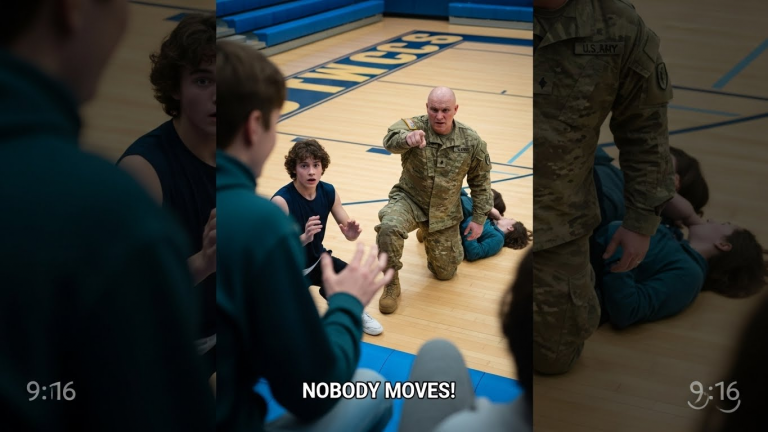
I didn’t strike back. I didn’t smash him. I simply sidestepped, used his momentum, and twisted his arm behind his back, forcing him face-first into the carpet of the aisle. It was a standard subjugation hold. Clean. Non-lethal. Controlled.
“Stay down,” I whispered in his ear.
The crowd gasped.
“Get off him!” Brenda screamed from the stage. But she didn’t run to help him. She stayed where she was, trembling.
“Call the police!” someone shouted.
“Yeah, call them!” I yelled back, looking at the crowd of stunned parents. “And tell them to check the bruises on this boy’s arms! Tell them to ask Brenda why she wears sunglasses inside!”
I looked at Brenda. Her sunglasses were on top of her head now. But under the heavy stage makeup, in the harsh lights, I could see it. A faint, yellowing bruise on her cheekbone.
The room turned.
They saw Richard pinned on the floor. They saw Tyler crying, not out of pain, but out of relief. They saw Brenda’s shame.
And they saw me. Not a psycho. A shield.
Epilogue: The Ceasefire
The police did come. But they didn’t arrest me.
They took statements. Dozens of parents had seen Richard raise his hand to a child. The spell of the “perfect family” was broken.
Richard was escorted out in handcuffs, shouting threats that fell on deaf ears. Brenda didn’t go with him. She sat on the edge of the stage, weeping, while another mom put an arm around her.
I stayed until the end.
When I walked out into the parking lot, the night air was cool.
“Mom?”
I turned. Lily was there, standing with Jenna near the car. They had come to find me.
Lily ran. She didn’t flinch this time. She ran full speed and collided with my legs, burying her face in my stomach.
“I saw you,” she sobbed. “I saw you save Tyler.”
I knelt down and wrapped my arms around her, burying my face in her hair. “I got you, baby. I got you.”
A movement caught my eye.
Tyler was standing by his mother’s SUV—the one with the dented hood. He looked lost.
He looked at me. He looked at Lily.
He didn’t smile. But he gave a small, jerky nod. An acknowledgment.
I nodded back.
The war wasn’t over. Jenna was still sick. We were still broke. I still had nightmares where the sand turned to glass.
But as I drove home that night, Lily asleep in the passenger seat, her hand clutching my sleeve, I realized something.
I wasn’t a soldier anymore. I was a mother.
And for the first time in a long time, that was enough to save the world.