They Told Him I Was Dead: The Biker Who Burned Down the World to Find His Son
Chapter 1: The Weight of Ghosts
The scar on Leo’s face didn’t hurt anymore, not physically. It had healed into a topographic map of pink and white ridges that stretched from his left ear down to the sharp curve of his jawline. But in the mornings, when the Ohio chill seeped through the thin windowpane of the foster home’s attic bedroom, the scar felt tight. It felt like a brand.
Leo stared at himself in the cracked bathroom mirror. He was twelve years old, but his eyes looked ancient—hazel irises swimming in a sea of exhaustion. He pulled the hood of his oversized, thrifted sweatshirt up. If he angled his head just right, and kept his chin tucked into his chest, he looked like a normal kid. A boring, invisible kid.
That was the goal: invisibility.
Downstairs, the house was already vibrating with chaos. Brenda, his foster mother, was a good woman, but she was spread thinner than cheap butter on burnt toast. There were four other kids in the house—two toddlers who screamed like banshees and a pair of teenage sisters who treated Leo like a contagious disease.
“Leo! You’re gonna miss the bus again!” Brenda yelled from the kitchen, the sound of a frying pan clanging against the stove punctuating her sentence.
Leo grabbed his backpack, which was held together by duct tape and hope. “Walking,” he muttered as he passed the kitchen.
“It’s three miles, Leo! Just take the—”
The door slammed shut before she could finish. Leo didn’t take the bus. The bus was a cage. The bus was where Tyler and his crew—the ‘Varsity Vultures,’ Leo called them in his head—held court. Last week, they had tripped him in the aisle and stepped on his hand until his fingernail turned black.
The walk to Lincoln Middle School was lonely, filled with the crunch of dry autumn leaves and the roar of passing cars. Leo liked the noise of the traffic; it drowned out the memories.
Three years. It had been three years since the fire.
The memories came in flashes, usually when he didn’t want them. The smell of smoke. The heat that felt like a living thing. The screaming. And then, the silence of the hospital. The social worker, a woman with kind eyes and a clipboard, telling him that there was no one left. His mother was gone. And his father?
“Your father isn’t in the picture, Leo. We don’t know where he is. He… he has a complicated past.”
That was code for criminal. Code for loser. Code for he doesn’t want you either.
By the time Leo reached the school gates, his sneakers were damp with morning dew. He kept his head down, navigating the hallway currents like a piece of driftwood. He mastered the art of being present but absent. He sat in the back. He never raised his hand. He ate his lunch—a smushed peanut butter sandwich—in the library, hidden behind a stack of encyclopedias nobody had opened since 1995.
But invisibility has an expiration date.
The final bell rang at 3:00 PM, releasing a flood of students into the grey afternoon. This was the most dangerous time. The teachers retreated to the lounge, the parents sat inside their idling SUVs scrolling on their phones, and the hierarchy of the schoolyard took over.
Leo tried to slip through the side gate, but a hand grabbed his backpack, yanking him backward so hard his teeth clicked together.
“Going somewhere, Scarface?”
It was Tyler. Of course it was Tyler. He was flanked by his two lieutenants, boys who were only friends with him because they were afraid of him. Tyler was wearing a new varsity jacket, the leather sleeves creaking as he crossed his arms.
“Leave me alone, Tyler,” Leo said, his voice quiet.
“I was talking to my dad about you,” Tyler said, loud enough for the girls nearby to hear. He wanted an audience. “He said kids like you are state property. Said your real parents were probably junkies who set the fire themselves to get the insurance money.”
Something hot and sharp flared in Leo’s chest. “Shut up.”
“Or what?” Tyler shoved him. Leo stumbled back, his heel catching on a tree root. He went down hard, his hands sinking into the cold mud near the curb.
Laughter erupted. It wasn’t just Tyler; it was the bystanders, the kids who were just glad it wasn’t them being targeted.
“Look at him,” Tyler sneered, looming over Leo. “Broken goods. Nobody wants you, Leo. Even the state doesn’t want you. You’re just a paycheck to that lady you live with.”
Leo lay in the mud, the cold seeping into his jeans. He didn’t try to get up. What was the point? The world was made of concrete and mud, and he was always going to be on the bottom. He closed his eyes, listening to the idling engines of the parent pickup line, wishing one of them would honk, would yell, would do something.
But the engines just purred. The windows stayed up.
Leo felt a tear leak out, hot against his cold skin. He hated himself for it. Don’t let them see you cry.
“Aw, look,” Tyler mocked. “The little orphan is crying for his mommy. Too bad she can’t hear you.”
Leo squeezed his eyes shut tighter, waiting for the next kick.
Chapter 2: Iron and Thunder
The vibration started in the ground.
It wasn’t a sound at first. It was a physical sensation, a trembling in the earth that buzzed against Leo’s palms pressed into the mud. The water in a nearby puddle began to ripple, creating concentric circles that danced violently.
Then came the sound.
It started as a low drone, like a hive of angry hornets, but within seconds it deepened into a mechanical roar. A baritone thunder that seemed to vibrate in the chest cavities of everyone in the parking lot.
Tyler stopped laughing. He looked toward the main road, his brow furrowed. “What is that?”
The parents in the pickup line looked up from their phones. A woman in a white Range Rover rolled down her window, looking annoyed, then confused.
The roar grew louder, swallowing the ambient noise of the suburb. It wasn’t the sound of a car. It was the sound of an invasion.
Around the corner of Elm Street, they appeared.
It was a column of black steel and chrome. Twenty motorcycles. Not the sleek racing bikes the high school kids dreamed of, but heavy, wide cruisers—Harleys, Indians, custom choppers with high-rise handlebars and exhausts that spat fire. They took up both lanes of the road, forcing a delivery truck to slam on its brakes.
Leading the pack was a monster of a machine, entirely matte black, with no chrome to catch the light. The rider was a mountain of a man. He wore a leather vest—a “cut”—over a grey hoodie. The patch on the back was obscured by the seat, but the rockers on his shoulders read PRESIDENT.
He didn’t wear a helmet. A bandana held back greying hair, and black sunglasses hid his eyes. His beard was thick, unruly, and streaked with silver.
They didn’t slow down as they approached the school zone. They accelerated.
Panic rippled through the crowd. Teachers who had been chatting near the door suddenly looked alert. Mothers in the SUVs locked their doors. This was a sleepy, upper-middle-class suburb; things like this didn’t happen here.
The lead biker didn’t turn into the designated pickup lane. He jumped the curb.
With a sickening crunch of suspension, the massive black bike slammed onto the grass, tearing up the manicured lawn. The nineteen riders behind him followed suit, fanning out in a military-grade formation. They created a semi-circle of steel and exhaust fumes, effectively boxing in the area where Tyler was standing over Leo.
The noise was deafening. The smell of high-octane gasoline and hot oil flooded the air, overpowering the scent of wet leaves.
Tyler, the king of the middle school, looked like he was about to vomit. He scrambled backward, tripping over his own feet to get away from the massive front tire that had stopped inches from his sneakers.
The lead biker killed his engine. One by one, the others followed. The silence that descended was heavier than the noise had been. It was a suffocating, terrifying silence.
The leader kicked his kickstand down. The metal clanged against the concrete like a gunshot.
He swung a heavy boot over the seat and stood up. He was even bigger than he looked on the bike—well over six feet, broad as a barn door. His arms were covered in tattoos that faded into his sleeves, ink that looked old and faded by the sun.
He stood there for a moment, just breathing, his chest rising and falling heavily. He looked dangerous. He looked like a man who had walked through hell and brought some of the fire back with him.
The school principal, Mrs. Gable, a small woman with a tight bun, came running out the front doors, her heels clicking frantically. “Excuse me! You can’t be here! This is a school zone! I’m calling the police!”
The biker didn’t even look at her. He didn’t look at the terrified parents. He didn’t look at Tyler, who was now hiding behind a tree.
He took off his sunglasses.
His eyes were red-rimmed, bloodshot, and frantic. He scanned the ground, searching. When his gaze landed on the small, muddy figure curled in a ball, the man’s stoic, terrifying face crumpled.
It was a look of pure, unadulterated devastation.
Leo looked up, squinting against the grey light. He was trembling, terrified that these men were here to hurt him, that this was some new level of punishment the universe had cooked up.
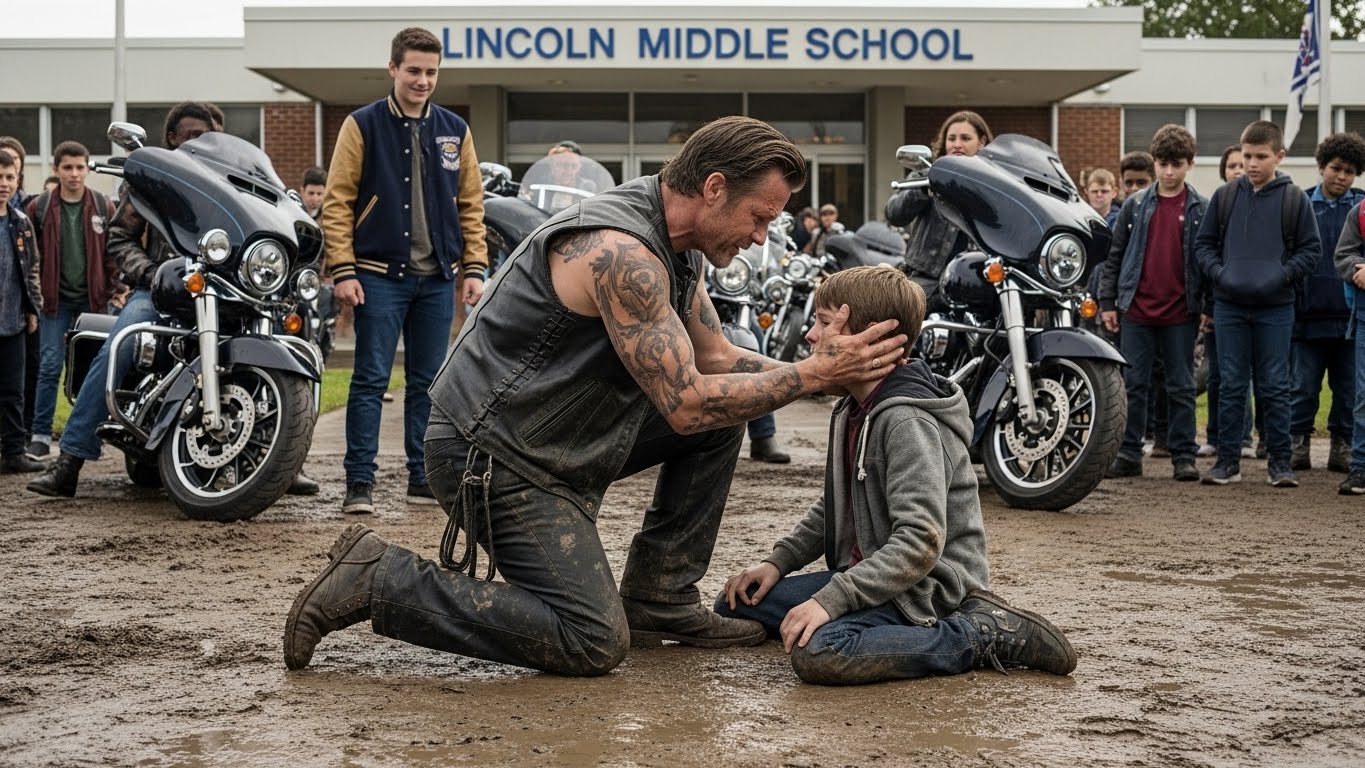
The big man didn’t shout. He didn’t posture. He simply walked forward, his heavy boots sinking into the mud. He ignored the gasps of the parents. He walked right up to Leo and, ignoring the filth, ignoring the dignity of his position, he dropped to his knees.
The impact of his knees hitting the ground was a thud that Leo felt in his own heart.
Chapter 3: The Dead Man’s Promise
The distance between them was less than two feet, but it felt like a canyon of lost time.
Up close, the man smelled like leather, rain, and stale tobacco. But underneath that, there was a scent Leo remembered from a dream—or maybe a memory he had tried to bury. The smell of sawdust and peppermint.
The man’s hands were shaking violently. He reached out, his fingers hovering over Leo’s face, afraid to make contact. When he finally touched Leo, his hand was calloused and rough, like sandpaper, but the touch was lighter than a feather. He traced the line of the scar on Leo’s jaw.
“Leo,” the man rasped. His voice sounded like it had been broken by years of screaming, or years of silence. “God… look at you.”
Leo pulled back slightly, confused. “Do I know you?”
The man let out a sound that was half-laugh, half-sob. Tears cut clear tracks through the road grime on his cheeks. “I’m sorry,” he whispered, rocking back on his heels. “I am so, so sorry, kid. They told me you were in the house. They told me you burned with her.”
Leo’s heart hammered against his ribs. The world seemed to narrow down to just this man’s weeping hazel eyes—eyes that were the exact same shade as his own.
“Who are you?” Leo asked again, his voice trembling.
“I’m Jack,” the man said, wiping his face with the back of a greasy glove. “I’m your dad.”
A collective gasp went through the crowd of onlookers.
“That’s a lie!”
The shout came from Mrs. Gable. She had finally gathered her courage and marched up to the edge of the grass, though she stayed a safe distance from the other bikers who stood like statues, arms crossed, watching the perimeter.
“Leo is a ward of the state,” Mrs. Gable announced, her voice shrill. “His father is… unavailable. You need to step away from the student immediately, sir, or the police will arrest you.”
Jack didn’t look at her. He didn’t take his eyes off Leo. He reached into the inside pocket of his cut.
Immediately, the parents in the cars screamed. Mrs. Gable flinched, expecting a weapon.
But Jack pulled out a photograph. It was old, crinkled, and water-damaged. He held it out to Leo with a trembling hand.
Leo took it. The photo showed a younger version of this giant man, smiling, sitting on a much shinier motorcycle. He was holding a baby in one arm and had his other arm around a woman with laughing eyes and dark hair. Leo recognized the woman instantly. It was the only memory he kept perfect in his mind. Mom.
And the baby… the baby was wearing a tiny onesie that said Little Biker.
“I was in prison,” Jack said, his voice low and urgent, speaking only to Leo. “I was inside for five years. Racketeering. Stupid stuff. When the fire happened… the warden, the chaplain… they told me my family was gone. All of them.”
He took a ragged breath. “I got out three days ago. I went to the gravesite. I saw your mom’s headstone. But there wasn’t one for you.”
Jack’s eyes hardened, a flash of the dangerous biker returning for a split second. “I tore that social services office apart until they gave me an address.”
“Sir!” Mrs. Gable shouted again, emboldened by the sirens wailing in the distance. “Get away from him!”
Jack stood up. The transformation was instant. The weeping father vanished, and the President of the Iron Saints returned. He turned to face the principal and the crowd of gawking parents. He didn’t yell. He projected.
“This boy,” Jack pointed a finger at Leo, who was still sitting in the mud, clutching the photo, “is my son. His name is Leo Rourke. And if any of you…”
He turned his head slowly, his gaze landing on Tyler. The bully squeaked and ducked behind the tree again.
“…if any of you ever make him feel small again, you won’t deal with the school board. You’ll deal with me.”
Jack turned back to Leo and extended a hand. “I can’t change what happened, Leo. I can’t bring her back. And I know I’m a stranger to you. But I’m not leaving you here. Not in the mud.”
He waited. He didn’t force Leo up. He just offered the hand.
Leo looked at the hand. It was scarred, stained with oil, and shaking. Then he looked at the school, the place of his daily torment. He looked at the white Range Rovers and the judging faces.
Leo reached up and gripped his father’s hand.
Jack pulled him up effortlessly, as if Leo weighed nothing. He didn’t let go. He pulled Leo into a hug that smelled of exhaust and desperation, burying his face in Leo’s small shoulder.
“Police are two minutes out, Boss,” one of the other bikers called out. He was a lanky man with a mohawk. “We gotta move if we’re moving.”
Jack pulled back, hands on Leo’s shoulders. “I have the custody papers in the saddlebag. I fought the court all morning. You’re legally mine, Leo. But it’s your choice. You can stay here, wait for Brenda, wait for the cops… or you can get on the bike.”
Leo looked at the matte black machine. It looked terrifying. It looked loud.
It looked like freedom.
Leo wiped the mud from his cheek. He looked at Tyler, who was peeking out from behind the tree. Leo didn’t look down this time. He stared right at him until Tyler looked away.
“Do I get a helmet?” Leo asked.
Jack’s grin broke through his beard, wide and radiant. “Yeah, kid. I brought you a helmet.”Chapter 4: The Velocity of Silence
The helmet was too big. It smelled of old sweat and cedar, a heavy, suffocating scent that somehow felt safer than the fresh air of the schoolyard. When Jack fastened the strap under Leo’s chin, his fingers were clumsy, trembling with an adrenaline that Leo could feel radiating off him like heat from a furnace.
“Hold on tight,” Jack shouted over the roar of the engine. “And I mean tight, Leo. Don’t let go. Not for anything.”
Leo wrapped his arms around his father’s waist. The leather of Jack’s vest was cold and stiff, worn smooth by years of wind. As Leo pressed his chest against Jack’s back, he felt the deep, rhythmic thumping of the massive V-twin engine. It wasn’t just a sound; it was a heartbeat, slower and heavier than a human’s, but alive.
Jack twisted the throttle. The bike surged forward, not with a jerk, but with a powerful, inexorable pull, like a tide going out.
Leo squeezed his eyes shut as the bike leaped off the curb and onto the asphalt. He heard the sirens then—the high-pitched wail of the local police cruisers approaching the school. He felt Jack’s body tense, a rigid block of muscle, but the bike didn’t slow down.
They didn’t run from the police, exactly. They simply ceased to exist in the world the police controlled.
The convoy of twenty Iron Saints moved like a single organism. As the first police cruiser rounded the corner, lights flashing blue and red against the grey sky, three of the rear bikers peeled off. They didn’t attack; they simply slowed down, occupying the entire width of the road, creating a rolling wall of steel and denim. They forced the police cars to brake, to honk, to get stuck in the bottleneck of suburban traffic.
By the time the cops could maneuver around them, Jack and Leo were gone.
They hit the highway, and the world dissolved.
For the first time in his life, Leo understood why people wanted to be invisible. But this wasn’t the invisibility of shame, of hiding in the back of the class or curling up in the mud. This was the invisibility of speed.
The wind roared around the helmet, a white noise that drowned out Tyler’s laughter, Mrs. Gable’s shrieking, and the whispers of the foster home. The suburban houses—those pristine, judgmental fortresses—blurred into streaks of beige and grey. The strip malls, the gas stations, the carefully manicured parks; they all became irrelevant smears of color.
Leo opened his eyes. Through the scratched visor of the helmet, the world looked different. It was framed, cinematic. He watched the yellow dashed lines of the highway disappear under the front wheel, swallowed up one by one.
He looked down at his own hands, clenched white-knuckled around his father. His fingernails were still dirty with the mud from the schoolyard, but up here, moving at seventy miles per hour, the mud seemed temporary. It could be washed off.
Jack didn’t ride recklessly. He rode with a terrifying precision. He anticipated the movements of the cars around them before the drivers even signaled. He shifted his weight, and the heavy bike leaned into the curves, defying gravity. Leo leaned with him, instinctively. It felt like dancing. It felt like flying.
After twenty minutes of highway riding, the cold started to seep through Leo’s thin hoodie. He shivered, his teeth beginning to chatter.
Immediately, as if he could feel the vibration of Leo’s shivering through his own spine, Jack tapped his left leg. He signaled to the pack. The formation shifted instantly. The bikers tightened the circle, surrounding Jack and Leo, cutting the wind.
Jack reached back with one hand—keeping the other steady on the handlebars—and gripped Leo’s forearm. A squeeze. I’ve got you. You’re okay.
They exited the highway, heading toward the industrial district on the south side of the city—the “Rust Belt” of the town, where the steel mills used to be. The roads here were cracked, the streetlights flickering orange. This was the part of town Brenda had told him never to go to. She said it was where the “bad element” lived.
But as they rolled past the abandoned warehouses and the chain-link fences topped with razor wire, Leo didn’t feel afraid. He looked at the bikers around him.
To his left was the guy with the Mohawk—’Spider’, Leo would later learn. Spider saw Leo looking and gave him a thumbs-up, grinning with missing teeth. To his right was a massive biker with a beard so long it was braided and tucked into his vest. He nodded at Leo, a solemn, respectful nod.
They weren’t looking at him like he was a charity case. They weren’t looking at him like he was a victim. They were looking at him like he was… cargo. Precious cargo.
The convoy slowed as they approached a large, brick building at the end of a dead-end street. It used to be a fire station, Leo guessed, judging by the massive bay doors. Now, the windows were painted black, and a steel gate surrounded the perimeter.
The gate rolled open automatically.
Jack guided the bike inside the compound. The roar of twenty engines bouncing off the brick walls was deafening, a cacophony of thunder that made Leo’s chest vibrate.
One by one, the engines cut out. The silence that followed wasn’t empty; it was ringing.
Jack kicked the stand down and swung his leg over. He didn’t wait to take off his own gear. He immediately turned to Leo, his hands working quickly to undo the helmet strap.
He pulled the helmet off Leo’s head.
Leo’s hair was a mess, matted with sweat and helmet hair. The cold air hit his flushed face. He took a deep, gulping breath.
Jack was staring at him. The big man’s face was pale beneath the windburn. He looked terrified.
“You okay?” Jack asked, his voice rough. “You cold? You scared?”
Leo looked around. They were in a courtyard. Twenty scary-looking men were dismounting, stretching, lighting cigarettes. But they were all watching him.
“I’m okay,” Leo whispered.
Jack let out a breath that sounded like a tire deflating. He pulled Leo into a hug, harder this time. He buried his face in Leo’s neck. Leo could feel the cold metal of the zippers on Jack’s vest pressing into him.
“I thought I lost you,” Jack mumbled into Leo’s hoodie. “I thought I lost you.”
“Hey, Boss,” a deep voice rumbled.
Jack pulled back, wiping his eyes quickly, composing himself. He turned. The man with the braided beard was standing there, holding a first-aid kit in one hand and a bottle of water in the other.
“Kid’s bleeding,” the bearded man said, pointing to Leo’s hand where Tyler had stepped on him, and the scrape on his cheek. “Let’s get him inside. Iron Church is open.”
Jack nodded. He put a heavy hand on Leo’s shoulder. “Come on, Leo. Welcome home.”
Chapter 5: The Iron Church
The inside of the clubhouse—the “Iron Church,” as they called it—was nothing like Leo had expected. He expected a dungeon, or a bar filled with smoke and broken glass.
Instead, it was… warm.
The main room was massive, with high ceilings and exposed brick walls. In the center was a long, polished oak table that looked like it belonged in a medieval castle. Around it sat mismatched leather armchairs that looked incredibly comfortable. There was a pool table in the corner, a jukebox glowing with neon light, and a bar that stretched along the far wall.
But what caught Leo’s eye were the walls. They were covered in photos. Hundreds of them. framed pictures of men on bikes, smiling, drinking, holding up trophies. And in between the photos were memorials. Vests encased in glass frames. Dates of birth and death.
It wasn’t a gang hideout. It was a museum of memories.
“Kitchen’s through there. Bunks are upstairs. Shop is out back,” Jack said, guiding Leo toward a leather couch near a wood-burning stove that was radiating heat. “Sit.”
Leo sat. The leather swallowed him. He felt incredibly small in this room built for giants.
The bearded man, whose name turned out to be ‘Doc’ (ironically, he had been a combat medic in the army, not a doctor), pulled up a stool. He opened the first-aid kit with surprising delicacy.
“Give me the hand, Little Man,” Doc grunted.
Leo hesitated, then extended his hand. Doc inspected the blackened fingernail and the scrapes from the pavement. He poured some antiseptic onto a cotton pad.
“This is gonna sting like a witch’s kiss,” Doc warned. “You gonna scream?”
Leo shook his head. “I’m used to it.”
The room went quiet. Jack, who had been pacing near the bar, stopped. He turned to look at Leo, his expression darkening.
Doc paused, his eyes narrowing slightly. “Used to it, huh?” He dabbed the wound. Leo didn’t flinch. He didn’t even blink.
“Who did this?” Jack asked. His voice was low, dangerous. He walked over, looming over the couch. “The kid at the school? Tyler?”
“Yeah,” Leo said quietly. “And his friends.”
“How long?” Jack asked.
“Since I got there. Since the fire.”
Jack turned away, running a hand through his hair. He looked like he wanted to punch the wall. He grabbed a chair and spun it around, straddling it so he was face-to-face with Leo.
“Leo,” Jack started, his voice trembling with suppressed rage—not at Leo, but at the universe. “I need you to understand something. I didn’t leave you. Do you understand that?”
Leo looked down at his bandaged hand. “They said you were in jail. They said you were a criminal.”
“I was,” Jack admitted. He didn’t try to hide it. “I am. I did bad things, Leo. I moved money for bad people. I hurt people who tried to hurt my club. And I got caught. But the plan… the plan was always to get out and take you and your mom away. We were going to move to Oregon. I had a house picked out.”
Jack’s eyes watered. “When the fire happened… I was in solitary confinement. They didn’t tell me for three days. And when they did… they said bodies were found. They said two bodies.”
“Mom threw me out the window,” Leo said. The memory hit him like a physical blow. The heat. The smoke. His mother’s screaming face. Run, Leo! Run! “She broke the window and pushed me out onto the porch roof. Then the floor fell in.”
Silence stretched through the room. The other bikers, who had been pretending to busy themselves with beers and pool cues, were all listening.
“She saved me,” Leo whispered. “But then the social workers came… and I had no name. The records were burned. They just called me ‘John Doe’ at the hospital until Brenda found my file.”
Jack reached out and took Leo’s good hand. His grip was desperate. “I wrote letters. Hundreds of them. They all came back ‘Return to Sender’. They told me you were dead because it was easier for them. It was easier to bury a number than to find a boy.”
“Why are you here now?” Leo asked. It was the question that had been burning in his chest. “Why today?”
“Because I got out 72 hours ago,” Jack said. “And I went to the cemetery. I saw her grave. Just hers. I tore the county clerk’s office apart until they gave me the foster records. I haven’t slept, Leo. I haven’t eaten. I just rode.”
Jack squeezed Leo’s hand. “And I promise you… on your mother’s soul… nobody is ever going to hurt you again. You aren’t ‘John Doe’. You aren’t ‘State Property’. You’re Leo Rourke. You’re my son.”
“Hey,” a voice called from the kitchen door. A large woman with tattoos up her neck and a “Mom” apron over a leather skirt walked in carrying a tray. “Enough trauma for five minutes. The boy looks like he’s gonna pass out. Eat.”
She set the tray down on the coffee table. It was piled high with burgers, fries, and a chocolate milkshake that looked thick enough to stand a spoon in.
“This is Sheila,” Jack said, a faint smile touching his lips. “She runs the place. Don’t make her mad.”
“Eat,” Sheila commanded, ruffling Leo’s hair. “You’re skin and bones.”
Leo reached for a fry. He was starving. He hadn’t eaten lunch because Tyler had knocked it out of his hands. As he took the first bite, the warmth of the food, the warmth of the fire, and the warmth of the room hit him all at once.
For the first time in three years, the cold in his bones began to thaw.
But as Leo ate, he watched his father. Jack wasn’t eating. He was standing by the window, peeking through the blackout curtains at the street outside. His hand was resting on the hilt of a knife sheathed at his belt.
Jack had found him. He was safe.
But Leo was smart. He knew that the way Jack was standing… that wasn’t the stance of a man who was safe. That was the stance of a man who was hunting. Or being hunted.
Chapter 6: The Ghost in the Fire
Night fell over the industrial district like a heavy wool blanket. The Iron Church quieted down. Most of the bikers had gone home to their own families or passed out in the bunks upstairs.
Leo had been given a room—Jack’s old room. It was sparse: a single bed, a nightstand, and a lamp made from a motorcycle headlight. But the sheets were clean, and it smelled of Jack.
Leo couldn’t sleep.
The adrenaline of the rescue had faded, leaving behind a jittery anxiety. Every creak of the old building sounded like footsteps. Every distant siren made his heart skip.
He got out of bed, his feet cold on the wooden floor. He needed water.
He crept into the hallway. The floorboards groaned under his weight, but he knew how to move silently. You learn how to walk without making a sound when you live in a house where making noise gets you yelled at.
He reached the top of the stairs that looked down into the main common room.
The lights were off, save for the glow of the embers in the wood stove and a single bulb over the bar.
Jack was there. He wasn’t alone.
He was sitting at the table with Doc and another man Leo hadn’t met properly yet—the VP, a guy they called ‘Hawk’. Hawk was older, with a face that looked like it had been carved out of granite and eyes that were cold and sharp.
They were whispering, but in the cavernous silence of the warehouse, their voices carried up to the landing.
“…police scanner is quiet,” Hawk was saying. “They aren’t putting out an APB. That means Gable didn’t press kidnapping charges yet. Probably because she’s scared of the bad press. ‘Orphan kidnapped by biker gang’ looks bad for the school.”
“She will eventually,” Doc said, nursing a beer. “Or CPS will. They won’t just let you keep him, Jack. You’re a felon on parole. You don’t have a house. You don’t have a job.”
“I have the papers,” Jack said. His voice sounded exhausted. “I signed the custody petition this morning. Legally, I have a claim. But that’s not what I’m worried about.”
Leo leaned closer to the railing, holding his breath.
“You think they know?” Hawk asked. The tone was grave.
“They have to,” Jack replied. “The fire wasn’t an accident, Hawk. We knew that three years ago, and we know it now.”
Leo froze. The fire wasn’t an accident?
“The arson investigator said it was faulty wiring,” Doc said, playing devil’s advocate.
“Bullshit,” Jack hissed. The anger in his voice spiked, sudden and violent. “It was an accelerant. It was a message. I was in prison, refusing to flip on the cartel distribution lines. They couldn’t get to me inside, so they went after my house. They went after her.”
Jack slam his hand on the table. “They thought they killed them both. That’s why the heat died down. That’s why the Saints haven’t had war in three years. Because they thought they won.”
Leo’s hands shook as he gripped the railing. His mother hadn’t just died. She was murdered. And the people who did it…
“If they find out the boy is alive,” Hawk said slowly, “and that you have him… they’ll come back to finish the job, Jack. You know that. The Bishop doesn’t leave loose ends.”
“The Bishop,” Jack spat the name like a curse. “He’s still running the South Side?”
“Stronger than ever,” Hawk said. “He’s got the cops, the judges, and the street. If he finds out Leo is here, he won’t just send a hitter. He’ll send an army. This clubhouse isn’t a fortress, Jack. It’s a target.”
Jack stood up and paced into the light. Leo could see his father’s face clearly now. It was twisted in agony.
“I can’t give him back to the state, Hawk. He’s… he’s broken. You saw him. If I send him back, he dies inside. If I keep him here, he might die for real.”
“So what’s the play?” Doc asked.
Jack stopped pacing. He looked up, almost as if he could sense Leo watching from the shadows, though he didn’t look directly at the stairs.
“I have to kill the threat,” Jack said. His voice was cold, devoid of the warmth he had shown Leo earlier. “I have to take the war to The Bishop. Before he knows the boy exists. I have to burn his world down like he burned mine.”
“That’s a suicide mission, Jack,” Hawk warned. “You just got out. You go after Bishop, you violate parole, you go back for life—or you end up in a box.”
“I don’t care what happens to me,” Jack said. “As long as Leo is safe. If I take Bishop out, the organization crumbles. The threat is gone. Leo can live.”
“And who raises him when you’re dead?” Doc asked softly.
Jack didn’t answer. The silence stretched, heavy and suffocating.
Up on the landing, Leo stepped back. A floorboard creaked—a loud, sharp crack in the silence.
Downstairs, three heads snapped up instantly.
“Leo?” Jack called out, his voice instantly shifting from killer to father.
Leo’s heart hammered in his throat. He didn’t answer. He turned and ran back to his room, diving under the covers just as he heard Jack’s heavy boots hitting the stairs.
He squeezed his eyes shut, pretending to be asleep.
The door creaked open. Leo controlled his breathing, keeping it slow and steady, even though his mind was screaming.
He felt Jack’s presence by the bed. He felt the large hand brush the hair off his forehead.
“I’m sorry, kid,” Jack whispered in the dark. “I’m so sorry I brought this to your door.”
Leo waited until the door closed and the footsteps faded. Then he opened his eyes. He stared at the ceiling, the tears hot and fast on his cheeks.
His father loved him. He knew that now.
But his father was going to leave him again. He was going to die to save him.
Leo sat up. He looked at his hands—the hands that everyone said were useless, broken, weak.
No, Leo thought. The fear was still there, but something else was mixing with it now. The iron he had seen in his father’s eyes.
I’m not let him die. I’m not going to be the reason he dies.
Leo swung his legs out of bed. He didn’t know what he was going to do, or how. But he knew one thing: he wasn’t going to be invisible anymore.Chapter 7: Blood on the Asphalt
Jack left an hour before dawn.
He moved like a ghost, boots silent on the floorboards, sliding out of the heavy steel doors of the Iron Church into the damp mist of the sleeping city. He didn’t take the rest of the pack. He didn’t wake Hawk or Spider. This was his debt to pay, his sin to bury.
He rode his matte black cruiser not to the highway, but downtown, toward the neon-soaked district where the skyline gleamed with glass and money. His destination was The Monarch, a high-end nightclub that served as the throne room for The Bishop.
Jack parked the bike right at the front entrance, ignoring the valet who rushed over in a red vest.
“Sir, you can’t park—”
Jack shoved a hundred-dollar bill into the kid’s pocket and walked past him. “Watch the bike.”
Inside, the club was empty of patrons, the cleaning crews vacuuming the confetti from the night before. But in the VIP mezzanine, shadows were moving.
Jack walked up the stairs, his hand resting near the waistband of his jeans where a .45 caliber pistol sat cold against his skin. He knew this was a trap. He knew he probably wasn’t walking out. But if he could take Bishop with him, Leo would be safe. That was the trade.
At the top of the stairs, three men in suits blocked his path. They didn’t look like bikers; they looked like Wall Street brokers who enjoyed hurting people.
“Jack Rourke,” a voice boomed from the darkness of a booth. “Fresh out of the cage. I heard you found a stray puppy.”
The men parted. The Bishop sat there. He was a small man, impeccably dressed in a charcoal suit, sipping an espresso. He didn’t look like a crime lord; he looked like a grandfather. That was what made him terrifying.
“Bishop,” Jack said, his voice gravel. “We’re done. Today.”
“Are we?” Bishop smiled, setting his cup down. “I heard you have a son. A miracle survival. The fire must have been… disappointing for him.”
Jack didn’t hesitate. He drew his weapon.
But before he could level it, a deafening crack filled the air. Jack’s right shoulder exploded in pain. He dropped the gun, stumbling back as his knees buckled.
A sniper. Up in the lighting rig.
Two of the suits surged forward, kicking Jack in the ribs, forcing him down. One of them stomped on his hand—the hand that had held Leo’s just hours ago. Jack grunted, tasting blood, but he didn’t scream.
Bishop stood up and walked over, looking down at Jack with mild amusement. He nudged Jack’s gun away with the toe of his Italian loafer.
“You think you’re a martyr, Jack?” Bishop sighed. “You think you can trade your life for the boy’s? How noble. But stupid.”
Bishop leaned down, whispering into Jack’s ear. “I’m not going to kill the boy because you died, Jack. I’m going to kill him while you watch. I have men en route to that warehouse right now. Your ‘Iron Church’ is about to become a funeral pyre. Again.”
Jack roared, a sound of pure animal desperation, and lunged up. But the suit behind him slammed a baton into the back of his head.
Jack’s vision blurred. The world swam in grey and black. He was failing. He had promised Leo he would be safe, and he had failed.
“Finish him,” Bishop said, turning his back to walk away. “Then bring me the boy.”
The man in the suit raised a silenced pistol to Jack’s head.
Jack closed his eyes. I’m sorry, Leo. I’m so sorry.
BOOM.
The front doors of the club downstairs didn’t open; they exploded inward. Glass shattered across the dance floor like diamond rain.
The roar hit them next. It wasn’t one bike. It was fifty.
Bishop spun around, his composure cracking for the first time. “What is—”
The Iron Saints didn’t come alone. They brought the Charter.
Through the smoke and debris of the entrance, bikers poured in—not just the twenty from the warehouse, but dozens more from the neighboring chapters. A tide of leather, chains, and fury.
And at the front, riding on the back of Spider’s bike, clinging to the sissy bar, was a small boy in an oversized hoodie.
“Leo?” Jack whispered, forcing his eyes open.
Spider killed the engine and pointed a sawed-off shotgun at the balcony. “Nobody touches the President!”
The club erupted into chaos. The suits opened fire, but they were overwhelmed instantly. The sheer volume of the bikers swarming up the stairs was unstoppable. It was a brawl of knuckles, boots, and pool cues.
Bishop tried to run for the back exit, but Hawk was already there, blocking the door with arms crossed and a terrifying grin.
“Going somewhere, Your Holiness?” Hawk asked.
On the mezzanine, the man holding the gun to Jack’s head hesitated, distracted by the invasion. That was all Jack needed.
Despite the bullet in his shoulder, Jack swept the man’s legs, grabbed the fallen pistol, and put two rounds into the floorboards at the man’s feet. The suit scrambled back, surrendering.
Jack struggled to his feet, clutching his bleeding shoulder. He didn’t look at Bishop. He didn’t look at the enemies. He looked over the railing, down to the dance floor.
Leo was standing there, shaking, surrounded by a protective ring of four massive bikers.
Jack stumbled down the stairs. The adrenaline was fading, replaced by a cold wave of shock. He reached the bottom and fell to his knees in front of his son.
“You…” Jack wheezed. “You were supposed to stay inside. I locked the door.”
Leo looked at his father—at the blood soaking his vest, the bruise forming on his face. The boy’s eyes were fierce, burning with a fire that matched Jack’s own.
“I picked the lock,” Leo said, his voice steady despite the chaos around them. “And I woke up Spider. I told him you were doing something stupid.”
Jack let out a jagged breath, half-laugh, half-sob. “I told you to be safe.”
“You said we’re family,” Leo said, stepping closer and putting his small hands on Jack’s bloody vest. “Family doesn’t ride alone.”
Jack looked up at Spider, who shrugged unapologetically. “Kid makes a compelling speech, Boss. Said if we let you die, he’d never forgive us. We couldn’t let that happen.”
Jack looked back at Leo. The “broken thing.” The victim.
He wasn’t broken. He was the strongest thing Jack had ever seen.
Chapter 8: The Unbroken Road
The hospital waiting room smelled of antiseptic and old coffee, a stark contrast to the leather and gasoline smell of the Iron Saints who had taken over the entire floor.
Nurses walked nervously past the rows of bikers sitting in plastic chairs, reading magazines or napping. No one asked them to leave. When fifty members of a motorcycle club decide to wait for their President, hospital policy tends to become flexible.
In Room 304, the rhythmic beeping of the heart monitor was the only sound.
Jack lay in the bed, his shoulder heavily bandaged, an IV line running into his tattooed arm. He was awake, staring at the ceiling.
The door creaked open.
It wasn’t a nurse. It was Leo.
The boy walked in, holding a plastic cup of water. He looked tired. The adrenaline of the night at The Club had worn off, leaving him looking like a twelve-year-old again—small, pale, with the scar on his cheek standing out in the harsh fluorescent light.
“Hey,” Jack rasped. His throat was dry.
“Hey,” Leo said. He put the water on the tray table. “Doc says you’re lucky. The bullet went through the muscle. Didn’t hit the bone.”
“I’ve had worse,” Jack muttered, trying to sit up. He winced.
“Stop moving,” Leo scolded him, sounding exactly like Brenda from the foster home. He adjusted the pillow behind Jack’s back.
Jack watched him. He watched the way Leo moved—careful, attentive, but no longer shrinking into himself. The hunch in his shoulders was gone.
“Bishop?” Jack asked.
“Police took him,” Leo said. “Hawk tied him to a lamppost outside the precinct with a note that listed where the bodies were buried. Literally. They found evidence of the arson. And the insurance fraud. He’s gone, Dad. For good.”
Dad.
The word hung in the air, heavy and sweet.
Jack reached out with his good hand. Leo took it.
“I tried to leave you behind,” Jack said, his voice thick with emotion. “I thought… I thought if I removed myself from the equation, you’d have a chance at a normal life. A life without targets on your back.”
Leo looked down at their joined hands—one massive and scarred, the other small and healing.
“I don’t want a normal life,” Leo said softly. “I had a normal life at the foster home. It was lonely. I want… I want this.”
“This?” Jack gestured to the hospital room, to his bandages, to the chaotic, dangerous world of the club. “This is hard, Leo. It’s gritty. People judge us. People hate us.”
“Let them,” Leo said. He looked up, and for the first time, he smiled. A real smile that reached his eyes. “Tyler judged me. The teachers judged me. They made me feel like I was nothing. When I’m with you… when I’m on the bike… I don’t feel like a ‘broken thing’. I feel real.”
Jack squeezed his son’s hand. He realized then that he had been looking at it all wrong. He thought he needed to fix Leo, or protect Leo from the world. But Leo didn’t need fixing. He just needed a corner to fight from.
“Okay,” Jack whispered. “Okay.”
Two Weeks Later
The morning air was crisp, smelling of frost and pine.
The lineup outside Lincoln Middle School was the usual parade of SUVs and sedans. But today, there was a gap in the traffic. A wide berth.
The roar approached from the east.
This time, it wasn’t twenty bikes. It was just two.
Jack rolled up to the curb on his matte black beast. Behind him, on a smaller, custom-built dirt bike that had been lowered and modified for street legality, was Leo.
Leo wore a brand new helmet, custom-painted black with a single silver lightning bolt down the side. He wore a leather jacket that actually fit him, with a patch on the chest that read PROSPECT.
They idled at the curb. The engines rumbled together, a harmony of steel.
Tyler was there, standing by the gate with his friends. He looked at the bikes. He looked at Jack, who stared back with stone-cold indifference. Then Tyler looked at Leo.
Leo killed his engine. He flipped up his visor.
There was no fear in his face. No shame about the scar. He looked at Tyler, gave a curt nod—not of submission, but of dismissal—and kicked his stand down.
“Have a good day,” Jack said, his voice carrying over the quiet schoolyard.
“I will,” Leo said.
“I’ll be here at three,” Jack promised. “Ride or die.”
“Ride or die,” Leo replied.
Leo hopped off the bike, grabbed his backpack, and walked toward the school entrance. He walked with a stride that was long and confident. He didn’t look at the ground. He looked straight ahead.
As he passed Tyler, the bully stepped back, creating a path.
Leo didn’t even notice. He wasn’t invisible anymore. He was electric.
Jack watched his son walk through the double doors, a lump in his throat the size of a fist. He revved his engine, a sharp bark of thunder that made the soccer moms jump, and peeled away from the curb.
The world had tried to break them both. It had burned their house, taken their family, and kicked them into the mud.
But as Jack accelerated down the open road, the wind drying the wetness in his eyes, he knew the truth.
Fire doesn’t just destroy. Sometimes, it forges steel.