A Billionaire Bet Me $100 Million I Couldn’t Open His “Impossible” Safe. He Didn’t Know My Dead Father Designed It. When I Punched In The Code, His Laughter Turned Into A Scream That Changed History.
Chapter 1: The Price of Dignity
The laughter in the room didn’t sound like joy. It sounded like breaking glass—sharp, expensive, and designed to cut.
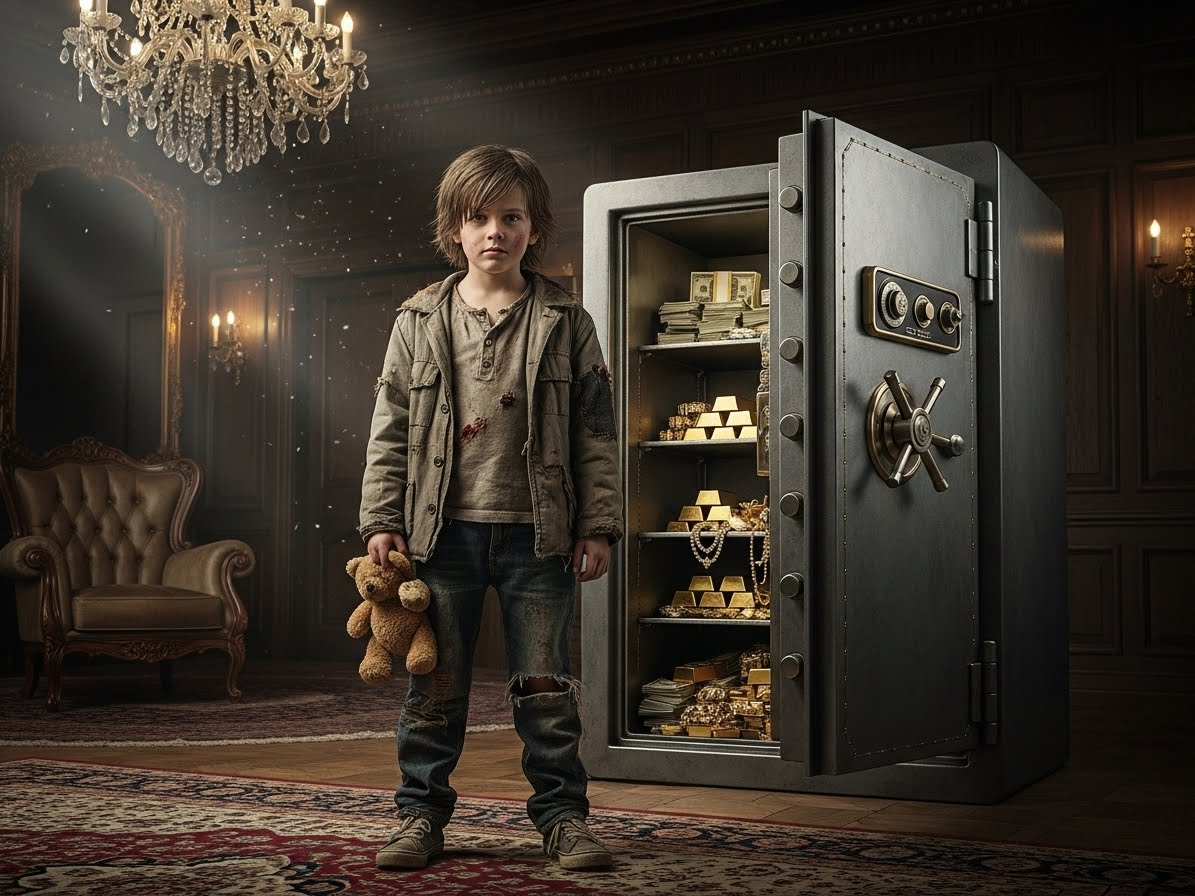
I stood near the door, my toes curling inside sneakers that had holes where the rubber met the canvas. I was eleven years old, invisible, and terrifyingly out of place. Beside me, my mother, Elena, gripped the handle of her mop so tightly her knuckles had turned the color of old bone. She was trembling. Not from the cold of the air conditioning that blasted through the penthouse, but from a humiliation so deep it felt like it was burning her skin.
We were in the office of Mateo Sterling, the CEO of Sterling Corp. We were on the 42nd floor of a glass needle piercing the Manhattan skyline, a place where the air smelled of aged scotch, leather, and money.
And we were the punchline.
“One hundred million dollars!” Mateo roared, slapping his hand against the cold, gunmetal grey steel of the massive vault in the center of the room. “It’s all yours, little street rat. Just open the door.”
Mateo was fifty-three years old, a man carved from arrogance and tanned from weekends in the Hamptons. He wore a suit that cost more than my mother earned in five years of scrubbing his floors. Around him sat his court—five other titans of industry, men who controlled pharmaceuticals, oil, and real estate. They were leaning back in Italian leather chairs, wiping tears of mirth from their eyes.
To them, this wasn’t cruel. It was Tuesday.
“Mateo, you’re too much,” gasped Gabriel Ortiz, a pharmaceutical heir with eyes that looked dead inside. “Look at him. He’s shaking. The kid probably thinks a hundred million is a type of candy bar.”
“Or he thinks he can eat it,” added Leonardo Marquez, the oil tycoon, swirling his whiskey. “Does he even speak English? Or just ‘mop’?”
The laughter exploded again, louder this time. A wave of noise that crashed over my mother.
She stepped forward, the mop handle clattering against her leg. “Mr. Sterling,” she whispered. Her voice was thin, a terrified sound that barely made it across the room. “Please… we were just leaving. My babysitter canceled. I had no choice. Santiago won’t touch anything. I promise.”
Mateo stopped laughing. The transition was instant and terrifying. He turned his head slowly, like a shark sensing a disturbance in the water.
“Silence,” he hissed.
The word hung in the air, heavy and suffocating.
“Did I give you permission to speak, Elena?” Mateo asked, his voice dropping to a silky, dangerous whisper.
My mother flinched as if he had struck her. She shrank back, trying to merge with the beige wall, trying to disappear. “No, sir. I’m sorry, sir.”
“For eight years, you have cleaned my toilets,” Mateo said, stepping closer to her, invading her personal space. “You empty my trash. You scrub the filth off my floors. You are a ghost in this building. Ghosts do not speak during board meetings. And they certainly do not bring their children to work to infect my office with poverty.”
I felt a heat rising in my chest. It started in my stomach, a hot ball of lead, and moved up to my throat. I looked at my mom. She was crying now, silent tears tracking through the dust on her cheeks. She looked so small. This was the woman who worked three jobs, who helped me with my homework at midnight, who skipped meals so I could have new school books.
And this man was treating her like something he scraped off his shoe.
“Come here, boy,” Mateo commanded, snapping his fingers at me.
I froze. My mom looked down at me, terror in her eyes. She nodded slightly. Go. Do what he says. Don’t make it worse.
I walked across the floor. My dirty sneakers left faint, dusty prints on the polished Italian marble. I saw Gabriel look at the floor with open disgust, shifting his legs away as if poverty was contagious.
“Can you read?” Mateo asked, crouching down so his face was level with mine. Up close, he smelled of expensive cologne and cruelty.
“Yes, sir,” I said. My voice was quiet, but it didn’t shake.
“And can you count to a hundred?”
“Yes, sir.”
“Perfect.” He stood up, towering over me, grinning at his friends. “Then you understand the stakes. This beauty…” He patted the safe again. “…is a SwissTech Titanium. Imported from Geneva. It has biometric scanners, military-grade encryption, and codes that change every hour. It cost me three million dollars. It protects the things that separate people like me from people like you.”
He leaned in, his eyes gleaming with malice.
“So, here is the deal. You open it, you keep what’s inside. One hundred million dollars. Enough to buy your mother some dignity. What do you say?”
“Mateo, that’s just sadistic,” Fernando Silva muttered from the couch, though he didn’t stop smiling. “Giving them hope is worse than starving them.”
“It’s not sadism, Fernando. It’s education,” Mateo replied, never taking his eyes off me. “I’m teaching him a valuable lesson about the real world. Some are born to own the safe. Some are born to polish it. It is the natural order.”
He looked back at my mother, who was now sobbing quietly into her hand.
“Tell him, Elena,” Mateo goaded. “Tell your son how much your dignity is worth per hour in the open market.”
She couldn’t speak. She was broken.
“Fine. I’ll tell him,” Mateo sneered. “Your mother makes twelve dollars an hour. I make twelve thousand dollars while I take a piss. That is why I am here, and you are there.”
I looked at the safe. It was a fortress. Impenetrable.
“Why?” I asked.
The single word cut through the room. Mateo blinked, confused. “What?”
“Why offer the money if it’s impossible?” I asked, looking him dead in the eye. “If there’s zero chance, then it’s not a bet. It’s just a lie. A game to make your friends laugh.”
The room went deadly silent. The billionaires exchanged uncomfortable glances. The street rat wasn’t supposed to have logic. He was supposed to cry.
“Look at that,” Rodrigo Fuentes laughed nervously. “The kid has a brain.”
“A brain isn’t enough without education,” Mateo snapped, his smile vanishing. “And education costs money you don’t have.”
“My dad said otherwise,” I said.
“Your dad?” Gabriel scoffed, checking his Rolex. “Where is he? Too busy to pick you up?”
“He’s dead,” I said.
The word landed like a stone. Even in a room of sharks, mentioning a dead parent sucked the air out of the space.
“I’m… sorry,” Mateo muttered, though he sounded bored. “But dead fathers don’t open safes.”
“He was a security engineer,” I said, my voice gaining strength. I wasn’t just defending myself anymore; I was defending a memory. “Diego Vargas. He designed systems for the National Bank. He died installing a vault just like this one.”
I took a step toward the machine.
“He taught me that safes aren’t just metal and math. They are psychology. And he taught me exactly how men like you think.”
Chapter 2: The Algorithm of Ego
The atmosphere in the penthouse shifted. It was no longer a circus; it was a confrontation. The five men sat up straighter, their amusement replaced by a flicker of annoyance—and perhaps, curiosity.
“And what did your father teach you about men like me?” Mateo asked. His voice was lower now, stripped of the performative laughter. He crossed his arms, leaning back against his mahogany desk.
I walked up to the SwissTech Titanium. It was cold to the touch, a silent beast of brushed steel and blue LED lights. I ran my fingers over the keypad. It was identical to the one my father used to bring home for practice—the demo units he’d let me play with on Sunday afternoons while he explained the logic of locks.
“He taught me that rich people buy the most expensive security not because they need it,” I said, my voice echoing in the silent office. “But because they want to show off that they can afford it. It’s about ego, not protection.”
“That’s ridiculous,” Fernando spat out. “We buy quality.”
I turned to face him. “Then tell me, Mr. Sterling. What is inside this safe? Is it something you truly cannot live without? Or is it just things you bought because you could?”
Mateo’s jaw tightened. I had struck a nerve. The safe contained stacks of cash he rarely touched, watches he never wore, and deeds to properties he’d never visited. It was a metal box of vanity.
“My dad said people confuse price with value,” I continued. “You pay millions for things that mean nothing, and you treat people who mean everything—like my mom—like they are worth nothing.”
“Enough philosophy,” Mateo snapped, pushing off the desk. “I didn’t bring you here for a lecture. Open it, or get out.”
“You didn’t bring us here at all,” I corrected him. “You trapped us here to humiliate us. You wanted to feel big by making us feel small. But you made a mistake.”
“And what mistake is that?” Mateo sneered.
I smiled. It wasn’t a happy smile. It was the smile my father had when he solved a puzzle that had stumped everyone else. “You assumed that because we are poor, we are stupid.”
I turned back to the safe. “I know how to open this.”
“Impossible,” Gabriel laughed, but the laugh was brittle. “It’s military-grade.”
“My dad was the lead engineer for SwissTech’s Latin American division for fifteen years,” I said. “He wrote the manual.”
I looked at my mom. She was watching me with wide, terrified eyes, but behind the fear, there was a spark of something else. Pride.
“Can I tell them, Mom?” I asked.
She nodded, tears streaming down her face.
“My dad didn’t die in an accident,” I said, turning back to the men. “He died because of negligence. The contracting company wanted to save money, so they sub-contracted the electrical work to the lowest bidder. There was a short circuit while he was inside the vault. He died instantly.”
Elena let out a soft, choked sob. The sound was devastating.
“The company denied responsibility,” I said, my voice trembling with suppressed rage. “They said he violated protocol. They took his pension. They took our apartment. That’s why my mom cleans your toilets. Because the people with the money decided her husband’s life was a rounding error.”
Mateo looked down at his shoes. For the first time, he looked ashamed. Or maybe just uncomfortable with the truth being spoken so plainly.
“But he taught me everything before he died,” I said, placing both hands on the keypad. “He taught me that 73% of private owners never change the factory master override code. They add layers of biometrics, yes. But they leave the root vulnerability because they don’t understand how the system works.”
“Override code?” Mateo whispered. “That’s a myth.”
“Is it?” I pointed to the small metal plate at the base of the safe. Series ST-471780.
“The algorithm for the SwissTech master code is the serial number inverted,” I recited, as if reading from a textbook. “Take the last digit, multiply by three, and append it to the inverted sequence.”
I looked at Mateo. “Serial ST-471780. Inverted is 087174. The last digit is 4. Four times three is twelve. Use the last digit: 2.”
I hovered my finger over the keypad.
“So the code is… 1-7-8-4-7-2.”
The room was so quiet you could hear the hum of the hard drives in the server rack.
“Wait,” Mateo said, panic rising in his voice. “Wait just a second.”
“And the security question,” I interrupted him, stepping closer. “My dad said rich men always pick answers related to their favorite possessions. Never their families. Never their memories. Just their toys.”
I looked at the digital display. SECURITY QUESTION: FIRST LOVE.
“It’s not a woman, is it?” I asked softly. “It’s ‘Corvette 1987’. Isn’t it?”
Mateo’s face drained of all color. He looked like a ghost. I had just dissected his entire psyche in front of his peers.
“Do it,” Rodrigo whispered, fascinated.
I didn’t hesitate. I punched in the numbers.
1… 7… 8… 4… 7… 2.
The keypad beeped. A cheerful, musical tone that sounded ridiculously out of place. Then, the heavy clunk of tumblers shifting into place. The hydraulic seal hissed.
Click.
The massive door of the three-million-dollar safe swung open an inch.
Inside, stacks of cash, gold bars, and velvet boxes sat exposed. The impossible fortress had fallen to an eleven-year-old boy in dirty sneakers.
Chapter 3: The True Negotiation
The silence that followed the opening of the safe was heavier than the steel door itself. Mateo Sterling stared at the open vault, his mouth slightly agape. He looked stripped. The armor of his wealth had been pierced, and underneath, he was just a man who had been outsmarted.
“You… you opened it,” Gabriel stammered, standing up. “He actually opened it.”
“Luck,” Fernando muttered, though he was sweating. “It was just luck.”
“It wasn’t luck,” Mateo said. His voice was hollow. He sank into his chair, looking at me with a mixture of horror and awe. “It was specific. It was exact.”
He looked at me, really looked at me, for the first time. “A deal is a deal,” he whispered. “One hundred million dollars. It’s yours.”
The air in the room seemed to vibrate. My mother gasped, her hands flying to her mouth. One hundred million dollars. It was an abstract number. It was enough to buy the building we lived in. Enough to never touch a mop again. Enough to disappear.
I looked at the stacks of cash inside the safe. Then I looked at my mother. I saw her worn-out hands, her tired eyes, the uniform that marked her as ‘less than.’
Then I looked at Mateo.
“I don’t want your money,” I said.
The shock in the room was palpable.
“What?” Leonardo shouted. “Are you insane, boy? Take the money and run!”
“I don’t want it,” I repeated firmly. “If I take your money, you’ll say I got lucky. Or you’ll say I stole it. Or tomorrow, your lawyers will find a way to take it back. Rich men always change the rules when they lose.”
I walked over to my mother and took her hand. It was rough and calloused, but warm.
“My dad taught me that money without respect is just another form of debt,” I said. “So here is my counter-proposal.”
Mateo looked at me, bewildered. “You’re negotiating? You just won the lottery, kid.”
“I want three things,” I said, ignoring his comment. “And they are worth more than money.”
“Name them,” Mateo said. He was leaning forward now, engaged. The predator was intrigued by the prey that refused to run.
“First,” I said, squeezing my mom’s hand. “I want my mother to have a real job in this company. Not cleaning bathrooms. She was a teacher before my dad died. She knows literature. She knows people. She has a brain that you have wasted for eight years. I want her in Human Resources. Coordinator of Personnel Development.”
Elena looked at me, tears spilling over. She squeezed my hand back, hard.
“Done,” Mateo said immediately. “Effective tomorrow. What else?”
“Second,” I continued, looking at the other men in the room. “I want you five to create an Education Fund. Not a charity tax write-off. A real fund. For the children of every service employee in your companies. The janitors, the security guards, the cafeteria ladies. You will pay for their college. You will give them the chance that my father wanted to give me.”
The businessmen exchanged glances. This wasn’t just a payout; this was systemic.
“That will cost… millions,” Rodrigo calculated.
“Less than you lose on bad stocks in a week,” I countered. “Do it.”
Mateo nodded slowly. “The Diego Vargas Scholarship Fund. We’ll set it up.”
“And third,” I said, turning back to the safe. “I want you to change the code.”
Mateo frowned. “What?”
“Change the code,” I said. “Because now I know it. And if a ‘street rat’ like me knows it, then you aren’t safe. And every time you type in the new code, I want you to remember today. I want you to remember that your security is an illusion, and that the people you step on are the ones who know how to unlock your life.”
I let go of my mother’s hand and walked to the door.
“We have a deal?” I asked, extending my small hand.
Mateo stared at it. Shaking my hand meant admitting defeat. It meant treating me as an equal.
Slowly, painfully, Mateo Sterling stood up. He walked around his massive desk. He looked at the open safe, then at me.
He took my hand. His grip was firm, but his hand was clammy.
“We have a deal, Santiago,” he said.
“Good,” I said. I turned to my mom. “Let’s go, Mom. We have to get you ready for your new job.”
Elena straightened her back. For the first time in years, she didn’t look like a cleaner. She looked like a queen. She placed the mop against the wall—leaving it there, a symbol of a life finished.
“Goodbye, Mr. Sterling,” she said. She didn’t call him sir.
We walked out of the penthouse, leaving five billionaires in silence, staring at an open safe and realizing they were the poorest men in the world.
Chapter 4: The Invisible Army
Three days later, the sun rose over Manhattan, but for Mateo Sterling, the world looked different.
He stood in the lobby of the Sterling Tower at 6:45 AM. Usually, at this hour, he was asleep in silk sheets or jogging on a private track. But today, he was standing by the security turnstiles, his heart hammering a nervous rhythm against his ribs.
He was waiting for Elena.
When the revolving doors spun, it wasn’t just Elena who walked in.
Santiago was beside her, wearing a clean shirt and his backpack, looking like he owned the place. But behind them… behind them was an army.
Twenty people walked in. There was Miguel, the night security guard. Rosa, the cafeteria cook. The maintenance crew. The window washers. They were all wearing their uniforms, but they were walking differently. Heads up. Shoulders back.
“Good morning, Mr. Sterling,” Elena said. She was wearing a simple blouse and slacks, clothes she had saved for church, but on her, they looked like executive wear. She held a leather portfolio—a gift from Santiago, bought with money he’d saved from odd jobs.
“Elena,” Mateo said, stepping forward. He extended his hand. “Welcome to your first day as Coordinator.”
As they shook hands, the elevator chimed. Rodrigo Fuentes stepped out, looking flustered. He spotted Mateo and marched over, his face flushed.
“Mateo! What is this?” Rodrigo hissed, gesturing at the group of service workers. “Gabriel called me. He says you’ve lost your mind. He says hiring the cleaning lady as an executive makes us a laughingstock. The board is going to eat you alive.”
Mateo looked at Rodrigo. Then he looked at Santiago, who was watching the interaction with those sharp, ancient eyes.
“Let them try,” Mateo said quietly.
“You don’t understand,” Rodrigo pressed, lowering his voice. “They are furious about the Scholarship Fund. Leonardo says it sets a dangerous precedent. If we start treating them like people, they’ll expect… things.”
“They are people, Rodrigo,” Mateo said, his voice hardening. “And maybe it’s time we stopped being afraid of them.”
“This is a mistake,” Rodrigo warned. “You’re weak, Mateo. You let a child guilt-trip you.”
“Weak?”
Santiago stepped forward. “Mr. Fuentes,” he said, his voice cutting through the lobby noise. “You think Mr. Sterling is weak?”
Rodrigo scoffed. “This doesn’t concern you, kid.”
“It does,” Santiago said. He pointed to Miguel, the security guard standing nervously by the desk. “That is Miguel Torres. You see a guard. Do you know what he was before he came to this country?”
Rodrigo rolled his eyes. “I don’t care.”
“He was a structural engineer,” Santiago said. “He has a Master’s degree in civil engineering. He speaks four languages. But you have him guarding a door because you never bothered to ask.”
Santiago pointed to Rosa. “She ran a restaurant for twenty years. She knows supply chain management better than your VP of Logistics.”
The lobby had gone quiet. Employees arriving for work—men in suits, women in heels—stopped to listen.
“We aren’t just ‘the help’,” Santiago said, his voice rising, filling the cavernous space. “We are the talent you are too blind to see. My dad taught me that the biggest waste in the world isn’t money. It’s potential.”
Mateo looked at his staff—really looked at them—and saw what Santiago saw. He saw a goldmine he had been walking over with muddy boots for decades.
“Rodrigo,” Mateo said, a new authority in his voice. “If you want to leave, leave. But the meeting is starting in ten minutes. And today, everyone is invited.”
“Everyone?” Rodrigo asked, horrified.
“Everyone,” Mateo confirmed. “Because I have a feeling the best ideas for this company aren’t going to come from the boardroom. They’re going to come from the breakroom.”
He turned to Elena. “Shall we?”
Elena smiled. It was a radiant, powerful thing. “Lead the way, Mr. Sterling.”
As the group moved toward the elevators, leaving a stunned Rodrigo in the lobby, Mateo realized something. The safe upstairs was empty of anything that mattered. The real treasure was getting on the elevator with him.
The transformation had begun. But the war with the old world—with Gabriel, Leonardo, and the system itself—was just starting. And they wouldn’t go down without a fight.
Chapter 5: Viral Poison
One week after the meeting that changed everything, the digital bomb detonated.
Mateo was in his office, reviewing the first draft of the scholarship program, when his phone began to buzz. It wasn’t a normal call. It was a relentless, violent vibration—text after text, alert after alert.
“Mr. Sterling,” his assistant’s voice crackled over the intercom, trembling. “You need to look at Twitter. Now.”
Mateo opened his laptop. The hashtag #MonsterMateo was trending #1 globally.
There it was. A video. Shaky, vertical footage filmed from a couch.
It showed everything. It showed him laughing. It showed Elena crying against the wall. It showed Santiago trembling in his torn sneakers. It showed Mateo pointing at the safe and calling them “filth.”
Someone had added brutal subtitles: “This man is worth $900 Million.” “This woman makes $12/hour.” “Watch him destroy a child for sport.”
The view count was climbing so fast the numbers were blurring. 2 million. 5 million. 10 million.
Mateo felt the blood drain from his face. He watched himself on the screen—the arrogance, the cruelty. For the first time, he saw himself not as a powerful CEO, but as the villain in a horror movie.
His phone rang. It was Gabriel Ortiz.
“Enjoying the show, Mateo?” Gabriel’s voice was smooth, dripping with venom.
“You filmed this,” Mateo whispered, gripping the phone. “Leonardo filmed it. You leaked it.”
“We didn’t leak it,” Gabriel corrected. “We just… shared it with a few friends who believe in transparency. You wanted to be a hero for the poor? Well, now the world knows how you really treat them.”
“You’re destroying the company,” Mateo roared. “Our stock is tanking!”
“No, you are destroying the company with your woke charity projects,” Gabriel snapped. “We’re just speeding up the inevitable. Resign, Mateo. Go away. Or we will release the rest.”
Mateo slammed the phone down. He walked to the window. Down below, forty-two stories down, he could already see news vans gathering like vultures.
He was finished. The narrative was set. He was the rich monster, and no amount of sudden kindness would look like anything other than damage control.
The door opened. He expected security to escort him out.
Instead, it was Elena and Santiago.
They had seen the video. Elena’s eyes were red, but dry. Santiago looked furious—not at Mateo, but at the injustice of the leak.
“They are outside,” Mateo said, not turning around. “They want blood. You two should go. Distance yourselves from me.”
“No,” Santiago said.
Mateo turned. “Kid, look at the news. I’m radioactive.”
“You’re only radioactive if you hide,” Santiago said, walking up to the massive desk. “My dad used to say that sunlight is the best disinfectant. If you hide, you admit you’re the monster they say you are.”
“I am that monster,” Mateo admitted, his voice breaking. “You saw the video. That was me.”
“That was you,” Elena said softly. She stepped forward, standing beside her son. “But it isn’t you today. Today, you are the man who gave Miguel a job as an engineer. You are the man funding the future of a hundred children.”
“Nobody will believe that,” Mateo said. “They’ll think it’s a PR stunt.”
Santiago pulled a thick binder from his backpack. It was the finalized plan for the Diego Vargas Education Fund. It was filled with data, projections, and personal letters from employees.
“Then we don’t ask them to believe words,” Santiago said, slamming the binder on the desk. “We force them to believe actions. We hold a press conference. Today. And we don’t just apologize. We go on the offensive.”
“Offensive?” Mateo asked.
Santiago’s eyes narrowed. “Miguel did some digging on Gabriel and Leonardo. You think you’re a monster? Wait until the world sees what they’ve been hiding in their safes.”
Chapter 6: The Glass House
The ballroom of the Plaza Hotel was suffocating. Three hundred journalists were packed in, cameras flashing like lightning storms. The atmosphere was hostile. They wanted a public execution.
When Mateo walked onto the stage, the booing was audible. But the booing faltered when Elena and Santiago walked out with him, standing on either side of the billionaire like shields.
Mateo gripped the podium. His hands were shaking.
“I am not here to make excuses,” Mateo began, his voice echoing in the tense silence. “The video you saw is real. I said those things. I was cruel. I was arrogant. And I was wrong.”
He looked at Elena.
“This is Elena Vargas. For eight years, she cleaned my office. I never knew her name. I treated her invisibility as a convenience.”
“Liar!” a voice shouted from the back.
Fernando Silva, one of the men from the original meeting, stood up. He had crashed the event. “This is a performance! He’s using them as props to save his stock price!”
Security moved to stop him, but Mateo raised a hand. “Let him speak.”
Fernando smirked. “You think donating a few pennies changes who you are? You’re a predator, Mateo.”
Santiago stepped up to the microphone. He had to stand on a box to reach it. The room went dead silent. This was the boy from the video. The victim.
“Mr. Silva,” Santiago said, his voice calm and terrifyingly adult. “You call this a performance. But in the video, were you not the one laughing the hardest?”
Fernando froze.
“You say Mr. Sterling is a predator,” Santiago continued. ” But my friend Miguel—who runs your security now—found something interesting. Your construction company has cut safety corners on twelve consecutive projects.”
Santiago held up a piece of paper.
“Fourteen workers died on your sites in five years. Fourteen fathers. Like mine.”
The cameras swiveled from Mateo to Fernando. The flashbulbs were blinding.
“That’s… that’s confidential,” Fernando stammered.
“It’s public record if you know where to look,” Santiago said. “Mr. Sterling was cruel with words. You are cruel with lives. Mr. Sterling is trying to change. Are you?”
The room erupted. Journalists were shouting questions now, but the narrative had shifted. It wasn’t just about a mean billionaire anymore; it was about a system.
Elena stepped forward next. She didn’t need a box. She radiated a quiet power that silenced the room instantly.
“I am not a prop,” she said clearly. “I am a mother. And I am an executive. Mr. Sterling did not buy my silence. He earned my forgiveness by doing the work.”
She gestured to the screen behind them.
“Today, we are announcing the Diego Vargas Fund. One hundred million dollars. Committed irrevocably. It will pay for the education of every child of every service worker in Sterling Corp.”
“One hundred million?” a reporter from CNN shouted. “Is that confirmed?”
“Signed this morning,” Mateo said, stepping back to the mic. “And it’s not under my control. The board of directors for the fund is led by Elena Vargas and Santiago. I just write the check.”
Mateo looked directly into the camera.
“To my former friends—Gabriel, Leonardo, Fernando. You tried to destroy me with the truth. Thank you. Because the truth set me free. Now, I suggest you look at your own glass houses. Because Santiago has a lot more paper in that backpack.”
The applause didn’t start instantly. It started slowly. One person. Then another. Then the room was standing.
It wasn’t applause for a celebrity. It was applause for redemption.
Fernando Silva slipped out the back door, his face pale, realizing the weapon he had forged had just been turned against him.
Chapter 7: The Wealth Multiplier
Six months later, the boardroom at Sterling Corp looked different.
The mahogany table was the same, but the people sitting around it had changed. Gone were the sycophants. In their place sat Miguel (Director of Safety), Rosa (Head of Employee Wellness), and Elena (VP of Human Capital).
And in the corner, doing his homework while listening to the Q3 projections, was Santiago.
“The numbers don’t make sense,” complained Hector Ramirez, an old-school investor who had been trying to oust Mateo for months. “We gave away 30% of our operating cash flow to this ‘Fund.’ We raised wages for janitors to $25 an hour. We should be in the red.”
Mateo smiled. “Look at page four, Hector.”
Hector flipped the page. He frowned. He adjusted his glasses.
“Productivity is… up 40%?”
“Turnover is zero,” Elena said, not looking up from her tablet. “We haven’t spent a dime on recruitment or training in six months because nobody leaves. Our employees are solving problems we didn’t even know we had.”
“And the PR value,” Miguel added, “is incalculable. People are buying our products specifically because of the Diego Fund. We are the most trusted brand in America right now.”
“But the dividends,” Hector grumbled. “My dividend check is smaller.”
Santiago closed his history book. He stood up.
“Mr. Ramirez,” the twelve-year-old said. “My dad used to explain leverage to me. You think leverage is borrowing money. Real leverage is loyalty.”
Santiago walked to the whiteboard. He drew a simple graph. It showed a line going straight up.
“When you starve your employees, they steal time. They do the bare minimum. They hate you. That is a tax on your business. When you feed them, when you educate their kids… they build your business for you.”
He tapped the board.
“We didn’t lose money. We invested in the only asset that actually thinks. That is the Wealth Multiplier. And if you don’t like it, Gabriel Ortiz is looking for investors.”
The room went quiet at the mention of Gabriel.
“How is Gabriel?” Mateo asked, a hint of genuine pity in his voice.
“Bankrupt,” Miguel replied. “After the harassment lawsuits and the OSHA violations came out… his stock is worth less than the paper it’s printed on.”
Mateo looked out the window. The skyline of New York glittered. Six months ago, he had been one of the sharks. Now, he was swimming in a different ocean.
“Motion to approve the new budget,” Mateo said.
“Seconded,” Elena said.
“All in favor?”
Every hand went up. Even Hector, grumbling, raised his hand. You couldn’t argue with a 40% rise in productivity.
The meeting adjourned. As the room cleared, Mateo walked over to Santiago.
“You should be in school, advisor,” Mateo joked.
“I am in school,” Santiago smiled. “This is Economics 101. But I have a field trip this afternoon. Are you coming?”
Mateo checked his watch—a simple leather strap, having sold the diamond Rolex for the fund.
“I wouldn’t miss it for the world.”
Chapter 8: The Key to the Future
The cemetery was quiet, the noise of the city fading into the distance. The autumn leaves were turning gold and red, carpeting the ground in a mosaic of fire.
We stood before a simple grey headstone.
Diego Vargas Engineer. Father. Husband. 1982 – 2023
It had been three years since he died. For the first two years, this grave had been a place of despair. A place where my mom came to cry about bills she couldn’t pay.
Today, there were two hundred people standing behind us.
There were the scholarship kids—the first “Class of Diego”—wearing blazers with the fund’s crest. There were the employees. There was Miguel, holding a shovel. Rosa, holding a sapling of an oak tree.
And there was Mateo Sterling.
Mateo stepped forward. He looked at the grave, then he knelt in the dirt. He didn’t care about his suit.
“Diego,” Mateo said softly, his voice catching in his throat. “I never met you. But you saved my life.”
He placed a hand on the cold stone.
“I tried to break your son. Instead, he broke me open. He taught me that a safe isn’t for locking people out. It’s for protecting what matters. And I promise you… I will protect them. I will watch over Elena and Santiago as long as I breathe.”
Elena wiped a tear from her cheek. She stepped up beside Mateo and placed a hand on his shoulder. It was a gesture of total forgiveness.
“Santiago?” she said.
I walked up to the grave. I had something in my pocket. It wasn’t money. It wasn’t a contract.
It was a small, brass key. The first key my dad ever gave me. The key to his old toolbox.
I dug a small hole in the soft earth at the base of the headstone.
“You were right, Dad,” I whispered. “You were right about everything. The combination wasn’t just numbers. It was truth.”
I dropped the key into the hole.
“You built the lock,” I said, covering it with dirt. “But you left us the answer.”
Miguel and Rosa brought the oak sapling forward. Together, Mateo, my mom, and I packed the earth around the roots, planting it directly over where the key was buried.
“This tree will grow,” I told the crowd of students. “Its roots will wrap around that key. It will be strong. It will weather storms. Just like us.”
As the sun began to set, casting long shadows across the grass, Mateo turned to me.
“So,” he said, dusting off his hands. “What’s the next lesson, Professor?”
I looked at the billionaire who had become a father figure, the cleaner who had become an executive, and the invisible people who had become a family.
I smiled.
“The next lesson is simple, Mateo. Now that the safe is open… we have to fill it with something better than gold.”
“Like what?”
“Like legacy,” I said, taking my mother’s hand. “Let’s go to work.”
We walked out of the cemetery together, leaving the dead to rest, and walking back toward a city that finally, for the first time, felt like it belonged to us too.
[END OF STORY]