I Blacked Out Behind the Wheel of My Squad Car. I Woke Up to a 10-Year-Old Girl Saving My Life.
Chapter 1: The Gray Veil
The heat in Texas doesn’t just sit on you; it presses down like a heavy, suffocating thumb. It was two in the afternoon in mid-July, and the asphalt on 5th Street was shimmering, creating mirages of water that didn’t exist. Inside my cruiser, the air conditioner was rattling, fighting a losing battle against the sun beating through the windshield.
I checked my watch, then wiped a layer of cold, sticky sweat from my forehead. My hand was trembling. Just a little tremor, like a vibration in a loose engine part, but I knew what it meant.
2:00 PM. I had missed lunch. Again.
“You okay, Mark?”
I gripped the steering wheel tight enough to turn my knuckles white, trying to steady the shake. Beside me, my partner, a Belgian Malinois named Buster, whined low in his throat. He shifted in the backseat, his nails clicking against the metal grate. Dogs know things. They smell the chemical shift in your sweat before you even feel the dizziness. Buster knew my blood sugar was crashing.
“I’m fine, buddy,” I lied to the dog.
I was lying to everyone these days. I lied to my Captain when he asked why I looked so pale in roll call. I lied to my ex-wife, Sarah, when she asked if I was managing my numbers. And I was definitely lying to myself.
I was a dinosaur in this department—forty-eight years old, three years away from a full pension. If the department found out my Type 1 diabetes had become “brittle”—unpredictable, swinging from highs to dangerous lows without warning—I’d be stripped of my badge. I’d be put behind a desk, or worse, medically retired before I hit the twenty-year mark. I needed that pension. It was the only thing I had left to leave to my own daughter, assuming she ever started talking to me again.
“Unit 4-Alpha,” the radio crackled, the dispatcher’s voice cutting through the static. “Domestic disturbance on Elm. 400 block. Caller reports shouting, breaking glass. Suspect fled on foot. Child left at scene.”
I shook my head, trying to clear the black spots that were starting to dance in my peripheral vision like stubborn flies. “4-Alpha, copy,” I said. My voice sounded thick to my own ears. “I’m two blocks out.”
I should have called for backup. I should have pulled over and jammed the glucose gel pack I kept in my tactical vest into my mouth. But the adrenaline of the call spiked, momentarily masking the hypoglycemia. A child at the scene. That always got to me.
When I pulled up to the run-down bungalow, the front door was hanging off its hinges. The lawn was overgrown, choked with crabgrass and rusted car parts. A man was sprinting through the back alley—I saw his work boots kicking up dust as he disappeared around a rotting wooden fence.
” suspect fleeing south through the alley,” I muttered into the radio, but I didn’t pursue. I couldn’t. My legs felt like they were made of lead pipes.
Sitting on the curb, hugging her knees to her chest, was the girl.
She couldn’t have been more than ten years old. She had messy blonde hair that looked like it hadn’t seen a brush in days, and she was wearing a dirty, oversized t-shirt that said ‘Daddy’s Little Princess’ in peeling pink glitter letters. The irony hit me harder than the heat.
I put the cruiser in park. My vision swam. The house number—412—seemed to split into two and float apart.
Focus, Reynolds. Just check the kid, clear the scene, then eat.
I stepped out of the car. The ground felt spongy, like walking on a mattress. “Hey there,” I managed. I tried to project the calm, authoritative voice of a veteran officer, but it came out raspy. “I’m Officer Reynolds. You okay?”
She looked up. Her face was smudged with dirt and tears, but her eyes—piercing, electric blue—were dry now. They were filled with a terrifying mix of defiance and exhaustion. It was the look of a soldier who had seen too much combat, not a fourth-grader.
“He didn’t mean to hit her,” she whispered, her voice cracking. “He just gets mad when the money runs out.”
“Is your mom inside?” I asked, swaying slightly. The sun felt like a physical weight on my shoulders.
“She’s sleeping,” the girl said. “She took the pills so she wouldn’t hurt.”
Overdose. Or just checking out. I needed to go inside. I needed to check the mother’s vitals. But as I took a step toward the porch, the world tilted violently to the left. The gray veil that had been hovering at the edges of my sight rushed inward, turning the bright afternoon into twilight.
“Whoa,” I breathed, putting a hand on the hood of the cruiser to steady myself. The metal was scalding hot, but my skin was clammy and cold.
“Mister?” The girl stood up. She was tiny. Scrappy.
“Come on,” I said, changing tactics. I couldn’t go in there. Not yet. If I went in, I might pass out over a potential crime scene. “Let’s get you into the A/C. It’s too hot out here.”
Protocol says I put her in the back. But the cage is for criminals, and this kid looked like she was holding the weight of the world. I fumbled with the handle of the front passenger door. “Hop in. Watch out for the laptop.”
She hesitated, looking at the dark house, then at me. She saw the sweat dripping off my nose. She saw the tremor in my hand.
“Are you sick?” she asked bluntly.
“Just… thirsty,” I lied again.
She climbed in, clutching a ragged backpack that looked empty. Buster, usually wary of strangers, shoved his nose through the grate and licked her ear. For the first time, the girl cracked a tiny, fragile smile.
I walked around the back of the car to the driver’s side. The distance felt like a mile. My feet were dragging. My brain was screaming for sugar. Glucose. Now. Or you die.
I fell into the driver’s seat. The blast of the A/C hit my face, but it didn’t help. The darkness was closing in fast now. It was a tunnel, and the light at the end was pin-sized.
“I’m just gonna… radio this in,” I slurred. I reached for the mic, but my fingers felt like swollen sausages. I couldn’t feel the texture of the plastic. I missed the button. The mic slipped from my hand and clattered onto the center console.
“Mister Police Officer?” the girl said. Her voice sounded like it was coming from underwater. “You’re scaring me.”
I tried to turn to her, to tell her to grab the candy bar in the glove box, but the connection between my brain and my body had been severed. My head hit the steering wheel with a heavy thud.
The last thing I heard was Buster barking—a frantic, ear-piercing alarm—and the terrified gasp of a little girl who was suddenly very, very alone.
Chapter 2: The Girl from the Farm
Darkness. It wasn’t a peaceful sleep. It was a void.
Then, pain. Sharp, stinging pain in my shoulder.
“Mister! Wake up! Wake up!”
I peeled my eyes open. It took a monumental effort, like lifting a garage door with my eyelashes. I was slumped against the driver-side door, my head lolling against the window glass. The cruiser was idling. The vibration of the engine hummed through my spine.
I couldn’t move my legs. My arms hung uselessly at my sides. This was the bad one. This was the kind of low that kills you in your sleep. Hypoglycemic shock. My brain was shutting down systems to preserve the core.
“Can you hear me?” The girl was shaking me. Her small hands were surprisingly strong, digging into my uniform shirt.
“Juice…” I wheezed. The word was barely a puff of air. “Need… sugar.”
She looked at me, her blue eyes wide with panic. She understood. Kids who grow up in broken homes, they learn to read the signs of adults failing. She didn’t know it was diabetes, but she knew it was life or death.
She tore open the glove box, dumping the contents onto the floorboard. Napkins, a stack of unpaid parking citations, a heavy flashlight, a spare magazine.
“There’s nothing!” she screamed. “Just paper!”
I had eaten the emergency Snickers bar yesterday and forgot to replace it. Stupid. Stupid, arrogant fool.
Buster was going berserk in the back, throwing his eighty-pound body against the metal divider, barking a rhythmic, deafening cadence. He was trying to keep me awake.
I tried to lift my hand to point to the trunk release button under the dash. My medical kit was in the trunk. Glucagon injection. It would save me in ten seconds. But my arm wouldn’t obey. It twitched and fell back into my lap.
My vision tunneled again. I was going to die here, parked on a curb in a bad neighborhood, while a suspect was on the loose and a ten-year-old watched the life drain out of my eyes.
“No, no, no,” the girl muttered. She looked at me, then out the windshield. The street was empty. The heat waves were still dancing. No backup was coming because I hadn’t called it in.
Suddenly, the sound of the seatbelt clicking release echoed like a gunshot in the small cabin.
“What…” I tried to speak, but only a groan came out.
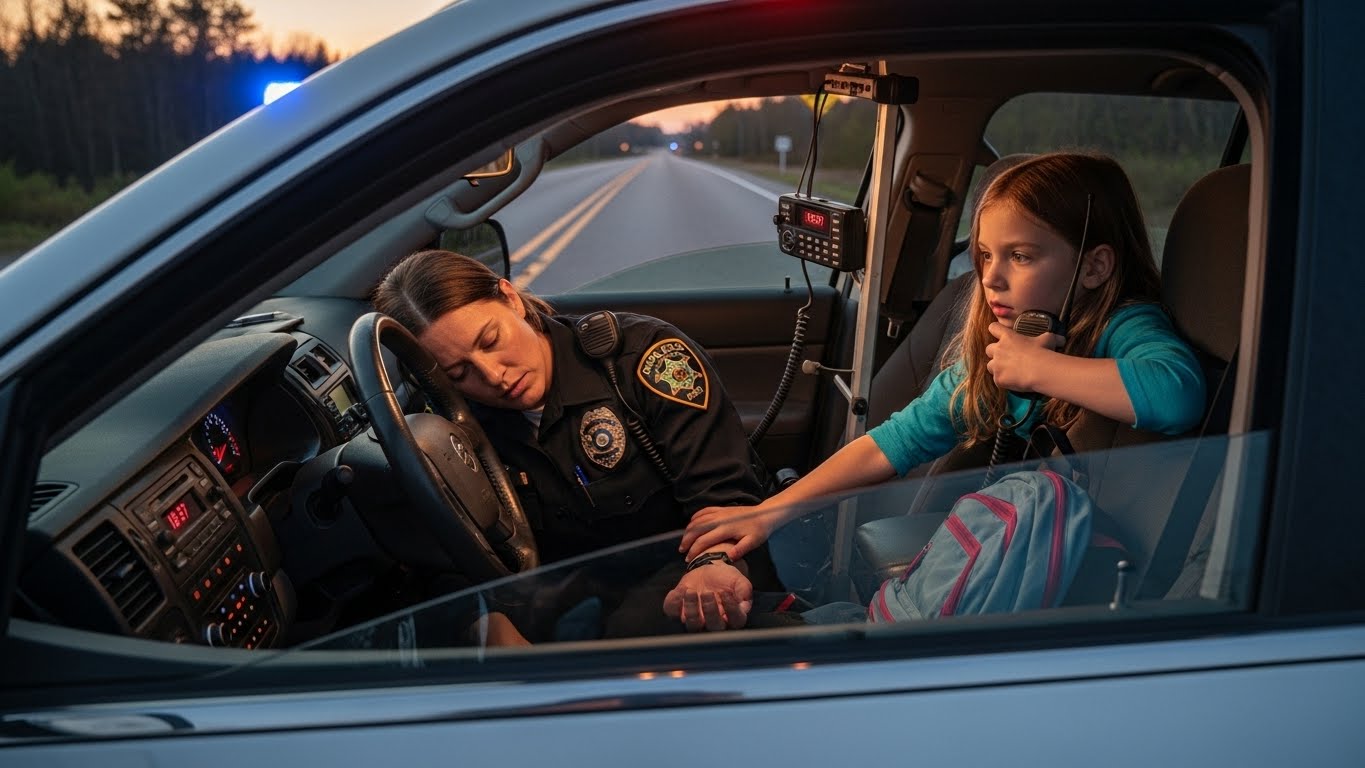
She scrambled over the center console, stepping on the radio, her knee digging into my thigh. I barely felt it. She shoved my heavy, limp body hard against the door, wedging herself between me and the steering wheel.
She was so small. She smelled like stale milk and rain.
“My dad taught me,” she whispered, her voice trembling but fierce. “On the farm. Before we moved here. Before he got bad. He taught me on the tractor.”
She wasn’t talking to me. She was talking to herself. Psyched herself up.
She reached down. Her dirty sneakers dangled inches above the pedals. She had to slide all the way down the seat, disappearing below the dashboard, stretching her leg until her toes found the brake pedal.
Clunk.
She shifted the heavy gear stick on the column into Drive. The car jolted.
“Don’t…” I whispered. My mind was screaming STOP, but my mouth couldn’t form the consonants.
“I can’t let you die,” she said, tears streaming down her dusty cheeks. She pulled herself back up, gripping the wheel at ten and two, just like they teach in driver’s ed, except her hands were so small they barely wrapped around the rim. “Mom says good people die because nobody helps. I’m gonna help.”
The car lurched forward.
She stomped on the gas too hard. The Charger has a V8 HEMI engine. It’s a beast designed for high-speed pursuit, not for a sixty-pound child. The car surged, tires screeching against the hot asphalt. We swerved violently toward a parked plumber’s van.
“Whoa!” she screamed, jerking the wheel to the left.
We missed the van by inches. I heard the side-view mirror clip a plastic mailbox—CRACK—sending it spinning into the street.
Buster barked louder now, sensing the motion, sensing the chaos.
“Hospital,” she said, her knuckles white on the wheel. “Big blue H. I saw the sign. It’s down the hill. Just go down the hill.”
She was driving a police cruiser, with a dying cop and a frantic K9, down a suburban street at 40 miles per hour.
I wanted to tell her to stop. I wanted to tell her she was going to get us killed. But as my eyes rolled back into my head, I saw her profile. Her jaw was set, jutting out slightly. The tears were drying on her cheeks. Her eyes were locked on the road with a terrifying intensity.
She wasn’t a victim of domestic violence anymore. She was the captain of this ship.
The siren switch was right by her knee on the center console. She bumped it by accident as she adjusted her grip.
WHOOP-WHOOP.
The siren wailed, then cut out, then wailed again.
The world went black, and the last sensation I had was the feeling of raw speed, and the sound of a little girl praying under her breath.
Chapter 3: The ride to Hell
Consciousness was flickering like a dying lightbulb. I was aware of motion. Violent, swaying motion.
I was floating. No, I was flying.
“Move! Move out of the way!”
The voice was high-pitched, screaming.
My eyes fluttered open for a second. Through the windshield, the world was a blur of green lawns and gray pavement rushing by at impossible speeds. We were in the wrong lane. A silver sedan was coming straight at us, horn blaring.
“Look out!” I tried to shout, but it came out as a gargle.
The girl—what was her name? I didn’t even know her name—yanked the wheel to the right. The cruiser dipped, the suspension groaning under the shift in weight. We swerved back into the correct lane, missing the sedan by a coat of paint. I felt the wind buffeting the car as the other driver passed us.
She was too short to see over the dashboard comfortably. She had to crane her neck, peering through the gap between the steering wheel rim and the dash. She was driving by instinct, navigating a two-ton weapon through afternoon traffic.
“Unit 4-Alpha,” the radio screamed. “Unit 4-Alpha, we have multiple reports of erratic driving on Highland Avenue. Be advised, civilians reporting a squad car driving recklessly. 4-Alpha, check in!”
The radio mic was on the floor. I couldn’t reach it. I couldn’t tell them it wasn’t me. I couldn’t tell them not to shoot out the tires.
” Almost there, Mister. Almost there,” the girl said. She was hyperventilating. “Don’t die. Please don’t die like Grandma.”
We hit a pothole. My head slammed against the window glass again, hard enough to taste blood. The pain was grounding. It brought a moment of clarity.
I looked at the speedometer. 55 mph. In a 30 zone.
We were approaching the intersection of Highland and Main. The busiest intersection in the city. The light was red. I could see the glow of it even through my blurry vision. Solid red.
“Red…” I groaned. “Stop.”
“I can’t!” she cried out. “If I stop, I can’t reach the gas again fast enough!”
She was making a tactical decision. A ten-year-old’s tactical decision. Momentum was her only friend.
She laid on the horn. HOOOOONK.
She didn’t slow down. She shot into the intersection.
I saw a delivery truck coming from the left. The driver slammed on his brakes. Smoke plumed from his tires. I saw his face—mouth open in shock—as we shot across his bow.
From the right, a minivan swerved, hopping the curb and taking out a flower bed.
We threaded the needle. It was a miracle. Or it was insanity.
“I see it!” she yelled. “The Blue H!”
The hospital emergency entrance was ahead, up a slight incline. But the driveway was blocked by a slow-moving ambulance backing into the bay.
She didn’t know how to finesse the brakes. She only knew ‘Go’ and ‘Stop’.
“Watch out!” she screamed at the ambulance.
She slammed her foot down on the wide brake pedal, using her whole body weight.
The anti-lock brakes kicked in—thud-thud-thud-thud. The cruiser skidded, the rear end fishtailing out. The smell of burning rubber flooded the cabin, acrid and sharp.
We were sliding sideways toward the sliding glass doors of the ER entrance.
People were scattering. A nurse dropped a clipboard and ran. A security guard froze, hand on his radio.
The car shuddered to a halt three feet from the automatic doors. The engine stalled. Silence rushed back in, broken only by the ticking of the cooling engine and the sound of Buster whimpering in the back.
The girl slumped over the wheel, sobbing uncontrollably now. The adrenaline had dumped, leaving her shaking.
I tried to turn my head to look at her. “You… did… good,” I whispered.
The driver’s door was ripped open from the outside.
“What the hell is going on here?” A voice boomed. It was a paramedic. He looked at me, then his eyes went wide as he saw the driver.
“Holy…”
“He’s sick!” the girl screamed, pointing at me. “He needs sugar! He’s dying!”
The paramedic looked at me. He saw the pale, clammy skin. He saw the unfocused eyes. He knew.
“Get a gurney!” he shouted to the team behind him. “Code Blue in the driveway! We got a diabetic emergency! Move, move, move!”
Hands were grabbing me, pulling me out of the car. The sudden movement sent a wave of nausea through me. As they lifted me onto the stretcher, I looked back.
The girl was still sitting in the driver’s seat, her hands still gripping the wheel of my cruiser. She looked so small. So terrified. And yet, she was the bravest person I had ever met in twenty years of wearing the badge.
“Get the girl,” I managed to say to the security guard before the darkness finally took me completely. “Protect… the girl.”
Then, nothing.
Chapter 4: The Sugar Hangover
Waking up from a severe hypoglycemic episode isn’t like waking up from a nap. It’s like clawing your way out of a grave filled with wet cement.
The first thing I registered was the rhythmic beep-beep-beep of a cardiac monitor. The second was the smell—antiseptic, floor wax, and stale coffee.
I tried to sit up, but a heavy hand pushed me back down.
“Easy, cowboy. You’re not going anywhere.”
I blinked, my eyes adjusting to the harsh fluorescent lights. A nurse with forearms like a dockworker and a face that had seen everything was adjusting an IV bag above my head.
“Glucagon and D50,” she muttered, checking the drip. “You were sitting at thirty-two when you rolled in here. You know thirty-two is basically ‘dead’ in medical terms, right?”
“Thirty-two,” I repeated. My tongue felt too big for my mouth. My head was pounding with a dull, throbbing ache—the sugar hangover. It takes hours, sometimes days, to feel human again after a crash that hard.
Then, the memory hit me like a physical blow.
The heat. The girl. The drive.
I shot up, ripping the tape on my IV line. “The girl. Where is she?”
“Whoa, settle down!” The nurse pushed me back, harder this time. “The kid is fine. She’s with the social workers in the family room. Police are all over the place outside. It looks like a donut convention in the hallway.”
I sank back into the pillows, my heart rate spiking on the monitor. Beep-beep-beep-beep.
“She drove the car,” I whispered, staring at the ceiling tiles. “She drove the damn squad car.”
“She sure did,” a deep voice rumbled from the doorway.
I froze. I knew that voice. It was the sound of authority, the sound of my career ending.
Captain Miller walked in. He was a big man, African-American, with a shaved head and eyes that could peel paint off a wall. He wasn’t wearing his uniform hat, which meant this wasn’t a formal commendation. He held a tablet in his hand.
He closed the door behind him, shutting out the noise of the ER.
“Captain,” I said, trying to sound like an officer, not a patient. “I can explain.”
“Explain what, Mark?” Miller pulled a plastic chair over and sat down heavily. The plastic groaned. “Explain how you failed to report a medical condition? Explain how you blacked out behind the wheel of a taxpayer-funded vehicle? or explain how a ten-year-old child had to pilot a Dodge Charger through rush hour traffic to save your life?”
I swallowed hard. There was no defense. “I thought I could manage it. I’m close to twenty years, Cap. I just… I needed the pension for Katie.”
Miller’s expression softened, just a fraction. He knew about my daughter, Katie. He knew she was starting college next year, and he knew my divorce had wiped me out financially. But he was still the Captain.
“You’re lucky you didn’t kill anyone, Reynolds. You’re lucky she didn’t kill anyone.”
He tapped the screen of his tablet and turned it toward me.
It was a video. Shaky, vertical footage taken from a cell phone on the sidewalk. It showed my cruiser swerving through the intersection, the siren blipping, the tires smoking as it drifted sideways into the hospital bay.
The caption read: HERO KID SAVES COP.
It had two million views.
“The media is calling her ‘The Angel of 5th Street’,” Miller said, pulling the tablet back. “The Mayor is already planning a press conference. Which puts me in a hell of a bind, Mark.”
“Am I fired?” I asked. The words tasted like ash.
“You’re on administrative leave. Pending a fitness-for-duty evaluation and an Internal Affairs investigation.” He stood up, smoothing his shirt. “Hand over your badge and gun, Mark. They’re already logged into evidence from the car.”
It felt like he had punched me in the gut. Being a cop wasn’t just what I did; it was who I was. Without that badge, I was just a sick, middle-aged man with a broken pancreas and an empty bank account.
“What about the girl?” I asked. “What happens to her?”
Miller sighed, looking at the door. “That’s the complicated part. Her name is Lily. CPS is running her file. Turns out, that ‘domestic disturbance’ you responded to? The father has a warrant in three states. Aggravated assault, possession. He’s in the wind. The mother… well, the mother isn’t in a state to take care of anyone right now.”
“So she’s in the system,” I said, a cold dread settling in my stomach. I knew the system. I had put hundreds of kids into it. It was a grinder.
“She’s in the system,” Miller confirmed. “Unless a relative steps up, she goes to a group home tonight.”
Miller walked to the door, then paused. “Get well, Mark. Don’t worry about the press. I’ll handle them. You just… fix yourself.”
He left. The room was quiet, except for the monitor.
Beep. Beep. Beep.
I looked at my arm, at the bruising where the IV went in. I was alive because of a ten-year-old girl who was terrified of her own father. And now, she was going to be thrown into a group home with strangers, probably separated from whatever life she knew.
I owed her a life.
I ripped the tape off my arm again. This time, I pulled the needle out. A small drop of blood welled up, bright red against the white sheet.
“Nurse!” I yelled, swinging my legs over the side of the bed. “I’m signing out against medical advice.”
Chapter 5: The Pink Backpack
The hospital waiting room was a chaotic purgatory. It was filled with people holding ice packs, crying babies, and the low hum of the vending machines.
I was wearing my street clothes—jeans and a flannel shirt that Sarah had bought me three Christmases ago. My uniform had been cut off me in the ER. I felt naked without the weight of the belt, without the radio on my shoulder.
I found them in a small, glass-walled office near the pediatric intake.
Lily was sitting on a plastic chair that was too big for her. Her feet dangled, swinging back and forth, hitting the legs of the chair. Thump, thump, thump.
She was still clutching that ragged pink backpack. It was the only thing she had brought from the house.
A social worker, a tired-looking woman with frizzy hair and a stack of files, was on the phone in the corner.
I tapped on the glass.
Lily looked up. Her eyes went wide. She didn’t smile, but her shoulders dropped about an inch. She recognized me.
I opened the door and stepped in. The social worker held up a finger—wait a minute—but I ignored her.
“Hey,” I said, crouching down so I was eye-level with Lily. My knees popped. I still felt shaky, weak, but the adrenaline of the mission was keeping me upright.
“You look better,” Lily said. Her voice was small, scratchy.
“Thanks to you,” I said. “You’re a heck of a driver, Lily. Where did you learn to handle a slide like that?”
“Tractor,” she said simply. “Mud is slippery.”
“Yeah, well, pavement is too.” I looked at her hands. They were gripping the backpack straps so hard her knuckles were white. “Is that your stuff?”
She nodded. “And Mr. Bear.”
“Mr. Bear?”
She unzipped the top inch of the bag. A ratty, one-eyed teddy bear peered out. “He gets scared of hospitals.”
“Me too, kid. Me too.”
The social worker hung up the phone and turned to me. “Sir, you can’t be in here. This is a restricted area for minors in protective custody.”
“I’m Officer Reynolds,” I said, instinctively reaching for the badge that wasn’t there. I lowered my hand. “I’m the officer she saved.”
The woman’s face softened. “Oh. The diabetic case. I heard.” She sighed, rubbing her temples. “Look, Mr. Reynolds, it’s been a long day. We’re trying to find placement for Lily.”
“Placement?” I stood up. “What about an aunt? A grandmother?”
“We’re looking,” she said, using the bureaucratic tone I knew meant we have nothing. “But until we vet a kinship placement, she goes to the emergency shelter on 9th Street.”
The shelter on 9th. I knew it. It was a warehouse for unwanted kids. Overcrowded, underfunded, and rough. A girl like Lily—quiet, traumatized—would be eaten alive there.
“No,” Lily whispered. She looked at me. “I don’t want to go to the shelter. The boys there are mean. My dad said if I ever go there, I have to fight.”
“You’re not going to fight anyone,” I said.
I looked at the social worker. “Is there… is there another option? Foster care?”
“There’s a waiting list a mile long for foster homes, especially for older kids. Everyone wants babies.” She looked at Lily with pity, but it was a detached, professional pity. “She’ll be fine for a few nights.”
She wouldn’t be fine. I looked at Lily. She wasn’t crying. She was resigning. She was accepting that the world was hard and cold, and that saving a policeman didn’t buy you a ticket out of hell.
“What about Buster?” Lily asked suddenly.
“Who?”
“The dog. The dog in the car. Is he okay?”
I smiled. It was the first genuine smile I’d felt in months. “Buster is fine. He’s at the K9 kennel. He’s probably eating a steak right now.”
“He liked me,” she said.
“He loved you,” I corrected. “He doesn’t let just anyone drive his car.”
I made a decision then. It was stupid. It was reckless. It was exactly the kind of thing that got cops fired or sued. But I looked at this girl, who had literally dragged me back from the edge of death, and I knew I couldn’t let her walk out those doors alone.
“Mrs. Higgins,” I read the social worker’s ID badge. “I’m a certified foster parent.”
It was technically true. Sarah and I had gone through the classes five years ago, thinking we might adopt a brother for Katie. We never went through with it, and the license had likely lapsed, or was gathering dust in a file somewhere. But I knew the system was desperate.
“Mr. Reynolds,” Mrs. Higgins narrowed her eyes. “You are currently the subject of an internal investigation. And you’re single.”
“I’m separated,” I corrected. “And the investigation is administrative. My home is vetted. My background is clear. You need a bed for tonight. I have one.”
“It’s highly irregular.”
“She saved my life,” I said, my voice dropping to a growl. “She is a hero in this city. If the press finds out you put the ‘Angel of 5th Street’ in the 9th Street shelter tonight, how is that going to look on the 6 o’clock news?”
Mrs. Higgins paused. She looked at Lily. She looked at the clock. It was 5:45 PM. Her shift ended in fifteen minutes.
She sighed. “I can do a 72-hour emergency kinship placement. Since you have a pre-existing relationship.”
“Pre-existing relationship?”
“She was your… ride to the hospital,” Mrs. Higgins said dryly. “I’ll need to inspect your home within 24 hours. And if your license is expired, you’re in trouble.”
“Deal.”
I looked down at Lily. “You want to come hang out with Buster for a few days? Until we find your grandma?”
Lily looked at the social worker, then at me. She hugged her backpack tight.
“Does Buster really get steak?”
“Tonight he does,” I promised.
Chapter 6: The Empty House
My house was too quiet. It had been too quiet for two years, ever since Sarah took half the furniture and moved to an apartment across town.
We pulled into the driveway in an Uber. My truck was still at the station.
Lily stood on the sidewalk, looking at the ranch-style house. The lawn needed mowing. The paint was peeling around the window frames. It looked like the house of a man who had stopped caring.
“It’s big,” she said.
“It’s mostly empty,” I admitted.
I unlocked the front door. The air inside was stale. I flipped on the lights.
“You can take Katie’s room,” I said. “She’s… away at school.”
I led her down the hall. Katie’s room was a time capsule. Pink walls, posters of bands I didn’t recognize, a layer of dust on the bookshelf.
Lily stood in the doorway. She didn’t step inside.
“Is she coming back?” Lily asked.
“Someday,” I said. “Maybe.”
Lily walked over to the bed and sat on the edge. She placed the pink backpack next to her. She looked small in the room, surrounded by the ghosts of my daughter’s childhood.
“I’m hungry,” she said quietly.
“Right. Dinner.” I checked my watch. I needed to eat too. My blood sugar was stable, but I needed complex carbs. “Pizza? Or… actually, we should eat healthy.”
“Pizza is healthy,” she said seriously. “It has tomato.”
I laughed. A dry, rusty sound. “Pizza it is.”
While we waited for the delivery, I went to the backyard to let Buster in. The K9 handler had dropped him off while I was at the hospital. Buster was pacing the fence line, agitated.
As soon as I opened the sliding glass door, he bolted in. He didn’t come to me. He ran straight down the hallway, nose to the ground.
He found Lily in the bedroom.
I watched from the doorway. The eighty-pound Malinois, a dog trained to take down fleeing felons, trotted up to the little girl. He sniffed her shoes. Then, he rested his heavy head on her knee.
Lily buried her hands in his fur. “Hi, Buster,” she whispered. “Did you miss me?”
Buster let out a long sigh and closed his eyes.
My phone buzzed in my pocket. I pulled it out. Unknown number.
“Officer Reynolds?”
“Speaking.”
“This is Detective Miller from the 4th Precinct. Not your Captain, his brother.”
“Yeah, I know you, Dave. What’s up?”
“We found the dad,” Dave said. His voice was grim. “Ray Cobb. We picked him up at a Greyhound station. He was trying to catch a bus to Mexico.”
“Good,” I said, watching Lily scratch Buster’s ears. “Lock him up.”
“There’s a problem, Mark. He’s lawyered up. And he’s claiming kidnapping.”
“Kidnapping?”
“He says you—Officer Mark Reynolds—abducted his daughter from the scene. He says he never hit the kid, and that you took her without consent. He’s demanding her back. And since there’s no official custody order from a judge yet… legally, he’s still the father.”
My blood ran cold. “He beat the mother unconscious, Dave.”
“The mother is in a coma, Mark. She can’t testify. And the neighbors? They heard yelling, but nobody saw him hit her. It’s he-said, she-said. And right now, the law says he has rights.”
“He’s not getting her,” I said, my voice shaking. “Over my dead body.”
“Mark, listen to me. If you don’t surrender the child to CPS or the father by tomorrow morning, they’re going to charge you. You’re already on suspension. Don’t add kidnapping to the list.”
The line went dead.
I looked at Lily. She was curling up on the bed, using Buster as a pillow. Her eyes were heavy. She finally looked safe.
“Mister Mark?” she mumbled.
“Yeah, Lily?”
“Thanks for the pizza. Even if we didn’t eat it yet.”
“You’re welcome, kid.”
I walked into the kitchen and stared at the dark reflection in the window. The system was broken. I had served it for twenty years, and now it was going to hand this girl back to the monster she had risked her life to escape.
I opened the drawer where I kept my spare keys. I looked at the back door.
I had a decision to make. A choice between the law and what was right.
I grabbed the keys to my personal truck.
“Lily,” I called out softly. “Grab your shoes. We’re going on a trip.”
Chapter 7: The Weight of the Bear
I drove for twenty minutes, my eyes darting between the rearview mirror and the road. The streetlights of the suburbs gave way to the darker, winding roads near the reservoir. I wasn’t running to Mexico; I was running to think. I was running to buy time before the legal machinery ground Lily up and spat her back into the hands of a monster.
I pulled the truck into a gravel turnout overlooking the city lights. The engine ticked as it cooled.
Lily was asleep in the passenger seat, her head resting awkwardly against the window. Buster was alert in the back, his ears swiveling at the sound of crickets.
I looked at her. In the dim dashboard light, she looked fragile. But she wasn’t. She was iron. She had driven a car through hell to save me. Now, I had to figure out how to save her.
My eyes fell on the pink backpack at her feet.
Why did Ray want her back so badly?
The question gnawed at me. Ray Cobb was facing assault charges. He was a drifter. Guys like Ray don’t fight for custody because of fatherly love. They fight because they want control, or because they want something the kid has.
I reached over, moving slowly so I wouldn’t wake her. I lifted the backpack. It was heavy. Heavier than a change of clothes and a teddy bear should be.
I unzipped the main compartment. The one-eyed teddy bear, “Mr. Bear,” stared up at me. I pulled him out. Underneath was a wad of dirty t-shirts. I moved them aside.
My breath hitched.
At the bottom of the bag, wrapped tightly in duct tape and thick freezer bags, were three brick-sized packages.
I pulled one out. I used my pocket knife to slice a tiny slit in the tape.
Green. The smell of old money.
I peeled it back further. Hundreds. stacks of them. It had to be at least fifty thousand dollars. Maybe more.
“He stole it.”
I jumped. Lily was awake. She was watching me, her blue eyes unblinking.
“Lily,” I whispered. “What is this?”
“It’s the bad money,” she said, her voice devoid of emotion. “He stole it from the guys in the truck behind the barn. I saw him. He hit the man with a shovel.”
My stomach turned over. This wasn’t just domestic abuse. This was armed robbery. Maybe murder.
“Is that why you took the bag?” I asked.
She nodded. “I knew if I took the money, he couldn’t leave. He promised Mom he was leaving us behind. I thought… if I took it, he’d have to stay and help Mom get better.”
She wasn’t stealing a getaway fund. She was trying to anchor her father, forcing him to be a dad by holding his fortune hostage. It was a child’s logic—heartbreaking and desperate.
“He doesn’t want me,” Lily said, a tear finally tracking down her cheek. “He wants the bag. That’s why he’s calling the police. He needs the bag back so he can run.”
I looked at the money, then at the girl.
The game had just changed. Ray Cobb wasn’t a grieving father claiming kidnapping. He was a desperate criminal trying to recover his loot before his partners—or the cops—found out he’d lost it to a ten-year-old.
I zipped the bag shut. My hands were steady now. The trembling was gone. I wasn’t a sick man anymore. I was a cop with a smoking gun.
“Lily,” I said, starting the engine. “Buckle up.”
“Where are we going?” she asked, clutching Mr. Bear.
“We’re going to the station,” I said grimly. “We’re going to trade.”
Chapter 8: The Exchange
I called Detective Miller on the way. I told him I was coming in. I told him to have Ray Cobb in the interview room, and to have his lawyer present. I told him I was bringing the girl.
When I walked into the precinct, the atmosphere was electric. Officers stopped what they were doing to watch. I was the guy who passed out in a cruiser. I was the liability. But I walked with my chin up, carrying the pink backpack in my left hand, holding Lily’s small hand in my right. Buster trotted at my heel, unleashed, scanning the room.
Captain Miller met us at the intake desk. “Mark, you’re playing a dangerous game. The lawyer is screaming for your badge.”
“Let him scream,” I said. “Is Ray in the box?”
“He is.”
“Let’s go.”
We walked into the observation room. Through the one-way glass, I saw Ray Cobb. He looked rough—unshaven, twitchy, wearing an orange jumpsuit. He was leaning forward, whispering aggressively to a slick-looking public defender.
I opened the door and walked into the interrogation room. I left Lily in the hallway with a female officer and Buster.
Ray looked up. His eyes didn’t go to my face. They went straight to the pink backpack in my hand. The hunger in his eyes was unmistakable.
“You can’t be in here,” the lawyer stood up. “Officer Reynolds, you are the subject of a kidnapping complaint. I demand you hand over my client’s daughter immediately.”
I ignored the lawyer. I tossed the backpack onto the metal table. It landed with a heavy thud.
Ray flinched.
“You want your daughter, Ray?” I asked, leaning over the table. “Or do you want what’s in the bag?”
“I want my kid,” Ray spat, but his eyes were glued to the zipper. “She’s mine. You stole her.”
“She’s a sweet kid,” I said. “Smart. She told me a funny story about a barn. And a shovel. And some men in a truck.”
Ray’s face went pale. The color drained out of him so fast it looked like someone pulled a plug.
“She’s a liar,” Ray stammered. “She… she has an active imagination.”
“Really?” I reached for the zipper. “Because this doesn’t look like imagination.”
I ripped the bag open. I didn’t take out the money. I just tilted it so Ray could see the duct-taped bricks.
“Fifty grand?” I guessed. “Maybe sixty? That’s a lot of lawn-mowing money, Ray.”
The lawyer looked confused. “What is that?”
“That,” I said, looking at the lawyer, “is evidence of a robbery. And since Ray here reported a kidnapping to get it back, he just admitted ownership of the bag.”
Ray stood up, his chair scraping violently against the floor. “That’s mine! She stole it from me!”
The room went silent.
The lawyer closed his eyes and sighed, dropping his pen.
I smiled. “Thanks, Ray. That’s a confession.”
Captain Miller and Detective Dave burst into the room.
“Ray Cobb,” Dave said, pulling out his cuffs. “You’re under arrest for grand larceny. We’re also reopening the investigation into the assault on your wife, and adding child endangerment to the list.”
Ray lunged for the bag. It was a desperate, animalistic move.
I didn’t even have to move. I just stepped aside. Dave tackled him, slamming him face-first into the table.
As they dragged him out, kicking and screaming, Ray looked at me. “You’re dead, cop! You hear me? You’re dead!”
“Get in line,” I muttered.
I picked up the backpack—now strictly evidence—and walked out into the hallway.
Lily was sitting on a bench, burying her face in Buster’s neck. She looked up as I came out. She saw the empty hallway behind me.
“Is he gone?” she whispered.
I sat down next to her. “Yeah, kiddo. He’s gone. He’s going to go away for a long, long time.”
She didn’t cheer. She didn’t smile. She just leaned her head against my shoulder and let out a long, shuddering breath. The tension of holding her family together, of holding that secret, finally left her body.
“What happens now?” she asked.
I looked at Captain Miller, who was standing at the end of the hall. He gave me a nod. A nod that said ‘You did good. We’ll figure the rest out.’
“Now,” I said, putting my arm around her. “We go get some real food. Pizza with actual pepperoni this time.”
Ending: The New Normal
Six Months Later
The Texas heat had finally broken, giving way to a crisp November afternoon.
I sat on the porch of my house, watching the leaves fall. The lawn was mowed. The peeling paint had been scraped and redone in a soft slate blue.
“Mark! Heads up!”
I looked up just in time to catch a football spiraling toward me. I fumbled it, but caught it against my chest.
“Nice hands, old man,” Sarah called out from the driveway. She was unloading groceries from her car. She wasn’t moving back in—not yet, anyway—but she was here every weekend. We were talking again. Really talking.
“I’m not that old,” I grumbled, tossing the ball back.
It sailed past Sarah and was snatched out of the air by Lily.
She looked different. Taller. The hollow look in her cheeks was gone, replaced by a healthy glow. She was wearing jeans and a hoodie that didn’t have any ironic slogans on it.
“Nice catch, Lil,” I said.
“You throw like a girl,” she teased, tucking the ball under her arm.
Buster barked from the yard, chasing a squirrel up the oak tree. He was retired now, too. We both were.
The department had offered me a desk job after the investigation cleared me. They called me a hero. But I knew the truth. I wasn’t the hero. I turned in my badge the week after Ray went to prison.
I found a new job. Security consultant for the school district. Better hours, better pay, and I could keep an eye on things.
The custody battle had been short. With Ray in prison and her mother requiring long-term care in a state facility, Lily needed a guardian.
The system tried to fight it. They said I was a single man, a recovering diabetic, too old. But they underestimated the power of viral fame. The “Angel of 5th Street” and the Cop she saved? The public wouldn’t accept any other ending.
I looked at the two of them—Sarah laughing as she tried to wrestle the ball from Lily, Buster barking joyfully at the chaos.
I reached into my pocket and pulled out my glucose monitor. I checked my number.
- Perfect.
“Hey!” I yelled. “Who wants burgers?”
“Me!” Lily shouted.
“Only if you cook them!” Sarah added.
I stood up, feeling the cool autumn breeze on my face. I had lost my career. I had lost the identity I held onto for twenty years. But as Lily ran toward me, dodging Buster, laughing that pure, unburdened laugh of a child who finally feels safe, I knew I had found something much more important.
I had found a reason to stay awake.
[THE END]