I Thought My Stepdad Was A Coward Until 50 Bikers Showed Up At My School To Take Orders From Him
CHAPTER 1: The Cage
The sound of a padlock snapping shut is a specific kind of violence. It’s dry, final, and echoes in your bones.
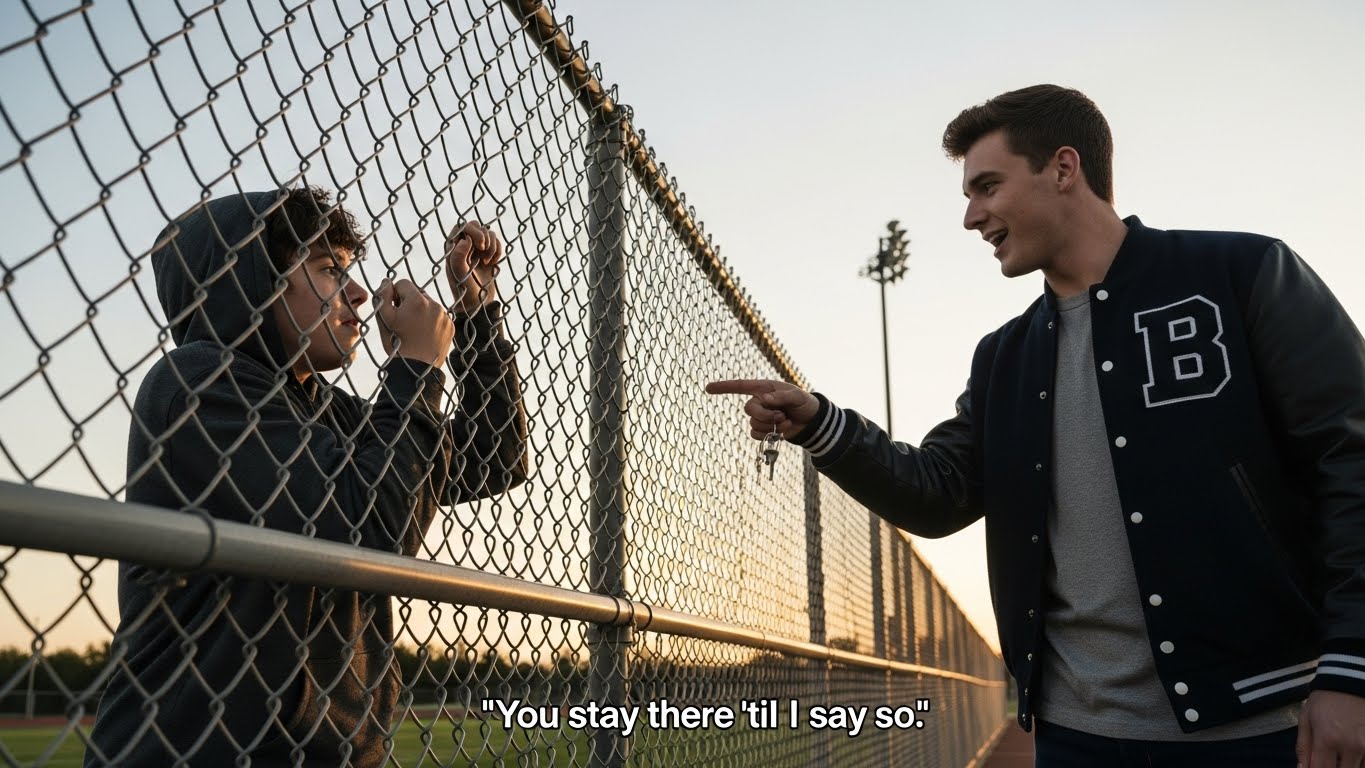
I stood there, gripping the diamond-shaped holes of the chain-link fence, my knuckles turning white. The sun was beginning to dip behind the bleachers of Oak Creek High, casting long, bruised purple shadows across the Astroturf. Most of the other kids were already home, playing video games or arguing about homework. I wasn’t going home. I was stuck in the varsity equipment cage. Again.
“Enjoy the view, Leo!”
Brad’s voice was a bark—loud, distinct, and cruel. He stood about ten feet away, spinning the silver key to the Masterlock on his index finger. He was wearing his letterman jacket, the maroon leather sleeves creaking softly as he shifted his weight. It was eighty degrees out in mid-September, humid enough to make the air feel like soup, but Brad wore that jacket like a suit of armor. To him, it was. It made him invincible in this town.
Behind him, his two shadows—Miller and Davis—were snickering, kicking dirt onto the toes of my beat-up Converse sneakers through the gaps in the fence.
“Come on, Brad,” I said, my voice cracking. I hated that. I hated that my voice decided to betray me right when I needed to sound tough. I cleared my throat, trying to channel some imaginary version of myself that wasn’t terrified. “My mom gets off her shift at six. If I’m not there to watch Sophie, she can’t go to her second job at the warehouse.”
Brad stopped spinning the key. The smile didn’t leave his face, but his eyes went dead. He walked up to the fence, his face pressing close to the wire. I could smell the spearmint gum he chewed aggressively and the faint, stale odor of locker room sweat.
“You think I care about your mom’s shift, Leo?” he whispered. “You spilled Gatorade on my cleats during practice. Do you know how much custom cleats cost? My dad had to order these from a specialist in Chicago.”
“It was an accident. You bumped into me while I was filling the cooler.”
“DETAILS!” Brad shouted, slamming his open palm against the chain-link.
The whole cage rattled. The vibration traveled up my arms. I flinched. I couldn’t help it. It was a reflex, learned from three years of being smaller than everyone else.
“You’re staying here until I finish my workout,” Brad said, stepping back and smoothing his jacket. “Maybe until the janitor comes at nine. Or maybe… maybe you just sleep here. Builds character. Toughens you up. God knows you need it.”
They turned around, laughing high-fiving, and started jogging toward the fifty-yard line, tossing a football back and forth.
I watched them go, a lump of hot coal burning in my throat. I sank to the concrete floor. It was cold and smelled of mildew, rubber, and old fertilizer. I pulled my knees to my chest.
I checked my pockets. My phone was there, miraculously. 14% battery.
I stared at the cracked screen. The background was a picture of my dog, Buster, who died last year. Just another thing I’d lost.
I could call the school office, but the secretaries left at 4:30. I could call the cops, but in Oak Creek, Brad’s dad—Councilman Halloway—practically owned the precinct. If I called the cops, I’d be labeled a snitch. In high school, being a snitch was a terminal diagnosis. The torment would upgrade from ‘locking in cages’ to ‘hospital visits.’
I scrolled to “Mom.” My thumb hovered. If I called her, she’d leave work early. She’d lose her tips for the night. She’d come down here in her diner uniform, smelling of grease and exhaustion, frantic and crying. Brad would mock her. He’d make jokes about her apron or her tired eyes. I couldn’t do that to her. She carried the weight of the world already; I couldn’t add my own pathetic problems to her load.
That left one person.
Arthur.
My thumb hovered over the contact: “Step-Dad (Arthur).”
I groaned, tilting my head back against the metal pole.
Arthur was… nice. That was the worst thing about him. He was a CPA who drove a beige 2014 Toyota Camry. He wore pleated khakis that were always ironed with a sharp crease. He spoke softly. He apologized to waiters when they got his order wrong. He was the kind of guy who stopped at yellow lights and flossed after every meal.
He had married my mom two years ago, stepping into the hole my real dad left behind. My real dad died when I was six. A massive heart attack. I barely remembered him, but the photos showed a giant of a man—broad shoulders, loud laugh, always covered in grease from the garage. I missed the idea of him. I missed the idea of having a father who would tear this fence down with his bare hands and terrify bullies just by looking at them.
Instead, I had Arthur. Arthur, who collected stamps. Arthur, who drank herbal tea.
If I called Arthur, he would come. He would ask Brad nicely to open the gate. Brad would laugh at him. Arthur would probably threaten to “write a letter to the principal,” and Brad would just throw the key into the tall grass. It would be humiliating.
But I had to pick up Sophie. My little sister was seven. She couldn’t be left alone.
I hit call.
It rang once.
“Leo?” Arthur’s voice was calm, almost monotone. “Everything okay? You’re usually home by now.”
“I… I need a ride,” I whispered, turning my back to the field so Brad wouldn’t see me on the phone. “I’m at the field. There’s a… situation.”
“What kind of situation?”
“Just come. Please. Don’t tell Mom.”
“I’m ten minutes away. I just left the office. Hang tight.”
I hung up and put my head in my hands. Great. Now I was going to be rescued by a man who wore sweater vests unironically. This was going to be the longest afternoon of my life.
CHAPTER 2: The Accountant
Ten minutes felt like ten years.
The sun was almost gone now. The stadium lights hadn’t turned on yet, leaving the field in a gray, murky twilight. Brad and his goons were running drills. Every time they ran past the cage, Miller would spit on the ground near my shoes.
“Your daddy coming to save you?” Brad yelled from the end zone, breathless from a sprint. “Oh wait, that’s right. You don’t have one!”
I grit my teeth so hard my jaw ached. Tears pricked at the corners of my eyes, but I refused to let them fall. I wouldn’t give him that satisfaction.
Then, I saw it. The beige Camry turned into the empty school parking lot.
My stomach dropped. It looked so small, so harmless against the massive, lifted Ford F-150s and Ram trucks the football players drove. It was a car for people who followed the rules.
Arthur stepped out. He was wearing his work clothes—a light blue button-down shirt tucked neatly into beige slacks. A brown leather belt. Sensible loafers. He looked like he was about to do someone’s taxes, not break a siege. He adjusted his rimless glasses, looked around the empty lot, and started walking toward the field.
Brad saw him. He whistled sharply. Miller and Davis stopped their drills. They jogged over to the gate, forming a wall of muscle and arrogance between Arthur and me.
“Can I help you, sir?” Brad asked. His voice dripped with mock politeness, the kind adults usually bought but I knew was poison. He puffed his chest out. Brad was seventeen, six-foot-two, and pure steroid-fed muscle. Arthur was fifty-five, five-foot-nine, and shrinking.
“I’m here for Leo,” Arthur said. His voice was level. No anger. Just a statement of fact.
“Leo?” Brad looked back at the cage, feigning surprise. “Oh, he’s in timeout. He’s reflecting on his clumsiness. We’re helping him learn responsibility.”
“Open the gate, son,” Arthur said.
“Or what?” Brad smirked, stepping closer. He towered over Arthur. “You gonna audit me? You gonna file a complaint?”
Miller and Davis laughed, a cruel, hacking sound.
I closed my eyes. This was it. The part where Arthur backs down. The part where he tries to reason with them, gets shoved into the dirt, and I have to watch my stepfather get bullied by a teenager. I wanted to dissolve into the concrete.
“I’m asking you politely,” Arthur said. He didn’t step back. He didn’t look up at Brad’s face. He was looking at Brad’s shoes. “Unlock the gate.”
“Get lost, old man,” Brad sneered, leaning down so his face was inches from Arthur’s. “Before you break a hip. This is varsity turf.”
Arthur sighed. It was a long, deep sigh, like he was disappointed that it had come to this. He took his glasses off, pulled a microfiber cloth from his pocket, cleaned them meticulously, and put them back on.
Then, he reached into his slacks pocket.
I froze. Was he calling the cops?
Instead, he pulled out a lighter.
It wasn’t a cheap plastic Bic. It was an old, battered silver Zippo. I had never seen Arthur smoke. I didn’t even know he owned a lighter.
He flicked it open. The flame danced in the twilight. He stared at the flame for a second, his face completely expressionless, and then snapped it shut.
Clink.
The sound was small, but in the silence of the standoff, it felt loud.
That’s when I felt it.
A vibration.
It started in the concrete floor of the cage. A low hum that traveled up through the soles of my sneakers and rattled my teeth.
Then came the sound.
It wasn’t a car engine. It wasn’t thunder.
The low rumble grew into a roar. A deep, guttural, earth-shaking roar that drowned out the crickets and the distant highway traffic. It sounded like a landslide. It sounded like a dragon waking up.
Brad looked around, confused. The smirk faltered. “What is that?”
The sound got louder. It was coming from the main road entrance to the school.
Suddenly, the first bike turned the corner.
It wasn’t a sleek racing bike. It was a chopper. High handlebars (“ape hangers,” my real dad used to call them), custom chrome pipes, matte black paint that seemed to absorb the light. The rider was massive, wearing a cut-off denim vest over a black leather jacket.
Then a second bike. A third. Ten. Twenty.
They kept coming. A tidal wave of chrome, steel, and black leather poured into the school parking lot. The noise was deafening. It wasn’t just loud; it was physical. It punched you in the chest.
Brad, Miller, and Davis stepped back, their eyes wide. They looked at the parking lot, then back at Arthur.
Arthur hadn’t moved. He was just standing there, hands loosely in his pockets, watching the procession with the same mild interest he used when watching the Weather Channel.
The bikers didn’t park in the designated spots. They rode right up onto the grass, their tires tearing up the manicured lawn Brad was so proud of. They circled the field, their engines revving in a chaotic symphony of intimidation. There had to be fifty of them.
The lead biker killed his engine. The silence that followed was heavier than the noise. He kicked his kickstand down and swung a heavy boot over the seat.
This guy was terrifying. A grey beard that reached his chest, tattoos covering every inch of exposed skin, a scar running through his eyebrow. He wore a patch on his back—a skull wearing a crown of thorns. The bottom rocker read: “PRESIDENT.”
He walked past the stunned football players. He walked right up to Arthur.
Brad looked like he was about to wet himself. He looked at Arthur, waiting for the old accountant to run away. Waiting for Arthur to be just as scared as he was.
The biker stopped two inches from Arthur’s face. He smelled of gasoline, leather, and stale tobacco. He was a giant.
Then, the biker did something impossible.
He lowered his head.
“We got the signal, Artie,” the biker rumbled. His voice sounded like gravel in a blender. “We were just passing through County Line. Came as fast as we could.”
Arthur nodded slowly. He looked at the biker, a small smile playing on his lips. “Good to see you, Gunner. Sorry to interrupt the ride.”
“For you? Never,” Gunner said. He looked at Arthur with something I had never seen anyone give my stepfather: Reverence.
Arthur tilted his head toward Brad.
“This young man,” Arthur said, his voice still soft, still calm, “seems to have lost the key to the equipment cage. And he seems to have forgotten his manners.”
Gunner turned his head slowly to look at Brad. A slow, predatory grin spread across his face, revealing a gold tooth. Behind him, fifty other bikers stepped off their machines. Chains clinked. Knuckles cracked. Boots crunched on the gravel.
“Is that right?” Gunner asked Brad.
Brad was trembling. Visibly shaking. He held the key up, his hand shaking so bad the metal jingled like a wind chime.
Arthur looked at me through the fence. For the first time ever, the “boring” accountant didn’t look like a CPA. He stood straighter. His eyes were hard. He looked like a general commanding an army of wolves.
“Leo,” Arthur said. “Grab your bag. We’re leaving.”
CHAPTER 3: The Ride Home
Brad didn’t just unlock the gate; he practically fell over himself trying to get the key into the lock. His hands were shaking so violently that he dropped the key twice.
Nobody laughed.
Fifty bikers stood in a semi-circle behind Arthur, their arms crossed, their faces grim masks of judgment. They watched Brad fumble in the dirt.
“Take your time, son,” Gunner said. His voice was deceptively light, but there was a razor blade hidden in the tone. “We got all night. But Artie here needs to get home for dinner.”
Brad finally managed to jam the key in and twist it. The lock clicked. He yanked the gate open and scrambled back, pressing himself against the fence as if trying to merge with the chain-link. He looked at me, his eyes pleading. Please don’t kill me.
I stepped out of the cage. My legs felt like jelly, but not from fear anymore. It was pure adrenaline shock.
I walked over to Arthur. Up close, he looked exactly the same as he did every morning over breakfast—mild, unassuming. But the energy radiating off him was different.
“You okay, Leo?” Arthur asked, adjusting his glasses again.
“Yeah,” I breathed. “I’m okay.”
Arthur turned to Gunner. He reached out and patted the giant biker on the arm. “Thanks, Gunner. I appreciate it. I’ll reach out next week.”
“You better,” Gunner grunted. He glanced at Brad, who was hyperventilating. “You want us to… teach the boy a lesson about respect? Maybe strip that fancy jacket off him?”
Arthur looked at Brad. Brad flinched, covering his face with his hands.
“No,” Arthur said softly. “I think he’s learned it.”
Arthur turned to Brad. “I expect you to stay away from Leo. And I expect you to fix the divots your friends kicked into the grass. Am I clear?”
“Yes, sir,” Brad squeaked. “Yes, sir. I promise.”
“Good.” Arthur turned to me. “Let’s go. Your mom made meatloaf.”
We walked to the Camry. The sea of bikers parted for us like the Red Sea. As we walked through, tough men with scars and prison tattoos nodded respectfully at Arthur.
“Evening, Artie.” “Good to see ya, Boss.” “Take care, Artie.”
Boss?
I got into the passenger seat of the Camry. It smelled like it always did—vanilla air freshener and old receipts. Arthur got in the driver’s side, buckled his seatbelt, and checked his mirrors.
Outside, the engines roared to life. It was a thunderous salute. As Arthur put the car in reverse, the bikers began to peel out, exiting the lot in a precise, military formation.
We drove out of the school lot in silence. Arthur used his turn signal. He stopped completely at the stop sign. He drove exactly thirty-five miles per hour.
I stared at him. I couldn’t process what had just happened. My brain was short-circuiting.
“Arthur?” I asked after we passed the first intersection.
“Yes, Leo?”
“Who… who are those guys?”
Arthur kept his eyes on the road. “Friends. From a long time ago.”
“Friends? They called you ‘Boss’. That guy, Gunner… he looked like he kills people for fun. And he bowed to you.”
Arthur sighed. He reached over and turned down the AC.
“Leo, before I was an accountant… I had a different life. A very different life.”
“You were a biker?”
“I wasn’t just a biker,” Arthur said, his grip tightening slightly on the steering wheel. “I was a founder. The Iron Saints. We started it in the eighties.”
“You?” I looked at his sweater vest. “You founded a biker gang?”
“Motorcycle club,” he corrected automatically. “And yes. But I left that life. I met your mother, and I realized I wanted peace. I wanted quiet. I wanted to do taxes and mow the lawn and sleep at night without worrying about the police kicking down my door.”
He glanced at me, his eyes serious behind the lenses.
“I traded the leather for the khakis because I wanted to be safe. For her. And for you.”
I sank back into the seat. I looked at this man—this man I had dismissed as a coward, as a bore, as a placeholder for my ‘real’ dad.
“Does Mom know?”
“She knows enough,” Arthur said. “She knows I have a past. She doesn’t ask for details.”
We pulled up to a red light. Arthur stopped smoothly.
“Leo,” he said, turning to me. “What happened today… I don’t want you to think that violence is the answer. Or that fear is respect. It’s not.”
“Brad respects you now,” I pointed out.
“Brad fears me,” Arthur corrected. “There’s a difference. I’d rather be respected for being a good man than feared for being a dangerous one. But…” He paused, a flicker of something dark and ancient passing through his eyes. “Sometimes, you have to remind the wolves that the shepherd has teeth.”
The light turned green. Arthur gently pressed the gas.
“Can we keep this between us?” he asked. “The details, I mean. Your mom worries.”
I looked at him. Really looked at him.
“Yeah,” I said. “Yeah, Arthur. We can keep it.”
“Thanks, son.”
He turned on the radio. Soft jazz filled the car.
We were three blocks from home when my phone buzzed. It was a text from a random number.
I opened it.
It was a photo. Grainy, taken from a distance. It showed Arthur standing in the parking lot, surrounded by the bikers.
The caption read: Who is he really?
My heart skipped a beat.
“Arthur,” I said, my voice tight.
“Hmm?”
“Someone took a picture.”
Arthur’s face didn’t change, but the car swerved slightly, just an inch, before he corrected it.
“Delete it if you can,” he said.
“I can’t. It was sent to me. It’s probably all over the school by now.”
Arthur didn’t say anything for a long moment. He pulled into our driveway, parked the car, and turned off the engine. The silence in the car felt heavy, suffocating.
“Well,” Arthur said, unbuckling his seatbelt. “Then I suppose my quiet retirement is officially over.”
He opened the door and stepped out, heading toward the house to greet my mom and eat meatloaf, leaving me in the car with a phone that was blowing up with messages.
I looked at the house. It looked the same. The lawn was mowed. The flower beds were weeded. But everything had changed. The beige veneer had cracked, and I had no idea what was going to crawl out from underneath it.
CHAPTER 4: The Cracks in the Porcelain
Dinner was meatloaf. It was always meatloaf on Thursdays.
The kitchen smelled of ketchup glaze, roasted onions, and the lavender cleaning spray my mom, Elena, used religiously. It was a smell that usually made me feel safe, wrapped in the predictable cocoon of suburban mediocrity. But tonight, the smell made me nauseous.
I sat at the round oak table, pushing peas around my plate with a fork. Opposite me, Sophie was babbling about her second-grade art project, something about making a giraffe out of toilet paper rolls.
“And then Mrs. Gable said my giraffe had too many spots,” Sophie said, waving a forkful of mashed potatoes. “But giraffes can have as many spots as they want, right, Artie?”
Arthur looked up from his plate. He had changed out of his work clothes. He was wearing a beige cardigan over a white t-shirt. He looked like Mr. Rogers. He looked like the safest man in America.
“That’s right, sweetie,” Arthur said, smiling. But the smile didn’t reach his eyes. His eyes were darting to the window every thirty seconds. “Creativity shouldn’t have limits.”
Mom walked over from the counter, wiping her hands on her apron. She kissed Arthur on the top of his thinning hair. “You barely touched your food, honey. Tough day at the firm? Did the IRS change the tax codes again?”
Arthur flinched. It was microscopic, a tiny tightening of the muscle in his jaw, but I saw it. I saw everything now.
“Something like that,” Arthur said softly. “Just… a lot of audits. A lot of old files being reopened.”
He looked at me. The double meaning hung in the air between us, heavy and invisible like gas from a leak.
My phone buzzed in my pocket. Then again. Then a steady stream of vibrations that made my thigh numb.
“Leo, no phones at the table,” Mom chided gently, sitting down.
“Sorry,” I mumbled.
I slipped my hand into my pocket and silenced it, but I knew what was happening. The picture. The one of Arthur standing in the twilight, surrounded by leather-clad giants, looking like a king. It was spreading. In Oak Creek, gossip moved faster than fiber-optic internet. By tomorrow morning, everyone would know that the town’s quietest accountant had an army on speed dial.
“Did you pick Leo up okay?” Mom asked, cutting into her meatloaf. “I was worried when I didn’t hear from you.”
“Smooth sailing,” Arthur said. “Leo was… hanging out at the field.”
“Yeah,” I lied, my voice sounding tinny to my own ears. “Just watching practice.”
Arthur suddenly stopped chewing. He put his fork down slowly.
“What is it?” Mom asked.
“Did you lock the back door, Elena?”
“I… I think so? Why?”
Arthur stood up. “I’ll just check. Drafty tonight.”
He walked out of the kitchen. I watched him go. He didn’t walk like an accountant anymore. His stride was different—silent, weight on the balls of his feet. He moved like a cat entering a room full of rocking chairs.
I excused myself and followed him, stopping in the shadow of the hallway.
Arthur wasn’t just checking the lock. He was standing by the back sliding glass door, peering out into the dark backyard. He reached up and turned off the patio light, plunging the yard into darkness. Then he stood there, perfectly still, watching the tree line.
“Arthur?” I whispered.
He didn’t jump. He just turned his head slowly.
“Go back to dinner, Leo.”
“Are we in danger?”
Arthur turned back to the window. “Not yet. But secrets have a half-life, Leo. And mine just expired.”
“Who were they? The Iron Saints?”
Arthur sighed. He reached into his pocket and pulled out the Zippo, flipping it over in his fingers. “We were… a brotherhood. A long time ago. We ran things. Not drugs or guns—we kept those out. We were the gatekeepers. But when you hold the gate, you make enemies of the people trying to break it down.”
“Why did you leave?”
He turned to me, his face half in shadow. “Because a war started. A war I didn’t want to fight anymore. And because I met your mother. She was… she was the only clean thing I’d ever seen. I wanted to be worthy of that.”
He looked at the lock on the door. It was a flimsy standard-issue deadbolt. He frowned.
“I need to go to the hardware store tomorrow,” he muttered to himself. “Get reinforced strike plates. Maybe shatter-proof film for the windows.”
“Arthur, you’re scaring me.”
He walked over and put a hand on my shoulder. His hand was heavy, warm, and calloused in places I hadn’t noticed before.
“You don’t need to be scared, Leo. I spent twenty years being Arthur the Accountant so you could have a normal life. But if I have to be Artie the Saint again to keep you safe…”
His eyes darkened, the brown iris shifting into something harder, like old oak.
“…then God help anyone who comes up that driveway.”
He ushered me back to the kitchen. We finished dinner in silence. But every time a car drove past the house, slowing down for the speed bump, Arthur’s hand would drift toward the steak knife on the table, just an inch, before pulling back.
The porcelain mask of our suburban life hadn’t just cracked. It had shattered.
CHAPTER 5: The Red Sea
Walking into Oak Creek High the next morning felt like walking onto a different planet.
Usually, I was invisible. I was part of the background texture of the school, like the beige lockers or the water fountains that tasted like pennies. I walked with my head down, shoulders hunched, navigating the hallways with the goal of zero eye contact.
Today, I couldn’t be invisible if I was on fire.
I stepped off the bus, and the noise level dropped. It started at the bike rack and rippled outward. Kids stopped texting. Groups of cheerleaders stopped giggling.
They were looking at me.
Not the “look at the loser” stare. This was different. It was curiosity mixed with something else. Caution.
I walked toward the main entrance. A group of seniors, usually the ones who blocked the doors and made freshmen pay a “toll,” saw me coming. They parted. They stepped aside, clearing a path wide enough for a truck.
“Morning, Leo,” one of them mumbled, looking at his shoes.
I gripped my backpack straps tighter. My heart was hammering against my ribs. I felt like an impostor. I hadn’t done anything. I was still the same scrawny kid who couldn’t throw a spiral. But Arthur… Arthur had changed the gravity of my world.
I got to my locker. I spun the combination—18-24-06.
“Hey.”
I jumped, spinning around.
It was Brad.
Yesterday, Brad had been a titan. Today, he looked smaller. He wasn’t wearing his letterman jacket. He was wearing a plain grey hoodie. He looked tired.
“Brad,” I said, bracing myself for a shove.
Brad looked around nervously. “Look, man. The grass… I’m fixing it. I got up at five this morning. I raked the gravel back. I’m buying sod with my allowance.”
I stared at him. “Okay.”
“And… and tell your dad… tell him I didn’t mean anything by it. Just having fun. You know?”
“He’s my stepdad,” I said automatically.
“Whatever,” Brad whispered, leaning in. “Just… my cousin knows about the Iron Saints. He said they used to run the tri-state area. He said they once burned down a bar just because the owner disrespected a waitress.” Brad swallowed hard. “Is that true?”
I didn’t know. But looking at Brad’s pale face, I realized the truth didn’t matter. The legend was doing the heavy lifting.
“Arthur doesn’t like bullies, Brad,” I said, trying to keep my voice steady.
Brad nodded frantically. “Got it. Loud and clear. We’re cool, Leo. We’re cool.”
He scurried away like a frightened rat.
I let out a breath I didn’t know I was holding. I felt a surge of power—intoxicating and dangerous. So this was what it felt like to be Brad. To have people fear you. I didn’t like it. It felt cold.
I opened my locker.
A small, folded piece of paper fluttered out and landed on the linoleum floor.
It wasn’t notebook paper. It was heavy, cream-colored cardstock. Expensive.
I picked it up. There was no name on the outside.
I unfolded it.
Inside, there was no text. No “Kick Me” sign. No threat written in cutout magazine letters.
There was just a drawing.
It was done in black ink, precise and professional. It depicted a snake—a viper—coiled around a cross, squeezing it until the wood splintered.
A chill went down my spine that had nothing to do with the school’s AC.
“Nice picture.”
I whipped around. A substitute teacher was standing there. I didn’t recognize him. He was young, maybe late twenties, wearing a tweed jacket that looked too big for him. He had slicked-back dark hair and a smile that showed too many teeth.
“Mr…?” I asked, hiding the note behind my back.
“Mr. Vane,” he said. “Subbing for Mrs. Higgins. English Lit.”
He looked at me, his eyes drifting to the hand behind my back.
“You know, Leo,” he said, his voice smooth and oily. “History is full of stories about kings returning from exile. But the problem with returning kings is that someone has usually taken their throne while they were gone.”
“I… I have to get to class,” I stammered.
“Of course,” Mr. Vane said, stepping aside. “Run along. And give my regards to your father. Tell him… tell him the Viper hasn’t forgotten the debt.”
I ran. I didn’t walk. I ran through the hallways, dodging confused students, until I hit the bathroom. I locked myself in a stall and stared at the drawing.
The Viper.
Arthur had mentioned a war. He had mentioned enemies.
I pulled out my phone. I needed to warn him.
But before I could dial, a notification popped up. A local news alert.
“DISTURBANCE AT DOWNTOWN DINER. POLICE RESPONDING.”
My blood froze.
The Downtown Diner.
That was where Mom worked.
CHAPTER 6: The Check is Due
I didn’t think. I reacted.
I ran out of the school. I burst through the emergency exit doors, setting off the alarm—a shrill, piercing wail that echoed across the campus. I didn’t care.
I sprinted across the parking lot. I didn’t have a car. I didn’t have a bike.
“Leo!”
It was Davis, one of Brad’s goons. He was sitting in his truck, skipping first period. He saw me running, saw the panic on my face.
“I need a ride!” I screamed at him. “I need a ride to the diner! Now!”
Davis hesitated. He looked at the school, then at me. Maybe he saw the terror in my eyes. Maybe he remembered the bikers.
“Get in,” he grunted.
I scrambled into the passenger seat of his lifted Chevy. “Go. Please go.”
Davis peeled out. For once, I was grateful for the reckless way these idiots drove. We tore down Main Street, weaving through traffic.
“What’s happening?” Davis asked, gripping the wheel.
“My mom,” was all I could say.
We skidded into the diner’s parking lot five minutes later.
There were no police cars yet. The alert must have just gone out. But there were motorcycles.
Not the heavy, American iron that Artie’s friends rode. These were crotch rockets—sleek, neon-colored, fast. They looked like angry hornets buzzing in a row. There were six of them.
And right in the middle of the lot was the beige Camry.
The driver’s side door was open. The engine was running.
“Stay here,” I told Davis.
“You don’t have to tell me twice,” he whispered, locking his doors.
I ran toward the diner. The “Open” sign was flickering. The blinds were drawn, which they never were at 9:00 AM.
I pushed the door open. The bell chimed—a cheerful ding-ding that felt obscenely out of place.
The scene inside was frozen, like a photograph taken seconds before a disaster.
The regular customers—Old Man Jenkins, the truckers, the ladies from the church group—were all sitting in their booths, terrified, silent.
Standing by the counter were five men. They wore modern biker gear—kevlar reinforced jackets, full-face helmets held under their arms. They looked like soldiers from the future.
Behind the counter, Mom was pressing herself against the soda machine, her face pale, tears streaming down her cheeks.
And sitting on a stool at the counter, calmly drinking a cup of coffee, was Arthur.
Standing behind him was a man who had to be the leader. He was lean, wiry, with a tattoo of a snake curling up his neck and onto his face. He held a switchblade, idly cleaning his fingernails with the tip.
“Leo, get out!” Mom screamed.
The snake-man turned to look at me. He smiled. “Ah. The cub.”
Arthur didn’t turn around. He took a sip of coffee. “I told you to leave the family out of this, Marcus.”
“You don’t get to give orders anymore, Saint,” Marcus spat. “You forfeited that right when you turned in your colors and became… this.” He gestured at Arthur’s khakis with the knife. “Look at you. You’re a domesticated pet.”
“I’m a father,” Arthur said. “And a husband.”
“You’re a traitor,” Marcus said. He stepped closer, bringing the knife blade to rest gently against the back of Arthur’s cardigan. “You owe the Vipers, Artie. You burned our warehouse in ’98. You cost us millions.”
“That warehouse was full of trafficked kids, Marcus,” Arthur said, his voice flat. “I did the world a favor.”
“Business is business,” Marcus shrugged. “And now, the debt is due with interest.” He looked at Mom. “She’s pretty. For an older broad. Maybe she works off your debt?”
The air in the diner changed.
It happened in a split second.
Arthur spun on the stool.
It was faster than my eyes could follow. One moment he was sitting, the next he was standing.
He caught Marcus’s wrist—the one holding the knife—with his left hand. There was a sickening crack sound, like a dry branch snapping.
Marcus screamed, dropping the knife.
Arthur didn’t stop. He drove his right palm into Marcus’s chin—an uppercut that lifted the man off his feet. Marcus crashed backward into a table, sending napkin dispensers and ketchup bottles flying.
The other four men roared and surged forward.
“Get down!” Arthur shouted at Mom.
He grabbed the heavy ceramic sugar dispenser from the counter and hurled it. It connected with the first attacker’s forehead with a dull thud. The man dropped like a stone.
Arthur wasn’t fighting like a boxer. He was fighting like a machine. Efficient. Brutal. No wasted movement.
One attacker swung a heavy chain. Arthur ducked, the chain shattering the pie display case behind him. Glass rained down on Mom.
Arthur grabbed a pot of boiling coffee from the burner. He didn’t hesitate. He threw the hot liquid into the face of the chain-wielder. The man howled, clawing at his eyes.
Arthur kicked him in the knee, shattering the joint, and shoved him into the fourth man.
But the fifth man—a giant with brass knuckles—caught Arthur from the side. He punched Arthur in the ribs. I heard the crack of bone.
Arthur grunted, stumbling back against the counter. He looked old suddenly. He gasped for air, clutching his side.
“Dad!” I yelled, stepping forward.
“Stay back, Leo!” Arthur wheezed.
The giant raised his fist for a killing blow. Marcus was stumbling back to his feet, blood pouring from his mouth, pulling a gun from his waistband.
“End him!” Marcus gargled.
Arthur looked at me. His glasses were gone. His lip was split. But he wasn’t looking at me with fear. He was looking at me with apology.
Clink.
The front door opened again.
But it wasn’t the bell.
It was the sound of a shotgun racking a shell.
“I suggest,” a gravelly voice rumbled from the doorway, “you boys drop the toys. Unless you want to leave here in pieces.”
Gunner stood in the doorway. He was holding a sawed-off shotgun.
Behind him, filling the parking lot, were more bikers. But not just the Iron Saints this time. There were others. Different patches. Different colors.
The entire parking lot was a sea of leather.
Gunner stepped into the diner, racking the shotgun again for effect.
“Nobody touches the Saint,” Gunner growled. “Not while I’m breathing.”
Marcus looked at Gunner, then at the army outside. He looked at his gun. He realized the math didn’t work.
He lowered the weapon.
“This isn’t over, Artie,” Marcus hissed, wiping blood from his chin. “The Vipers are everywhere.”
“So are we,” Arthur said, straightening up and adjusting his cardigan, though his face was gray with pain. “Get out. And tell your boss… the Saint is back.”CHAPTER 7: The Saint in the Cardigan
The ride home from the hospital was quiet.
Arthur had broken two ribs and fractured his wrist. His face was a map of bruises—purple, yellow, and angry red. He sat in the passenger seat of the Camry (which Gunner had driven home for us), holding a bag of frozen peas to his jaw.
I sat in the back with Mom. She hadn’t let go of my hand since the police took our statements. The official story? A robbery gone wrong. Self-defense. The police chief, an old friend of Gunner’s, didn’t ask too many questions about why a CPA took down five armed bikers.
When we pulled into the driveway, the house looked different.
It wasn’t just a house anymore. It was a fortress.
Two bikers I didn’t recognize were standing at the end of the driveway, arms crossed. Another was sitting on his bike on the front lawn. Gunner was on the porch, smoking a cigar.
Arthur groaned as he tried to get out of the car. I rushed to help him, but Mom was faster. She slid her arm under his good side and hoisted him up. She was small, but she was fierce.
“I can walk, Elena,” Arthur mumbled through his swollen lip.
“You can barely stand, you stubborn old mule,” she retorted, but her voice was shaking.
We got him inside and onto the living room sofa. Gunner followed us in, locking the door behind him.
“Perimeter is set, Boss,” Gunner said. “The Vipers won’t come within ten miles of this zip code. We called in chapters from Jersey and Philly. We have the numbers now.”
Arthur nodded, closing his eyes. “Thank you, Gunner. But… this isn’t a long-term solution.”
Arthur opened his eyes and looked at Mom. Then at me.
“I have to go,” he said.
The room went dead silent.
“What?” I asked.
“I have to leave,” Arthur said, his voice straining. “As long as I’m here, you’re targets. Marcus won’t stop. The Vipers… they have long memories. If I leave, if I go back to the life and draw them away, you two will be safe.”
He tried to sit up, wincing in pain. “I’ll pack a bag tonight. Gunner can get me a bike. I’ll be gone by morning.”
“No,” Mom said.
It wasn’t a shout. It was a whisper. But it had more power than the shotgun rack I’d heard earlier.
Arthur looked at her. “Elena, you saw what happened. I’m dangerous. I’m not… I’m not the man you married.”
“You are exactly the man I married,” Mom said, stepping forward. She knelt beside the sofa, taking his bruised hand in hers.
“I knew, Arthur,” she said softly. “When we met. I saw the scars. I saw the way you scanned every room we entered. I saw the tattoo you tried to burn off your shoulder.”
Arthur froze. “You knew?”
“I didn’t know the details,” she admitted. “But I knew you had walked through fire to get to me. And I knew you chose to stay in the cool water. You chose peace. Every single day, you woke up and chose to be boring Arthur the Accountant.”
She squeezed his hand.
“You don’t get to run away to protect us,” she said, tears finally spilling over. “You stay and you fight for us. That’s what a father does. That’s what a husband does.”
Arthur looked at her, his tough, battered face crumbling. The mask of the stoic general fell away, leaving just a man who loved his wife desperately.
“I just… I wanted you to be safe,” he whispered.
“We are safe,” I said, stepping up beside Mom. “We have the Iron Saints. And we have you.”
Arthur looked at me. He looked at the bruises on his own knuckles—evidence of the violence he hated, violence he had used only to save us.
“Okay,” Arthur breathed, leaning back into the cushions. “Okay. I’m staying.”
Gunner grinned from the doorway. “Good choice, Boss. I wasn’t gonna let you leave anyway. I parked my bike behind your Camry.”
CHAPTER 8: The Sleeping Dragon
It’s been a month since the incident at the diner.
Things have returned to normal. Mostly.
The Vipers never came back. Rumor has it that a “summit” was held in an abandoned warehouse near the docks. Arthur didn’t go. Gunner went in his place. Apparently, the Iron Saints made it very clear that Oak Creek was a protected territory. The terms were simple: Stay out, or we burn you down. The Vipers took the deal.
At school, the atmosphere has shifted. I’m not the “cool kid”—I’m still terrible at football and I still read comic books. But nobody locks me in cages anymore.
Brad even sits at my table sometimes. He doesn’t say much, but he brings me extra dessert from the cafeteria line. It’s a peace offering. I take it.
On Friday night, I came home late from the library.
The house was quiet. The biker sentries were gone—Arthur had sent them home last week, saying the neighborhood needed to sleep without hearing Harleys idling at 3 AM.
I found Arthur on the back porch.
He was sitting in his rocking chair, a mug of herbal tea in his hand. The cast on his wrist was gone, replaced by a brace. The bruises on his face had faded to faint yellow shadows.
I sat on the step next to him.
“Hey,” I said.
“Hey, Leo,” he replied. “Homework done?”
“Yeah. Math is killer this year.”
“I can help you with that,” he offered. “I am pretty good with numbers.”
We sat in silence for a while, listening to the crickets and the distant hum of the highway. It was the same soundscape as before, but it felt different now. It felt earned.
“Arthur?”
“Yeah, kid?”
“Do you miss it?” I asked. “The power? The respect? Being the ‘Boss’?”
Arthur took a sip of tea. He looked out at the dark yard, where the fireflies were dancing.
“Power is heavy, Leo,” he said softly. “It’s a weight you carry on your back every second of every day. You have to watch every shadow. You have to doubt every handshake.”
He set the mug down and looked at me.
“Respect is different. What those boys showed me… that wasn’t just because I could fight. It was because when I was in charge, I made sure they got home to their families. I made sure they had rules.”
He reached into his pocket and pulled out the silver Zippo. He held it up to the moonlight.
“But do I miss it?” He flicked the lighter open. The flame flared up, illuminating his glasses and the deep lines around his eyes. “No. I don’t miss the noise. I like the quiet.”
He snapped the lighter shut. Clink.
“It takes a lot more strength to be kind than it does to be cruel, Leo. Remember that. Any idiot can throw a punch. It takes a man to catch one and not throw it back until he absolutely has to.”
He stood up, groaning slightly as his healing ribs stretched.
“Come on. Your mom made apple pie. Let’s go inside.”
I watched him walk into the house. He walked slowly, checking the lock on the sliding door as he passed it. He looked like a boring, middle-aged accountant in a beige cardigan.
But I knew better now.
I looked at the closed door, at the warm yellow light spilling out from the kitchen where my family was safe.
I used to wish my dad was a superhero. I used to wish he was John Wick or Captain America. I used to be embarrassed that he stopped at yellow lights and flossed his teeth.
I stood up and brushed the dirt off my jeans.
Arthur wasn’t a coward. He was a dragon curling himself into a ball to keep us warm. He was the most dangerous thing in the world, pretending to be harmless for the sake of love.
And that was cooler than any leather jacket.
I opened the door and stepped into the warmth.
“Save me a slice!” I called out.
“Wash your hands first!” Arthur called back.
I smiled.
“Yes, sir,” I whispered. “Yes, sir.”