“STOP. That’s My Wife’s Grave.” The Stranger Screamed. Then He Saw My Eyes.
Chapter 1: The Girl in the Window
I was nine years old the first time I saw a grown man fall to his knees in the mud, ruined by the sight of my face.
It happened on a Tuesday, a day that smelled like wet asphalt and dead leaves. Tuesday was usually oatmeal day at the Sunflower Home for Children, a crumbling Victorian house on the outskirts of Columbus, Ohio, that had seen better decades, let alone better days.
I sat by the bay window on the second floor, the rubber tires of my wheelchair squeaking against the hardwood as I maneuvered for a better view. Down below, the other kids were playing kickball in the drizzle. I watched them the way a scientist watches bacteria in a petri dish—curious, but separated by a layer of glass I couldn’t breach.
“Lily-bug, you’re gonna fog up the glass with all that sighing,” a deep voice rumbled behind me.
It was Big Al—Albert—the home’s custodian and unofficial protector of the runts. He was a mountain of a man with a beard like steel wool and a heart made of marshmallow fluff.
“I’m not sighing, Al,” I said, spinning my chair around. “I’m observing. Did you know Timmy cheats? He steps over the base every time.”
Al chuckled, tossing a heavy wool blanket over my lap. “Timmy steps over a lot of things. But never mind him. You know what today is?”
I went quiet. My hands tightened on the rims of my wheels. “October 15th.”
“Mrs. Harrison is warming up the van,” Al said gently. “She said you asked to go.”
“I did.”
October 15th was the day I was born. It was also the day my mother died. For nine years, I had been the trade-off. Her life for mine. It was a transaction I hadn’t agreed to, but one I paid for every time I looked in the mirror and saw her blue eyes staring back at me from a face she never got to kiss.
Getting me into the van was a production. The Sunflower Home didn’t have a fancy hydraulic lift; it had a rusty ramp and Al’s biceps. By the time we were buckled in, the rain had turned from a drizzle to a steady, depressing drumbeat.
Mrs. Harrison drove. She was a woman made of sharp angles and soft sweaters, the kind of person who could yell at a truancy officer and bake cookies in the same hour.
“We don’t have to stay long, Lily,” she said, eyeing me in the rearview mirror. “The weather is turning.”
“I just want to say hi,” I whispered. “I’ve never said hi before.”
The drive to Oakland Cemetery took forty minutes. The gravestones looked like crooked teeth jutting out of the gray earth. We parked near the eastern edge, where the old oak trees strangled the sunlight.
Mrs. Harrison struggled with the wheelchair in the sodden grass. The mud sucked at the wheels, fighting us with every step.
“I can walk part of it,” I lied. My legs were dead weight, useless since birth due to spina bifida.
“Hush now,” Mrs. Harrison panted, pushing harder. “We’re almost there. It’s right under that—”
She stopped.
I leaned forward, squinting through the rain. “Mrs. Harrison?”
“There’s someone there,” she murmured, her voice tight.
There was. A man.
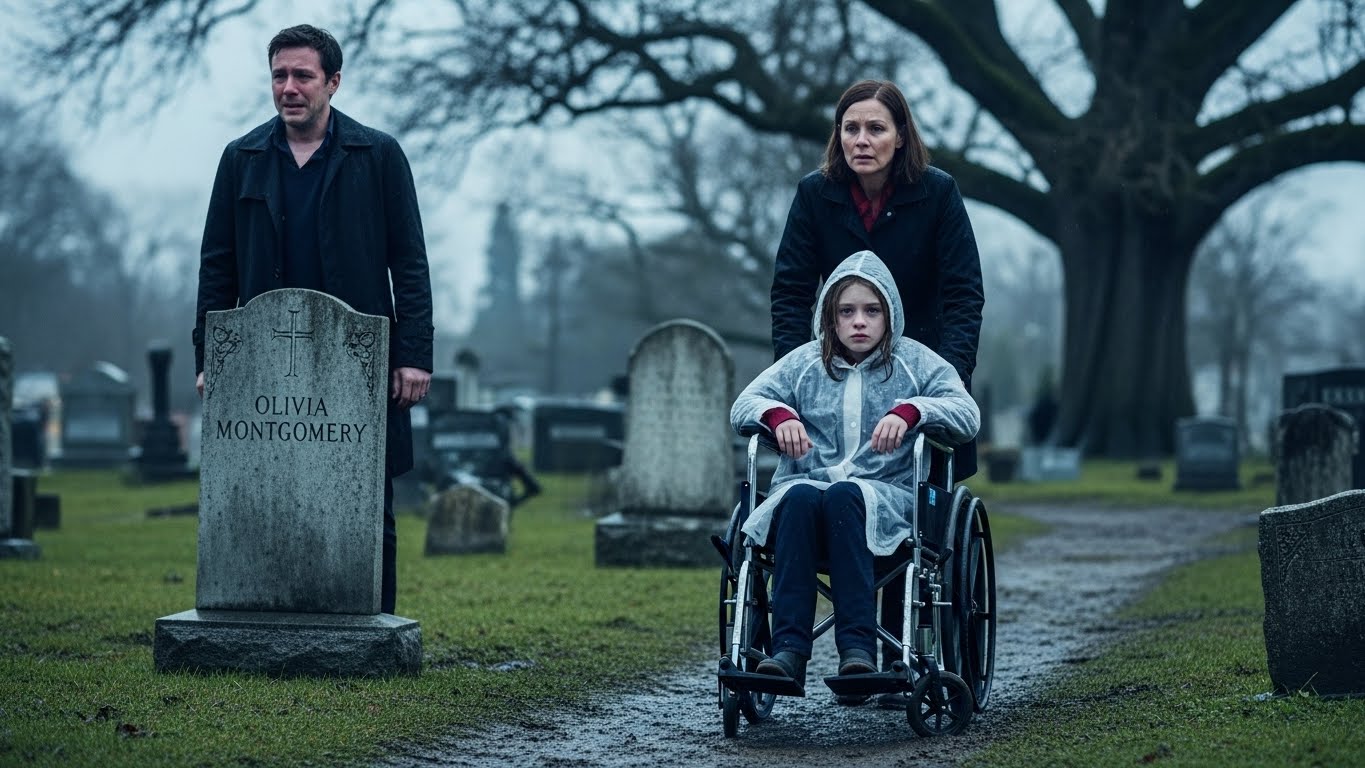
He was standing over the grave marked Olivia Montgomery. He wasn’t like the people we usually saw in town—tired, worn-down folks in denim. This man was wearing a black trench coat that looked like it cost more than the orphanage’s entire yearly budget. He was tall, broad-shouldered, and standing so still he could have been a statue.
Except for his shoulders. They were shaking.
“Maybe we should come back,” Mrs. Harrison whispered, turning the chair.
“No,” I said, louder than I intended.
The man turned.
The movement was sharp, aggressive. He spun around like a predator disturbed at a kill. His face was wet, but I couldn’t tell if it was rain or tears. He was handsome in a terrifying way—sharp jaw, dark eyes that looked like shattered glass.
“This is a private plot,” he barked, his voice cracking like a whip. “Get out.”
Mrs. Harrison stiffened, her protective instinct flaring. “Excuse me, sir. We have every right to be here. This is a public cemetery.”
“I said leave!” The man took a step toward us, his hands balling into fists at his sides. “I am grieving my wife. I don’t need an audience!”
“Your wife?” Mrs. Harrison stepped in front of me, shielding me. “Sir, Olivia Montgomery was a widow. Her husband died before she gave birth.”
The man stopped. He looked at Mrs. Harrison as if she had just slapped him. Then, he laughed—a jagged, horrible sound.
“Died?” He dragged a hand down his face. “Is that the story? No. I didn’t die. I just… I wished I had.” He looked back at the headstone. “I come here every year on this cursed day to apologize to her. For surviving. For letting our daughter die with her.”
My heart hammered against my ribs like a trapped bird. Daughter? Die?
I pushed my wheels forward, rolling out from behind Mrs. Harrison.
“Sir?” I said.
The man looked down. His annoyance vanished, replaced by a confusion that rapidly curdled into shock. He stared at my wheelchair. Then his eyes moved up to my hands, gripping the armrests. Then my chin.
And finally, my eyes.
He made a sound I’ll never forget—a guttural, strangled gasp, like the air had been punched out of his lungs.
“Impossible,” he whispered.
He swayed, his knees hitting the mud with a wet thud. He didn’t seem to notice the grime ruining his expensive trousers. He crawled toward me, ignoring Mrs. Harrison’s warning shout.
“Sir, stay back!” Mrs. Harrison warned.
“Olivia?” he breathed, reaching a trembling hand toward my face.
I didn’t flinch. I sat there, frozen, looking into eyes that were the exact same shade of blue as mine.
“I’m not Olivia,” I said, my voice trembling. “I’m Lily.”
The man froze, his hand hovering inches from my cheek. Rain dripped from his nose. He looked at me with a hunger so raw it terrified me. He was searching my face, cataloging every freckle, every curve.
“Lily?” he choked out. “You… you died. The doctors told me. They said the trauma… the cord…”
“I didn’t die,” I said simply. “I’m right here.”
He collapsed forward, his forehead resting on the metal footrest of my wheelchair, and began to sob. It wasn’t a quiet cry. It was the wailing of a man who had been holding his breath for nine years and finally, finally exhaled.
Chapter 2: The Ghost in the Machine
The drive back to the orphanage felt like a funeral procession, but in reverse. We were leading, and the black luxury sedan was following us, close on our bumper.
Mrs. Harrison kept glancing in the rearview mirror, her knuckles white on the steering wheel. “I don’t like this, Lily. This man… he’s unstable.”
“He’s sad,” I said, staring out the window at the gray Ohio sky. “He’s really, really sad.”
“Sadness makes people do dangerous things,” she muttered.
When we pulled into the gravel driveway of Sunflower Home, the rain had stopped, leaving everything slick and cold. Big Al was waiting on the porch. He took one look at Mrs. Harrison’s face, then at the strange car pulling in behind us, and he stood up straighter, crossing his massive arms.
The stranger—Jackson, he had said his name was Jackson—stepped out of his car. He was a mess. His suit was caked in mud, his hair plastered to his skull, but he walked with a terrifying purpose.
We sat in the visitation room. It was a bleak room with yellowing walls and a smell of stale coffee. Jackson sat on one of the folding metal chairs. It looked like it might buckle under his intensity.
“Explain,” Jackson said. His voice was no longer shaking. It was cold, hard steel. “Now.”
Mrs. Harrison placed a file on the table. “This is Lily’s intake form from nine years ago. Mother: Olivia Montgomery. Deceased during childbirth. Father: Unknown/Deceased. Lily was placed in state care immediately due to special needs requiring medical intervention.”
Jackson picked up the file. His hands were shaking again, but with rage, not sorrow. “Special needs? You mean the spinal bifida?”
“Yes,” Mrs. Harrison said, surprised. “How did you—”
“Because I’m a neurosurgeon,” Jackson snapped. “And because we knew. We knew before she was born. We had a plan. We had specialists lined up at Johns Hopkins.”
He slammed the file shut. “I was in a car accident driving Olivia to the hospital. A drunk driver ran a red light. I woke up from a coma three weeks later. They told me Olivia died on the table. They told me the baby… my daughter… didn’t make it due to fetal distress.”
He looked at me then. The anger in his face softened into something painful to watch. “I buried a casket. I paid for a headstone. For nine years, I have been visiting an empty box.”
“Why would they lie?” I asked. It was the question hanging in the room like smoke.
Jackson’s jaw tightened. “Because a single man in a coma can’t sign consent forms. Because a baby with a severe disability is a burden to the system, or maybe… maybe someone made a mistake. A clerical error that cost me my entire life.”
Mrs. Harrison softened. She was a good judge of character, and she could see the truth in his pain. “Mr. Bennett… Jackson. If you are her father, we need proof. DNA.”
“Take it,” Jackson said instantly. He rolled up his sleeve. “Take my blood. Take my hair. Take whatever you need. But I am not leaving this building until I know she is safe.”
“She is safe,” Mrs. Harrison said firmly. “This is her home.”
“This?” Jackson looked around the room, his eyes catching the peeling paint, the flickering fluorescent light, the drafty window. “This isn’t a home. It’s a holding cell.”
“It’s better than nothing,” I said defensively.
Jackson looked at me, and his expression crumbled. “No, Lily. It’s not. You deserved… you deserved the nursery we painted. You deserved the ocean. You deserved a father.”
He reached into his pocket and pulled out his phone. “I’m calling my lawyer. I’m calling the lab. We’re doing this stat.”
The next three days were a blur of needles, cotton swabs, and lawyers in expensive suits standing in the hallway of our dusty orphanage.
Jackson didn’t leave. He slept in his car in the driveway. Big Al offered him a blanket on the second night, and I saw them talking on the porch. Al, usually suspicious of rich folks, gave Jackson a cup of coffee. That was Al’s seal of approval.
When the results came in, Mrs. Harrison called us into her office.
She didn’t need to speak. She was crying.
She slid the paper across the desk. Probability of Paternity: 99.999%.
Jackson didn’t cheer. He didn’t smile. He picked up the paper, read it twice, and then closed his eyes. He let out a long, shuddering breath, and a single tear tracked through the stubble on his cheek.
He stood up and walked over to my wheelchair. He knelt down, ruining another pair of suit pants on the floor.
“Hello, Lily,” he whispered, his voice thick. “I’m… I’m your dad.”
“Hi, Dad,” I said. The word felt strange in my mouth, like a foreign candy—sweet, but I wasn’t sure if I should swallow it.
“I’m going to take you home,” he promised. “I’m going to make up for every single day. I swear it.”
I wanted to believe him. But looking at his desperate intensity, I felt a knot of worry in my stomach. He wanted to make up for nine years. That was a lot of pressure for one little girl in a wheelchair.
Chapter 3: The Glass Castle
“It’s… big,” I said.
That was an understatement. Jackson’s house wasn’t a house. It was a fortress of glass and steel perched on a hill overlooking the city. It looked like the kind of place where Iron Man would live, not a nine-year-old girl who liked collecting rocks.
Jackson parked his sleek car in a garage that was cleaner than the Sunflower Home’s kitchen. He killed the engine and turned to me, a nervous smile plastered on his face.
“I had the contractors working all week,” he said, speaking too fast. “They installed a lift in the foyer. Ramps in the hallway. Everything is accessible. State of the art.”
“Cool,” I said, clutching my small backpack. It contained my entire life: two changes of clothes, a sketchbook, and a stuffed rabbit named Barnaby that was missing an ear.
Jackson unloaded my wheelchair—a new one he had bought yesterday, lighter and faster than my old clunker—and helped me transfer. He was gentle, his hands possessing the steady, careful grace of a surgeon, but he held me like I was made of spun sugar. Like I might break if he squeezed too hard.
Inside, the house was silent. And white. Everything was white. White marble floors, white leather sofas, white walls. It felt like walking inside an iPhone.
“Where’s the stuff?” I asked.
“What stuff?” Jackson asked, pushing me toward the living room.
“You know. Mail on the table. Coats on the chair. Dust bunnies.”
Jackson laughed, but it sounded brittle. “I like to keep things… orderly. Control is important in my line of work.”
He wheeled me into a room that had clearly been staged. It was a bedroom, painted a soft, generic cream. There was a bed with a mountain of pillows, a desk with a brand-new computer, and shelves filled with books that had never been opened.
“This is your room,” he said, watching my face anxiously. “Do you like it?”
“It’s very clean,” I said politely.
“I can buy you anything you want,” he said, kneeling beside me. “Paint, posters, toys. You name it.”
“It’s fine, really.”
We had dinner at a long glass table. A personal chef had prepared grilled salmon and asparagus. It was delicious, but I missed the chaotic noise of the orphanage dining hall, where food fights were a weekly occurrence. Here, the only sound was the clinking of silverware.
“Lily,” Jackson said, wiping his mouth with a linen napkin. “I’ve been making some calls. To colleagues of mine.”
I looked up. “Colleagues?”
“In Switzerland,” he continued, his eyes lighting up with that same intensity I saw at the graveyard. “There’s a clinic in Zurich. They are doing experimental work with nerve regeneration and advanced robotics. It’s groundbreaking stuff.”
I stopped chewing. “Okay?”
“I sent them your scans,” he said, leaning forward. “They think you’re a candidate. It would involve a series of surgeries, maybe six months of intensive rehab, but… Lily, there’s a chance you could walk. With braces, maybe even without.”
He said it like he was offering me a trip to Disneyland. Like he was handing me the keys to the universe.
But all I heard was: You’re broken. And I need to fix you.
I put my fork down. The salmon suddenly tasted like ash.
“I don’t want surgery,” I said quietly.
Jackson blinked. “What? Lily, I’m talking about the best surgeons in the world. I can afford it. Money is no object.”
“I’ve had surgeries,” I said, my voice rising. “I’ve had five. They hurt. And I have to stay in bed for weeks. I hate hospitals.”
“But this is different,” Jackson insisted, reaching for my hand. “This is for your future. Don’t you want to run? Don’t you want to be… normal?”
The word hung in the air between us, sharp and ugly. Normal.
I pulled my hand away.
“I am normal,” I said, tears stinging my eyes. “This is my normal. Mrs. Harrison says my wheelchair is just my legs. It’s not a bad thing. It’s just how I get around.”
“Mrs. Harrison is a social worker,” Jackson said dismissively. “I am a doctor. I know what’s possible. I can fix this, Lily. I can fix you.”
“I didn’t ask to be fixed!” I shouted.
The echo of my voice bounced off the cold, white walls.
Jackson looked stunned. He sat back, looking at me like I was a medical puzzle he couldn’t solve. He didn’t see a daughter. He saw a patient. He saw a mistake he had to correct to alleviate his own guilt.
“I’m tired,” I said, wiping my face. “I want to go to bed.”
“Lily, I’m just trying to help,” he said, his voice pleading.
“You’re not trying to help me,” I said, turning my fancy new wheelchair toward the door. “You’re trying to help yourself feel better about not being there.”
I rolled out of the room, leaving him sitting alone at the head of his long, empty table.
That night, lying in the bed that cost more than Mrs. Harrison’s car, I hugged my one-eared rabbit and stared at the ceiling. I had found my father, but I felt lonelier than I ever had at the orphanage.
At the orphanage, I was Lily. Here, I was just a problem to be solved.
Chapter 4: The Consultation
Two weeks later, the Glass Castle felt less like a home and more like a laboratory.
Jackson didn’t enroll me in the local school immediately. He said he wanted me to “settle in,” but what he really meant was that he wanted to schedule appointments.
It was a Wednesday when the Swiss doctors appeared on a video conference call in Jackson’s study. He wheeled me in, positioning me in front of a massive monitor like a prop.
“This is Dr. Strauss and Dr. Weber,” Jackson introduced them, his voice vibrating with that eager, desperate energy. “They are the best in the world, Lily. Say hello.”
“Hi,” I mumbled, pulling the sleeves of my oversized sweater over my hands.
For an hour, they didn’t speak to me. They spoke about me. They used words like “lumbar deficits,” “atrophy,” and “aggressive surgical intervention.” They put my X-rays on the screen—my crooked, imperfect spine glowing in high-definition blue and white.
“The girl is… how old? Nine?” Dr. Strauss asked, his accent thick. “The window for optimal regeneration is closing. If we operate, we must do it before puberty hits fully.”
“Exactly my thoughts,” Jackson nodded, taking furious notes. “I can have her in Zurich by the first of the month.”
“Dad?” I said softly.
Jackson held up a hand, silencing me without looking away from the screen. “And the recovery time? Six months in the traction unit?”
“Dad,” I said, louder.
He finally looked down, blinking as if waking from a trance. “Just a minute, Lily. This is important.”
“I have art class,” I said. “Mrs. Harrison is picking me up in twenty minutes. It’s the one thing you promised I could keep.”
Jackson sighed, the annoyance flashing across his face before he could hide it. “Lily, we are talking about your ability to walk. Surely drawing pictures can wait?”
It felt like a slap. Drawing wasn’t just “pictures.” It was how I spoke when words were too big or too scary.
“It’s not just pictures,” I whispered, my throat tight.
“Dr. Bennett,” the voice on the screen crackled. “We need to schedule the pre-op MRI.”
Jackson looked at me, then back at the screen. The choice was obvious to him. “Book it. We’ll be there.”
I spun my wheelchair around and left the room. He didn’t follow. He didn’t even notice I was gone until Mrs. Harrison’s horn honked in the driveway.
When I got into her beat-up minivan, the smell of stale french fries and vanilla air freshener hit me like a hug. I burst into tears.
“Oh, baby girl,” Mrs. Harrison said, putting the car in park and turning to me. “What is it? Is he mean to you?”
“He loves me,” I sobbed, wiping my nose on my sleeve. “But he hates my wheelchair. And I think… I think that means he hates me.”
Mrs. Harrison’s face hardened. She gripped the steering wheel until her knuckles turned white. “He’s a grieving man, Lily. He’s trying to fix the past. But you are not a broken time machine.”
Chapter 5: The Emergency
The breaking point didn’t come with a shout. It came with a spasm.
It was three a.m. a week later. I woke up screaming.
Pain in my lower back is normal for me—a dull ache that lives there like a roommate I can’t kick out. But this was different. It was a hot, white iron rod being twisted into my spine.
“Dad!” I screamed. “Daddy!”
Jackson was in my room in seconds. He was wearing silk pajamas, his hair messy, eyes wide with panic.
“Lily? What is it? Where does it hurt?”
“My back! It’s on fire!” I curled into a ball, sobbing.
Immediately, the Dad disappeared. The Surgeon took over.
He didn’t hug me. He didn’t stroke my hair. He flipped on the overhead lights, blinding me. He ripped the covers off. His hands were cold and clinical as he palpated my spine, pressing down on the tender spots.
“Scale of one to ten?” he demanded, checking my pupil response.
“It hurts! Just make it stop!” I wailed.
“I need data, Lily! Is it muscular or neurological? Can you feel your toes?” He was shouting now, his own fear masking itself as aggression.
“I want Mrs. Harrison!” I cried out. It was instinct. When I hurt, I wanted the woman who rubbed my back and hummed lullabies, not the man asking for data points.
Jackson froze. The rejection hit him hard, but he shook it off. “I’m a doctor. I can handle this.”
He rushed me to his hospital—City General—in his sports car, speeding through red lights. He bypassed the waiting room, barking orders at nurses who jumped when they saw the Chief of Surgery.
“Get an MRI suite open. Now! I want a full spinal workup. Prepare a sedative.”
I was terrified. The hospital was cold, loud, and full of strangers in masks poking me. I wanted my stuffed rabbit. I wanted a hand to hold.
“Dad, I’m scared,” I whimpered as they slid me onto the cold metal table of the MRI machine.
“Be quiet and hold still, Lily,” Jackson snapped, adjusting the IV line. “I need clear images. Don’t move.”
He wasn’t trying to be cruel. He was trying to save me. But to a nine-year-old girl, he looked like a monster.
I closed my eyes and wished I was back at the orphanage.
Two hours later, I was in a private room, groggy from the pain meds. The door burst open.
Mrs. Harrison stormed in. She was wearing her nightgown under a trench coat, her hair in rollers. She looked like a hurricane.
“Where is she?” she demanded.
Jackson stood up from the chair in the corner. “I handled it. It was a shunt malfunction. Minor pressure buildup. I adjusted the treatment plan.”
Mrs. Harrison didn’t look at him. She went straight to my bed, wrapped her arms around me, and kissed my forehead. “I’m here, baby. I’m here.”
I melted into her, the tension finally leaving my small body.
Only then did Mrs. Harrison turn to Jackson. Her voice was low, dangerous.
“You didn’t call me.”
“It was a medical emergency,” Jackson defended, crossing his arms. “I am her father and her physician. I didn’t need a social worker.”
“You needed a parent!” Mrs. Harrison hissed. “Look at her, Jackson! She’s trembling! You treated the spine, but you terrified the child!”
“I saved her from pain!”
“You treated her like a biology project!” Mrs. Harrison poked him in the chest, hard. “She asked for me. Why? Because I know that when she hurts, she needs the ‘Magic Song.’ She needs her rabbit. She needs to be held, not processed!”
Jackson stared at her. “The Magic Song? That’s… that’s unscientific nonsense.”
“It’s comfort!” Mrs. Harrison yelled, her voice cracking. “And right now, you are failing at the only job that matters. You’re a great doctor, Jackson. But you are a lousy father.”
The silence that followed was heavy enough to crush bones.
Chapter 6: The Hidden Note
Jackson kicked Mrs. Harrison out.
He had the legal right, of course. He was my father. But as she left, giving me one last squeeze of the hand, the room felt empty.
Jackson didn’t speak to me. He sat by the window, staring out at the parking lot lights. He looked smaller than I had ever seen him. Defeated.
“Is she right?” he asked the glass.
I didn’t answer. I pretended to be asleep.
He sighed, a heavy, ragged sound. He walked over to his briefcase and pulled out the file he had been carrying around—the medical records Mrs. Harrison had given him during the transfer.
He sat in the chair next to my bed and opened it. I watched through half-closed eyelashes.
He wasn’t looking at the X-rays this time. He was looking at the personal items. The drawings I had made. The report cards. And then, he found it.
A small, sealed envelope tucked into the back of a photo frame Mrs. Harrison had included. The photo was of my mother, pregnant, sitting at a piano.
Jackson’s hands shook as he picked up the envelope. The handwriting on the front was unmistakable. To my darling child.
He opened it.
The silence in the room changed texture. It stopped being cold and started feeling tragic.
“What is it?” I whispered, forgetting I was supposed to be asleep.
Jackson looked up. His face was wet. Tears were streaming silently down his cheeks, soaking into his collar. He couldn’t speak. He just held the letter out to me.
I took it. The paper was old, slightly yellowed.
My Dearest Baby,
If you are reading this, it means I am not there to tell you myself. My pregnancy has been… complicated. The doctors—even your stubborn, brilliant father—are worried.
Jackson thinks he can fix everything. He thinks love is a shield that can stop bad things from happening. But I know that sometimes, life is just… life.
I don’t know who you will be. I don’t know if you will run or roll, if you will sing or paint. But I know this: You are not a problem to be solved.
Jackson, if you are reading this with her—listen to me. Don’t try to make her perfect. She already is. Love the child you have, not the one you imagined.
Play her the music, Jack. The ‘Clair de Lune’. She kicked every time I played it. She knows the rhythm of your heart.
Love, Mom.
I lowered the letter.
Jackson had his face buried in his hands. He was making sounds I had never heard a grown man make—deep, wrenching sobs that shook the bedframe.
“I didn’t know,” he choked out. “I thought… I thought if I fixed you, I could bring her back. I thought if you walked, it would mean she didn’t die for nothing.”
He looked up at me, his eyes bloodshot and raw.
“I’m so sorry, Lily. I’m so, so sorry.”
For the first time since we met at the graveyard, he didn’t look at my legs. He looked at me.
“I don’t want to go to Switzerland,” I said, my voice tiny.
Jackson reached out and took my hand. He held it like it was the most precious thing in the world.
“We’re not going to Switzerland,” he whispered. “We’re going home. And… and we’re going to buy a piano.”
Chapter 7: The War for custody
We didn’t go to Switzerland. We went to a music store.
And then, just as the ice between us was starting to thaw, the doorbell rang.
It wasn’t a neighbor with a fruit basket. It was a process server. A man in a cheap windbreaker handed Jackson a thick envelope.
Jackson opened it in the hallway. I watched his face go from confusion to the pale gray of old ash.
“Who is Victoria Lawson?” he asked, his voice barely a whisper.
I shrugged. “I don’t know.”
“She claims to be your aunt,” Jackson said, reading the legal jargon. “Your mother’s estranged sister. And she’s filing for full custody.”
The world tilted. Just as I had started to unpack my bag—really unpack it, putting my books on the shelves and my drawings on the fridge—someone wanted to pack me up again.
The courtroom smelled like floor wax and anxiety.
Victoria Lawson was beautiful in a way that made you feel inadequate. She wore a cream-colored suit that cost more than the Sunflower Home’s annual heating bill. She sat with perfect posture, not a hair out of place.
She hadn’t visited me once in nine years. Not a card. Not a phone call. But now that a wealthy neurosurgeon had found me, suddenly, she cared.
“Your Honor,” her lawyer began, pacing like a shark. “Dr. Bennett is a single man with a demanding career. He works eighty-hour weeks. He has no experience with special needs children. In fact, just last week, he rushed the child to the emergency room for a panic-induced medical incident caused by his own negligence.”
Jackson flinched. He sat beside his lawyer, his hands clenched so tight his knuckles were white. They were using his panic against him. They were using the moment he tried to fix me to prove he couldn’t love me.
“Mrs. Lawson,” the lawyer continued, gesturing to the ice queen, “is a stay-at-home mother with two healthy children. She has a nanny. She has a stable home environment. She is the biological aunt.”
The judge, a stern woman with glasses perched on the end of her nose, looked at Jackson. “Dr. Bennett, is it true you sought experimental surgery abroad immediately after meeting the child?”
Jackson stood up. He didn’t look like the arrogant surgeon anymore. He looked tired. He looked human.
“Yes, Your Honor,” he said.
“And why?”
Jackson looked at me. I was sitting in the back with Mrs. Harrison, clutching my one-eared rabbit.
“Because I was a coward,” Jackson said.
The courtroom went silent. Even Victoria turned to look at him.
“I looked at Lily and I saw my dead wife,” Jackson said, his voice trembling but clear. “I saw the tragedy of nine years ago. I thought if I could ‘fix’ her legs, I could undo the past. I treated her like a patient because I was too terrified to treat her like a daughter.”
He took a breath. “But I was wrong. Lily doesn’t need fixing. She needs a father who listens. She needs a home, not a hospital. I made a mistake. But I am learning. And I love her more than I have ever loved anything in my life.”
Victoria’s lawyer scoffed. “A touching speech. But love doesn’t pay for 24-hour care.”
“I can pay for care,” Jackson shot back. “But Mrs. Lawson didn’t even know Lily existed until my name hit the papers. Where was she when Lily was eating oatmeal at the orphanage? Where was she for the first nine birthdays?”
The judge turned to me. “Lily? Do you have a preference?”
Mrs. Harrison nudged me. “Go on, baby.”
I wheeled myself into the aisle. The carpet was thick; it made moving hard. Jackson stepped forward to help, but stopped himself. He waited. He let me do it.
That was the difference. Before, he would have pushed me. Now, he waited for me to ask.
“I want to stay with my dad,” I said. My voice was small, but it bounced off the wood paneling.
I looked at the beautiful woman in the cream suit. “You look like my mom,” I said to Victoria.
She blinked, startled. “I… yes. We were sisters.”
“Did you know she played the piano?” I asked.
Victoria stiffened. “I… I suppose so. It’s been a long time.”
“My dad knows,” I said. “He bought me one. He doesn’t want to send me to Switzerland anymore. He just wants to make cookies. They were burnt,” I added, looking at the judge. “But we ate them anyway.”
I turned to Jackson. “He’s not perfect. He yells when he can’t find his keys. And his house is too white. But he came back. He came to the cemetery in the rain. You didn’t.”
Victoria looked down at her manicured hands. The shame in the room was palpable. It wasn’t the loud kind of shame; it was the quiet, suffocating kind.
The judge cleared her throat. “In the matter of the custody of Lily Montgomery… the court finds in favor of Dr. Jackson Bennett.”
When the gavel banged down, it sounded like a heartbeat.
Jackson didn’t cheer. He just crumpled into his chair, put his head in his hands, and wept.
Chapter 8: The Symphony of Imperfection
Six Months Later
The Glass Castle didn’t look like a museum anymore.
There was a purple juice stain on the white leather sofa that no amount of scrubbing could remove. There were scuff marks on the baseboards from my wheels. The pristine marble hallway was now lined with ramps covered in stickers—stars, planets, and one that said Powered by Pizza.
It was messy. It was chaotic. It was perfect.
It was Christmas Eve. The snow was falling outside, turning the world into a snow globe, but inside, it was warm.
“Dad! You’re doing it wrong!” I laughed.
Jackson was on a ladder, trying to put the star on the tree. He was wearing a ridiculous sweater with a reindeer on it—a gift from Mrs. Harrison.
“I am a board-certified neurosurgeon,” Jackson grunted, stretching. “I think I can handle a pine tree.”
“It’s leaning left,” Mrs. Harrison called out from the kitchen. She was stirring a pot of hot cocoa, looking as much at home here as she did at the orphanage. She came over every Sunday for dinner, and tonight, she was spending the holiday with us.
“It’s artistic,” Jackson argued, climbing down. He wiped his hands on his jeans. “Alright. Cocoa break.”
We sat around the fire. The flames reflected in the glass walls, making it look like we were floating in light.
“I have something for you,” Jackson said. He handed me a small, rectangular box.
I tore off the paper. It was a framed photo.
But it wasn’t of my mom. And it wasn’t of me.
It was a picture taken last week. It was Jackson, me, Mrs. Harrison, and Big Al (who had come over to fix the sink). We were all squeezed onto the juice-stained couch, laughing. My eyes were closed because I was laughing so hard. Jackson had flour on his face.
“It’s us,” Jackson said softly. “The whole team.”
“I love it,” I whispered.
“And,” Jackson stood up and walked over to the corner of the room.
There it stood. The baby grand piano. It was black and shiny, the only thing in the room that commanded respect.
“I haven’t played in ten years,” Jackson admitted, running a hand over the keys. “Not since she died.”
“Play for me?” I asked.
He sat down. He cracked his knuckles. He took a deep breath, closing his eyes.
Then, he began to play.
Clair de Lune.
The notes floated through the house, sad and sweet and hopeful all at once. It was the sound of moonlight. It was the sound of memory.
I closed my eyes and leaned my head back. I could feel the vibration of the music in the floorboards, traveling up through the wheels of my chair, into my bones.
For the first time in my life, I didn’t wonder where I came from. I didn’t wonder why I was the one who survived. I didn’t wish for legs that worked or a mother who lived.
I just listened.
The music swelled, filling the cracks in the walls, the cracks in our hearts. It wasn’t a perfect song—Jackson missed a note here and there, his fingers a little stiff from disuse.
But that made it better.
Because life isn’t about the perfect notes. It’s about the pauses in between. It’s about the people who sit in the room with you, listening to you play, even when you mess up.
Jackson hit the final chord. It hung in the air, shimmering.
He turned to look at me. His eyes—my eyes—were shining.
“Merry Christmas, Lily-bug,” he said.
“Merry Christmas, Dad.”
I wheeled myself over to the piano. “Teach me?”
He smiled, scooting over on the bench to make room for my wheelchair. He took my small hand and placed it on the keys next to his.
“Okay,” he said. “Middle C. Start here.”
And together, we played.