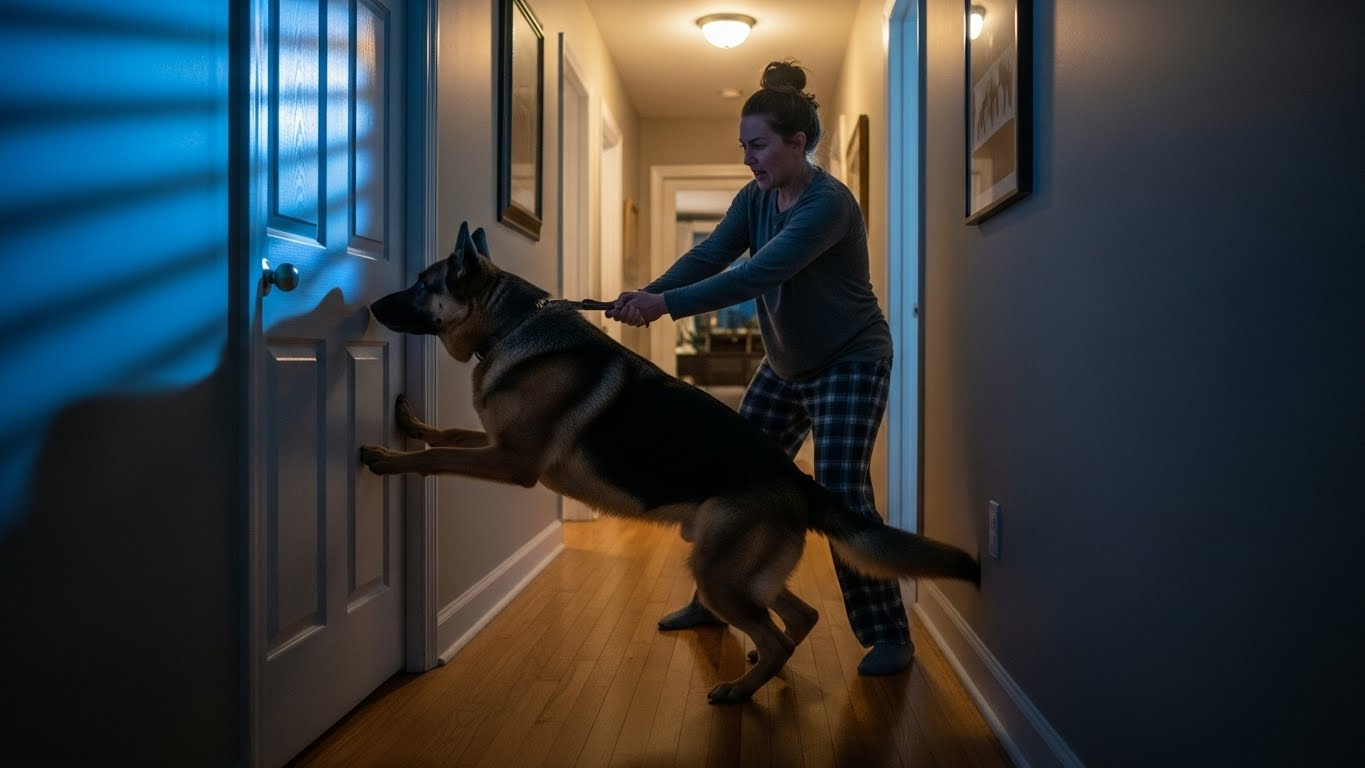
Our German Shepherd kept attacking the nursery door every night. We thought he was jealous. We were wrong. When I finally dragged him away, the silence from the crib revealed a secret about his past that changed everything.
Chapter 1: The Enemy in the Hallway
The silence of a suburban house at 3:00 AM is a heavy thing. It presses against your ears, amplifying every creak of the floorboards, every hum of the refrigerator, every beat of your own exhausted heart.
For the first six weeks of Noah’s life, that silence was my sanctuary. It was the only time the world stopped demanding things from me. But for the last ten days, that silence had become a battlefield.

And the enemy was my own dog.
Rex, our four-year-old German Shepherd, was eighty-five pounds of muscle, loyalty, and—lately—pure, unadulterated neurosis. We had adopted him as a puppy, long before the idea of a baby was even on our radar. He was supposed to be our “first child.” He was the dog who slept at the foot of our bed, who chased frisbees with reckless abandon, who let me cry into his fur when I lost my job two years ago.
But since we brought Noah home from the hospital, Rex had changed.
It started subtly. A low growl when we changed Noah’s diaper. Pacing circles around the bassinet. But then, it escalated. He started guarding the nursery door.
Not guarding us. Guarding the door from us. Or so it seemed.
Scritch. Scritch. Scritch.
I jolted awake, the red numbers on the digital clock burning into my retinas: 3:14 AM.
“Again,” Dan groaned beside me, pulling the pillow over his head. “Emily, you have to do something. I have a presentation at eight.”
“I know,” I snapped, swinging my legs out of bed. My body felt like it was made of lead. “I know, Dan.”
I walked into the hallway. The nightlight cast long, distorted shadows against the walls. Rex was there. He was always there. He was standing rigid outside the closed nursery door, his nose pressed against the crack at the bottom, inhaling deeply.
When he heard me, he didn’t cower. He didn’t wag his tail. He turned his massive head toward me, his amber eyes wide and unblinking. His hackles—the strip of fur along his spine—were fully raised.
“Rex, stop it,” I whispered, grabbing his collar.
He resisted. He planted his feet, digging his claws into the carpet runner. A low whine built in his throat, vibrating up through the leather collar and into my hand. It wasn’t a growl of aggression, exactly. It sounded… desperate.
“Come. On,” I gritted my teeth, using my full body weight to drag him backward. “You are going to wake the baby, and if you wake the baby, I swear to God, Rex…”
I hauled him down the hall, shoving him behind the heavy wooden baby gate we had installed at the top of the stairs specifically because of this behavior.
“Stay,” I commanded, pointing a finger at him.
Rex paced the small landing, letting out a sharp, frustrated yip. He looked at me, then at the nursery door, then back at me. He was trying to tell me something, but all I spoke was the language of sleep deprivation.
“Go to sleep,” I hissed.
I went back to bed, adrenaline making my hands shake. I stared at the baby monitor. Noah was a grey lump on the screen, motionless in his swaddle. The audio picked up the white noise machine: shhhhhh. Everything was fine.
“We can’t keep doing this, Em,” Dan said into the darkness, his voice heavy with guilt. “It’s dangerous. My mom said she’d take him. Maybe… maybe it’s for the best. Just until Noah is walking.”
My heart sank. The thought of sending Rex away felt like a betrayal. But the thought of him hurting Noah was unbearable. The articles I had doom-scrolled at 2 AM were terrifying: Jealousy in breeds. Prey drive triggers. Sudden aggression.
“Okay,” I whispered, tears pricking my eyes. “I’ll call her tomorrow.”
I closed my eyes, resigning myself to a broken heart.
I must have drifted off. I don’t know how much time passed. Maybe ten minutes. Maybe an hour.
CRASH.
The sound was explosive. It wasn’t a scratch. It was the sound of wood splintering.
I sat up, gasping. “What was that?”
Then came the barking.
It wasn’t normal barking. It was a guttural, roaring sound, the kind of noise a dog makes when they are fighting for their life. And it was coming from inside the nursery.
“He broke the gate!” Dan screamed, already scrambling out of bed. “He’s in with the baby!”
Panic, cold and sharp, flooded my veins. I didn’t feel my feet hit the floor. I didn’t feel the doorframe as I shoulder-checked it running into the hall. All I could see was the open nursery door, the splintered wood of the jamb where Rex had barreled through.
“No, no, no, no!” I shrieked.
I burst into the room, expecting blood. Expecting violence.
Rex was there. He was standing on his hind legs, his massive front paws hooked over the railing of the white crib. He was barking directly down at the mattress. ROOF! ROOF! ROOF!
Then, he did something that made my blood freeze. He lunged forward, shoving his snout through the bars, and violently nudged the bundle of blankets.
“Get away from him!” Dan roared, tackling the dog.
Dan grabbed Rex by the scruff and the flank, trying to wrestle him down. Rex snarled—a terrifying sound—and snapped at Dan’s arm, breaking free. He wasn’t attacking Dan; he was fighting to stay at the crib. He lunged back, barking again, wild-eyed.
And then, in the split second between the barks, the silence hit me.
Rex was making enough noise to wake the dead.
But Noah wasn’t crying.
Noah wasn’t moving.
The world tilted on its axis. The adrenaline shifted from fight to horror.
I pushed past the wrestling match of man and dog. I reached into the crib. My hand found Noah’s chest.
Stillness.
No rise. No fall.
I touched his cheek. It was cool. Not cold, but not the warm, flush heat of a sleeping infant.
“Dan…” My voice was a broken croak. “Dan, stop.”
Rex stopped fighting the moment I touched the baby. He dropped to all fours, panting, whining high and sharp, looking from me to the baby.
“He’s not breathing,” I screamed, the reality crashing down on me like a tidal wave. “Dan, he’s not breathing! Call 911!”
Chapter 2: The Red Line
Chaos is a blur, but trauma is high definition. I remember everything about those next five minutes in agonizing detail.
I remember the way Dan’s face went the color of ash. He fumbled with his phone, his fingers too slippery with sweat to unlock it on the first try.
I remember grabbing Noah. He felt terrifyingly heavy, a dead weight in my arms. I ripped the swaddle open. His tiny onesie—the one with the little yellow ducks—was still perfectly buttoned. His skin had a terrifying, grayish-blue tint under the nursery light.
“Speakerphone! Put it on speaker!” I yelled, laying Noah on the changing table. It was the only flat surface.
“9-1-1, what is your emergency?” The operator’s voice was calm, a stark contrast to the hurricane inside our house.
“My baby isn’t breathing! He’s two months old! He’s turning blue!” Dan shouted, his voice cracking.
“Okay, sir. Help is on the way. I need you to listen to me. Is the baby on a flat surface?”
“Yes! Yes!”
“I need you to start CPR. Two fingers, center of the chest. Push down about an inch and a half. Hard and fast. Do you know the rhythm?”
I didn’t wait. I knew the theory. I had taken the class when I was pregnant, giggling with Dan as we practiced on plastic dolls. It wasn’t funny now.
I placed two fingers on my son’s tiny sternum. I pushed.
One, two, three, four.
“Come on, Noah. Come on, baby. Please,” I sobbed between counts. “Don’t do this to mommy. Please don’t do this.”
Rex was still in the room. He hadn’t left. But he was no longer the chaotic beast that had smashed through the door. He was sitting in the corner, his body trembling violently. He let out a low, mournful howl, a sound so full of sorrow it felt like a prayer. He didn’t take his eyes off the changing table.
One, two, three, four.
“Is he breathing?” the operator asked.
“No!” I screamed. “He’s not doing anything!”
“Keep going. Don’t stop. The paramedics are two minutes away.”
Two minutes. It sounded like two centuries.
My fingers hurt. I was terrified I was breaking his ribs. I was terrified I wasn’t pushing hard enough. I stared at his little face, his eyes closed, his eyelashes resting on his cheeks. He looked like he was sleeping, except for the color. That horrible color.
“Dan, take over!” I gasped, my hands cramping.
Dan stepped in without a word, his tears dripping onto Noah’s chest as he pumped.
And then, a sound.
A wheeze. A gasp. A choke.
It was the ugliest, most beautiful sound I had ever heard.
Noah’s back arched. His arms flew out in the Moro reflex. And then, a wail. A thin, reedy cry that grew louder and louder until it filled the room.
“He’s crying!” Dan sobbed, collapsing over the table but keeping his hand on the baby. “He’s crying! Oh my God, he’s crying!”
I fell to my knees. The relief was physical; it felt like my legs had been cut off. I buried my face in my hands, shaking so hard my teeth clattered.
Suddenly, I felt a wet nose on my ear. A rough tongue licking the tears from my cheek.
Rex.
I looked up. Rex was standing over me, licking my face, then moving to lick Dan’s arm, then trying to see the baby. His tail gave a slow, tentative thump against the floor.
“You knew,” I whispered, staring at the dog I had planned to give away tomorrow. “You knew.”
The sirens cut through the night air, growing louder, drowning out the last remnants of the quiet suburb.
By the time the paramedics rushed up the stairs, carrying their heavy bags and portable monitors, Noah was pink and screaming his lungs out. They checked his vitals, listened to his heart, and loaded him onto the stretcher.
“We need to take him in,” the lead paramedic said, a kind man with grey hair. “It sounds like an ALTE—Apparent Life-Threatening Event. Or a severe apnea episode.”
As they wheeled Noah out, I paused at the top of the stairs. Rex was sitting by the broken nursery door. He didn’t try to follow. He just watched us go, his job apparently done.
I looked at the splintered wood of the doorframe. I looked at the dog.
“Good boy,” I choked out. “Good boy, Rex.”
He dipped his head, just once.
Chapter 3: The Silent Guardian
The hospital stay lasted three days. They ran every test imaginable. EEGs, EKGs, blood work, sleep studies.
The diagnosis was “Idiopathic Central Sleep Apnea.” Essentially, Noah’s immature brain sometimes simply “forgot” to tell his body to breathe during deep sleep cycles. It was rare, but manageable with medication and monitoring.
But the doctor’s words in the hallway stuck with me more than the medical jargon.
“You’re very lucky,” Dr. Aris said, looking over his glasses at us. “With these silent apnea cases, the parents usually don’t wake up. The baby doesn’t cry because they can’t breathe to cry. They just… fade away. If you hadn’t intervened when you did, we would be having a very different conversation right now.”
I looked at Dan. We both knew the truth. We hadn’t intervened. We were asleep.
“It wasn’t us,” Dan said, his voice raspy. “It was the dog.”
Dr. Aris raised an eyebrow but didn’t laugh. “Then buy that dog a steak. He’s the only reason you’re holding your son.”
Coming home was terrifying.
The house felt different. The nursery, once a place of cute decor and dreams, now felt like a trap. Every time I looked at the crib, I saw the blue face of my son.
We set up a high-tech medical grade monitor that wrapped around Noah’s foot. We had video cameras. We had audio monitors.
But the first night back, neither Dan nor I could close our eyes. We sat in the living room, staring at the screen, terrified that the technology would fail.
Then, Rex walked in.
He walked past us, his nails clicking on the hardwood. He didn’t ask for food. He didn’t ask to go out. He walked straight up the stairs.
We followed him, quietly.
Rex went into the nursery. He sniffed the air. He sniffed the crib. Then, with a heavy sigh, he circled three times and laid down directly underneath the crib. He rested his chin on his paws, his eyes facing the door, but his ears swiveled back toward the mattress.
“He’s not going to leave him,” I whispered to Dan.
“No,” Dan replied. “He’s not.”
We tried to call him out. “Rex, come here! Bed time!”
He lifted his head, looked at us, and laid it back down. He wasn’t moving.
So, we let him stay.
That night, I slept on the floor of the nursery, a pillow and blanket thrown on the rug. I watched Rex.
He didn’t sleep. Not really. He dozed, but every time Noah shifted, every time the baby let out a tiny sigh, Rex’s ears would twitch. Every hour or so, he would stand up, put his front paws on the rail—gently this time—sniff the baby’s face, and then lie back down.
He was checking his work.
Weeks passed. The fear began to recede, replaced by a new routine. Rex was the third parent. He was the head of security. If Noah cried, Rex was there before we were. If a stranger came to the house, Rex placed himself between the guest and the baby, not aggressive, just a physical barrier. A wall of fur.
One afternoon, while Noah was doing tummy time on the playmat in the living room, I was brushing Rex. He was shedding his winter coat.
As I ran the brush over his neck, I noticed his collar was looking ragged. The leather was worn. I unbuckled it to clean it.
The metal ID tag jangled. It was scratched and old. We had kept the tag he came with from the shelter because it was riveted onto the leather and we couldn’t get it off, so we just added our own tag next to it. I had never really looked closely at the old one.
I rubbed my thumb over the tarnished brass, squinting to read the worn-down engraving.
It didn’t have a name. It had a number: K9-ISO-442.
And below that, in tiny, barely legible letters: PROJECT GUARDIAN angel – WASH OUT.
“Wash out?” I muttered.
I turned the tag over. There was a phone number. It wasn’t the number for the local shelter where we picked him up. It was a number with an area code from three states away.
My curiosity piqued. I had always assumed Rex was just a stray or a surrender from a family who couldn’t handle his energy. That’s what the local shelter told us: “Owner surrender, no history.”
I picked up my phone and dialed the number on the tag.
Chapter 4: The Ghost of the Past
The phone rang four times before a gruff voice answered.
“Midwest K9 Training Center. This is Sarg.”
“Hi,” I stammered, feeling suddenly foolish. “I… I’m calling about a dog. I think he might have come from your facility years ago.”
“We train a lot of dogs, ma’am. You have a chip number?”
“No, but I have a tag number. It says K9-ISO-442. And… Project Guardian Angel?”
There was a long silence on the other end of the line. I heard the sound of a chair squeaking, as if the man had sat up straighter.
“You have 442?” the voice softened, losing its professional edge. “We called him Radar. Where did you find him?”
“His name is Rex now,” I said. “We adopted him from a shelter in Ohio four years ago. He… he did something incredible recently. He saved my son’s life.”
I told him the story. The scratching. The door. The CPR. The way he checks the baby’s breathing.
When I finished, the man on the other end let out a heavy breath that sounded like a sob suppressed by years of discipline.
“I’m not surprised,” Sarg said quietly. “That’s what he was born to do. But I am surprised he did it. He was supposed to be broken.”
“What do you mean?” I asked, looking over at Rex, who was currently letting Noah pull his ear without flinching.
“Project Guardian Angel was a pilot program,” Sarg explained. “We were trying to train dogs to detect distinct chemical changes in infants with high-risk medical conditions. seizures, blood sugar drops, apnea. Radar… Rex… was our star pupil. He had a nose like nothing I’ve ever seen. He could smell a drop in oxygen levels from across a room.”
“So he’s a service dog?”
“He was almost one. We placed him with a family. A test run. They had a little girl. Sick kid. Respiratory issues.”
My stomach tightened. “What happened?”
“It wasn’t the dog’s fault,” Sarg said quickly. “The parents… they were heavy sleepers. One night, the heater malfunctioned. Carbon monoxide. The dog went crazy. He tried to wake them. He barked, he bit the father’s leg, he did everything he was trained to do.”
I covered my mouth with my hand.
“The father woke up eventually,” Sarg continued, his voice grim. “He got the wife out. He got the dog out. But by the time they got to the crib… the little girl was gone.”
Tears streamed down my face. I looked at Rex. He wasn’t just a dog. He was a survivor of a tragedy I couldn’t even imagine.
“The father blamed the dog,” Sarg said. “Grief makes people crazy. He said the dog didn’t try hard enough. He surrendered him to a kill shelter two counties over and told them the dog was aggressive. We lost track of him. I thought he was dead.”
I looked at the scar on Rex’s snout—a faint white line I had always assumed was from a fence. Now I wondered if it was from that night. From trying to break into a crib.
“He wasn’t aggressive,” I whispered. “He was traumatized.”
“He failed his mission, in his head,” Sarg said. “Dogs like that… when they lose their charge, they mourn. They carry it. I figured if he ever got near a kid again, he’d either run away or… well.”
“Or he’d make sure it never happened again,” I finished.
“Ma’am,” Sarg said, his voice thick. “That dog has been waiting four years for a second chance. He didn’t just save your son. You gotta understand… your son saved him.”
I hung up the phone and sat on the floor.
Rex trotted over, sensing my distress. He sat down and nudged my hand with his wet nose. I wrapped my arms around his massive neck and buried my face in his fur. I could smell the doggy scent, the dust, and underneath it all, the fierce, unbreakable spirit of a guardian.
He hadn’t been attacking the door out of jealousy. He had been attacking the door because he recognized the smell of death. He had recognized the silence.
And this time, he refused to fail.
“Thank you,” I whispered into his ear. “Thank you, Radar.”
He licked my tears away, then pulled back. He looked toward the crib where Noah was sleeping. His ears perked up. He gave a short, satisfied huff, and laid his head down on my lap.
He was finally off duty. For now.
Chapter 5: The Nanny with Fangs
Life with a dog who believes he is a Secret Service agent is… complicated.
As Noah grew from a fragile infant into a chaotic toddler, Rex’s role evolved. He wasn’t just checking for breath anymore; he was managing perimeter security for a tiny, reckless human who had zero survival instincts.
When Noah learned to crawl, Rex became a mobile barrier. If Noah headed toward the stairs, Rex would gently body-check him, nudging him back toward the center of the rug. If Noah reached for an electrical outlet, Rex would lick his hand—gross, but effective distraction.
But the outside world didn’t see a guardian angel. They saw a monster.
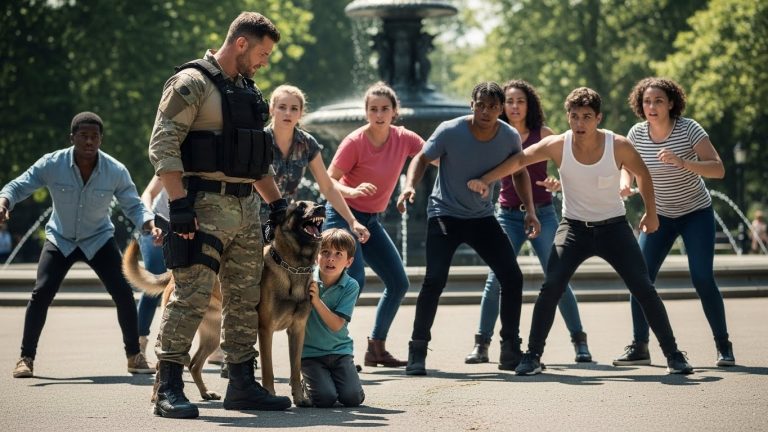
I remember one afternoon at the park when Noah was about two years old. It was a crisp autumn day, and the playground was packed. I sat on a bench, watching Noah stumble toward the sandbox. Rex was lying at my feet, unleashed but under perfect voice command. He was wearing his “DO NOT PET” vest that I had bought online to deter grabby hands.
His eyes never left Noah. Not for a squirrel. Not for another dog. He was locked in.
“Excuse me,” a sharp voice cut through the air.
I looked up. A woman in expensive yoga pants was standing over me, clutching a terrified-looking pug mix. She was pointing a manicured finger at Rex.
“Is that thing safe?” she demanded, loud enough for the other moms to turn their heads.
“He’s fine,” I said, keeping my voice calm. “He’s a service dog.”
“He looks like a wolf,” she sneered. “My son is playing right over there. If that beast snaps, he could kill a child in seconds. You shouldn’t bring aggressive breeds to a family park.”
Rex didn’t even look at her. His ears swiveled toward her voice, categorizing it as an annoyance rather than a threat, but his gaze remained fixed on Noah, who was currently trying to eat sand.
“He’s not aggressive,” I said, my patience thinning. “He’s actually trained to—”
Suddenly, Rex stood up.
He didn’t growl. He didn’t bark. He just shot up like a loaded spring and bolted.
“He’s attacking!” the woman screamed, shrinking back.
But Rex flew past her. He wasn’t running toward her kid. He was running toward the edge of the playground, where the gate had been left slightly ajar.
My heart stopped. Noah had wandered away from the sandbox while I was distracted by the woman. He was waddling straight toward the open gate, and beyond it, the busy street where cars were whizzing by at forty miles an hour.
“Noah!” I screamed, scrambling up.
But I was too slow. Rex was a streak of black and tan lightning.
Just as Noah stepped onto the sidewalk, Rex drifted in front of him, using his heavy hip to gently knock the toddler backward onto the grass. Noah plunked down on his diaper, looking surprised but unhurt.
Rex stood between the boy and the road, barking once—a sharp, commanding bark that said Stay.
I reached them ten seconds later, scooping Noah up, my heart hammering against my ribs like a trapped bird. I looked at the road. A delivery truck zoomed past, inches from where Noah had been standing moments ago.
I turned back to the playground. The silence was deafening. The woman with the yoga pants was pale, her mouth hanging open.
I clipped the leash back onto Rex’s collar. He looked up at me, panting, his tongue lolling out in a goofy grin, as if to say, Situation handled, Mom.
I walked past the woman. “You’re right,” I said, my voice shaking with adrenaline. “He is dangerous. He attacks anything that tries to hurt my son. Including traffic.”
We walked home, my hand gripping the leash so tight my knuckles were white. Rex didn’t pull. He walked right beside the stroller, his head high, the king of the concrete jungle.
Chapter 6: The Weight of Time
Time is a cruel thief, especially when it comes to dogs.
While Noah grew stronger, taller, and faster, Rex began to slow down. The irony was heartbreaking to watch. The boy who once couldn’t lift his head was now running circles around the dog who had once barreled through a solid wood door to save him.
When Noah was five, the signs became impossible to ignore.
It started with the stairs. Rex, who used to bound up them two at a time, began to hesitate at the bottom. He would look up, gauge the distance, and let out a soft huff before hauling himself up, his back legs slipping on the hardwood.
Then came the dragging. On our walks, I could hear his rear claws scraping against the pavement. Scrape. Step. Scrape. Step.
“Degenerative Myelopathy,” the vet said, showing us the X-rays. It’s like ALS for dogs. A slow, painless paralysis of the hindquarters. “It’s common in Shepherds. I’m sorry.”
We bought him a harness with a handle on the back so we could help lift him. We put down yoga mats all over the house so he wouldn’t slip. We started him on acupuncture and hydrotherapy.
But the hardest part wasn’t the physical decline. It was Rex’s emotional distress.
He knew he was failing.
He would try to follow Noah into the backyard, but his legs would give out, and he’d slide into the grass. He would whine, a high-pitched sound of frustration, watching Noah play from a distance.
One rainy Tuesday, I found Noah in the living room. He had built a fortress out of couch cushions and blankets. Usually, this was a game for one. But today, the fortress was built around Rex.
Rex was lying on his side on the rug, unable to get up comfortably on his own. Noah, five years old and full of empathy, was tucking a blanket around the dog’s shoulders.
“What are you doing, bud?” I asked, leaning against the doorframe.
“Rex is tired,” Noah whispered seriously. “So I’m guarding him today.”
I watched, tears blurring my vision, as Noah sat cross-legged in front of the dog’s face. He had his favorite picture book open.
“And then the dragon flew away,” Noah read aloud, stumbling over the big words.
Rex’s eyes were closed, his breathing heavy and rhythmic. But as Noah spoke, Rex’s tail gave a tiny, weak thump against the floor. Even in his sleep, even with his body failing him, he was listening to the boy.
“He took care of me when I forgot to breathe,” Noah told me later that night over dinner. We had never hidden the story from him. He knew Rex was his hero.
“Yes, he did,” Dan said, reaching out to squeeze Noah’s hand.
“Now I have to take care of him,” Noah stated simply. “That’s the rules.”
From that day on, the dynamic shifted. Noah became the eyes and ears. If Rex needed water, Noah brought the bowl to him. If Rex needed to go out, Noah would run to get me, yelling, “Mom! Rex needs the bathroom help!”
The protector had become the protected. And in a way, I think that gave Rex permission to finally rest. He didn’t have to be on high alert anymore. His replacement had been trained well.
Chapter 7: The Final Watch
The end came in winter, seven years after the night of the broken door.
A blizzard had buried the suburbs under two feet of snow. The wind was howling outside, rattling the windowpanes. Inside, the house was warm, but the atmosphere was heavy.
Rex hadn’t eaten in two days. He couldn’t stand up at all anymore. We had moved his bed into the living room because the stairs were impossible. We knew. We had the appointment with the vet scheduled for the next morning to come to the house. We wanted him to pass at home, where he was loved.
It was 10:00 PM. We were all camping out in the living room. Dan and I were on the pull-out couch. Noah was in his sleeping bag on the floor next to Rex.
“Goodnight, Rex,” Noah whispered, kissing the dog’s grey, velvety muzzle.
Rex let out a long sigh, his eyes half-open, watching the boy.
Around 2:00 AM, the power went out.
The house plunged into darkness. The sudden silence of the furnace shutting off was jarring. The wind sounded louder now, like a beast scratching at the walls.
I woke up to a sound.
Scritch. Drag. Scritch. Drag.
I sat up, using my phone’s flashlight to scan the room.
Rex was moving.
He had dragged himself off his orthopedic bed. His back legs were useless dead weight, but he was clawing his way across the floor with his front paws, pulling his heavy body inch by agonizing inch.
“Rex?” I whispered, sliding off the couch. “Buddy, what are you doing? Lay down.”
He ignored me. He was panting heavily, the effort costing him everything he had left. He wasn’t moving toward the water bowl. He wasn’t moving toward us.
He was moving toward Noah.
Noah was asleep in his sleeping bag, shivering slightly as the house began to cool down.
Rex dragged himself until he was pressed tightly against Noah’s back. He curled his body around the boy, creating a barrier of fur and warmth between the child and the cold room. He let out a grunt of pain as he settled his head on Noah’s ankles.
He wasn’t confused. He wasn’t lost. The power was out. The heat was off. The environment had changed.
And so, Protocol “Guardian Angel” had engaged one last time.
He knew he was dying. I could see it in the glassy look of his eyes. But he refused to leave this world until he was sure the boy was warm.
I woke Dan up. We didn’t try to move him. We sat on the floor with them, wrapping blankets around the dog and the boy. We cried silently in the dark, illuminated only by the dying flashlight.
Rex’s breathing changed. It became shallow. Irregular.
The same way Noah’s had been all those years ago.
But this time, there was no reboot. There was no shaking him awake.
At 4:00 AM, just as the storm outside began to break, Rex lifted his head one inch. He looked at Noah’s sleeping face. He licked the boy’s sock.
And then, he exhaled. A long, final breath that carried the weight of a lifetime of duty.
The silence that followed wasn’t scary. It was peaceful. It was the silence of a watch that had successfully ended.
Chapter 8: The Badge
The funeral was small. Just us, in the backyard, under the old oak tree where Rex used to chase squirrels he had no intention of catching.
Noah didn’t cry. He looked solemn, holding a shovel that was too big for him. He was seven years old, but he looked older that day. He understood something about sacrifice that most adults never grasp.
We were just finishing filling the grave when a black truck pulled into our driveway.
I didn’t recognize it. A man stepped out. He was older now, his hair completely white, walking with a cane. He wore a jacket with a logo: Midwest K9 Training Center.
It was Sarg.
I hadn’t spoken to him in years, not since that first phone call. I walked over to the fence, surprised.
“I saw your post online,” Sarg said, his voice rough. “About him passing.”
“I didn’t think you’d come,” I said. “It’s a six-hour drive.”
“He was one of mine,” Sarg said simply. He opened the gate and limped into the yard. He looked at the fresh mound of earth. He looked at Dan, and then he looked at Noah.
“You must be the boy,” Sarg said, looking down at Noah.
“Yes, sir,” Noah said, wiping dirt from his hands. “He was my best friend.”
Sarg nodded. He reached into his pocket and pulled out a small velvet box. He knelt down—wincing as his bad knee hit the grass—so he could be eye-level with Noah.
“Son, there’s something you need to know about your dog,” Sarg said. His voice trembled slightly. “Years ago, Rex… well, Radar… he was kicked out of the academy. They said he was a failure. They said he couldn’t handle the pressure.”
Noah frowned. “He wasn’t a failure.”
“No,” Sarg agreed. “He wasn’t. He was just waiting for the right assignment.”
Sarg opened the box. Inside sat a silver badge, heavy and polished. It wasn’t a toy. It was an official K9 service badge.
“Technically,” Sarg cleared his throat, fighting back emotion, “we only give these to dogs who complete their service and retire with honors. But I looked at the records. I looked at what he did for you.”
Sarg took the badge out and pressed it into Noah’s small hand.
“He didn’t just do the job, son. He rewrote the manual. So, I’m reinstating him. Agent Radar is officially retired, with full honors.”
Noah looked at the silver shield, his eyes wide. He ran his thumb over the engraving. To Protect and Serve.
“Can I put it with him?” Noah asked.
“It belongs to him,” Sarg said.
We watched as Noah knelt by the fresh dirt. He placed the silver badge gently on top of the mound, right where Rex’s heart would be.
“Mission accomplished, Rex,” Noah whispered.
The wind rustled through the oak leaves above us. For a second, just a split second, I swore I heard the jingle of a collar.
We stood there for a long time, the four of us—three humans and the memory of a dog who taught us that love isn’t just an emotion. It’s an instinct. It’s a duty. And it never, ever dies.
As we walked back toward the house, Noah stopped and looked back at the grave one last time.
“Mom?” he asked.
“Yeah, baby?”
“Do you think he’s with the little girl now? The one he couldn’t save before?”
I choked back a sob. “Yeah, Noah. I think he found her. And I think she’s safe now, too.”
Because Rex was on the job. And Rex never missed a shift.