I Caught A “Thief” Digging Through My Dumpster At Midnight On Christmas Eve, But When I Saw Her Face, I Dropped My Flashlight In Horror—What I Found In Her Pocket Changed My Life Forever.
THE GIRL IN THE GARBAGE
CHAPTER 1: THE GHOST OF CHRISTMAS EVE
The bitter December wind cut through the night air like a serrated knife, slicing right through the layers of my wool coat. It was 11:47 PM. Christmas Eve.
To most people in this sleeping suburb, this was a time of warmth. It was a time for eggnog by the fire, for the frantic joy of last-minute wrapping paper panic, and the soft, amber glow of tree lights reflecting in frosted windows. It was a night for families.
But for me, Nathan Hayes, it was just another shift. Just another Tuesday where silence was my only companion, and the biting cold was the only thing that felt real.
I pulled my collar up tighter, my keys jingling in my hand—a lonely, sharp sound in the vast, empty parking lot of the Oak Creek Apartment complex. I worked security here. It was the perfect job for a man who wanted to disappear. It required minimal human interaction, long hours of solitude, and most importantly, it gave me a legitimate excuse to be nowhere near a family gathering.
“Merry Christmas, Nathan,” I muttered to myself, the words turning into white vapor before vanishing into the dark.
I was heading toward my beat-up sedan, ready to drive back to my own silent apartment. My place was sterile. Functional. No tree. No lights. No stockings hung with care. I hadn’t put up a single decoration in three years. Not since the day the nursery turned into a storage room. Not since Sarah.
But I don’t let myself think about Sarah on Christmas Eve. That’s the rule. You survive the grief by building walls, and my walls were reinforced with concrete, steel, and the graveyard shift.
I was about ten feet from my car when a sound stopped me dead in my tracks.
Scritch. Crunch.
It was coming from the dumpster enclosure—a bricked-off area at the edge of the lot, shrouded in deep shadow. The snow was falling harder now, muffling the distant sounds of the highway, making the noise from the trash bins even louder.
I sighed, the deep fatigue of the holiday season settling into my bones. “Great,” I whispered, rubbing my gloved hand over my face. “Raccoons again.”
I debated just getting in my car and ignoring it. It wasn’t technically my problem anymore; I was off the clock. But the tenant association had been complaining about the mess, and if trash got strewn everywhere, I’d be the one hearing about it on the 26th.
Grumbling, I pulled my heavy Maglite from my belt and clicked it on. The beam cut a sharp, white cone through the darkness, illuminating the swirling snowflakes like dancing dust.
“Alright, beat it!” I shouted, stomping my heavy boots against the pavement to make noise. “Go on! Get out of here!”
Usually, that’s all it took. A scamper of claws, a flash of fur, and the problem was solved.
But this time, the rustling didn’t stop. It paused abruptly, held its breath, and then started again. Slower. More deliberate.
That wasn’t an animal.
My grip tightened on the flashlight. My first instinct was defensive. We’d had issues with drug users looking for shelter in the utility rooms recently. I squared my shoulders, putting on the “security guard” mask—the tough, no-nonsense guy I pretended to be to keep the world at bay.
I rounded the corner of the brick enclosure, swinging the light directly into the gap between the two massive green dumpsters.
“I said get the hell out of—”
The words died in my throat. Strangled.
My heart hammered against my ribs, a sudden, violent rhythm that made me dizzy.
It wasn’t a raccoon. It wasn’t a junkie.
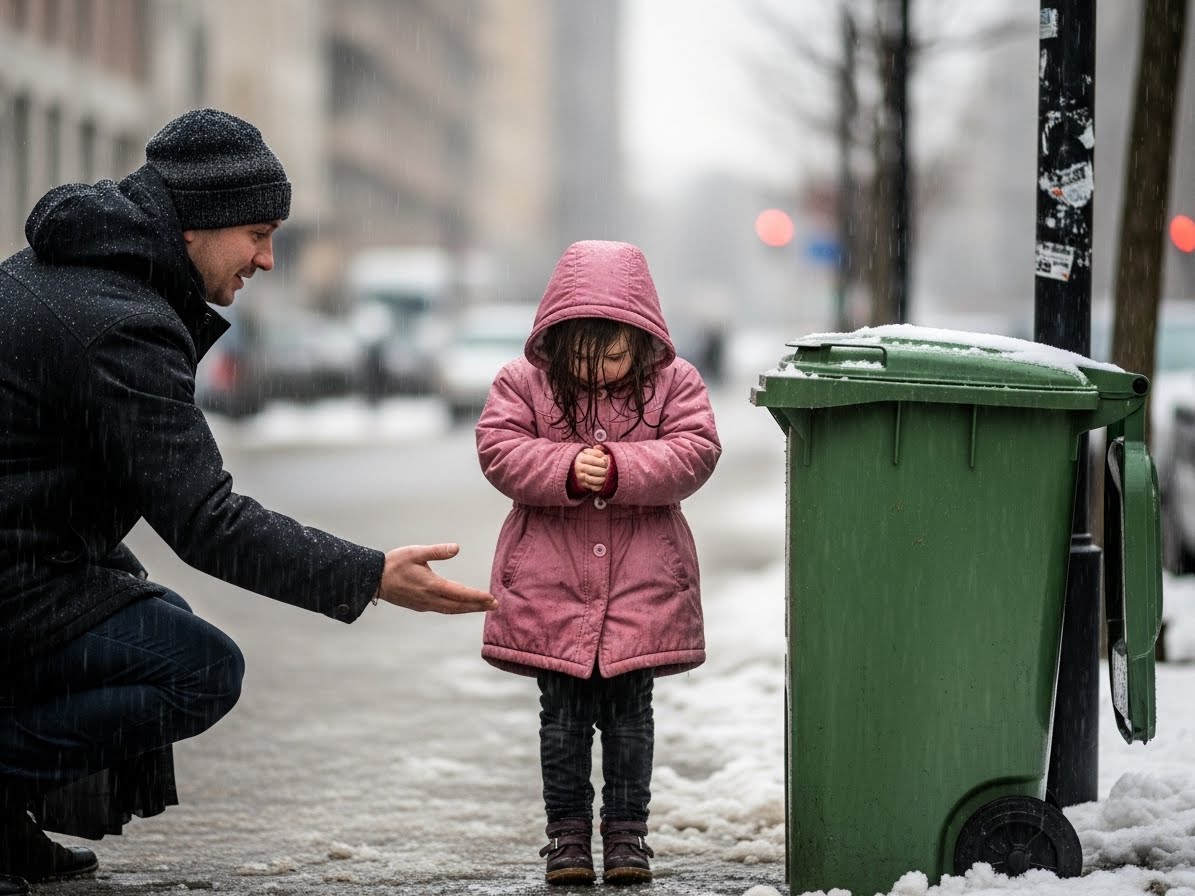
It was a child.
She couldn’t have been more than seven years old.
She was small, painfully small, standing on top of a discarded wooden pallet to reach the lip of the dumpster. The beam of my flashlight hit her like a spotlight, freezing her in place.
She wore a purple winter jacket that was clearly three sizes too big, the sleeves rolled up in thick, dirty cuffs. The zipper was broken, held together by a safety pin. Her legs were clad in thin cotton leggings that offered zero protection against the Chicago winter, and her sneakers were soaked through, dark with slush.
But it was her face that paralyzed me.
Under a tangle of matted dark hair, her skin was a translucent, sickly pale. Her cheeks were hollowed out, shadowing the sharp angles of her cheekbones. And her eyes… God, her eyes. They were wide, brown, and filled with a primal, animalistic terror that no child should ever know.
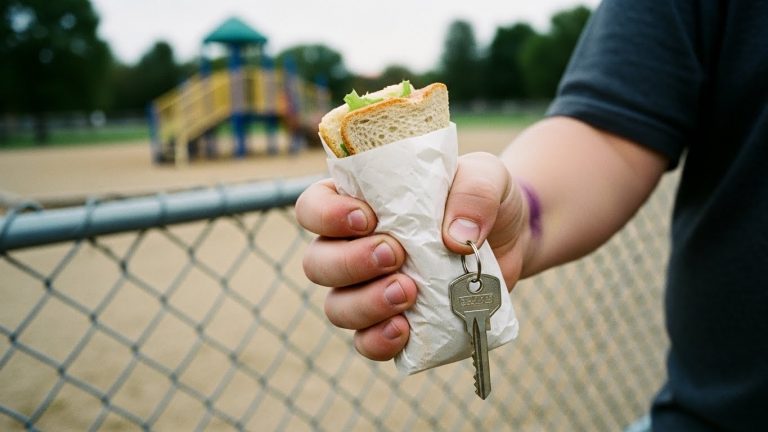
In her trembling red hand, she clutched a crumpled fast-food wrapper. Half of a discarded, moldy sandwich poked out of it.
She didn’t run. She didn’t scream. She just stood there, shaking violently, clutching that garbage to her chest like it was a lifeline.
My brain stalled. The “security guard” mask crumbled. I wasn’t Nathan the employee anymore. I was just a man looking at a tragedy unfolding in real-time.
“Hey…” I breathed out, my voice cracking. It came out softer than I intended.
The girl flinched as if I’d raised a hand to strike her. She took a step back, her foot slipping on the icy pallet.
“Whoa, careful!” I instinctively reached out a hand, but I stopped myself, staying where I was. “It’s okay. I’m not going to hurt you.”
She stared at me, her chest heaving. The vapor of her breath was coming in short, panicked puffs. She looked at the gap behind me, calculating her escape route.
“I… I wasn’t doing nothing,” she whispered. Her voice was raspy, thin as paper.
“I know,” I said, slowly lowering the flashlight so it wasn’t blinding her. “I know you weren’t. You’re okay.”
I took one cautious step forward, moving as if I were approaching a wounded bird. “It’s freezing out here, sweetheart. Where are your parents?”
The question hung in the freezing air between us. It was a standard question, the logical question. But the reaction it triggered was visceral.
The color drained from her already pale face. Her bottom lip, chapped and bleeding, started to quiver. She gripped the sandwich tighter, her knuckles white.
“I don’t…” She stammered, looking down at her wet shoes. “I don’t have any.”
The wind howled around the corner of the building, rattling a loose metal sign nearby, but I barely heard it.
I don’t have any.
The words hit me like a physical blow to the stomach. I felt a twisting sensation in my chest—a phantom pain from a wound I thought had scarred over long ago.
I looked at this girl—alone, scavenging for food in a dumpster at midnight on Christmas Eve—and I saw the ghost of the child I never got to hold. I saw the vulnerability. The absolute abandonment.
“What’s your name?” I asked, kneeling down onto the frozen asphalt. The cold soaked into my knees instantly, but I didn’t care. I needed to be on her level. I needed her to see my eyes.
She hesitated, studying my face. She was looking for a threat. She was scanning me for the anger she was probably used to seeing in adults.
“Melody,” she whispered.
“Melody,” I repeated. “That’s a beautiful name. My name is Nathan.”
I glanced at the sandwich in her hand—the bread was hard, the lettuce wilted and brown.
“Melody,” I said, keeping my voice steady, though my insides were shaking. “Are you hungry?”
She nodded, a small, jerky movement. “I… I found this. It’s still good. The wrapper was closed.”
“No,” I said firmly, but gently. “No, honey, you don’t have to eat that.”
“But I’m hungry,” she insisted, her voice rising in panic, clutching the trash to her chest again. “I have to eat.”
“I know,” I said. “But you don’t have to eat that. I have food. Real food. Warm food.”
She froze. The concept seemed alien to her. “You do?”
“Yeah,” I said. “I have a warm apartment right over there. And I have… I have grilled cheese. Do you like grilled cheese?”
I didn’t actually have grilled cheese made, but I had bread and cheese. It was the only thing I could think of.
She looked at the sandwich in her hand, then at me. “You’re not gonna call the police?”
“No police,” I promised. “Just food. And warmth. Look at your hands, Melody. You’re freezing.”
She looked down. Her fingers were raw, swollen, and bright red. She was probably minutes away from frostbite.
“Okay,” she whispered.
I stood up and held out my hand. “Come on. Let’s get you out of the cold.”
She didn’t take my hand immediately. She climbed down from the pallet, clutching her scavenged prize in one hand, and walked warily toward me. She was so small that when she stood next to me, the top of her head barely reached my hip.
As we walked toward the building entrance, under the harsh buzz of the security lights, I got my first good look at her profile. And that’s when I saw it.
Sticking out of the pocket of her oversized purple jacket wasn’t a toy. It wasn’t a phone.
It was a prescription bottle. An orange plastic cylinder with the label ripped half off.
“Melody,” I asked, opening the door and ushering her into the warm lobby. “What’s in your pocket?”
She clamped her hand over the pocket protectively. “It’s Grandma’s,” she said, her voice trembling again. “I have to keep it safe. For when she wakes up.”
I stopped walking. The lobby was warm, smelling of floor wax and old mail.
“Grandma?” I asked. “Is she… is she here?”
Melody looked up at me, and the dam finally broke. Tears, hot and fast, spilled over her dirty cheeks.
“No,” she sobbed, the sound echoing in the empty hallway. “She wouldn’t wake up. The men in the uniforms took her. They took her a long time ago. But I kept her medicine. I kept it just in case.”
I stared at this little girl, holding onto a bottle of pills for a grandmother who was clearly gone, eating trash to survive, alone in a city of millions.
And in that moment, the ice around my heart didn’t just crack. It exploded.
CHAPTER 2: THE THAW
My apartment was on the third floor. As I unlocked the door, a wave of self-consciousness hit me. I hadn’t had a guest in three years. Not one.
The space was clean, but it was the cleanliness of a place that isn’t lived in. The walls were bare beige. The furniture was nondescript gray. There were no photos. No clutter. No signs of life. It was a waiting room for a life I wasn’t living.
But when Melody stepped inside, she looked around as if I’d brought her into a palace.
“It’s so warm,” she whispered, hugging herself.
The central heating hummed, a sound I usually ignored, but now it sounded like a luxury.
“Go sit on the couch,” I said, locking the door behind us—a solid click that felt like a promise. “I’m going to get you a blanket.”
She moved tentatively, sitting on the very edge of the sofa as if she were afraid of dirtying it. She was still clutching that moldy sandwich.
“Melody,” I said softly, crouching in front of her. “Can I trade you?”
I held out my hand. “You give me the sandwich, and I’ll give you the grilled cheese. I promise. Fresh. Hot. With tomato soup.”
She looked at the garbage in her hand, then at me. Her survival instinct was warring with her exhaustion. Slowly, shakingly, she placed the sandwich in my palm.
“Thank you,” I said. I walked to the kitchen and threw it in the trash bin, burying it deep so she wouldn’t see it.
“First things first,” I called out, trying to sound cheerful. “We need to get you warm. How about a bath?”
She nodded. “I… I smell bad.”
“No, you don’t,” I lied. She smelled like old grease and damp wool, the scent of poverty and neglect. “But a hot bath feels good.”
I went into the bathroom and turned the tap. The steam began to rise, fogging up the mirror. I didn’t have bubble bath or toys. I had a bar of unscented soap and a gray towel.
I rummaged through my dresser. I had nothing for a child. I pulled out my smallest t-shirt—a faded navy blue one—and a pair of sweatpants with a drawstring I could tie tight.
“Here,” I said, setting the clothes on the vanity. “I’ll leave the door cracked just a little so you know I’m here, okay? But I’ll be in the kitchen making food.”
She looked at the tub, filled with steaming water, and her eyes welled up again. “Is there… is there hot water for the whole time?”
“As long as you want,” I choked out. “Use it all.”
While she bathed, I went into overdrive in the kitchen. I didn’t just make a sandwich; I made a feast. Three grilled cheeses. A can of tomato soup. I cut up an apple I found in the fridge. I poured a glass of milk.
I could hear the water splashing gently. It was the first sound of life in this apartment since… since forever.
When she emerged, she looked like a different child. She was swimming in my t-shirt, the hem reaching her ankles. I had tied the sweatpants as tight as they would go, but they were still bunched up around her waist. Her hair was wet and combed back, revealing a forehead that looked too worry-lined for a seven-year-old.
She climbed onto the kitchen stool. She stared at the food.
“Go ahead,” I said.
She didn’t attack the food. She ate with a heartbreaking slowness. She took a small bite, chewed thoroughly, and then took a sip of milk. It was the discipline of a child who didn’t know when the next meal was coming. She was making it last.
“So,” I said, sitting across from her with a cup of coffee I didn’t need. “You said you were with your Grandma Ruth?”
She nodded, wiping a milk mustache off her lip. “Yeah. Grandma Ruth. She was the best. She smelled like peppermint.”
“And… after the men took her?” I asked gently.
Melody stopped chewing. She put the sandwich down.
“They sent me to the Smiths,” she said, her voice dropping. “But Mrs. Smith said I cried too much. Then I went to the big house with all the beds. Then I went to another house…”
She counted on her small fingers. “Four. I went to four houses.”
“And the last one?”
“They locked the fridge,” she whispered. “They put a chain on it. And they told me I was expensive.”
My grip on the coffee mug tightened until my knuckles turned white. Expensive.
“So I left,” she said simply. “I thought… I thought if I came back to our old neighborhood, maybe Grandma Ruth would be back. Maybe it was all a mistake.”
“How long have you been out there, Melody?”
“Two days,” she said. “I sleep in the basement of the building next door. There’s a broken window I can fit through.”
Two days. A seven-year-old girl. Alone. In Chicago. In December.
I looked at the clock. It was 12:30 AM. Christmas morning.
“Melody,” I said, leaning forward. “You are not going back to that basement.”
She looked up, fear flickering in her eyes. “But the people… the social worker lady… she’ll make me go back to the locked fridge house.”
“No,” I said, and the ferocity in my voice surprised even me. “No, she won’t. I won’t let her.”
“You can’t stop them,” she said, a wisdom far beyond her years in her voice. “They have papers.”
“I have a phone,” I said. “And I have a friend who knows about papers. And I have this apartment. And I have plenty of grilled cheese.”
She looked at me, really looked at me, searching for the lie. She didn’t find one.
“You’d keep me?” she asked, her voice barely audible.
“I’d keep you,” I said.
And just like that, the empty nursery in the back of my mind, the one I’d locked away for three years, cracked open. Not with pain this time, but with purpose.
CHAPTER 3: THE VOW
That night, Melody slept on my couch. I didn’t want to put her in the spare bedroom—the room that was supposed to be the nursery. It was too empty, too far away. I wanted her where I could hear her breathe.
I gave her my duvet and three pillows. She curled up into a ball so small she barely made a lump under the covers.
I didn’t sleep. I sat in the armchair by the window, watching the snow fall, my phone in my hand.
I knew what I was doing was reckless. It was legally gray, bordering on kidnapping if you looked at it from the wrong angle. But morally? Morally, it was the only choice I had.
At 2:00 AM, I made the call.
“Mitchell,” I said when he answered, his voice groggy and thick with sleep.
“Nathan?” Mitchell coughed. “It’s 2 AM on Christmas. Is everything okay? Did you burn down the complex?”
“I found a girl,” I said.
Silence on the other end. Then, a sharp intake of breath. “What kind of girl? Nathan, tell me you didn’t…”
“A child, Mitch. A seven-year-old. She was digging in the dumpsters. She’s a runaway from the foster system.”
“Oh, hell,” Mitchell sighed, the lawyer in him waking up. “Did you call the police?”
“No.”
“Nathan, you have to call the police. You can’t just keep a child. That’s kidnapping.”
“She’s sleeping on my couch, Mitch. She has frostnip on her fingers and she weighs about forty pounds. If I call the cops, they put her back in the system. The system that starved her. I’m not doing it.”
“So what’s the plan?” Mitchell asked, his voice hardening. “You’re just going to raise her? You? The guy who hasn’t left his apartment for a social event in three years?”
“Yes,” I said. The answer came out before I could think about it. “Yes. I want to apply for emergency guardianship. I want to foster her. Adopt her. Whatever it takes.”
“Nathan…” Mitchell’s voice softened. “I know what day it is. I know what you lost. Are you sure you’re not just… projecting? This isn’t a replacement for David.”
The name of my unborn son hung in the air. David. I hadn’t spoken his name out loud in so long.
“I know she’s not David,” I whispered, glancing at the sleeping form on the couch. “But Mitch… when I looked at her tonight, I felt something I haven’t felt since Sarah died. I felt like I was here. Like I was alive.”
“It’s going to be a war,” Mitchell warned. “The state doesn’t like single men adopting. They don’t like unofficial placements. They’re going to drag you through the mud. Background checks, home studies, psych evals. They’re going to ask about Sarah. They’re going to ask about your depression.”
“Let them,” I said. “I don’t care. Just tell me what form to file first.”
We talked for an hour. Mitchell, being the good friend he was, agreed to come over in the morning with paperwork.
When I hung up, I walked over to the couch. Melody was tossing and turning. She was whimpering in her sleep.
“No,” she mumbled. “Don’t take it. It’s mine.”
I knelt beside her and gently placed a hand on her shoulder. “Shhh,” I whispered. “You’re safe. It’s Nathan. You’re safe.”
She settled down instantly at my touch.
I sat there on the floor for the rest of the night, watching the sun come up on Christmas morning. I didn’t have any presents to give her. I didn’t have a tree. But as the gray light of dawn filled the room, I realized I had something better.
I had a reason to wake up.
When Melody opened her eyes, she gasped, sitting up straight, scanning the room in panic. Her eyes landed on me, sitting in the armchair, still in my uniform pants but wearing a flannel shirt.
“You’re still here,” she whispered, her eyes wide.
“I told you,” I smiled, though my eyes were burning with fatigue. “I’m not going anywhere.”
“Merry Christmas, Melody.”
She looked around the empty room. “I don’t have a present for you.”
“You being here is the present,” I said. “Now, how do you feel about pancakes? I think I can figure out how to make pancakes.”
She smiled then. It was a small, fragile thing, like a crack in the ice. But it was there.
CHAPTER 4: THE GHOSTS OF THE PAST
The next three months were the hardest of my life. Mitchell wasn’t lying; it was a war.
We filed for emergency kinship care, arguing that since she had no living relatives and I was a “concerned party” with a safe home, I should be the placement. It helped that the “locked fridge” foster home was investigated and shut down immediately after Melody’s testimony. That gave me leverage.
But the bureaucracy was a nightmare. Social workers visited my apartment weekly. They opened my closets. They checked my fridge temperature. They asked me intrusive questions about my grief, my mental state, my income.
“Mr. Hayes,” a stern woman named Mrs. Higgins asked me one afternoon, her pen hovering over her clipboard. “You admit you haven’t dated or socialized since your wife’s passing. Do you think you’re emotionally stable enough to handle a traumatized child?”
I looked at Melody, who was sitting at the kitchen table coloring in a book I’d bought her. She was humming a song. She wasn’t shaking anymore.
“I think,” I said, meeting Mrs. Higgins’ gaze, “that we’re healing each other. Stability isn’t about being perfect. It’s about showing up. And I show up every day.”
But the real battle wasn’t with the state. It was with the trauma.
Melody was damaged. You don’t survive the streets and neglect without scars.
Some nights, she would wake up screaming, thinking the police were coming to take her. I would have to sit with her for hours, reading stories until her breathing slowed.
Other times, I’d find food hidden all over the house. Slices of bread under her pillow. Apples in her shoe box. A bag of chips taped behind the toilet tank.
The first time I found the bread, moldy and stiff under her pillow, my initial reaction was frustration. I had just changed the sheets.
“Melody,” I called her into the room.
She saw the bread in my hand and immediately curled into herself, covering her head with her arms. “I’m sorry! Don’t hit me! I just… I just wanted to be sure!”
My heart broke all over again. I dropped the bread and pulled her into a hug, ignoring how she stiffened.
“I’m not going to hit you,” I said firmly into her hair. “I’m never going to hit you. And you don’t need to hide food. Look.”
I took her by the hand and walked her to the kitchen. I opened the pantry. It was stocked floor to ceiling.
“See this?” I pointed. “This is yours. All of it. If you’re hungry at 3 AM, you come here and eat. You don’t need to hide it. It’s not going away.”
It took weeks for her to believe me.
Then there was the silence. Sometimes, she would just shut down. She would stare at the wall for hours, unresponsive, retreating into some safe place in her mind where nothing could hurt her.
In those moments, I saw myself. I saw the man I had been for the last three years. The man who sat in the dark and stared at nothing.
One Saturday afternoon in March, exactly three years since I lost Sarah, the breakthrough happened.
I was trying to braid Melody’s hair. I was terrible at it. My clumsy fingers were fumbling with the strands, pulling too tight, missing sections.
“Ouch,” she complained. “You’re doing it wrong. Grandma Ruth went over, not under.”
“I’m trying, kiddo,” I grunted, sticking my tongue out in concentration. “I’m a security guard, not a hairdresser.”
I twisted a piece of hair and the rubber band snapped, shooting across the room and hitting the cat clock on the wall.
Melody froze. Then, a sound bubbled up from her chest. A giggle.
Then another.
Then, she threw her head back and laughed. A real, loud, belly laugh.
“You’re so bad at this!” she squealed.
I started laughing too. It felt foreign in my throat, dusty and rusty, but it came out. We laughed until we were crying, sitting on the floor of the living room.
“Okay, okay,” I wiped my eyes. “You win. We’re going to a salon.”
She looked at me, her eyes shining. “Dad?”
The word hung in the air. She hadn’t called me that before. It was always Nathan.
She froze, realizing what she’d said. She looked terrified, waiting for me to correct her. To tell her not to get attached.
I reached out and tucked a strand of hair behind her ear.
“Yeah, honey?” I said, my voice thick. “What is it?”
She smiled, and the sun came out in my living room.
“Can we get ice cream after the salon?”
“Yeah,” I whispered. “We can get anything you want.”
I looked at the calendar on the wall. March 14th. The anniversary of the worst day of my life. But looking at Melody, I realized it wasn’t a day of death anymore. It was just a Saturday. And we had places to go.
We were going to be okay.
CHAPTER 5: THE MIRROR
Six months had passed since that freezing Christmas Eve. Summer had arrived in Chicago, turning the gray slush into humid heat, but inside Dr. Richards’ office, the air was cool and smelled of lavender.
“Have you ever felt like you were meant to meet someone?” I asked, staring at the ceiling tiles.
Dr. Richards, the court-appointed therapist evaluating my fitness to parent, paused her note-taking. She peered at me over her glasses. “What makes you say that, Nathan?”
I sat up, leaning forward, my elbows on my knees. I had spent three years in therapy after Sarah died, mostly sitting in silence or angry crying. But this was different.
“Before I found Melody,” I began, my voice steady, “I was just existing. I was a ghost. I went to work, I came home, I stared at the wall. I convinced myself I was ‘fine’ because I wasn’t drinking myself to death or jumping off a bridge. But I wasn’t living. I was hiding.”
I looked out the window. Down in the parking lot, I could see Melody. She was waiting with Mitchell, skipping between the painted lines of the parking spots, her hair bouncing in a ponytail I had finally learned to tie correctly.
“When Sarah died… when we lost the baby…” I choked up, the old pain surfacing, but it didn’t sting as sharply as it used to. “I thought that was it. I thought my capacity to love died in that hospital room. I thought being a father was a chapter that got ripped out of my book.”
“And now?” Dr. Richards asked softly.
“Now,” I said, a small smile tugging at the corner of my mouth. “I realize I was wrong. Maybe I needed to go through that hell to understand what Melody was feeling. When she talks about the ‘black hole’ inside her when her grandma died… I know exactly what that looks like. I know the furniture in that room.”
I turned back to the doctor. “I thought I was rescuing her that night. I thought I was the hero pulling the poor orphan out of the dumpster.”
I shook my head, tears pricking my eyes. “But she saved me, Doc. I was drowning, and I didn’t even know it until I had to swim for her. She gave me a reason to get up. She made me want to be the man Sarah always believed I could be.”
Dr. Richards closed her folder. She took off her glasses and smiled—a genuine, un-clinical smile.
“Nathan,” she said. “In twenty years of doing this, I’ve seen a lot of broken people try to fix themselves with children. It never works. But this? This isn’t that. You aren’t using her as a bandage. You’re building a foundation together.”
She scribbled one final note.
“I’m recommending full adoption,” she said. “Go be a dad, Nathan.”
When I walked out to the car, Melody ran up and hugged my waist, burying her face in my shirt.
“Did you tell her about the time I put dish soap in the dishwasher and made a foam party?” she asked, muffled against my stomach.
“I left that part out,” I laughed, lifting her up. “That’s a state secret.”
CHAPTER 6: JUDGMENT DAY
The Cook County Courthouse was a towering monolith of stone and glass, busy and echoing with the sound of lawyers arguing and families weeping. It was a Tuesday morning in August.
I sat on the hard wooden bench outside Courtroom 304, my leg bouncing with a nervous energy I couldn’t suppress. I adjusted my tie for the tenth time. I hated ties.
Melody sat beside me. She wasn’t wearing the tattered purple jacket anymore. She was wearing a yellow sundress with sunflowers on it—her choice—and white sandals. She looked healthy. Her cheeks had filled out, the hollows gone. Her skin was no longer translucent but sun-kissed from our trips to the park.
“Are you nervous?” she asked, her small hand finding mine. Her grip was strong.
“A little,” I admitted. “Are you?”
Melody swung her legs, her sandals tapping against the bench. “I think I’m excited-nervous. Like… like when you’re about to open a present you really want, but you’re scared the box might be empty.”
I squeezed her hand, my heart clenching. She was so wise for seven years old. Too wise.
“What are you hoping for?” I asked.
She stopped swinging her legs. She looked up at me, her brown eyes fierce and clear.
“For you to be my real dad forever,” she said. “Not just until a social worker changes her mind. Not just until I turn eighteen. Forever. So I never have to go to a house with a locked fridge again.”
“Melody,” I said, leaning down so our foreheads touched. “No matter what that judge says in there, you are my daughter. Paper or no paper. I am not letting you go.”
“All rise,” the bailiff bellowed, the doors swinging open.
We walked in. The room was intimidating, smelling of old wood and serious decisions. Mitchell was already there at the table, looking sharp in his navy suit. The social worker, Mrs. Higgins, was there too, looking unreadable.
Judge Patricia Hernandez sat high up on the bench. She had a reputation. She was fair, but she was tough. She had been a family court judge for fifteen years, and she had seen every kind of lie and manipulation imaginable.
She shuffled the stack of paperwork in front of her. The silence in the room was deafening.
“Mr. Hayes,” Judge Hernandez began, peering over her reading glasses. “When this case first crossed my desk six months ago as an emergency placement, I had severe reservations. A single, grieving widower finding a child in a dumpster and taking her home? It sounded… unstable. Impulsive.”
My stomach dropped. Mitchell stiffened beside me.
“However,” the judge continued, her voice softening slightly. “I have read the reports. I have read Dr. Richards’ evaluation. I have read the school reports.”
She looked directly at Melody.
“Melody,” the judge said gently. “You understand what we are doing here today?”
Melody stood up. She looked tiny in the vast courtroom, but she stood tall.
“Yes, Your Honor,” she said, her voice clear. “We’re making it official.”
“Is there anything you want to tell me?” the judge asked. “About living with Mr. Hayes?”
I held my breath.
“He saved my life,” Melody said. She didn’t look at me; she looked straight at the judge. “Not just that first night when I was cold. But every day. He helps me with my math homework even though he hates fractions. He braids my hair, and at first, it was really crooked, but now he’s pretty good.”
A ripple of soft laughter went through the few people in the courtroom.
“He stays with me when I have bad dreams,” Melody continued, her voice trembling slightly. “And he never locks the food away. He told me that families are the people who choose you. And he chose me. Even when I was dirty and stealing his trash. He chose me.”
I bit the inside of my cheek to keep from sobbing loud enough to disturb the proceedings.
CHAPTER 7: THE GAVEL DROPS
Judge Hernandez listened intently, her expression unmoving. She looked from Melody to me, then back to the file.
She picked up her pen.
“The court finds,” she declared, her voice resonating off the wood paneling, “that it is in the best interest of the child to remain permanently in the care of Mr. Hayes.”
She signed the paper with a flourish.
“Nathan Hayes, you are now the legal father of Melody Hayes.”
Bang.
The gavel came down with a satisfying, final thud. It was the best sound I had ever heard.
I felt the tension leave my body in a rush, leaving me lightheaded. I looked down at Melody. She was grinning so wide I thought her face might split.
“We did it!” she whispered/screamed.
“We did it,” I confirmed.
I dropped to one knee right there on the courtroom floor and opened my arms. She launched herself at me, knocking me back a few inches. I buried my face in her neck, breathing in the scent of strawberry shampoo and sunshine.
“Hi, Dad,” she whispered.
“Hi, daughter,” I choked out.
Mitchell was patting me on the back, wiping his own eyes. Even Mrs. Higgins, the stern social worker, was smiling as she packed up her briefcase.
As we walked out of the courthouse, the summer sun hit us. It felt different than it had that morning. It felt brighter.
“So,” I said, unlocking the car. “We have a tradition to start. What do the Hayes family do to celebrate?”
Melody tapped her chin theatrically. “Well, since you found me near a dumpster… maybe we shouldn’t eat trash.”
I barked out a laugh. “Definitely no trash.”
“How about Chinese food?” she suggested. “And we eat it out of the boxes like in the movies?”
“Deal,” I said. “Extra fortune cookies.”
CHAPTER 8: THE PICTURE ON THE FRIDGE
That evening, our living room looked very different from the sterile, empty box it had been on Christmas Eve. There were toys scattered on the rug. There were throw pillows in bright colors. There was life.
We sat on the floor, surrounded by white takeout cartons—Kung Pao chicken, chow mein, egg rolls. We were laughing, trying to use chopsticks and failing miserably.
“Okay, okay,” Melody said, wiping sauce off her chin. “I have something for you.”
She ran to her backpack, which she’d brought from the car, and pulled out a piece of paper. It was from her art therapy class.
She handed it to me with a sudden shyness.
“It’s us,” she said quietly.
I held the paper carefully. It was a drawing done in marker. There was a house—our apartment building, but she had drawn it with bright yellow windows. There were flowers in the front (we didn’t have a garden, but in the picture, we had a jungle).
And in the center were two figures holding hands. One tall figure with messy brown hair and a security guard badge. One small figure in a yellow dress.
Above them, written in careful, slightly uneven block letters: MY FAMILY.
“Is it okay?” she asked, twisting her hands.
I looked at the drawing, then at the spot on the refrigerator I had walked past a thousand times—the spot that had been bare for three years.
“It’s perfect,” I said, my voice thick. “It’s the best thing I own.”
I grabbed a magnet and hung it right in the center, at eye level.
“Can I tell you something?” I asked, turning to her.
“Yeah?”
“I used to think that families were only the people you were born with. Or the people you married,” I said. “But you taught me something, Melody. You taught me that the best families are the ones we build. The ones we choose.”
Melody climbed into my lap, resting her head on my chest. I could feel her heartbeat, steady and calm.
“Thank you for not walking away that night,” she whispered.
I kissed the top of her head. “Thank you for letting me stay.”
Later that night, after I tucked her in—checking under the bed for monsters and leaving the hall light on just a crack—I went back to the living room.
I stood in the silence, but it wasn’t the heavy, suffocating silence of a lonely man anymore. It was the peaceful silence of a home that was resting.
I looked at the picture on the fridge.
Two broken people had found each other on the coldest, loneliest night of the year. The man who had lost his future, and the girl who had lost her past.
We hadn’t just survived. We had built something new.
I walked to the window and looked out at the summer night. I thought about Sarah. For the first time in years, I didn’t feel the crushing weight of grief. I felt a gentle warmth, like a nod of approval from the other side.
“Merry Christmas,” I whispered to the empty air, smiling.
Sometimes, the family you need most is the one you never saw coming. Sometimes, love finds you in the garbage, wearing a tattered purple jacket, waiting to be seen.
And sometimes, when you think you’re saving someone else, you discover they were actually saving you all along.
THE END.