They Kicked Her In The Mud Because She Was An Orphan—But They Didn’t Know Her “Ghost” Had Just Returned From War.
Chapter 1: The Mud and The Ghost
The rain in Pennsylvania has a way of soaking right through your bones, making you feel cold even when you’re angry. Especially when you’re angry.
I hadn’t seen my niece, Lily, in six years. Not since I signed the papers to enlist and left her with my mother. I was twenty-two then, running away from a town that felt like a cage. I didn’t know I was leaving her in one.

When Mom passed away last week, I came back to a town that felt smaller, grayer, and meaner than I remembered. I came back to take custody of a thirteen-year-old girl who I barely knew anymore.
I was late picking her up. My truck, an old beast I’d picked up for cheap near the base, had stalled on the highway. By the time I parked near the middle school, the yellow buses were gone. The parking lot was empty, except for a cluster of kids near the edge of the old retention pond—a muddy, miserable patch of land where the drainage was blocked.
I got out, adjusting my jacket. I was still wearing my fatigues—I hadn’t even had time to change since the flight landed.
That’s when I heard it. The laughter. It wasn’t the innocent kind. It was that sharp, jagged sound of kids who smell blood.
I squinted through the drizzle. There were three of them. Boys. Eighth graders, probably. Big for their age, wearing expensive varsity jackets that looked too clean for this weather.
And in the middle of them was a small figure, clutching a backpack to her chest like a shield.
Lily.
I started walking. Fast.
“Say it,” one of the boys sneered. I could hear him from fifty yards away. He was a blond kid with a buzzcut that screamed ‘future frat boy.’ “Say your grandma’s dead. Say nobody wants you.”
Lily didn’t speak. She just looked down at her shoes.
“She’s a mute, Tyler. Leave it,” one of the other boys laughed, though he didn’t sound convinced.
“She’s not mute, she’s just stupid,” the ringleader, Tyler, spat. “Hey! I’m talking to you!”
He shoved her.
It wasn’t a playful shove. It was violent. He planted his foot right in the center of her back and kicked.
Lily stumbled forward. She tried to catch her balance, but the mud was slick like grease. She went down hard, face-first into a puddle of brown, stagnant water. Her backpack flew off, landing in the muck.
The splash was sickening.
The boys howled. They were high-fiving, doubling over as if they’d just seen the funniest thing in the world. Lily tried to push herself up, her hair plastered to her face with mud, coughing as she wiped filth from her eyes. She looked like a broken doll.
Something inside me snapped. It wasn’t the hot, red rage of a bar fight. It was the cold, focused clarity of a combat zone.
I didn’t run. You don’t run when you want to control the ground. I marched.
My boots—standard issue combat boots, caked in desert dust that was now turning to mud—hit the pavement with a heavy, rhythmic thud.
Thud. Thud. Thud.
The sound cut through the rain. It was the sound of authority. The sound of consequences.
Tyler was the first to stop laughing. He looked up, wiping rain from his eyes. He saw me coming from the edge of the lot. I’m six-foot-two, and I’ve spent the last six years carrying eighty pounds of gear up mountains. I don’t look friendly on my best days. Today was not my best day.
“Who the hell is that?” one of the lackeys whispered.
Tyler tried to maintain his bravado. “Probably just some homeless vet. Ignore him.” He turned back to Lily, who was shivering in the mud, too scared to move. “Get up, trash. You’re getting my shoes dirty.”
I was ten feet away now.
“That,” I said, my voice low but carrying like thunder, “is enough.”
The temperature in the parking lot seemed to drop ten degrees.
The three boys spun around. When they saw me up close—the scars on my knuckles, the grim set of my jaw, the unit patch on my shoulder—the air left their lungs.
Tyler took a step back. His arrogance flickered, replaced by the primal instinct that tells a prey animal it has made a grave mistake.
“We… we were just playing,” Tyler stammered. His voice cracked. He sounded like the child he was.
I didn’t look at him. I walked past him, ignoring him completely, and knelt in the mud beside Lily.
She flinched when I reached out. That hurt more than a bullet.
“It’s okay, Lil,” I said, my voice softening just enough for her. “It’s Uncle Jack. I’m here.”
She looked up. Her face was streaked with mud and tears, her lip bleeding. Recognition dawned in her eyes—a mixture of disbelief and terror. She didn’t look relieved. She looked ashamed.
I took off my jacket and wrapped it around her trembling shoulders. It swallowed her small frame.
“Can you stand?” I asked.
She nodded weakly. I helped her up, ignoring the mud staining my own clothes. I picked up her backpack, shaking off the worst of the sludge.
Then, I turned back to the boys.
They hadn’t moved. They were frozen, their eyes locked on my boots, then up to my face.
“You said you were playing?” I asked Tyler. I kept my voice terrifyingly calm.
“Y-yeah. Just… you know. Messing around,” Tyler said, looking for an exit route.
I took one step toward him. He took two steps back, nearly tripping over his own feet.
“Playing implies everyone is having fun,” I said. “She isn’t laughing. I’m certainly not laughing.”
I looked at his shoes—pristine, expensive Nikes. Then I looked at Lily, covered in filth.
“You kicked a girl when her back was turned,” I said, tilting my head. “In my line of work, we call that a coward’s move. In fact, that’s the kind of thing that gets people hurt. Badly.”
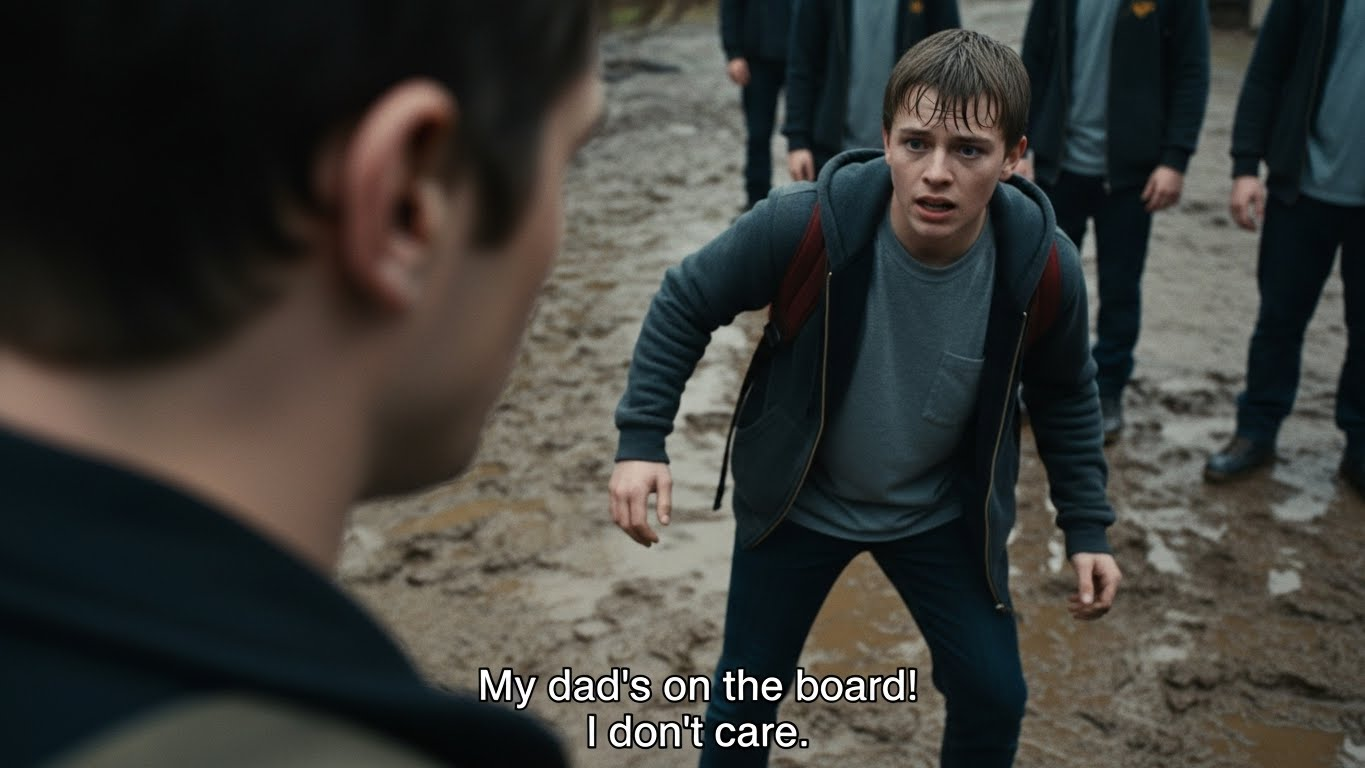
Tyler’s face went pale. “My… my dad is on the school board. You can’t touch me.”
I let out a dry, humorless chuckle. “Kid, where I’ve been, nobody cares who your daddy is. But right now, I don’t care about the school board.”
I stepped closer, invading his personal space until I was towering over him. I could smell the fear on him. It smelled like bubblegum vape and sweat.
“I care about the fact that you just assaulted my niece.”
“I didn’t mean to—”
“You did,” I cut him off. “You meant to humiliate her because it makes you feel big. But looking at you now? Shaking in your designer jacket because a grown man looked you in the eye?”
I leaned down, whispering so only he could hear.
“You look very, very small.”
Tyler’s lip quivered. I thought he might cry. Suddenly, the heavy metal door of the school banged open.
“Hey! What is going on out here?”
A woman in a gray pantsuit came marching out, holding an umbrella. Principal Gable. I remembered her. She looked tired twenty years ago; now she just looked exhausted.
“He’s threatening us!” Tyler screamed immediately, finding his voice now that an authority figure he recognized was present. “Mrs. Gable! This maniac is threatening to kill me!”
The other two boys nodded vigorously, playing the victim instantly.
Mrs. Gable stopped, looking from the terrified boys to me, and then to Lily, who was shivering under my military jacket, covered in mud. Her eyes narrowed at me. “Sir, step away from the students. I’m calling the police.”
I didn’t back down. I put a hand on Lily’s shoulder, feeling her tense up.
“Go ahead, ma’am,” I said, staring her down. “Call them. I’d love to file a report about assault on a minor on school property. And I’d love to explain why three of your students were allowed to gang up on an orphan while your staff was… where exactly?”
Mrs. Gable paused. She looked at Lily again, really seeing the mud, the blood on her lip. Then she looked at Tyler. She knew Tyler. Everyone knew Tyler.
“Major… Jack?” she asked, squinting at me.
“It’s Sergeant,” I corrected. “And I’m taking my niece home. But first, this young man is going to apologize.”
“I’m not apologizing to a freak,” Tyler muttered, gaining confidence again.
I moved too fast for them to track. I didn’t touch him. I just stomped my boot down into the puddle next to him—hard.
SPLAT.
Mud exploded upward, coating Tyler’s expensive varsity jacket and his face in brown sludge. He shrieked, jumping back.
“Oops,” I said, deadpan. “Slippery out here. Dangerous.”
Tyler stood there, dripping, his face turning beet red. The humiliation was total.
“Now,” I said, my voice dropping back to that dangerous whisper. “Apologize. Or the next time I slip, it won’t be mud that hits you.”
Tyler looked at Mrs. Gable, pleading for help. She looked at the mud on his jacket, then at Lily. She slowly closed her umbrella.
“I didn’t see anything,” Mrs. Gable said, turning her gaze to the trees. “But I suggest you apologize, Tyler. Before I have to call your mother about why you were bullying a student.”
Tyler trembled. He looked at me, saw the darkness in my eyes—a darkness he couldn’t possibly understand—and broke.
“Sorry,” he mumbled to the ground.
“Look at her,” I commanded.
He looked up at Lily. “Sorry, Lily.”
“Louder.”
“I’M SORRY!” he yelled, tears finally spilling over.
“We’re leaving,” I said to Lily. “Get in the truck.”
I guided her to my beat-up Ford, opened the door, and helped her in. I walked around to the driver’s side, stopping once to look back at the trio of boys.
They were still standing there, watching us. I pointed two fingers at my eyes, then at them. I’m watching you.
As we drove away, leaving the stunned silence of the parking lot behind, Lily spoke for the first time. Her voice was raspy, unused.
“You shouldn’t have done that,” she whispered, staring out the window. “They’ll only make it worse tomorrow.”
I gripped the steering wheel until my knuckles turned white.
“Tomorrow,” I said, “I’ll be there too.”
But as I looked at her reflection in the glass, I realized the war I had just walked into was going to be harder than anything I’d faced overseas.
Chapter 2: The Silent House
The ride home was suffocating. The windshield wipers slapped back and forth, counting the seconds of silence.
Slap-swish. Slap-swish.
I glanced at Lily every few seconds. She had pulled her knees up to her chest, still wearing my oversized camouflage jacket. The mud had dried into a crust on her cheek. She wasn’t crying anymore. She was staring at the dashboard like it was the most interesting thing in the world.
“You hungry?” I asked. My voice sounded too loud in the cab.
She shrugged. A non-committal lift of one shoulder.
“I saw a diner back near the highway. We could stop? Get some pancakes?”
“I just want to go home,” she said. Her voice was flat. Empty. It was the voice of a forty-year-old divorcée, not a thirteen-year-old girl.
“Okay,” I said. “Home it is.”
Home. The word tasted like ash.
We pulled up to the driveway of the old Victorian house on Elm Street. It used to be white with blue trim. Now, it was a peeling gray, the porch sagging on the left side. The yard, once my mother’s pride and joy, was overgrown with knee-high weeds. A rusting tricycle—not Lily’s, she was too old for that, maybe a neighbor’s kid threw it there—lay on its side in the grass.
I killed the engine. The silence rushed back in.
“Lily,” I started, turning to her. “About what happened back there…”
She opened the door before I could finish. “I’m fine, Jack. Thanks for the ride.”
She didn’t call me Uncle. Just Jack.
She grabbed her muddy backpack and bolted for the front door. I watched her fumble with the key, her small hands shaking, before she disappeared inside.
I sat there for a minute, gripping the steering wheel. I took a deep breath, inhaling the smell of old leather and stale coffee.
“Good job, Sergeant,” I muttered to myself. “Day one and you’ve already almost assaulted a minor and alienated the asset.”
I got out and followed her.
The inside of the house was worse than the outside. It smelled of dust, old paper, and something sweet and rotting—maybe old fruit. The curtains were drawn, making it dark even in the middle of the afternoon.
Piles of newspapers were stacked in the hallway. Not just a few weeks’ worth—years. There were boxes of QVC purchases that had never been opened. My mother had become a hoarder in her final years, filling the emptiness of the house with things she didn’t need.
And Lily had been living in the middle of it.
“Lily?” I called out.
“I’m taking a shower,” she yelled from upstairs. The bathroom door slammed, and the lock clicked.
I walked into the kitchen. The sink was full of dishes that had been there for days. I opened the fridge.
A jar of pickles. A half-empty carton of milk that expired two weeks ago. A ketchup packet. And a single, hardened slice of pizza on a paper plate.
That was it.
My chest tightened. I had assumed… I don’t know what I assumed. That Social Services checked in? That the neighbors helped? That my mother, even in her sickness, had fed the girl?
I grabbed a trash bag from under the sink and started clearing the counter. Beer cans. My mother didn’t drink beer. Someone else had been here.
I picked up a can of cheap lager. It was crushed.
I walked into the living room. On the mantle, amidst the dust, was a framed photo of me in my dress blues, taken right before I deployed the first time. The glass was cracked, like someone had thrown it across the room and then put it back.
Next to it was a photo of Lily and my sister, Sarah. Sarah had died in a car wreck when Lily was five. That was when I should have come back. But I didn’t. I was too busy being a hero overseas, chasing medals and adrenaline, leaving my aging mother to raise a traumatized child alone.
I sat down on the dusty sofa, the springs groaning under my weight. I put my head in my hands.
I had faced insurgents, IEDs, and sandstorms. But sitting in this dark, cluttered living room, realizing I had no food to feed a hungry child and no idea how to fix six years of abandonment… I was terrified.
The pipes groaned as the shower turned off upstairs.
I stood up. Action. I needed a mission.
Mission objective: Secure food. Secure perimeter. Establish comms.
I grabbed my keys. I’d go to the grocery store. I’d buy everything. Steaks, eggs, milk, cereal—the sugary kind Mom never let me have.
I went to the bottom of the stairs.
“Lily!” I shouted up. “I’m going to the store. I’ll be back in twenty minutes. Lock the door behind me.”
No answer.
“Lily?”
The door to her room creaked open. She stepped out, wearing oversized sweatpants and a t-shirt that was too big for her. Her hair was wet, dripping onto the floor. She looked cleaner, but somehow more fragile.
“You’re leaving?” she asked. Her eyes were wide.
“Just to the store,” I said quickly. “To get food. The fridge is empty.”
She gripped the banister. Her knuckles were white.
“You’re coming back?”
The question hit me like a physical blow. She didn’t think I was going to the store. She thought I was doing what everyone else in her life had done. Leaving.
I walked up the stairs, two at a time, until I was standing on the landing below her. I looked her right in the eye.
“Lily, look at me.”
She hesitated, then met my gaze.
“I am not going anywhere,” I said, enunciating every word. “I signed the papers. I moved my stuff. This is my base now. You are my mission. You understand? I’m just getting burgers.”
She studied my face, looking for the lie. She had become an expert at finding lies, I guessed.
Finally, she nodded. “Okay.”
“Lock the door,” I repeated.
“I always do,” she whispered.
I turned to leave, but stopped. “And Lily? About the boys…”
“Don’t,” she said, cutting me off. She turned and went back into her room, closing the door softly.
I walked out to the truck. The rain had stopped, but the sky was still a bruised purple. As I backed out of the driveway, I saw a black SUV slow down in front of the house. The window rolled down.
It was a man in a suit. He looked at my house, then at my truck. He pulled out a phone and snapped a picture.
I hit the brakes and stared at him. He saw me looking, rolled up his window, and sped off.
The license plate was obscured by mud. Or maybe it was deliberate.
I didn’t like it. My instincts were screaming. The hair on the back of my neck stood up.
I wasn’t just fighting eighth-grade bullies. There was something else rotting in this town, something that smelled worse than the trash in my mother’s kitchen.
Chapter 3: The War Room
I came back with five bags of groceries and three boxes of pizza. I figured if the cooking failed, pepperoni was a safe backup.
The house was dark when I entered.
“Lily? I’m back!”
Silence.
Panic spiked in my chest. I dropped the bags on the kitchen floor and ran to the stairs.
“Lily!”
I threw open her bedroom door without knocking.
She was sitting on the floor, surrounded by papers. She jumped, scrambling to cover them up with her arms.
“You have to knock!” she screamed. It was the first time she had raised her voice.
I stopped, breathing hard. “I called you. You didn’t answer.”
“I had my headphones on,” she said, pointing to the old, frayed cords hanging from her ears.
I exhaled, the adrenaline fading. “Sorry. I… I panicked.”
I looked at the papers she was hiding. Sketches. Charcoal and pencil.
“What are you drawing?” I asked, stepping into the room.
Her room was a stark contrast to the rest of the house. It was obsessively neat. The bed was made with military precision—tighter than I could make it. The books were arranged by height. It was a control freak’s room. A survivalist’s room.
“Nothing,” she said, gathering the papers.
“Can I see?”
“No.”
She shoved them under her mattress.
“Pizza’s downstairs,” I said, retreating. “And I bought… stuff. Soap. Toothpaste. Apples.”
“I’m not hungry.”
“Lily, you have to eat. I saw the fridge. You haven’t eaten a real meal in God knows how long.”
She stood up. She was so small. “I said I’m not hungry.”
“That’s an order,” I said, the sergeant in me slipping out.
Her eyes flashed. “You’re not my commanding officer. You’re just my uncle who showed up because Grandma died.”
“I’m your guardian.”
“For now,” she challenged. “Until you get bored. Or until the bills come due.”
She walked past me, brushing my arm, and went downstairs.
I stood in her room for a moment. I shouldn’t snoop. I knew that. But I needed to know who I was dealing with.
I walked over to the mattress. I lifted the corner.
The sketchbook was there. A black, leather-bound book.
I opened it.
The first page was a drawing of a wolf. It was good. Really good. Detailed, ferocious, snarling.
The next page was a drawing of the house. But in the drawing, the house was a cage. Bars on the windows.
I flipped further.
There were drawings of monsters. Grotesque, exaggerated figures with sharp teeth. But they wore clothes. One wore a varsity jacket.
Tyler.
And then, I found the page that made my blood run cold.
It was a drawing of a soldier. He was tall, faceless, a shadow. He was standing on a pile of skulls. In one hand, he held a rifle. In the other, he held a small girl’s hand.
Underneath, in jagged, heavy pencil strokes, she had written:
THE GHOST. Projected Arrival: NEVER.
She had been waiting. She had been fantasizing that I would come back and save her, turning me into some mythical monster-slayer. And I had stayed away.
I closed the book, feeling a lump in my throat the size of a grenade.
I went downstairs. Lily was sitting at the kitchen table, eating a slice of pizza. She didn’t look up.
“I’m sorry I didn’t come sooner,” I said quietly, leaning against the doorframe.
She stopped chewing. She didn’t look at me.
“Pass the salt,” she said.
We ate in silence.
Around 8 PM, the phone on the wall rang. An old landline. I didn’t even know people still used them.
Lily froze. Her eyes went to the phone, wide with terror.
“Don’t answer it,” she whispered.
“Why?”
“Just don’t.”
I stood up and walked to the phone. I picked it up.
“Hello?”
“Is this Jack Miller?” A man’s voice. Deep, smooth, authoritative.
“Who’s asking?”
“This is Robert Vance. Tyler’s father. The President of the School Board.”
I looked at Lily. She was shaking her head, pleading with her eyes.
“What can I do for you, Bob?” I asked, leaning against the wall.
“Mr. Miller, my son came home today covered in filth, claiming a maniac assaulted him on school property. I’m told that maniac is you.”
“Your son slipped,” I said calmly. “It was very slippery.”
“Listen to me, you piece of trailer trash,” Vance’s voice dropped the politeness. “I know you just got back from whatever sandbox you were playing soldier in. But in this town, we have laws. I’ve already spoken to the Sheriff. He’s a good friend of mine.”
“Is that so?”
“I’m giving you a courtesy call. You have twenty-four hours to bring that girl to my house so she can apologize to my son for the emotional distress she caused. And you will apologize to me for the dry cleaning bill.”
I laughed. I couldn’t help it. It was a dark, dangerous laugh.
“And if I don’t?”
“Then I will have Social Services at your door by Monday morning. I’ll have that house condemned—I know about the code violations, Jack. I know about the unpaid property taxes. I’ll bury you in paper, and I’ll put that girl in a foster home so far away she’ll need a passport to find her way back.”
The threat hung in the air. He wasn’t playing. He knew my weak spots: the house, the money, the custody.
I looked at Lily. She was hugging her knees, terrified.
“Bob,” I said, my voice dropping an octave. “You want to talk about laws? Let’s talk about the law of the jungle. You think you can threaten my family because you have a badge in your pocket?”
“I’m not threatening, Mr. Miller. I’m promising.”
“Good,” I said. “I like promises. Here is mine: If you or your son ever go near Lily again, I won’t call the Sheriff. I won’t call the school board.”
I paused.
“I’ll come to your house. And we’ll see if your money can stop what I bring with me.”
I hung up the phone.
My hand was shaking. Not from fear. From the effort of holding back.
I turned to Lily. She was staring at me, mouth slightly open.
“Who was that?” she asked.
“Nobody,” I said. “Just a ghost.”
I walked over and locked the front door. I slid the deadbolt home. Then I wedged a chair under the handle.
“Go to sleep, Lily,” I said. “We have a lot of work to do tomorrow.”
“What kind of work?”
“Fortifications,” I said. “We’re digging in.”
As she went upstairs, I went to my duffel bag in the hallway. I unzipped the bottom compartment.
Wrapped in an oil cloth was my Ka-Bar knife and a stack of cash I’d saved from my last tour. Not much, but enough for a fight.
I wasn’t a father. I wasn’t a good man. But I was a soldier. And for the first time in six years, I had a war worth fighting.
Chapter 4: The Inspection
Sunday morning didn’t bring peace; it brought a tactical assessment.
I woke up at 0500 hours—old habits die hard. The house was silent, save for the settling groans of the timber. I moved through the downstairs like I was clearing a building in Fallujah, checking the locks, checking the windows.
The kitchen was my first target.
By the time Lily came down at 9 AM, rubbing sleep from her eyes, the kitchen was unrecognizable. The counters were scrubbed raw. The mountain of trash was gone, bagged and stacked by the curb. The linoleum floor, previously sticky with unknown substances, smelled of lemon and bleach.
I was at the stove, flipping pancakes.
“Morning,” I said, not turning around. “Breakfast is ready.”
Lily stood in the doorway, staring at the clean room. She looked disoriented, like she’d walked into the wrong house.
“You… you cleaned,” she said softly.
“A clean workspace is a safe workspace,” I said, sliding three pancakes onto a plate. “Eat. We have a lot to do.”
She sat down, eyeing the pancakes suspiciously before taking a bite. Her eyes widened. I’d used the good butter.
“It’s good,” she mumbled.
“Don’t talk with your mouth full,” I corrected automatically, then softened. “Glad you like it.”
We spent the day working. It wasn’t a bonding montage from a movie. It was hard, sweaty work. We hauled boxes of my mother’s hoarding out to the yard. Old magazines, broken lamps, clothes that smelled like mothballs.
For the first time, I saw Lily smile—just a small quirk of the lips—when we found an old box of Halloween costumes and I put on a ridiculous plastic pirate mask.
“You look stupid,” she said.
“That’s Captain Stupid to you,” I retorted.
But the moment shattered at 2 PM.
A white sedan pulled up. A man with a clipboard got out. He wore a short-sleeved dress shirt and a tie that was too short.
I walked out to the porch, wiping grease from my hands. Lily stayed behind the screen door, watching.
“Jack Miller?” the man asked, not looking up from his clipboard.
“Who’s asking?”
“City Code Enforcement. Name’s Gary. We received an anonymous tip about hazardous living conditions and structural instability.”
“Anonymous,” I repeated dryly. “Let me guess. The tip came from a number starting with 555-VANCE?”
Gary looked up, sweating slightly. “I just do the inspections, sir. I need to see the interior.”
“You have a warrant?”
“I don’t need one for a code violation check on the exterior, and if I see probable cause, I can condemn the property immediately.” He pointed to the sagging porch roof. “That’s a violation. The grass height? Violation. The trash on the curb? improper disposal. Violation.”
He was ticking boxes with a smug satisfaction.
I stepped off the porch. I didn’t shout. I didn’t threaten. I just walked into his personal space.
“Gary,” I said. “You know what I see? I see a man who’s scared of his boss. Robert Vance put you up to this.”
“I’m just doing my job,” Gary squeaked, backing up.
“Write your tickets,” I said, staring into his eyes. “Write them all. But tell Vance that paper doesn’t stop a bullet. And it doesn’t stop me.”
Gary turned pale. “Are you threatening a city official?”
“I’m telling you to get off my lawn before I consider you a trespasser,” I said. “And in this state, we have very specific laws about how homeowners can deal with trespassers.”
Gary scrambled back to his car. He shoved a pink slip of paper into my mailbox and peeled out.
I walked to the mailbox. A condemnation warning. 72 hours to rectify violations or vacate.
I ripped it off the box and walked back to the house. Lily was standing there, her face pale.
“They’re going to take the house,” she whispered. “Grandma said they would.”
“They’re not taking anything,” I said, crushing the paper in my fist. “He wants a war of attrition? Fine. I’ll give him a siege.”
I looked at the sagging porch.
“Grab the hammer, Lily. We’re fixing the roof.”
Chapter 5: The Walk of Honor
Monday morning. The enemy territory shifted from the house to the school.
Lily was terrified. She sat in the passenger seat of the truck, her backpack clutched so tight her knuckles were white. She was wearing a new hoodie I’d bought her yesterday—navy blue, clean, no holes.
“You don’t have to come in,” she said as we pulled up to the curb. “Please don’t come in. It’s embarrassing.”
“You know what’s embarrassing?” I asked, cutting the engine. “Letting bullies think they won. I’m walking you to your locker.”
“Jack…”
“Move out, soldier.”
I got out. I was wearing a clean flannel shirt and jeans, my boots polished. I looked like a civilian, but I walked like a sergeant.
The school hallway fell silent as we entered. Kids stopped talking. Eyes followed us.
Lily tried to shrink, to make herself invisible. I put a hand gently on her back—not pushing, just guiding. I’ve got your six.
We passed the spot where Tyler had kicked her. The mud was gone, but the memory hung heavy in the air.
At her locker, I saw them. Tyler and his crew. They were leaning against the lockers, laughing. When they saw me, the laughter died instantly.
Tyler looked at his shoes. His face was still bruised from where—presumably—his father had disciplined him, or maybe just from the shame.
I stopped in front of them.
“Morning, gentlemen,” I said pleasantly.
Tyler mumbled something unintelligible.
“I didn’t hear you,” I said.
“Morning,” Tyler said, louder.
“Lily has a math test today,” I said, looking at each of them. “She needs to focus. I’d hate for her to be distracted by… nonsense. You boys understand?”
The two lackeys nodded vigorously. Tyler just glared, a mix of fear and hatred burning in his eyes.
“Good.”
I turned to Lily. “I’ll pick you up right here at 3:00. If anyone bothers you—anyone—you go straight to the office and you call me.”
She looked at me, then at the boys who were now cowed into silence. For the first time, she stood a little straighter.
“Okay,” she said.
As I walked away, a woman stepped out of a classroom. She was about my age, with paint-stained fingers and tired eyes.
“Mr. Miller?”
I stopped. “Yes?”
“I’m Sarah Hayes. Art teacher.” She glanced down the hall to make sure Lily was out of earshot. “I need to talk to you.”
“About Lily’s drawings?” I guessed.
“About her drawings, and about why Robert Vance is trying to destroy your family.”
My attention sharpened. “I’m listening.”
“It’s not just bullying, Jack. And it’s not just that your mom owed money.” She lowered her voice. “Your mother’s house sits on the only access point to the creek bed behind the subdivision. Vance has been trying to rezone that land for a strip mall for five years. Your mother refused to sell.”
I felt a cold realization wash over me.
“So he squeezes the grandmother,” I said. “And now he squeezes the orphan.”
“He squeezed her hard,” Sarah said. “He cut the water supply line ‘accidentally’ last year. He had the city ignore her calls about the drainage—that’s why the mud is so bad. He wanted to make the house unlivable so she’d sell cheap.”
She looked at me with intensity.
“Lily knows,” Sarah said. “She heard them arguing once. That’s why Tyler targets her. Vance told his son that your family is ‘trash squatting on a gold mine.’ He authorized the cruelty.”
I looked back at the classroom door where Lily had disappeared. The rage in my chest wasn’t hot anymore. It was ice.
“Thank you, Ms. Hayes,” I said.
“Be careful, Jack,” she warned. “Vance isn’t just a school board president. He is this town. And he doesn’t lose.”
“He’s never fought a ghost before,” I said.
Chapter 6: Glass and Blood
The attack came at 0200 hours on Tuesday.
We had survived the inspection. We had survived the school day. I thought we had a moment to breathe.
I was sleeping on the couch downstairs—my “watch post.” My K-Bar knife was under the cushion.
CRASH.
The sound of shattering glass exploded in the living room.
I was up and moving before my eyes were fully open. A brick had smashed through the front window, landing on the floor amidst a shower of shards.
“JACK!” Lily screamed from upstairs.
“Stay down!” I roared. “Don’t move!”
I grabbed the baseball bat from behind the door (the knife was for lethal force; the bat was for questions) and kicked the front door open.
A dark truck was peeling away down the street, tires screeching. No lights.
I ran to the edge of the lawn, but they were gone.
I went back inside. The brick was wrapped in paper. I unwrapped it.
LAST WARNING. LEAVE.
I looked up. Lily was standing at the top of the stairs, trembling. She was holding her sketchbook.
“Are they coming back?” she sobbed.
“No,” I said, my voice eerily calm. “They’re done for tonight.”
I grabbed a piece of plywood from our renovations and nailed it over the broken window. Bang. Bang. Bang. Each hammer strike was a promise of violence.
“Jack,” Lily said, coming down the stairs. She avoided the glass. “I need to show you something.”
She opened her sketchbook. Not to the drawings of monsters. But to the back pocket.
She pulled out a crumpled, yellowed envelope.
“Grandma gave me this before she went to the hospital,” Lily said. “She told me to hide it. She said if the ‘Bad Man’ ever came inside, he would look for it.”
I took the envelope. It was heavy.
I opened it. Inside wasn’t money. It was a deed. The original deed to the land, dated fifty years ago. And underneath it, a handwritten letter from my father—who died before I could remember him.
But there was something else. A contract.
I scanned the legalese. It was a mineral rights agreement.
“Holy hell,” I whispered.
The creek bed wasn’t just for a strip mall. The water table… it was connected to the aquifers the county used. Vance didn’t just want the land for a mall. He wanted the water rights.
And there was a clause in the old deed: Ownership of the water rights remains with the bloodline of the Miller family in perpetuity.
“What is it?” Lily asked.
“This,” I said, looking at her, “is why they want you gone. As long as you live here, as long as you breathe, Vance can’t drill. He can’t build. He can’t do anything.”
I looked at the brick on the floor.
“He’s not trying to evict us because we’re poor, Lily. He’s trying to evict us because you own a million dollars worth of leverage.”
The fear in Lily’s eyes changed. It wasn’t just fear anymore. It was confusion, then a slow, dawning realization.
“I own it?” she asked.
“We own it,” I said. “And tomorrow, we’re not going to school.”
“Where are we going?”
I picked up the bat.
“We’re going to the County Clerk’s office. And then,” I looked at the dark street, “we’re going to pay Mr. Vance a visit.”
I checked the time. 3 AM.
“Go pack a bag, Lily.”
“Are we running?”
“No,” I said, walking to the wall and pulling down the old shotgun my father had left mounted there—a relic I hadn’t touched in twenty years. I cracked the breach. Empty. But the visual was enough.
“We’re repositioning. The enemy just broke the rules of engagement.”
I looked at her, my eyes hard.
“And now, I’m going to break him.”
Chapter 7: The Lion’s Den
We didn’t run. We attacked.
By 0900 hours, we were at the County Clerk’s office. The clerk, a woman named Mrs. Higgins who had known my mother, looked at the documents with trembling hands. She stamped them. She made copies. She looked at me over her spectacles and said, “Jack, do you know what this means? The town council is voting on the rezoning project today at noon. Vance pushed the meeting up.”
“Of course he did,” I said, tucking the certified copies into my jacket. “He knows I’m back.”
“If that vote passes,” she warned, “he can use eminent domain. He can seize the land for ‘public utility’ before you file the claim.”
I looked at the clock. 10:30 AM.
“Then we better not be late.”
I drove to the Town Hall. The parking lot was full of luxury SUVs and sedans. The sharks were circling.
I turned to Lily. She was wearing her new jeans and a clean white shirt. She looked terrified, but she wasn’t hiding.
“Listen to me,” I said, gripping her shoulders. “In there, they have suits, they have money, and they have loud voices. But that’s just noise. You have the truth. And you have me. Do not look down. Do not flinch. You are a Miller. You own the ground they’re standing on.”
She took a deep breath. “I’m ready.”
We walked in.
The meeting hall was packed. Robert Vance stood at the podium, looking every bit the benevolent leader. He was pointing at a colorful map projected on the screen—a map that showed a shiny new shopping center right where my mother’s house stood.
“…and this project will bring jobs, revenue, and modernization to our beloved town,” Vance was saying, his voice smooth as silk. “The only obstacle is a single, dilapidated property that has become a blight on our community. A hazard. We need to vote to condemn and acquire Lot 42 immediately.”
“Seconded!” a council member shouted.
“I object,” a voice boomed from the back.
Mine.
The room went silent. Heads turned. Vance looked up, his smile faltering for a microsecond before hardening into a sneer.
“Mr. Miller,” Vance said, gripping the podium. “This is a closed session for council members. You can speak during the public comment section in… three hours.”
“I’m not here to comment,” I said, walking down the center aisle. My boots clacked loudly on the hardwood floor. Lily walked right beside me, matching my pace. “I’m here to clarify ownership.”
“Security!” Vance shouted. “Remove this man!”
Two deputies started to move from the side of the room. I stopped and held up the large manila envelope.
“Sheriff!” I called out to the man in the corner—the one Vance had bragged was his friend. “I have a certified federal deed here stating that the water rights to the aquifer beneath Lot 42 belong to the Miller bloodline in perpetuity. If you remove me, and if this council votes to seize that land without acknowledging the mineral rights, you are all committing federal fraud.”
I paused, looking around the room at the wealthy investors.
“And that carries a mandatory minimum sentence of ten years.”
The deputies stopped. The Sheriff looked at Vance, then at the envelope. He didn’t move.
Vance’s face turned a violent shade of purple. “This is nonsense! The old woman is dead! The girl is a ward of the state!”
“The girl,” I said, reaching the front row and placing a hand on Lily’s shoulder, “is the sole heir. And I am her legal guardian. We aren’t selling.”
I tossed the papers onto the council table. They slid across the polished wood and stopped right in front of Vance.
“You knew,” I said, my voice low but audible to everyone in the silent room. “You didn’t want a strip mall, Bob. You wanted the water. You wanted to sell the rights to the bottling plant in the next county. That’s a twenty-million-dollar contract.”
Gasps rippled through the room. The other council members looked at Vance with shock. They had been kept in the dark.
“You bullied an old woman to death,” I continued, stepping closer to the podium. Vance shrank back. “And when she died, you sent your son to bully a thirteen-year-old girl. You broke our windows. You cut our pipes. You tried to make her feel like garbage so she’d run away.”
I turned to the audience. I saw Sarah, the art teacher, nodding. I saw neighbors who had ignored us for years now looking ashamed.
“She’s not garbage,” I said. “She’s the landlord.”
Vance slammed his hand on the podium. “You have no proof of any harassment! You’re a violent, PTSD-ridden drifter!”
“Actually,” a small voice said.
Lily stepped forward.
She reached into her backpack and pulled out a phone. Not hers—mine. I had set it up to record the call the night before. But she had something better.
“I recorded Tyler,” she said, her voice shaking but clear. “Yesterday. At school.”
She pressed play and held it up to the microphone on the table.
Tyler’s voice, arrogant and cruel, filled the room. “…My dad said we just have to keep scaring you until you leave. He said he’s gonna pay the inspector to condemn the house anyway. You’re done, loser.”
Static. Then silence.
The room was so quiet you could hear a pin drop.
Vance looked at the Sheriff. The Sheriff was no longer looking at him as a friend. He was reaching for his radio.
“Robert Vance,” the Sheriff said, walking forward. “We need to step outside.”
Vance looked at me. His eyes were full of hate, but he was defeated. He had lost the high ground.
As they led him away, I looked down at Lily. She wasn’t looking at the floor anymore. She was looking at the crowd, her chin held high.
The “mute” girl had just spoken the loudest words in the room.
Chapter 8: Roots and Wings
The fallout was swift.
When you expose a man like Vance, the rats flee the sinking ship. The rezoning vote was canceled. The “anonymous” code violations were dismissed. The school board launched an immediate investigation into the bullying culture at the middle school.
Tyler was transferred to a private school two counties away. I didn’t care. He was a memory.
Two weeks later, the air in Pennsylvania felt different. It was crisp, clean.
I was on the porch, finishing the last of the repairs. The sagging beam was replaced. The peeling gray paint was now a warm, butter-yellow. It wasn’t perfect, but it was solid.
I heard the screen door creak.
Lily came out. She held two glasses of lemonade.
“You’re working too hard,” she said, handing me one.
“Just finishing the perimeter,” I said, wiping sweat from my forehead.
She sat on the porch swing. It didn’t squeak anymore. I had fixed that too.
“Social Services called today,” she said, looking at the ice in her glass.
My chest tightened. “And?”
“They said since the financial situation is… resolved…” She smiled a little. The water rights contract I had renegotiated (honestly this time) meant we wouldn’t have to worry about money for a long, long time. “…and since the home inspection passed, the case is closed. You’re officially my permanent guardian.”
I let out a breath I felt like I’d been holding since I stepped off the plane.
“Is that okay with you?” I asked.
She looked at the yard. The weeds were gone. I had planted hydrangeas, just like Mom used to have.
“I used to think you were a ghost,” she said quietly. “In my head. I thought you were this invisible thing that would never come back.”
“I know,” I said. “I saw the drawing.”
She looked at me, surprised. Then she reached behind a cushion on the swing and pulled out her sketchbook.
“I made a new one.”
She handed it to me.
I opened the book. The charcoal drawing was detailed, shaded with care.
It showed the house. But it wasn’t a cage anymore. The windows were open. There was light coming out of them.
And on the porch, there were two figures. A girl, sitting on the swing. And a man, standing next to her. He wasn’t faceless. He had my nose, my jaw, my tired eyes. But he was smiling.
He wasn’t holding a rifle. He was holding a hammer.
Underneath, she had written:
UNCLE JACK. Status: HOME.
I stared at the drawing, my vision blurring. The dust, surely. Just the dust.
“It’s good,” I managed to say, my voice thick. “Really good.”
“So,” she said, taking the book back. “Does this mean you’re staying? Like, forever?”
I looked at the street. I looked at the spot where the boys had stood, where the brick had flown, where the mud used to be. The war here was over. But the rebuilding—the real work—was just starting.
I looked at Lily.
“My enlistment is up, kid,” I said, putting my arm around her shoulders. “I’m not going anywhere.”
She leaned her head against my shoulder. For the first time in six years, the house behind us wasn’t just a structure of wood and brick.
It was a home.
And the ghost was finally resting in peace.
[END]