He Bullied My Daughter Because She Was “Alone.” He Didn’t Expect The Entire US Army To Show Up Behind Her.
Chapter 1: The White Crow
The world is designed for people who can stand the light. I am not one of them.
My name is Lily Sterling, though at Oak Creek High, I answer to other names. “Casper.” “Powder.” “The Vampire.” I was born with Oculocutaneous Albinism. My skin is the color of milk, my hair is stark white, and my eyes are a pale, translucent violet that shakes uncontrollably when I’m stressed—a condition called nystagmus.
To the sixteen-year-olds in this suburban ecosystem, I am a glitch in the matrix. A target.
“Move it, Ghost.”
Shoulders brushed against mine hard enough to spin me around. I stumbled, clutching my lunch tray like a riot shield. I didn’t look up. I knew the voice.
Brad Miller.

Brad was the quarterback, the prom king, and the son of the town Mayor. He had a smile that charmed teachers and a cruelty that he reserved specifically for me. To him, I was offensive simply because I existed.
I navigated the cafeteria by memory and blurry shapes. My vision is legally blind; the harsh fluorescent lights of the lunchroom felt like needles in my corneas. I just needed to get to Table 9. The empty table. The exile zone.
I could feel eyes on me. The cafeteria noise was a roar of gossip and silverware clattering, but in my head, it was just white noise masking the anxiety.
Just sit down. Eat your apple. Put on your headphones. Disappear.
I reached the table. I could see the blurry outline of the blue plastic chair. I sighed, the tension in my shoulders releasing just a fraction. I turned around, shifted my weight, and committed to the sit.
I expected plastic.
I met air.
It happened in slow motion. My body tipped backward, gravity betraying me instantly. My hands flew up, the tray launching into the air.
THUD.
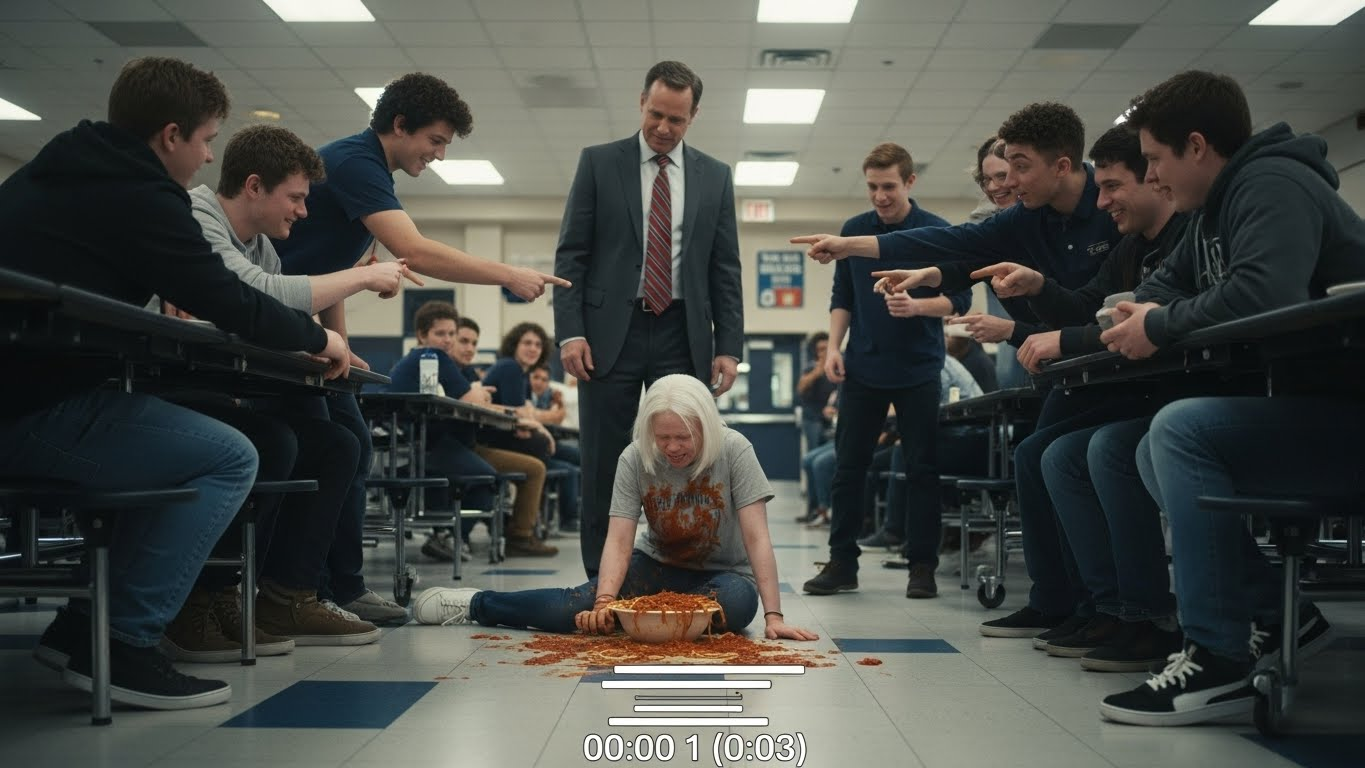
My tailbone slammed into the unforgiving linoleum with a violence that rattled my teeth. But that wasn’t the worst part. Momentum carried my upper body backward. The back of my head whipped down and cracked against the metal leg of the table behind me.
A flash of white light exploded behind my eyes.
For a second, there was no sound. Just a high-pitched ringing in my ears.
Then, the sauce rained down. Spaghetti marinara, cold and sticky, splattered across my white hair, my pale face, and my vintage cream sweater.
The silence broke.
“TOUCHDOWN!”
Brad’s voice boomed above the din.
The cafeteria erupted. It wasn’t just a few giggles; it was a roar. Three hundred students laughing in unison. I lay there, curled in a ball, the pain in my head throbbing in time with my heartbeat. I felt warm liquid trickling down my neck, mixing with the pasta sauce.
“Look at her!” Brad laughed, pointing a finger at me as I struggled to sit up. “She finally has some color! You’re welcome, Ghost!”
I blinked, trying to clear the tears and the dizziness. The world was spinning. I saw blurry faces looming over me, phones out, recording. I was going to be a meme by third period.
I wiped my face, my hand coming away red. Whether it was sauce or blood, I couldn’t tell.
“Get up, freak,” Brad sneered, kicking the sole of my sneaker. “Stop being so dramatic.”
Chapter 2: The Enabler
“Alright, break it up! Show’s over!”
The voice was nasally and irritated. Principal Higgins.
I felt a surge of pathetic hope. An adult. An authority figure. He would fix this. He would see the blood.
Higgins pushed through the circle of laughing students. He looked down at me—a mess of white hair, red sauce, and tears. Then he looked at Brad, who was leaning casually against the table, smirking.
“Brad,” Higgins sighed, pinching the bridge of his nose. “We have a pep rally on Friday. I don’t need this kind of headache.”
“She slipped, Mr. Higgins,” Brad lied, his voice smooth as silk. “Clumsy. You know how she is. Can’t see two feet in front of her face.”
“I… I didn’t slip,” I managed to whisper, my voice trembling. “He pulled the chair.”
Higgins looked at me with open disdain. He didn’t offer a hand. He didn’t check my head.
“Lily, get up,” he snapped. “You’re making a mess of the floor. The janitors are busy enough.”
“Sir, she’s bleeding,” a freshman girl whispered from a nearby table, looking terrified.
“It’s just marinara, honey,” Higgins dismissed her, waving his hand. He turned back to me. “Go to the nurse, clean yourself up, and then go to detention.”
“Detention?” I choked out, finally standing up, swaying on my feet. “For what?”
“For causing a disruption during lunch hour,” Higgins said, checking his watch. “And Brad? Try to keep the horseplay to the field, okay? Your dad is coming by later to discuss the new stadium lights.”
“You got it, Principal,” Brad gave a mock salute.
As Higgins walked away, Brad leaned in close to me. His breath smelled of gum and arrogance.
“See?” he whispered, his voice dripping with venom. “Nobody cares. You’re a ghost, Lily. Invisible. Your dad’s been gone for what? Five hundred days? He’s probably hiding in the desert just so he doesn’t have to look at his freak of a daughter.”
That hit harder than the floor.
My dad. General Marcus Sterling. He had been deployed for 18 months. I missed him so much it felt like a physical hole in my chest. Brad knew that. He knew it was my weakest point.
“You’re alone,” Brad hissed. “Totally alone.”
I looked down at my shoes, defeated. He was right. I was alone.
But then, the coffee cup on the nearest table started to ripple.
Thrum. Thrum. Thrum.
A low vibration began to hum through the floorboards. It grew louder, deeper, until the windows of the cafeteria started to rattle in their frames.
“Is that an earthquake?” someone asked.
“No,” a kid by the window said, his voice shaking. “Look outside.”
I looked up. Through the large glass windows that faced the front lawn, I saw them.
Trucks. Massive, matte-green Humvees. One, two, ten… they kept coming, surrounding the school’s circular driveway, blocking the exits.
And then, the sound of boots.
Heavy, synchronized boots on the hallway tile. It sounded like thunder rolling indoors.
The double doors to the cafeteria didn’t just open. They were kicked open.
BOOM.
The entire room jumped.
Standing in the doorway, framed by the blinding afternoon sun, was a silhouette that blocked out the light. He was six-foot-four, with shoulders that looked like they were carved from granite.
He stepped forward, the light hitting his uniform.
Army Service Greens. Perfectly tailored.
And on his shoulders, four silver stars flashed like lightning.
General Marcus Sterling.
He wasn’t smiling. His face was a mask of cold, calculated fury.
But the most terrifying part wasn’t him. It was what was behind him.
Soldiers.
Dozens of them. MPs in tactical gear, Rangers with stone-cold faces. They poured into the cafeteria behind him, filing along the walls with military precision, weapons slung across their chests, eyes scanning for threats.
The laughter died. The gossip died. The air left the room.
My dad scanned the crowd. His gray eyes—the only thing I inherited from him aside from my stubbornness—locked onto me. He saw the sauce. He saw the blood matting my white hair. He saw the tears.
Then, he looked at the empty space where my chair should have been.
Finally, he looked at Brad.
Chapter 3: Defcon One
The silence in the cafeteria was absolute. You could hear a pin drop. Or in this case, the sound of Brad swallowing hard.
My dad didn’t run to me. He didn’t scream. That’s what civilians do. Generals assess, strategize, and conquer.
He began to walk.
His boots struck the floor with a rhythmic, terrifying cadence. Clack. Clack. Clack.
Principal Higgins, who had been halfway to the exit, froze. He turned around, his face draining of color.
“General Sterling?” Higgins squeaked. “We… we weren’t expecting you.”
My dad walked right past him. He didn’t even blink. To my father, Higgins was an obstacle, not a person.
He stopped three feet from where I stood. He looked at me, his eyes softening for a microsecond. He reached out a large, calloused hand and gently touched the side of my head where the blood was drying.
“Report,” he said softly.
“I fell,” I whispered, falling back into our old game.
“Soldiers don’t fall, Lily,” he said, his voice low. “Did you slip?”
I looked at Brad. Brad looked like he was about to vomit. He was shaking his head slightly, pleading with his eyes.
I looked back at my dad. “No, sir. The chair was pulled.”
My dad nodded. Once. Slow.
He turned to Brad.
Brad was six feet tall, an athlete, used to physically dominating everyone in school. But standing next to my father, he looked like a toddler.
“Name,” my dad commanded. Not asked. Commanded.
“B-Brad,” he stammered. “Brad Miller.”
“Mr. Miller,” my dad said, his voice projecting to the back of the room without shouting. “My daughter tells me you have a fascination with gravity.”
“It was a joke,” Brad blurted out, sweat beading on his forehead. “Just a prank, sir. No hard feelings.”
My dad stared at him. The silence stretched for five seconds. Ten seconds. It was agonizing.
“A prank,” my dad repeated, tasting the word like it was poison. He gestured to the soldiers lining the walls. “Do you know who these men and women are, son?”
Brad shook his head.
“This is the 101st Airborne Division,” my dad said casually. “We just got back from a deployment where we slept in dirt and ate out of bags for eighteen months. We missed birthdays. We missed Christmases.”
He took a step closer to Brad. Brad took a step back, hitting the table behind him.
“And all that time,” my dad continued, his voice dropping to a dangerous growl, “the only thing keeping me going was the thought of coming home to my little girl. Protecting her.”
My dad leaned down, his face inches from Brad’s.
“You told her she was alone.”
Brad’s eyes widened. “I… I didn’t mean…”
“You told her she had no one,” my dad interrupted. He swept his arm back, gesturing to the hundred grim-faced soldiers standing at attention, and the hundreds more visible through the windows.
“Does she look alone to you now, boy?”
Brad couldn’t speak. He was shaking so hard the table behind him rattled.
“Sir!” A voice cracked from the side. Principal Higgins rushed over, trying to regain control. “General, this is highly irregular! You can’t bring a battalion into a high school! I’ll have to call the Mayor!”
My dad turned to Higgins slowly.
“The Mayor?” my dad asked. “Brad’s father?”
“Yes!” Higgins puffed out his chest. “And he won’t be happy about you threatening a student.”
My dad smiled. It wasn’t a nice smile. It was the smile of a wolf who just realized the sheep are trapped in the pen.
“Good,” my dad said. “Call him. Tell him to bring the police. Tell him to bring the National Guard if he wants.”
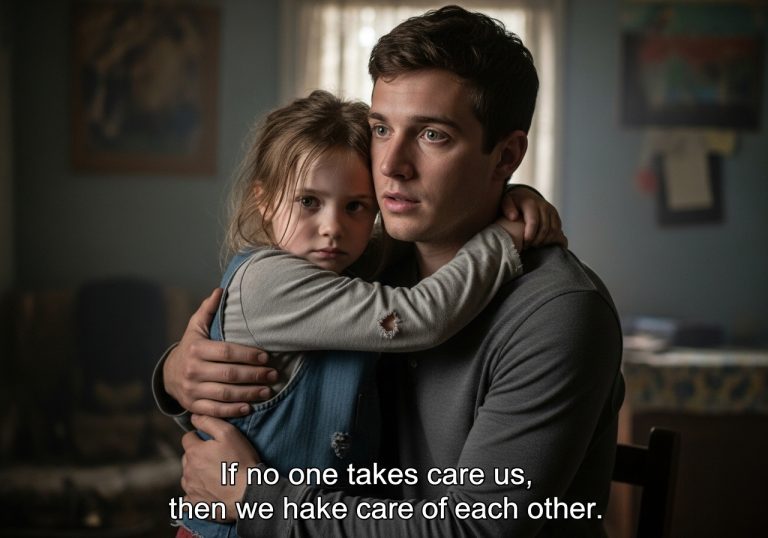
My dad turned back to me, unbuttoning his dress jacket and draping it gently over my shoulders, covering the pasta stains. It was heavy, warm, and smelled like starch and safety.
“Because until I get an explanation for why my daughter is bleeding,” my dad announced to the room, “this school is under military jurisdiction. Nobody leaves.”
He looked at Brad, then at Higgins.
“Now,” my dad said, pulling out a chair and sitting down right in the middle of the chaos. “Who wants to explain why the victim is the one going to detention?”
Chapter 4: The Chain of Command
The standoff lasted exactly twelve minutes before the sirens began to wail.
Outside the cafeteria windows, blue and red lights flashed against the glass, mixing with the olive green of the military trucks. The local police had arrived.
Principal Higgins exhaled a long, shaky breath, his confidence returning. “That will be Mayor Miller,” he sneered, adjusting his tie. “He controls the police board. You’ve made a grave mistake, General.”
My dad didn’t even look out the window. He was busy carefully wiping a smudge of marinara sauce from my cheek with a tactical handkerchief. “Is he a doctor?” my dad asked calmly.
“What?” Higgins blinked.
“Is the Mayor a doctor?” my dad repeated. “Because unless he has a medical degree to check my daughter’s concussion, I don’t have much use for him.”
The double doors swung open again. This time, it wasn’t soldiers. It was a man in a three-thousand-dollar suit, flanked by the Chief of Police.
Mayor Robert Miller looked exactly like an older, thicker version of Brad. Same square jaw, same arrogant tilt of the head. He stormed in, his eyes scanning the room until they landed on the soldiers lining the walls.
“What in God’s name is going on here?” Mayor Miller bellowed, his voice booming. “Who authorized a military occupation of my town’s high school?”
Brad practically leaped from his spot. “Dad! He’s crazy! He threatened me!”
Mayor Miller marched right up to our table. The two MPs behind my dad stepped forward, blocking his path, their hands hovering near their weapons. The Mayor stopped short, his face reddening.
“General Sterling,” the Mayor spat the name like an insult. “I know who you are. You’re a war hero. Congratulations. But this isn’t a battlefield. This is my jurisdiction. You are trespassing.”
My dad stood up. Slowly. He buttoned his jacket. He was three inches taller than the Mayor and radiated a kind of power that money couldn’t buy.
“Your jurisdiction?” my dad asked, his voice deceptively light. “Mr. Mayor, do you know the penalty for assaulting a dependent of a deployed military officer?”
“Assault?” The Mayor scoffed, waving a hand at Brad. “My son said it was a prank. A joke. Your daughter is fine. She’s just fragile. Always has been.”
I flinched. The word fragile cut deep. It was the word they always used to dismiss me.
“Fragile,” my dad repeated. He looked down at me, wrapped in his oversized jacket, my white hair stained red. Then he looked back at the Mayor.
“She’s not fragile, Bob. She’s wounded. And from what I hear, your son caused it, and your Principal here tried to cover it up by sending the victim to detention.”
“He said she slipped!” the Mayor argued. “Higgins saw it!”
My dad turned his gaze to Principal Higgins. Higgins was sweating profusely now.
“Is that the official report, Principal?” my dad asked. “That she slipped?”
“Y-yes,” Higgins stammered, avoiding eye contact. “Witnesses confirm it.”
“Which witnesses?” My dad gestured to the football team. “The accomplices?”
“There is no proof otherwise!” the Mayor shouted, checking his watch. “Now, order your men to stand down, or I will have the Governor on the phone in five minutes.”
My dad smiled. It was the coldest thing I had ever seen.
“No proof,” he whispered. “Specialist Rodriguez?”
“Sir!” A young soldier with a laptop strapped to his chest stepped forward from the line of troops. He was tapping furiously on a keyboard.
“Status of the school’s security server?” my dad asked.
“Access granted, Sir,” Rodriguez replied crisp and clear. “We bypassed the firewall sixty seconds after entry.”
Higgins’ face went ghost white.
Chapter 5: The Deleted Scene
“You can’t do that!” Higgins shrieked, lunging forward. “That’s private property! That’s a violation of privacy!”
An MP simply extended an arm, stopping Higgins in his tracks without barely moving.
“Actually,” my dad said, crossing his arms. “Under the Patriot Act and given the immediate threat to a family member of a high-ranking officer, I have significant latitude. But honestly? I just wanted to see if you were a liar.”
He nodded to Rodriguez. “Connect to the cafeteria projector.”
A massive screen rolled down from the ceiling at the front of the lunchroom. The projector hummed to life. The room, already quiet, fell into a deathly stillness.
“We… the cameras were down today,” Higgins lied, desperate. “Technical glitch. You won’t find anything.”
“That’s funny,” Specialist Rodriguez said, his voice amplified by the room’s speakers. “Because I found a file named ‘Cafeteria_Cam_04’ that was manually moved to the ‘Trash’ folder three minutes before we walked in.”
Higgins looked like he was about to faint. The Mayor looked at the Principal with pure venom.
“Play it,” my dad commanded.
The screen flickered. A grainy, black-and-white video appeared. It showed the cafeteria from a high angle.
There I was. Walking with my tray. Small. hesitant.
There was Brad. He was whispering to his friends, tracking me like a hunter.
The entire school watched in silence.
On screen, I turned to sit. Brad’s leg shot out. He hooked the chair leg and ripped it backward with vicious force.
It wasn’t a playful tug. It was violent.
On the screen, my body hit the floor. The impact was visible—my head snapping back against the metal table leg.
The video didn’t have sound, but the visual was enough. It looked brutal. It looked criminal.
Then, the video showed Brad laughing. It showed him high-fiving his friends. It showed him pointing at me as I writhed in pain.
And finally, it showed Principal Higgins walking over. It showed him stepping over my legs to talk to Brad. It showed him pointing a finger at me, scolding me while I bled.
My dad watched the screen, his jaw muscle twitching. That was the only sign of the rage boiling inside him.
“Pause,” my dad said.
The image froze on the frame where Brad was laughing while I was on the floor.
My dad turned to the Mayor.
“That doesn’t look like a slip, Bob. That looks like assault with intent to do bodily harm.”
The Mayor loosened his tie. He was trapped. The evidence was giant, glowing, and undeniable.
“Okay,” the Mayor said, his voice lower, lacking its previous boom. “Okay, so the kid got rough. We’ll handle it internally. A week of suspension. Maybe two.”
“Suspension?” my dad laughed. It was a harsh, barking sound. “You think this ends with a vacation for your son?”
Chapter 6: The Weight of Silence
My dad turned his back on the Mayor and walked over to me. He knelt down so he was eye-level with me. The entire room was watching us—the soldiers, the students, the faculty.
“Lily,” he said softly. “Does this happen often?”
I looked at him. I wanted to lie. I wanted to protect him from the truth, to keep him from going nuclear. But looking into those gray eyes, I couldn’t do it.
“Yes,” I whispered.
“Every day?”
“Most days.”
“Does the Principal know?”
I looked at Higgins, who was trembling. “He tells me to stop being sensitive. He says I provoke them by looking… weird.”
My dad closed his eyes for a second. When he opened them, the sadness was gone, replaced by a resolve that terrified me.
He stood up and faced the student body. He didn’t use a microphone, but his voice reached the back wall.
“You all watched,” my dad said. “Three hundred of you. You watched him pull the chair. You watched her fall. You watched her bleed.”
He scanned the faces of my classmates. Some looked down in shame. Others looked terrified.
“And then you laughed,” my dad continued. “Why? Because she looks different? Because she lacks pigment?”
He walked over to Brad, who was shrinking into his varsity jacket.
“You call her a ghost,” my dad said to Brad. “You think she’s weak because she’s quiet. Because she doesn’t fight back.”
My dad unpinned a badge from his uniform. It was the Ranger tab.
“Do you know what real strength is, son? Strength isn’t knocking people down. Gravity does that for free. Any idiot can destroy.”
He placed a hand on my shoulder.
“Strength is walking into a room every single day where you know you are hated, where you know you will be mocked, and doing it anyway. Strength is keeping your head up when the whole world is trying to push it down.”
He looked around the room.
“My daughter has more courage in her little finger than this entire football team combined.”
He turned back to the Mayor, his voice dropping to a lethal whisper.
“You offered me a suspension. I’m declining that offer.”
“Then what do you want?” the Mayor snapped, though he looked sweaty and pale. “You can’t arrest him. You’re military, not police.”
“True,” my dad nodded. “I can’t arrest him.”
He signaled to the two MPs standing by the door. They stepped aside, revealing a woman in a sharp navy blazer walking in. She held a briefcase and looked like a shark smelling blood.
“But she can,” my dad said.
“Who is that?” Higgins asked.
“That,” my dad said, “is the United States Attorney for this district. And she’s very interested in a federal hate crime case involving a government official’s son targeting a disabled minor.”
My dad leaned in close to the Mayor’s ear.
“This isn’t a schoolyard fight anymore, Bob. I’m taking you to federal court. And I’m going to take everything.”
Chapter 7: The Fall of the Untouchables
The words “Federal Hate Crime” hung in the air like a guillotine blade.
Mayor Miller laughed, but it was a dry, hollow sound. “You’re bluffing, Sterling. You can’t turn a school prank into a federal case.”
The woman in the navy blazer stepped forward. She didn’t shout. She didn’t need to. Her voice was crisp, professional, and terrifyingly calm.
“Mr. Mayor,” she said, opening her briefcase. “Targeting a student based on a genetic condition, combined with the documented negligence of school officials receiving federal funding, falls directly under several civil rights statutes. And since you, a public official, attempted to coerce the witness—General Sterling—just now, we can add obstruction of justice to the list.”
She handed a document to the local Police Chief, who was standing awkwardly next to the Mayor.
“Chief,” she said. “I suggest you secure the evidence before it disappears like that video file almost did.”
The Police Chief looked at the Mayor, then at the General, and finally at the Federal Attorney. He made a choice. He took a step away from the Mayor.
“I’ll secure the server room,” the Chief said quietly.
“Traitor!” the Mayor hissed.
“No, Bob,” the Chief replied. “I’m just not going down with your ship.”
Then, the moment everyone was waiting for happened.
Brad, the untouchable god of Oak Creek High, the boy who had terrorized me since middle school, broke.
He didn’t fight. He didn’t yell. He started to cry.
It wasn’t a noble cry. It was the sobbing of a bully who suddenly realized his dad’s money couldn’t buy his way out of this one.
“Dad, do something!” Brad wailed, tears streaming down his face, ruining his tough-guy image forever. “I don’t want to go to jail!”
My dad didn’t look triumphant. He looked sad. He looked at Brad with a mixture of pity and disgust.
“You’re not going to jail today, son,” my dad said quietly. “But your life as you know it is over. The colleges you applied to? They’ll be getting a call. The scholarship? Gone. And this town? They finally know who you really are.”
My dad turned to Principal Higgins, who was sitting in a chair, head in his hands.
“And you,” my dad said. “I expect your resignation on my desk by 0800 tomorrow. Or I let her—” he pointed to the Attorney “—file charges for child endangerment.”
Higgins nodded weakly. He couldn’t even speak.
The bell rang. It was the end of the lunch period. But nobody moved. Three hundred students sat glued to their seats, witnessing the toppling of a dynasty.
Chapter 8: Walking in the Sun
“Dismissed,” my dad said to the room.
It broke the spell. The students began to whisper, shifting in their seats, but nobody dared to laugh. Nobody dared to point. They looked at me with something new. Not pity. Not mockery.
Respect. Or maybe fear. Either way, I was no longer a target.
My dad turned to his soldiers. “Company! Fall out! Return to base.”
“Hoo-ah!” The shout from dozens of soldiers shook the walls one last time.
They filed out with organized precision, leaving the cafeteria as quickly as they had entered. The trucks outside revved their engines, rumbling away like a receding storm.
My dad offered me his arm.
“Ready to go, sweetheart?” he asked.
“I have History class,” I said automatically.
My dad smiled, a genuine, warm smile that crinkled the corners of his eyes. “I think you’ve made enough history for one day. Let’s get ice cream.”
I took his arm. We walked out of the cafeteria, down the long hallway, and out the front doors.
The sun was bright outside. Usually, I would flinch. Usually, I would hide my eyes. But today, walking next to my father, I didn’t feel the need to hide.
We reached his jeep. He opened the door for me, but before I got in, he stopped me. He gently took my chin in his hand and tilted my head up.
“I’m sorry,” he said, his voice thick with emotion.
“For what?” I asked. “You saved me.”
“For not being here sooner,” he said, tears welling in his steel-gray eyes. “I spent so much time fighting for my country that I forgot to fight for my daughter. I thought you were safe here. I was wrong.”
He pulled me into a hug. It was tight and desperate. I buried my face in his chest, smelling the starch of his uniform and the faint scent of Old Spice. For the first time in eighteen months, the hollow ache in my chest vanished.
“You’re not a ghost, Lily,” he whispered into my hair. “You are the brightest thing in my life. And I promise you, you will never fight a battle alone again.”
I pulled back and wiped my eyes. I looked back at the school—a place that had been my prison for years. It looked smaller now. Less scary.
“I know, Dad,” I smiled.
We got in the jeep. As we drove away, I looked in the rearview mirror. I saw Brad standing in the parking lot, arguing with his father, looking small and defeated.
I put on my sunglasses, leaned back in the seat, and for the first time in my life, I didn’t care who was watching.
The Ghost was gone. Lily Sterling was finally here to stay.
(End of Story)